

Best Sales Enablement Platforms in 2026: Ranked by Motion
A RevOps lead we know ran a bake-off across three sales enablement platforms last year. The winner on features lost on adoption - reps ignored it within six weeks, and 65% of the content uploaded never got opened once. The runner-up won because reps could actually find what they needed and reach the people they were supposed to contact.
That story isn't unusual. The market is projected at $6.9-$7.8 billion in 2026, growing at a 16-18% CAGR, and the category is consolidating fast: two of the biggest players just announced a merger, another major vendor pair merged in October 2025, and Gong launched a full enablement suite. Meanwhile, 76% of organizations now have a dedicated enablement function - up from 32% five years ago. Enablement went from niche to non-negotiable.
Let's break down what actually matters.
Why Enablement Technology Is Exploding
Three forces are driving the surge. First, revenue teams spend 440 hours per year searching for or creating content - nearly a quarter of a rep's working year burned on non-selling activity. Second, 65% of sales content goes completely unused. Third, only 25% of organizations actually track enablement's impact on revenue, meaning three out of four teams are flying blind on whether their investment is working.
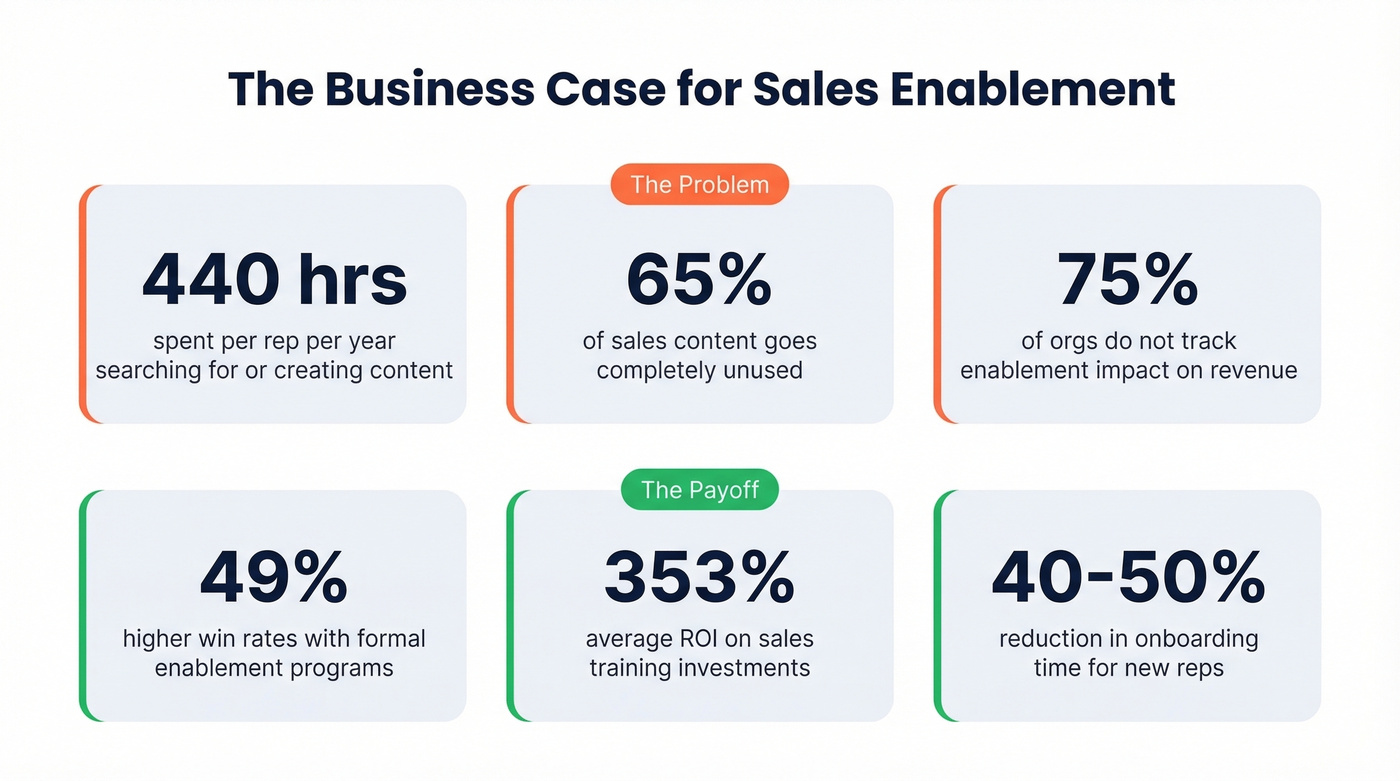
The business case writes itself: organizations with formal enablement programs report 49% higher win rates on forecasted deals, training ROI averages 353%, and onboarding time drops 40-50%. That's why every conversation intelligence vendor, every CRM, and every LMS is suddenly calling itself an "enablement platform" - which makes the buying decision harder, not easier.
Our Picks (TL;DR)
Best for enterprise content governance: Seismic / Highspot. The deepest content lifecycle management in the category, with analytics tied directly to pipeline. The merger creates uncertainty, but the combined platform will be formidable once it stabilizes.
Best for readiness and coaching: Mindtickle. If your problem is rep competency - inconsistent messaging, slow ramp times, no way to measure skill gaps - Mindtickle's Readiness Index and AI-powered practice tools are the most mature option.
Best for conversation-driven enablement: Gong Enable. If you're already a Gong customer, the expansion path into coaching and initiative tracking is the most natural move in the category right now.
What Counts as a Platform in 2026
The word "platform" gets thrown around loosely. A content repository isn't a platform. A standalone LMS isn't one either. A conversation intelligence tool, by itself, doesn't qualify.
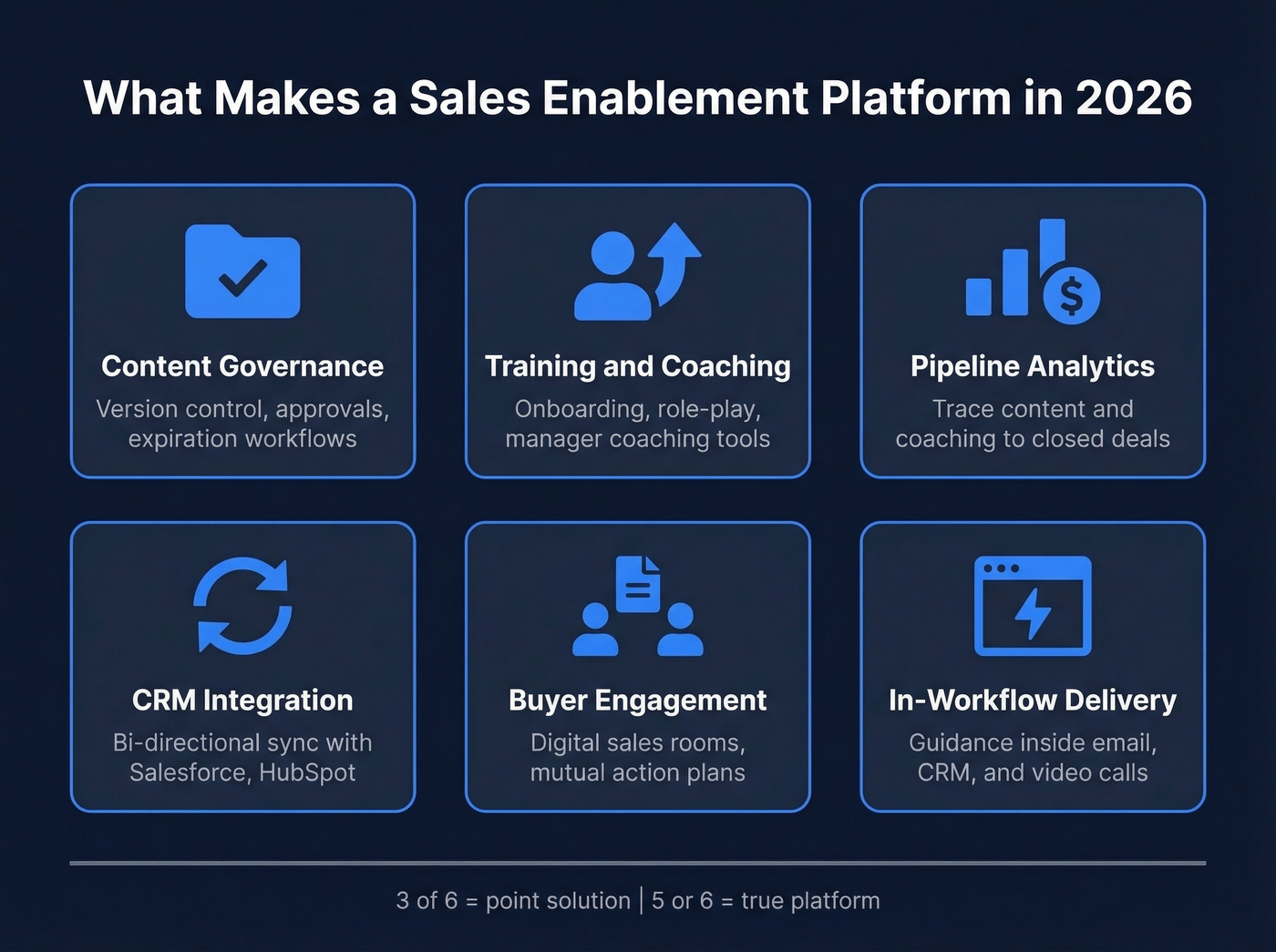
Based on Gartner's mandatory capabilities for revenue enablement platforms and G2's inclusion criteria, a sales enablement platform in 2026 needs to cover six core areas:
- Content management and governance. Not just storage - version control, approval workflows, content expiration, and the ability to surface the right asset at the right moment in a deal cycle.
- Training, coaching, and readiness. Onboarding programs, ongoing skill development, role-play practice, and manager coaching workflows. Frontline managers spend just 9% of their time coaching, which is why AI-powered coaching tools are becoming table stakes.
- Analytics tied to pipeline. Content usage metrics are baseline. The real question is whether you can trace a piece of content or a coaching session to a closed deal. If your analytics stop at "this deck was viewed 47 times," you don't have a platform.
- CRM integration. Bi-directional sync with Salesforce, HubSpot, or whatever your system of record is. Enablement data that lives in a silo gets ignored.
- Buyer engagement and digital sales rooms. Shared spaces where reps and buyers collaborate on mutual action plans, content, and deal milestones. This is the fastest-growing capability in the category, and modern platforms increasingly extend these motions to post-sales teams for upsell and cross-sell.
- In-workflow delivery. Content and guidance surfaced inside the tools reps already use - email, CRM, video calls - not buried in a portal they have to remember to visit. AI content recommendations yield a 41% improvement in relevance and a 28% reduction in search time.
A tool that covers three of these is a point solution. A tool that covers five or six is a platform. The distinction matters because platform purchases are $50k-$500k+ commitments with 2-6+ month implementation timelines.
A note on security: Any enablement software handling sales content and customer data should meet SOC 2 Type II compliance, support SSO/MFA, and comply with GDPR. If a vendor can't produce a SOC 2 report, walk away.
What Changed in 2026
Highspot + Seismic Merge
On February 12, 2026, Highspot and Seismic signed a definitive agreement to merge. The combined company will operate under the Seismic brand, led by Seismic CEO Rob Tarkoff, with Highspot founder Robert Wahbe joining the board. Permira remains the controlling shareholder.
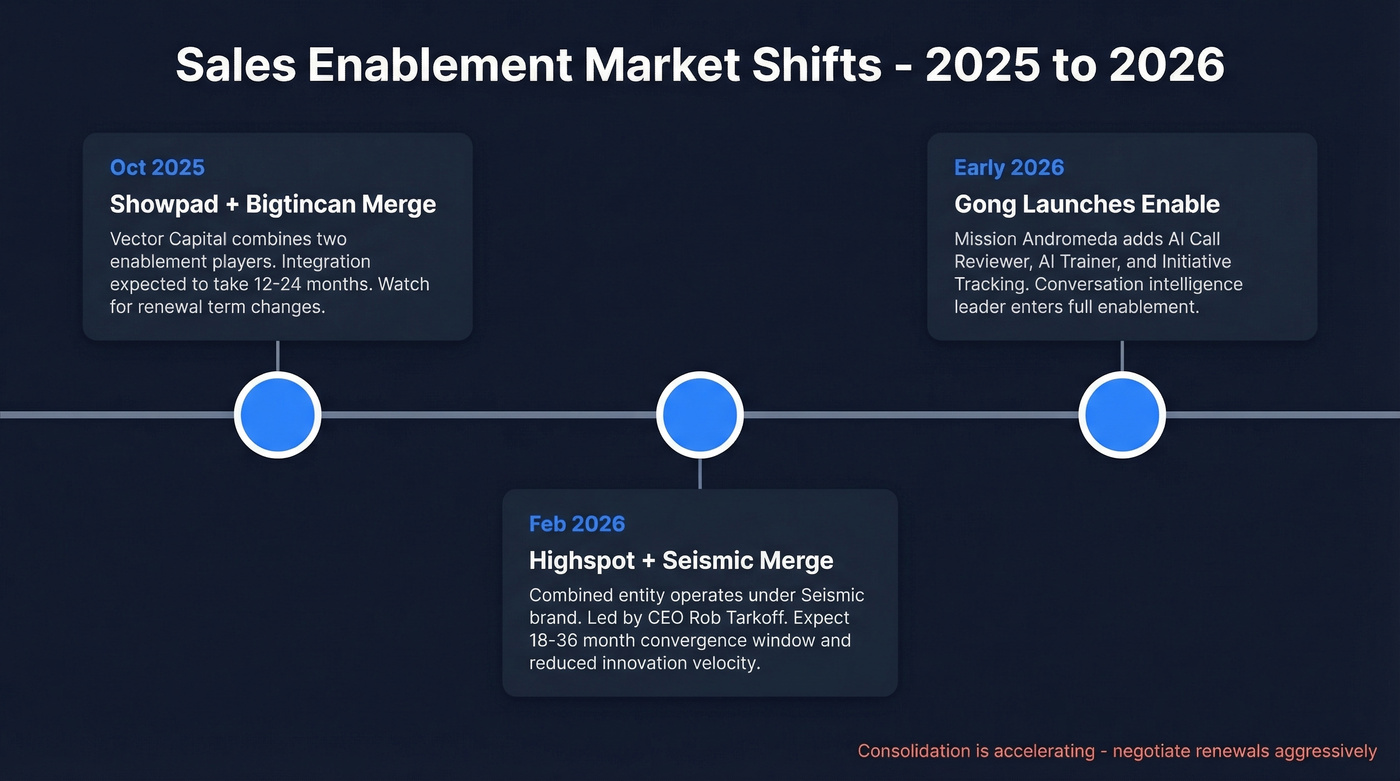
Both platforms will continue to be supported after the transaction closes. But let's be honest about what "supported" means during a merger. The consensus on r/SaaS is that integration typically causes reduced innovation velocity for 18-24 months while engineering teams reconcile overlapping stacks. Expect a convergence window of 18-36 months.
If you're a current Highspot or Seismic customer coming up for renewal in the next 12 months, negotiate like consolidation is coming - because it is. Lock in pricing, get written commitments on platform support timelines, and start evaluating alternatives before your contract auto-renews.
Showpad + Bigtincan Merge
Vector Capital brought Showpad and Bigtincan together in October 2025, creating another combined entity in the enablement space. A March 2026 RepVue review describes "lots of change" and "friction with big changes," but also notes excitement about the direction. That's the standard merger emotional arc.
For customers, the practical concern is the same: product integration takes 12-24 months for meaningful consolidation. Watch for changes in your renewal terms.
Gong Enters Enablement
Gong's Mission Andromeda launch is the most interesting category shift of early 2026. Gong Enable turns the conversation intelligence leader into a full enablement contender with AI Call Reviewer, AI Trainer, and Initiative Tracking tied to win rates, deal size, and ramp time.
Gong CPO Eilon Reshef framed the goal as moving beyond insights to "clear, timely guidance" embedded into revenue work. The enablement features are new, so they're less mature than Seismic or Mindtickle on content governance and readiness depth. But for teams already running Gong for conversation intelligence, the expansion path is compelling - and the AI-native approach may leapfrog traditional enablement technology faster than anyone expects.

Reps spend 440 hours a year on non-selling activity - and bad contact data makes it worse. Prospeo gives your enabled reps 98% accurate emails and 125M+ verified mobile numbers so the content, coaching, and playbooks you invest in actually reach real buyers.
Enablement without accurate contact data is just expensive training with nowhere to go.
Top Sales Enablement Platforms Ranked
Seismic / Highspot
Best for: Enterprise content governance and analytics.

Use this if you're a 200+ person sales org that needs industrial-strength content governance - version control, approval workflows, content expiration, and analytics that tie asset usage to pipeline movement. Both platforms are Gartner and G2 leaders. The combined entity will have the deepest content lifecycle management in the category.
Skip this if you're a sub-100 person team or you need a platform decision within 90 days. Highspot runs $600-$1,200/user/year with 50-user minimums and $15k-$45k in setup costs. Seismic runs $384-$780/user/year, annual only, with months of implementation. Post-merger, expect prices to rise.
Mindtickle
Best for: Readiness, coaching, and measurable competency.
Use this if your core problem is rep performance variability. Mindtickle's Readiness Index gives you a single score per rep across knowledge, skills, and behaviors. Virtual role-plays, coaching rooms, and AI-powered practice sessions make it the most complete readiness platform available.
Skip this if your budget is tight or your team is under 50 reps. The average annual contract runs ~$92,184 based on 34 Vendr-tracked deals, with some contracts reaching $430,000. Average negotiated savings sit at 17.68%, so push hard - especially on the Enable package for 1,000+ users, where community reports suggest per-user pricing drops close to 60%.
| Package | Key Modules |
|---|---|
| Readiness | Role-plays, Readiness Index, coaching |
| Enable | Asset Hub, digital sales rooms, analytics |
| Transform | All modules, advanced analytics, CaaS |
Gong Enable
Best for: Conversation-driven enablement for teams already on Gong.
We've seen too many enablement programs fail because managers simply don't have time to coach. AI Call Reviewer automatically scores calls against your methodology. AI Trainer lets reps practice against AI-generated scenarios. Initiative Tracking connects enablement programs directly to win rates, deal size, and ramp time.
The strength is the data flywheel: Gong already captures every customer conversation, so the enablement layer identifies skill gaps from real calls rather than hypothetical assessments. A Morningstar enablement leader praised the ability to scale coaching consistency without requiring managers to listen to every call.
The caveat is maturity. Content governance and readiness depth don't match Seismic or Mindtickle yet. But if your enablement strategy is coaching-first and you're already paying for Gong's conversation intelligence, adding Enable is a natural expansion. Pricing runs $100-$200/user/month, enterprise contracts only.
Allego
Imagine your top closer records a 3-minute breakdown of how she handles the "we're already using [competitor]" objection. Within an hour, 40 reps across three time zones have watched it, practiced their own version, and gotten AI-scored feedback. That's Allego's peer learning model in action, and it works exceptionally well for distributed sales teams.
Implementation takes about 2 months with ROI at ~13 months per G2 benchmarks. Pricing runs $30-$100/user/month billed annually with no usage-based costs. Average discount is 11%. The trade-off: content governance and buyer-facing digital sales rooms are secondary to coaching here.
Showpad
Showpad's real strength is multi-stakeholder deal visibility. Shared Spaces let you see exactly which stakeholders viewed which content and when - invaluable for complex enterprise deals where you're selling to a buying committee of 6-10 people. G2 rates it 4.5/5 across 671 reviews.
The downsides are real: the iOS mobile app has reliability issues for offline access, Google Drive sync is manual and multi-step, and the reporting UI draws consistent complaints. Add the Bigtincan merger uncertainty, and you should negotiate your renewal aggressively. Expect $420-$720/user/year on annual commitments. Implementation runs 6-9 weeks.
SalesHood
SalesHood delivers about 70% of what Mindtickle or Seismic offer at roughly 40% of the cost. Coaching, content management, mutual action plans, and buyer engagement analytics are all built in, with guided selling workflows and pitch practice rounding out the package. For mid-market teams of 50-200 reps who don't need industrial-strength content governance, it's the sweet spot. Expect $30-$80/user/month.
Dock
Dock is the specialist pick for buyer enablement and digital sales rooms. If your primary need is mutual action plans, stakeholder alignment, and a clean buyer-facing experience, Dock's self-serve pricing is refreshingly transparent: free tier, $350/month for 5 users, $750/month for 10 users. It's not a full enablement suite - no coaching, no readiness scoring - but for the buyer engagement piece, it's the best standalone option available.
HubSpot Sales Hub
If your CRM is HubSpot, Sales Hub's native enablement features - playbooks, sequences, conversation intelligence, and content recommendations - cover the basics without adding another vendor. It won't match Seismic on content governance or Mindtickle on coaching depth, but for teams under 100 reps already in the HubSpot ecosystem, it eliminates integration headaches. Pricing starts around $100/user/month for the Enterprise tier that includes enablement features.
Salesforce Sales Programs
If your entire GTM stack lives in Salesforce, Sales Programs keeps enablement inside the ecosystem at $100/user/month billed annually. Requires a Sales Cloud, Service Cloud, or Agentforce 360 Platform license.
Spekit
In-workflow contextual enablement - tooltips, walkthroughs, and just-in-time guidance surfaced inside the tools reps already use. Strong for driving adoption of new processes. Runs ~$20-$40/user/month.
Guru
Knowledge management and internal wiki with AI-powered search. Guru solves the "reps can't find answers" problem, not the full enablement challenge. Free tier available, paid plans from ~$15/user/month.
WorkRamp
Combined employee and customer learning platform. Useful if you need a single LMS for internal training and customer education under one roof. Pricing typically runs $25-$50/user/month for sales-focused modules.
GTM Buddy
Just-in-time content recommendations surfaced during active deals based on deal stage, persona, and competitive context. A solid point solution for content delivery. Runs ~$30-$60/user/month.
Comparison Table
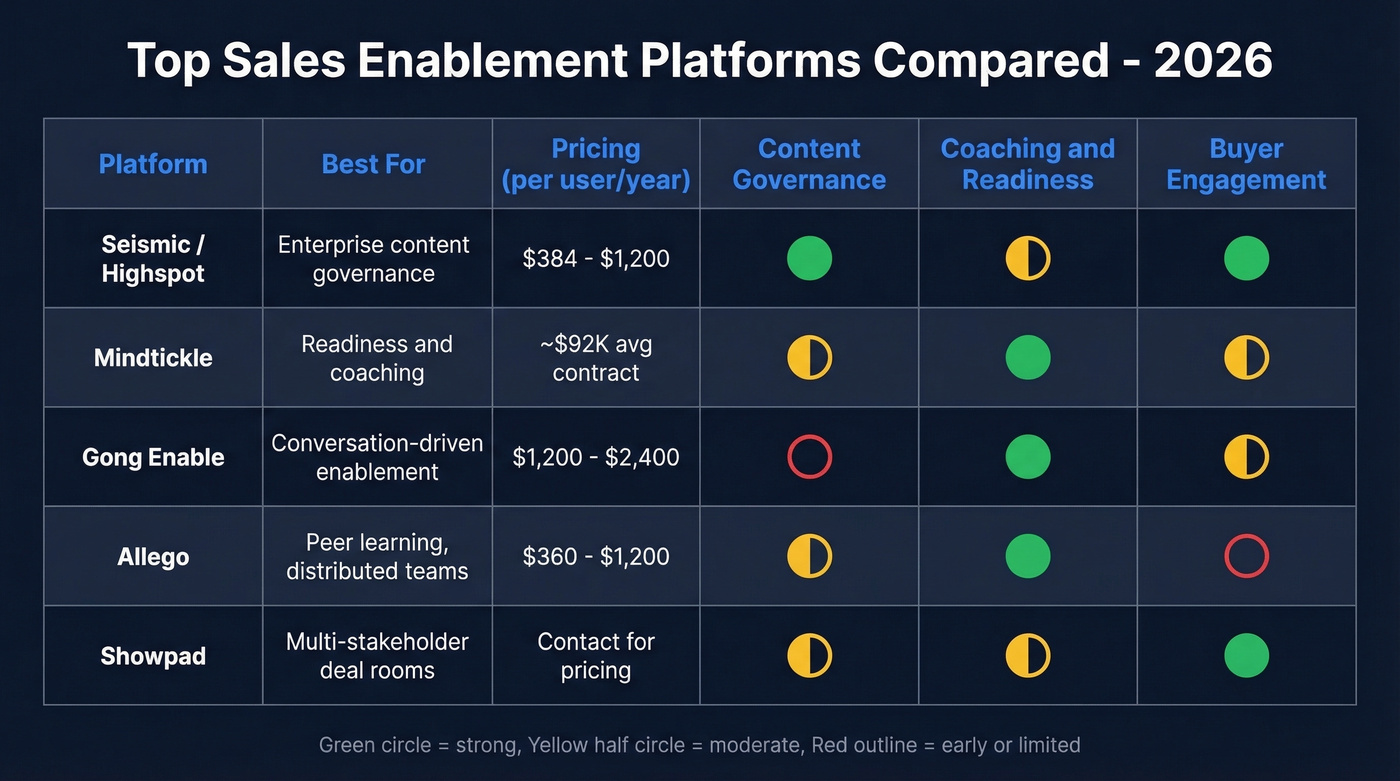
| Tool | Best For | Content Mgmt | Coaching | Buyer Rooms | Price Range |
|---|---|---|---|---|---|
| Seismic/Highspot | Content governance | ★★★★★ | ★★★☆☆ | ★★★★☆ | $384-$1,200/user/yr |
| Mindtickle | Rep readiness | ★★★★☆ | ★★★★★ | ★★★☆☆ | ~$92k/yr avg |
| Gong Enable | AI coaching | ★★☆☆☆ | ★★★★★ | ★★☆☆☆ | $100-$200/user/mo |
| Allego | Peer learning | ★★★☆☆ | ★★★★☆ | ★★☆☆☆ | $30-$100/user/mo |
| Showpad | Multi-stakeholder deals | ★★★★☆ | ★★★☆☆ | ★★★★☆ | $420-$720/user/yr |
| SalesHood | Mid-market all-in-one | ★★★☆☆ | ★★★★☆ | ★★★☆☆ | $30-$80/user/mo |
| Dock | Buyer enablement | ★★☆☆☆ | ☆☆☆☆☆ | ★★★★★ | Free-$750/mo |
| HubSpot Sales Hub | HubSpot-native teams | ★★★☆☆ | ★★★☆☆ | ★★☆☆☆ | ~$100/user/mo (Enterprise) |
Category winners: Seismic/Highspot for content management. Mindtickle for coaching (Gong wins if you're already a Gong customer). Dock for buyer rooms. SalesHood for mid-market value.
Here's the thing: most teams buying a $100k+ enablement suite would get better results spending $40k on a lighter tool and investing the other $60k in data quality and rep coaching time. The platform isn't the bottleneck - the data and the habits are.
Pricing Reality
Most enterprise enablement vendors won't publish pricing. If a vendor won't put a number on their website, you're paying for packaging complexity and professional services margins, not just software.
| Tool | Typical Cost | Billing | Setup / Timeline |
|---|---|---|---|
| Seismic | $384-$780/user/yr | Annual | 3-6 months implementation |
| Highspot | $600-$1,200/user/yr | Annual | 50-user min, $15-$45k setup |
| Mindtickle | ~$92k/yr avg | Annual | 2-4 months |
| Gong Enable | ~$100-$200/user/mo | Annual | Enterprise onboarding |
| Allego | ~$30-$100/user/mo | Annual | ~2 months |
| Showpad | ~$420-$720/user/yr | Annual | 6-9 weeks |
| SalesHood | ~$30-$80/user/mo | Annual | 4-6 weeks |
| Dock | Free-$750/mo | Monthly | Self-serve, days |
| SF Sales Programs | $100/user/mo | Annual | Requires SF license |
| HubSpot Sales Hub | ~$100/user/mo | Annual | Requires HubSpot CRM |
Look at the spread. A 100-person sales team on Highspot could be paying $60k-$120k/year before setup costs. The same team on Mindtickle might pay $90k+. Add Gong for conversation intelligence and you're stacking six-figure line items.
The takeaway: budget for the platform and the execution layer separately. Most teams underestimate the data cost because it's buried in rep productivity losses rather than a visible line item.
Platform vs. Stack: How to Decide
Not every team needs a monolithic enablement suite.
Go platform if you have 200+ reps, a dedicated enablement team, complex content governance needs, and the budget for a six-figure annual commitment plus 3-6 months of implementation. Seismic, Highspot, and Mindtickle all fit here. The all-in-one approach reduces integration headaches and gives you unified analytics.
We've seen this pattern play out repeatedly: reps are "enabled" with playbooks, battle cards, and training certifications, but they still miss quota because half their emails bounce and they can't find direct dials for the VP they're supposed to multi-thread into. That's not an enablement problem. It's a data execution problem, and solving it doesn't require replacing your platform - it requires adding the right data layer underneath it.
If you're building that layer, start with lead enrichment and a clean contact management process so your CRM stays usable.
Driving Adoption After Launch
A portal no one opens isn't enablement - it's a content graveyard. Avoiding that outcome comes down to six things.
Validate need before you buy. Engage sales leaders and a representative group of sellers early. If the tool solves a problem they don't think they have, adoption will be single digits.
Secure visible executive sponsorship. Not a Slack message - an all-hands announcement, a CEO email, a recorded video. Reps take cues from leadership. If leadership doesn't visibly champion the platform, reps won't either.
Build a comms plan for before, during, and after launch. Pre-launch: set expectations. Launch week: training sessions and office hours. Post-launch: weekly tips, success stories, and usage dashboards. The Sales Enablement Collective's adoption research consistently flags poor communication as the #1 adoption killer.
Pilot with champions first. Find 5-10 enthusiastic early adopters. Let them use the platform for 30 days, collect feedback, fix friction points, then roll out with their success stories as proof.
Prioritize relevance over volume. Reps recreate existing content 40% of the time because they can't find what's relevant. Uploading 500 assets on day one doesn't help - curating the 50 most-used assets and making them findable does. The best enablement features in the world won't drive adoption if the content library is a disorganized mess.
Measure what matters. Don't be in the 75% of organizations that can't track enablement impact. Tie everything to pipeline influence, win rate changes, and ramp time - not logins or page views. If you need a baseline, start with a simple set of sales operations metrics and expand from there.
Your enablement stack governs content and coaches reps. But who ensures they're reaching the right people? Prospeo's 300M+ profiles with 30+ filters - including buyer intent, job changes, and technographics - connect your enabled reps to in-market decision-makers at $0.01 per email.
Close the gap between enablement investment and pipeline with data that actually connects.
FAQ
What is a sales enablement platform?
A sales enablement platform centralizes content management, training, coaching, buyer engagement, and analytics into one system designed to improve seller effectiveness and tie activities to pipeline outcomes. Unlike point solutions that handle a single function, a true platform connects these capabilities together. Modern options increasingly incorporate AI-driven recommendations, digital sales rooms, and readiness scoring.
How long does implementation take?
Most mid-market teams should budget 2-4 months. Allego averages roughly 2 months; Showpad targets 6-9 weeks. Enterprise deployments of Seismic or Highspot can stretch to 6+ months with complex CRM integrations, custom taxonomies, and multi-region rollouts. Implementation timelines are often the hidden cost that blows up project plans.
Do I need a separate data tool alongside my enablement platform?
Yes - enablement solutions manage content, coaching, and analytics but don't verify contact data or provide direct dials. Without accurate contacts, perfectly designed playbooks never translate into conversations. A tool like Prospeo fills that gap at ~$0.01/email with 98% accuracy and 125M+ verified mobiles, connecting directly to Salesforce and HubSpot.
What should I do if my vendor just announced a merger?
Negotiate your renewal as if consolidation is coming. Lock in current pricing for 2-3 years, get written commitments on platform support timelines, and evaluate alternatives before your contract auto-renews. The worst position is discovering your tool is being sunset six months after you signed a new multi-year deal.
How do I measure enablement ROI?
Track pipeline influence - opportunities touched by enabled content or coached reps - along with win rate changes, new hire ramp time, and content adoption rates. Avoid vanity metrics like login frequency or total assets uploaded. The gold standard is connecting a specific program to a measurable change in revenue outcomes.