

Sales Feedback: Stop Giving Advice, Start Building a System
Your AE missed quota last quarter. Activity numbers looked fine - 80 calls a day, 200 emails a week, pipeline at 3x. So you pulled them into a 1:1 and said, "Keep doing what you're doing, just tighten up your discovery." That's not sales feedback. That's a platitude wearing a coaching hat.
Here's what's actually happening across sales floors right now: roughly 90% of sellers feel burned out, 67% think leadership is disconnected from reality, and 54% are actively job hunting. Only 18% of buyers believe salespeople are well-prepared for meetings. The global sales training market has grown past $10B and is projected to hit $19B by 2032 - yet most teams still don't run a consistent, ongoing coaching cadence. Billions spent on training. Day-to-day improvement left to chance.
The fix isn't "better feedback." It's a feedback system. And the ROI is real: every $1 spent on structured sales coaching returns $4.53.
What You Need (Quick Version)
If you've only got five minutes, here's the skeleton:
- A named framework. SBII (Situation-Behavior-Impact-Intent) gives every coaching conversation a repeatable structure.
- A weekly cadence. Teams that get weekly coaching hit 25% higher quota attainment and close 30% more deals. Monthly check-ins don't cut it.
- A data layer you trust. If 70% of your CRM data goes stale each year, you're coaching to false signals. Fix the inputs before you diagnose the outputs.
- Tiered coaching. Your top rep and your struggling rep need completely different conversations. Constructive feedback only works when it's calibrated to the individual.
Read the SBII framework section and the cadence calendar if nothing else. Those two pieces do 80% of the work.
Five Types of Coaching Input
Most teams think feedback means a manager telling a rep what to improve. That's one type out of five - and it's not even the most valuable one.
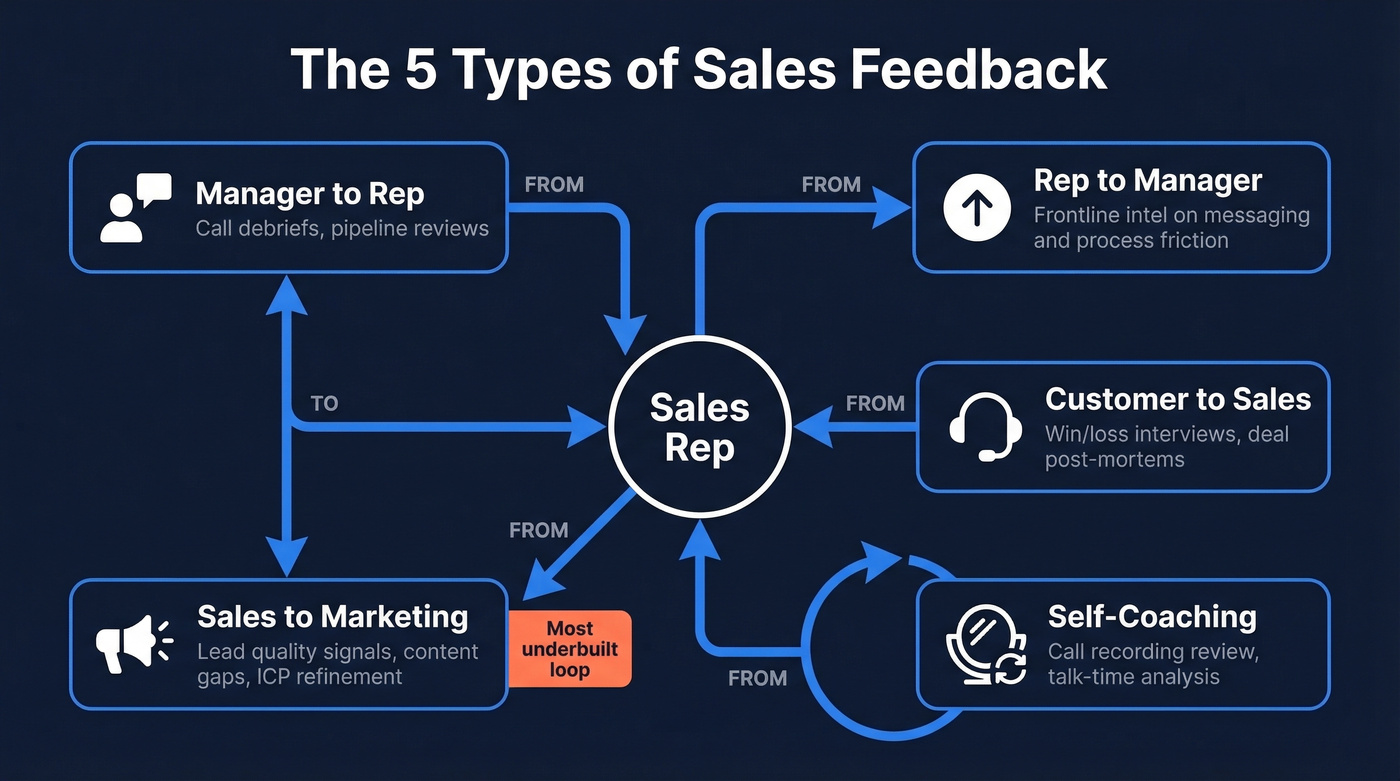
| Feedback Type | Direction | Example |
|---|---|---|
| Manager to Rep | Downward | Call debrief, pipeline review |
| Rep to Manager | Upward | Frontline intel on messaging, tools, process friction |
| Customer to Sales | External | Win/loss interviews, deal post-mortems |
| Sales to Marketing | Cross-functional | Lead quality signals, content gaps, ICP refinement |
| Self-coaching | Internal | Call recording review, talk-time analysis |
The sales-to-marketing loop is chronically underbuilt. 87% of sales and marketing leaders say collaboration drives critical business growth, yet only 29% of reps are completely satisfied with the enablement materials marketing produces. Structured channels - shared Slack rooms, monthly lead-scoring reviews, closed-loop reporting - turn that tension into pipeline.
Self-coaching is the sleeper. A thread on r/techsales captured it well: reps want objective input on filler words, monotone delivery, and dominating talk time. They know they have blind spots. They just don't have a structured way to find them without waiting for a manager to listen to a call.
The SBII Framework
SBII stands for Situation, Behavior, Impact, Intent. It comes from the Center for Creative Leadership, and their research shows it reduces defensiveness in the receiver and anxiety in the giver. The "Intent" step separates this from the standard SBI model - it turns a judgment into a conversation.
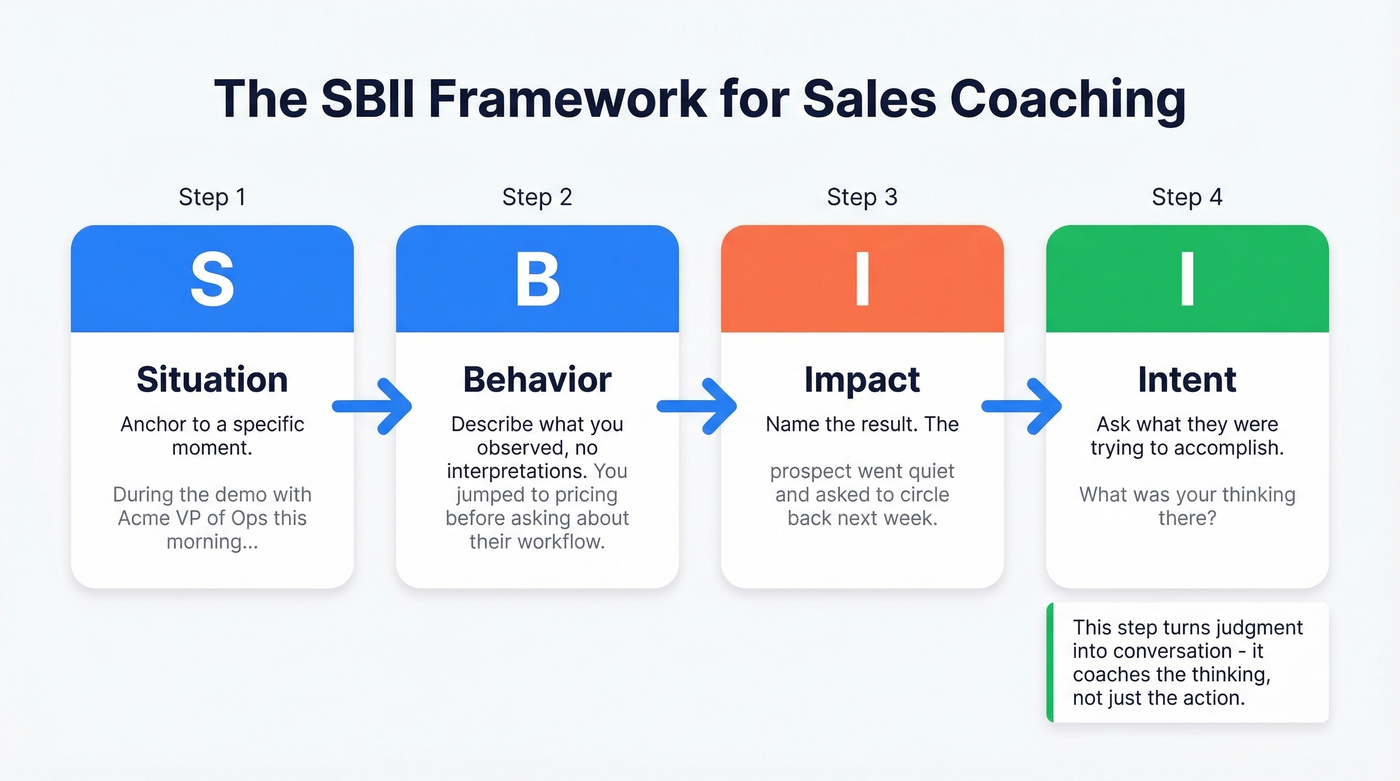
- Situation. Anchor to a specific moment. "During the demo with Acme's VP of Ops this morning..."
- Behavior. Describe what you observed - no interpretations. "You jumped to the pricing slide before asking about their current workflow."
- Impact. Name the result. "The prospect went quiet and asked to 'circle back next week,' which usually means we've lost momentum."
- Intent. Ask what they were trying to accomplish. "What was your thinking there? Were you reading a buying signal I missed?"
That last step changes everything. Instead of the rep hearing "you screwed up," they hear "help me understand your reasoning." Nine times out of ten, there's a logic behind the behavior - it's just the wrong logic, and now you can coach the thinking, not just the action.
Two Sales-Specific Scripts
Cold call debrief:
"On the Datadog call at 2pm - you pitched the product within 15 seconds of the prospect picking up. They hung up at the 40-second mark. The speed killed the conversation before it started. What were you trying to accomplish with that opening?"
Compare that to the vague alternative: "You need to slow down on cold calls." One is coachable. The other is noise.
Demo review:
"In the Stripe demo yesterday, you showed 11 features in 25 minutes. The prospect only asked questions about two - the API and the reporting dashboard. The other nine created noise that diluted the two they cared about. Were you trying to cover everything in case they hadn't read the pre-call materials?"
Coaching High, Mid, and Low Performers
75% of reps say they're more likely to hit targets with a coach or mentor. But the coaching each tier needs looks completely different, and treating everyone the same is one of the fastest ways to waste your time as a manager.
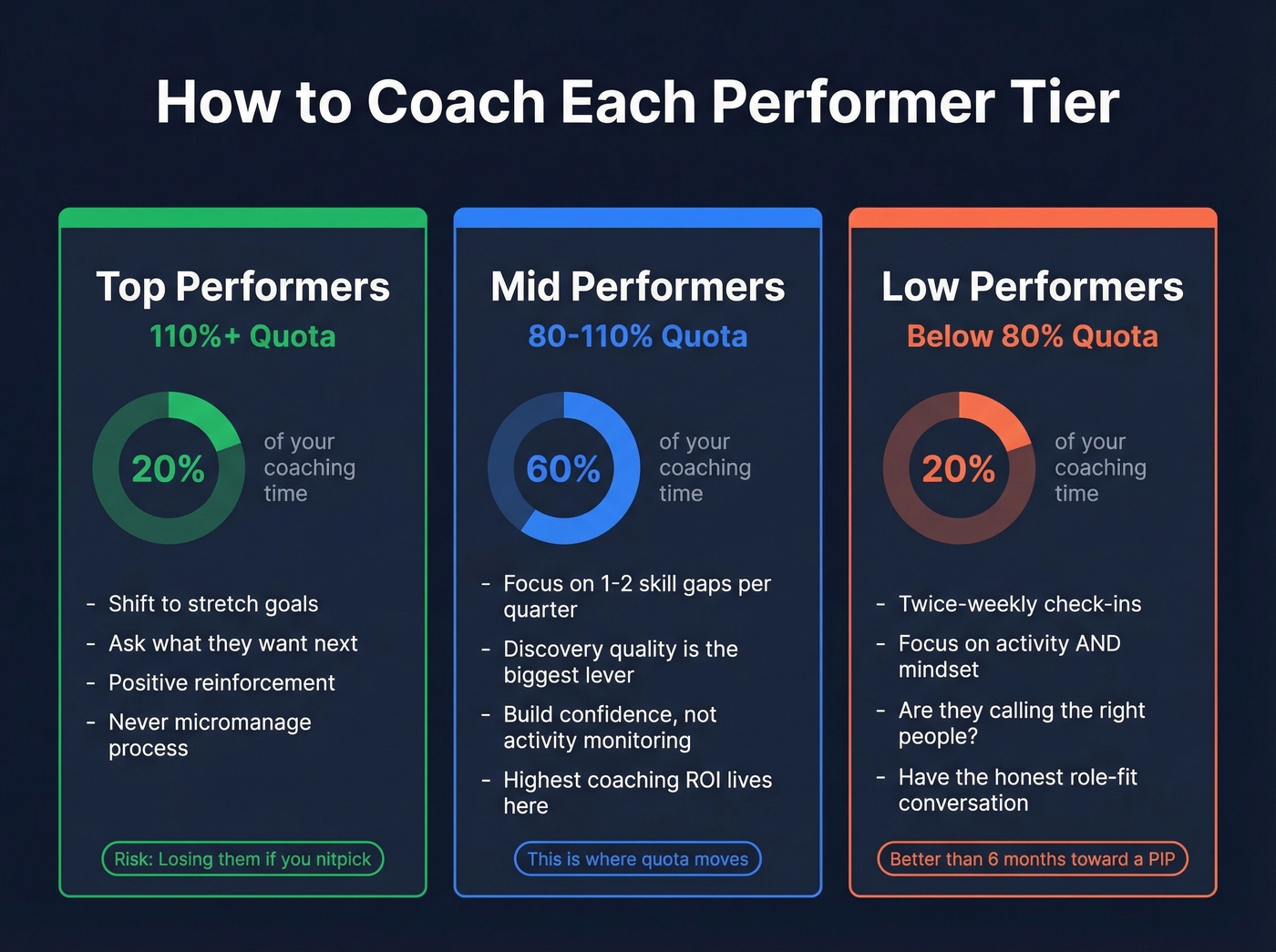
Top performers (110%+ quota): Shift from skill coaching to stretch goals. Ask what they want next - enterprise deals, a new vertical, a leadership track. Positive reinforcement matters most here; acknowledge what's working so they stay motivated to push further. Skip micromanaging their process. Nitpicking call structure for someone crushing quota is a fast way to lose them.
Mid performers (80-110% quota): This is where your coaching ROI is highest. Focus on one or two skill gaps per quarter. Pipeline management and discovery quality are usually the biggest levers. I've seen more mid-performers break through on discovery alone than any other skill. Don't treat them like low performers - they don't need activity monitoring. They need skill-building and confidence.
Low performers (below 80% quota): Increase cadence to twice-weekly check-ins. Focus on activity and mindset. Are they calling the right people? Do they believe the product solves a real problem? Sometimes the honest conversation is about whether this role is right for them. That's uncomfortable, but it's better than six months of coaching someone toward a PIP.
Let's be honest about time allocation: spend roughly 20% of your coaching hours on top performers, 60% on mid performers, and 20% on low performers. Adjust based on team size and deal complexity, but the 60% in the middle is where quota moves.

You just read that 70% of CRM data goes stale every year. You're coaching reps on false signals - bad emails, wrong titles, dead phone numbers. Prospeo refreshes every 7 days (not 6 weeks) and delivers 98% email accuracy. Fix the data layer before you diagnose the rep.
Stop coaching to stale data. Start coaching to real buyer signals.
Build a Continuous Coaching Cadence
Only 26% of reps receive weekly coaching. That's staggering when 80% of employees who receive meaningful weekly input report being fully engaged.
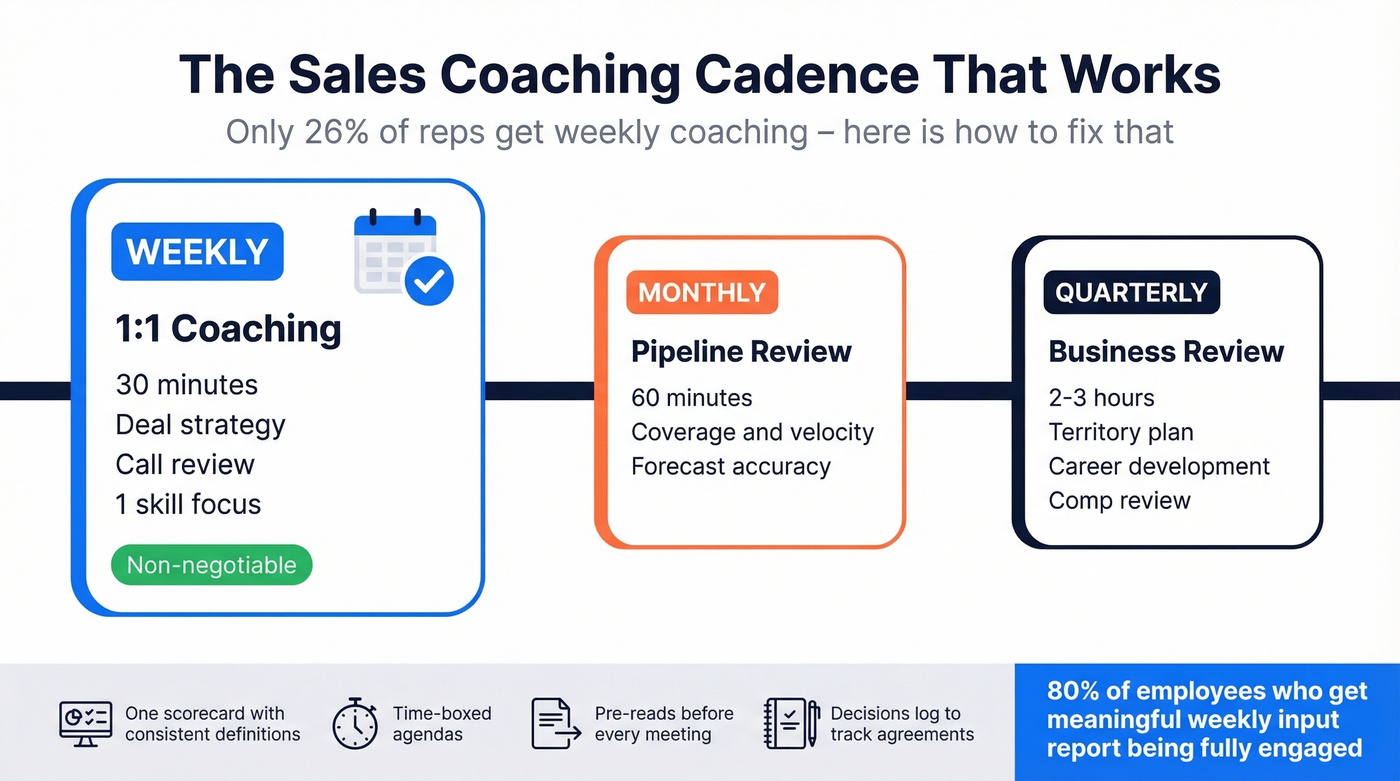
This rhythm works:
| Meeting | Frequency | Duration | Focus |
|---|---|---|---|
| Weekly 1:1 | Weekly | 30 min | Deal strategy, call review, 1 skill focus |
| Pipeline Review | Monthly | 60 min | Coverage, velocity, forecast accuracy |
| Business Review | Quarterly | 2-3 hrs | Territory plan, career development, comp |
The weekly 1:1 is non-negotiable. We've tested this cadence with teams of 5 and teams of 50, and the weekly 1:1 is the constant that holds everything together. Monthly and quarterly reviews handle the strategic layer. Key principles: one scorecard with consistent definitions, time-boxed agendas, pre-reads distributed before the meeting, and a decisions log that tracks what was agreed.
Time allocation matters. 60% of reps' time already goes to non-selling tasks. If your coaching cadence eats further into selling time, you've over-engineered it. Async updates via Slack or CRM comments can replace half the meetings most teams run.
Mistakes That Kill Coaching Cultures
Saving it for reviews. If anything in a performance evaluation is a surprise, you've already failed as a manager. Coaching should land the same day as the behavior - ideally within hours.
Coaching from stale calls. Reviewing a call from three weeks ago is an archaeological exercise, not coaching. The rep barely remembers the conversation. Use the most recent call, ideally from today.
The feedback sandwich. The positive-negative-positive format trains reps to brace for criticism every time you start with a compliment. SBII replaces it with something more honest.
Wrong channel. Delivering constructive observations in a team Slack channel or group call guarantees defensiveness. Praise publicly, coach privately. Always.
One-way monologues. If your rep hasn't spoken in the first five minutes of a coaching session, you're lecturing. The SBII "Intent" step forces two-way dialogue - use it.
Ignoring the data. Coaching based on gut feel when you have call recordings, conversion rates, and pipeline data available is malpractice. Use the numbers to diagnose, then coach the behavior behind them.
Win/Loss Analysis: The Loop Most Teams Ignore
Here's the thing about win/loss analysis: it's the most honest feedback mechanism in B2B sales because it comes from the buyer, not from your CRM notes.
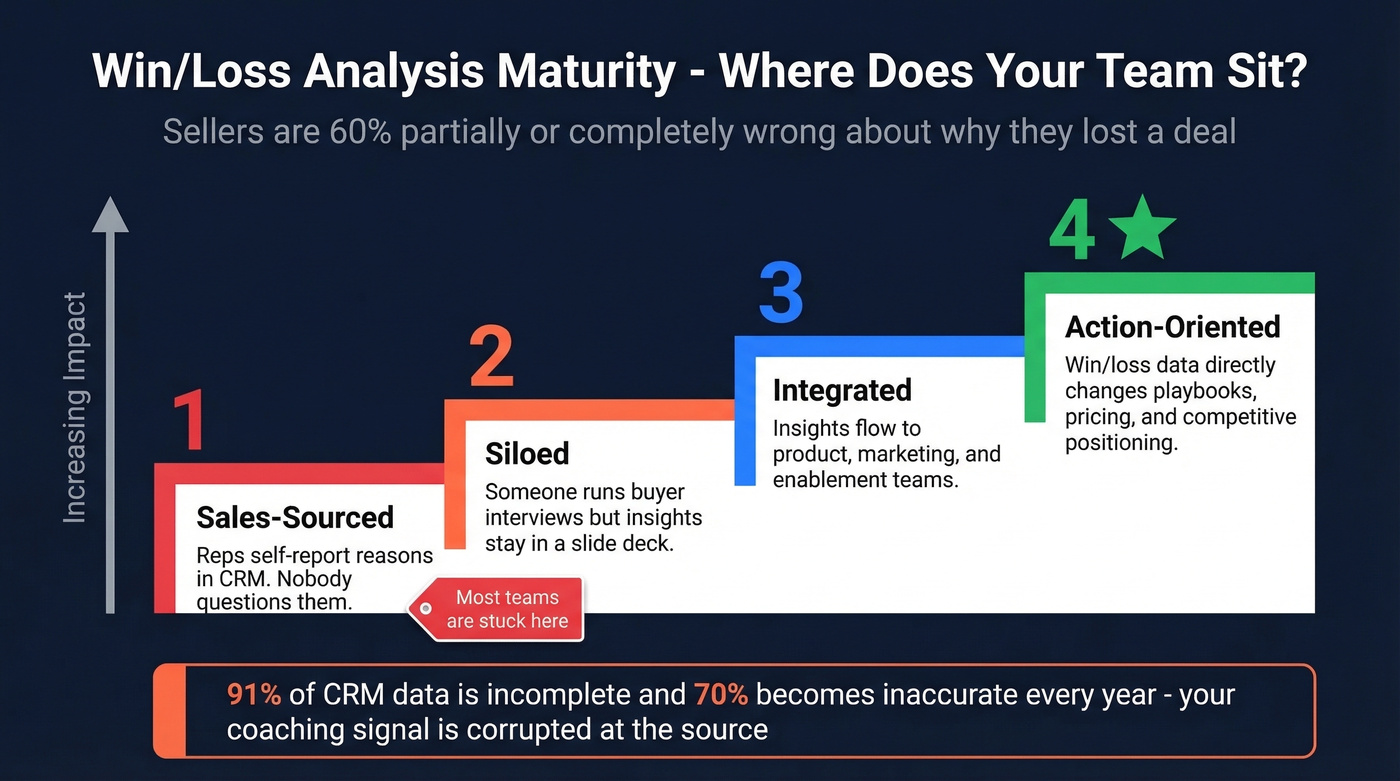
Sellers are 60% partially or completely wrong about why they lost a deal. They'll say "price" when the buyer chose a competitor for better integrations. They'll say "timing" when the champion left mid-cycle. CRM disposition codes are fiction written by the person with the most incentive to spin the narrative.
A mature win/loss program moves through four stages:
- Sales-Sourced - Reps self-report reasons in the CRM. Nobody questions them. Most teams sit here.
- Siloed - Someone's running buyer interviews, but insights stay in a slide deck.
- Integrated - Insights flow to product, marketing, and enablement.
- Action-Oriented - Win/loss data directly changes playbooks, pricing strategy, and competitive positioning.
The data quality problem compounds everything. 91% of CRM data is incomplete, and 70% becomes inaccurate annually. You can't coach conversion rate when the denominator is polluted by bounced emails, dead phone numbers, and contacts who changed jobs six months ago. The coaching signal is corrupted at the source.
This is where fixing your data layer becomes a coaching investment, not just an ops task. When Meritt switched to Prospeo, their bounce rate dropped from 35% to under 4% and pipeline tripled from $100K to $300K per week. Suddenly their reps' conversion metrics meant something real, and coaching conversations shifted from "why aren't you converting?" to "here's what's different about the deals you're winning."
Real-Time Coaching Tools
The AI coaching market has crossed $62B and is growing at 28.3% CAGR. 88% of reps with AI agents say the technology increases their odds of hitting targets. The biggest shift in 2026 is toward tools that coach reps during live conversations, not just after the fact.
| Tool | Best For | What It Does | Pricing |
|---|---|---|---|
| Gong | Call coaching at scale | Records, transcribes, surfaces coaching moments | ~$1,000-2,000/user/yr |
| Prospeo | Fixing data before coaching | Verifies emails and phones before they enter your CRM, so coaching metrics reflect reality. 98% email accuracy, 7-day refresh cycle. | Free tier; ~$0.01/email |
| Mindtickle | Onboarding + skill dev | AI scorecards, role-play simulations, personalized learning paths | ~$45,000/yr for 100 users |
| Demodesk | Live call coaching | AI call analysis with real-time prompts during live calls | ~$500-1,500/user/yr |
| Salesloft / Outreach | Full-stack sequencing | Sequencing platforms with embedded coaching dashboards and call analytics | ~$1,200-1,800/user/yr |
Gong is the default for conversation intelligence - the insights on talk-to-listen ratio, topic tracking, and deal risk scoring are genuinely useful for managers running weekly 1:1s. Mindtickle fills a different gap: onboarding and ongoing skill development with AI-driven simulations, which is especially valuable for teams ramping new hires quickly.
Most teams buy a conversation intelligence tool before fixing their data layer. That's backwards. If too many of your emails bounce and half your phone numbers are disconnected, no amount of call analysis fixes the pipeline. Clean the inputs first, then invest in analyzing the outputs. If you're rebuilding outbound from the ground up, start with a repeatable cold calling system and a clear set of sales prospecting techniques so coaching has something consistent to reinforce.
Mid-performers are your highest-ROI coaching tier - but they need to reach the right people first. Prospeo gives your team 300M+ verified profiles, 125M+ direct dials with a 30% pickup rate, and intent data across 15,000 topics so every coached call lands on an actual buyer.
Give your reps contacts worth coaching on - at $0.01 per email.
FAQ
How often should managers give sales feedback?
Weekly 1:1s of 30 minutes produce 25% higher quota attainment than less frequent coaching. Pair those with monthly pipeline reviews and quarterly business reviews. The weekly session handles behavioral coaching; monthly and quarterly cover strategy and career development.
What's the best framework for delivering coaching?
SBII (Situation-Behavior-Impact-Intent) from the Center for Creative Leadership. The first three steps structure the observation; the Intent step - asking what the rep was trying to accomplish - turns it into a two-way conversation and significantly reduces defensiveness.
How do I coach a top performer who's coasting?
Shift from skill coaching to stretch goals. Ask what they want next - leadership, enterprise accounts, a new vertical - and tie observations to that ambition. Top performers disengage when coaching feels like micromanagement. Give them autonomy on process and challenge them on trajectory.
What metrics belong in a sales performance review?
Quota attainment, conversion rate by stage, pipeline coverage (target 3-4x), talk-to-listen ratio on calls, and forecast accuracy. Blend quantitative KPIs with behavioral observations from call reviews. The numbers tell you what's happening; the behaviors tell you why.
How do I fix bad CRM data that's skewing coaching metrics?
Run your contact lists through a verification tool before coaching to metrics. Prospeo's 5-step verification catches bounced emails, dead numbers, and job-changers - returning 98% accurate emails across 143M+ verified addresses. Snyk cut their bounce rate from 35-40% to under 5% and saw AE-sourced pipeline jump 180%.