

Best Sales Intelligence Companies, Ranked by Real Users
The sales intelligence market is projected to hit about $4.99 billion in 2026, up from $3.31 billion in 2024. That growth means more vendors, more noise, and more platforms promising "the most accurate B2B database." Meanwhile, B2B contact records decay at roughly 30% per year. A database you bought in January is missing a third of its value by December.
Every list you'll find is written by a vendor - including this one. We've tested these tools across real outbound campaigns, and we're sharing what we found: real pricing, real tradeoffs, and clear recommendations.
Our Picks (TL;DR)
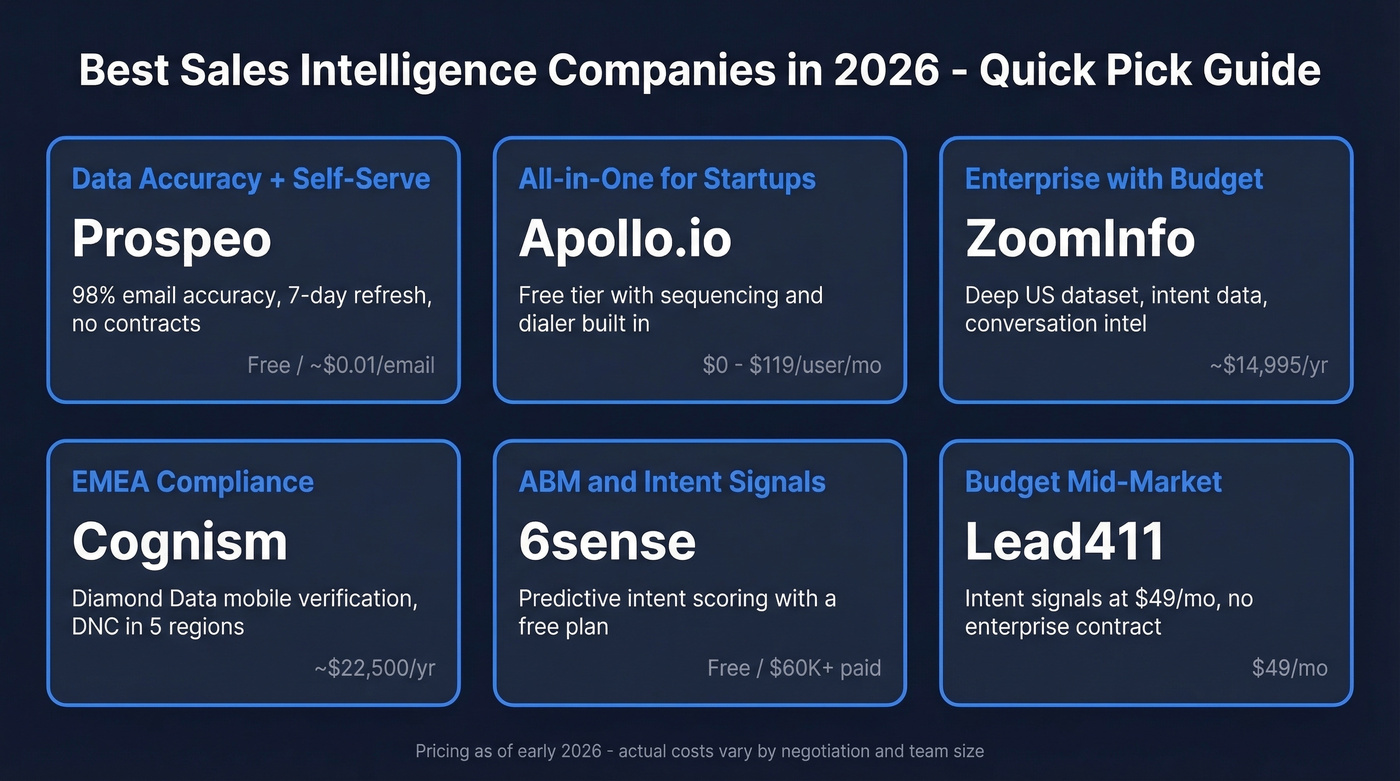
| Best For | Tool | Why | Starting Price |
|---|---|---|---|
| Data accuracy + self-serve | Prospeo | 98% email accuracy, 7-day refresh, no contracts | Free / ~$0.01/email |
| All-in-one for startups | Apollo.io | Free tier with sequencing + dialer | $0-$119/user/mo |
| Enterprise with budget | ZoomInfo | Deep US dataset + intent + conversation intel | ~$14,995/yr (3 seats) |
| EMEA compliance | Cognism | Diamond Data mobile verification + DNC across 5 regions | ~$22,500/yr (5 users) |
| ABM / intent signals | 6sense | Predictive intent scoring + free plan | Free / $60K-$100K+ paid |
| Budget mid-market | Lead411 | Intent signals at $49/mo, no enterprise contract | $49/mo |
Pricing at a Glance
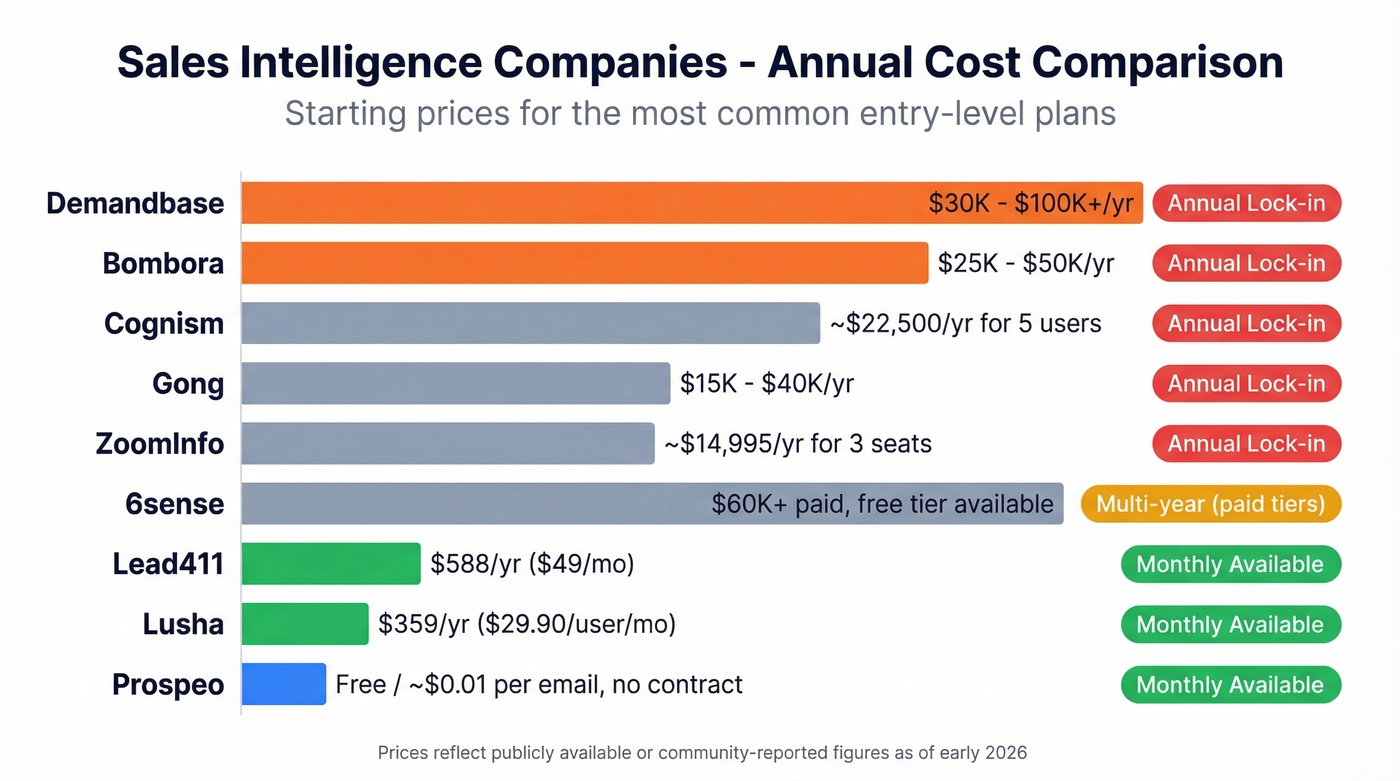
Here's the money question. Every tool here uses a different pricing model, and most vendors make it deliberately hard to compare apples to apples.
| Tool | Starting Price | Model | Contract? | Free Tier? |
|---|---|---|---|---|
| ZoomInfo | ~$14,995/yr | Platform + seats | 1-2 year | Limited |
| Apollo.io | $0 | Per user/mo | Monthly available | Yes |
| Cognism | ~$22,500/yr (5 users) | Platform + seats | Annual | No |
| Lusha | $29.90/user/mo | Per user + credits | Monthly available | Yes (limited) |
| 6sense | $0 | Credits + modules | Multi-year (paid) | Yes (50 credits/mo) |
| Lead411 | $49/mo | Per user | Monthly available | 7-day trial |
| Bombora | ~$25K-$50K/yr | Data license | Annual | No |
| Demandbase | ~$30K-$100K+/yr | Platform | Annual | No |
| Gong | ~$15K-$40K/yr | Per seat | Annual | No |
The 10 Best Platforms Reviewed
Prospeo
Snyk's 50-person AE team switched to Prospeo and saw bounce rates drop from 35-40% to under 5%, generating 200+ new opportunities per month. That's not a marginal improvement - it's a different category of output entirely.
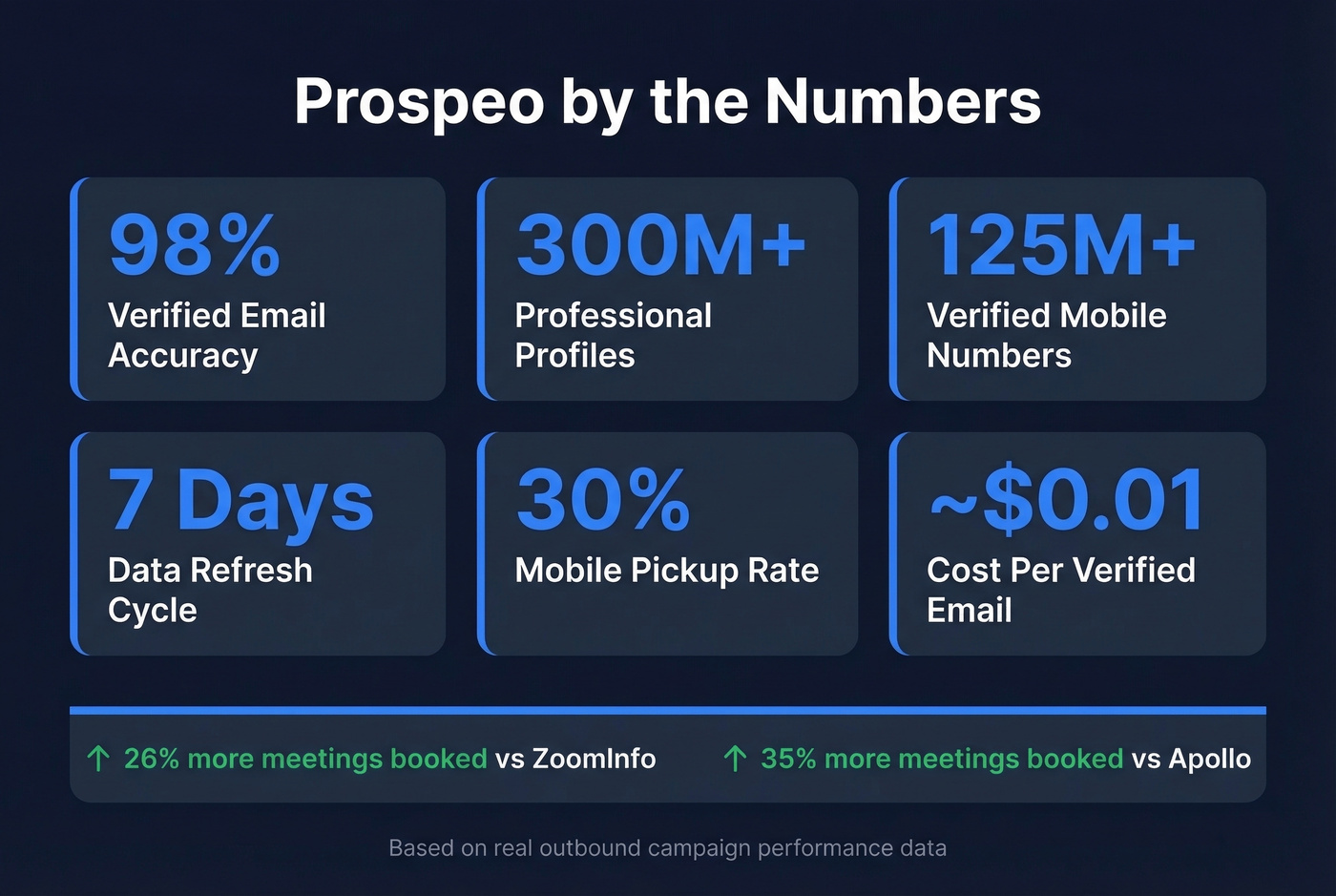
The numbers behind that result: 300M+ professional profiles with 98% verified email accuracy (compared to 87% at ZoomInfo and 79% at Apollo), 125M+ verified mobile numbers with a 30% pickup rate, and a 7-day data refresh cycle. The proprietary email-finding infrastructure runs a 5-step verification process - catch-all handling, spam-trap removal, honeypot filtering - which is why teams book 26% more meetings versus ZoomInfo and 35% more versus Apollo.

Pricing is transparent and self-serve: roughly $0.01 per email, 10 credits per mobile number, with a free tier giving you 75 verified emails and 100 Chrome extension credits monthly. No annual contracts, no "talk to sales" gates. Integrations cover Salesforce, HubSpot, Smartlead, Instantly, Lemlist, Clay, and Zapier.
Pair with: Outreach, Salesloft, or Instantly for sequencing and dialing - Prospeo handles the data, they handle the workflow.
ZoomInfo
ZoomInfo is the incumbent for a reason: deep US B2B coverage, a full GTM suite spanning intent data, conversation intelligence through Chorus, and workflow automation. It holds a 4.5/5 on G2 with over 9,000 reviews - one of the most-reviewed products in the category.
Here's the thing, though. The #1 complaint theme across those reviews? Inaccurate and outdated data. That's a problem when data accuracy is literally the product you're selling.
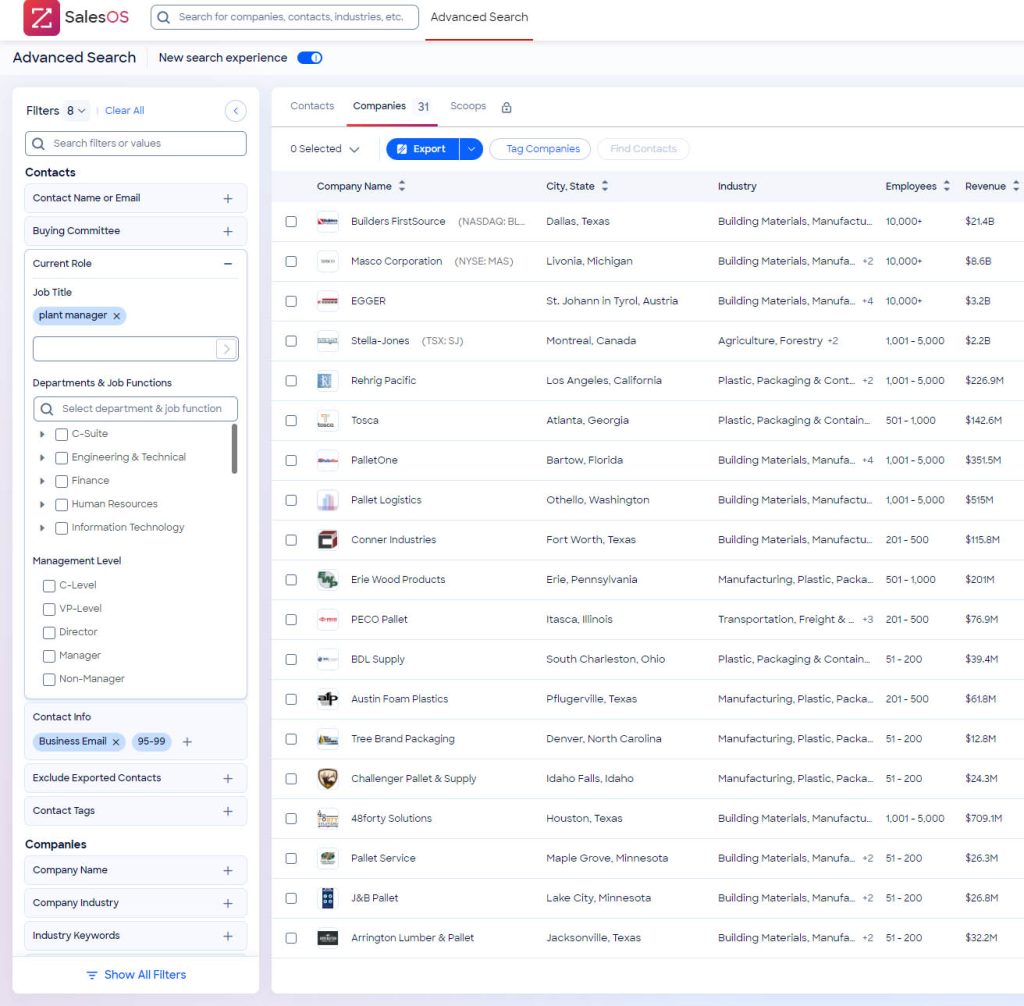
Pricing starts at ~$14,995/year for Professional+ with 3 seats included, jumps to $29,995 for Advanced+, and $35,995 for Elite+. Additional seats run $2,500/year at list price. Discounts of 30-65% are common if you negotiate hard, but two-year contracts are standard, and early termination can cost 50-100% of the remaining value. Bundle Chorus and you're looking at $35K-$50K/year for 10 users on Professional, or $60K-$80K on Advanced.
Where ZoomInfo wins: US database depth, workflow breadth, enterprise credibility. Where it doesn't: pricing transparency, data freshness, and EMEA coverage.
Apollo.io
Apollo's real problem isn't the features - it's the credit math. The database covers 210M+ contacts across 35M+ companies, the free tier gives you 10,000 credits per month, and you get a built-in sequencer plus dialer. For a startup running its first outbound motion, the value is hard to beat.
But on the Organization plan, Apollo caps mobile credits at 200/month. If you're prospecting at any real volume, you'll hit that wall within the first week.
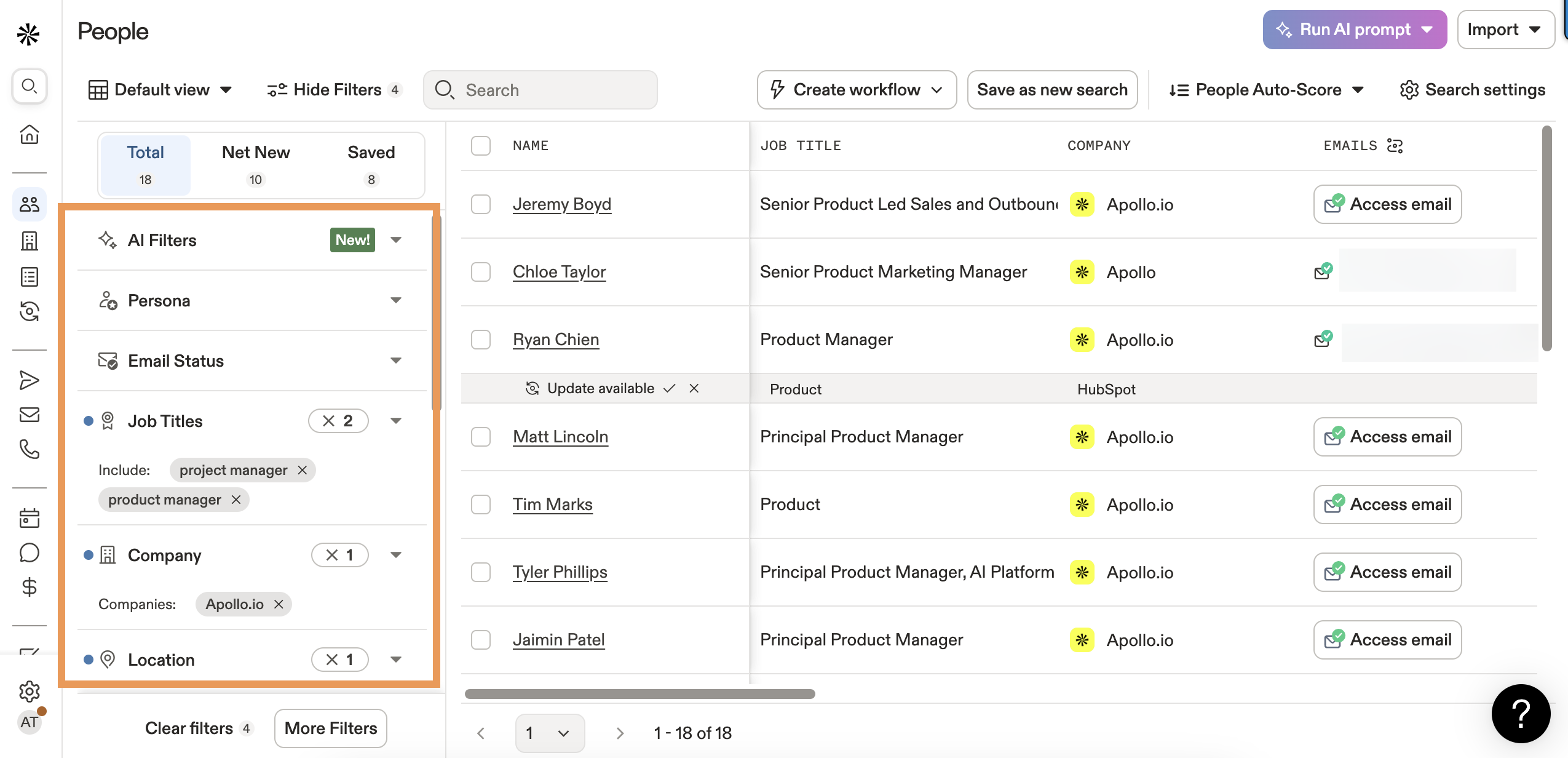
The data quality gap is the bigger issue. Apollo's data is largely user-populated, not vendor-verified. As one practitioner on r/sales put it, it's a "jack of all trades, master of none" - the data exists, but "they're not verifying anything by themselves." The dialer runs on Twilio VoIP numbers that get spam-flagged. And the email tracking features can actively hurt your deliverability if you leave open/click trackers on.
Paid plans run $49/user/month (Basic) to $119/user/month (Organization, minimum 3 users). The move: Use Apollo for sequencing and prospecting workflow, but verify your exported data through a dedicated accuracy-first provider before you send anything.
Cognism
We watched a team move from ZoomInfo to Cognism specifically for EMEA prospecting, and the difference in phone connect rates was immediate. Cognism's Diamond Data feature is built around mobile number verification and re-verification, with human validation in its broader data process. Users consistently report 2-3x better pickup rates versus non-verified numbers, and community discussions on r/sales back that up for European markets.
Cognism checks DNC lists across the US, UK, Canada, Australia, and Europe as standard. If you're selling into regulated markets, this isn't a nice-to-have - it's a compliance requirement that ZoomInfo only partially covers.
Pricing isn't public, but here's what to budget. The Grow tier runs roughly $15,000 platform fee plus $1,500/user/year. Elevate is $25,000 platform plus $2,500/user/year. For a 5-person team, that's $22,500-$37,500/year. Watch for 10-15% annual renewal increases and "unlimited" access that's actually capped at around 2,000 records per user per month under fair-use policies.
Where Cognism wins over ZoomInfo: EMEA compliance and mobile verification. Where ZoomInfo still wins: US database depth and workflow breadth.
Lusha
Lusha is the fastest path from "I need this person's number" to having it on your screen. The Chrome extension is snappy, the UI is clean, and Pro starts at just $29.90/user/month. For reps who need to grab a phone number or email mid-conversation, it's one of the lowest-friction options available.
The tradeoff is credit math at scale. Phone reveals cost 5 credits each, emails cost 1. On the Pro plan, you'll burn through your allocation quickly doing any kind of volume prospecting. The "unlimited" Scale plan is still capped at roughly 2,000 contacts per month under fair use. Premium runs $69.90/user/month, and monthly billing pushes Pro up to $79.90. Best for individual reps or small teams doing targeted outreach - skip this for bulk list building.
6sense
6sense is the real deal for enterprise ABM - and the free plan is surprisingly functional. You get 50 credits per month, company and people search, sales alerts, and a Chrome extension. That's enough to test whether intent data actually changes your prioritization before committing real budget.
The paid side is where it gets serious. Expect $60K-$100K+ per year with multi-year commitments. 6sense processes 500B+ intent signals across 200 countries, and its predictive scoring helps large teams focus on accounts showing buying behavior. But this is an enterprise tool with enterprise pricing. Overkill for a 5-person sales team.
Lead411
A solid mid-market alternative that doesn't get enough attention. Lead411 offers intent signals, growth and hiring triggers, and starts at $49/month with a free 7-day trial. For teams that want intent signals without a $60K commitment, it's the most accessible entry point in the category. The database isn't as deep as ZoomInfo's, but the price-to-value ratio is strong for US-focused prospecting. Multiple threads on r/sales recommend it as the "ZoomInfo alternative that actually fits a normal budget."
Bombora
Bombora isn't a prospecting tool - it's the intent data layer powering other platforms. Cognism and others integrate Bombora intent signals to surface accounts showing buying behavior across thousands of topics. You'd buy Bombora directly only if you're building custom data infrastructure, and at that point you're looking at roughly $25K-$50K/year for a direct data license. For everyone else, access it through a platform that already includes it.
Demandbase
Enterprise ABM platform for large marketing and sales alignment plays, typically $30K-$100K+ per year. If you're running coordinated account-based campaigns across display, web personalization, and sales outreach, Demandbase is purpose-built for that. If you're a pure outbound team, it's overkill - and the budget is better spent on data quality and sequencing tools.
Gong
Gong is conversation intelligence, not contact data - a complementary sub-category rather than a replacement for the tools above. It records and analyzes sales calls to surface coaching insights and deal risk. Pricing runs $15K-$40K/year. Gong now competes directly with ZoomInfo's Chorus, which means bundling decisions matter. In our conversations with sales leaders, Gong's standalone analytics are generally considered stronger, but Chorus wins on convenience if you're already locked into ZoomInfo's ecosystem.

You're comparing sales intelligence companies because your current data is costing you deals. Prospeo delivers 98% email accuracy, 125M+ verified mobiles, and a 7-day refresh cycle - at $0.01/email with no contracts.
Stop comparing. Start sending emails that actually land.
How Credit Systems Actually Work
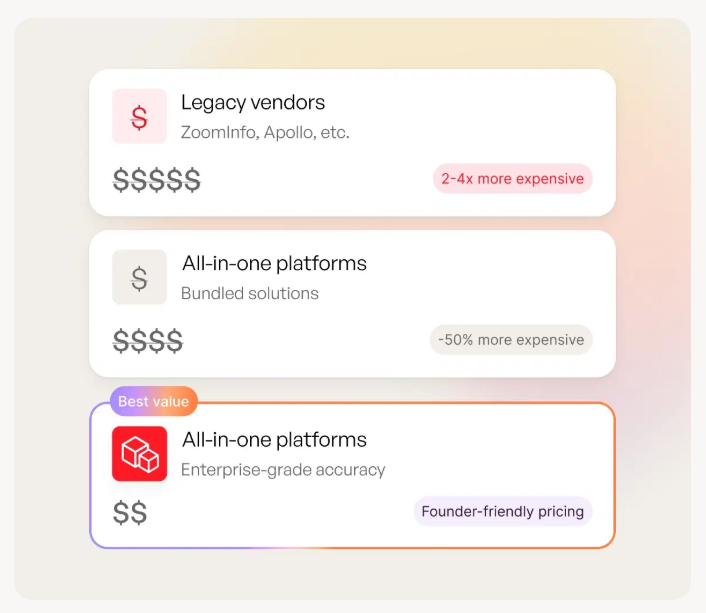
Most B2B intelligence vendors use credits to gate access to their data. The mechanics vary wildly, and the differences directly impact your cost per lead.
Let's break this down with a worked example. Say you need 500 contacts per month - each with a verified email and phone number - for outbound prospecting.
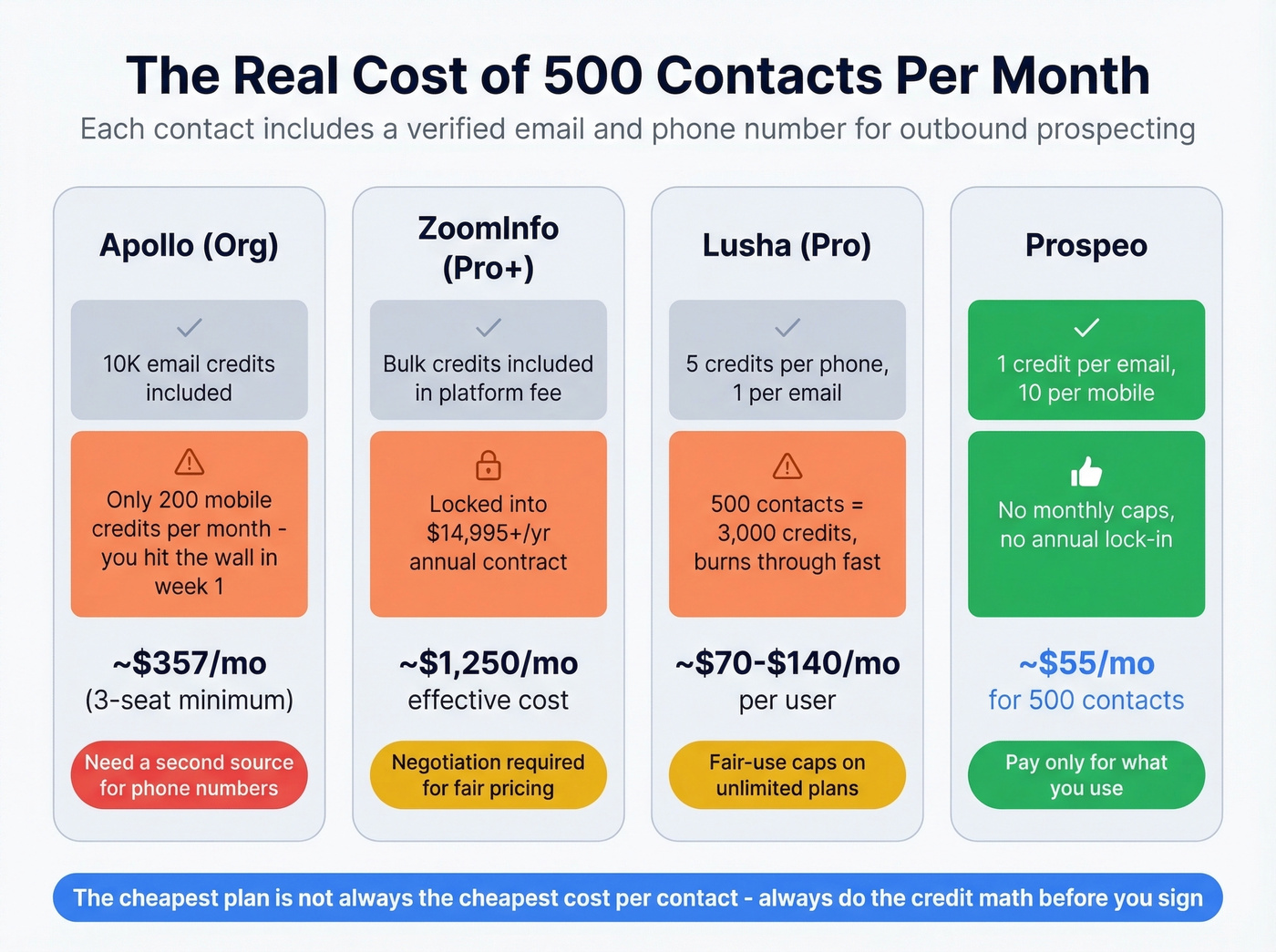
| Tool | What 500 contacts costs | How it works |
|---|---|---|
| Apollo (Organization) | ~$357/mo (3-seat min) | 10K credits included, but only 200 mobile credits/mo - you'll need overages or a second source for phones |
| ZoomInfo (Professional+) | ~$1,250/mo (amortized) | $14,995/yr / 12; credits priced $0.20-$0.60 each depending on volume |
| Prospeo | ~$50/mo | ~$0.01/email + 10 credits/mobile; pay for what you use, no monthly caps |
The credit scarcity model - where platforms cap your monthly reveals and charge overages - creates a scarcity mindset. Reps start rationing data instead of prospecting freely. Apollo caps mobile credits at 200/month on Organization. Lusha charges 5 credits per phone reveal. ZoomInfo's credit pricing ranges from $0.20 to $0.60 per credit depending on volume.
Look: the credit systems at most platforms are designed to make you pay more, not prospect better. Pay-per-result models without monthly caps are the antidote.
Data Freshness Beats Database Size
Every vendor leads with database size. "210M contacts!" "300M profiles!" The number that actually matters is how often that data gets refreshed.
With a third of your database going stale every year, a 300M-record database that refreshes every six weeks is serving you outdated contacts for most of its lifecycle. Multiply that across thousands of outbound touches and you're burning sender reputation on bounced emails and disconnected numbers.
Here's our hot take: if your average deal size is under $10K, you probably don't need an enterprise-tier platform - but you absolutely need enterprise-tier data freshness. The difference between a 5% bounce rate and a 35% bounce rate isn't a feature comparison. It's the difference between a functioning outbound program and a dead one. And deals closed within 50 days have a 47% win rate versus 20% or lower after that threshold, so stale data doesn't just waste emails - it drags out your entire sales cycle by forcing reps to re-verify, re-research, and re-prospect contacts that should've been accurate from the start.
When you're evaluating any provider, ask one question before database size: how often do you refresh?
Snyk's 50 AEs dropped bounce rates from 35% to under 5% and added 200+ opportunities per month after switching. That's what happens when your sales intelligence platform refreshes data every 7 days instead of every 6 weeks.
See why teams book 26% more meetings than with ZoomInfo.
Choosing the Right Provider for Your Team
There's no single best tool. There's the right tool for your team size, budget, and market.
10-30 rep team, US-focused: ZoomInfo or Lead411. ZoomInfo gives you the deepest US dataset plus intent and workflow tools - if you can stomach the contract. Lead411 offers intent signals at a fraction of the cost, with month-to-month flexibility. Make sure the platform can grow with your team without forcing a painful contract renegotiation at every headcount milestone.
EMEA-heavy team needing compliance: Cognism is the clear pick. DNC checking across five regions and Diamond Data mobile verification aren't features you can bolt on elsewhere. Budget $22K-$37K/year for a 5-person team.
Enterprise ABM with $60K+ budget: 6sense for predictive intent scoring, paired with a dedicated data provider for contact-level accuracy. 6sense tells you which accounts to target; you still need clean contact data to reach the right people. For recruiting-specific prospecting, practitioners on r/recruiting have also flagged RocketReach as worth evaluating.
Contract Gotchas to Watch For
Before you sign anything, check these boxes:
- ZoomInfo locks you into 2-year contracts with early termination penalties of 50-100% of remaining value. Negotiate hard on year one - discounts of 30-65% are common, but they'll try to claw it back on renewal.
- Cognism builds in 10-15% annual renewal increases. Your $22K year-one deal becomes $27K+ by year three. Get the increase cap in writing.
- 6sense requires multi-year commitments on paid plans. The free tier is genuinely no-strings, but upgrading means a serious financial commitment.
- "Unlimited" doesn't mean unlimited. Cognism's fair-use policy caps exports at roughly 2,000 records per user per month. Lusha's Scale plan has similar soft caps. Ask for the fair-use policy document before you buy.
- Credits that don't roll over are the norm at 6sense and most credit-based platforms. If you don't use them, you lose them - every billing cycle.
The alternative: self-serve platforms with month-to-month billing and transparent per-unit pricing. You pay for what you use, scale up or down freely, and never negotiate a renewal.
FAQ
What is a sales intelligence company?
A sales intelligence company provides B2B data - contact details, firmographics, technographics, and buyer intent signals - so teams can find and prioritize the right prospects faster. The category is projected to reach $9 billion by 2034, driven by AI-powered enrichment and intent data adoption.
How much do these tools cost?
Pricing ranges from free (Apollo and 6sense both offer functional free tiers) to $15K-$100K+ per year for enterprise platforms like ZoomInfo and Demandbase. Most mid-market teams spend $5K-$25K annually. The biggest cost variable isn't the sticker price - it's the credit model and contract structure.
Which provider has the most accurate data?
Prospeo leads with 98% verified email accuracy on a 7-day refresh cycle, compared to 87% at ZoomInfo and 79% at Apollo. Accuracy depends on verification methodology and refresh frequency, not database size. When evaluating tools, ask for bounce rate data - not contact count.
Can I use these tools without a long-term contract?
Yes - Apollo, Lusha, and Lead411 all offer month-to-month or self-serve plans. ZoomInfo, Cognism, and 6sense typically require annual or multi-year commitments on paid tiers. Start with self-serve options and only lock in once you've validated the data against your ICP.
What's the difference between sales intelligence and intent data?
Sales intelligence covers contact and company data - who to reach and how. Intent data tracks buying signals, showing which accounts are actively researching topics related to your product. Tools like 6sense and Bombora specialize in intent, while platforms like Prospeo layer Bombora-powered intent signals on top of verified contact records, giving you both the "who" and the "when."