

How to Plan a Sales Kickoff That Doesn't Waste $400K
A trainer threw a $100 bill on the stage floor and waited to see who'd grab it. Bold motivational tactic - except the company had just laid off 15% of the team. The room didn't feel inspired. It felt hostile. Ask a sales engineer - not everyone even wants to be there in the first place.
That's the gap between a sales kickoff that moves pipeline and one that becomes a cautionary tale on r/sales. More than 80% of the information reps absorb during an SKO gets forgotten within weeks, sometimes days. And once you factor travel, venue, and production, budgets routinely land in the hundreds of thousands - without a reinforcement plan or even a pre-event survey asking reps what they actually need.
Whether you call it a sales kickoff, annual sales meeting, or SKO, the best ones aren't events. They're the launch of a year-long performance system.
The Three Things That Matter Most
- Survey your reps before building the agenda. Ask what's broken and what last year's SKO got wrong.
- Budget $2,000-$4,000 per attendee for in-person events, with ~$3,144/person as a solid US conference benchmark.
- Build a 90-day reinforcement plan before the event happens. No post-SKO follow-up cadence means a forgettable experience.
If you only fix one thing this year: cut presentations by 50% and replace them with practice sessions. Reps don't need more slides. They need reps.
Why SKO ROI Is Higher Than You Think
The typical AE spends 2.7 years on the job and takes 4.7 months to ramp. That means roughly 15% of an AE's tenure is spent getting up to speed.
Run the math: if your average AE generates $500K in annual revenue and you shave two weeks off ramp for 20 new reps, that's roughly $385K in accelerated pipeline - enough to cover a mid-market SKO by itself. One prevented departure pays for the whole thing. Frame it that way to your CFO, and the budget conversation gets a lot easier.
What It Actually Costs
The average US conference runs about $3,144 per attendee. One UK-based company flying 200 people to Barcelona spent £500,000 all-in - roughly $2,500 per head, or 0.4% of their £150M ARR.
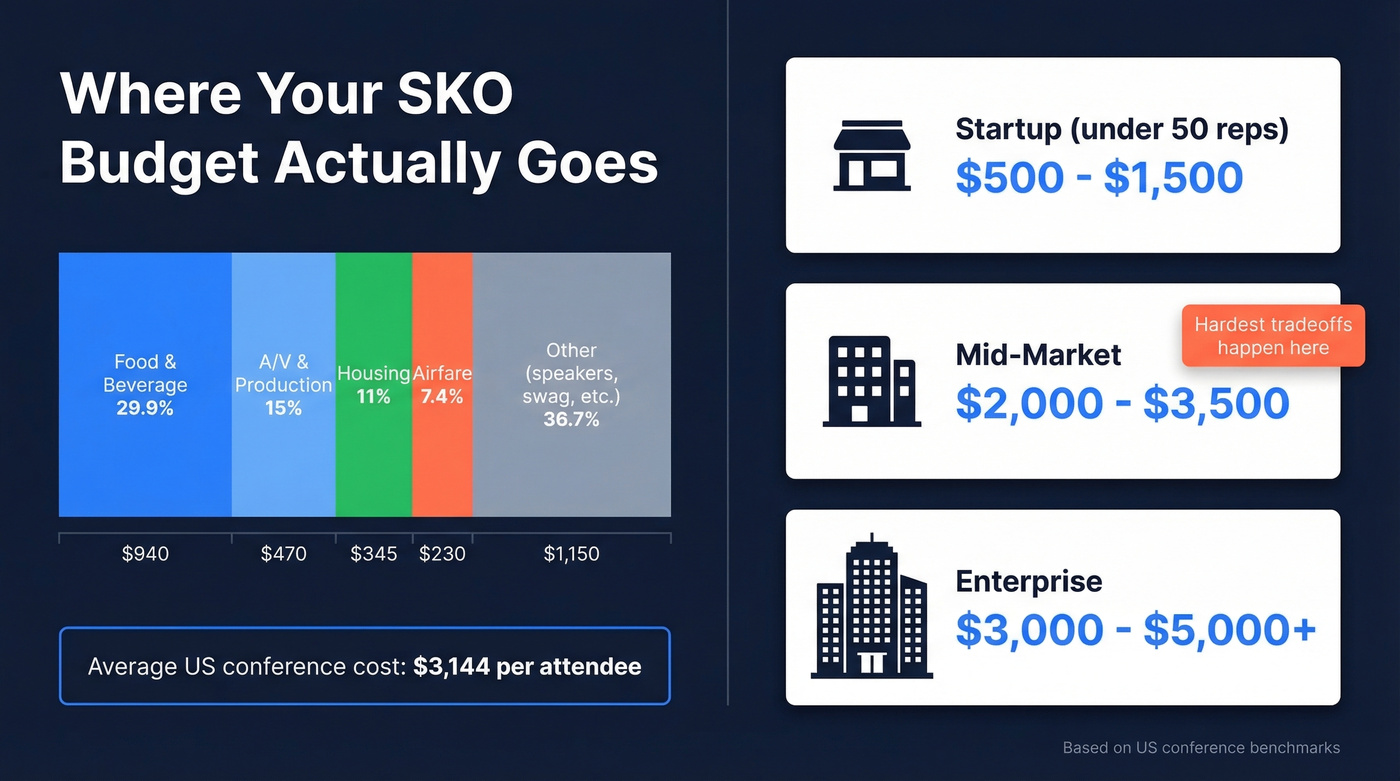
| Category | % of Budget | Per Attendee (~) |
|---|---|---|
| Food & Beverage | 29.9% | ~$940 |
| A/V & Production | 15% | ~$470 |
| Housing | 11% | ~$345 |
| Airfare | 7.4% | ~$230 |
| Other (speakers, etc.) | 36.7% | ~$1,150 |
| Company Stage | Per Attendee Range |
|---|---|
| Startup (< 50 reps) | $500-$1,500 |
| Mid-Market | $2,000-$3,500 |
| Enterprise | $3,000-$5,000+ |
Mid-market is where the hard decisions happen. You're big enough to need a real event but small enough that every dollar matters. The startup range assumes something local - a hotel conference room and catered lunch. Enterprise numbers include production, keynote speakers, and multi-day venue rentals.
12-Week Planning Timeline
Most SKO disasters trace back to starting too late. Here's the cadence we've seen work across dozens of kickoffs.
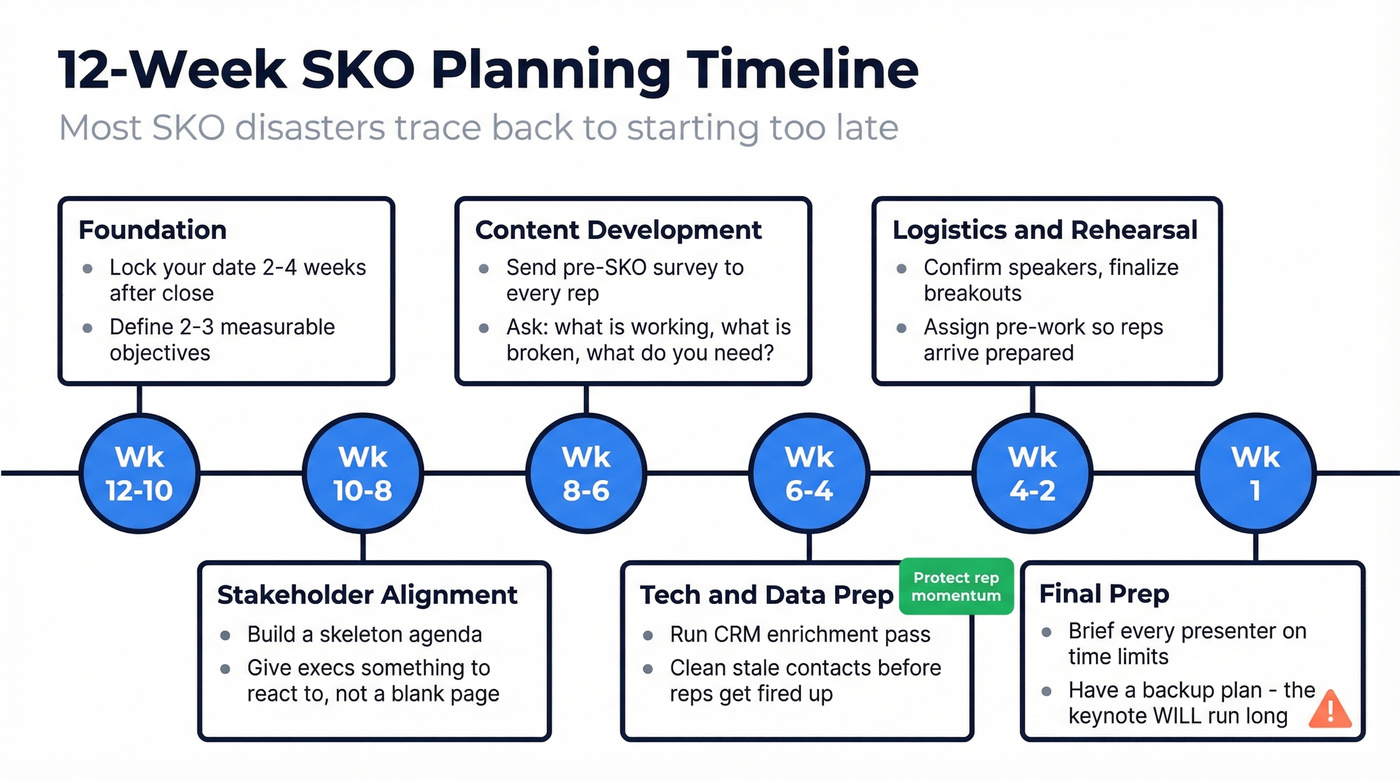
Weeks 12-10: Foundation. Lock your date 2-4 weeks after quarter- or year-end close. Define 2-3 measurable objectives - not "inspire the team," but something like "every AE leaves with a 90-day territory plan."
Weeks 10-8: Stakeholder alignment. Build a skeleton agenda and give your exec team something to react to. Don't hand them a blank page. That's how every VP demands a 45-minute slot.
Weeks 8-6: Content development. Send a pre-SKO survey to every rep. Ask three questions: what's working, what's broken, and what do you need to sell more? A SaaS CRO on Reddit shared they gathered "love/hate" input across a ~50-person sales org - BDRs, AEs, SCs, and CSMs - before finalizing their agenda. We've seen teams skip this step and regret it every single time.
Weeks 6-4: Tech and data prep. Run your CRM through an enrichment pass so reps don't leave the kickoff fired up only to bounce their first 30 emails on stale data. Prospeo's enrichment returns contact data on 83% of leads at 98% email accuracy - a quick cleanup before the event that protects deliverability and rep momentum.
Weeks 4-2: Logistics and rehearsal. Confirm speakers, finalize breakout tracks, run A/V checks. Assign pre-work so reps arrive prepared.
Week 1: Final prep. Brief every presenter on time limits. Have a backup plan for the keynote that runs long. It will.
Choosing and Activating Your Theme
Stop obsessing over your theme. A clever theme with a bad agenda is worse than no theme with great sessions. That said, a good theme creates connective tissue across two days of content.
Bucom's framework breaks theme activation into three parts: Message (the business story), Design (the visual system), and Moments (where the theme comes alive in sessions and awards). Themes that work - "Pressure is a Privilege," "Winning as One," "Light the Fire" - are short, action-oriented, and connected to a business reality. "Synergize Our Go-to-Market Flywheel" isn't a theme. It's a headache.
The real differentiator is whether you activate it beyond the event. Extend it into Slack channels, Zoom backgrounds, recognition programs, and mid-year reactivation moments. A theme that dies on the flight home was decoration, not strategy.
In-Person, Virtual, or Hybrid?
59% of meeting professionals prefer in-person gatherings, per AmEx GBT's 2025 forecast. But 52% of US employees work under hybrid arrangements. Ignoring virtual execution isn't an option.
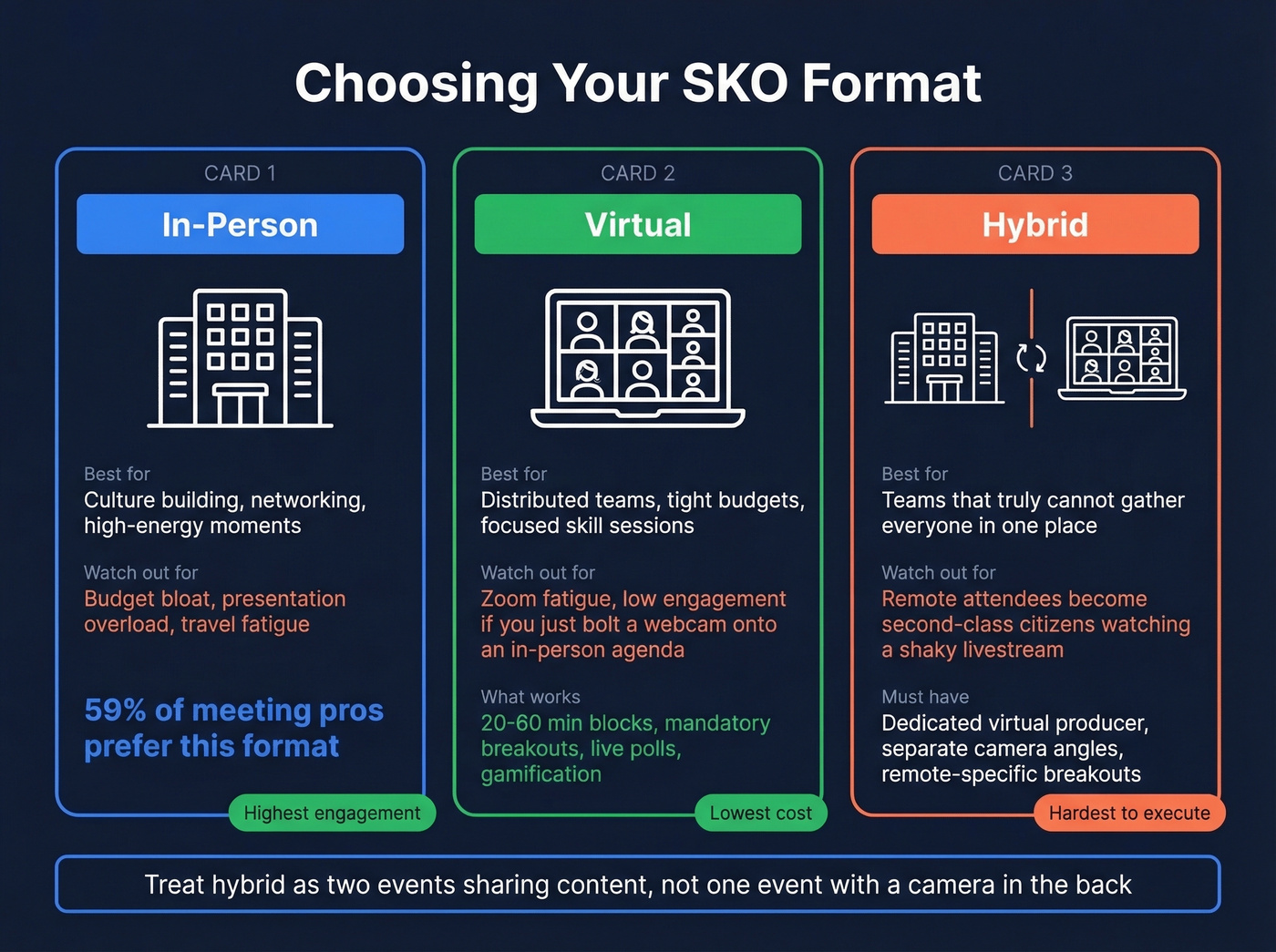
Virtual SKOs aren't inferior - they're poorly executed. The teams that fail try to replicate a two-day in-person event over Zoom. What works instead: 20-60 minute blocks, mandatory breakout rooms, live polls, and gamification that gives remote attendees a reason to stay engaged. If you're designing a virtual kickoff, build it as a native digital experience from the ground up - don't bolt a webcam onto your in-person agenda.
Hybrid is the hardest to pull off. Remote attendees become second-class participants watching a shaky livestream while the in-person crowd networks over cocktails. For teams going hybrid, assign a dedicated producer for the virtual experience - separate camera angles, moderated chat, and remote-specific breakouts. Treat it as two events sharing content, not one event with a camera in the back.

Your SKO is only as good as the data reps walk out with. Run your CRM through Prospeo's enrichment before kickoff - 83% of leads come back with verified contact data, 98% email accuracy, and a 7-day refresh cycle that keeps everything current. Reps leave with territory plans that actually connect.
Don't spend $3,000 per head on an SKO and hand reps a stale CRM.
Sample 2-Day Agenda
Day 1 - Align and Energize
| Time | Session | Format |
|---|---|---|
| 8:30-9:00 | Breakfast + networking | Open |
| 9:00-9:30 | CEO keynote (30 min max) | Presentation |
| 9:30-10:30 | State of the business | Panel + Q&A |
| 10:45-12:00 | Breakouts by role | Workshop |
| 12:00-1:00 | Lunch + networking | Open |
| 1:00-2:30 | New product deep-dive | Interactive |
| 2:45-4:15 | Objection handling practice | Role-play |
| 4:15-4:45 | Day 1 wrap-up | Presentation |
| 6:30 | Team dinner | Social |
Keep the CEO keynote to 30 minutes. Not 45. Not "30 but probably 50." Thirty. The moment leadership runs long, practice time - the most valuable part - gets cut first.
Day 2 - Practice and Plan
| Time | Session | Format |
|---|---|---|
| 8:30-9:00 | Breakfast | Open |
| 9:00-10:00 | AI tools hands-on lab | Workshop |
| 10:00-11:00 | Deal strategy lab (real accounts) | Workshop |
| 11:15-12:15 | Rep presentations (quota plans) | Peer learning |
| 12:15-1:15 | Lunch | Open |
| 1:15-2:30 | Cross-functional collaboration | Workshop |
| 2:30-3:00 | Recognition + awards | Celebration |
| 3:00-3:30 | 90-day commitments + wrap-up | Interactive |
For teams under 20 reps, compress to one day: metrics review, celebrate wins, rep presentations on their quota plan, and time-boxed discussions. Skip breakout tracks - everyone's in the same room. Allocate at least 30% of the day to practice.
AI at Your 2026 SKO
Here's the thing: if reps leave your 2026 kickoff without knowing how to use AI in their daily workflow, you wasted the event. AI isn't a novelty session anymore. It's a core competency.
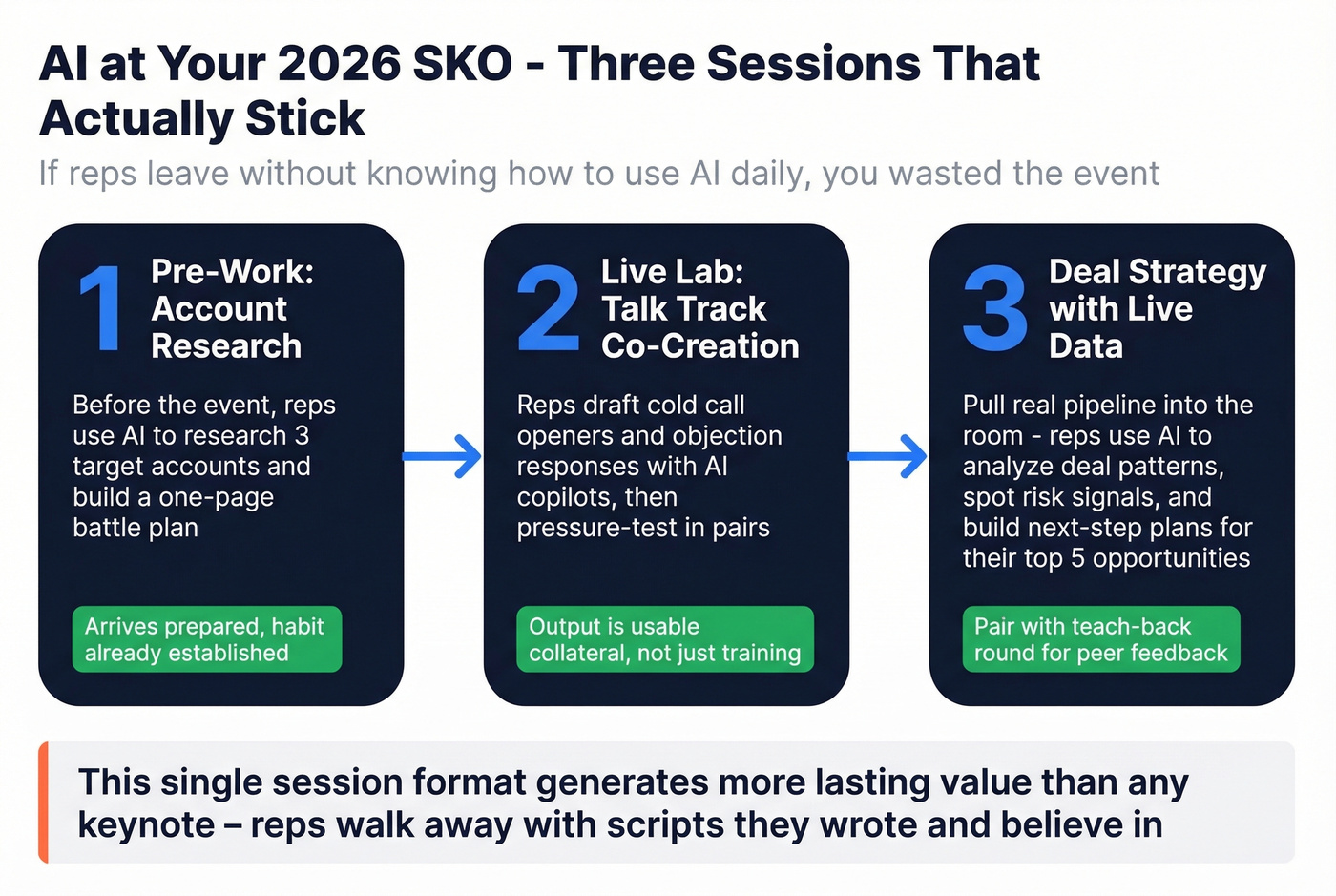
Pre-work that sets the tone. Before the meeting, assign reps to use AI tools to research three target accounts and build a one-page battle plan. They arrive prepared, and you've already established the habit.
Talk track co-creation. Run a live session where reps use AI copilots to draft cold call openers and objection responses, then pressure-test them in pairs. The output is usable collateral, not just training. In our experience, this single session generates more lasting value than any keynote - reps walk away with scripts they actually wrote and believe in, which means they'll use them on Monday morning instead of filing them in a folder they'll never open.
Deal strategy labs with live data. Pull real pipeline into the room. Have reps use AI to analyze deal patterns, identify risk signals, and build next-step plans for their top 5 opportunities. Pair this with a teach-back round where reps present their AI-refined messaging to the group for peer feedback.
Activities That Don't Make People Cringe
The best activities are fast, low-stakes, and don't single anyone out.
Rock Paper Scissors Extreme - a tournament-style, whole-room bracket - takes 10 minutes and gets energy up without making anyone uncomfortable. Shark Tank Fail, where teams pitch intentionally terrible product ideas, builds presentation confidence through comedy. Flip the Tarp, where teams stand on a tarp and flip it without stepping off, is genuinely collaborative and surprisingly competitive.
For recognition, peer appreciation shout-outs cost nothing and land hard. Creative award categories - fastest sales cycle, best comeback deal, most improved - celebrate more than just top revenue.
What to skip: anything that puts individuals on the spot during layoffs. Forced karaoke. Trust falls. The r/sales cringe thread is required reading before you finalize your activity list. If your idea would end up there, cut it.
7 Mistakes That Waste Your Budget
1. No clear objectives. When every group feels entitled to stage time, the agenda bloats and nothing lands. Write objectives first, build the agenda second.
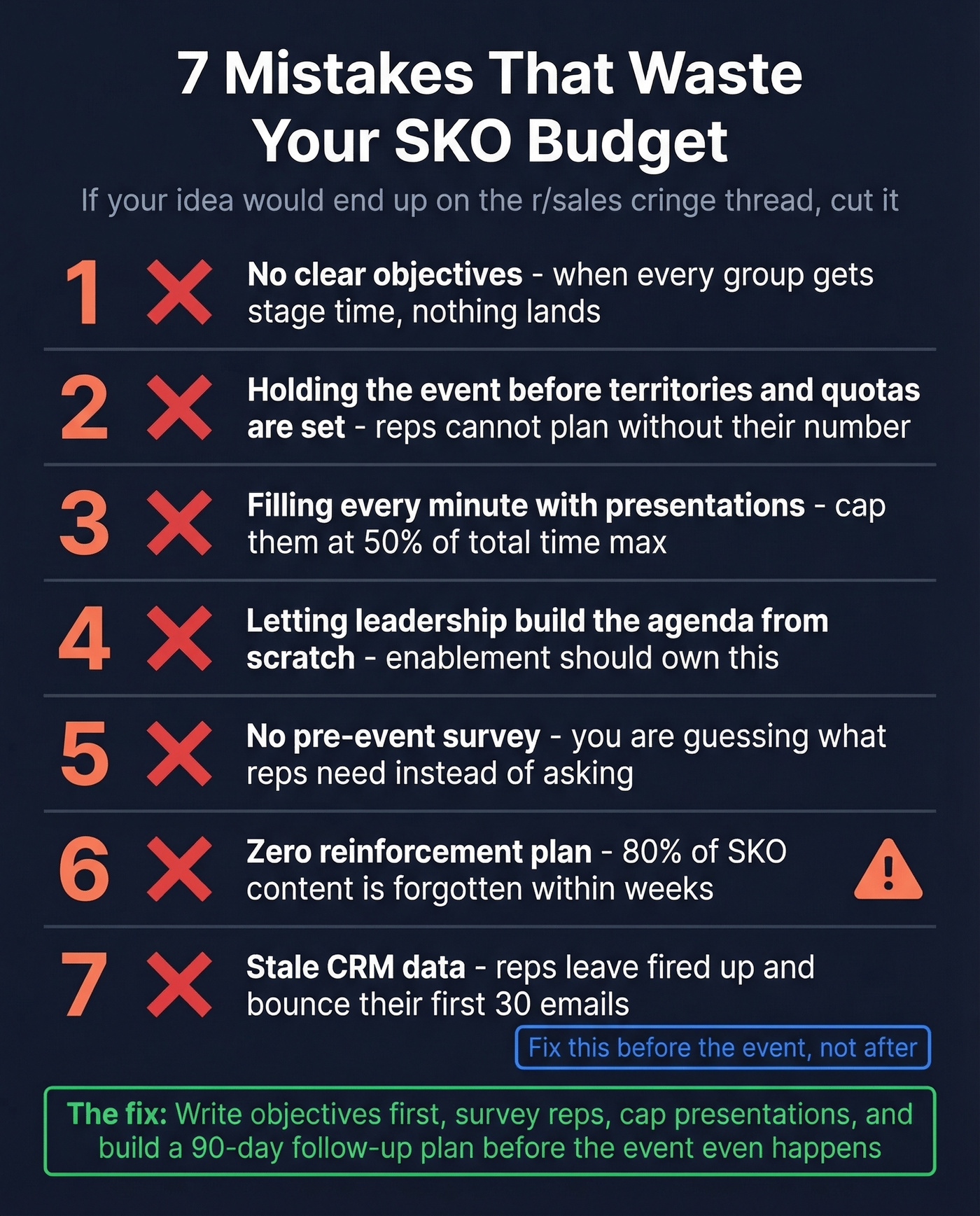
2. Holding the event before territories and quotas are set. Reps can't plan if they don't know their number or their patch. This is one of the most common timing mistakes and it's entirely avoidable - finalize comp plans before you finalize the date.
The next three mistakes are related, and they all stem from the same root cause: letting leadership run the show instead of enablement. Filling every minute with presentations kills the room, so cap them at about 50% of total time. Letting leadership build the agenda from scratch produces a wish list, not a strategy - enablement owns the draft, leadership edits. Skipping early executive alignment means the CRO, CMO, and VP of Product contradict each other on stage, so run an alignment meeting 8 weeks out.
6. Tone-deaf activities during hard times. Throwing $100 bills on stage during layoffs. Survey sentiment before planning activities.
7. No reinforcement plan. More than 80% forgotten within weeks. If there's no post-SKO follow-up cadence, you hosted an expensive party. Build the 90-day reinforcement plan before Day 1.
Measuring SKO ROI
| Indicator | What to Track | When |
|---|---|---|
| Leading | Session attendance, content downloads, survey scores | During + Week 1 |
| Lagging | Deal velocity, average deal size | 30-90 days |
| Lagging | Quota attainment delta | Quarter-end |
| Lagging | Sales team turnover | 6 months |
For your ROI spreadsheet, Bigtincan's framework offers a clean cost checklist: travel, F&B, venue, A/V, speaker fees, awards, and entertainment. Total those up, then compare against the lagging indicators.
Don't expect to prove ROI in week one. Leading indicators tell you whether content landed. Lagging indicators tell you whether it changed behavior. Track both, and you'll have a real case for next year's budget.
Making It Stick After the Event
The biggest sales kickoff mistake isn't a bad agenda. It's no reinforcement plan.
That "more than 80% forgotten" stat should haunt every enablement leader who's ever planned a kickoff without follow-up. What actually works:
- Flash drills in weeks one and two - 15-minute practice sessions on key skills
- Weekly product knowledge quizzes distributed through Slack or your LMS
- Recorded session replays available on-demand for reps who want to revisit specific content
- Manager coaching cadences that reinforce SKO content in 1:1s, not just pipeline reviews
- 90-day accountability check-ins where reps present progress against their Day 2 commitments
Reactivate your theme in internal comms - Slack channels, email headers, team meeting openers. A theme that disappears after the event was never a theme. It was a logo on a lanyard.
Post-SKO, reps are fired up to prospect. Make sure their data matches that energy. A quick CRM enrichment pass catches dead emails and invalid numbers before reps waste their first week back bouncing messages into the void. If you're rebuilding outbound motion, start with sales prospecting techniques and a clean list.

You just shaved two weeks off ramp and accelerated $385K in pipeline - now protect that momentum. Prospeo gives every AE 300M+ verified profiles, direct dials with 30% pickup rates, and buyer intent signals across 15,000 topics. At $0.01 per email, it costs less than one SKO coffee break.
Turn post-SKO energy into booked meetings the same week.
FAQ
When should you hold your sales kickoff?
Two to four weeks after quarter-end or year-end close - January or early February for calendar-year companies. Scheduling too early means territories and quotas aren't finalized, which undermines planning sessions and 90-day commitments.
How long should an SKO be?
Two days for most teams. One day feels rushed; three days causes fatigue and inflates costs. Under 20 reps? One focused day works if you prioritize practice over presentations and allocate at least 30% of time to role-play.
Can a virtual sales kickoff actually work?
Yes - if you design it as a native digital experience. Use 20-60 minute sessions, mandatory breakout rooms, live polls, and gamification. Teams that fail try to replicate a two-day in-person event over Zoom instead of building for the medium.
How do you get executive buy-in for SKO budget?
Show the math on ramp time: shaving two weeks off ramp for 20 new AEs at $500K annual quota equals ~$385K in accelerated pipeline. Anchor with per-attendee benchmarks ($2,000-$4,000) and compare total cost against ARR - most events land well under 1%.
How do you keep CRM data fresh after the kickoff?
Run an enrichment pass before and after the event. Stale contact data is the fastest way to kill post-SKO momentum - reps come back energized, fire off 50 emails, and half of them bounce. Clean your database on a regular cycle so the pipeline they build actually converts.