

How to Build a Sales Kickoff Agenda That Actually Changes Behavior
The average AE stays 2.7 years and takes 4.7 months to ramp. That means a huge chunk of your sales floor is either still learning or already halfway out the door. Your SKO is the single highest-leverage moment to compress ramp time, align a scattered team, and set the trajectory for the fiscal year - yet 85% of companies fail to maximize its impact. A well-designed sales kickoff agenda is the difference between a forgettable offsite and a quarter of changed behavior.
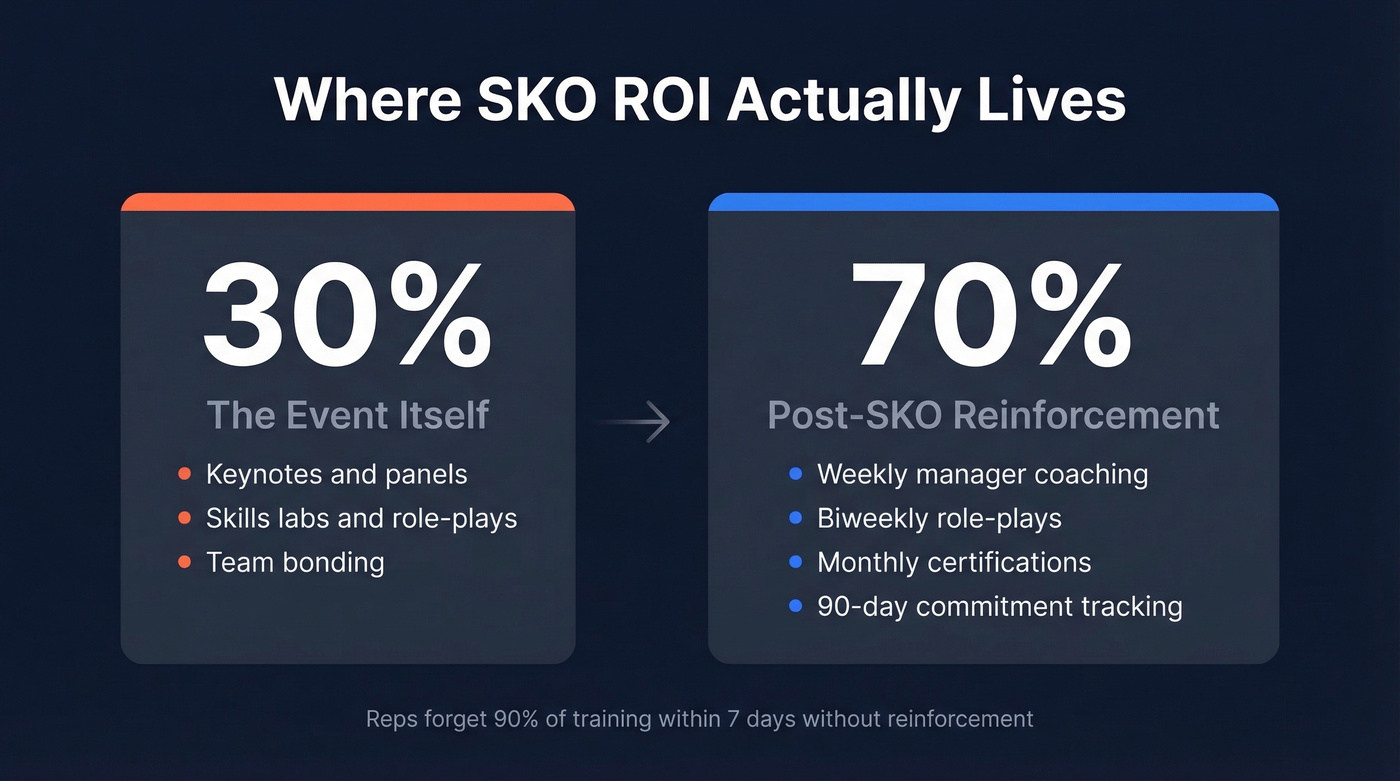
Here's the uncomfortable truth: reps forget roughly 90% of what they learned within seven days. That stat - rooted in the Ebbinghaus forgetting curve and echoed by SBI - should haunt every enablement leader who treats the kickoff as a two-day party with a strategy veneer. The event itself isn't the product. The behavior change afterward is. And that only happens if your agenda is engineered for retention, not just attendance.
What You Need (Quick Version)
Stop planning a two-day event. Plan a 90-day performance sprint that starts with one.
Below you'll find copy-paste 2-day and 3-day timed agendas, a budget calculator, and a 30/60/90-day reinforcement calendar. The reinforcement plan is where the ROI lives.
A great SKO agenda needs six things:
- Clear objectives tied to revenue outcomes, not vague "alignment"
- A timed agenda with no session over 60 minutes without a format change
- Pre-work assignments that prime reps before they arrive
- Interactive sessions that outnumber keynotes 3:1
- A realistic budget with a 10% contingency buffer
- A 30/60/90-day reinforcement plan built before the event, not after
The event is 30% of the value. Reinforcement is 70%. Build your 2026 SKO agenda backward from that ratio.
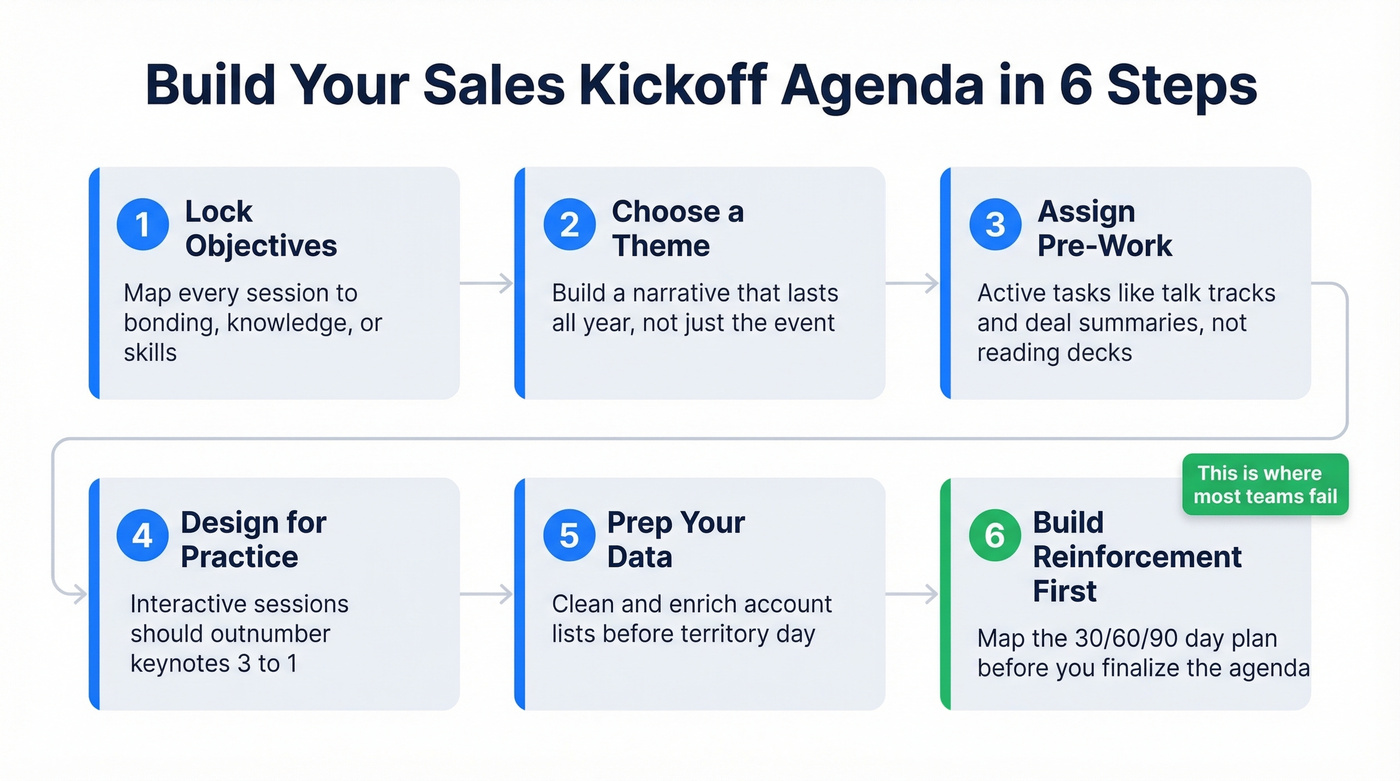
Build Your SKO Agenda in 6 Steps
Lock Objectives to Three Buckets
ZoomInfo's planning framework organizes SKO objectives into three buckets: bonding and morale, product and market knowledge, and selling skills. Every session should map to one. If it doesn't fit a bucket, it doesn't belong.
This kills the "everyone wants 30 minutes on stage" problem fast.
Choose a Theme That Outlives the Event
A good SKO theme isn't a motivational poster - it's a strategic narrative that carries through dashboards, recognition programs, and Slack channels for the rest of the year. The BuCom framework breaks themes into message, design, and moments. Research on goal visualization shows teams are 1.2-1.4x more likely to hit targets when goals are vividly described and reinforced over time. If your theme dies the Monday after SKO, it was decoration.
Assign Pre-Work (Not Pre-Reading)
Nobody reads the pre-read deck. Let's be honest about that.
We've found that pre-work completion rates jump when you assign active tasks instead of reading. Have reps draft talk tracks, summarize their top three deals, or identify one competitive loss they want to dissect. This primes the room for real conversation instead of cold-start presentations where half the audience is checking email.
Design Sessions Around Practice
Highspot's 2026 SKO guidance emphasizes short content delivery followed by deal strategy labs using real account data, role-plays with AI-generated objections, and peer teach-backs. If reps aren't doing something with their hands or voices, the session is a keynote in disguise. The best sales kickoff meeting ideas center on active participation, not passive listening.
Prep Your Data Before Territory Day
Territory planning is the most strategic session on your agenda - and the most frequently derailed by bad data. If reps spend the first 45 minutes flagging stale contacts and dead accounts, you've turned strategy into data cleanup.
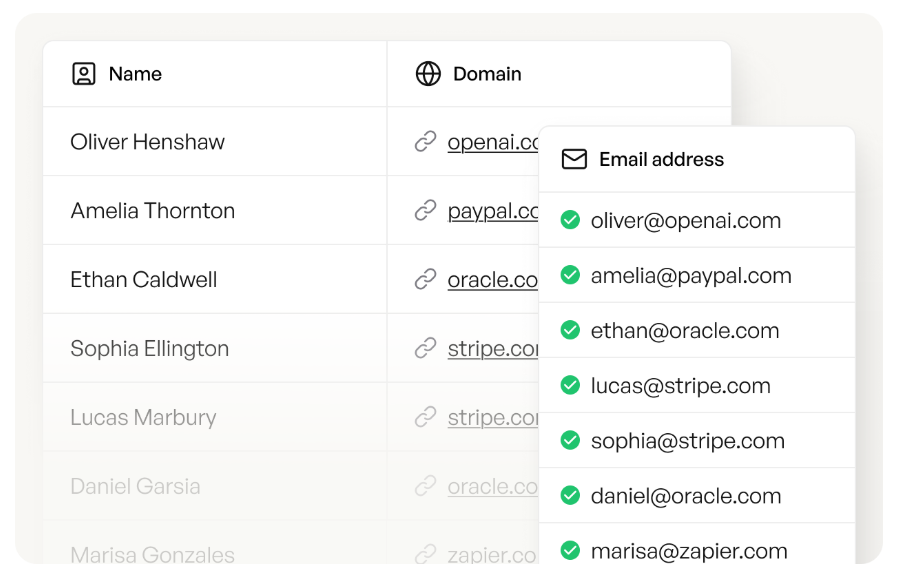
Run your account lists through Prospeo before SKO. With a 7-day data refresh cycle and 98% email accuracy, you'll hand reps verified contacts and enriched company data in Salesforce or HubSpot. The conversation stays on who to target and how to multi-thread - not "is this person still at the company?"
Build Reinforcement Before the Event
This is the step everyone skips and the one that determines whether your SKO changes behavior. Before you finalize the agenda, map out the 30/60/90-day cadence: weekly manager coaching, biweekly role-plays, monthly certifications. The post-SKO energy window is brief. After that, pipeline pressure takes over and SKO becomes a memory.
Sample 2-Day Sales Kickoff Agenda
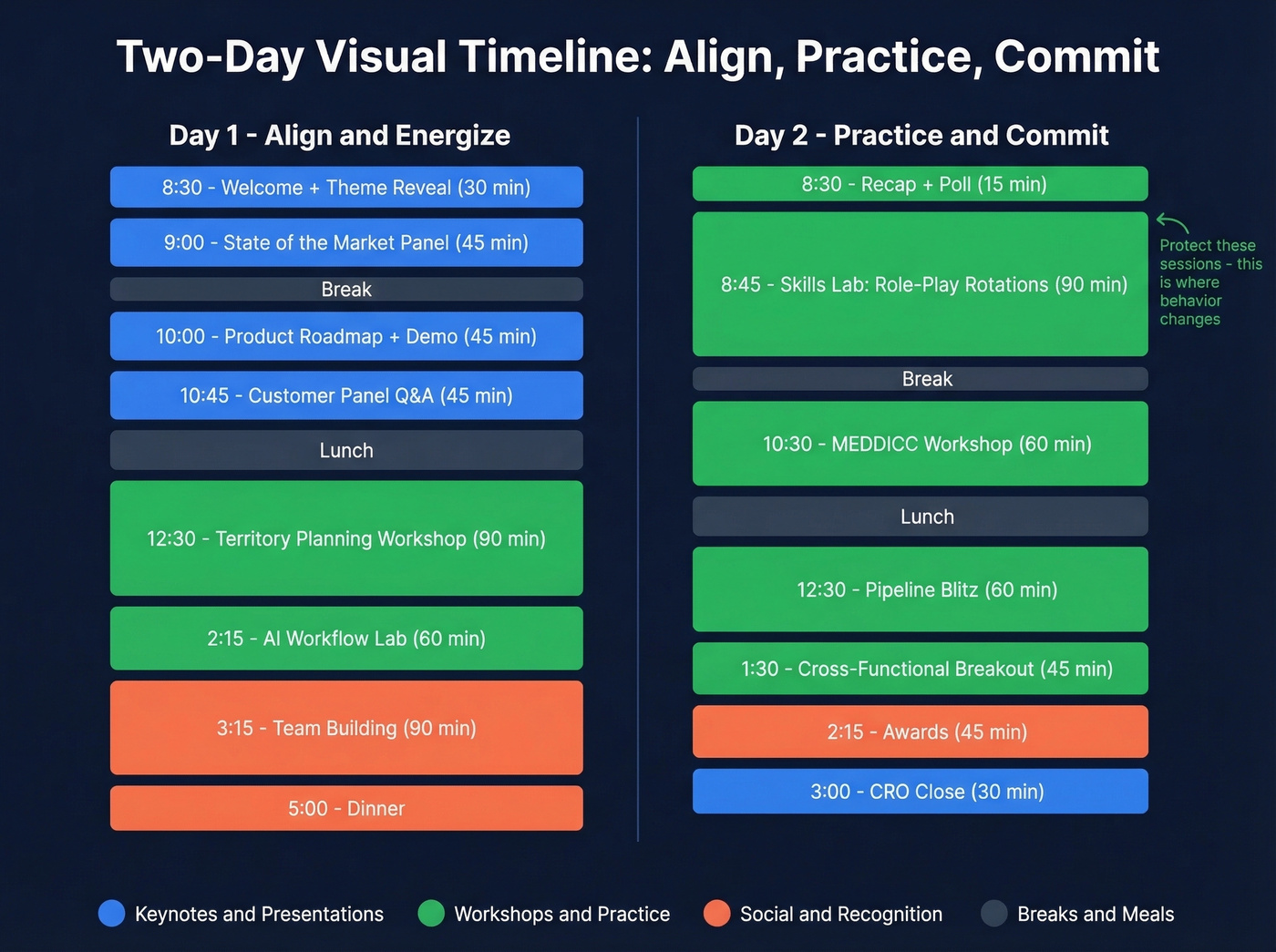
This template works well for teams under 200 people. The key constraint: no session runs longer than 60 minutes without a format change. Adjust times to your time zone, but protect the session lengths.
Day 1: Align and Energize
| Time | Session | Format | Duration |
|---|---|---|---|
| 8:30 | Welcome + theme reveal | Exec keynote | 30 min |
| 9:00 | State of the market | Panel (CRO + VP Sales + Product) | 45 min |
| 9:45 | Break | - | 15 min |
| 10:00 | Product roadmap + competitive intel | Presentation + live demo | 45 min |
| 10:45 | Customer panel | Moderated Q&A | 45 min |
| 11:30 | Lunch | - | 60 min |
| 12:30 | Territory planning workshop | Small-group working session | 90 min |
| 2:00 | Break | - | 15 min |
| 2:15 | AI workflow lab | Hands-on practice | 60 min |
| 3:15 | Team-building activity | Offsite or in-room | 90 min |
| 5:00 | Day 1 wrap + dinner | Social | - |
Day 2: Practice and Commit
| Time | Session | Format | Duration |
|---|---|---|---|
| 8:30 | Day 1 recap + energy check | Interactive poll | 15 min |
| 8:45 | Skills lab: discovery + objection handling | Role-play rotations | 90 min |
| 10:15 | Break | - | 15 min |
| 10:30 | MEDDICC deep dive | Workshop with deal reviews | 60 min |
| 11:30 | Lunch | - | 60 min |
| 12:30 | Pipeline blitz: Q1 action planning | Manager-led small groups | 60 min |
| 1:30 | Cross-functional breakout (CS + Marketing) | Collaborative session | 45 min |
| 2:15 | Awards + recognition | Ceremony | 45 min |
| 3:00 | CRO close: 90-day commitments | Keynote + pledge cards | 30 min |
| 3:30 | End | - | - |
Leadership vision is capped at 30 minutes on Day 1. We've seen too many SKOs where the CEO takes 90 minutes and the skills labs get compressed into a rushed afterthought. Protect the practice sessions - they're where behavior change happens.
Sample 3-Day SKO Template
Three-day agendas make sense for enterprise orgs with 200+ attendees or teams that need role-specific breakouts. The extra day buys you depth, not more keynotes.
Day 1 follows the same structure as the 2-day template above.
Day 2: Role-Specific Depth
| Time | Session | Format | Duration |
|---|---|---|---|
| 8:30 | Breakout: AE advanced selling | Workshop | 90 min |
| 8:30 | Breakout: SDR prospecting lab | Hands-on practice | 90 min |
| 8:30 | Breakout: Manager coaching clinic | Peer learning | 90 min |
| 10:00 | Break | - | 15 min |
| 10:15 | Extended skills practice | Role-play rotations | 90 min |
| 11:45 | Lunch | - | 60 min |
| 12:45 | Customer panel (expanded) | Moderated Q&A | 60 min |
| 1:45 | AI workflow lab | Hands-on practice | 75 min |
| 3:00 | Team activity | Offsite | 150 min |
Day 3: Commit and Launch
| Time | Session | Format | Duration |
|---|---|---|---|
| 8:30 | Cross-functional alignment | Marketing + CS + Product | 60 min |
| 9:30 | Pipeline blitz: Q1 action planning | Manager-led groups | 90 min |
| 11:00 | Break | - | 15 min |
| 11:15 | Awards + recognition | Ceremony | 45 min |
| 12:00 | Lunch | - | 60 min |
| 1:00 | 90-day commitment workshop | Individual + manager pairs | 60 min |
| 2:00 | CRO close | Keynote | 30 min |
| 2:30 | End | - | - |
Reps should leave Day 3 with a written 90-day plan and a clean account list, not another slide deck.

Territory planning is the highest-stakes session on your SKO agenda. Don't waste it on stale data. Prospeo enriches your account lists with 98% accurate emails and 50+ data points per contact - refreshed every 7 days, not 6 weeks.
Hand reps clean territory data before Day 1. Start free.
Virtual and Hybrid SKO Playbook
Virtual SKOs can cut major line items like travel and lodging. But they fail when you try to replicate a two-day in-person agenda over Zoom.
The rules are different. Highspot recommends keeping virtual sessions under 20 minutes. Spread the SKO across 2-3 half-days. Record everything so reps can revisit the material during the reinforcement cycle.
Here's a take that'll get pushback from your events team: if your average deal size is under $25K and your team is distributed, skip the in-person SKO entirely. A well-run virtual kickoff with a strong reinforcement plan will outperform a $400K boondoggle where reps bond over drinks but forget the strategy by February. The money you save is better spent on quarterly in-person coaching days.
For hybrid events, treat the virtual audience as the primary audience. They're the ones most likely to disengage, and if you design for them, the in-person experience only gets better.
SKO Budget Planning
SBI's benchmarks put the average SKO cost at $2,500-$5,500 per attendee. For 100 people, that's roughly $300K-$700K. Shift90 documented a £500,000 all-in cost for flying 200 people to Barcelona - and framed it as just 0.4% of £150M ARR. Whether that feels reasonable depends on your stage and your CFO's temperament.
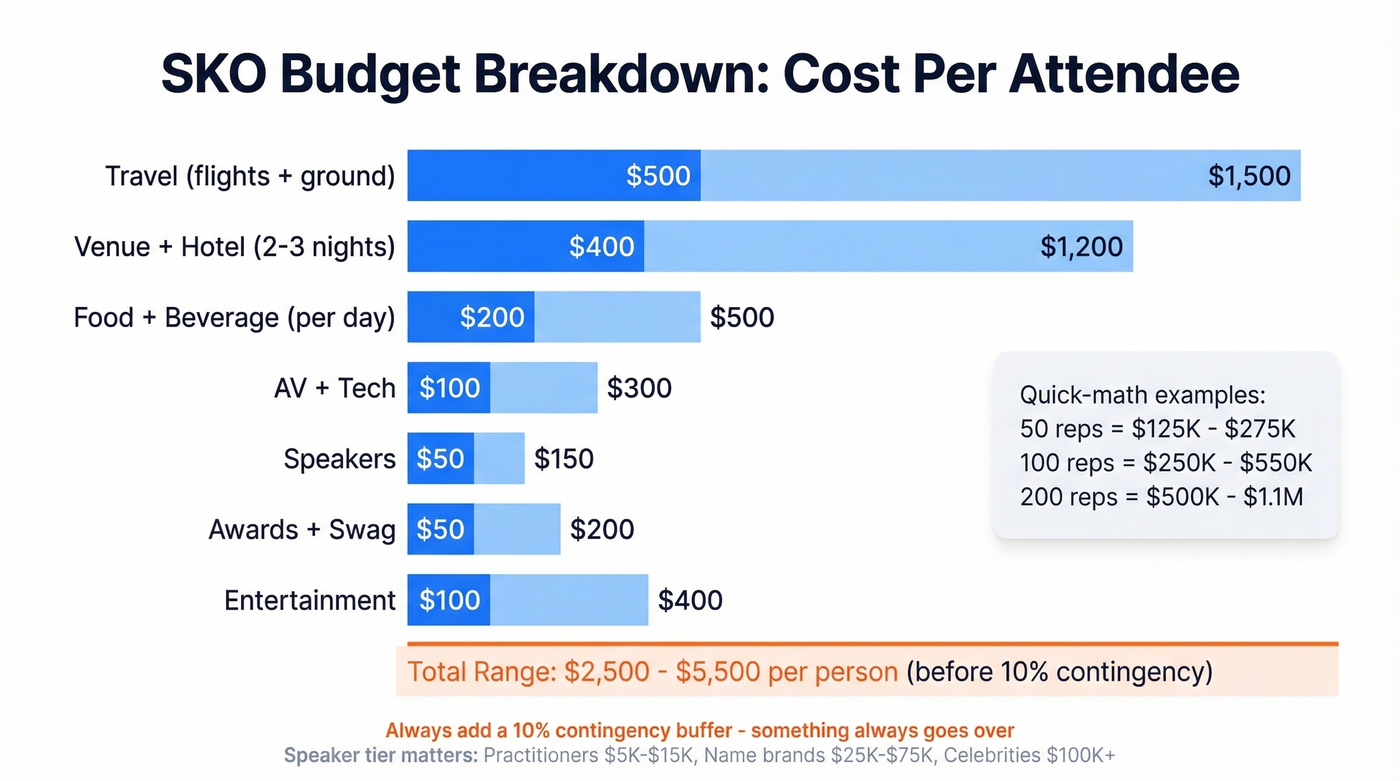
Build a 10% contingency buffer into every line item. Something always goes over.
| Category | Per-Attendee Range | Notes |
|---|---|---|
| Travel (flights + ground) | $500-$1,500 | Domestic vs international |
| Venue + hotel | $400-$1,200 | 2-3 nights |
| Food + beverage | $200-$500 | Per day, all meals |
| AV + tech | $100-$300 | Sound, screens, Wi-Fi |
| Speakers | $50-$150 | Amortized across attendees |
| Awards + swag | $50-$200 | Trophies, gifts, merch |
| Entertainment | $100-$400 | Team activity, dinner event |
| Total range | $2,500-$5,500 | Before contingency |
Speaker fees deserve their own note. Practitioner speakers run $5K-$15K. Name-brand speakers with books and TED talks cost $25K-$75K. Celebrities start at $100K+. Unless your CEO insists, the practitioner tier delivers more actionable value per dollar.
7 SKO Mistakes That Kill Momentum
1. Unclear objectives. Without the three-bucket framework, every department demands agenda time and the event becomes a two-day all-hands meeting.
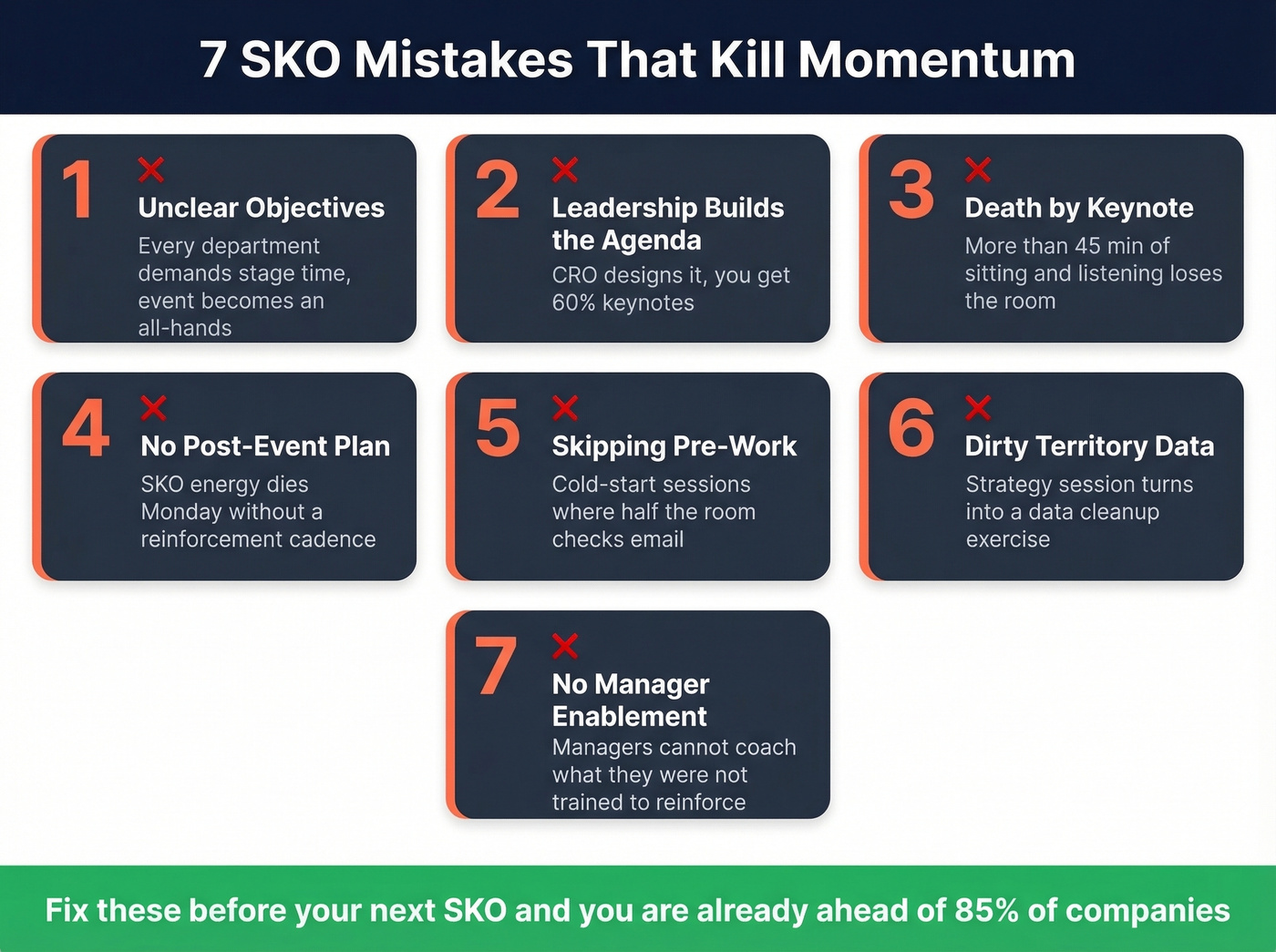
2. Letting leadership build the agenda. Build a skeleton first, then let execs react. If the CRO designs the agenda, it'll be 60% keynotes.
3. Death by keynote. If reps are sitting and listening for more than 45 minutes straight, you've lost them. Replace presentations with workshops wherever you can.
4. No post-event plan. The 90% forgetting curve is real. If your reinforcement plan is "managers will follow up," nothing will happen.
5. Ignoring role differences. SDRs and enterprise AEs have different skill gaps. Generic sessions waste half the room's time.
6. Misdiagnosing skill gaps. As Presicci's research highlights, teams sometimes build an entire SKO around competitive positioning when the real gap is persona pivoting or discovery depth. Diagnose before you design.
7. Dirty data in territory planning. Ask any AE what derails territory planning and you'll hear the same answer: stale contacts, wrong titles, dead accounts. Verify and enrich your CRM data before the event - not during it.

30/60/90-Day Post-SKO Reinforcement
This plan turns a two-day event into a quarter of behavior change. Build it before SKO and assign owners to every row.
| Timeframe | Activity | Owner | Cadence |
|---|---|---|---|
| Week 1 | Reps launch outreach with clean account lists. Manager 1:1s review commitments. | Managers + RevOps | Daily outreach, 1x coaching |
| Week 2 | First role-play on new talk tracks. Theme reinforcement in Slack. | Enablement | 1x role-play |
| 30 days | Certification checkpoint on core skills. Track leading indicators: CRM adoption, coaching completion. | Enablement + RevOps | Biweekly role-plays, monthly cert |
| 60 days | Second certification. Track lagging indicators: deal size, velocity. Mid-year theme refresh. | Enablement + Sales Ops | Biweekly role-plays |
| 90 days | Final assessment. Measure quota attainment lift, pipeline generation, rep retention vs baseline. | CRO + RevOps | Monthly review |
The leading indicators at 30 days tell you whether the training stuck. The lagging indicators at 60-90 days tell you whether it moved revenue. Track both and share results with the team - when reps see the connection between SKO skills and pipeline outcomes, the reinforcement sells itself.
Your Q1 pipeline blitz falls flat when reps leave SKO with outdated contacts. Prospeo's CRM enrichment pushes verified emails and direct dials into Salesforce or HubSpot automatically - 92% match rate, $0.01 per email, no contracts.
Reps should leave SKO ready to sell, not ready to Google prospects.
FAQ
When should you start planning your SKO?
Eight to twelve weeks before the event. Lock objectives and theme first, then build the timed agenda. Venue and travel logistics need at least 6 weeks of lead time for groups over 50.
How long should a sales kickoff be?
Two days for most teams under 200 people. Three days for enterprise orgs needing role-specific breakouts. Virtual SKOs should run 2-3 half-days with sessions capped at 20 minutes.
How do you make an SKO stick after the event?
Build a 30/60/90-day reinforcement plan with weekly coaching, biweekly role-plays, and monthly certifications. Track CRM adoption at 30 days and deal velocity at 60-90 days. Without this cadence, 90% of content is forgotten within a week.
What's the biggest SKO planning mistake?
Treating it as a standalone event instead of the launch of a 90-day performance sprint. The agenda matters, but the reinforcement plan determines whether anything changes. Teams that skip post-event follow-through waste 70% of their SKO investment.
How do you keep territory planning from derailing the agenda?
Enrich and verify your CRM data before the event. When reps walk into territory sessions with validated contacts and fresh account data, the conversation stays on strategy - targeting, sequencing, multi-threading - instead of data cleanup.