

Sales Lead: What It Is & How to Convert One in 2026
Your marketing team just handed sales 500 "leads" from last week's webinar. Your reps called 200. Twelve picked up. Three were remotely qualified.
That's not a lead generation problem - it's a lead quality problem. And it's costing you pipeline every single week. 80% of new leads never convert into sales, so the fix isn't more volume - it's better qualification, faster follow-up, and cleaner data. Below you'll find the qualification frameworks (BANT, CHAMP, MEDDIC), a copy-paste scoring model, industry benchmarks by funnel stage, and the tool stack to make it all work.
What Is a Sales Lead?
A sales lead is any person or organization that has shown interest in what you sell - or fits your ideal customer profile closely enough to warrant outreach. No mystical definition required. Someone worth talking to because they either raised their hand or match the profile of someone who would.
The lead generation software market sits at $7.4B and is projected to hit $16.2B by 2034. Companies are spending more than ever to find and capture leads, yet 80% of those leads never turn into revenue.
Not all leads are created equal:
- Cold leads have no prior interaction with your brand. You found them; they didn't find you.
- Warm leads have engaged - visited your site, downloaded a resource, responded to an email.
- Hot leads have expressed direct buying intent: requested a demo, asked for pricing, or started a trial.
B2B and B2C leads behave differently. B2B leads typically involves seven stakeholders (seven on average), and higher contract values. B2C leads convert faster, often through a single buyer making an impulse or need-based decision. This guide focuses on B2B, where qualification frameworks and lead scoring actually matter.
The inbound vs. outbound distinction matters too. Inbound leads come to you through content, SEO, and social - your lead magnets and landing pages doing the work. Outbound leads are ones you go after through cold email, calls, and events. Content marketing generates 3x more leads at 62% lower cost than outbound, but outbound gives you control over who enters your pipeline. Most healthy B2B pipelines run both.
Lead vs. Prospect vs. Opportunity
These three terms get used interchangeably in most sales orgs, and it creates real pipeline confusion. Here's how to think about them:
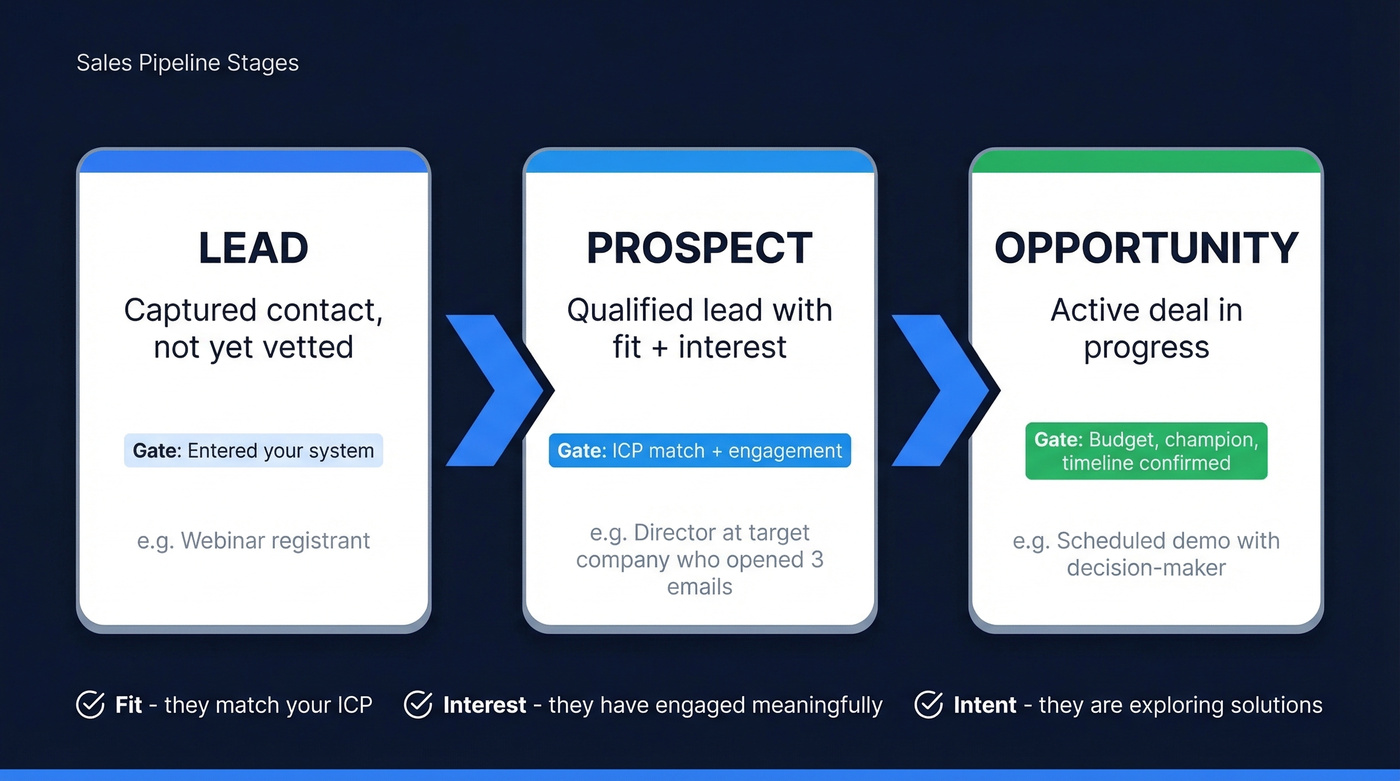
| Stage | Definition | Gate Criteria | Example |
|---|---|---|---|
| Lead | Captured contact, not yet vetted | Entered your system | Webinar registrant |
| Prospect | Qualified lead with fit + interest | ICP match + engagement | Director at target company who opened 3 emails |
| Opportunity | Active deal in progress | Budget, champion, timeline confirmed | Scheduled demo with decision-maker |
A lead becomes a prospect when you've confirmed three things: fit (they match your buyer persona and ICP), interest (they've engaged meaningfully), and intent (they're exploring solutions). Without all three, you're guessing.
The opportunity litmus test is stricter: the problem is confirmed, a champion is identified, budget and timeline are known, and a next step is scheduled. If any of those are missing, it's still a prospect - not a deal. Best-in-class companies close just 30% of their sales qualified leads. Seven out of ten "good" opportunities don't close. Loose definitions make that number much worse.
How to Generate Leads for Your Pipeline
B2B buyers now use 10 channels on average before making a purchase - up from 5 in 2016. Omnichannel engagement rates run 18.96% compared to 5.4% for single-channel outreach. You can't rely on one source.
Inbound channels pull leads toward you:
- Content marketing and SEO - blog posts, guides, tools, and gated resources that rank and convert. Highest-ROI channel for most B2B companies over a 12-month horizon.
- Social media - organic thought leadership builds trust; paid social targets specific job titles and companies.
- Webinars and virtual events - high-intent registrants who give you 30-60 minutes of attention are worth more than a thousand page views.
Outbound channels let you control who enters your pipeline:
- Cold email - still the workhorse of B2B outbound. The key is verified data and personalization, not volume.
- Cold calling - less scalable, but direct dials to decision-makers convert at rates email can't touch.
- Events and conferences - expensive per lead, but the quality is often unmatched.
- Referrals - the highest-converting channel in almost every study. Most teams underinvest here.
We've seen teams triple their outbound volume and watch reply rates drop because they're spraying instead of targeting. More unqualified contacts your team doesn't need is just more noise. The constraint isn't reach - it's relevance.
How to Qualify Sales Leads
Qualification is where pipeline gets real. An average B2B purchase involves seven stakeholders, and deals without a decision-maker identified are 80% less likely to close. You need a framework, not gut instinct.
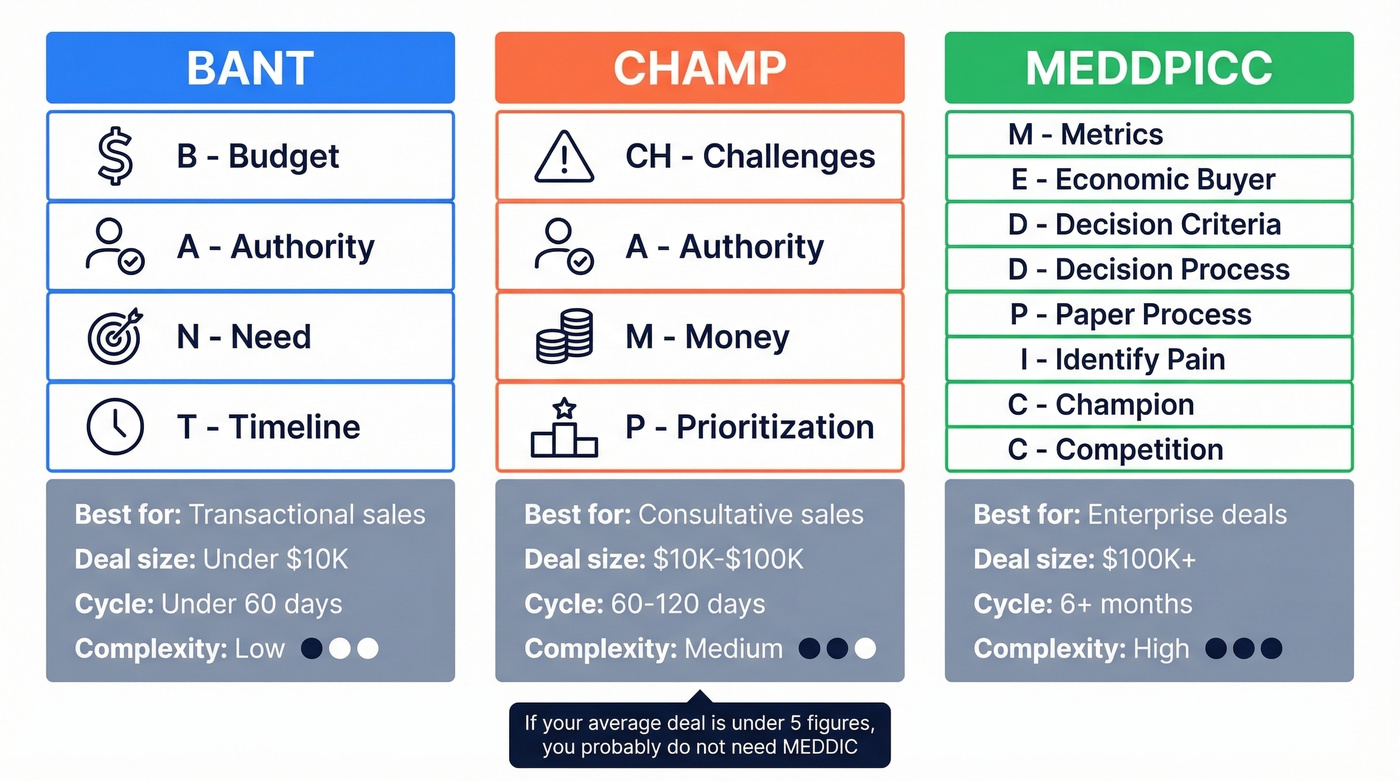
BANT Framework
IBM developed BANT in the 1950s - Budget, Authority, Need, Timeline - and it's still the most widely used qualification framework for a reason: it's simple and fast. A lead is typically considered qualified when it meets at least 3 of 4 criteria, and companies that implement BANT effectively see conversion rates increase by up to 59%.
One practical insight: reps who bring up pricing on the first call close 10% more deals. BANT encourages that directness. Discovery questions that work:
- Budget: "What have you allocated for solving this problem this quarter?"
- Authority: "Who else needs to sign off before a decision is made?"
- Need: "What happens if you don't solve this in the next 90 days?"
- Timeline: "When are you looking to have a solution in place?"
BANT works best for transactional cycles - deals under five figures with shorter timelines and fewer stakeholders.
CHAMP Framework
CHAMP reorders BANT to lead with the buyer's pain: Challenges, Authority, Money, Prioritization. The logic is that budget conversations are premature if you haven't established that the prospect has a problem worth solving.
This framework fits consultative, relationship-driven sales where you're educating the buyer as much as qualifying them. If your reps spend more time diagnosing than pitching, CHAMP is the better fit. 66% of prospects expect companies to understand their specific needs, and CHAMP's challenge-first approach delivers on that.
MEDDIC / MEDDPICC
MEDDIC was developed at PTC in the 1990s by Jack Napoli and Richard Dunkel. After implementing it, PTC's revenue grew from roughly $195M to around $650M in four years. That kind of result gets a framework adopted industry-wide.
MEDDIC stands for Metrics, Economic Buyer, Decision Criteria, Decision Process, Identify Pain, and Champion. MEDDPICC adds Paper Process (procurement and legal complexity) and Competition (who else is in the deal). This is the gold standard for enterprise deals with 7+ stakeholders, long sales cycles, and six-figure-plus contract values.
| Framework | Best For | Complexity | When to Use |
|---|---|---|---|
| BANT | Transactional sales | Low | Sub-$10K deals, <60 days |
| CHAMP | Consultative sales | Medium | Relationship-driven cycles |
| MEDDIC | Enterprise deals | High | 7+ stakeholders, $100K+ |
Let's be honest: if your average deal size is under five figures, you don't need MEDDIC. BANT or CHAMP will get you 90% of the way there without the training overhead. Save MEDDIC for when a lost deal actually hurts.

You just read that 80% of new leads never convert - and bad data is the #1 reason. Prospeo gives you 300M+ profiles with 98% email accuracy and 125M+ verified mobiles, so every lead your reps touch is real, reachable, and worth qualifying.
Stop qualifying ghosts. Start with data that actually connects.
How to Score Leads Effectively
Most lead scoring is theater. If your model doesn't include negative signals, you're just assigning gold stars to everyone who opens an email. We've watched teams with inflated pipelines burn weeks chasing leads that were never real - all because their scoring model only went up, never down.
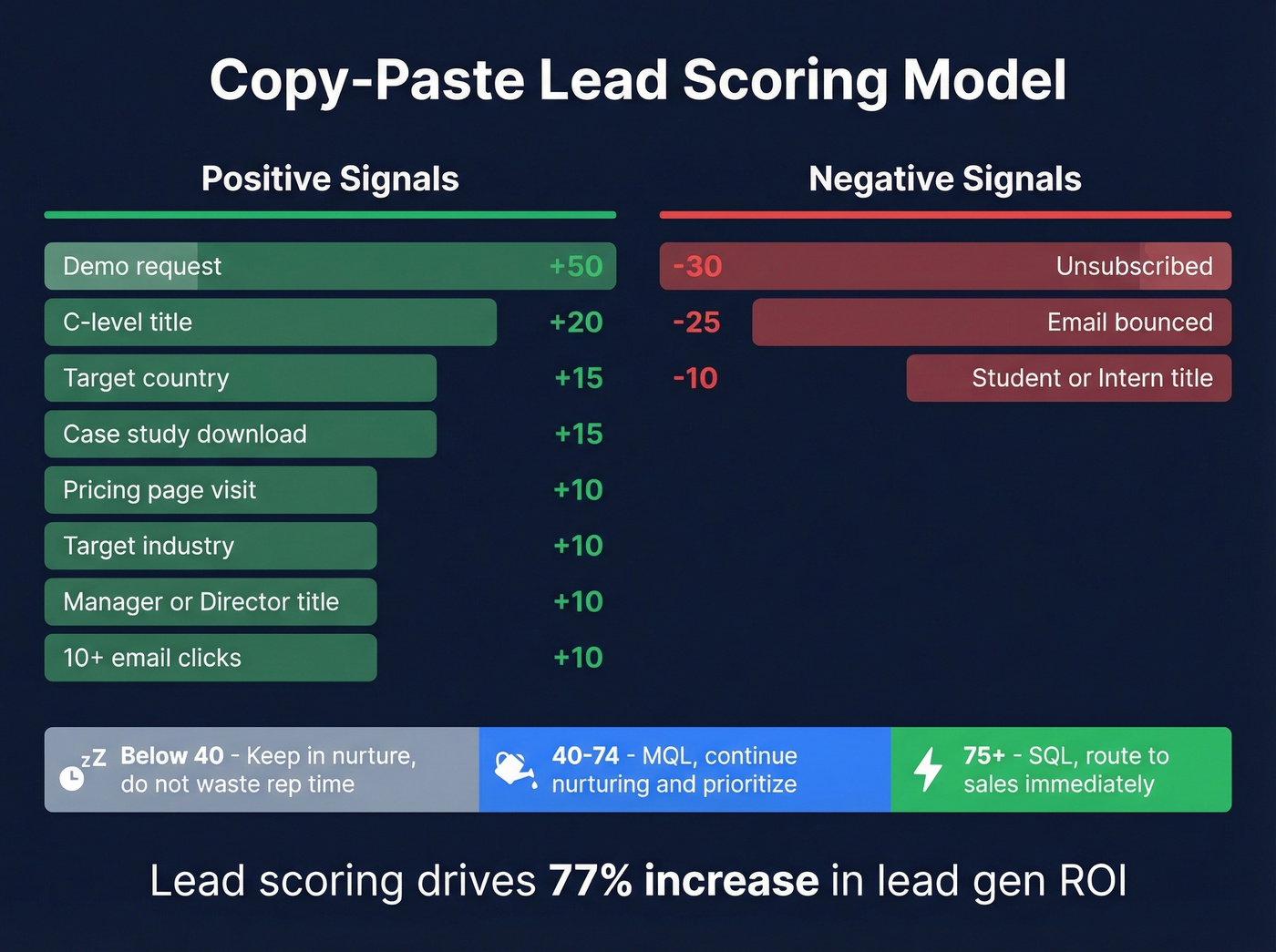
A real scoring model operates across four dimensions: engagement behavior, demographic fit, firmographic match, and negative signals. Here's a rubric you can copy into HubSpot or Salesforce today:
| Action / Attribute | Points |
|---|---|
| Demo request | +50 |
| Case study download | +15 |
| Pricing page visit | +10 |
| 10+ email clicks | +10 |
| C-level title | +20 |
| Manager / Director | +10 |
| Target country | +15 |
| Target industry | +10 |
| Email bounced | -25 |
| Student / Intern | -10 |
| Unsubscribed | -30 |
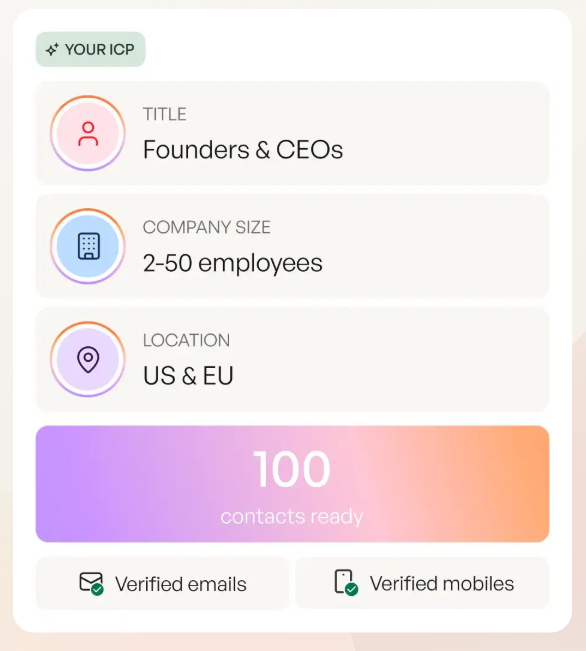
Set threshold bands that trigger different actions:
- 75+ points = SQL - route to sales immediately
- 40-74 points = MQL - continue nurturing, prioritize for outreach
- Below 40 = Not ready - keep in automated nurture, don't waste rep time
Formal lead scoring drives a 77% increase in lead gen ROI. Behavioral scoring specifically boosts conversion rates by up to 40%. Those aren't marginal improvements - they're the difference between a pipeline that converts and one that just looks full.
Treat scoring as a feedback loop. When high-scoring leads don't convert, adjust the model. When low-scoring leads close, figure out what signal you missed. Static scoring models decay fast.
Conversion Benchmarks by Industry
Benchmarks give you a baseline. Without them, you're optimizing blind.
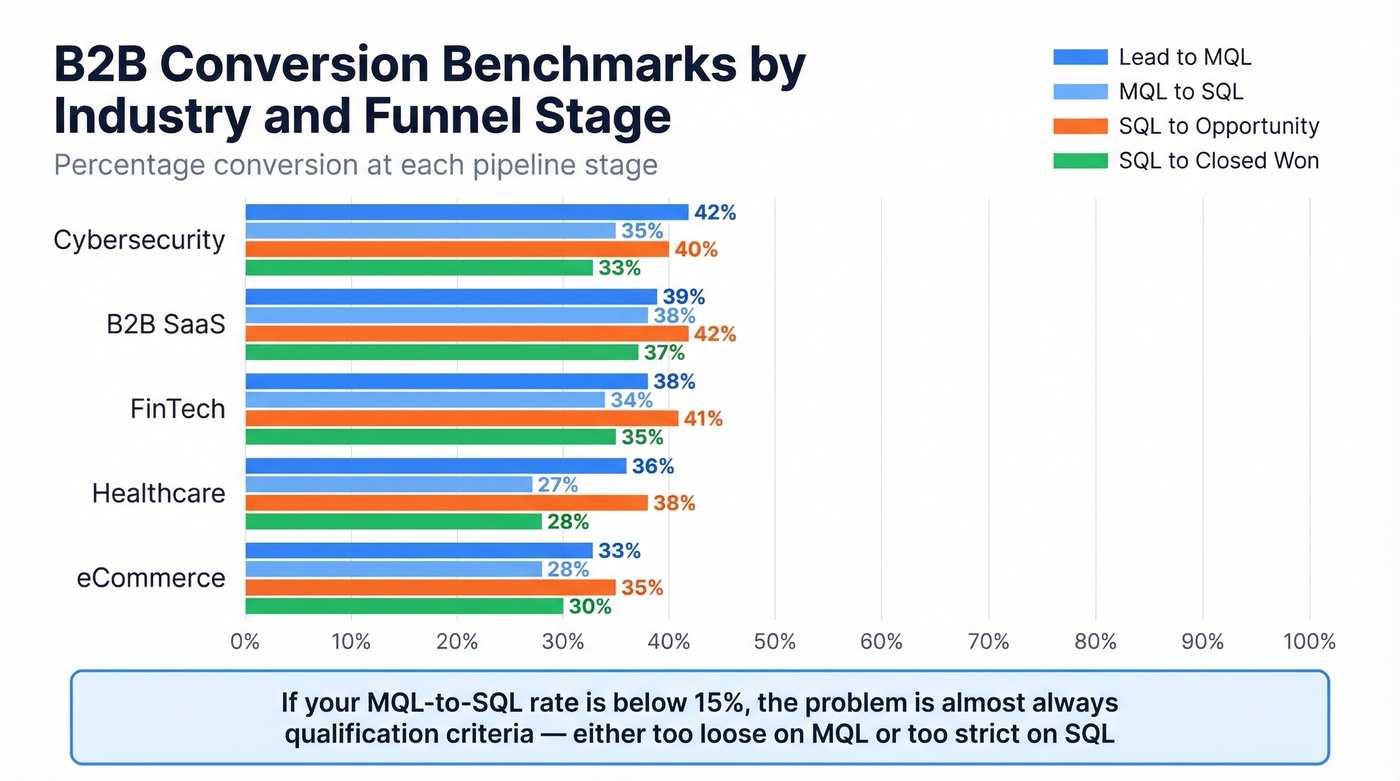
| Industry | Lead-to-MQL | MQL-to-SQL | SQL-to-Opp | SQL-to-Closed |
|---|---|---|---|---|
| B2B SaaS | 39% | 38% | 42% | 37% |
| eCommerce | 33% | 28% | 35% | 30% |
| Cybersecurity | 42% | 35% | 40% | 33% |
| Healthcare | 36% | 27% | 38% | 28% |
| FinTech | 38% | 34% | 41% | 35% |
Across sectors, MQL-to-SQL averages range 12-21%, with top performers hitting 40%. If your MQL-to-SQL rate is below 15%, the problem is almost always qualification criteria - either too loose on the MQL side or too strict on the SQL side.
These benchmarks are directional, not gospel. Your specific numbers depend on deal size, sales cycle length, and how strictly you define each stage. But if you're closing 10% of SQLs and the benchmark says 30%, that's a signal worth investigating.
How to Nurture Leads Into Deals
Picture this: a VP of Sales downloads your ROI calculator at 2:14 PM. Your automated "thanks for downloading" email fires at 8:00 PM. By then, she's already booked a demo with your competitor who called her at 2:19 PM.
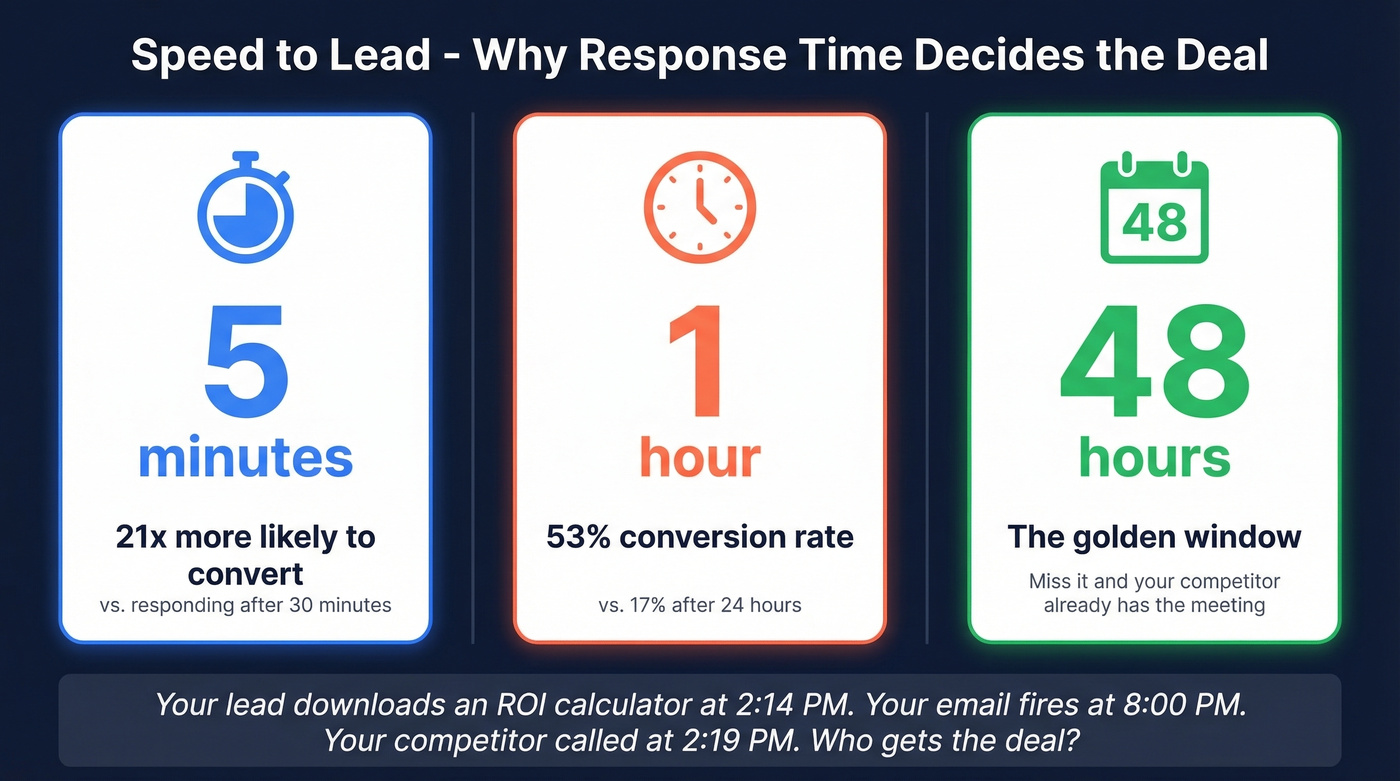
Speed kills - in a good way. Contacting a lead within 5 minutes makes them 21x more likely to convert. Following up within the first hour yields a 53% conversion rate vs. 17% after 24 hours. The first 48 hours after a new lead enters your system is the golden window. Miss it, and you're nurturing someone who's already talking to your competitor.
Bad data - bounced emails, wrong titles, disconnected numbers - kills nurturing before it starts. The playbook below only works if your contact data is accurate.
- Respond within 5 minutes. Automate the first touch if you have to. A personalized email or call within minutes dramatically outperforms a delayed drip sequence.
- Follow the 3:1 give-to-get ratio. Deliver value three times before you ask for anything. Share a relevant case study, a benchmark, a tool recommendation - then ask for the meeting.
- Run multi-channel surround sound. Email alone isn't enough. Layer in retargeting ads, SMS with consent, and social touches. Segmented multi-channel campaigns drive a 760% increase in revenue compared to non-segmented blasts.
- Segment by behavior, not just demographics. A VP who visited your pricing page twice needs a different sequence than a VP who downloaded a top-of-funnel guide. Dynamic branching by entry point and engagement level is table stakes.
Nurtured leads produce 47% higher order values and generate 50% more sales-ready leads at 33% lower cost. The math is simple: nurturing well costs less than generating new leads from scratch.
Sales Lead Management Tools
You don't need 15 tools. Start with three things: a CRM, a data enrichment tool, and an outreach platform. Everything else is optimization.
CRM
HubSpot's free tier is enough to start. It handles contact management, deal tracking, and basic automation without costing a dollar. When you outgrow it, paid plans run from $15/user/month to $150/user/month.
Salesforce Sales Cloud is the enterprise standard - $25/user/month for Starter up to $350/user/month for Unlimited. Move to Salesforce when you need deep customization, complex reporting, or you're managing 50+ reps. Before that, it's overkill.
Data Enrichment and Verification
Here's a scenario we hear constantly: an SDR buys 2,000 contacts from a list broker, half the emails bounce, and the sending domain's reputation tanks overnight. One team we spoke with saw bounce rates drop from 35% to under 4% after switching data providers - and their connect rate tripled to 20-25%.
Prospeo covers 300M+ professional profiles with 98% email accuracy, backed by a 5-step verification process with catch-all handling, spam-trap removal, and honeypot filtering. The platform includes 143M+ verified emails and 125M+ verified mobile numbers with a 30% pickup rate across all regions. Data refreshes every 7 days, compared to the 6-week industry average. CRM enrichment returns 50+ data points per contact at a 92% API match rate. Pricing starts free with 75 emails and 100 Chrome extension credits per month, with paid plans running about $0.01 per lead and no contracts.

Skip this if you're running a small pipeline with fewer than 100 outbound emails a month - manual verification with free tools will get you by. But once you're scaling outbound across multiple reps or clients, data quality becomes the bottleneck, not volume.
Outreach Platforms
Smartlead and Instantly handle cold email infrastructure well, with plans from about $30-40/month. Lemlist adds multi-channel sequencing for email, calls, and social touches in one workflow - plans start around $59/user/month for email-only, scaling up for multi-channel. Apollo offers a free tier with a built-in database, and paid plans from $49-99/user/month, which is solid for teams that want prospecting and outreach in one tool.
Automation
Zapier connects everything. Free plan available; paid plans from $19.99/month billed annually. Use it for lead routing - new high-score lead triggers a Slack notification and auto-assigns in your CRM - enrichment triggers, and keeping your stack in sync without custom code.
Improve Lead Quality Without More Spend
65% of marketers say generating traffic and leads is their biggest challenge. But for most teams, the real issue isn't generation - it's quality.
Evaluate every lead across three dimensions:
- Fit - Do they match your ICP? Right industry, company size, job title, geography.
- Intent - Are they actively researching solutions? Visiting pricing pages, downloading comparison guides, attending competitor webinars.
- Readiness - Do they have budget, authority, and a timeline? Can they actually buy in the next 90 days?
Enrichment tools drive a 25% increase in sales productivity and a 15% decrease in sales cycles. That's because reps stop wasting time on leads that were never going to convert.
Contact data degrades 2-3% per month across industries. Biotech companies experience 22% monthly pipeline decay. If you're not actively refreshing your database, one in four records goes stale every quarter. According to Gartner's research on marketing-sourced leads, companies sourcing more than 40% of leads from marketing see higher conversion rates - but only if that data stays accurate. In our testing across dozens of data enrichment tools, accuracy claims rarely hold up under real-world bounce rate analysis. Weekly refresh cycles and multi-step verification are the only reliable safeguards against data decay, and the HubSpot State of Marketing report backs this up with similar findings on data hygiene's impact on conversion rates.
BANT, CHAMP, and MEDDIC only work when your reps reach the right people. Prospeo's 30+ filters - buyer intent, job changes, headcount growth, technographics - let you build lists of leads who already match your ICP before qualification even starts. At $0.01 per email.
Pre-qualify your pipeline at the data layer, not on the phone.
FAQ
What's a sales lead vs. a marketing lead?
A marketing lead (MQL) has engaged with content - downloaded a guide, attended a webinar - but hasn't been vetted by sales. A sales lead (SQL) has been qualified against criteria like budget, authority, and timeline. Most teams draw the line at the scoring threshold: when a lead hits 75+ points in a formal model, it moves from marketing's responsibility to sales.
How many leads does it take to make one sale?
Using B2B SaaS benchmarks: if 39% of leads become MQLs, 38% of MQLs become SQLs, and 37% of SQLs close, you need roughly 18 leads per closed deal. Track your own stage-by-stage conversion rates - the Salesforce State of Sales report is a good starting point for benchmarking.
What's a good lead-to-customer conversion rate?
MQL-to-SQL conversion averages 12-21% across industries, with top performers hitting 40%. Best-in-class companies close about 30% of SQLs. If your rates fall below these ranges, tighten qualification frameworks and lead scoring before generating more volume.
How do you find verified leads online?
Combine inbound channels like SEO, content, and social with outbound prospecting tools. A B2B database with strong verification - look for multi-step processes, not just syntax checks - lets you search by buyer intent, technographics, job changes, and funding signals, then export verified emails and direct dials straight into your CRM.