

Sales Management Strategies That Actually Work in 2026
It's Q2. Your team is at 38% of annual target. Two reps are "working deals" that haven't moved stages in six weeks. Your VP wants a forecast by Friday, and you're not sure whether to sandbag or pray.
The sales management strategies that worked a few years ago aren't broken - they're just insufficient. Your reps are spending 60% of their time on non-selling tasks, and 57% of sales professionals say cycles are getting longer. You don't need more tips. You need an operating system.
The Quick Version
The single most important metric is pipeline velocity. The single most impactful habit is a weekly coaching cadence. And the single most overlooked problem is bad data - if your reps can't reach the right people, nothing else matters. The rest of this article gives you the formulas, cadences, and frameworks to execute all three.
The 2026 Reality Check
The macro environment isn't helping. GDP projections hover around 1.8% for 2026, and only 52% of CEOs believe in their own growth plans. Leaders who nail their GTM strategy are 2x more likely to exceed revenue expectations, which means the gap between disciplined and undisciplined execution is widening fast.
Meanwhile, the tool market is consolidating. Teams that ran 8-12 point solutions are trimming to 4-6 platforms. The era of "buy a tool for every problem" is over. What's replacing it is fewer, better-integrated systems and sharper execution fundamentals.
This matters because the margin for error is thinner than it's been in years. You can't outspend a bad process, and you can't out-hire a broken pipeline. The approaches below are the operating system that separates teams hitting 110% from teams scrambling at 38%.
Nine Strategies That Move Pipeline
1. Build a Repeatable Sales Process
Every stalled deal traces back to the same root cause: unclear exit criteria between pipeline stages. When "Discovery" means something different to each rep, your forecast is fiction.
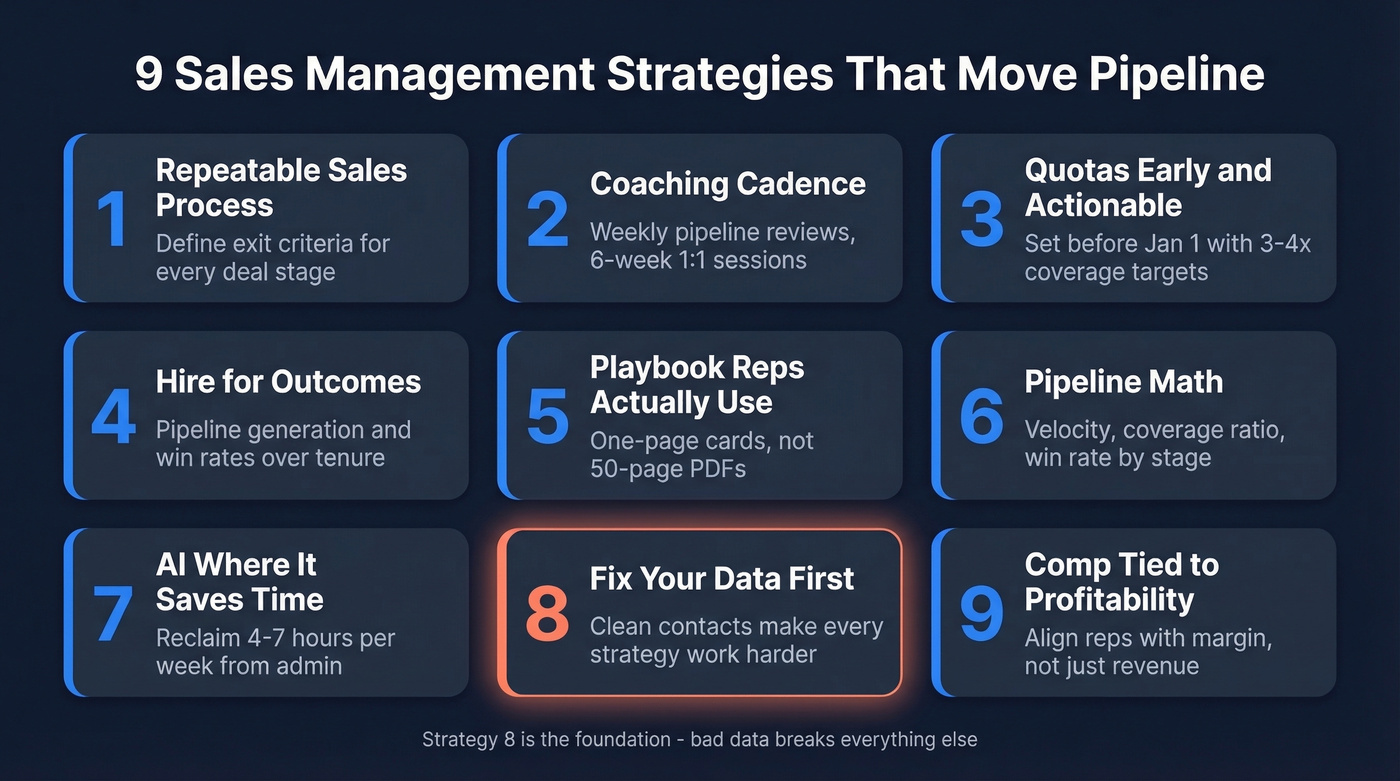
Define what must be true before a deal advances. Who's the economic buyer? Is there a documented pain point? Has budget been confirmed? Teams that implement deal stage exit criteria see a 30% reduction in stalled deals. That's not a marginal improvement - it's the difference between a pipeline that moves and one that rots.
2. Design a Coaching Cadence
Coaching isn't a quarterly event. It's a rhythm.
Here's a cadence we've seen work for mid-sized teams: weekly pipeline reviews, dedicated 1:1 coaching every six weeks, quarterly planning sessions, and biannual performance reviews. 75% of reps say they're more likely to hit targets when they have a coach or mentor. Yet most managers treat coaching as something they'll "get to" after the forecast call. Flip the priority. The forecast improves when the coaching happens, not the other way around.
3. Set Quotas Early and Actionable
Late quota rollouts are a silent killer. When reps don't know their number until February, you've already lost six weeks of strategic planning. Set quotas before the year starts, and back them with pipeline coverage targets of 3-4x the revenue goal.
Use scenario modeling to pressure-test those targets. What happens if win rates drop 5 points? What if average cycle length stretches by two weeks? If your quota only works in the best-case scenario, it's not a plan - it's a wish.
4. Hire for Outcomes, Not Experience
The most expensive mistake in sales team management isn't a bad quarter - it's keeping a non-producer for six months because they "have experience." Tenure doesn't close deals. Pipeline generation and win rates do.
Identify non-producers early and act fast. The longer you wait, the more your top performers notice that mediocrity is tolerated. That's when you lose the people you can't afford to lose.
5. Build a Playbook Reps Actually Use
A 50-page PDF that lives in a SharePoint folder isn't a playbook. It's a graveyard.
Effective playbooks are one-page reference cards built around five components: a discovery question bank by persona, an objection handling flowchart, deal stage checklists with exit criteria, competitive battle cards, and a 30/60/90-day ramp scorecard. Teams that implement persona-specific question banks see a 23% increase in qualified opportunities, and ramp scorecards cut time to first quote by 40%.
The practitioner consensus on r/sales is consistent: SPIN Selling is excellent for question quality, and MEDDICC is elite for qualification rigor. The Challenger Sale gets attention but requires org-wide alignment to implement. For individual managers looking for immediate impact, SPIN and MEDDICC are more actionable.
6. Manage by Pipeline Math, Not Gut Feel
If you only track one number, track pipeline velocity: (Opportunities x Win rate x Average deal size) / Sales cycle length. This single metric tells you whether your team is accelerating or stalling.
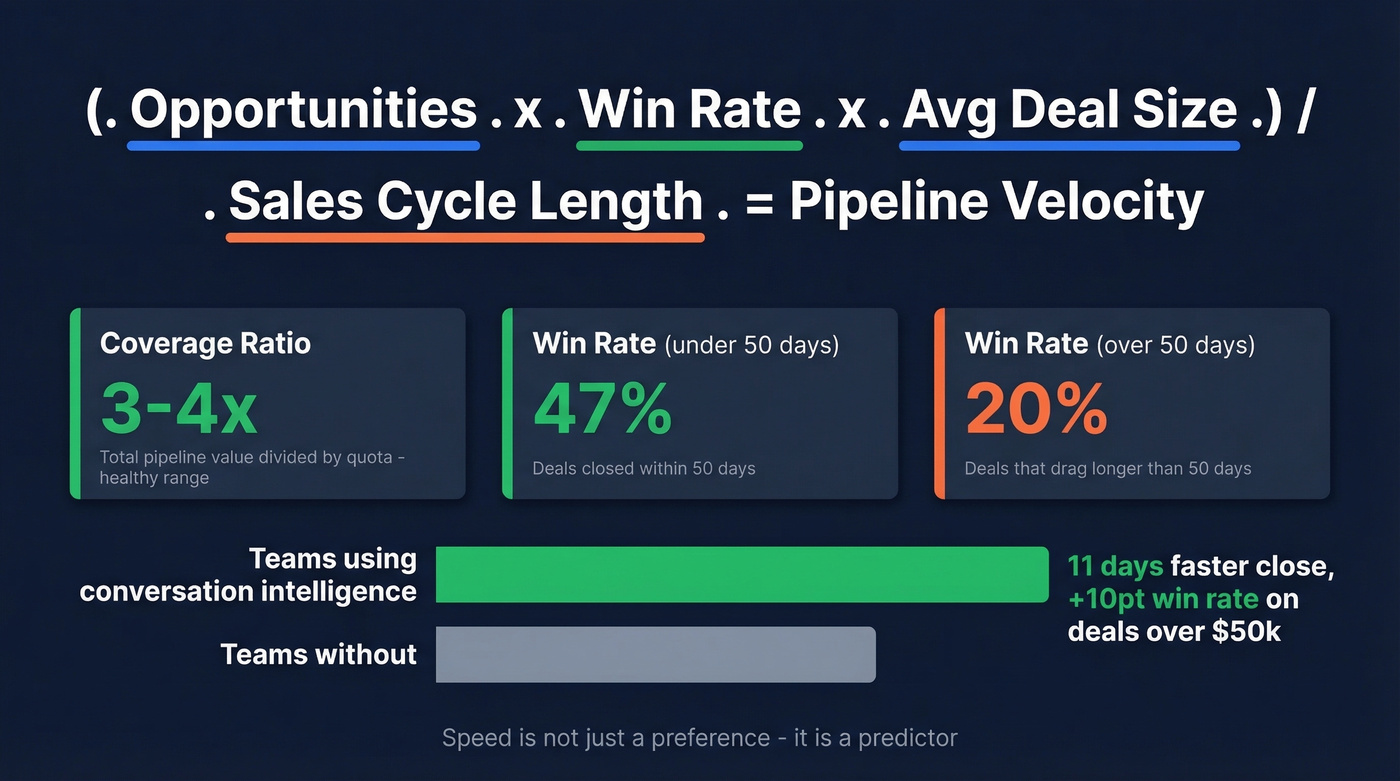
Layer in coverage ratio (total pipeline value divided by quota - healthy is 3-4x) and win rate by stage. Together, these three numbers replace the gut-feel forecasting that burns credibility with your CFO. Deals closed within 50 days show a 47% win rate versus 20% for deals that drag longer. Teams using conversation intelligence close deals 11 days faster on average, with a 10-percentage-point win-rate improvement on deals over $50k. Speed isn't just a preference. It's a predictor.
7. Use AI Where It Actually Saves Time
Sales reps spend 60% of their time on non-selling tasks. That's the real opportunity: reclaim time from admin and reinvest it into pipeline creation, deal strategy, and coaching.
Among teams using AI SDR tools, 40% save 4-7 hours per week. Sellers partnering with AI are 3.7x more likely to meet quota.
Here's the thing: AI replaces admin, not management. It's excellent at drafting emails, summarizing calls, and prioritizing accounts. It's terrible at coaching a rep through a stalled enterprise deal. 45% of high-performing teams now run hybrid human-AI SDR models - not replacing reps, but augmenting them. Use AI to reclaim non-selling time, then reinvest those hours into the coaching and deal strategy that only humans can do.
8. Fix Your Data Before Your Process
73% of B2B buyers actively avoid sellers who send irrelevant outreach. And 84% of data leaders say AI outputs are only as good as the inputs. Every strategy above collapses if your reps are calling wrong numbers and emailing dead addresses.
We've all seen the scenario: an SDR makes 2,000 calls, books 12 meetings, and 8 turn out to be the wrong persona. That's not a rep problem. It's a data problem.
Prospeo addresses this upstream with 98% email accuracy and 125M+ verified mobile numbers, delivering a 30% pickup rate across all regions. Records refresh every 7 days versus the 6-week industry average, so data doesn't decay between campaigns. Snyk's team of 50 AEs dropped their bounce rate from 35-40% to under 5%, and AE-sourced pipeline jumped 180%. When your data is clean, every other strategy in this article works harder.

9. Tie Compensation to Profitability
Revenue-based commission is simple but incomplete. Tying comp to gross margin or gross profit per hour aligns reps with the business, not just the top line. This is especially critical for teams selling variable-margin products or services.
Two more principles top-performing orgs follow: don't cap commissions (caps drive your best people to competitors), and protect selling time ruthlessly. Every hour a rep spends on admin or CRM busywork is an hour they're not closing.

Every strategy above depends on one thing: reps reaching real buyers. Prospeo delivers 98% email accuracy, 125M+ verified mobiles, and a 7-day data refresh cycle - so your pipeline math actually holds.
Stop managing around bad data. Start managing on clean pipeline.
Snyk's 50 AEs dropped bounce rates from 35% to under 5% and grew AE-sourced pipeline 180% - because clean data made every coaching session and pipeline review count. At $0.01 per email, Prospeo costs less than one stalled deal.
Give your reps data worth managing. Start free today.
The Manager's Weekly Rhythm
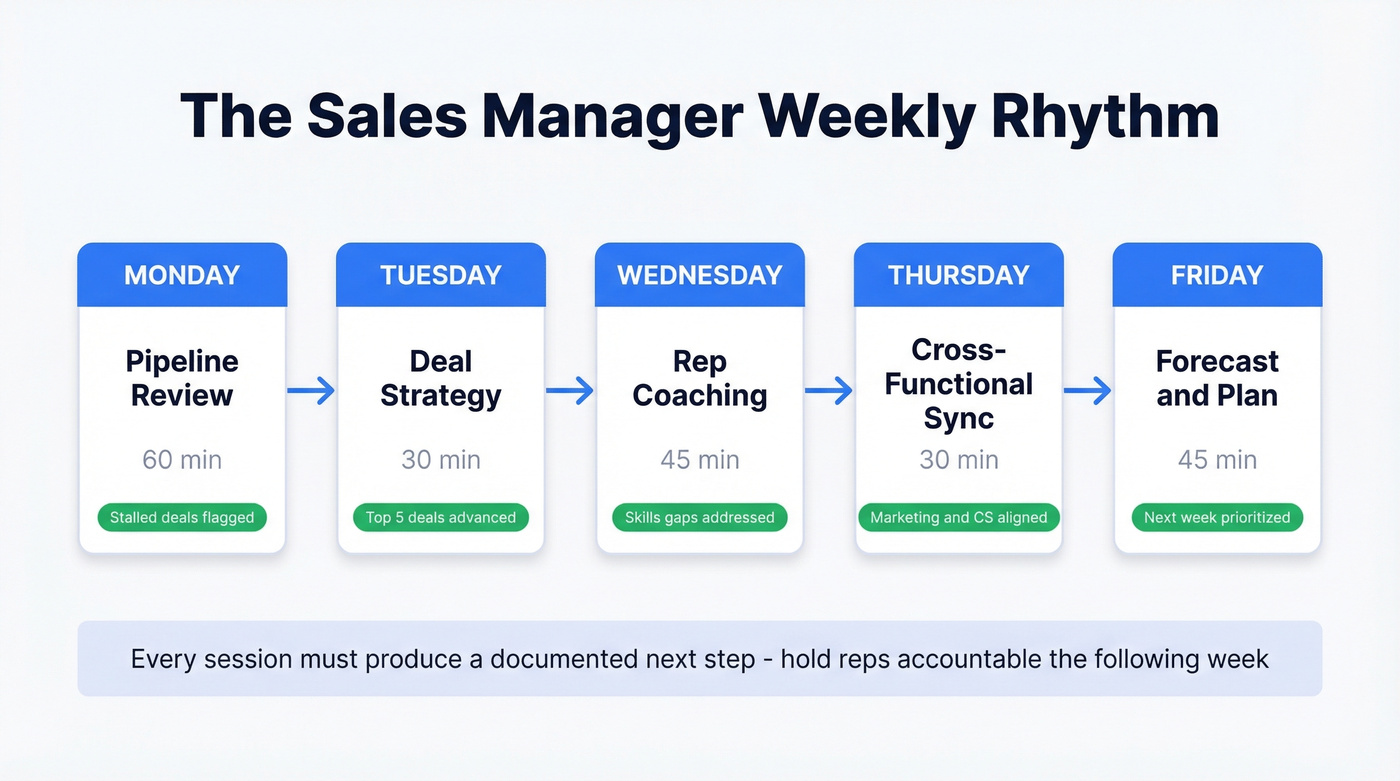
You've read 15 articles about sales culture and none told you what Monday morning looks like. Let's fix that.
| Day | Activity | Duration | Output |
|---|---|---|---|
| Monday | Pipeline review | 60 min | Stalled deals flagged |
| Tuesday | Deal strategy | 30 min | Top 5 deals advanced |
| Wednesday | Rep coaching | 45 min | Skills gaps addressed |
| Thursday | Cross-functional | 30 min | Marketing/CS aligned |
| Friday | Forecast + plan | 45 min | Next week prioritized |
The Brevet Group's 7-point cadence checklist nails the mechanics: pre-schedule every event, set clear prep expectations, use standardized templates so you're comparing apples to apples, and track outcomes in your CRM. A cadence without follow-through is just a calendar invite. Make every session produce a documented next step, and hold reps accountable to it the following week.
Seven Mistakes That Kill Pipeline
Assuming everyone works like you. Your top-performer instincts don't transfer by osmosis. Build structure and measure weekly KPIs instead of expecting reps to "figure it out."
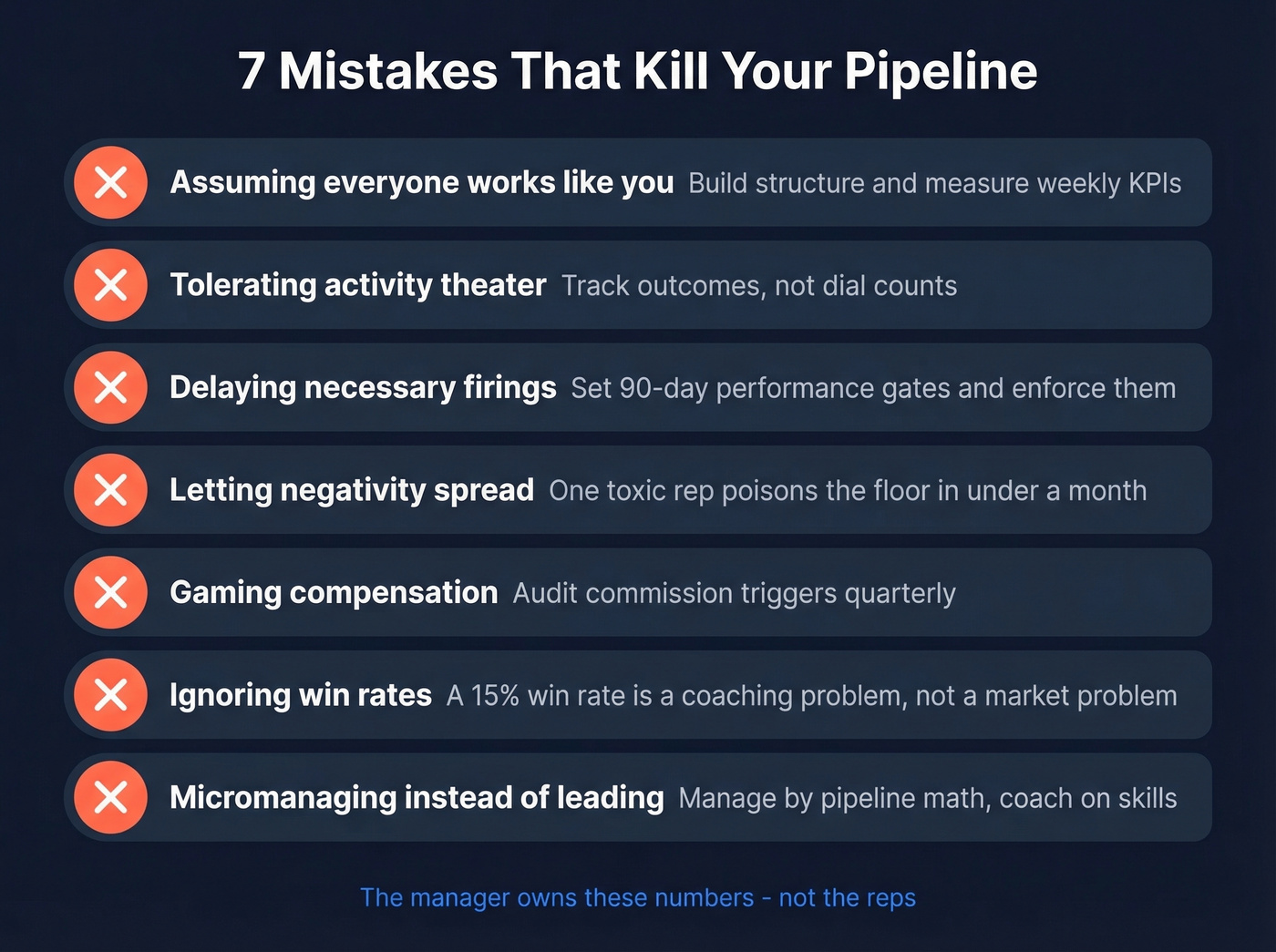
Tolerating activity theater. High dial counts and zero meetings isn't hustle - it's noise. Track outcomes, not inputs. Tie metrics to pipeline created, not calls made.
Delaying necessary firings. One manager discovered their "top rep" was at the pool during work hours. The real mistake wasn't the rep - it was the six months of ignored warning signs. Set 90-day performance gates and enforce them.
Letting negativity spread. One toxic rep poisons the entire floor. We've seen it happen in under a month. Address attitude issues as fast as you'd address a missed quota.
Gaming compensation. Reps who cancel and rebook invoices to hit accelerators aren't creative - they're eroding trust. Audit commission triggers quarterly.
Ignoring win rates. A 15% win rate isn't a market problem - it's a coaching problem. The manager owns this number.
Micromanaging instead of leading. Checking CRM activity logs every hour doesn't make reps better. It makes them resentful. Manage by pipeline math and coach on skills.
How Execution Changes by Segment
The strategies above apply universally, but execution shifts dramatically based on who you're selling to. Small businesses represent 99.9% of all US firms - if you're managing an SMB team, you're in the majority, not the niche.
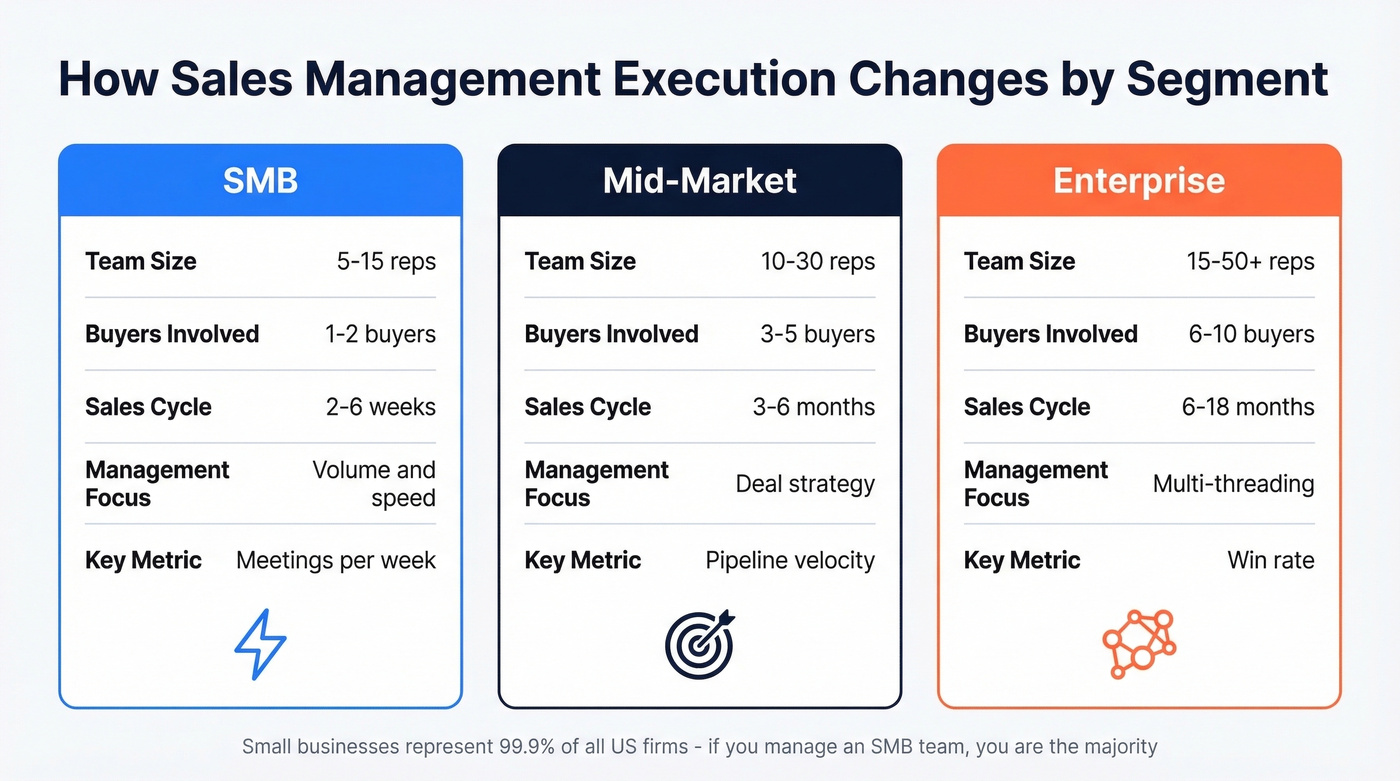
| Segment | Typical Team / Stakeholders | Typical Cycle | Management Focus | Key Metric |
|---|---|---|---|---|
| SMB | 5-15 reps / 1-2 buyers | 2-6 weeks | Volume, speed | Meetings/week |
| Mid-Market | 10-30 reps / 3-5 buyers | 3-6 months | Deal strategy | Pipeline velocity |
| Enterprise | 15-50+ reps / 6-10 buyers | 6-18 months | Multi-threading | Win rate by stage |
SMB management is a velocity game - fast cycles, high volume, minimal stakeholder complexity. Mid-market is where deal strategy starts to matter, with 3-6 month cycles demanding disciplined pipeline reviews. Enterprise is a different sport entirely: timelines stretching past a year and management focused on account planning and multi-threading across buying committees.
One stat that cuts across all segments: aligned sales and marketing teams report 2.3x higher conversion rates and 1.6x faster revenue growth. Yet 60% of organizations still lack that alignment. If you're managing in a silo, you're leaving pipeline on the table regardless of segment.
Look - if your average deal is under $15k, you probably don't need a six-figure tech stack or a 12-step sales process. A tight two-stage qualification, a solid playbook, and clean contact data will outperform a bloated enterprise setup every time. Complexity is a luxury reserved for complex deals.
The 2026 Sales Tech Stack
The consolidation trend is real. Here's what a lean, effective stack looks like:
| Category | Example Tools | Directional Pricing |
|---|---|---|
| CRM | Salesforce, HubSpot | HubSpot has a free CRM; Salesforce starts ~$25/user/mo |
| Enablement | Allego, Highspot | Typically per user/month for mid-market+ |
| Conversation Intel | Gong, Chorus | Per user/month; usually annual contracts |
| Data & Prospecting | Prospeo | Free tier; ~$0.01/email |
| Forecasting | Clari, BoostUp | Annual contracts; pricing varies by seats |
The stack matters less than the data flowing through it. A premium CRM fed with bad contact data produces worse results than a free CRM fed with verified emails and direct dials. In our experience, teams that fix data quality first get more ROI from every other tool in the stack.
FAQ
What's the most important KPI for sales managers?
Pipeline velocity - it combines opportunity count, win rate, deal size, and cycle length into one diagnostic number. Track it weekly to pinpoint whether your bottleneck is volume, conversion, deal size, or speed. A 10% improvement in any single input compounds across the formula, which is why it's more useful than tracking those metrics in isolation.
How often should managers coach reps?
Weekly pipeline reviews plus dedicated 1:1 coaching every six weeks is the baseline. 75% of reps report higher confidence in hitting targets when they have a consistent coaching cadence. Skip the reviews, and your forecast accuracy drops with them.
How do you fix bad data in your pipeline?
Use a verified data source that refreshes every 7 days, not the 6-week industry average. Pair clean sourcing with CRM hygiene rules and automated enrichment. The goal is to catch decay before it costs you meetings.
Do these sales management strategies work for SMB teams?
Yes, but weight them toward speed and volume. SMB cycles run 2-6 weeks with 1-2 decision-makers, so pipeline velocity and meetings-per-week matter more than multi-threading. Simplify your process, keep your playbook to one page, and invest in data quality over complex tooling. Skip the enterprise-grade forecasting tools - they'll slow you down more than they'll help.