

The 6 Sales Management Styles - and the One That Actually Moves Quota
It's Monday morning. You're staring at a pipeline report that looks like a crime scene - 60% of deals stuck in stage two, three reps below 40% of quota, and your VP wants a forecast by noon. Your instinct is to start directing. Call blitzes. Activity mandates. Tighter inspection. It's the most common of all sales management styles, and the data says it's the wrong default.
Only 16% of sales reps hit quota in recent years, down from 53% in 2012. Meanwhile, 70% of preventable turnover traces back to daily management quality - not comp, not territory, not product-market fit. The quota crisis isn't a rep problem. It's a management problem.
The short version: Most managers default to one style and ride it into the ground. Coaching should be your baseline - reps with effective coaching, management, and training are 63% more likely to be top performers per RAIN Group research. Master two approaches: coaching as your daily operating system, directive for emergencies. Everything else is a gradient between those two.
The 6 Styles Ranked by Quota Impact
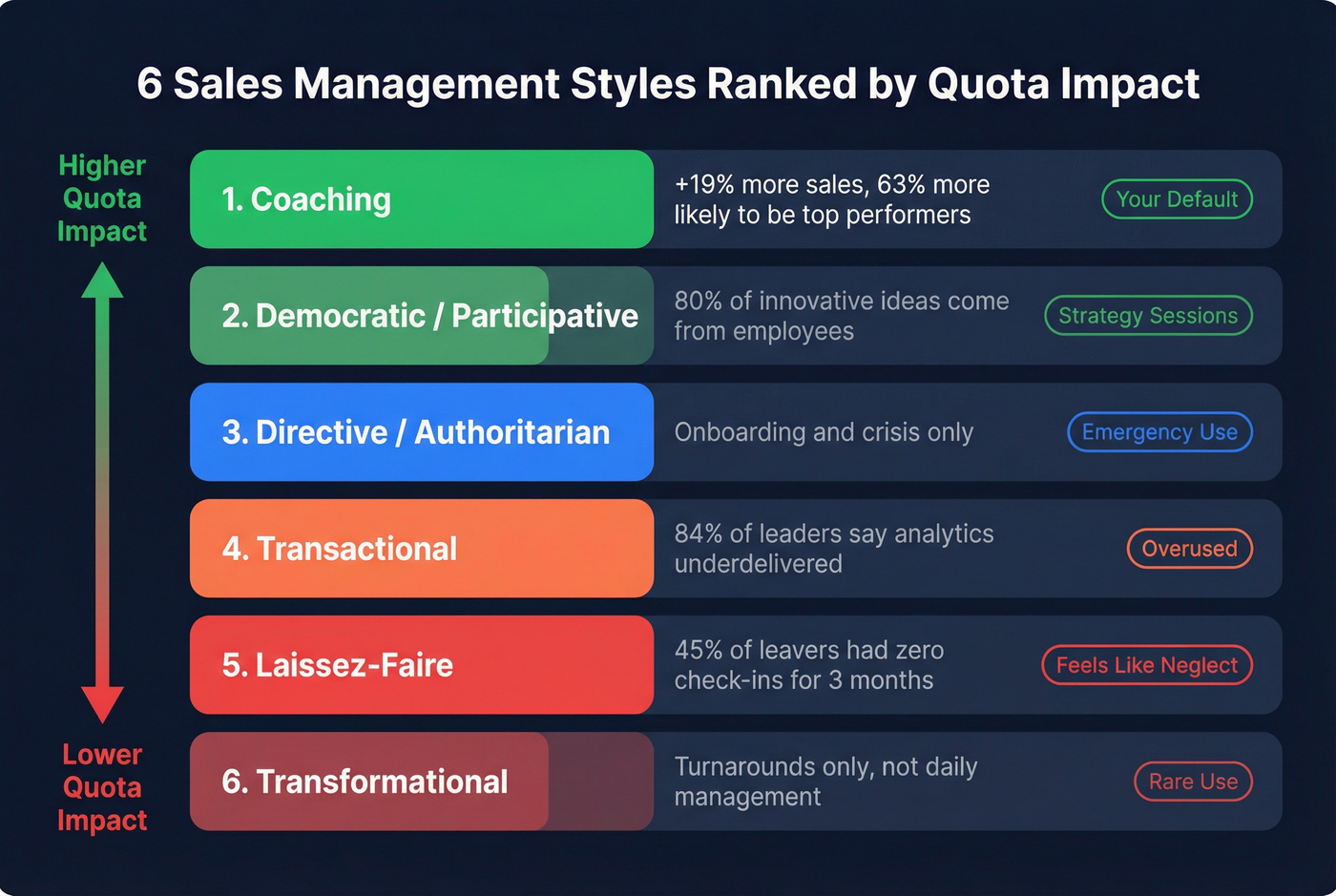
Some frameworks use personas - the Savior, the Reporter, the Dabbler. Those are useful shorthand, but they obscure the real question: which style actually moves quota? Here are the six that matter, ranked by the evidence behind them.
1. Coaching
This is the only style with consistent, replicated data behind it. Corporate Executive Board research shows salespeople achieve 19% more sales with a highly effective coach. A 2025 State of Sales Coaching survey of 1,600+ respondents found 94% of reps say coaching improved their performance, and 96% of sales leaders said coaching influenced quota attainment.
We've seen this firsthand across dozens of sales orgs we work with: the teams that treat coaching as a daily discipline - not a quarterly check-in - consistently outperform the ones running on dashboards and gut instinct.
Use when: Always. This is your default operating mode. Skip when: Never permanently. Pause only during genuine crises that need immediate directive action.
2. Democratic / Participative
You bring the team into the decision. Quota allocation, territory design, playbook iteration - experienced reps have opinions worth hearing. Research consistently shows that 80% of innovative ideas come from employees, and the best orgs build systems to capture them. Democratic management builds buy-in that no top-down mandate can replicate. Some leaders blend this with servant leadership, prioritizing the team's needs and removing blockers so reps can focus on selling.
Use when: Your team has 2+ years of experience and you're designing strategy, not executing under pressure. Skip when: You've got a floor of new hires who need structure, not brainstorming sessions.
3. Directive / Authoritarian
Anthony Iannarino tells a story about becoming a sales leader at 26 and assuming everyone worked like him. They didn't. Directive management - imposing standards, mandating activity, inspecting results - belongs in two places: onboarding new reps and pulling teams out of a quarter-end nosedive. Anywhere else, it's how you lose your best people.
The trap is that directive feels productive. You're making decisions, setting pace, holding people accountable. But accountability without development is just surveillance, and your A-players will notice the difference long before your laggards do.
4. Transactional
Here's the thing: transactional management is the most overused style in sales, and it's actively making teams worse. Hit number, get bonus. Miss number, get PIP. That's not management - it's scorekeeping. And 84% of sales leaders admit analytics had less influence on performance than they expected.
A common leadership question captures the tension: is sales leadership transactional or strategic? Neither. It's situational. The transactional manager can recite every rep's activity metrics but can't tell you why their best closer is thinking about leaving.
5. Laissez-Faire
Your best rep quit. The exit interview says "lack of development." You thought giving her autonomy was development.
It wasn't.
Gallup found that 45% of voluntary leavers report that neither a manager nor leader discussed their job satisfaction, performance, or future in the three months before they left. The cost of getting this wrong: 40-200% of that rep's salary to replace them. Laissez-faire feels like trust. To your reps, it feels like neglect. Reserve it for proven senior reps who explicitly ask for space - and still check in monthly.
6. Transformational Leadership
Satya Nadella shifted Microsoft's culture from "know-it-all" to "learn-it-all." Stock tripled. Transformational leadership works for turnarounds and culture resets - moments when the team needs a new identity, not just new targets. When executed well, it rallies a demoralized team around a compelling vision and can produce dramatic performance swings.
But most sales managers don't need to transform culture. They need to coach reps through deals. If things are working, scale what's already there instead of chasing a reinvention narrative.
Why Managers Get Stuck on One Approach
75% of managers report being overwhelmed by expanding responsibilities. Another 69% say they aren't equipped to lead change. And here's the stat that should alarm every VP of Sales: 43% of leaders don't even know their reps want more coaching.
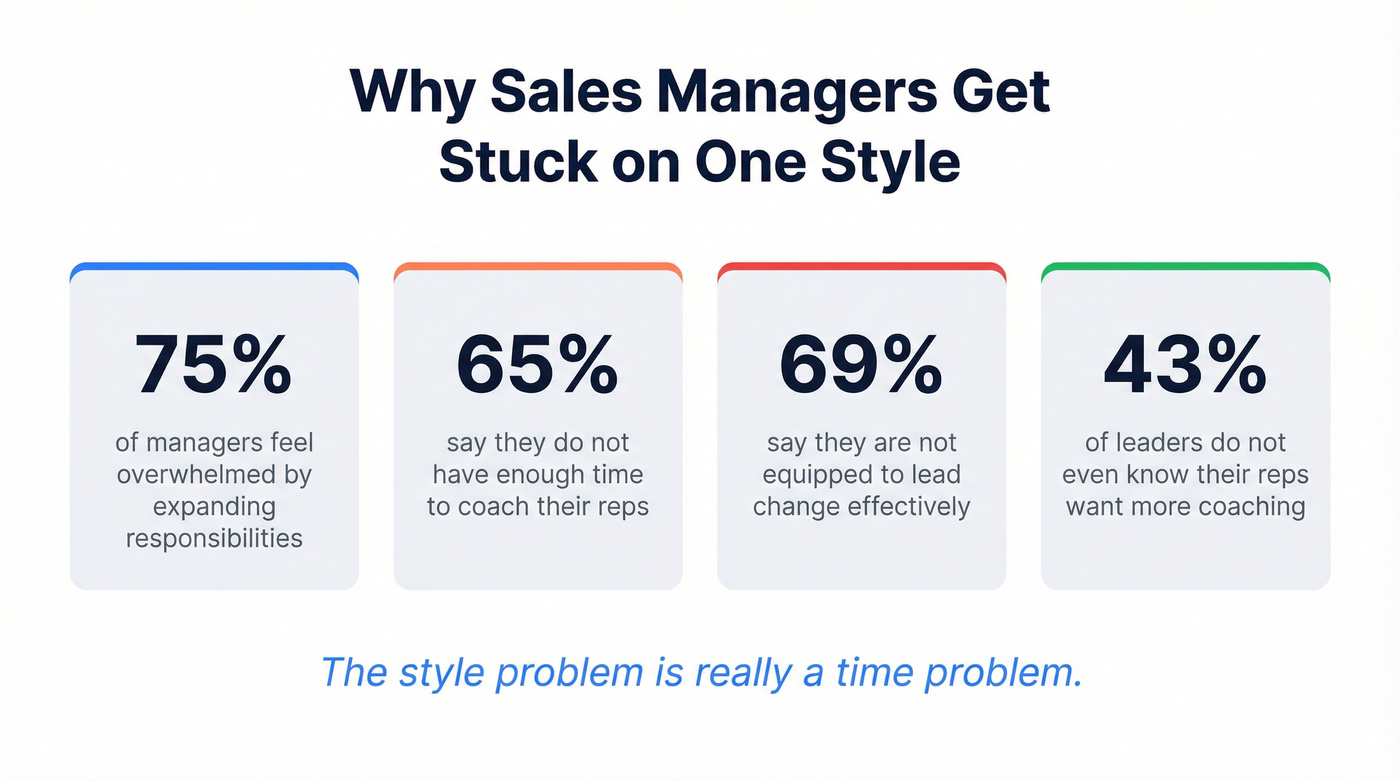
We've watched this pattern play out dozens of times. Sales managers routinely lose a third or more of their week to non-coaching tasks - forecasting, CRM hygiene, cross-functional meetings - and 65% say they don't have enough time to coach. The style problem is really a time problem. Adopting situational leadership - reading the room and shifting your approach based on what the moment demands - is nearly impossible when your calendar is consumed by admin work.

Your reps lose hours to CRM hygiene and list building - hours you could spend coaching. Prospeo's 92% enrichment match rate and 7-day data refresh mean your pipeline stays clean automatically, giving managers back the time that 65% say they don't have.
Stop managing spreadsheets. Start coaching reps who actually hit quota.
Which Style Are You?
Four scenarios. Be honest about your first instinct - not what you'd do after thinking about it.
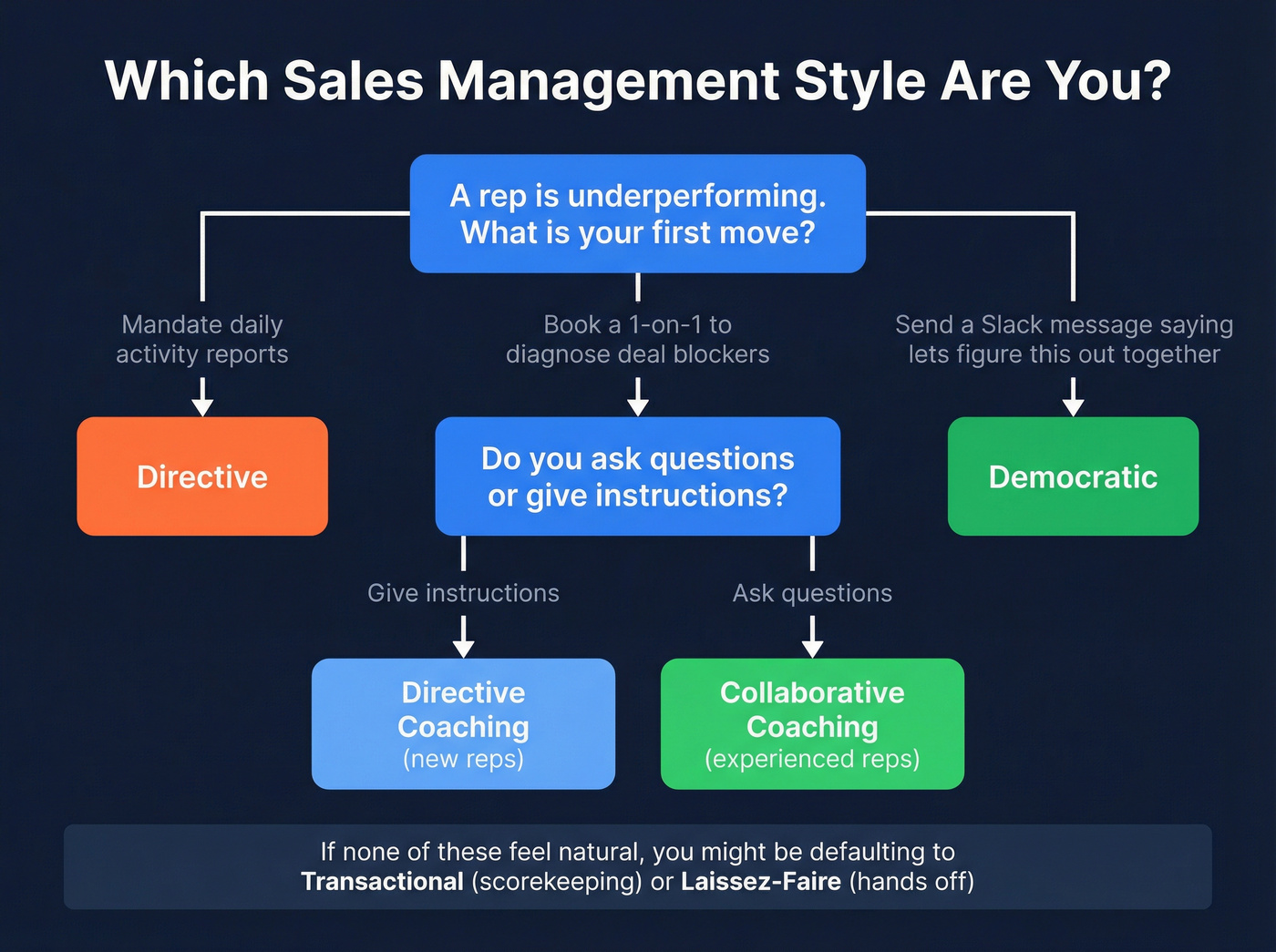
Pipeline review shows 3 reps below 50% of quota. Immediately mandate daily activity reports? That's directive. Book 1:1s to diagnose deal-level blockers? Coaching. Send a Slack message saying "let's figure this out as a team"? Democratic.
New hire's first week. Hand them a playbook and say "follow this"? Directive. Shadow their calls and debrief after each one? Coaching. Tell them to watch the top reps and figure it out? Laissez-faire.
Top performer plateaus. Increase their quota to "motivate" them? Transactional. Explore what's changed in their process or motivation? Coaching.
End-of-quarter crunch. Take over deal strategy yourself? Directive. Run rapid coaching sessions on closing skills? Coaching.
For a more structured assessment, Factor8 offers a sales-specific manager quiz worth ten minutes of your time.
How to Coach Effectively
Knowing coaching matters is useless without knowing how to do it. Let's break it into three principles that actually stick.
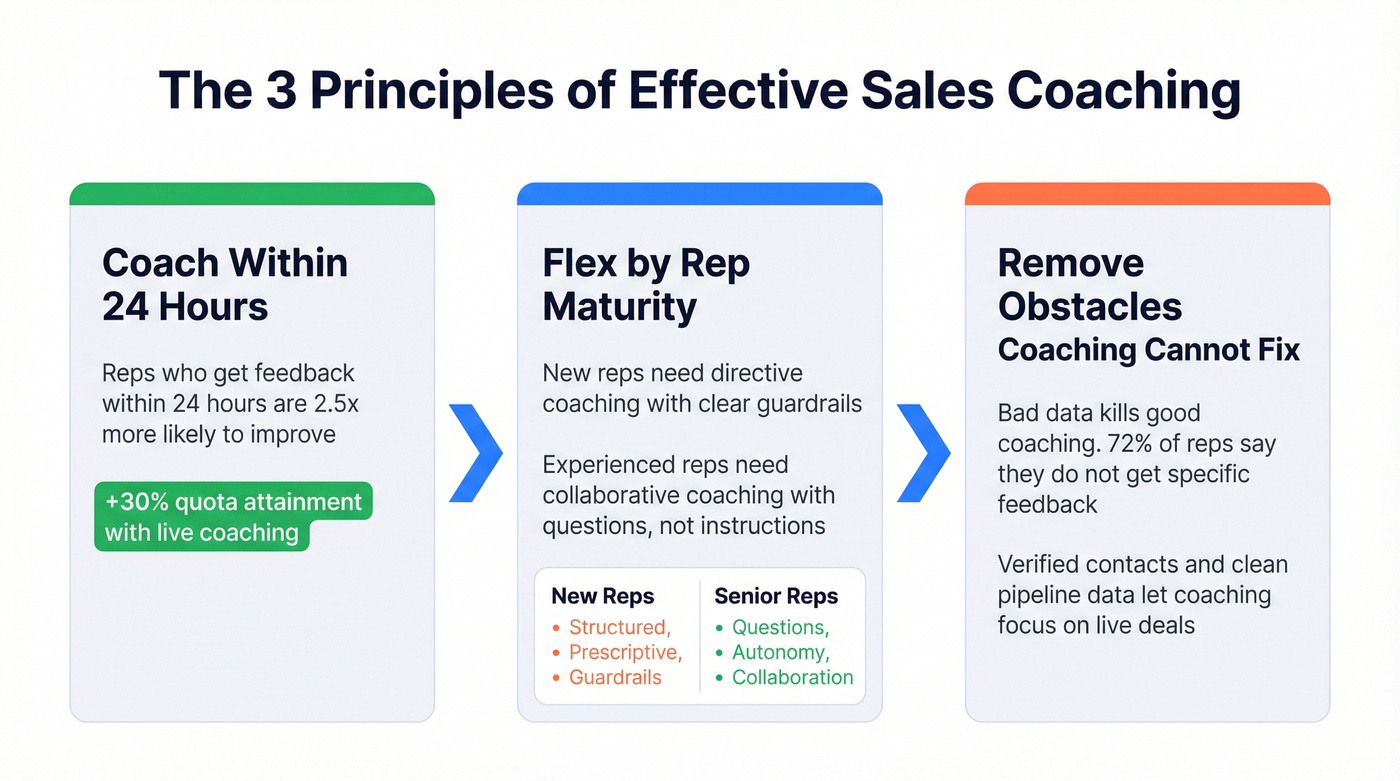
Coach within 24 hours. Reps who receive feedback within 24 hours of a call are 2.5x more likely to improve than those who get delayed feedback. Live coaching - real-time guidance during calls - yields a 30% increase in quota attainment and cuts ramp time in half. Yet 72% of reps say they don't receive specific, actionable feedback. That gap between knowing and doing is where most managers fail.
Flex your style based on rep maturity. This is the situational leadership framework sales teams have relied on for decades - Hersey and Blanchard's model, revisited in a 2025 peer-reviewed paper. New reps need directive coaching: structured, prescriptive, with clear guardrails. Experienced reps need collaborative coaching: questions, not instructions. In our experience, the managers who struggle most aren't using the wrong style - they're the ones who never switch.
Remove the obstacles coaching can't fix. No amount of call coaching saves a pipeline when a big chunk of your emails bounce. Tools like Prospeo keep contact data verified on a 7-day refresh cycle with 98% email accuracy, so coaching time goes toward live opportunities instead of chasing dead leads. (If bounces are a recurring issue, start with email bounce rate benchmarks and fixes.)
The best coaching style won't save a team dialing dead numbers and bouncing emails. Prospeo delivers 98% email accuracy and 125M+ verified mobiles with a 30% pickup rate - so every rep activity you mandate actually connects to a real buyer.
Give your reps data worth coaching around. Start free today.
FAQ
What's the most effective sales management style?
Coaching outperforms every other approach in replicated research. Corporate Executive Board data shows 19% more sales with an effective coach, and RAIN Group found reps are 63% more likely to be top performers when coaching, management, and training work together.
Can you combine multiple styles?
Yes - and you should. The best managers default to coaching daily and switch to directive for onboarding or crisis moments. This situational approach ensures you're never applying a one-size-fits-all method to a team with wildly different experience levels. Most high-performing leaders flex between two or three styles depending on the rep and the quarter.
How do I know if my approach is hurting my team?
Watch three signals: turnover above your industry average, reps missing quota despite strong pipeline generation, and exit interviews citing "lack of development." Gallup data shows 42% of departures are preventable - and most trace back to manager behavior. If you're seeing two or more of those signals, it's time to audit your default style honestly.
What tools help sales managers spend more time coaching?
Anything that automates data hygiene frees up hours for coaching. Prospeo's 7-day refresh cycle and 98% email accuracy eliminate manual list cleaning, while its CRM enrichment - 92% match rate, 50+ data points - keeps rep workflows moving without manager intervention. The r/sales community regularly recommends automating the admin layer so managers can focus on what actually moves numbers: time with reps.