

Sales Manager Goal Setting: Benchmarks, Frameworks, and Templates That Actually Work
69% of B2B sales reps missed quota last year. That's not a rounding error or a tough quarter - it's a structural failure in how sales targets get built. The fix doesn't start with reps working harder. It starts with managers setting smarter targets through disciplined goal setting.
What You Need (Quick Version)
- One framework to start with: OKRs for team-level objectives, SMART for individual rep targets. They're complementary.
- Three metrics to goal on: pipeline coverage, win rate, average deal size. Everything else is a derivative.
- The biggest mistake: setting goals top-down with no math. Cascade from your revenue target to rep-level activities using the formula below.
- If reps hit activity goals but miss pipeline: your data quality is the problem, not their effort.
The Quota Reality Check
Let's look at who's actually hitting quota right now. These numbers come from RepVue data compiled in a 2026 salary guide, and they're sobering:
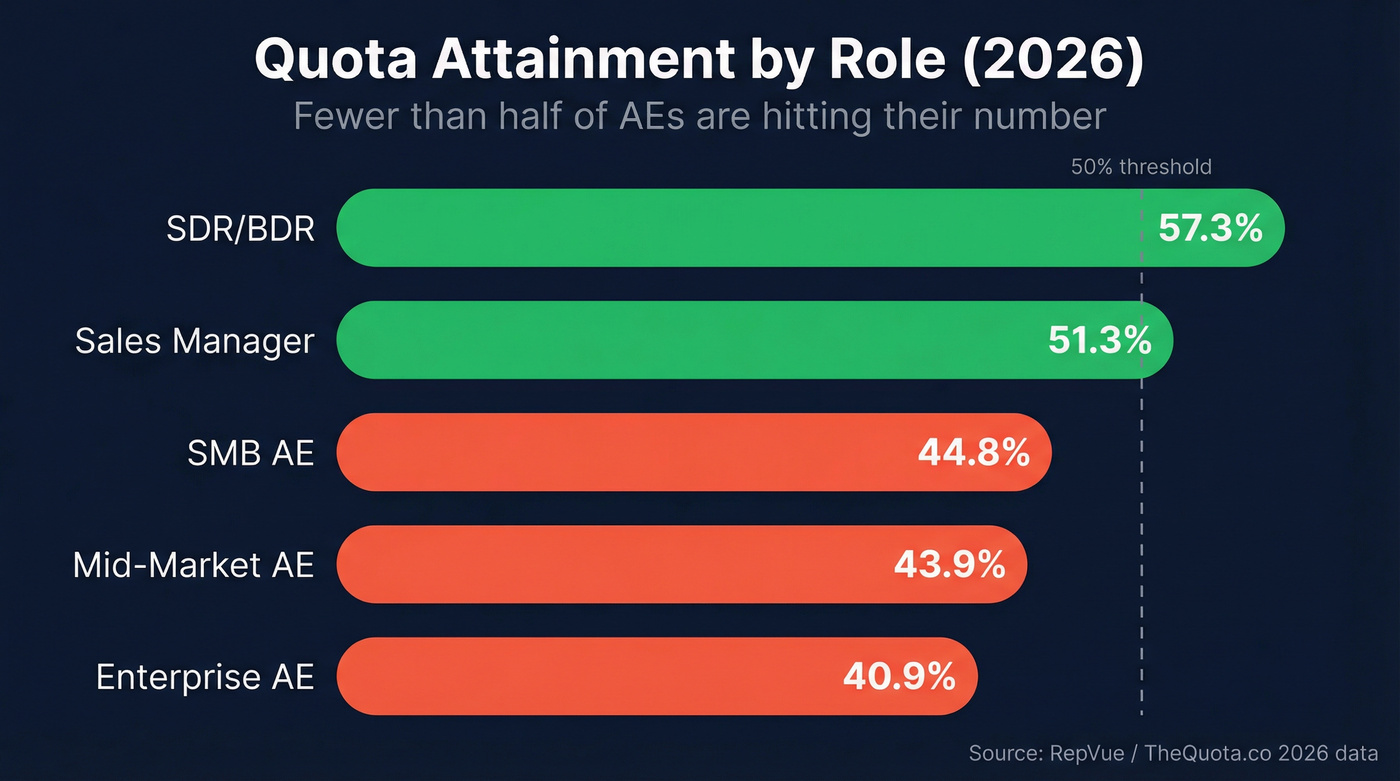
| Role | % Hitting Quota |
|---|---|
| Enterprise AE | 40.9% |
| Mid-Market AE | 43.9% |
| SMB AE | 44.8% |
| SDR/BDR | 57.3% |
| Sales Manager | 51.3% |
When fewer than half your AEs are hitting number, the problem isn't talent. It's target-setting.
The gap between "ambitious" and "delusional" is where most sales organizations live, and managers are the ones who have to bridge it. The best sales managers focus on coaching and process - not personally chasing revenue - and that starts with setting goals grounded in math, not wishful thinking. Goal-setting is a skill, not a personality trait, and there's a repeatable system for getting it right.
Why Most Sales Goals Fail
We've seen five mistakes derail teams that had the talent to win. Every single one comes down to a planning failure, not a people failure.
1. Setting goals top-down with no math. Leadership picks a revenue number, divides by headcount, and calls it a quota. No win-rate analysis, no pipeline coverage calculation, no territory weighting. The number feels arbitrary because it is.
2. Moving goalposts mid-quarter. One Reddit thread captures this perfectly: a rep growing 15-25% quarter-over-quarter got hit with a 57% growth target two months into the quarter - after leadership saw early results and decided to raise the bar. The perception? Goals are manipulated to avoid paying bonuses. Once reps believe that, you've lost them.
3. Inconsistent targets across reps. The "top performer = lowest goal" dynamic is real. When your best rep has the hardest number and the newest hire has the easiest territory, you're not rewarding performance - you're punishing it.
4. Full quota on ramping reps. Handing a new AE 100% quota in month one is a setup for failure. It takes 5.7 months on average for an AE to ramp. Expecting full productivity in month two is fantasy.
5. Annual goals that become fiction by March. A 12-month target set in January rarely survives contact with Q1 reality. Markets shift, products launch, territories change. By Q2, the annual number is a relic nobody references except during performance reviews.
Here's the thing: if more than 60% of your reps are missing quota, you don't have a performance problem. You have a planning problem. Fire the goal, not the rep.
The Cascading Math
Good goal setting is just arithmetic. Start with the revenue target and work backward.
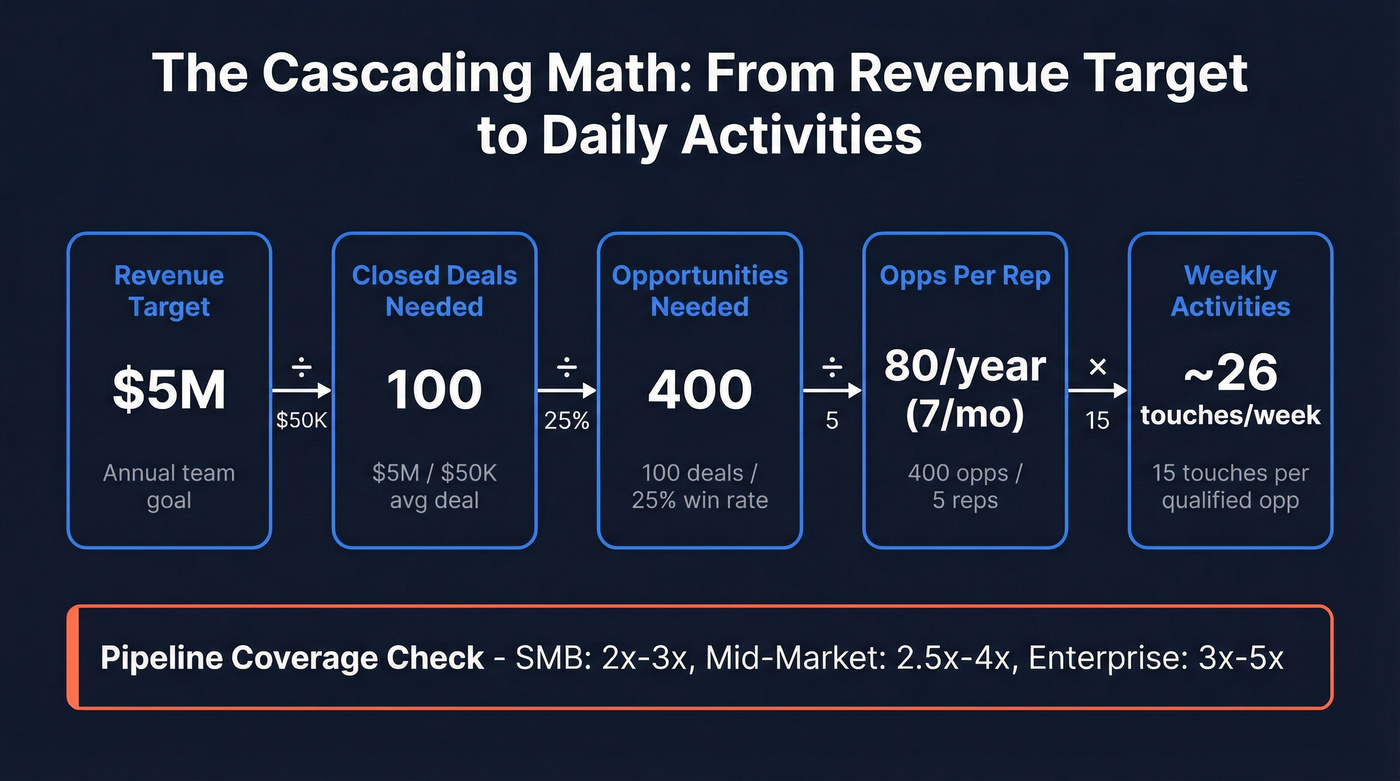
The formula:
Revenue Target / Average Deal Size = Required Closed Deals Required Closed Deals / Win Rate = Required Opportunities Required Opportunities / Reps = Opps Per Rep Opps Per Rep / Conversion Rates = Weekly Activities Per Rep
Worked example: Say your 5-person mid-market team needs to close $5M this year. Average deal size is $50K. Win rate is 25%.
- $5M / $50K = 100 closed deals needed
- 100 / 0.25 = 400 opportunities needed
- 400 / 5 reps = 80 opps per rep per year, roughly 7 per month
- If it takes 15 outbound touches to generate one qualified opp, that's about 105 touches per rep per month
For SDRs, a common outbound benchmark looks like: 100 dials produce 15 connects, which produce 5 meetings, 3 of which are held, yielding 1 qualified opp. Knowing your team's actual conversion at each stage turns guesswork into a plan.
Now you've got a number that connects daily activity to annual revenue. No guessing.
Pipeline coverage is the other critical calculation. Total Pipeline Value divided by Sales Target. But the required multiple varies by segment:
| Segment | Coverage Needed |
|---|---|
| SMB | 2x-3x |
| Mid-Market | 2.5x-4x |
| Enterprise | 3x-5x |
If your enterprise team has 2x coverage and a 20% win rate, the math doesn't work. Period.
Activity goals only work if the underlying contact data is accurate. When 20% of emails bounce, a rep needs to send 250 emails to reach 200 inboxes - and your activity-to-pipeline conversion math falls apart. We've seen this firsthand with teams using Prospeo's 98% email accuracy: the math behind activity targets actually holds because reps aren't burning effort on dead addresses. GreyScout cut rep ramp from 8-10 weeks to 4 after switching to verified data from day one.
One thing most articles on this topic ignore: different stakeholders want different things from your targets. Your CEO wants revenue predictability. Your CRO wants pipeline health. Sales Ops wants forecast accuracy. Your reps want achievable numbers tied to fair comp. Good goals satisfy all four audiences, and the cascading math is how you build that alignment.

Your cascading math breaks when 20% of emails bounce. Prospeo's 98% email accuracy means activity targets actually convert to pipeline - not wasted effort on dead addresses. GreyScout cut rep ramp from 8-10 weeks to 4 by giving new hires verified data from day one.
Stop setting goals your data can't support.
Frameworks: SMART vs. OKRs
SMART Goals
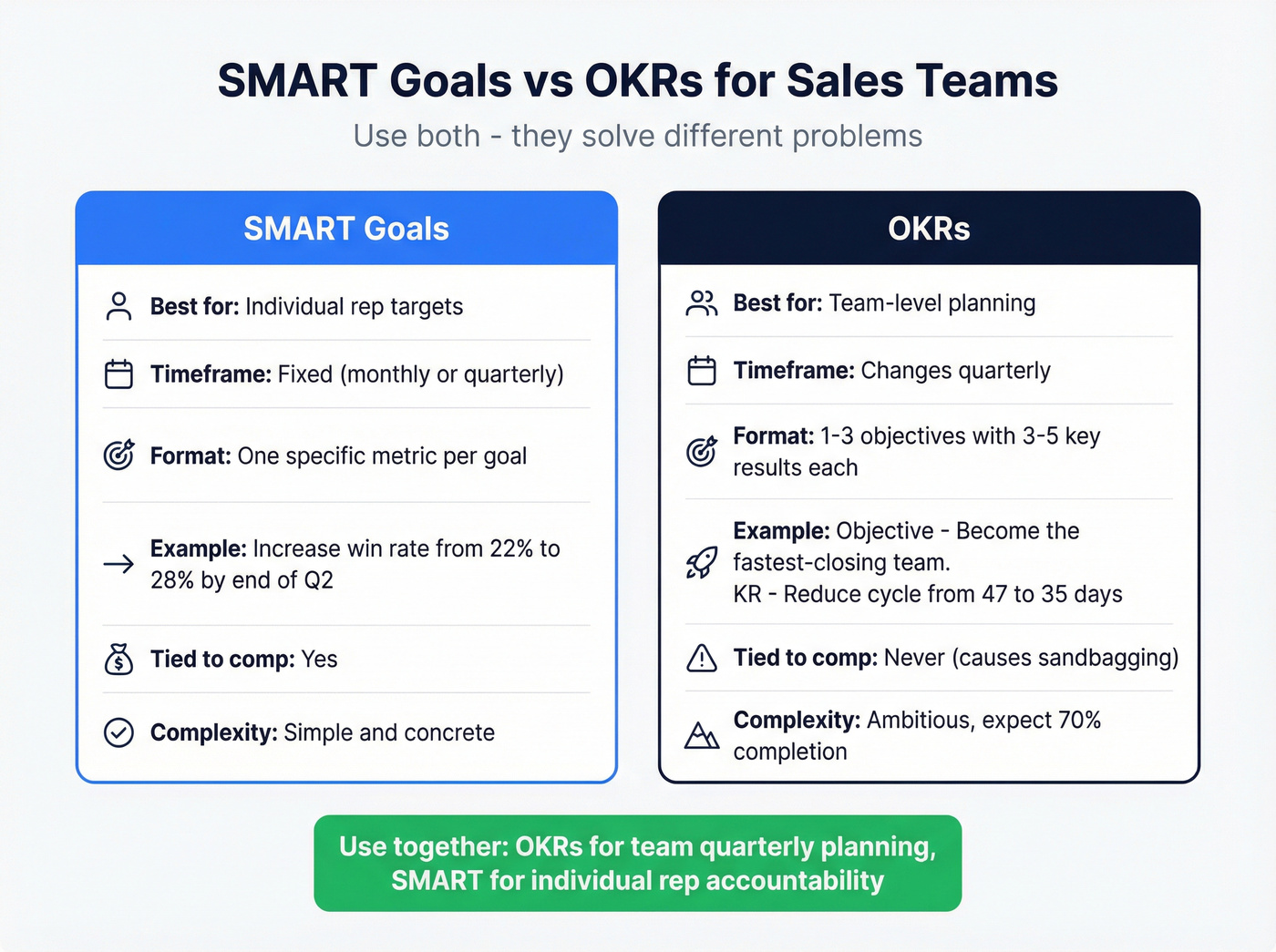
You know the acronym: Specific, Measurable, Achievable, Relevant, Time-bound. SMART goals work best for individual rep targets where the metric is clear and the timeline is fixed. "Increase win rate from 22% to 28% by end of Q2" is a solid SMART goal. It's concrete, measurable, and the rep knows exactly what success looks like.
Don't overthink this framework. It's table stakes for individual performance management.
OKRs - Better for Teams
OKRs are where team-level planning gets interesting. John Doerr's original framework recommends 1-3 objectives per team, with 3-5 measurable key results per objective. Objectives can be qualitative - "Become the fastest-closing team in the org." Key results must be measurable - "Reduce average sales cycle from 47 to 35 days."
The critical distinction from QuotaPath's framework: OKRs change quarterly and are team-focused. KPIs are standing metrics that persist. Don't conflate them.
Quantive's guidance adds an important guardrail: never tie OKRs to compensation. The moment you do, reps sandbag their key results to guarantee payouts. OKRs should be ambitious - if you're hitting 100% of every OKR, they aren't challenging enough.
The hub-and-spoke model works well here. Set one team-level OKR at the center, then create individual spokes for each rep or function that ladder up to it. The manager owns the hub. Reps own their spokes. Use OKRs for team-level quarterly planning, SMART for individual rep targets. Most teams need both.
Goal Examples by Role
SDR / BDR Goals
SDR goals should be heavily weighted toward leading indicators:
- Book 15 qualified meetings per month with a minimum 60% show rate
- Generate $200K in qualified pipeline per quarter
- Maintain 80+ outbound touches per day across email, phone, and social
- Achieve 5% positive reply rate on cold outbound sequences
Account Executive Goals
Unlike SDR goals that focus on top-of-funnel volume, AE targets balance pipeline creation with closing efficiency. The best AE goals force reps to improve deal quality, not just deal quantity. For our 5-person mid-market team from earlier:
- Create $500K in new pipeline per quarter from self-sourced outreach
- Maintain a 25%+ win rate on qualified opportunities
- Increase average deal size from $45K to $55K by Q3
- Reduce average sales cycle from 62 to 50 days
Sales Manager Goals
Manager goals are the most misunderstood category. Too many organizations just give managers a team revenue number and call it a day. That's not a manager goal - that's an aggregated rep goal.
Real sales goals for managers should reflect what managers actually control: team development, process rigor, and forecast accuracy. A strong sales manager targets 55%+ team quota attainment, reduces new rep ramp time from 6 months to 4, delivers 3+ hours of documented coaching per rep per week, and maintains forecast accuracy within 10% of actual closed revenue each quarter. These are the levers that compound over time, and they're what separates a manager who builds a team from one who just watches a scoreboard.
The Three-Tier Framework
Borrowed from Superhuman Prospecting's approach, the three-tier model gives reps a floor, a target, and a stretch:
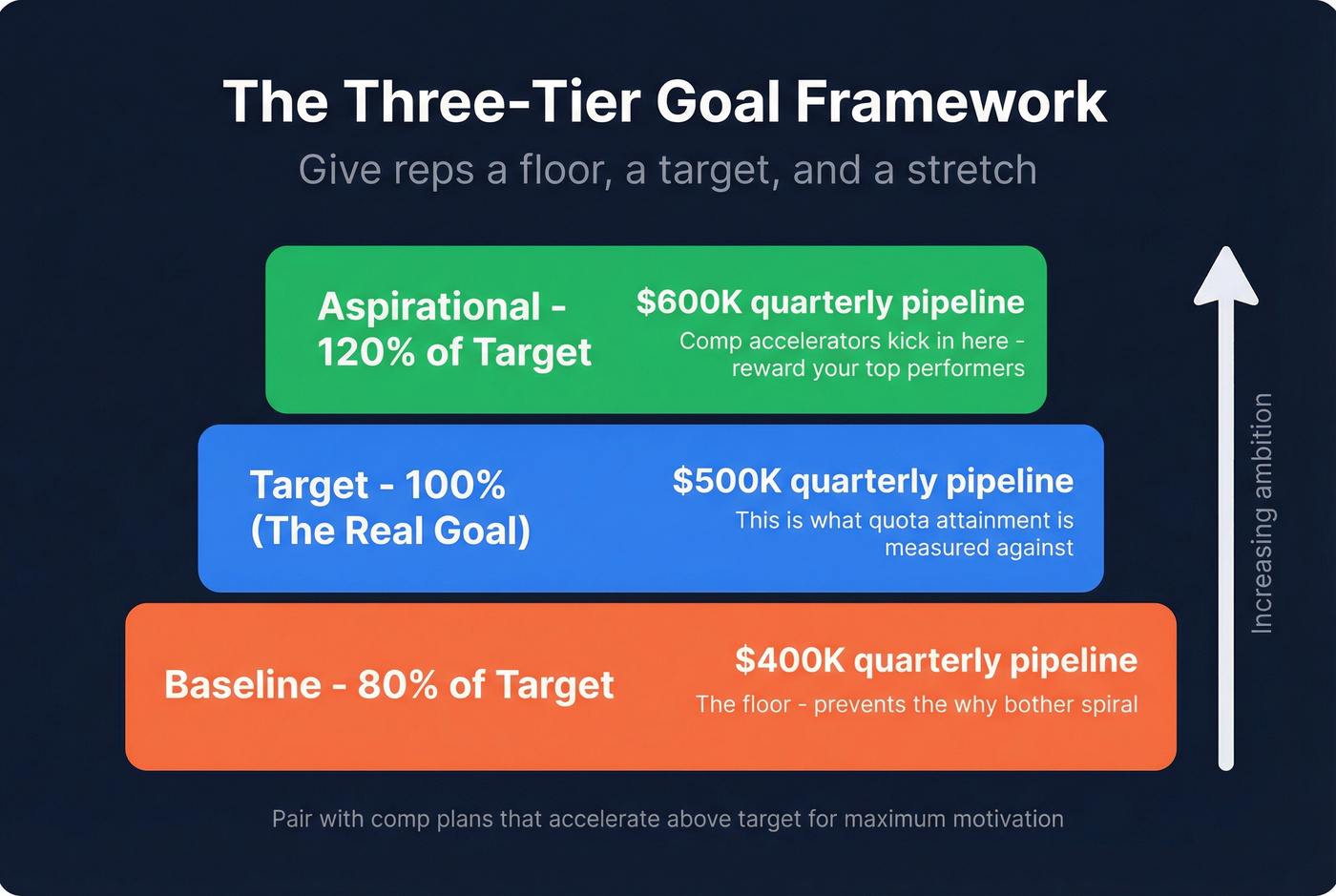
| Tier | Definition | Example (Quarterly Pipeline) |
|---|---|---|
| Baseline | 80% of target | $400K |
| Target | 100% - the real goal | $500K |
| Aspirational | 120% of target | $600K |
This framework prevents the "I'm already behind, why bother" spiral when reps miss target early. It also gives top performers something to chase beyond 100%. Comp plans that accelerate above target pair naturally with this model.
Setting Goals for Ramping Reps
Average AE ramp time is 5.7 months - up 32% since 2020. And 49% of AEs missed quota in Bridge Group benchmarks. Throwing a new hire into full quota on day one is a recipe for early attrition.
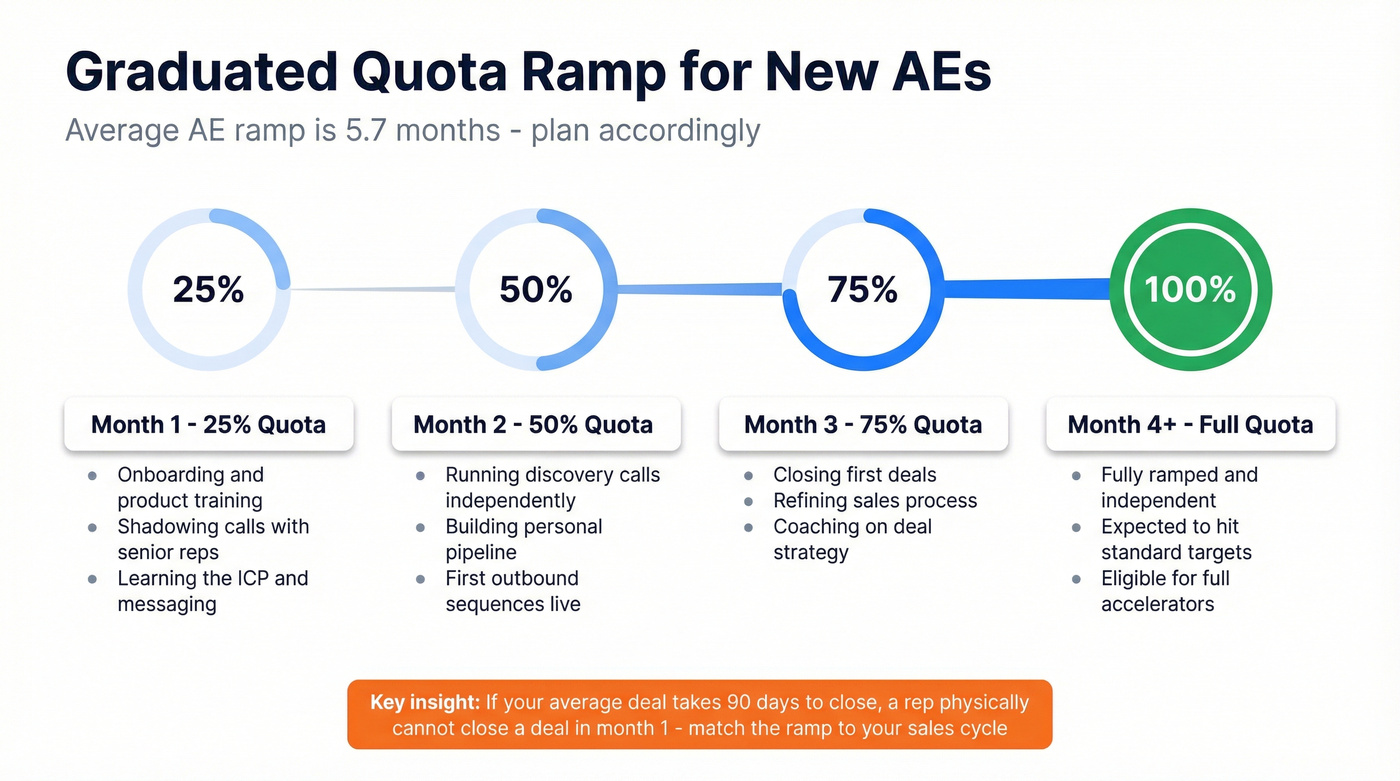
Skip this section if your team is fully ramped and stable. But for anyone hiring, the graduated quota approach is simple and effective:
- Month 1: 25% of full quota - focus on onboarding, learning the product, shadowing calls
- Month 2: 50% - running discovery calls, building pipeline
- Month 3: 75% - closing first deals, refining process
- Month 4+: 100%
Adjust the timeline based on your sales cycle length. If your average deal takes 90 days to close, a rep physically can't close a deal in month one - so why quota them as if they can? Match the ramp to the reality of your sales motion.
The Weekly 1:1 Template
Most sales 1:1s are pipeline interrogations disguised as coaching sessions. I've sat through hundreds of them. Flip the ratio: 20% inspection, 80% coaching. The 10/10/10 rule gives you a clean structure for a 30-minute weekly meeting.
First 10 minutes - Numbers + Pipeline Red Flags
- Quota attainment vs. goal (MTD/QTD)
- Pipeline coverage ratio
- Deals at risk: stalled, no next step, single-threaded
Second 10 minutes - Call Review + Skill Coaching
- Listen to one recorded call together
- Focus on one skill per week: discovery, objection handling, negotiation
- Rep self-assesses before manager provides feedback
Third 10 minutes - Roadblocks + Rep Wellbeing
- What's blocking progress this week?
- What support do you need from me?
- Energy check - burnout is a pipeline killer
HBR research confirms that employees perform better when they see how their work connects to larger corporate objectives. The 1:1 is where that connection gets made explicit. Don't skip it. Don't cancel it. Don't turn it into a forecast review.
Tools That Make It Work
You don't need a dozen tools. You need three categories covered well.
CRM Dashboards
Salesforce typically starts around $25/user/month and can run well over $150/user/month depending on edition and add-ons. HubSpot has a free CRM, with paid Sales Hub tiers ranging from tens to hundreds per user/month depending on plan. Either works - what matters is that your reps actually log activity and your dashboards reflect real pipeline, not wishful thinking. If you're rebuilding your stack, start with a clear view of examples of a CRM and what each one is best at.
Conversation Intelligence
Gong typically lands around $1,200-$1,800 per user/year depending on package. Expensive, but it pays for itself if you actually use it for coaching instead of surveillance. When teams treat call recordings as coaching material rather than gotcha evidence, win rates go up.
Contact Data Quality
Bad data is the silent killer of activity goals. If your reps are dialing disconnected numbers and emailing invalid addresses, their activity metrics are inflated and your pipeline math is fiction. We've tested this extensively - Prospeo covers 300M+ professional profiles with 98% email accuracy and 125M+ verified mobile numbers with a 30% pickup rate. The 7-day data refresh cycle means the contacts your reps worked last month are still valid this month. There's a free tier so managers can test it before rolling out to the team, and at roughly $0.01/email, it's a rounding error in your tech stack budget. If you're diagnosing deliverability, start with email bounce rate benchmarks and fixes, then evaluate data enrichment services to keep records current.

Pipeline coverage ratios mean nothing if your reps are prospecting with stale contacts. Prospeo refreshes 300M+ profiles every 7 days - not the 6-week industry average - so the opportunities in your forecast are built on real, reachable buyers.
Make your pipeline math actually hold up this quarter.
FAQ
How often should I review sales goals?
Weekly for activity metrics, monthly for quota and pipeline, quarterly for OKRs. Annual goals are too slow - most become irrelevant by Q2. Use your weekly 1:1 to track leading indicators and your monthly review to adjust pipeline targets.
What's a realistic quota attainment target?
50-60% of your team hitting quota means goals are well-calibrated. Below 40% signals targets are disconnected from reality. Above 80% means they're too easy and you're leaving revenue on the table.
Should I use SMART goals or OKRs?
Both. OKRs for team-level quarterly objectives, SMART for individual rep targets. Never tie OKRs to compensation. Strong SMART goals for sales managers look like "reduce average sales cycle from 60 to 45 days by end of Q3" or "improve team pipeline coverage from 2.5x to 3.5x within 90 days."
What do I do when leadership gives me an unrealistic target?
Build a business case with data. Show current win rate, pipeline coverage, and what the target implies in required activity. If the math demands 300 dials per rep per day, the number speaks for itself. Come with math, not complaints.
My reps hit activity goals but miss pipeline - why?
Almost always a data quality problem. If 20% of emails bounce, activity numbers are inflated and reps look busy without reaching anyone. Clean, verified contact data closes the gap between logged activity and actual pipeline creation.