

Sales Marketing Collaboration: The Infrastructure Playbook Most Guides Skip
82% of C-level B2B professionals say their sales and marketing teams are aligned. Meanwhile, 65% of the people actually doing the work say alignment doesn't exist. That gap is wide enough to lose your entire pipeline in.
Most advice on sales marketing collaboration boils down to "meet more often" and "use a shared Slack channel." That's like telling someone with a broken engine to wash the car. The real problem is infrastructure: mismatched KPIs, broken hand-offs, and dirty data that neither team trusts.
If You Only Do Three Things This Quarter
- Agree on a shared lead definition and set an 8-hour accept/reject SLA this week. Not next month. This week.
- Replace MQLs with Cost Per Meeting as your shared north-star metric. MQLs measure marketing activity, not revenue progress.
- Audit your contact database for accuracy. Dirty data breaks every alignment initiative before it starts - if 15% of your emails bounce, no SLA in the world saves you.
Why Alignment Breaks Down
This isn't a culture problem. It's an infrastructure problem.
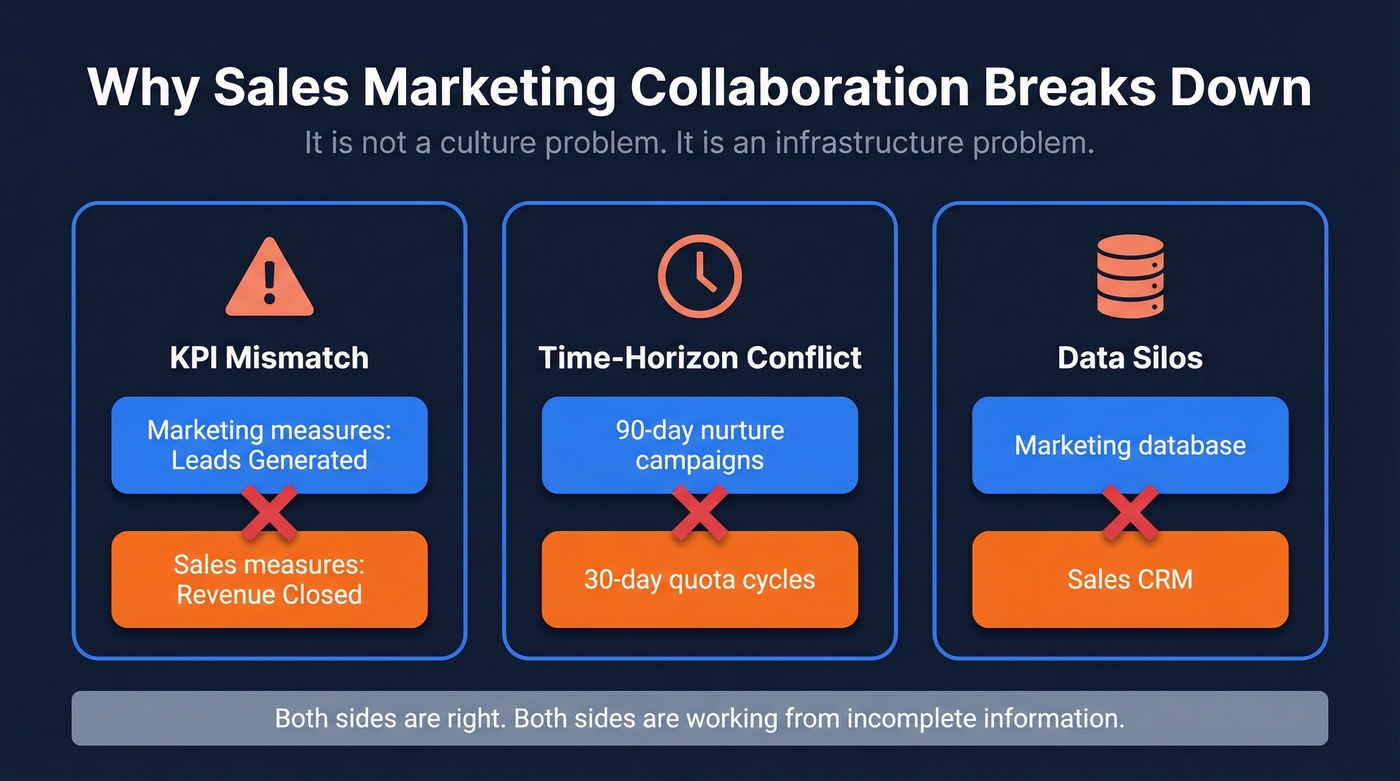
The friction Forrester describes - "friction, exclusion, credit-stealing, slandering, name-calling, and undermining" - those are symptoms. The root causes are structural:
KPI mismatch. Marketing measures leads generated. Sales measures revenue closed. Without shared goals, neither metric tells you whether the hand-off between them is working.
Time-horizon conflict. Marketing plans quarterly campaigns. Sales lives in monthly quota cycles. When marketing launches a nurture sequence that takes 90 days to mature, sales is already panicking about this month's number - and rightfully so, because their comp depends on it.
Data silos. Marketing runs campaigns from one database. Sales works from another. Neither team sees the full picture, and both blame the other for gaps.
Here's the thing: on r/b2bmarketing, you'll find the same frustration on repeat. Marketers saying they don't get enough customer pain-point feedback from sales, while sales reps demand short-term leads that convert now. Both sides are right. Both sides are working from incomplete information.
The Real Cost of Misalignment
Only 11% of companies achieve both effective hand-offs and high audience overlap between sales and marketing. The other 89% are leaking revenue somewhere in the middle.
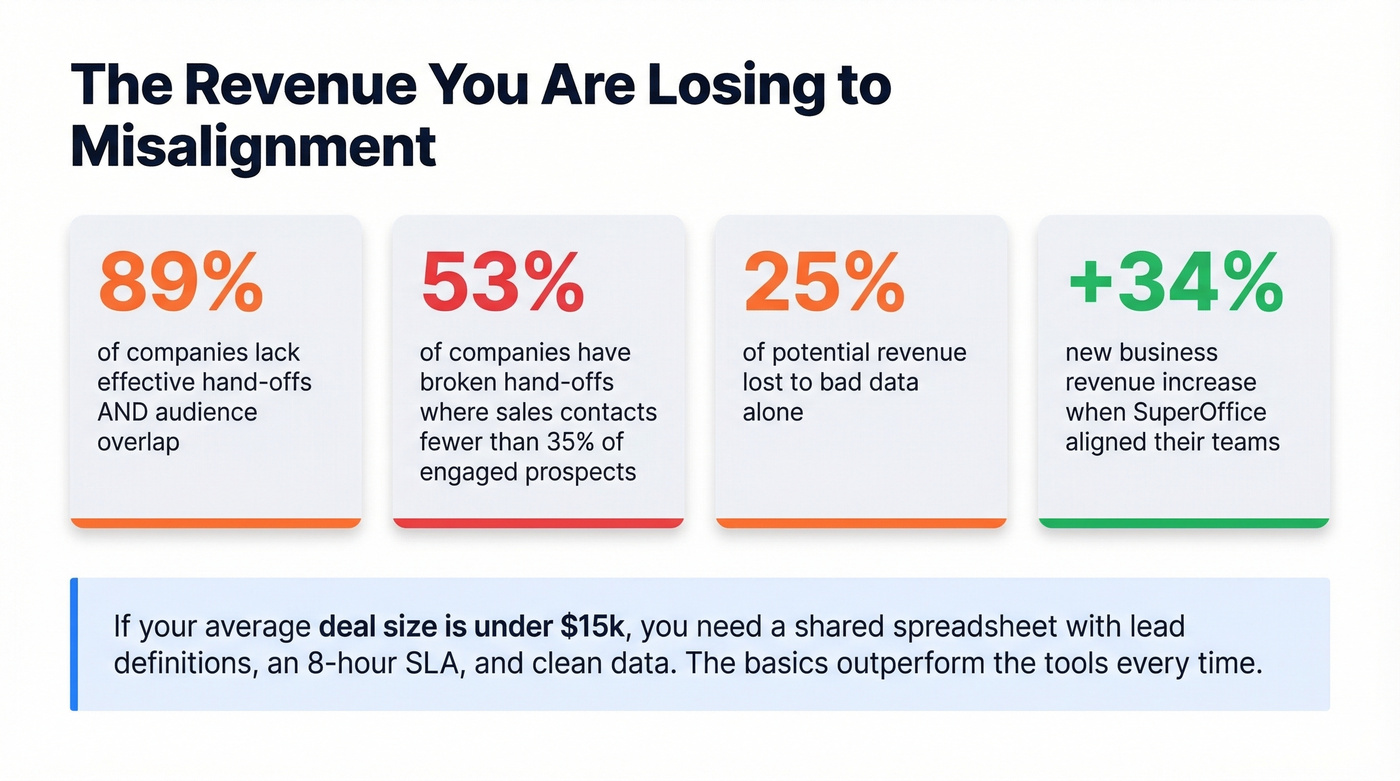
Let's break down what that looks like in practice. 53% of companies have what Influ2 calls a "broken hand-off" - sales follows up with fewer than 35% of the prospects marketing has already engaged. We've seen this pattern firsthand: marketing generates 500 MQLs in a quarter, sales contacts 47 of them. Marketing screams about lead follow-up. Sales screams about lead quality. The CFO screams about CAC. Nobody's wrong. The process is broken.
Bad data alone costs companies up to 25% of potential revenue. On the flip side, SuperOffice saw a 34% increase in new business revenue within two years of aligning their sales and marketing teams in their Dutch office. That's not a marginal improvement - that's a different trajectory entirely, and it's one of the clearest benefits of revenue marketing: when both teams optimize toward the same pipeline, the entire business accelerates.
If your average deal size is under $15k, you probably don't need a six-figure alignment tech stack. You need a shared spreadsheet with lead definitions, an 8-hour SLA, and clean data. The basics outperform the tools every time.

You just read it: bad data costs companies up to 25% of revenue. Every bounced email erodes sales trust in marketing's leads. Prospeo's 98% email accuracy and 7-day data refresh give both teams a single source of truth - so your SLAs actually hold.
Alignment starts with data both teams believe in.
The Alignment Playbook
Build a Sales-Marketing SLA
An SLA isn't a document that lives in a Google Drive folder nobody opens. It's an enforceable contract between two teams:
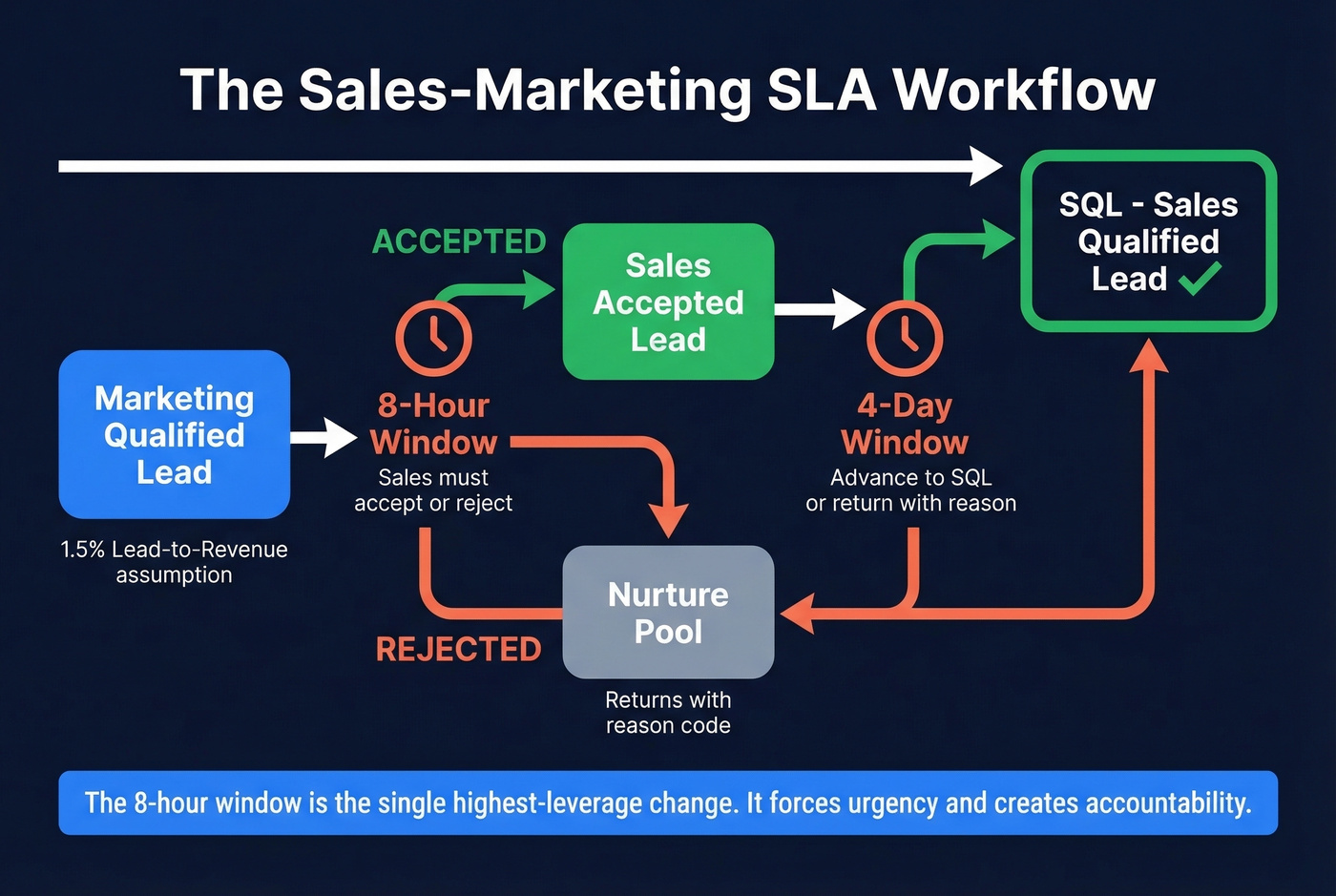
- 8-hour accept/reject window. Sales has 8 hours to accept or reject a marketing-qualified lead. If they don't act, the lead reverts to marketing for re-nurturing. No exceptions.
- 4-day SQL advancement. Once accepted, sales has 4 days to advance the lead to SQL status or send it back with a reason code.
- Lead recycling rules. Rejected leads don't die - they go back into nurture with context about why they weren't ready.
- Joint lead score definition. Sales and marketing define "sales-ready" together, combining prospect fit and purchase intent signals. Start with a 1.5% Lead-to-Revenue conversion assumption and adjust quarterly.
We've tested SLAs with and without time-bound commitments. The 8-hour window is the single highest-leverage change - it forces urgency and creates accountability that "follow up when you can" never does.
Replace MQLs With Metrics That Matter
MQLs are a vanity metric dressed up as a KPI. They measure marketing's ability to generate form fills, not the business's ability to generate revenue.
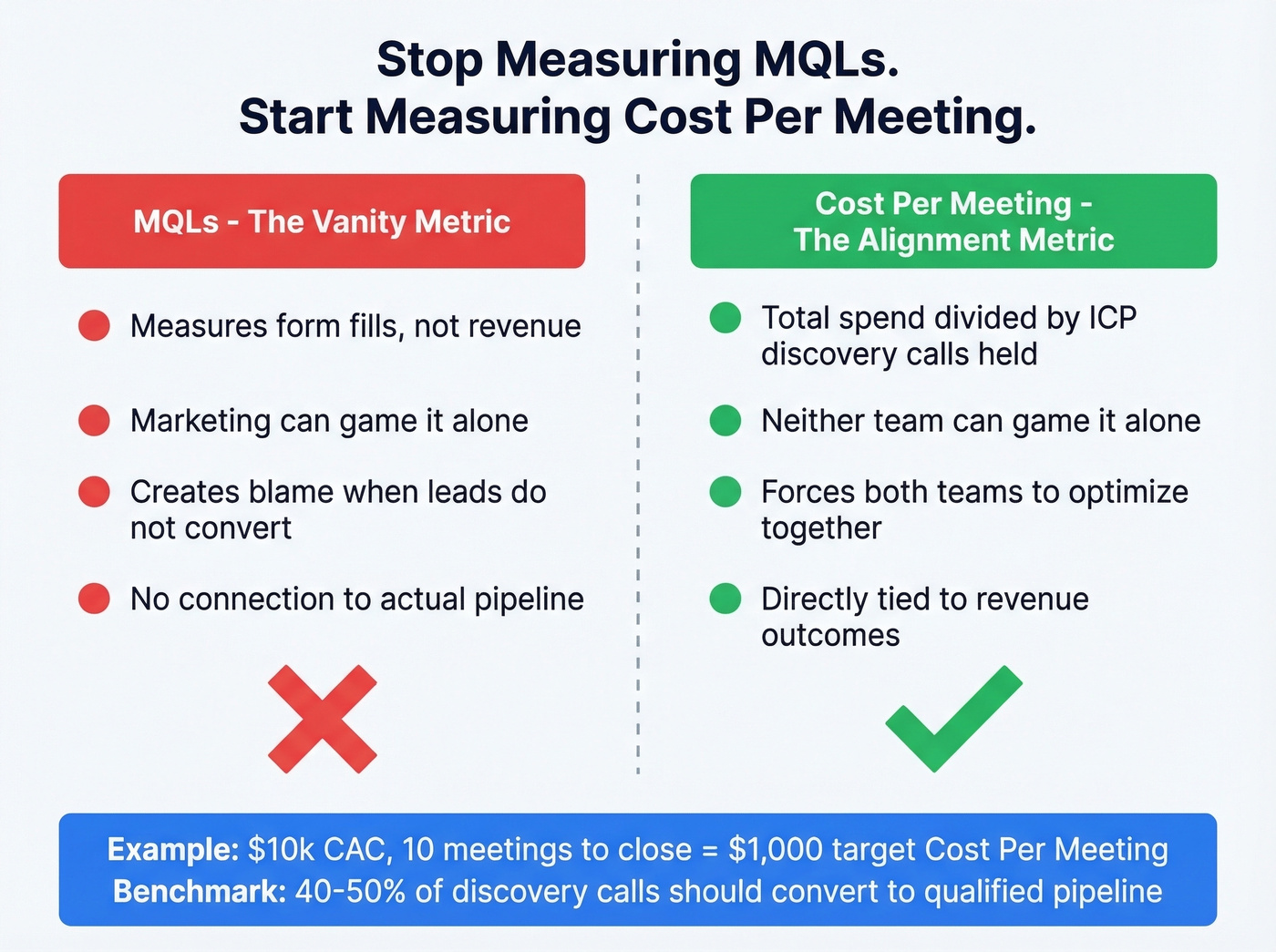
Cost Per Meeting is the metric that forces alignment. Total spend divided by ICP discovery calls booked and held. If your CAC is $10k and it takes 10 meetings to close a deal, your target Cost Per Meeting is $1,000. Both teams can optimize toward that number, and neither team can game it alone.
Qualified Meeting Conversion Rate measures what happens after the hand-off: what percentage of discovery calls convert to qualified pipeline. The benchmark is 40-50%.
Pipeline attribution matters here too. Don't silo credit - track whether a deal was marketing-sourced, sales-sourced, or jointly sourced. Teams that share pipeline credit align faster than teams fighting over who "owns" the deal. Some companies split commission 75% to each collaborator, which sounds generous until you realize the alternative is both teams sandbagging each other's efforts and everyone losing.
Fix the Hand-Off Process
Do this:
- Pass complete lead context with every hand-off - engagement history, content consumed, intent signals. Sales shouldn't have to guess why a lead is "qualified."
- Automate routing so sales gets notified the moment a lead hits qualification signals. Responding within 5 minutes dramatically improves contact rates versus hours later.
- Track hand-off effectiveness weekly: what percentage of marketing-engaged leads did sales actually contact?
Stop doing this:
- Passing leads with nothing but a name and email. That's not a hand-off - it's a dump.
- Letting leads sit in a queue for days. One in three marketers say fixing the handover process is their top priority. Speed-to-lead isn't optional.
Consider a RevOps Layer
68% of SDR teams report to sales, per Bridge Group data. That creates a structural bias - SDRs optimize for what their sales manager wants, not what the full funnel needs.
The RevOps model combines marketing ops and sales ops under a single function with shared planning and metrics. The end state is a unified revenue team where sales and marketing operate from the same playbook, the same data, and the same targets. Companies investing in RevOps report 20%+ revenue productivity gains and 36% revenue growth.
But here's the caution most articles skip: if RevOps reports to the VP of Sales, you don't have RevOps. You have sales ops with a new title. Real RevOps needs structural independence to serve both teams equally.
The Data Problem Nobody Talks About
Every alignment tactic above assumes one thing: both teams are working from accurate, shared data. In practice, that assumption is almost always wrong.
A third of companies still move data manually between systems. Marketing runs campaigns from one database. Sales works from the CRM. The two aren't synced, or they're synced with a one-way integration that drops fields. The result? An SDR calls a prospect who says, "I already talked to someone from your company last week." That's not a minor embarrassment - it's a trust-destroying moment that poisons the entire relationship between your teams and the buyer.
When both teams pull from the same verified dataset, the blame game around lead quality drops dramatically. In our experience, the single fastest way to defuse a sales-vs-marketing standoff is to run a data audit together - sit in the same room, pull a random sample of 100 "qualified" leads, and check how many have valid contact info. The number is usually sobering enough to shift the conversation from blame to problem-solving. Tools like Prospeo help here with 98% email accuracy and a 7-day refresh cycle, keeping the contacts entering your SLA actually reachable across native Salesforce and HubSpot integrations.
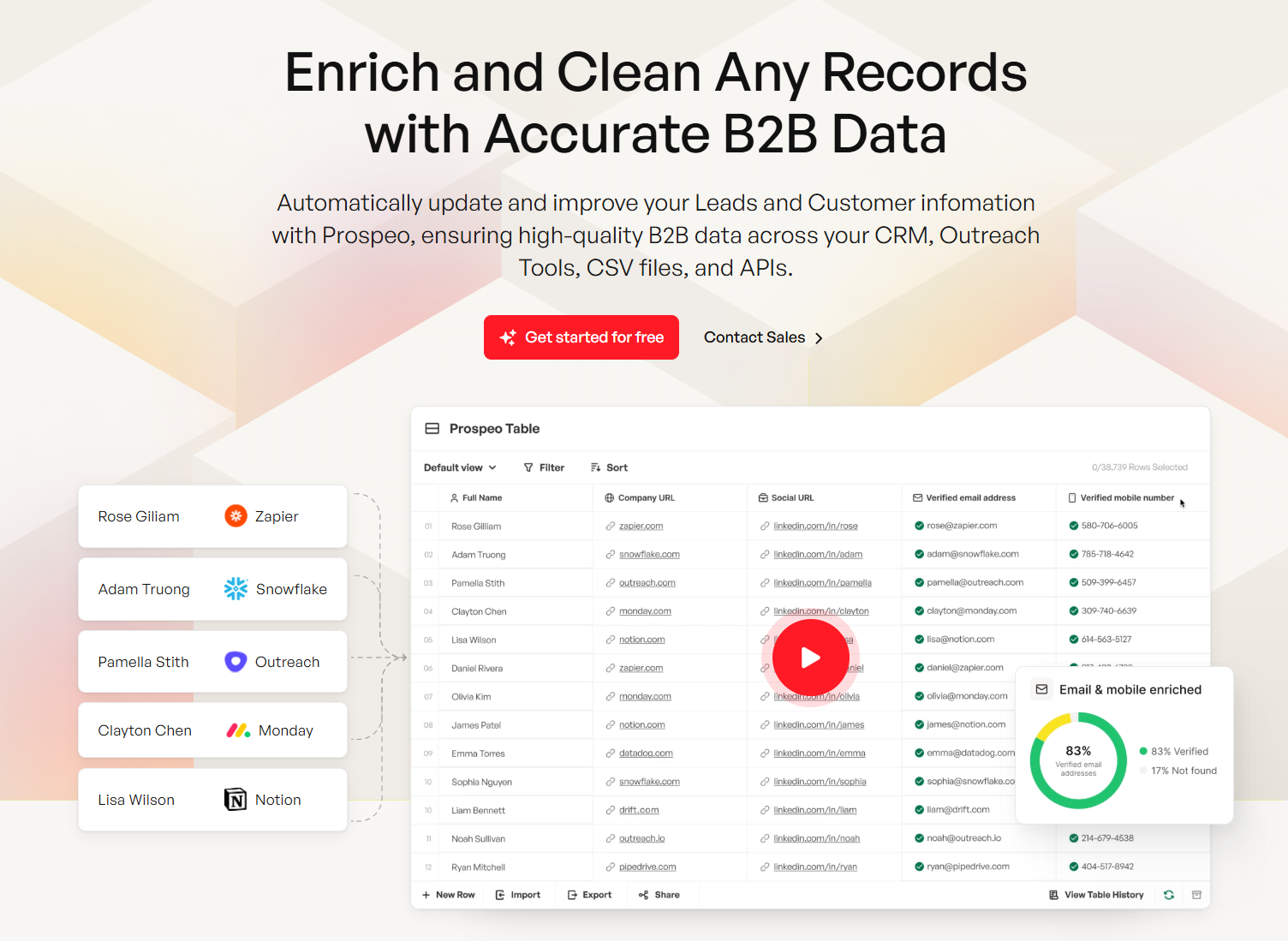
Passing leads with just a name and email is a dump, not a hand-off. Prospeo enriches every contact with 50+ data points - job title, intent signals, technographics, funding - so sales gets the full context marketing promised in your SLA.
Give sales the lead context that actually converts to meetings.
Alignment Maturity - Where Are You?
Most companies are stuck somewhere between Undefined and Defined. Kotler's maturity model gives you a framework for diagnosing where you are:
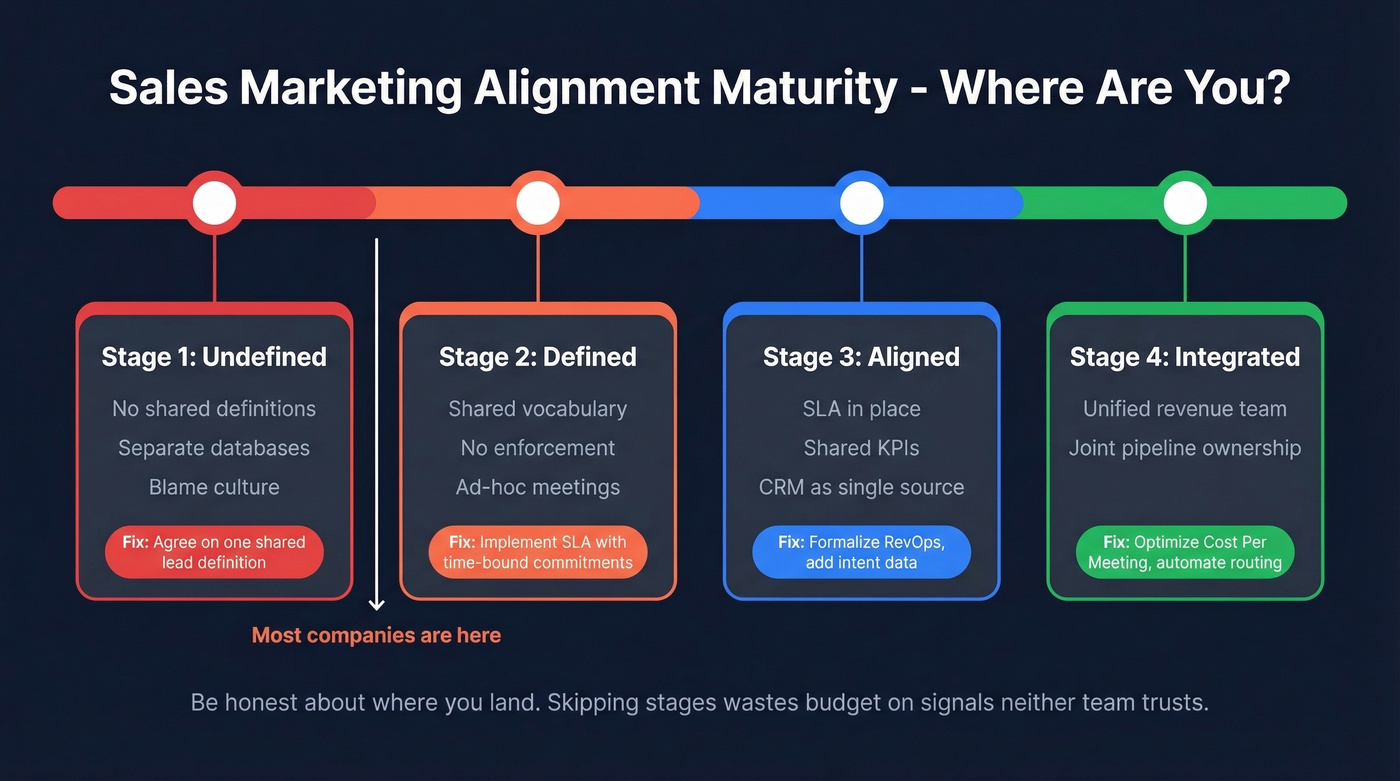
| Stage | Characteristics | What to Do Next |
|---|---|---|
| Undefined | No shared definitions, separate databases, blame culture | Agree on one shared lead definition |
| Defined | Shared vocabulary, no enforcement, ad-hoc meetings | Implement an SLA with time-bound commitments |
| Aligned | SLA in place, shared KPIs, CRM as single source | Formalize RevOps, add intent data |
| Integrated | Unified revenue team, joint pipeline ownership | Optimize Cost Per Meeting, automate routing |
Be honest about where you land. If your sales and marketing teams can't agree on what a "qualified lead" means, you're Undefined - and that's okay. Skip this stage and jump straight to buying intent data tools, though, and you'll waste budget on signals neither team trusts.
What Not to Do
Five anti-patterns that kill alignment initiatives:
- Expecting instant results. SuperOffice's 34% revenue lift took two years. This is a structural change, not a quick fix.
- Prioritizing tech over process. A $50k tech stack doesn't fix a broken hand-off if nobody agrees on what "qualified" means.
- Skipping executive buy-in. Without a CRO or VP-level sponsor who owns the cross-functional outcome, alignment reverts to silos within a quarter.
- Rebranding sales ops as RevOps without changing reporting lines or incentives. That's a title change, not a structural one.
- Measuring alignment by meeting frequency instead of outcomes. Weekly syncs where nobody reviews hand-off data are just calendar clutter.
FAQ
What's the difference between alignment and collaboration?
Alignment means shared goals and metrics - both teams agree on what a qualified lead looks like and how success is measured. Collaboration means day-to-day joint execution: enforceable SLAs, feedback loops, and working from the same data. You need both. Alignment without collaboration is just a slide deck that gets presented once and forgotten.
How do you measure sales marketing collaboration?
Track hand-off effectiveness - what percentage of marketing-engaged leads get contacted by sales. Layer in Cost Per Meeting and Qualified Meeting Conversion Rate. If sales follows up with fewer than 35% of marketing-engaged leads, your collaboration is broken regardless of how many joint meetings you hold.
What tools help both teams collaborate?
A shared CRM like HubSpot or Salesforce, a data verification platform to keep contact records clean across both teams, and a dedicated cross-functional channel in Slack or Teams. Tools enable collaboration - they don't replace process. Get the SLA and metrics right first, then let the tooling enforce them.