

Every Sales Methodology Works. Most Rollouts Fail. Here's the Fix.
Your VP just announced the team is adopting MEDDIC. You've been selling for eight years. You've sat through Sandler training, read the Challenger book, and used SPIN questions without knowing they were SPIN questions. Now someone's telling you there's a new framework that'll change everything.
Here's what the r/sales crowd will tell you: all sales methodologies are basically the same. Need, budget, stakeholders, timeline - every one boils down to those four things. That's not wrong, but it misses the point.
The methodology isn't the problem. The rollout is. 96% of prospects research your product before they'll talk to a rep, 71% prefer doing that research alone, and 80% of B2B interactions now happen through digital channels](https://www.bookyourdata.com/blog/b2b-sales-statistics). The question isn't whether you need a structured approach - you do - it's which one fits your motion and whether your org can actually implement it without turning it into a two-day offsite that nobody remembers.
Quick version for the time-pressed VP: If you're choosing a methodology for a 10-person B2B team, go MEDDIC for qualification, SPIN for discovery, Challenger for differentiation. For SMB/high-velocity: Sandler + SNAP. Stop agonizing over which one. The implementation is what kills you. Jump to the decision matrix and the rollout failure section if that's all you need.
What Is a Sales Methodology?
A sales methodology is the how of selling - the framework your reps use to qualify, discover pain, build consensus, and advance deals. It's not the same as a sales process, which is the what: the stages a deal moves through from prospecting to close.
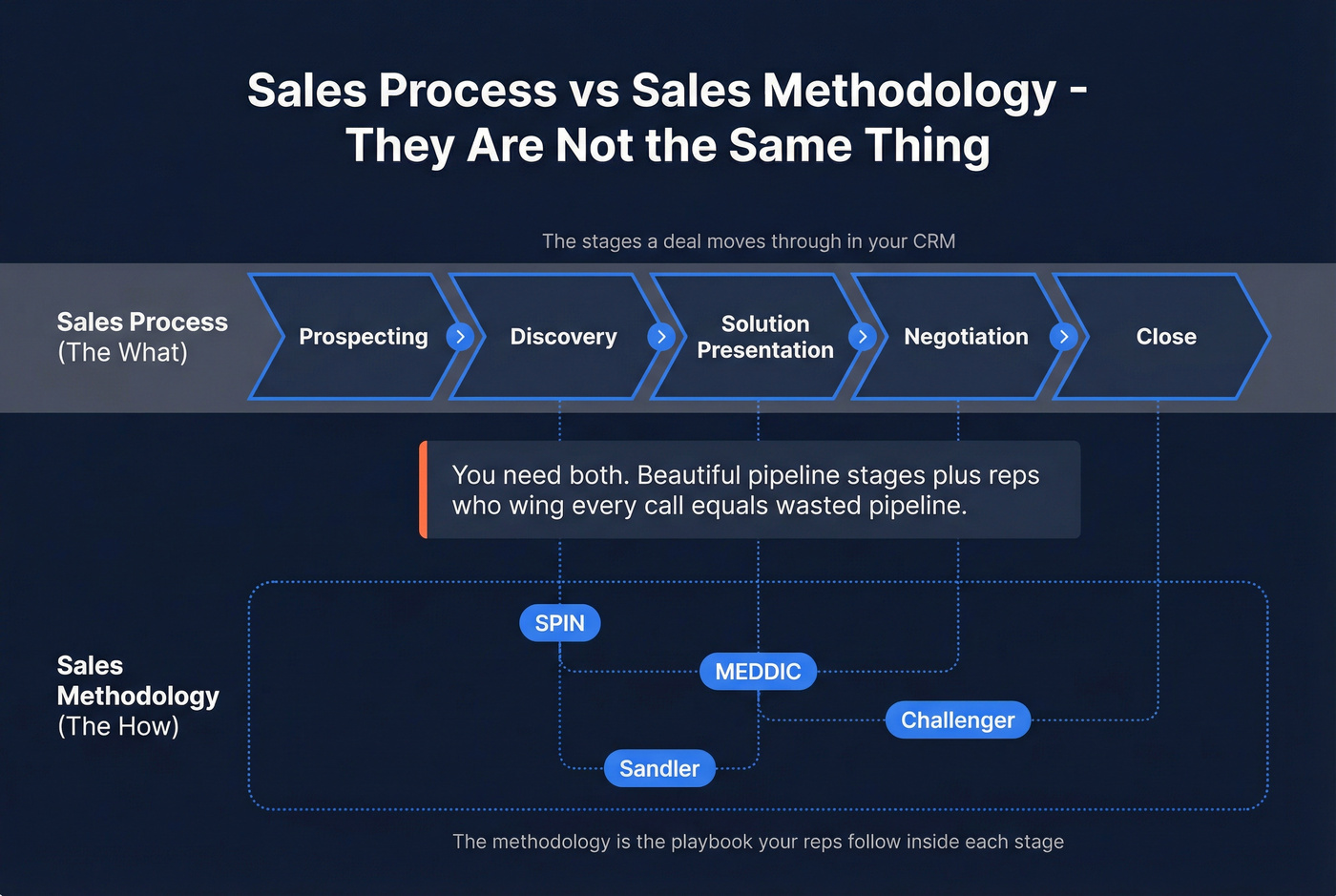
Think of the process as the pipeline stages in your CRM. The methodology is the playbook your reps follow inside each stage. You need both, and confusing them is how orgs end up with beautifully designed pipeline stages and reps who still wing every discovery call.
Fundamentals come first. There's a great analogy floating around Reddit - forcing a new rep to learn MEDDPICC before they can run a decent discovery call is like teaching a football player the triple-option before they've learned to tackle. If your team can't ask good questions, listen actively, and handle objections, no framework will save them.
The Numbers Behind the Problem
The average B2B win rate across all opportunities is roughly 21%. For qualified opportunities only, it climbs to 29%. For enterprise deals above $100K ACV, it drops to about 15%. And the stat that should keep every VP up at night: 40-60% of enterprise pipeline ends in no decision. Not a loss to a competitor - just nothing.
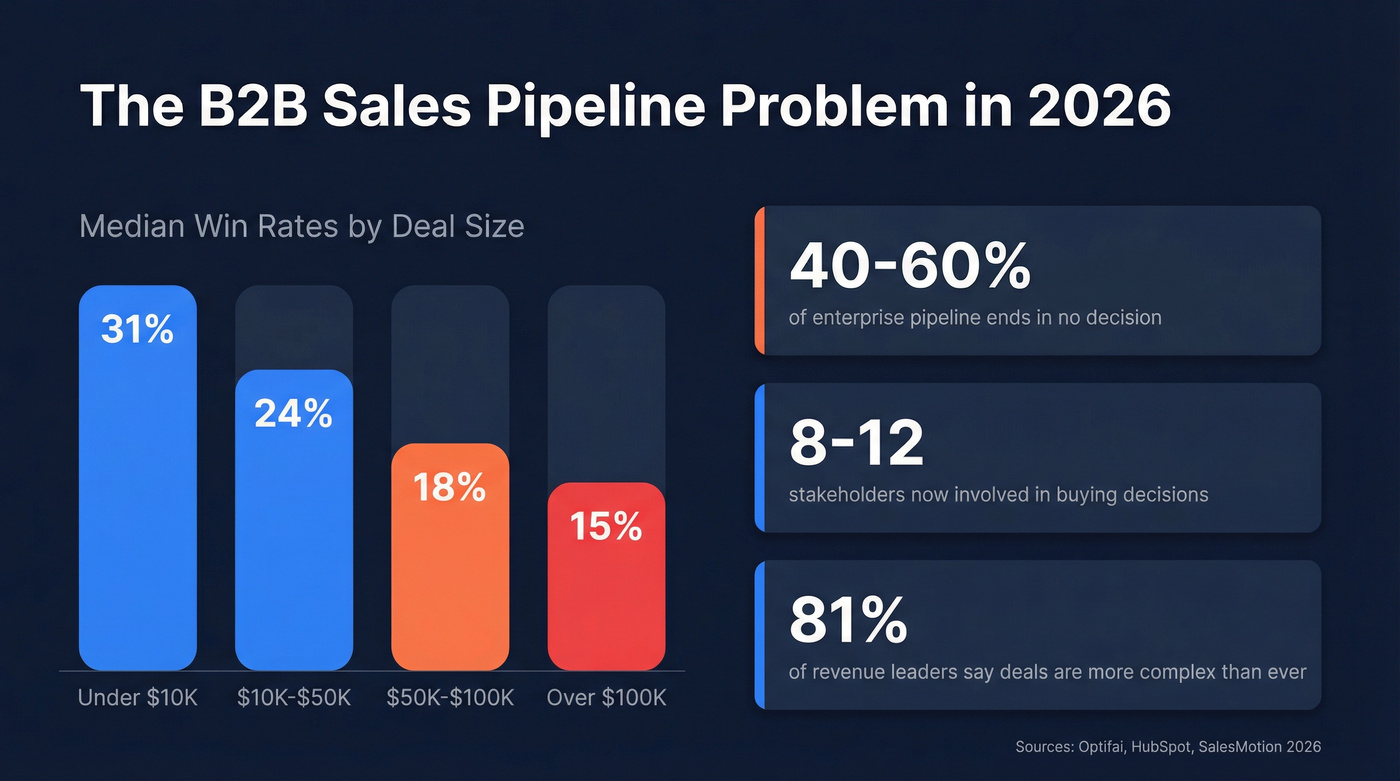
| ACV Tier | Median Win Rate |
|---|---|
| Under $10K | 31% |
| $10K-$50K | 24% |
| $50K-$100K | 18% |
| Over $100K | 15% |
Based on an Optifai benchmark study of 847 B2B SaaS companies (2026 data).
Decision committees have expanded from 3-5 stakeholders to 8-12. Sales cycles that used to close in three months now stretch to six or nine. 81% of revenue leaders say deals are more complex than they've ever been. Speed matters too - responding to inbound within five minutes correlates with 21% higher win rates, and after 24 hours, win rates drop roughly 60%.
This is why structured selling frameworks aren't optional anymore. Teams with fully documented qualification criteria see 40% higher close rates. Proper authority mapping produces 35% fewer late-stage deal collapses. Engaging three or more contacts per deal yields 2.4x higher close rates - and 3.1x for enterprise. The methodology gives your team the structure to do these things consistently, not just when a rep happens to remember.
12 Frameworks That Actually Get Used
MEDDIC / MEDDPICC
MEDDIC stands for Metrics, Economic Buyer, Decision Criteria, Decision Process, Identify Pain, Champion. MEDDPICC adds Paper Process and Competition. 73% of SaaS companies selling above $100K ARR use some version of MEDDIC, and teams that adopt MEDDPICC report 18% higher win rates and 24% larger deal sizes compared to simpler frameworks.
In practice, this sounds like a rep asking on a second call: "Who signs off on purchases above $50K? Walk me through what happens after they say yes - legal review, procurement, security?" Every answer fills a CRM field. Every empty field is a red flag.
Use this if: You're running enterprise outbound with 60+ day cycles and complex procurement. MEDDPICC's structured fields map cleanly to CRM data, making it the most AI-compatible framework for teams using call intelligence tools to auto-populate deal records.
Skip this if: Your team is junior and your deals are transactional. Average time-to-proficiency is 3.6 months. Forcing MEDDPICC on an SMB team selling $5K deals is overkill that breeds resentment and CRM abandonment.
Challenger Sale
Xerox implemented Challenger and saw a 17% increase in sales and $65M in contract value. That result wasn't accidental. Built on CEB research involving 6,000+ sales reps, Challenger's core loop is teach, tailor, take control - the rep leads with an insight the buyer didn't have, tailors the message to the stakeholder's priorities, and takes control of the commercial conversation.
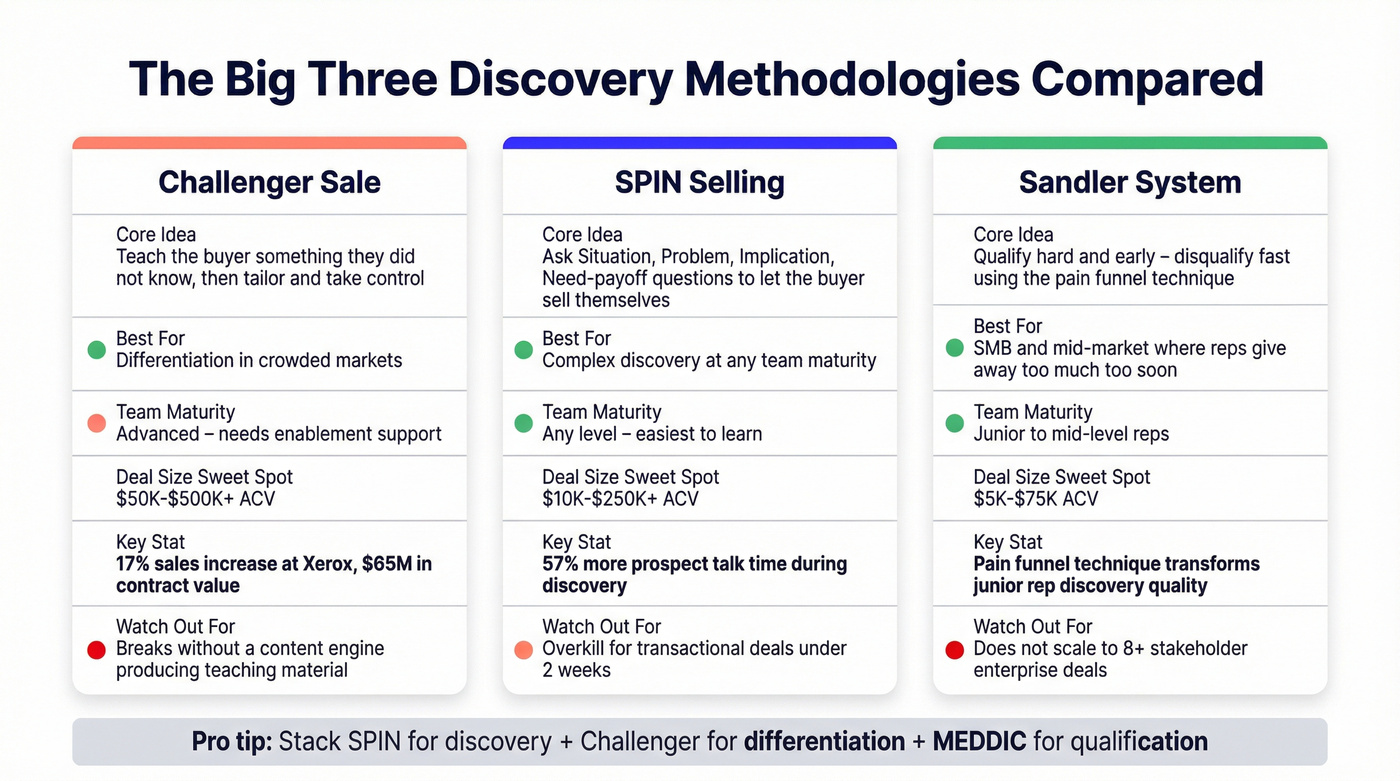
This is the approach that separates reps who compete on features from reps who compete on the conversation itself. But it breaks when individual reps have to create their own insights. Challenger needs sales enablement and marketing behind it - without a content engine producing "teaching" material at scale, your reps are improvising, and improvised insights are just opinions.
SPIN Selling
57% higher prospect talk time during discovery. That's what SPIN practitioners achieve versus traditional approaches - and in complex sales, the person talking less is usually winning. Neil Rackham developed SPIN from research analyzing 35,000+ sales calls across 20+ countries over 12 years. The framework - Situation, Problem, Implication, Need-payoff - remains the gold standard for complex discovery.
SPIN works at any team maturity level and pairs beautifully with MEDDIC as the discovery engine. Skip it only if your sales cycle is under two weeks and transactional - SPIN's depth is wasted on deals where the buyer already knows what they want.
GAP Selling
Keenan's framework focuses on the distance between the buyer's current state and their desired future state. The "current state" breaks into five elements: physical environment, problem, impact, root cause, and emotions. Stay problem-centric before discussing your solution - the gap is the sale.
Use this if: You're doing outcome-based selling in mid-market or enterprise. GAP Selling forces reps to understand business impact before pitching features.
Skip this if: Your primary contacts are procurement or IT people gathering quotes. Reddit threads consistently flag this friction - drilling contacts on numerical business goals when they don't have authority or access to those goals can push buyers to competitors who just send the quote.
Sandler Selling System
Sandler flips the traditional buyer-seller dynamic. The rep qualifies hard and early - "no mutual mystification" - and isn't afraid to disqualify. Its pain funnel is one of the most effective techniques for uncovering real buyer motivation: a series of increasingly specific questions that move from surface-level issues to the emotional and financial cost of inaction.
Use this if: You're in SMB or mid-market and your reps struggle with giving away the farm too early. The pain funnel technique alone can transform how junior reps handle discovery. For the official training program, see Sandler Training.
Skip this if: You're running enterprise deals with 8+ stakeholders. Sandler's conversational framework doesn't scale well to complex buying committees.
Solution Selling
Mike Bosworth's pain-focused approach was the consultative selling standard before Challenger came along. Reps diagnose pain, map it to capabilities, and build a vision of the solution. It's intuitive and doesn't require heavy training investment - a solid bridge framework for teams transitioning from product-push to consultative selling. But the modern B2B buyer has done their research. Solution Selling's assumption that the rep "discovers" the pain first feels dated when the prospect already has a shortlist.
SNAP Selling
Jill Konrath's framework - Simple, iNvaluable, Aligned, Priority - is designed for busy C-suite buyers who won't give you 45 minutes for discovery. Keep it simple, make yourself invaluable, align with their priorities, and raise the urgency. It's the antidote to overengineered discovery calls that lose the buyer in the first five minutes. Skip it for complex multi-stakeholder deals - SNAP doesn't have the depth for consensus-building.
Consultative Selling
Less a formal framework and more a philosophy: understand the client's business deeply, become a trusted advisor, and let the relationship drive revenue. Best for professional services, strategic accounts, or any motion where lifetime value dwarfs the initial deal. Don't use it when speed matters more than depth - consultative selling is a slow burn.
BANT and Modern Variants
IBM created BANT in the 1950s: Budget, Authority, Need, Timeline. It's the most widely known qualification framework and the most outdated as a standalone. Modern variants like CHAMP, ANUM, and FAINT address some gaps. BANT is a starting point, not a destination - use it for lightweight initial qualification of inbound leads or junior SDRs.
NEAT Selling
Need, Economic impact, Access to authority, Timeline. NEAT is BANT's evolution for teams that want more rigor without the weight of MEDDIC. Good for mid-market teams with 14-30 day cycles. A related modern hybrid, SPICED (Situation, Pain, Impact, Critical Event, Decision), takes a similar approach with more emphasis on urgency triggers.
Inbound Sales Methodology
Aligned to the buyer journey: awareness, consideration, decision. The inbound approach meets the buyer where they are instead of pushing a linear sales process. Use this if you're running a PLG or inbound-heavy motion where prospects self-educate before ever talking to a rep.
Command of the Message
Force Management's value-based messaging framework ensures every rep articulates value consistently. It's a messaging layer, not a full methodology - pair it with MEDDIC or Challenger for large sales orgs where messaging drift is a real problem.

MEDDIC can't help you if you're emailing the wrong Economic Buyer. Prospeo gives your reps 300M+ verified profiles with 30+ filters - including job title, department headcount, and buyer intent - so every deal starts with the right contact, not a bounced email.
Stop qualifying ghosts. Start qualifying real buyers.
How to Choose the Right Methodology
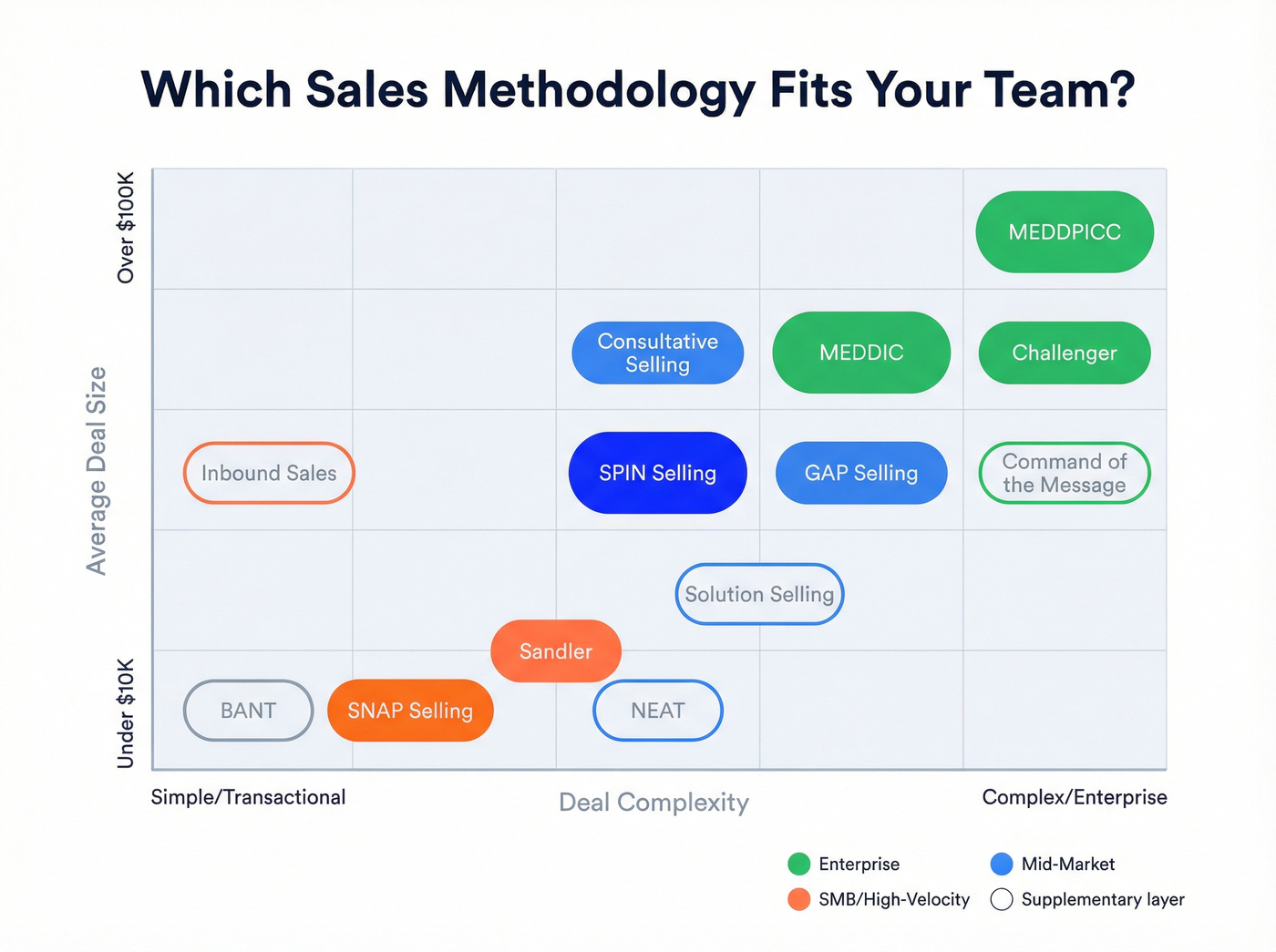
| Methodology | Deal Profile | Maturity | AI Fit | Best Motion |
|---|---|---|---|---|
| MEDDIC/MEDDPICC | $50K+ / 60+ days | Intermediate+ | ★★★★★ | Enterprise outbound |
| Challenger | $25K+ / 30+ days | Advanced | ★★★☆☆ | Competitive markets |
| SPIN | $10K+ / 30+ days | Any | ★★★☆☆ | Complex discovery |
| GAP Selling | $25K+ / 30+ days | Intermediate+ | ★★★☆☆ | Outcome-based |
| Sandler | $5K-$50K / 14-60 days | Any | ★★☆☆☆ | SMB/mid-market |
| SNAP | Any / <30 days | Any | ★★☆☆☆ | High-velocity |
| BANT/CHAMP | Any / Any | Junior | ★★★★☆ | Initial qualification |
| NEAT | $5K-$50K / 14-30 days | Any | ★★★☆☆ | Mid-market |
If you're staring at this and still unsure, read the next section. You probably don't need one methodology - you need a stack.
Building a Methodology Stack
Here's the thing most articles won't tell you: high-performing teams don't pick one framework. They pick two or three and assign each to a specific stage of the deal. The qualification layer handles one job, the discovery layer handles another, and the differentiation layer handles a third.
Enterprise outbound (deals above $50K): MEDDIC for qualification + SPIN for discovery + Challenger for differentiation. This is the stack we've seen work most consistently for teams selling into large buying committees.
Mid-market ($10K-$50K): Sandler for qualification + GAP Selling for discovery. Lighter weight, faster to implement, and Sandler's "disqualify early" ethos keeps the pipeline honest.
SMB / high-velocity: SNAP for engagement + BANT/CHAMP for quick qualification. Don't overthink it - at this velocity, speed and discipline matter more than framework sophistication.
Inbound / PLG: Inbound Selling for lead handling + NEAT for qualification. Meets the buyer where they are without forcing an outbound-style process onto someone who filled out a form.
The key is assigning each framework to a specific stage so reps aren't confused about when to use what. Multi-threading across 3+ contacts per deal yields 2.4x higher close rates - your methodology stack should make that multi-threading systematic, not accidental.
Let's be honest about one thing: MEDDIC is still the best all-in-one framework for enterprise. But most teams don't need all-in-one. If your average deal is under $25K, a Sandler + NEAT stack will outperform MEDDPICC every time - because your reps will actually use it instead of treating it as a CRM chore they ignore.
Why Most Rollouts Fail
Four structural failures kill methodology rollouts. Fix them and virtually any framework will produce results.
Pipeline stages don't map to buyer actions. Most CRMs have stages defined by internal activities - "demo completed," "proposal sent." But the buyer doesn't care about your internal milestones. Stages should be defined by observable buyer actions: "champion confirmed," "decision criteria shared," "paper process initiated." If your stages don't reflect what the buyer is doing, your methodology has no foundation.
No coaching cadence tied to the methodology. Deal reviews become status updates - "where's this deal at?" - instead of methodology-aligned coaching. "Who's the Economic Buyer? What's the paper process? Where's the champion?" Those questions should be the backbone of every weekly review. If managers aren't asking them, the methodology is dead on arrival.
Managers are trapped in deal jail. Your frontline managers are closing deals and firefighting instead of coaching. This is the most common and most destructive failure mode. The fix is structural: reduce span of control and use call intelligence tools like Gong or Chorus so managers can coach asynchronously instead of sitting on every call.
Training without reinforcement is just entertainment. A two-day workshop with no follow-up produces exactly zero behavior change. Reinforcement means weekly roleplays, internal spotlights on reps who execute the methodology well, and CRM-embedded prompts that force reps to fill in methodology fields before advancing a deal. If you're not doing all three, save your training budget.
We've all sat through that exact two-day training, gotten a binder, and never opened it again. That's not your fault - it's a leadership failure.
Implementation Checklist (2026)
These conditions need to be true before your methodology rollout has a chance:
- Leadership models the methodology in every deal review - not just endorses it
- CRM fields map to methodology elements (MEDDIC fields, SPIN question logs, Challenger insight tracking)
- Weekly sales coaching cadence is tied to the methodology, not pipeline status
- Reinforcement plan is active: roleplays, call reviews, internal spotlights on wins
- Revenue operations KPIs are methodology-aware: win rate by stage, qualification-to-close ratio, deal velocity
- Data quality is locked down: verified emails and direct dials for every target account
That last point is where we've seen rollouts quietly fail. Your methodology is only as good as your ability to reach the right people. If half your emails bounce, MEDDIC's "Economic Buyer" field stays empty. Prospeo gives your team 143M+ verified emails at 98% accuracy and 125M+ verified mobile numbers - refreshed every 7 days, not every 6 weeks. Your reps spend time qualifying, not hunting for working contact info.

Choosing for AI-Powered Teams
MEDDIC/MEDDPICC is the most AI-compatible framework right now. Its elements map cleanly to structured CRM fields that AI tools can auto-populate from call recordings. SPIN and Sandler produce conversational outputs - valuable for the rep in the moment, but harder for AI to parse and structure automatically.
This matters because reps spend only 28% of their week actually selling. The rest is admin, data entry, and internal meetings. The framework that reduces admin overhead wins - and in 2026, that means choosing approaches whose outputs are machine-readable. If your AI tools can auto-fill MEDDIC fields from a Gong transcript, your reps get time back. If they're using a conversational framework that lives in the rep's head, the AI can't help.
The Socratic Method in Sales
One approach that cuts across formal frameworks is the Socratic method - using carefully sequenced questions to guide prospects toward their own conclusions rather than telling them what to think. SPIN's Implication and Need-payoff questions are essentially Socratic in design, and Sandler's pain funnel follows the same logic. Daniel Pink explores a related idea in To Sell Is Human, arguing that the modern seller succeeds by serving and asking rather than pitching and persuading. His concept of "attunement" - stepping outside your own perspective to understand the buyer's - aligns naturally with a customer-centric approach where the rep's job is to help the buyer decide, not override their thinking.
Engaging 3+ contacts per deal yields 2.4x higher close rates. But multi-threading fails when your data is stale. Prospeo refreshes every 7 days and delivers 98% email accuracy - so your Challenger insights and SPIN questions reach actual decision-makers, not dead inboxes.
Your methodology is only as good as the data feeding it.
FAQ
What's the difference between a sales methodology and a sales process?
A sales process defines the stages a deal moves through (prospecting to close); a sales methodology is the framework reps use within each stage to qualify, discover pain, and advance deals. Process is the "what," methodology is the "how." You need both - beautifully designed stages mean nothing if reps wing every call.
Which methodology works best for SaaS?
For enterprise SaaS above $50K ACV, MEDDIC/MEDDPICC - 73% of SaaS companies above $100K ARR use some version. For mid-market, pair Sandler with NEAT. Match the framework to your deal size, cycle length, and team maturity rather than chasing a universal "best."
Can you combine multiple frameworks?
Yes, and most high-performing teams do. A proven enterprise stack: MEDDIC for qualification, SPIN for discovery, Challenger for differentiation. Assign each to a specific deal stage so reps know when to apply what - overlap causes confusion, clear boundaries create consistency.
Why do methodology rollouts fail?
Four reasons: pipeline stages don't map to buyer actions, no coaching cadence tied to the framework, managers are too busy closing deals to coach, and training happens once with no reinforcement. Fix those structural issues and virtually any methodology will produce measurable results.
What tools support methodology execution?
CRM platforms like Salesforce and HubSpot for methodology-aligned fields, call intelligence tools like Gong and Chorus for coaching, and verified contact data from Prospeo so reps can actually reach the Economic Buyer or Champion they need to qualify.