

Sales Metrics Tracking: Benchmarks, Cadences, and the KPIs That Actually Matter
Only 43.5% of sales professionals hit quota in recent years. Reps spend roughly 30% of their time actually selling. The other 70% disappears into admin, internal meetings, and CRM hygiene nobody's doing well.
Most teams respond by adding more metrics to the dashboard - 15, 20, 26 KPIs blinking in Salesforce - and acting on none of them. That's not sales metrics tracking. It's data hoarding.
The real problem isn't a lack of data. It's a lack of discipline about which data matters, how often you review it, and whether anyone's accountable for moving the numbers. Tracking effectively starts with choosing fewer numbers and reviewing them more often.
The Short Version
Six metrics cover 90% of what a sales team needs to operate:
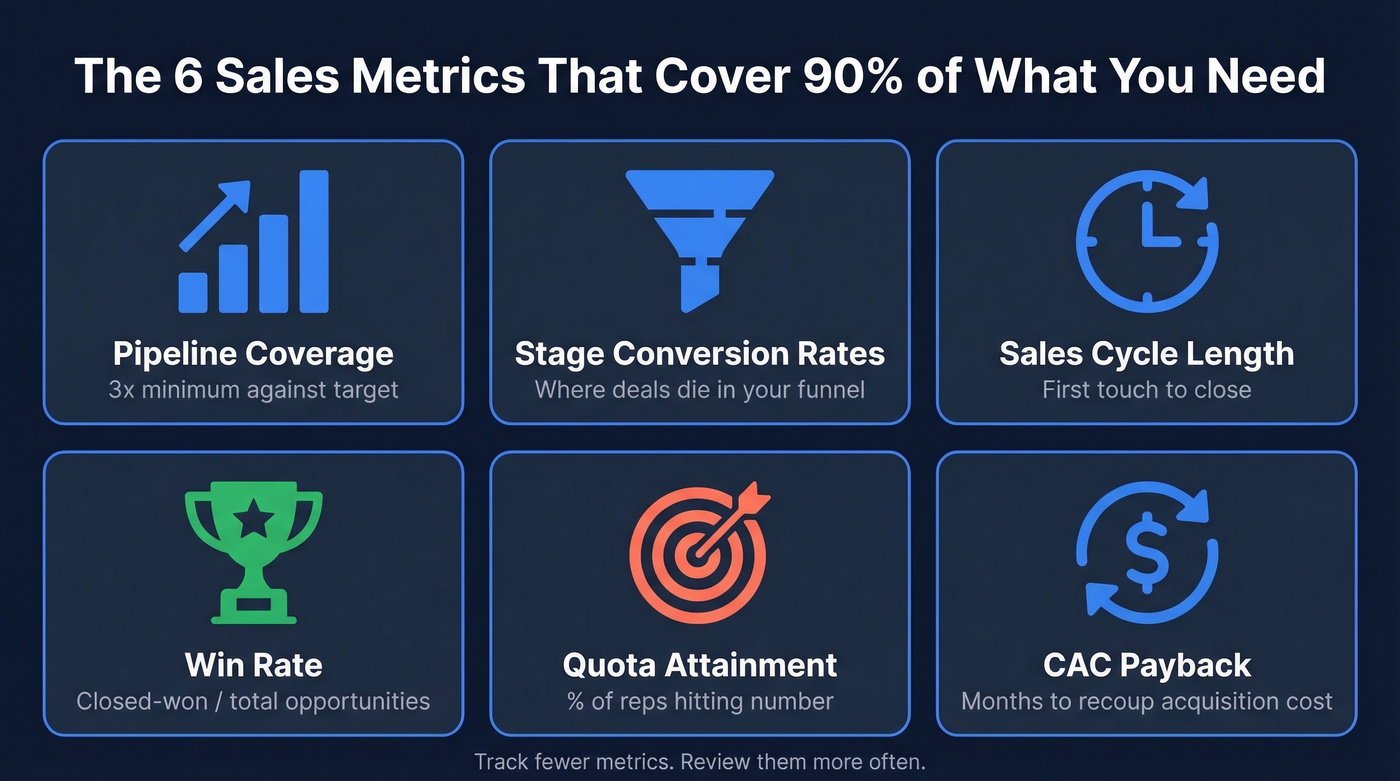
- Pipeline coverage - 3x minimum against target
- Stage conversion rates - where deals die in your funnel
- Sales cycle length - first touch to close
- Win rate - closed-won deals / total opportunities
- Quota attainment - percentage of reps hitting number
- CAC payback - months to recoup customer acquisition cost
Review pipeline and activity-to-conversion ratios weekly. Dig into conversion trends and data hygiene monthly. Recalibrate CAC payback, NRR, and quota attainment quarterly. And before any of this means anything, you need one prerequisite nobody talks about: clean CRM data. Metrics built on stale records are just expensive fiction.
Metrics vs. KPIs - Why the Distinction Matters
People use these interchangeably. They shouldn't.
A metric is a raw measurement - your win rate is 24%. A KPI ties that metric to a target and a timeframe: "increase win rate from 24% to 30% by Q3 2026." Every KPI is a metric, but not every metric is a KPI.
This distinction changes how you build dashboards. Metrics tell you what's happening. KPIs tell you whether what's happening is good enough. The best systems pair leading indicators (activity, pipeline creation) with lagging ones (revenue, retention) so you can see problems before they show up in the P&L. Outreach's framework puts it well: KPIs require a target and an objective. Without those, you're just watching numbers move.
The KPIs That Actually Matter
If you're tracking more than 10 metrics, you're tracking zero. Different roles need different views - reps track activity-to-conversion, managers track pipeline and coaching metrics, execs track revenue and retention. The categories below cover the full picture.
Activity Metrics
Calls, emails, meetings booked. These are the easiest to measure and the most dangerous to optimize in isolation. Two hundred calls means nothing if your connect rate is 2%.
Activity metrics only matter when paired with conversion context - calls-to-meetings, emails-to-replies, meetings-to-opportunities. Without that link, you're rewarding effort instead of outcomes.
Pipeline Metrics
Three numbers matter most.
Pipeline coverage = total pipeline value / revenue target. The floor is 3:1. Below that, you're hoping, not forecasting.
Pipeline velocity = (qualified opportunities x win rate x average deal size) / sales cycle length. This is one of the best compound metrics for understanding revenue momentum, per Allego's framework.
Deal slippage = deals that missed their close date / total committed deals. If slippage runs above 20%, your stage definitions are broken or reps are sandbagging commit dates.
Conversion Rate Tracking
Win rate = closed-won / total opportunities x 100. Simple, but the benchmark range matters.
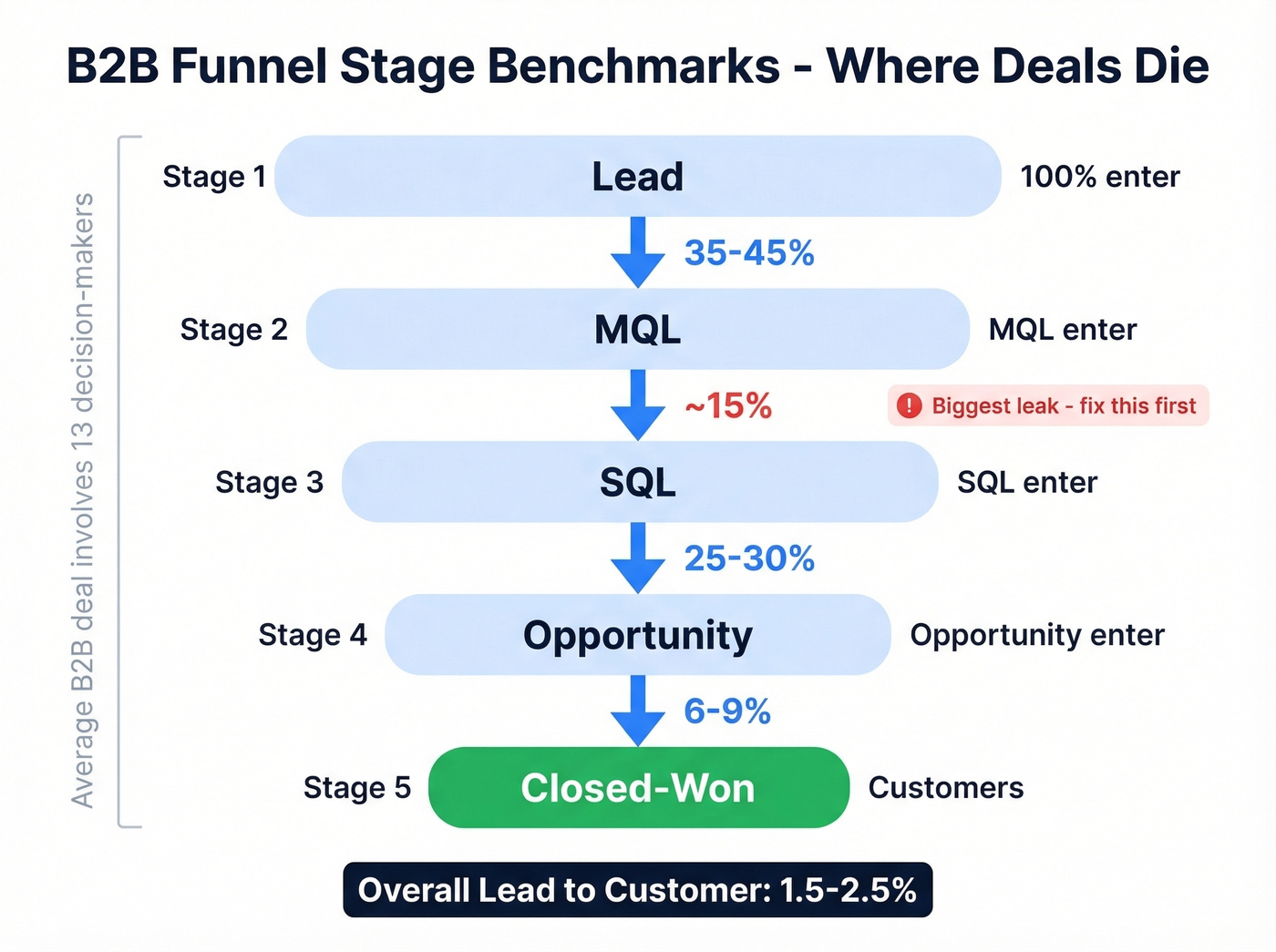
Your lead-to-customer conversion rate is the reality check on your entire go-to-market system: median B2B conversion sits at 2.9% from lead to customer, with most companies landing between 2.0% and 5.0%. Stage-by-stage conversion rates reveal where the funnel leaks - and the biggest leak is almost always MQL to SQL, where only about 15% survive.
One concrete lever worth tracking: prospects who interact with interactive demos convert 3.2x more often (10.1% vs. 3.1%) and close in 27 days versus 33. If you aren't measuring demo engagement as a conversion signal, you're missing one of the strongest predictors in your funnel.
Revenue and Retention
These are the numbers your board cares about.
CAC = (sales + marketing costs) / new customers acquired. Median payback is 15-18 months; elite companies get under 12.
LTV:CAC should land between 3:1 and 5:1. Below 3:1, you're spending too much to acquire. Above 5:1, you're probably underinvesting in growth.
NRR = ((starting MRR + expansion - churn - downgrades) / starting MRR) x 100. Top performers hit 120%+, which correlates with 2.3x higher valuations. If you're only tracking new logo revenue and ignoring NRR, you're missing the metric that matters most for long-term health.
Team Health
Quota attainment, ramp time, and rep turnover. These are the coaching-oriented metrics most dashboards miss entirely. If only 43.5% of reps are hitting quota, the problem isn't motivation - it's enablement, territory design, or unrealistic targets. Track ramp time by cohort. Track turnover against quota attainment.
One metric most teams skip: coachability, measured by training uptake, feedback response time, and performance improvement after coaching sessions. These tell you whether your sales org is sustainable, not just productive.
Funnel Stage Benchmarks
This is where deals die. Here's the stage waterfall for a typical B2B funnel:
| Stage | Conversion Rate |
|---|---|
| Lead to MQL | 35-45% |
| MQL to SQL | ~15% |
| SQL to Opportunity | 25-30% |
| Opportunity to Closed-Won | 6-9% |
| Overall Lead to Customer | 1.5-2.5% |
The biggest leak is MQL to SQL - only 15% survive that handoff. If your MQL-to-SQL rate is below 10%, your lead scoring model is broken or your SDRs don't trust the leads marketing sends over.
The average B2B deal now involves 13 decision-makers, and 80% of buyer interactions happen digitally. Your conversion metrics need to account for multi-threading, not single-contact progression.

Your MQL-to-SQL conversion rate tanks when reps chase stale contacts. Prospeo refreshes 300M+ profiles every 7 days - not every 6 weeks - so your pipeline metrics reflect real opportunities, not dead leads. 98% email accuracy means your activity-to-conversion ratios actually mean something.
Stop tracking metrics built on bad data. Start with contacts that connect.
Segment Benchmarks
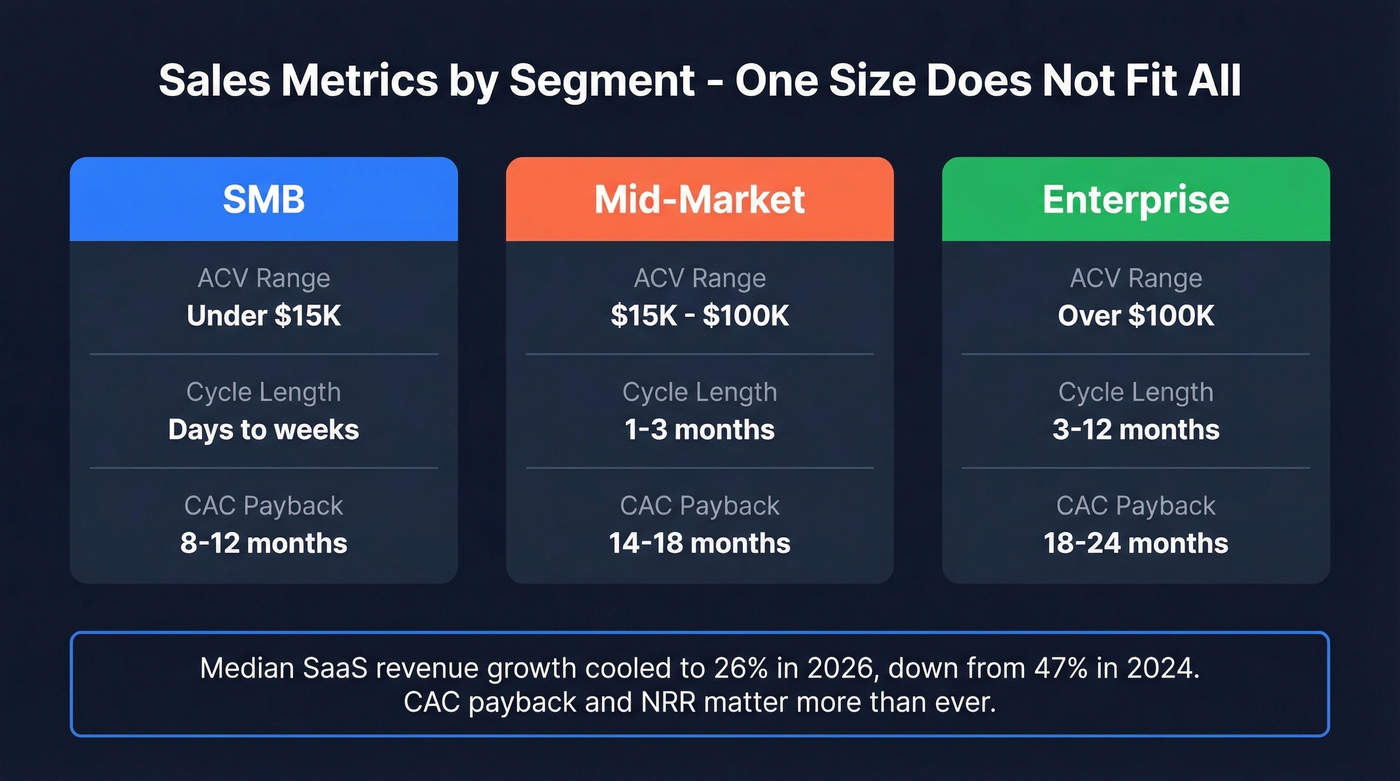
Your metrics mean nothing without segment context. A 90-day sales cycle is terrible for SMB and perfectly normal for enterprise.
| Segment | ACV Range | Cycle Length | CAC Payback |
|---|---|---|---|
| SMB | <$15K | Days to weeks | 8-12 months |
| Mid-Market | $15K-$100K | 1-3 months | 14-18 months |
| Enterprise | >$100K | 3-12 months | 18-24 months |
Early-stage companies under $5M ARR typically see ~$12K ACV; growth-stage orgs ($10M-$50M ARR) average ~$35K. Median SaaS revenue growth has cooled to 26% in 2026, down from 47% in 2024. That compression means CAC payback and NRR matter more than ever - growth alone won't paper over inefficiency anymore.
Here's the thing: if your average deal size is under $15K, you probably don't need 26 metrics and a six-figure BI tool. Pipeline coverage, win rate, and cycle length will tell you 80% of what you need to know. Save the complex dashboards for when your deal complexity justifies them.
Building a Review Cadence
ParkerGale's operating philosophy nails it: "Less Data, More Often." Weekly reporting isn't about perfect analytics. It's about discipline and operating rhythm. Dashboards don't drive change. People do.
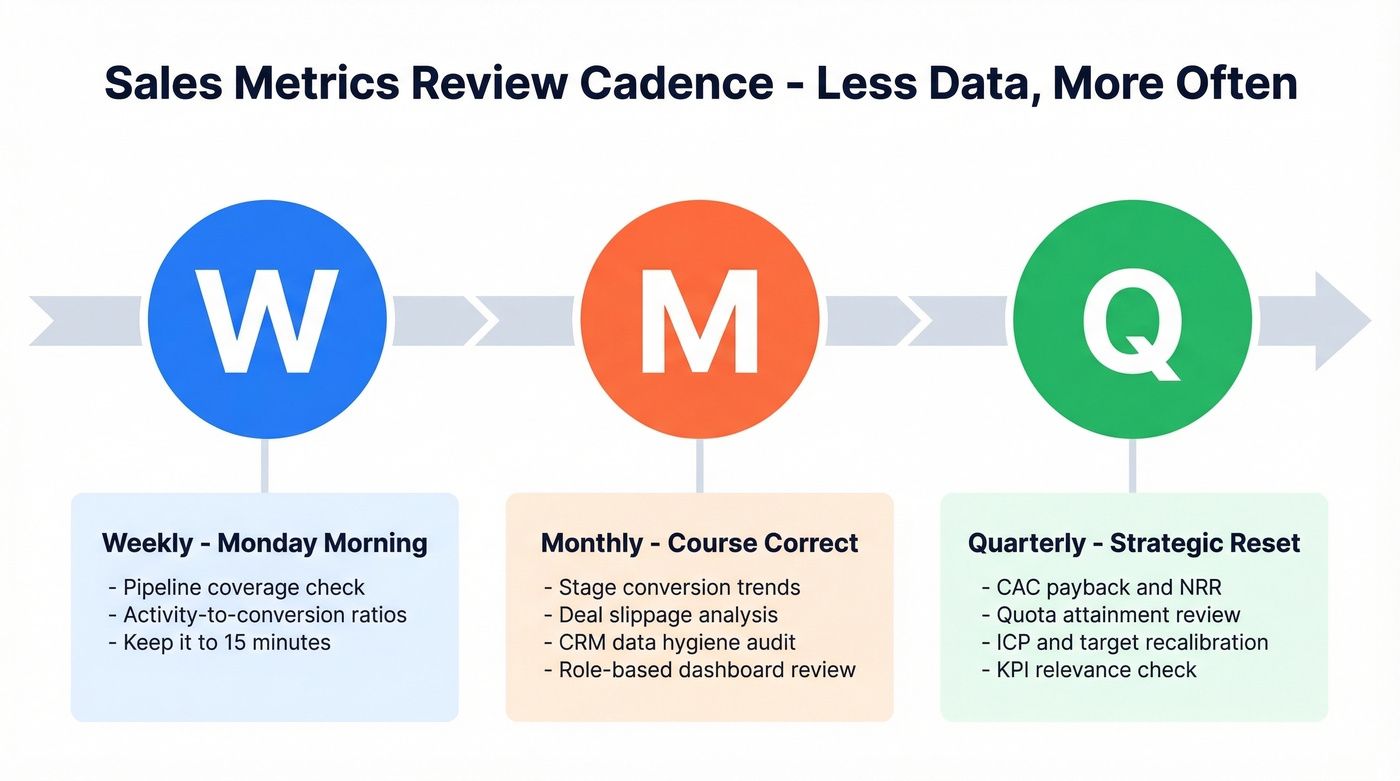
Weekly: Pipeline coverage and activity-to-conversion ratios. This is your Monday morning check - do we have enough pipe, and is rep activity translating into meetings? Ask any RevOps lead what they actually check on Monday morning, and you'll hear the same two things: pipeline coverage and stage conversion rates. Keep the meeting to 15 minutes. If it runs longer, your data is too messy or your metrics are too many.
Monthly: Stage conversion trends, deal slippage, and a data hygiene audit. This is where you catch systemic issues - a stage that's leaking worse than last month, a segment that's underperforming. Monthly analysis at this level is how you measure progress against quarterly targets before it's too late to course-correct.
Audit contact data freshness as part of this cycle. Build role-based dashboards so each stakeholder sees what they need without drowning in someone else's numbers. Keep leaderboards to three metrics max - more than that and they backfire, diluting focus instead of driving it.
Quarterly: CAC payback, NRR, quota attainment, and strategic recalibration. This is where you ask whether your targets still make sense, whether your ideal customer profile has shifted, and whether the KPIs you chose three months ago are still the right ones.
Five Mistakes That Kill Your Dashboard
1. Tracking 26 metrics and acting on none. Bernard Marr called it being "data rich, but insight poor." If your dashboard has more than 10 KPIs, nobody owns any of them. Pick six. Assign owners. Review weekly.
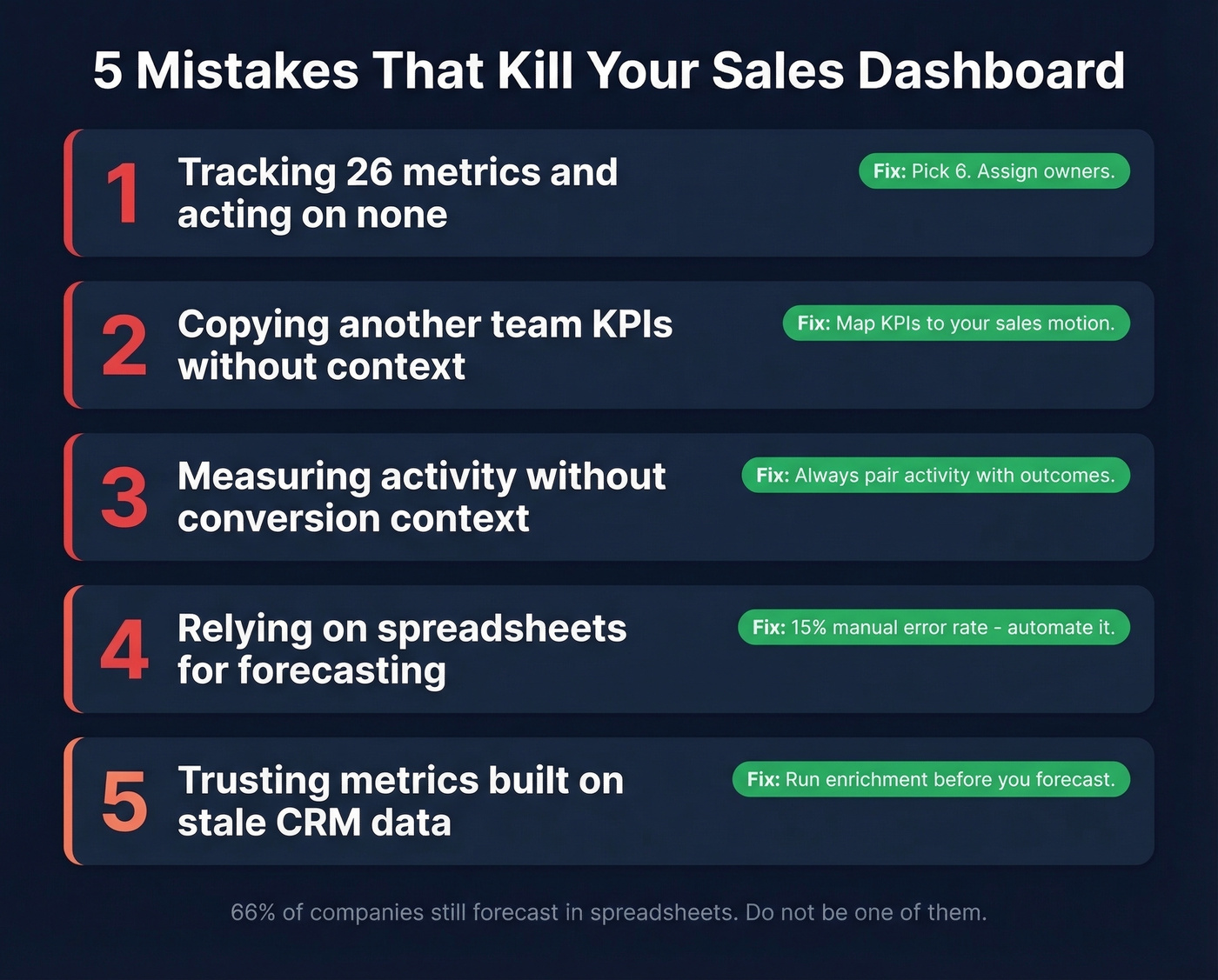
2. Copying another team's KPIs without context. Your Series B SaaS company doesn't need the same metrics as Salesforce. A PLG motion tracks activation and expansion revenue. An outbound-heavy org tracks pipeline creation and connect rates. Borrowing KPIs from a blog post without mapping them to your sales motion is how you end up measuring things nobody can influence.
3. Measuring activity without conversion context. We've seen this pattern repeatedly: a team celebrates 2,000 outbound calls in a week while pipeline creation is flat. The activity dashboard is green. The revenue dashboard is red. Nobody connects the two until the quarter's already lost.
4. Relying on spreadsheets. 66% of companies still forecast in spreadsheets, with a manual error rate averaging around 15%. Traditional spreadsheet forecasting hits 70-79% accuracy at best. That's a coin flip with extra steps.
5. Trusting metrics built on stale CRM data. Your dashboard says pipeline coverage is 4.2x. Looks healthy. But 30% of those opportunities haven't been updated in 60 days. Contact emails are bouncing. Decision-makers have changed roles. Your real coverage is closer to 2x, and you won't know until the forecast misses. If your CRM contacts haven't been refreshed in months, your pipeline coverage is a fiction - run an enrichment pass before you trust your next forecast.
How AI Changes Forecasting in 2026
89% of revenue organizations now use AI in some capacity, up from 34% in 2023. Teams using AI forecasting report 15-20% higher forecast accuracy, 25% shorter sales cycles, and up to 30% improvement in quota attainment.
What makes AI forecasting different isn't just speed - it's the inputs. Traditional forecasting relies on CRM fields that reps update (or don't). AI pulls from behavioral and engagement data: email sentiment, meeting attendance patterns, stakeholder expansion within an account, content engagement signals. Leading organizations are hitting 95%+ accuracy on 30-90 day forecasts.
AI doesn't fix dirty data, though. It amplifies it.
The teams getting 95% accuracy aren't just buying better software - they're maintaining cleaner CRM data and enforcing stricter stage definitions. In our experience, tools like Prospeo that refresh records on a 7-day cycle (vs. the 6-week industry average) make a measurable difference here, because AI-powered forecasting only works when the underlying data is trustworthy. If you're evaluating platforms, compare sales forecasting solutions and the broader set of best sales forecasting tools before you commit.
If your CAC payback is creeping past 18 months, the problem might not be your funnel - it's the data feeding it. At $0.01 per verified email, Prospeo cuts acquisition costs so your LTV:CAC ratio stays in the 3:1-5:1 sweet spot. Teams using Prospeo book 26% more meetings than ZoomInfo users.
Shrink your CAC payback by starting with data that actually converts.
FAQ
What's a good win rate for B2B sales?
Median B2B win rates land between 15% and 25% for most industries. Enterprise deals with long cycles often close at 10-15%, while transactional SMB deals can hit 30%+. The trend matters more than the absolute number - a win rate declining quarter over quarter signals pipeline quality or competitive positioning problems regardless of where it benchmarks.
How many sales metrics should a team track?
Six to ten, max. Start with pipeline coverage, stage conversion rates, win rate, sales cycle length, quota attainment, and CAC payback. Add more only when you're consistently acting on these first. Tracking 20+ KPIs usually means acting on none - dashboards people glance at but nobody uses to make decisions.
How do you measure sales progress effectively?
Pair leading indicators with lagging ones. Activity and pipeline creation tell you whether you're on track this week; win rate, quota attainment, and revenue confirm whether activity translated into results. Review leading indicators weekly and lagging indicators monthly or quarterly. If activity is high but conversion is flat, you have a quality problem, not a volume problem.
How do you keep CRM data accurate for reliable metrics?
Audit contact records monthly, enforce consistent stage definitions across reps, and use enrichment tools with high match rates and short refresh cycles. Metrics built on stale records produce bad forecasts and worse decisions - and we've seen teams discover that 30%+ of their "active" pipeline was built on contacts who'd already changed jobs.