

Sales Models Explained: Types, Benchmarks, and a Framework for Choosing the Right One
Your SDR team makes 55 calls a day and books two meetings a week. Emails bounce at 35%. Half the phone numbers ring disconnected. The CRO says the problem is "pipeline discipline." The real problem? Nobody's examined whether the sales model itself still fits.
Here's a framework with benchmarks, a decision matrix, and the execution layer most guides skip.
What Is a Sales Model?
The terms "sales model," "sales process," and "sales methodology" get used interchangeably. They shouldn't.
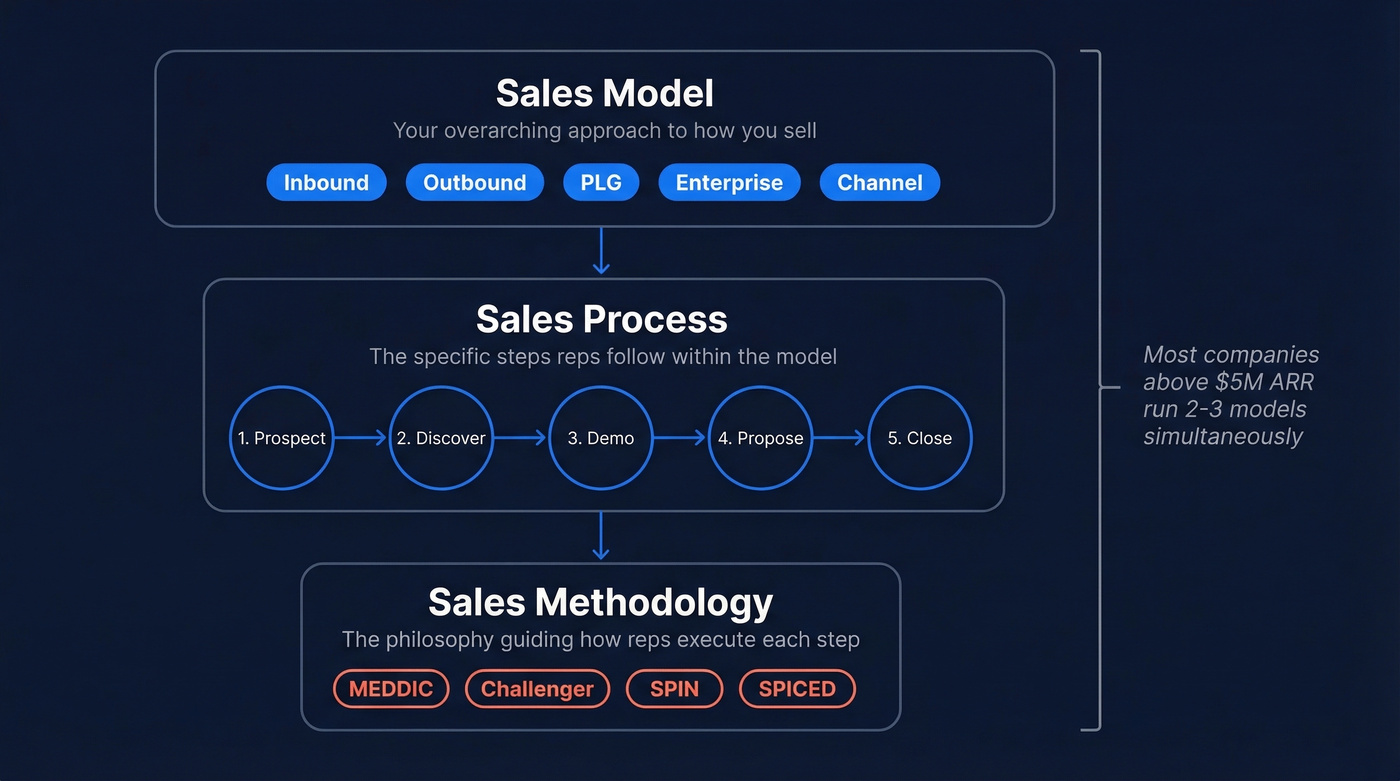
A sales model is your organization's overarching approach to how you sell - inbound, outbound, product-led, enterprise, channel, or some combination. It defines who initiates contact, how deals flow, and what the team looks like.
A sales process is the specific sequence of steps reps follow within that model - prospecting, discovery, demo, proposal, close. Two companies running the same model will have different processes.
A sales methodology is the philosophy guiding how reps execute those steps. MEDDIC, Challenger, SPIN, SPICED - these are methodologies. The most common question on r/sales isn't "what's the best methodology?" - it's "which one works for your context and why?" That's the right framing.
Companies above $5M ARR almost never run a single selling motion. They run two or three simultaneously - PLG for SMB, outbound for mid-market, enterprise for strategic accounts. The question isn't "which model should we pick?" It's "what blend fits our market, product, and stage?"
Why Your Selling Approach Matters in 2026
Gartner projected 80% of B2B sales interactions would happen in digital channels by 2025, and the shift has only accelerated. Buyers now use roughly 10 interaction channels on average, up from five in 2016. And 33% of all buyers prefer a completely seller-free experience - a number that climbs to 44% among millennials.
Average close rates sit at 29%. Win rates hover around 21%.
McKinsey's "rule of thirds" captures the new reality: at any buying stage, roughly one-third of buyers prefer in-person, one-third prefer remote, and one-third prefer digital self-serve. That's why 90% of companies plan to stick with hybrid approaches. A Bain analysis of ~200 large companies found that more than half saw sales and marketing costs rise as a percentage of revenue - complexity is eating margin.
Picking the right model blend isn't academic. It's the difference between scaling efficiently and burning cash.
8 Types of Sales Models
PLG isn't optional anymore - any guide that ignores it is stuck in 2018. Here are the eight types worth evaluating, with benchmarks and fit criteria for each.
Inbound
Content, SEO, and paid channels attract buyers who initiate contact. Marketing generates MQLs; sales qualifies and closes. Best for: companies with strong content operations and products buyers actively research. Key metric: MQL-to-SQL conversion rate. Reality check: B2B SaaS website conversion averages just 1.1%, so you need serious volume or exceptional targeting to make inbound your primary motion.
Outbound
Why do some teams book 15 meetings a week while others struggle to book 3? It's rarely about effort - it's about data quality. Reps initiate contact through cold email, cold calls, and social selling. Best for: teams with a defined ICP and ACV above $5K. Key metric: meetings booked per rep per week.
Outbound is only as good as the data powering it. Bad emails and disconnected numbers turn activity into noise. We've seen teams double their meeting rate without changing a single word of their messaging - just by fixing the contact data underneath.
Direct Sales
Field reps sell face-to-face for high-value deals where relationships and on-site presence matter. Best for: complex products where the buyer expects a handshake before signing a six-figure contract - medical devices, industrial equipment, infrastructure. Key metric: ACV and deal velocity. Expensive, but hard to replace at the top of the market.
Consultative / Solution Selling
Diagnosis-first selling where the rep acts more like an advisor than a product pusher. The sale starts with understanding the problem, not pitching the product. Best for: complex problems where the buyer doesn't fully understand their own requirements. Key metric: win rate. Consultative sellers close at higher rates because they've earned trust through discovery - and that trust compounds across deal stages in ways that are hard to measure but impossible to fake.
Account-Based (ABM)
Target a defined list of named accounts, multi-thread into the buying committee, and run coordinated plays. Best for: narrow TAMs with high ACV that justify the investment. Key metric: pipeline generated per account. It's common for ~60% of revenue to come from the top 5% of accounts in ABM motions - when it works, the concentration is dramatic.
Partner / Channel
Resellers, referral partners, VARs, and technology alliances sell on your behalf. Best for: products needing local expertise, industry-specific positioning, or geographic coverage you can't economically staff with direct reps. Key metric: partner-sourced revenue as a percentage of total. Expect 20-40% margin sharing.
Product-Led Growth (PLG)
The product itself drives acquisition, activation, and expansion. Dropbox, Calendly, Zoho, and Notion all run PLG. Best for: simple, intuitive products with broad horizontal markets and price points of $5-$100/user/month. Key metric: PQL activation rate.
Skip this if your product requires a 45-minute demo to understand. PLG isn't your primary motion - it's a supporting one at best.
Enterprise
High ACV, long cycles, multiple decision-makers, and significant implementation requirements. Best for: products with $100K+ ACV and multiple stakeholders in the buying process. Key metric: deal cycle length. Buyers spend just 17% of their buying time meeting suppliers, so every interaction has to count.
Sales Model Decision Matrix
| Model | Best ACV Range | Complexity | Typical Buyer | Sales Cycle | Team Shape |
|---|---|---|---|---|---|
| Inbound | $1K-$50K | Low-Med | Self-educated | 2-6 weeks | Marketing-heavy |
| Outbound | $5K-$100K | Med | Targeted ICP | 1-3 months | SDR + AE |
| Direct | $25K-$500K+ | High | Exec sponsors | 3-9 months | Field reps |
| Consultative | $10K-$250K | High | Problem-aware | 2-6 months | Senior AEs |
| ABM | $50K-$1M+ | High | Buying committee | 3-12 months | Cross-functional |
| Partner/Channel | $5K-$100K | Med-High | Partner-referred | 1-6 months | Channel mgrs |
| PLG | $0-$15K | Low | End user | Days-weeks | Product + growth |
| Enterprise | $100K-$1M+ | Very high | C-suite + IT | 6-18 months | Specialists |
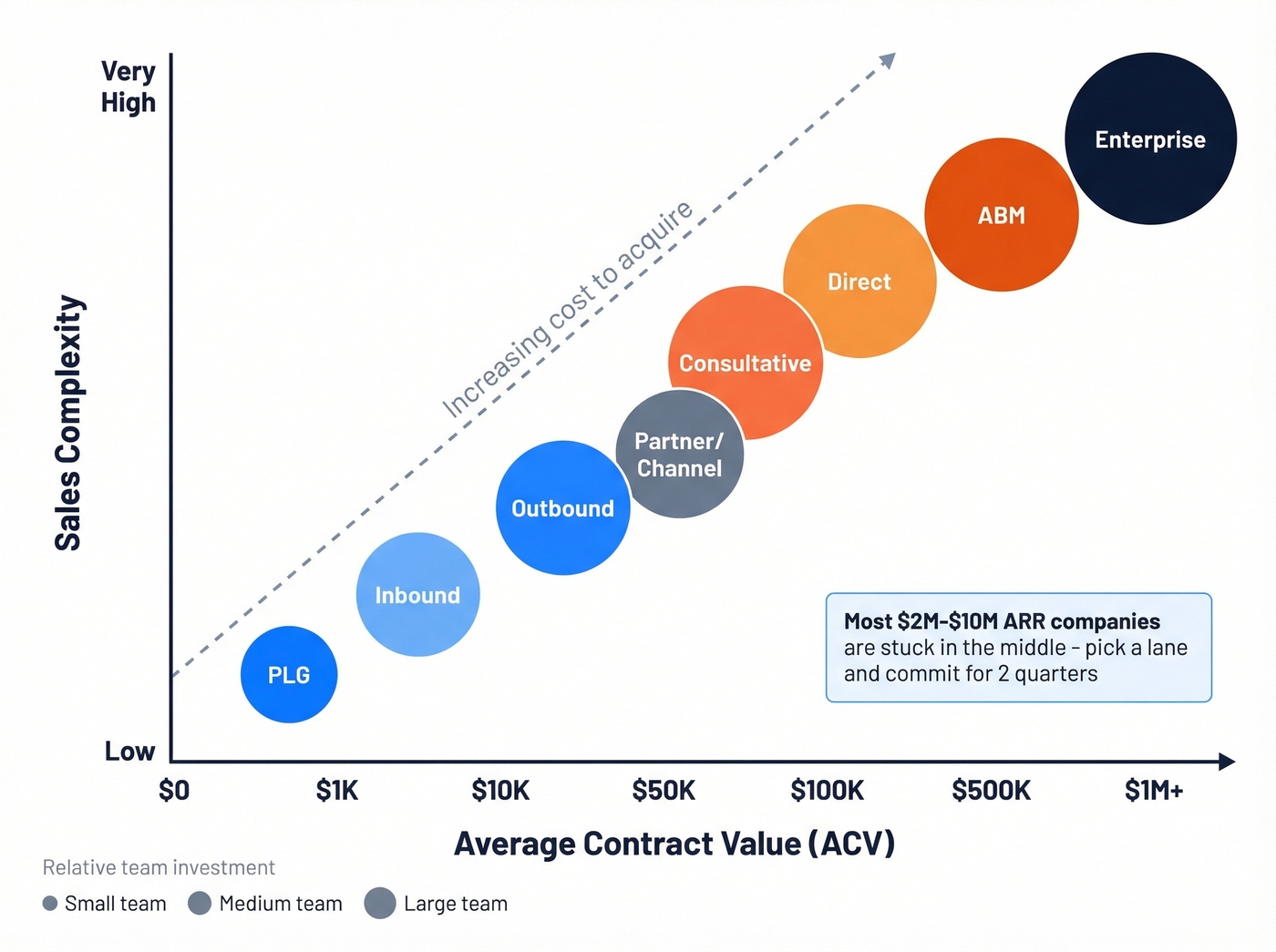
If your ACV is under $1K and your product has self-serve onboarding, you're in PLG territory. If your ACV is consistently six figures and you're selling to a buying committee, you're running enterprise - and you need specialist coverage, not generalist AEs trying to do everything.
Here's the thing: most companies between $2M and $10M ARR are running the wrong model. They've outgrown founder-led selling but haven't committed to a real motion. They're stuck in the messy middle - too expensive for pure PLG, too small for enterprise, running outbound with inbound expectations. If that's you, pick the approach that matches your ACV and commit for two quarters. Half-measures kill pipeline faster than the wrong model does.

You read it above: outbound is only as good as the data powering it. Teams using Prospeo cut bounce rates from 35% to under 4% and book 26% more meetings - without changing their scripts or sequences. 300M+ profiles, 98% email accuracy, 125M+ verified mobiles.
Stop blaming the sales model when the data underneath is broken.
Benchmarks for 2026
These are the numbers most guides leave out. Use them as a baseline to pressure-test your own metrics.
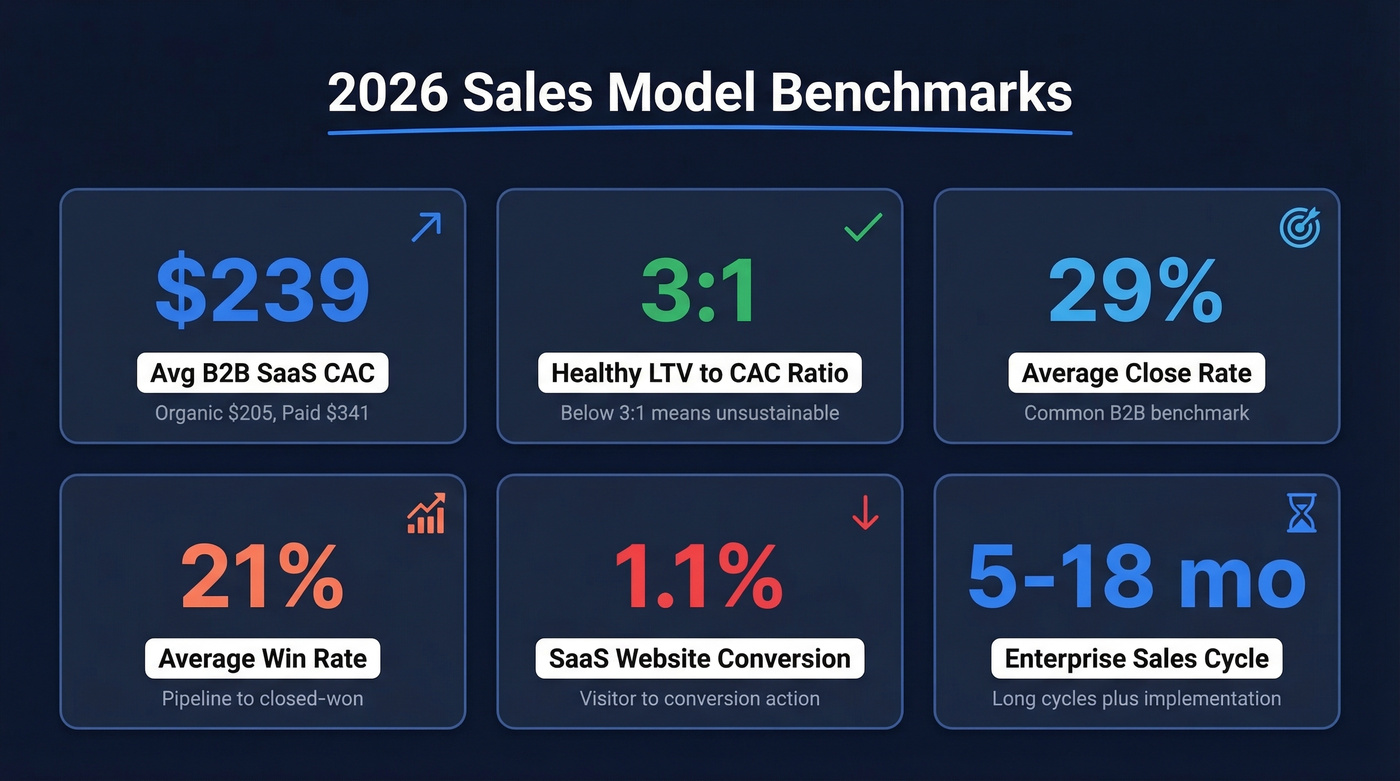
| Metric | Benchmark | Context |
|---|---|---|
| B2B SaaS CAC (avg) | $239 | Organic $205, inorganic $341 |
| LTV:CAC ratio | 3:1 healthy | Below 3:1 = unsustainable |
| Avg close rate | 29% | Common B2B benchmark |
| Avg win rate | ~21% | Pipeline to closed-won |
| Sales cycle (SMB) | 1-3 months | Self-serve can be days |
| Sales cycle (enterprise) | 5-18 months | Long cycles + implementation |
| Website conversion (SaaS) | 1.1% | Visitor to conversion action |
| PLG self-serve CAC | ~$50-$150 | Industry estimate |
| Enterprise CAC | ~$5K-$15K+ | Reflects long cycles + headcount |
If your LTV:CAC ratio is below 3:1, the problem isn't your reps - it's your model. A team running expensive outbound against $3K ACV deals will never hit healthy unit economics. That's a PLG or inbound problem being solved with an outbound budget.
When to Evolve Your Selling Motion
The "everyone does everything" approach works until about $2M ARR. After that, it's a ticking time bomb for pipeline predictability.
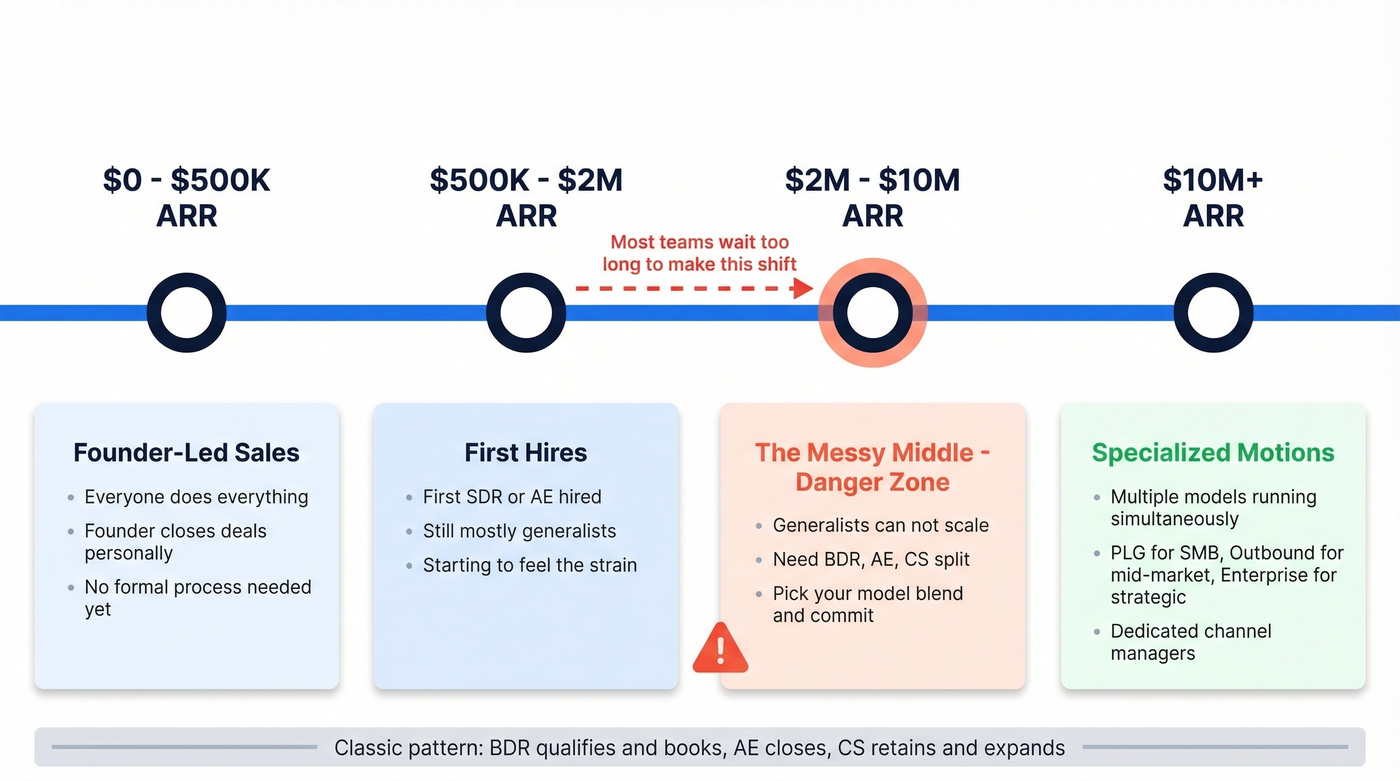
One Reddit thread nailed it: a founder described their team of generalists crushing it to $1.5M, then growth flatlined because nobody owned any single stage of the funnel. The reps weren't the problem. The structure was.
The classic specialization pattern is BDR → AE → CS/AM. BDRs qualify and book. AEs close. Customer success retains and expands. The transition is painful, and most teams wait too long.
Symptoms that signal it's time to evolve: AEs spending 30%+ of their time on renewals instead of new business, follow-ups slipping through the cracks because nobody owns the handoff, pipeline unpredictability despite consistent activity levels, bounce rates spiking because your outbound data is degrading, or ACV shifting significantly while your team structure stays frozen. If you just hit $2M ARR and your top AE spends 40% of their time on renewals, that's not a performance problem. That's a structural one. Fix the model, not the rep.
Data Quality: The Hidden Model Killer
Every sales model depends on reaching the right people with accurate contact data. This is the execution layer most guides ignore - and it determines whether your chosen approach actually works in practice.
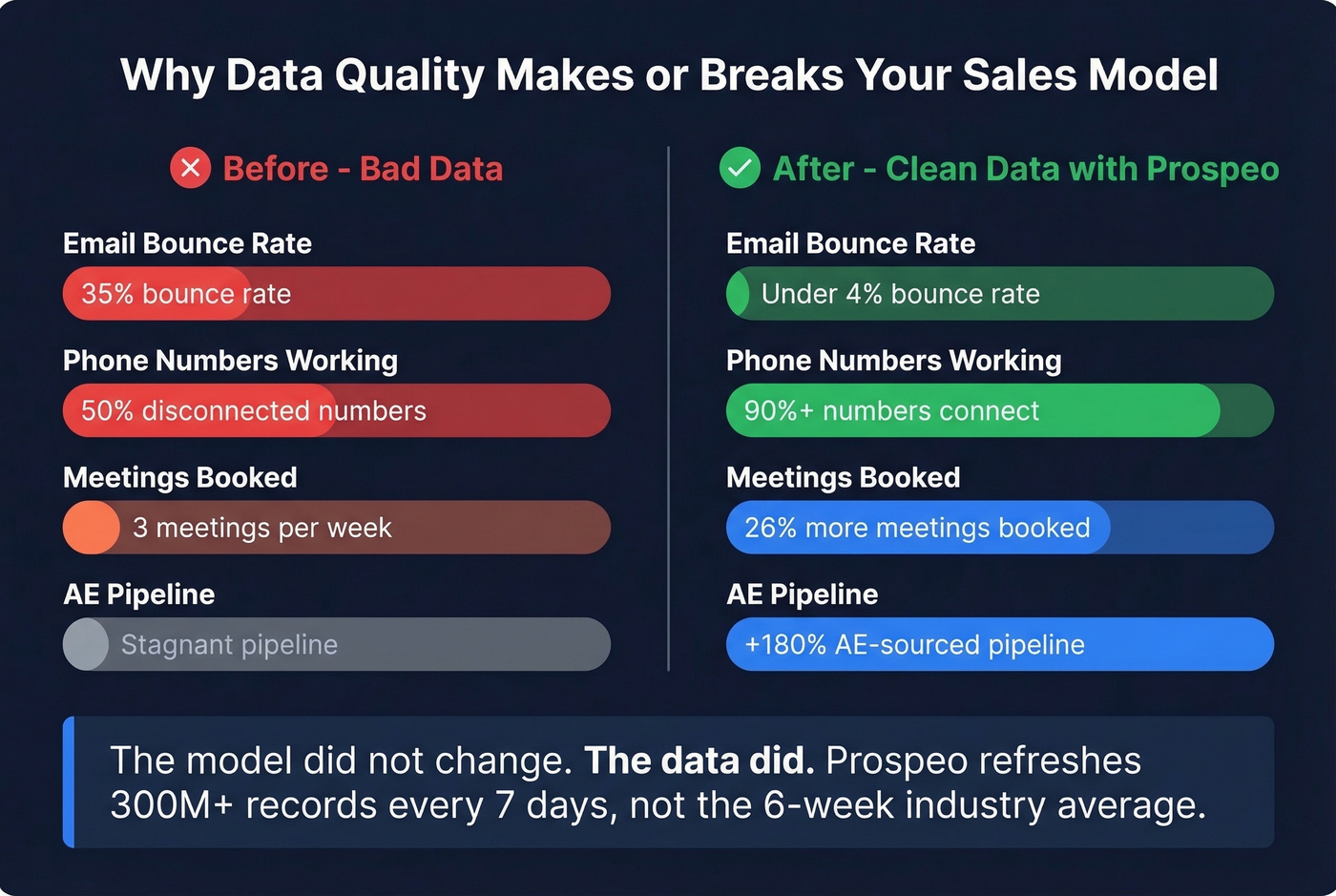
57% of the buying journey is completed before a prospect speaks to sales. If the buyer is already more than halfway through their decision, you can't afford to waste the remaining touchpoints on bad data. Your SDR team making 55 calls a day with half the numbers disconnected isn't running outbound - it's running a noise machine.
The fix is better data infrastructure. In our experience, the difference between a 6-week data refresh cycle and a weekly one is staggering. Snyk's team of 50 AEs cut bounce rates from 35-40% to under 5% after switching to Prospeo's 7-day refresh and 98% email accuracy, and AE-sourced pipeline jumped 180% with 200+ new opportunities per month. The model didn't change. The data did.

Running PLG, outbound, and enterprise simultaneously? Every motion needs clean contact data. Prospeo refreshes all 300M+ records every 7 days - not the 6-week industry average - so your hybrid model runs on data that's actually current.
Get the execution layer your sales model is missing for $0.01 per email.
AI and the Future of Selling
Gartner predicts that by 2028, AI will close 70% of sales cycles by automating prospecting, qualification, and negotiations. By 2031, 35% of sales organizations will introduce EQ-related productivity metrics - a direct response to AI handling the transactional work while humans handle the relational.
Research by Dr. Carmen Simon found that sellers receiving AI coach feedback remembered 50% more information after 48 hours than those receiving human feedback. But sellers expecting human coaching showed greater motivation and emotional well-being. The practical takeaway: let your AI coach the deal, let your manager coach the rep.
Activity metrics are dying. Calls per day and emails sent become meaningless when AI generates the activity. The models that win in 2026 and beyond will measure deal acceleration, buyer engagement quality, and stakeholder alignment - not rep busyness. But even the most sophisticated AI SDR still needs accurate data to operate on. AI can write the email and time the send. If the address bounces, none of it matters.
Common Mistakes to Avoid
Treating methodology as a bandaid. Your CRO says "move to Challenger." But Challenger is a methodology, not a model. If your territories are wrong and your data is stale, a new methodology won't save you.
Ignoring data quality. You can architect the perfect model on a whiteboard. If 30% of your contact data is wrong, execution falls apart on day one.
Over-engineering the motion. Adding layers of specialization, tooling, and process before you have the volume to justify it burns cash without improving outcomes. Let's be honest - most early-stage teams need fewer tools and better data, not a more complex org chart.
Importing your last company's playbook. The model that worked at your Series C employer doesn't automatically fit your Series A startup. Different ACV, different buyer, different team size. Evaluate fit from scratch.
FAQ
What's the difference between a sales model and a methodology?
A sales model is your organization's overarching approach to selling - inbound, outbound, PLG, enterprise. A methodology like Challenger, SPIN, or MEDDIC is the philosophy guiding how reps execute within that structure. You pick the model first, then layer in the methodology that fits your buyer and deal complexity.
What's the best sales model for SaaS startups?
Most SaaS startups under $2M ARR benefit from a hybrid inbound + outbound approach with generalist roles. Once you hit product-market fit and predictable pipeline, specialize into BDR → AE → CS. If your product is self-serve and under $100/user/month, layer in PLG early - it can cut CAC to $50-$150 per customer.
When should I change my sales model?
Common triggers include AEs spending 30%+ of time on renewals, bounce rates above 10%, pipeline unpredictability despite consistent activity, or ACV shifting significantly. The $2M ARR mark is a common inflection point for SaaS companies to specialize roles and formalize the motion.
How does data quality affect which model works?
Directly - and it's the most underestimated factor. Outbound fails when emails bounce. ABM fails when you can't reach the buying committee. A weekly data refresh cycle and 98% email accuracy keep execution sharp across every model type; the industry average refresh of 6 weeks means stale records tank deliverability regardless of how good your strategy looks on paper.