

Sales Operations Training: What to Learn, Where to Learn It, and Whether It's Worth It
Your VP just asked you to build a territory model by Friday. You've got a Salesforce instance that hasn't been cleaned in six months, a comp plan spreadsheet with circular references, and a vague sense that you should know how to do this. Nobody taught you this - and the available sales operations training options aren't much help. Outdated CRM tutorials, a handful of course product pages, and programs still teaching 2019-era basics while the job has moved on to AI evaluation, tech consolidation, and data governance.
Here's the thing: companies with dedicated sales ops teams see 15-20% higher revenue growth than those without. The role matters. But the training landscape hasn't kept pace with the role itself.
What You Need (Quick Version)
If you don't want to read the full breakdown:
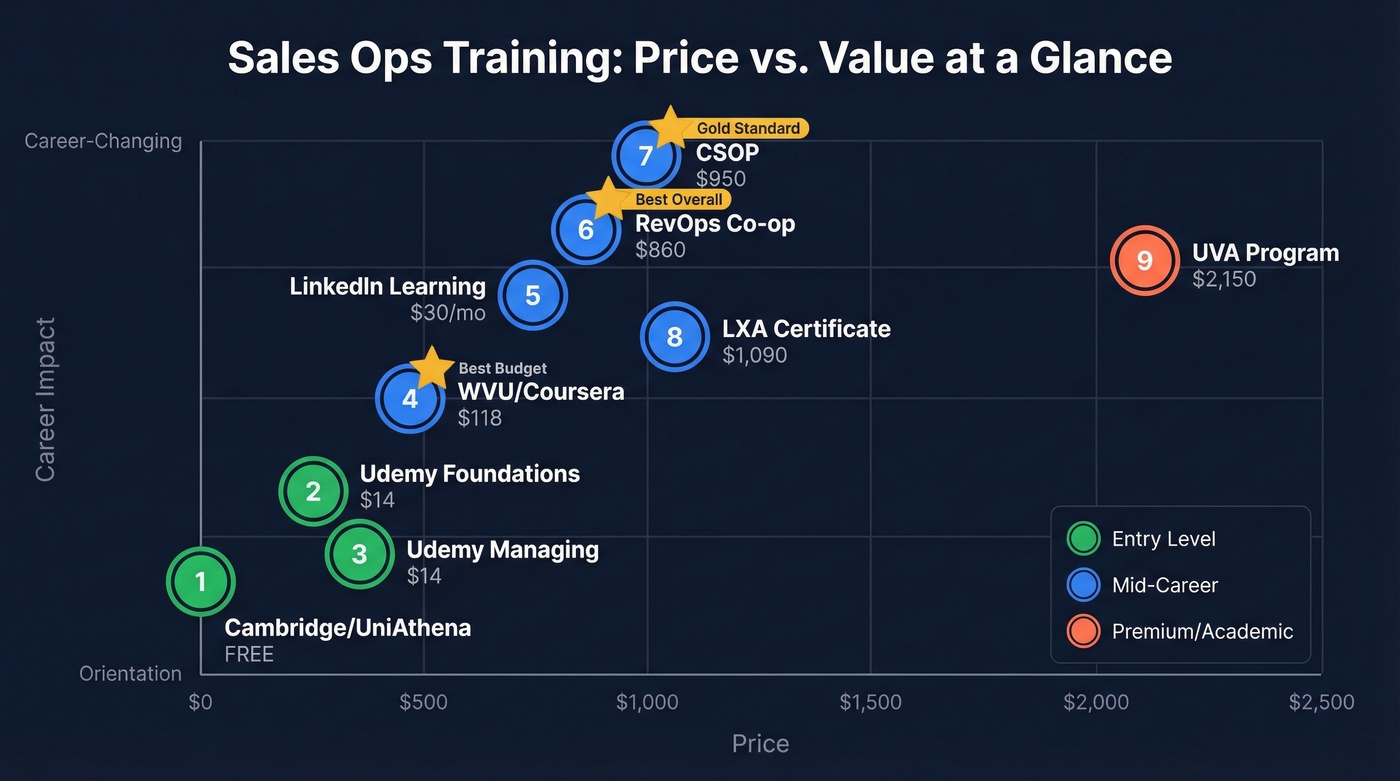
- Best overall for practitioners: RevOps Co-op SalesOps Masterclass ($860) - on-demand, immediately applicable frameworks
- Best formal certification: CSOP from the Sales Management Association ($950) - the only sales-ops-specific credential that carries real weight
- Best budget starting point: Udemy Foundations of Sales Operations ($14) - about 4 hours, low risk, decent orientation
And the contrarian take you won't hear from course providers: you probably don't need a certification. You need a portfolio. A territory model you built beats a certificate you earned every time. But if you're going to invest, the options above are where to put your money.
Core Skills to Learn in 2026
Sales ops in 2026 spans five core domains. Any course worth your time should touch all of them:
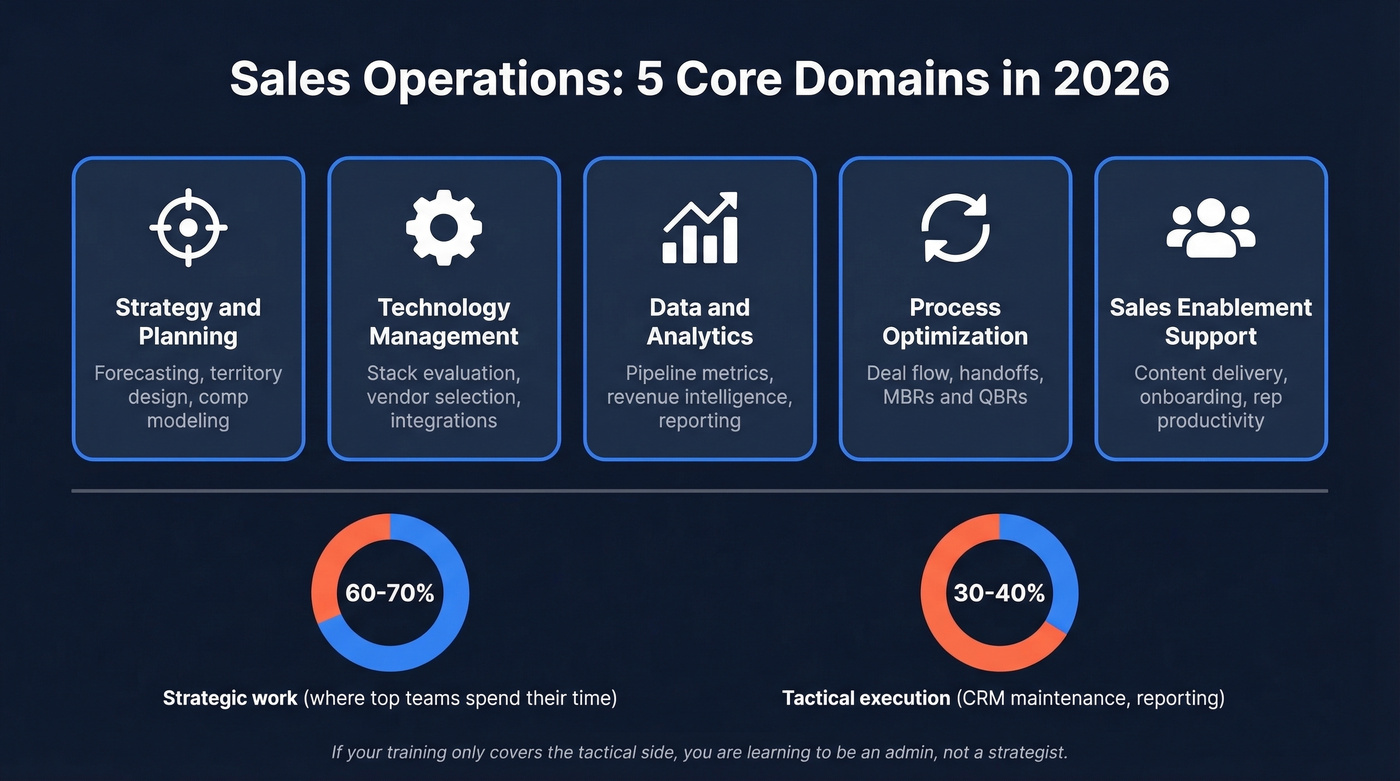
- Strategy and planning - forecasting, territory design, compensation modeling
- Technology management - stack evaluation, vendor selection, integration architecture
- Data and analytics - pipeline metrics, revenue intelligence, reporting infrastructure
- Process optimization - deal flow, handoffs, operational cadences like MBRs and QBRs
- Sales enablement support - content delivery, onboarding workflows, rep productivity
The time split matters too. Effective ops teams spend 60-70% of their time on strategic work and 30-40% on tactical execution like CRM maintenance and reporting. If your training only teaches the tactical side, you're learning to be an admin, not a strategist.
Three forces are reshaping what you need to know. First, 85% of sales leaders are planning tech stack consolidation over the next two years. Second, companies using AI in sales have seen a 50% increase in leads and appointments per McKinsey's research, and AI-native sales tools deliver 241% ROI versus 87% for non-AI tools. Third, the shift from activity metrics to outcome-based metrics - pipeline velocity, cycle length, CLV - means you need real analytical chops, not just dashboard-building skills.
Sales Ops vs. RevOps: Which Path?
Train for RevOps breadth if: your company is under $50M ARR, you'll wear multiple hats regardless of title, or you want maximum career flexibility. Gartner projects 75% of the highest-growth companies will adopt a RevOps model by 2026. The industry benchmark sits at roughly 12:1 sales reps to RevOps personnel - meaning you'll own a lot.
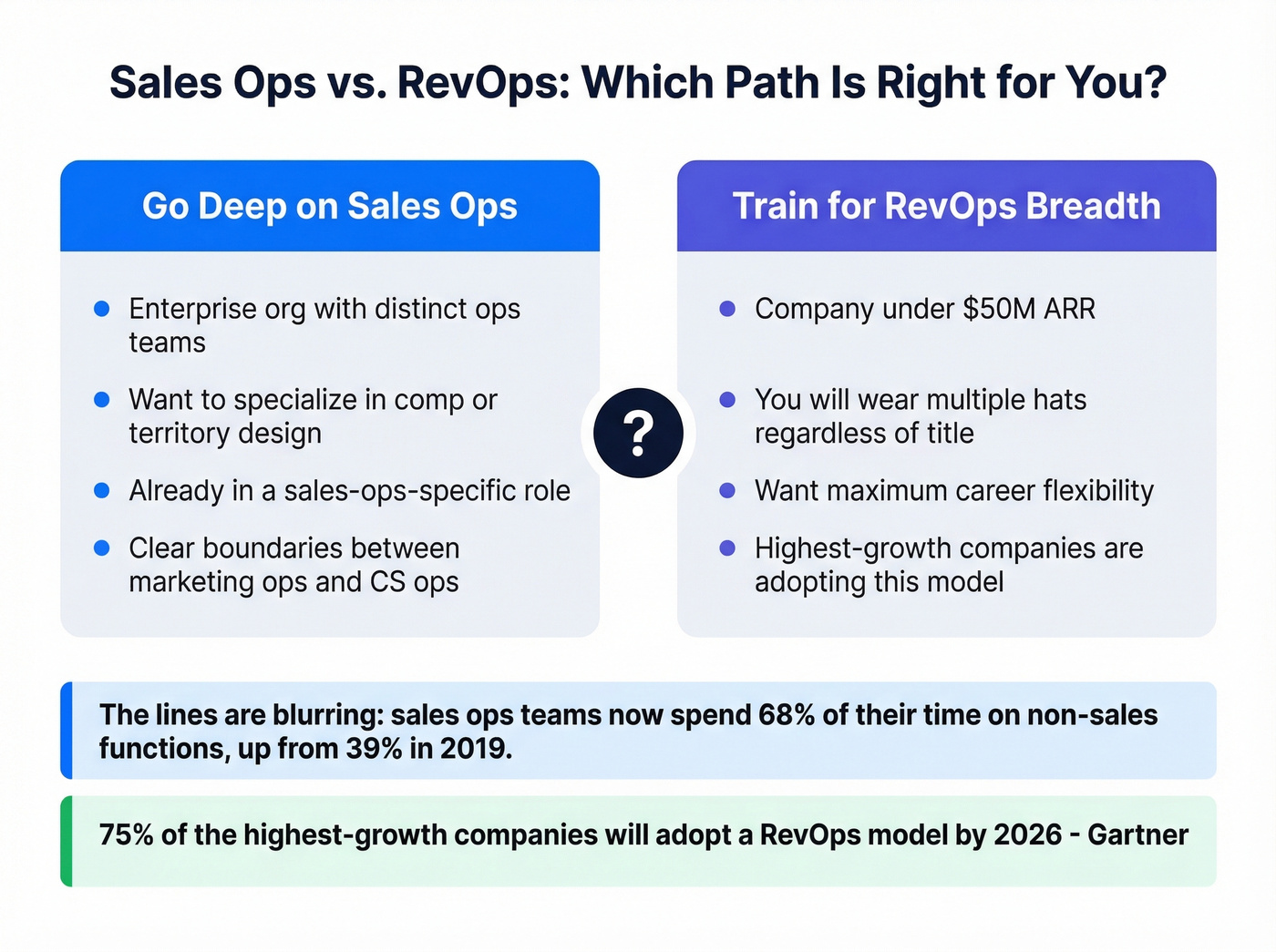
Go deep on sales ops if: you're at an enterprise org with distinct marketing ops and CS ops teams, you want to specialize in compensation modeling or territory design, or you're already in a sales-ops-specific role with clear boundaries.
One data point that clarifies the decision: sales ops teams now dedicate 68% of their time to non-sales functions, up from 39% in 2019. The lines are blurring whether you like it or not.

No course teaches you data quality like working with real data. Prospeo gives you 300M+ profiles with 98% email accuracy, 30+ filters for territory modeling, and a 7-day refresh cycle - the exact infrastructure sales ops teams need to practice what certifications only preach.
Stop studying sales ops in theory. Build pipelines with data that's actually clean.
Best Courses and Certifications
Here's every program worth considering, with real pricing and format details:
| Course | Price | Format & Duration | Cert? | Best For |
|---|---|---|---|---|
| CSOP (Sales Mgmt Assoc.) | $950 (members: $350-$895) | On-demand modules, ~20 hrs + optional workshops | Yes | Gold-standard ops cert |
| SalesOps Masterclass (RevOps Co-op) | $860 | On-demand & virtual, 6 modules | Certificate | Mid-career practitioners |
| Sales Ops Program (UVA) | $2,150 | Online, 10 weeks | Certificate | Career switchers |
| Sales Ops Specialization (WVU / Coursera) | $59/mo (~$118 total) | Self-paced, ~2 months at 10 hrs/week | Certificate | Structured beginners |
| Foundations of Sales Ops (Udemy) | $14 | Self-paced, 3h 46m | Completion | Budget learners |
| Managing Sales Ops (Udemy) | $14 | Self-paced, 1 hr | Completion | Quick tactical upskill |
| Basics of Sales Ops (Cambridge/UniAthena) | Free | Self-paced, ~6 hrs | Optional paid | Zero-cost intro |
| Sales Ops Certificate (LXA) | $1,090 | Online, 12 weeks | Certificate | Marketing-adjacent ops |
| Sales Operations (LinkedIn Learning) | ~$30/mo | Self-paced video | Completion | Teams on LI Learning |
CSOP - The Gold Standard
The CSOP from the Sales Management Association covers the full spectrum: territory design, compensation, pipeline management, performance metrics, and sales strategy. Participants complete approximately 20 hours of instructional and participatory learning, including 10-15 on-demand modules totaling about 17.5 hours, with optional instructor-led workshops depending on availability. You get a two-year membership and a digitally verifiable credential. At $950 - or as low as $350 for corporate members - it's the strongest signal you can put on a resume.
That said, it won't get you hired alone. Hiring managers care more about what you've built than what you've passed.
RevOps Co-op Masterclass - Best for Practitioners
This is the program we'd recommend for mid-career ops professionals who want to stop watching videos and start applying frameworks the same week. It's structured as 6 modules, priced at $860 with four monthly payments of $215 available. You also get lifetime access to the course portal, optional recurring office hours with the instructor, and a private Slack channel in the RevOps Co-op workspace. The curriculum goes beyond theory into operational cadences, CRM architecture details like timestamps and contact roles, and frameworks that translate directly to your day job. In our experience, the community access alone is worth the price - the Slack channel becomes an ongoing resource long after you finish the modules.
WVU Coursera Specialization - Best Budget Path
At $59/month - most people finish in two months for roughly $118 total - the WVU specialization through Coursera is the best structured entry point for career switchers. It requires an exam, which forces actual retention. It won't make you an expert, but it'll give you the vocabulary and mental models to start contributing in an ops role without floundering.
Skip this if you already have two or more years in an ops-adjacent role. You'll find the content too basic and end up frustrated.
The Career ROI of Training
Let's be honest: a lot of people in sales ops ask whether certifications are even worth it. That skepticism is well-founded.
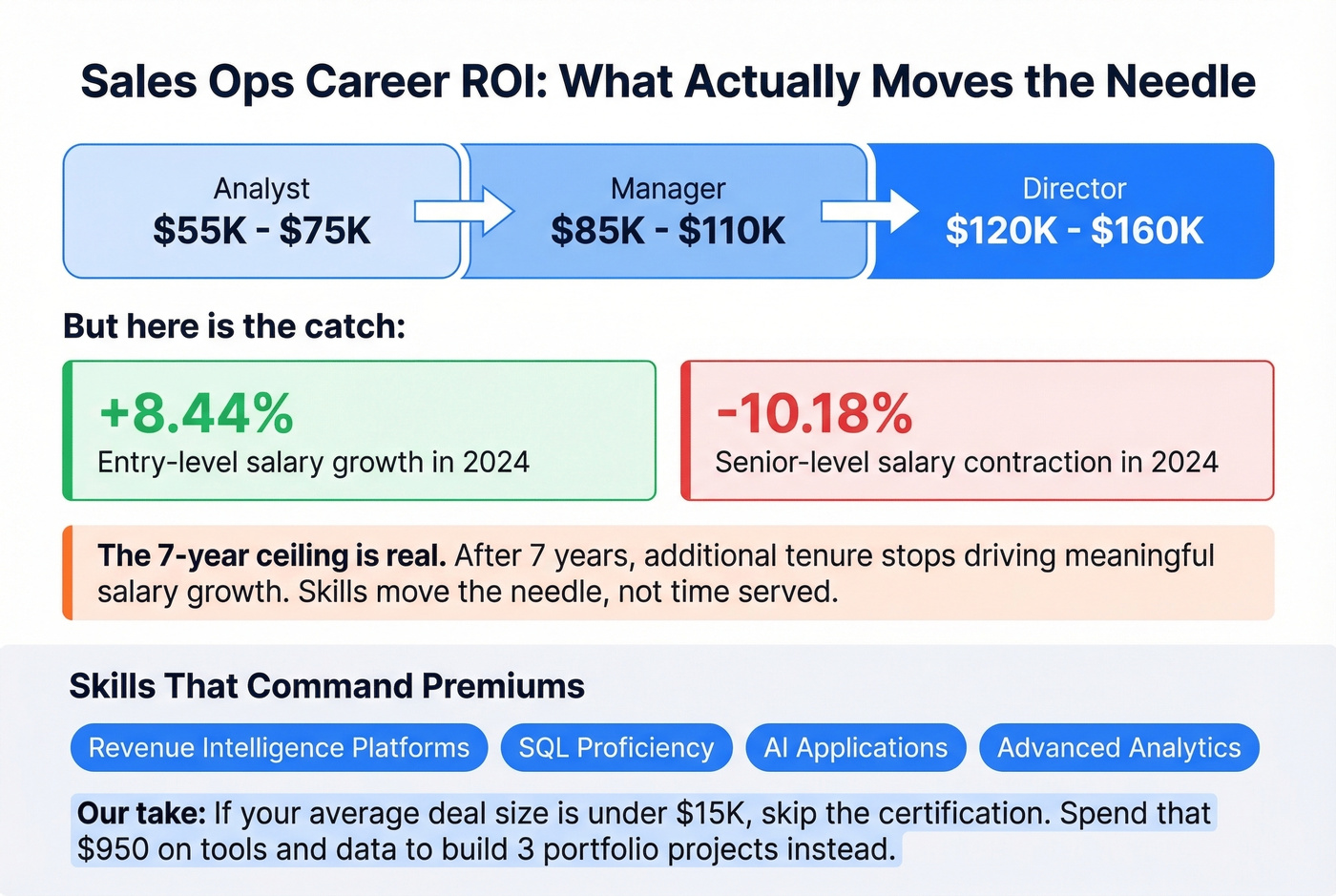
The salary market has compressed. Entry-level ranges grew +8.44% in 2024, while senior ranges contracted -10.18%. There's a seven-year ceiling where additional tenure stops driving meaningful salary growth. After that, it's skills that move the needle. Geography matters too - Phoenix salaries jumped ~34% while Houston dropped ~31%, so location still drives comp more than most people realize.
Rough salary bands for US-based roles: Analyst ~$55-75K, Manager ~$85-110K, Director ~$120-160K. The premiums go to people with revenue intelligence platform experience, SQL proficiency, AI applications knowledge, and advanced analytics skills. Salesforce's research also shows how central ops has become: 94% of sales organizations plan to consolidate their tech stack in the next 12 months, which means the ops person who can evaluate and implement tools has real leverage.
A $950 certification won't jump you from Analyst to Director. But pairing it with a portfolio of real projects - a territory model, a tech stack audit, a comp plan redesign - absolutely can. If your average deal size is under $15K, skip the certification entirely and spend that $950 on tools and data to build three portfolio projects instead. The projects will teach you more and impress hiring managers more than any credential. The consensus on r/salesops backs this up - portfolio projects come up in nearly every "how do I break in?" thread.
Applying Training With Real Tools
Scenario-based training improves retention up to 70% compared to lecture-based learning. That stat should shape how you approach any course: don't just watch videos. Build something.
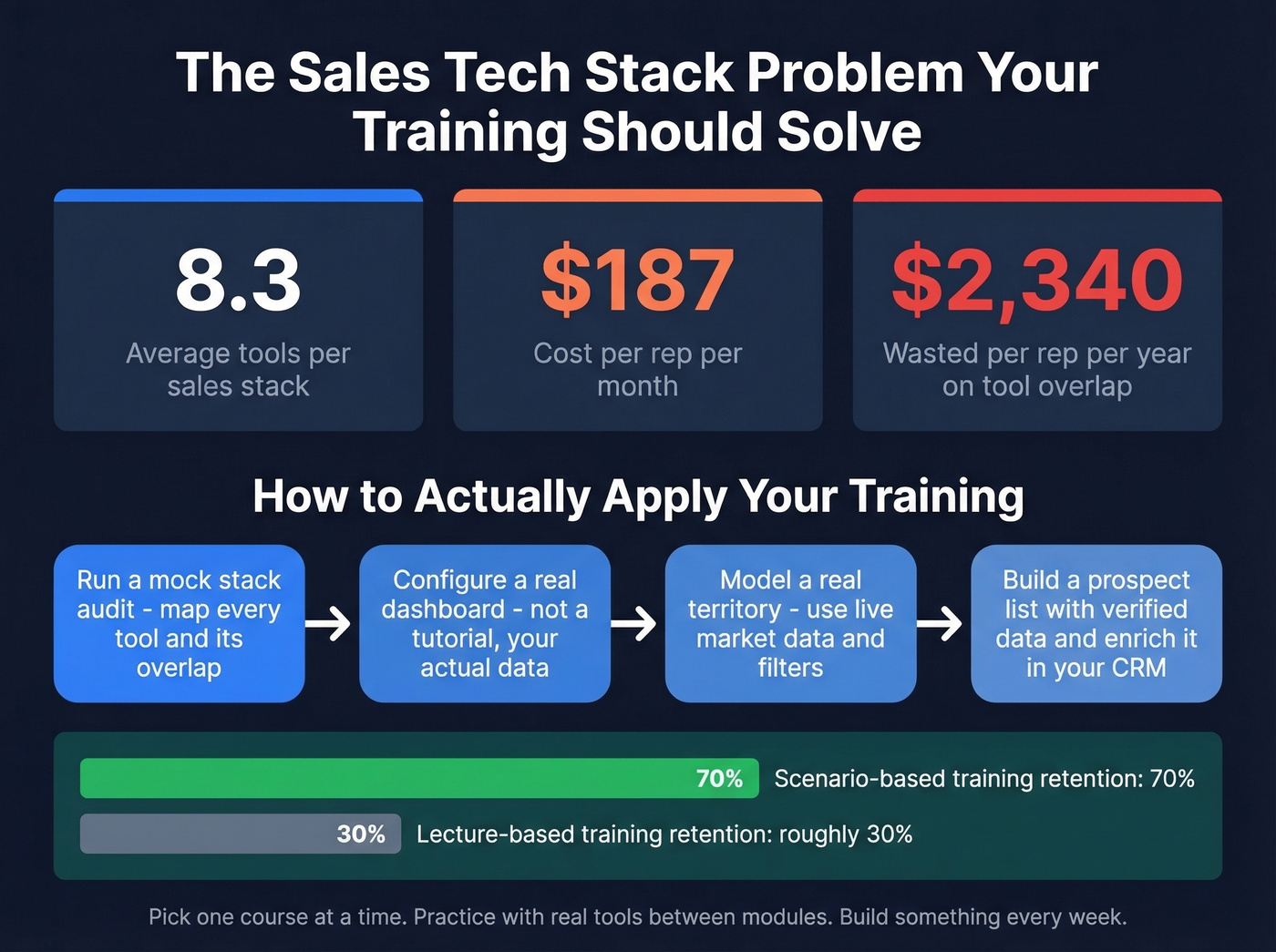
The common pitfalls are predictable - information overload, skipping reinforcement, assuming everyone starts at the same skill level. Avoid all three by picking one course at a time and practicing with real tools between modules.
Look at the average sales tech stack: 8.3 tools costing $187/rep/month, with 73% of companies reporting overlap that wastes $2,340/rep/year. If your training doesn't teach you to audit and consolidate a stack like that, supplement it yourself. Run a mock stack audit. Configure a real dashboard. Model a real territory. Build a prospect list with verified data and run it through your CRM enrichment workflow - we've found that the muscle memory from hands-on tool work matters more than any certificate.
If you want a structured way to practice the "build a list → enrich → route → sequence" loop, start with sales prospecting techniques and then map the workflow to your CRM.
The Data Quality Gap Training Ignores
Every ops workflow you'll learn - forecasting, territory planning, pipeline reporting, comp modeling - depends on accurate upstream data. Most courses teach you to configure Salesforce and build reports. Almost none teach you to ensure the data feeding those reports is actually clean.
This is where training falls short and tools fill the gap. When you're learning to build pipeline reports, the difference between 98% accurate contact data and 80% accurate data isn't academic. It's the difference between a forecast your VP trusts and one that falls apart on inspection. Prospeo's free tier gives you 75 verified emails per month - enough to practice real enrichment workflows without spending a dollar while you're still in learning mode.
If you're comparing vendors, it helps to understand the broader landscape of data enrichment services and what "verification" actually means in practice.

The best sales ops training is a portfolio, not a certificate. Use Prospeo's 30+ search filters - buyer intent, technographics, headcount growth, funding - to build the territory models and pipeline reports that get you hired. At $0.01 per email, it costs less than a Udemy course.
Build your sales ops portfolio with enterprise-grade data at startup pricing.
FAQ
Is a sales operations certification worth it?
It signals commitment but won't get you hired alone. Hiring managers prioritize tool proficiency and analytical problem-solving over credentials. The CSOP at $950 is the strongest signal if you want one, but a portfolio of real projects - territory models, stack audits, comp analyses - matters more than any certificate on your wall.
How long does it take to learn sales operations?
Expect 8-12 weeks to become productive in CRM reporting and dashboards, and 3-6 months for forecasting, territory design, and compensation modeling. Your analytics background determines the pace. Structured courses accelerate the timeline, but hands-on practice with real tools and data is non-negotiable.
What tools should I learn for sales operations?
Start with your CRM - Salesforce or HubSpot - then add a data quality tool like Prospeo for contact verification, a BI platform like Tableau or Looker for reporting, and one engagement tool such as Outreach or Salesloft. Master four tools well before expanding. The average stack has 8.3 tools, and most of that is bloat.
Can I break into sales ops without a certification?
Yes - most hiring managers rank hands-on CRM experience and analytical skills above formal credentials. Build two to three portfolio projects: a territory model in Google Sheets, a pipeline dashboard in Tableau, a mock tech stack audit. You'll outperform candidates who only have a certificate. Certifications help most when you're switching careers and need to prove baseline knowledge.