

How to Build a Sales Pitch Deck That Actually Closes Deals
Your VP just asked you to refresh the deck before QBR. You open the file - 47 slides, last updated eight months ago, half the case studies reference churned customers. The problem slide still says "in today's fast-paced world." You close the laptop and start searching for help.
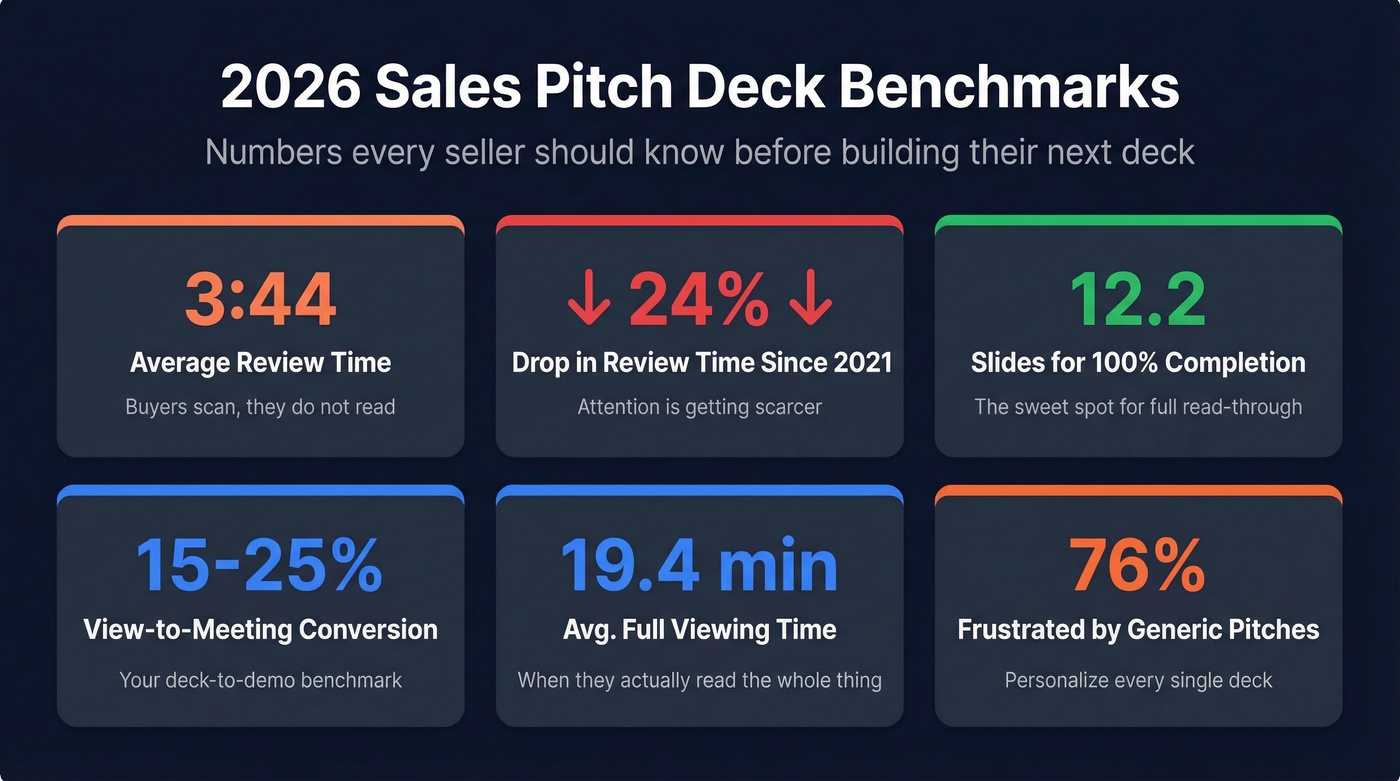
Here's the thing: your sales pitch deck is often the single artifact a buying committee reviews before making a decision. In B2B SaaS, the average SQL-to-Closed Won conversion rate sits around 37%. Most qualified opportunities still don't become revenue. Your deck won't save a bad product, but a bad deck will absolutely kill a good one - especially when the average reviewer spends just 3 minutes and 44 seconds looking at it.
The Short Version
Structure your deck around a narrative framework - either Raskin's 5-element structure or the Sales Hero's Journey, both broken down below. Keep the core story to ~12 slides. Decks with 100% completion rates average 12.2 slides. Push everything else to an appendix. And personalize every deck to the specific buyer. 76% of prospects get frustrated by generic pitches. If you're sending the same deck to a VP of Engineering and a CFO, you're losing both.
Sales Deck vs Pitch Deck
Sales teams use these terms interchangeably. That confusion costs deals. Beautiful.ai frames the distinction well: a pitch deck sells belief, a sales deck sells commitment. Going feature-heavy in a first meeting or staying high-level in a late-stage deal review creates a mismatch that confuses buyers.
| Dimension | Pitch Deck | Sales Deck |
|---|---|---|
| Goal | Spark interest | Drive commitment |
| Audience | Investors, partners | Buyers, committees |
| Timing | Early relationship | Mid-to-late funnel |
| Slide Count | 10-15 | 15-30+ |
| Tone | Visionary, story-led | Specific, proof-heavy |
| Format | Presentation or PDF | Leave-behind + live |
A pitch deck says "here's why this matters." A sales deck says "here's exactly how this works for you, what it costs, and what happens after you sign." If you're reading this article, you need the second one.
Two Proven Deck Frameworks
Most sales decks fail because they're organized around the product instead of a story. Feature, feature, feature, pricing, logo slide, "any questions?" That's not a narrative. It's a spec sheet with transitions.
Raskin's 5-Element Structure
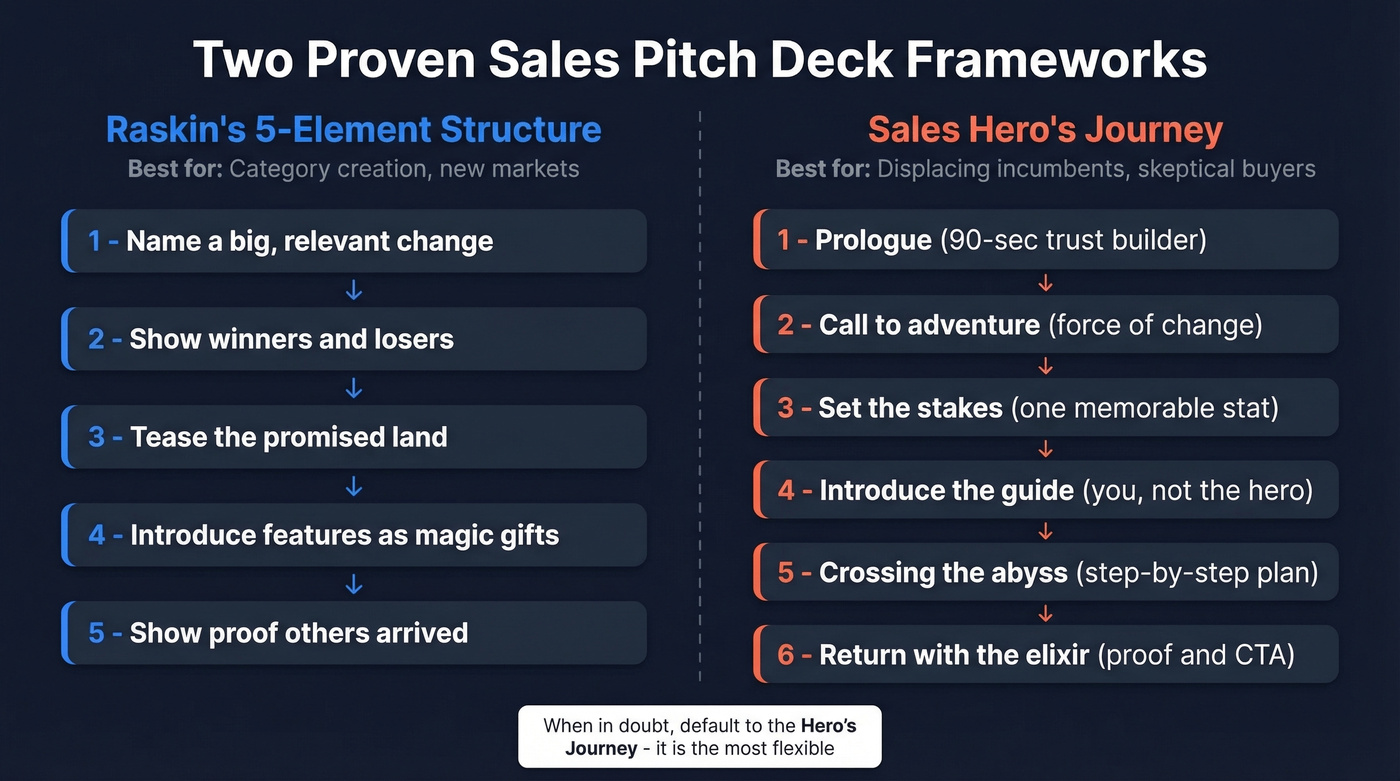
Andy Raskin published this framework in 2016 and it's still the most referenced sales deck structure online:
- Name a big, relevant change in the world - don't start with your product.
- Show winners and losers - who adapts thrives; who doesn't falls behind.
- Tease the promised land - paint the future state, not the product.
- Introduce features as "magic gifts" - tools that help the buyer reach that promised land.
- Show proof - evidence that others have already arrived.
Zuora's deck is the canonical example. The key insight: starting with "here's your problem" puts prospects on the defensive. Starting with "here's what's changing in the world" opens them up.
The Sales Hero's Journey
This 6-step framework updates Raskin for modern sales cycles where buyers are more skeptical and attention spans are shorter:
- Prologue - establish trust with a 90-second founding story (time it - literally).
- Call to adventure - introduce the force of change affecting the buyer's world.
- Set the stakes - winners and losers, anchored by one memorable stat.
- Introduce the guide - your company as the guide, not the hero. Simple value statement, minimal jargon.
- Crossing the abyss - a step-by-step plan showing how you get the buyer from here to there.
- Return with the elixir - proof, outcomes, and a clear next step.
The difference from Raskin: this framework puts the buyer as the hero, not the market trend. It also forces you to earn trust before you pitch - that 90-second prologue is a discipline most sellers skip.
Which Framework to Use
If you're creating a new category and need to convince buyers that the world has changed, Raskin's trend-first approach works. If you're displacing an incumbent and the buyer already knows the problem, start with their frustrations - the ContentCamel approach of "what we've heard" to "cost of doing nothing" to "what changes." When in doubt, default to the Sales Hero's Journey. It's the most flexible.
Slide-by-Slide Structure
Here's a practical slide order that works for most B2B sales decks. We've tested variations of this across dozens of deals, and this sequence keeps the narrative tight while giving buyers everything they need to move forward:
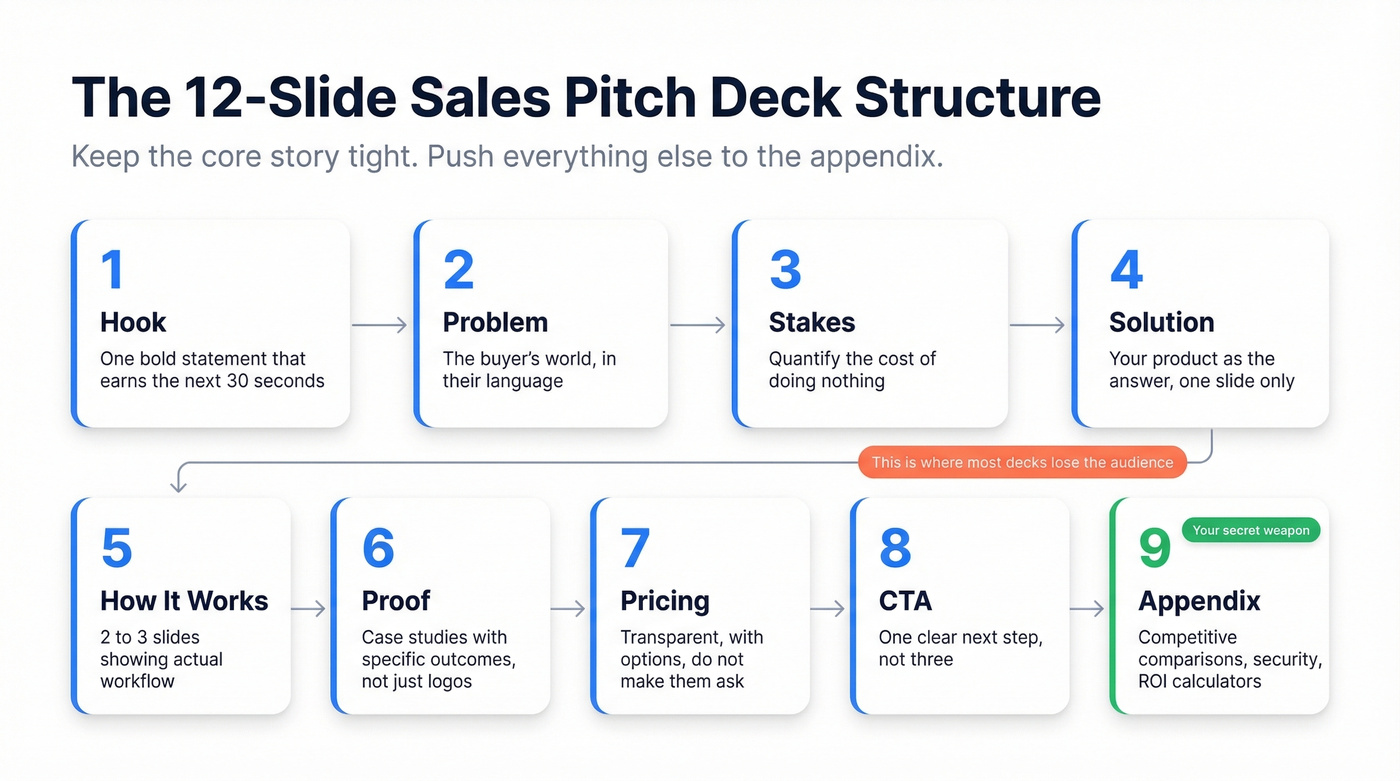
- Hook - one bold statement or question that earns the next 30 seconds.
- Problem - the buyer's world, in their language. This is where you win or lose.
- Stakes - what happens if they do nothing. Quantify the cost of inaction.
- Solution - your product as the answer. Keep it to one slide.
- How it works - 2-3 slides showing the actual workflow or implementation.
- Proof - case studies with specific outcomes, not just logos. Don't say "10K users" - say "10K users, 23% MoM growth, $47 ARPU." Traction without context is noise.
- Pricing - transparent, with options. Don't make them ask.
- CTA - one clear next step. Not three. One.
- Appendix - competitive comparisons, security details, integration specs, ROI calculators.
The appendix is your best friend. It lets you keep the core narrative tight while having answers ready for every objection. We've seen teams try to cram 30 slides into a 15-minute meeting. It never works. Keep the story to ~12 slides and let the appendix handle the deep dives.
Slide count doesn't matter as much as story count. A 20-slide deck with one coherent narrative beats a 10-slide deck that's just a feature list with nice fonts.
3 Decks Worth Studying
Theory is useful. Seeing what actually works is better.
Zuora opens with "We live in a subscription economy" - not a product slide, not a logo, not a mission statement. The early slides establish a world-changing trend before the product details show up. By the time features appear, the buyer is already nodding along to the narrative. This is Raskin's framework executed well.
Outreach takes the opposite approach. Their deck leads with a rep productivity angle - something every sales leader feels in their gut. The problem slide uses the buyer's own language, and the solution slide maps directly to that pain. No vision statement, no "we believe" fluff. Pure Sales Hero's Journey.
Stripe keeps it visual. Their deck leans heavily on diagrams and technical clarity, which works because their audience - developers and technical decision-makers - processes information visually. The lesson: match your deck's density to your buyer's communication style, not your marketing team's preferences.
The hot take nobody wants to hear: most decks fail not because the design is bad, but because the seller never decided who the deck is for. A deck built for "everyone on the buying committee" persuades no one on the buying committee.

Your proof slide is only as strong as the pipeline behind it. Teams using Prospeo book 26% more meetings than ZoomInfo users - the kind of stat that turns a case study slide into a deal-closer.
Stop pitching hypothetical ROI. Start showing real pipeline numbers.
2026 Engagement Benchmarks
These numbers should inform how you build and diagnose your deck:
| Metric | Benchmark | Source |
|---|---|---|
| Avg. review time | 3 min 44 sec | Zyner |
| Review time trend | Down ~24% since 2021 | Zyner |
| View-to-meeting rate | 15-25% | Zyner |
| 100% completion sweet spot | 12.2 slides | Visible |
| Avg. viewing time (full) | 19.4 minutes | Visible |
| Avg. deck uploaded | 18 slides (median 16) | Visible |
That 3:44 number should haunt you. Buyers aren't reading your deck - they're scanning it. If your key message isn't visible within the first three slides, it doesn't exist. And review time has dropped 24% since 2021, so attention is getting scarcer, not more generous.
Use slide-3 drop-off as a diagnostic: if your tracking shows viewers leaving at slide 3, your hook failed. If they stall on a single slide for a long time, that slide is confusing them, not engaging them.
10 Common Mistakes (Ranked by Frequency)
A Reddit reviewer analyzed 82 pitch decks and ranked mistakes by frequency. The review focused on investor decks, but every mistake maps directly to sales decks too:
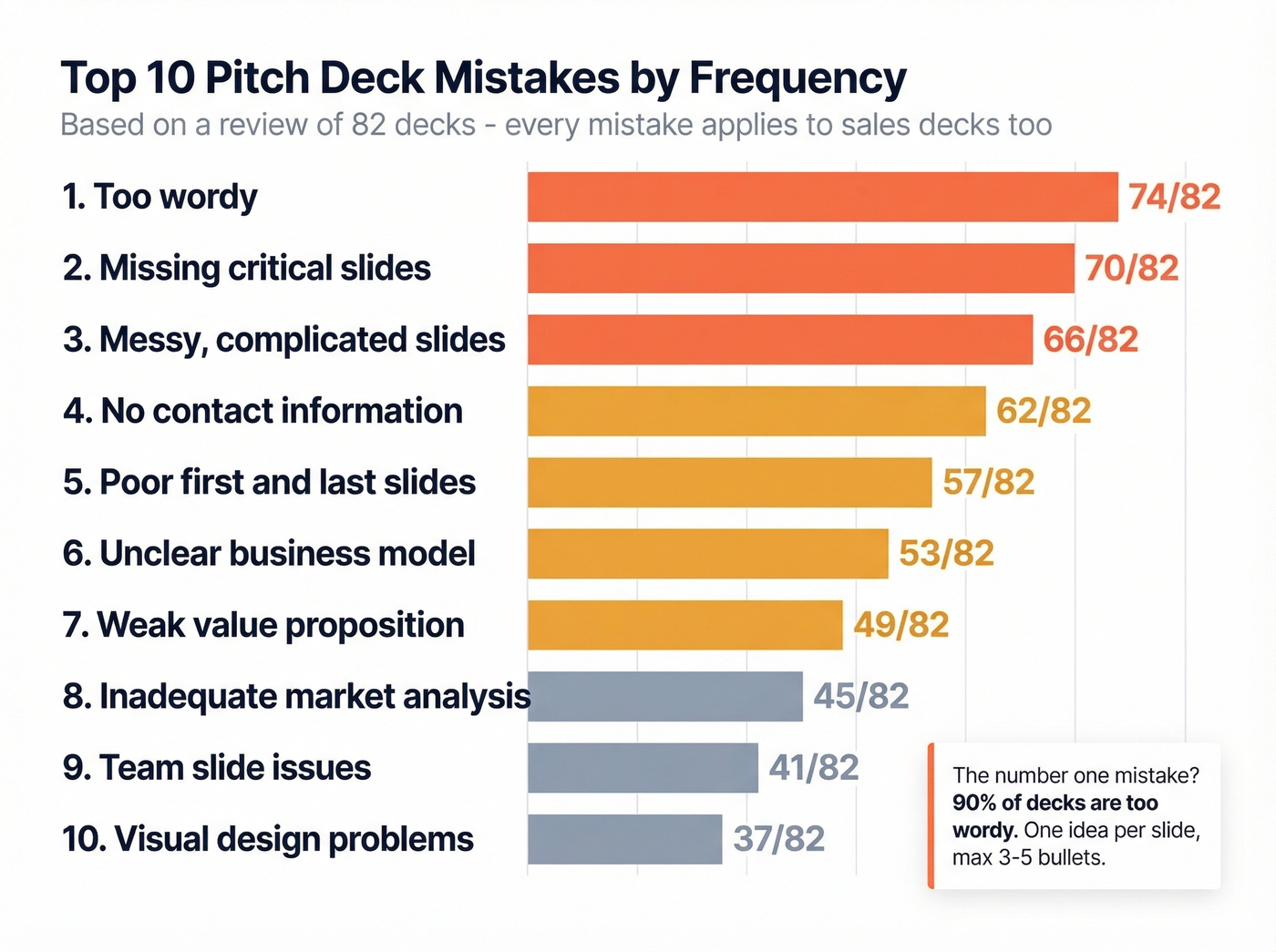
- Too wordy (74/82). The most common mistake by far. Slides aren't documents. One idea per slide, max 3-5 bullets.
- Missing critical slides (70/82). Financial projections were absent in ~85% of decks. In sales decks, the equivalent is hiding pricing or skipping "how it works."
- Messy, complicated slides (66/82). Cluttered layouts with competing visual elements. If a slide needs a legend to decode, it's too complex.
- No contact information (62/82). Sounds basic. Still happens constantly.
- Poor first and last slides (57/82). Your first slide earns the next 30 seconds. Your last slide determines whether they take action. Both get treated as afterthoughts.
- Unclear business model (53/82). If the buyer can't explain how you make money after seeing your deck, you've failed.
- Weak value proposition (49/82). Generic differentiators that apply to any competitor. "We're faster, cheaper, and more innovative" says nothing.
- Inadequate market analysis (45/82). The "1% of TAM" slide has become a punchline. If your market sizing comes from a Statista screenshot, don't include it.
- Team slide issues (41/82). Irrelevant bios, missing key hires, or no team slide at all.
- Visual design problems (37/82). Font size 10 is illegal - optimize for mobile viewing. Inconsistent colors and stock photos that scream "generic" all fall here.
The "megadeck" trap deserves its own callout. Duarte reports that sellers spend roughly 30 hours per month creating or searching for content because their master deck doesn't fit any specific situation. That's nearly a full work week wasted on PowerPoint archaeology. The fix isn't a bigger deck - it's situational decks built for specific buyer roles and stages. And as the consensus on r/Entrepreneur puts it: the word "platform" is poison. If your deck describes your product as a "platform" without immediately showing what that means in concrete terms, you've already lost credibility.
Design Principles That Matter
One idea per slide. This is the single most impactful design rule, and it's the one teams violate most often. If you can't summarize the slide's point in one sentence, split it into two slides. Aim for roughly 70% visual content - charts, screenshots, diagrams - and 30% text.
Send PDFs, not PowerPoint files. Fonts and layouts break in PPT and Keynote. A deck that looks polished on your screen arrives as a formatting disaster on the buyer's laptop. PDF is the only safe format for leave-behinds.
Match your brand voice. Stripe's deck is clean and visual because that's their brand. Reddit's advertiser deck uses humor and memes because that's theirs. Before/after framing - "old way vs new way" - is a recurring persuasive device in the best sales decks because it makes the value concrete without requiring the buyer to imagine it.
Personalize or Lose
71% of buyers expect personalized interactions. 76% get frustrated when they don't get them. "One size fits one" - that's the Duarte principle, borrowed from Tom Peters. Your deck for a client pitch meeting should feel like it was built for the specific person reading it, not pulled from a template library.
Build two versions of every deck: a live version designed for screen share at 10-12 slides, and a leave-behind version that adds context slides and the appendix for async review. The live version tells the story. The leave-behind version survives the forwarding chain to the rest of the buying committee.
AI Tools for Deck Creation in 2026
AI compresses multi-hour deck creation into a 30-minute sprint. Let's be honest about what it actually does well, though: layout, first drafts, and design consistency. It won't replace your narrative strategy, your buyer research, or your ability to tell a story that lands.
| Tool | Starting Price | CRM Integration | Best For |
|---|---|---|---|
| Gamma | $8/mo | No | Speed + simplicity |
| Beautiful.ai | $12/mo | No | Design-forward teams |
| PlusAI | $10/mo | Google Slides | Slides users |
| monday CRM | $12/user/mo | Yes - native | CRM-integrated workflows |
| Alai | Free (300 credits) | No | Zero-budget start |
| Figma Slides | Free | No | Design teams in Figma |
| Canva | Free / Pro ~$13/mo | No | Templates + brand kits |
monday CRM is the only option here with native CRM integration, which makes it the obvious pick if you want deck creation triggered by pipeline stage. For everyone else, Gamma is the fastest path from blank page to presentable deck. Skip Alai if you need anything beyond basic slides - the free credits run out fast and the output needs heavy editing.
How to Diagnose a Failing Deck
If your deck isn't converting, don't redesign blindly. Diagnose first.
I once watched a rep send a perfectly crafted 12-slide deck to a prospect's old email address three times before checking whether the contact was still valid. Three weeks of follow-up, zero opens. The deck was great. The data was garbage.
When to update your deck entirely: new product release, a new competitor showing up in deals, any case study older than six months, or a pattern in lost-deal feedback. If you haven't touched your deck in a quarter, it's already stale.
If you’re seeing the same objections repeat, build sales battle cards and update your competitive comparisons in the appendix.
A great sales deck earns you 3 minutes and 44 seconds. Don't waste them pitching prospects who never see your email. Prospeo's 98% email accuracy and 125M+ verified mobiles mean your deck lands in front of real decision-makers, not dead inboxes.
Reach the buying committee your deck was built for.
FAQ
How many slides should a sales pitch deck have?
Decks with 100% completion rates average 12.2 slides. Keep the core narrative to around 12 and push competitive comparisons, security details, and ROI calculators into an appendix. Sales decks often run 15-30+ total, but the appendix doesn't count against your story - it supports it.
What's the difference between a sales deck and a pitch deck?
A pitch deck sells belief - it targets investors or early-stage relationships and runs 10-15 slides focused on vision and opportunity. A sales deck sells commitment - it targets buyers later in the funnel and includes pricing, implementation details, ROI proof, and a clear CTA. Mixing the two confuses your audience at every stage.
Should I use AI to build my deck?
AI tools like Gamma or Beautiful.ai handle layout and first drafts in minutes. They won't replace your narrative strategy or buyer research. Use them to compress creation time, then customize the story, proof points, and pricing for each prospect manually.
What makes the best sales pitch presentation stand out?
The strongest presentations open with the buyer's world instead of a product overview, keep the core narrative to roughly 12 slides, and include specific proof - revenue numbers, timelines, named customers. Design matters, but story matters more. Personalization is the multiplier.
How do I make sure my deck reaches the right person?
Verify contact data before sending. A bounced email means your deck never existed. Use a tool like Prospeo to confirm emails and find direct dials - 98% email accuracy and 125M+ verified mobile numbers mean your leave-behind actually lands with the decision-maker, not a dead inbox.