

How to Write a Sales Pitch Email That Actually Gets Replies
The average cold email reply rate is 3.43%. That means for every 100 sales pitch emails you send, roughly 97 people ignore you. Meanwhile, the top 10% of senders hit 10.7%+ reply rates using the same channels, the same inboxes, the same 24 hours in a day. The gap isn't talent or luck - it's inputs. Bad data, bloated copy, and weak subject lines are killing your email sales pitch before anyone reads it.
Here's the quick version of what actually moves the needle:
- Verified contact data. Nothing else matters if your emails bounce. Keep bounce rates below 2%.
- A 2-4 word personalized subject line. Personalized subjects hit 46% open rates and double reply rates versus generic ones.
- An email body under 80 words with one clear ask. Pain point, value, proof, CTA. That's the whole formula.
Everything below unpacks those three levers with real numbers.
Subject Lines That Get Opened
A Belkins study across 5.5 million emails found that personalized subject lines hit 46% open rates versus 35% without personalization. That's a 31% lift from adding a name, company, or relevant detail to a handful of words. Reply rates jumped too - 7% with personalization versus 3% without.
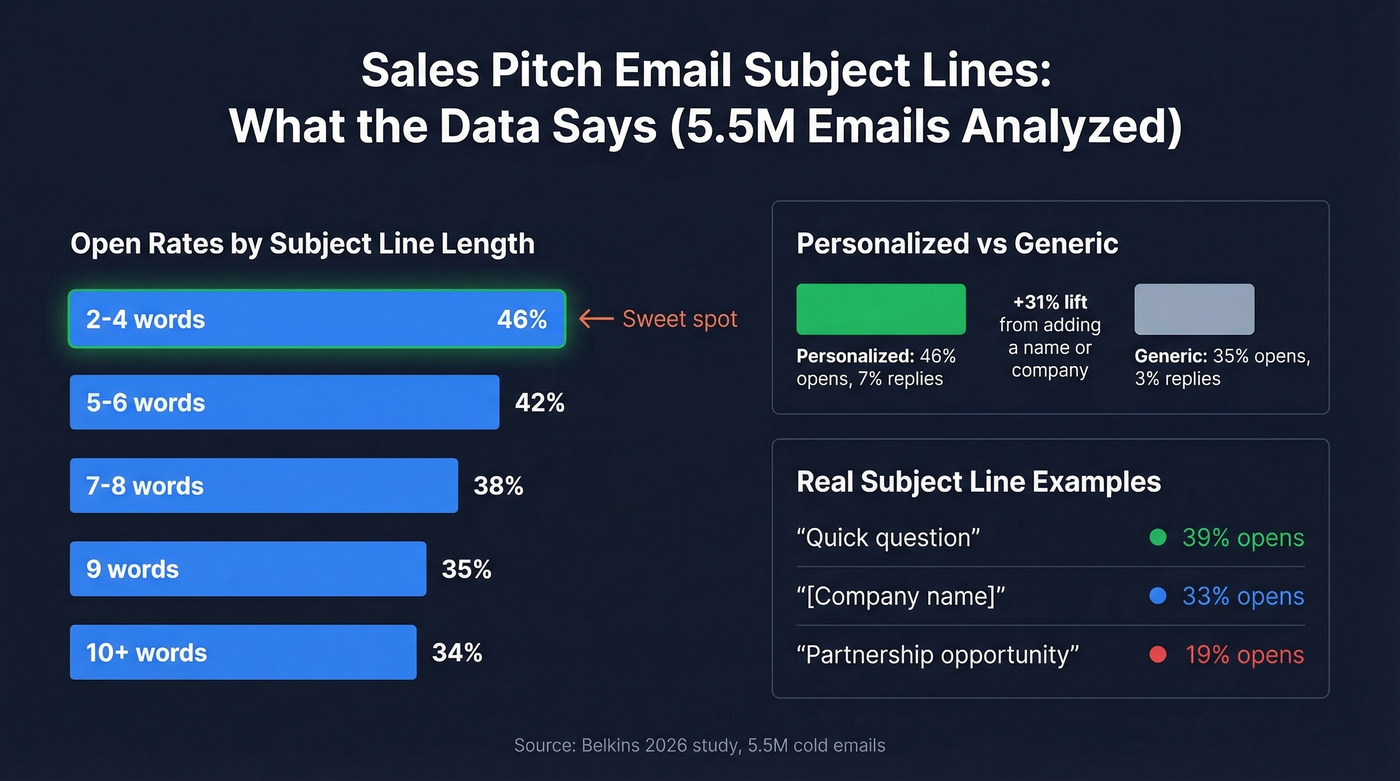
Length matters more than most people think. Two-to-four-word subject lines performed best at 46% opens. Once you cross seven words, performance drops steadily - nine words hit 35%, ten words 34%. Keep it tight.
One Reddit practitioner shared a telling comparison: "Quick question" pulled 39% opens, company-name subjects landed at 33%, and "Partnership opportunity" cratered below 19%. Casual and specific beats formal and generic every single time.
Numbers in subject lines don't help. The data shows subjects with numbers actually opened slightly worse (27% vs 28% without). Skip the "5 ways to..." format. Avoid urgency buzzwords like "ASAP" or marketing-speak greetings - they drag opens below 36%.
Email Structure That Drives Replies
Here's the thing: your prospects get 10-15 cold emails a day. The emails that survive follow a dead-simple structure:
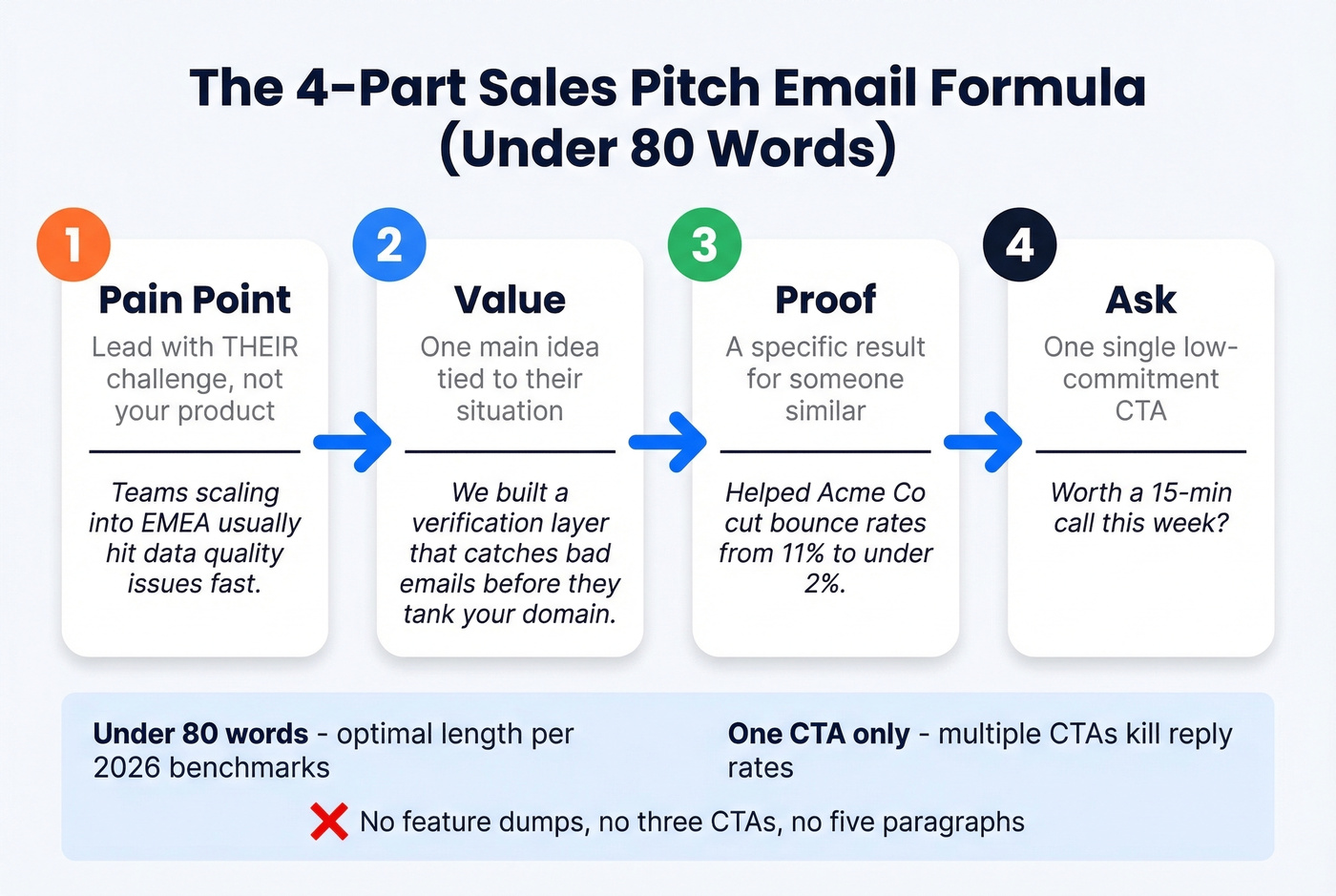
- Pain point - lead with their challenge, not your product
- Value - one main idea, tied to their situation
- Proof - a specific result you've delivered for someone similar
- Ask - a single clear CTA, not three
These four components are non-negotiable. One practitioner on r/Entrepreneur cut their emails from 141 words to under 56 and doubled their reply rate - from 3% to 6%. 2026 benchmark data reinforces the same direction: keep cold emails under 80 words.
The biggest mistake we see is feature-dumping. Nobody cares about your platform's capabilities in a first touch. They care about their problem. A solution-focused outreach email starts with the prospect's pain, connects it to a result, and closes with a low-commitment ask. One CTA, not three.
If your average deal size is under $15K, you probably don't need a multi-paragraph pitch. Two to three sentences with a specific proof point will outperform your polished five-paragraph email every time. Save the detail for the call.
Teams scaling personalization beyond a few dozen emails per day are increasingly using LLMs to generate custom first lines from prospect signals - job changes, funding rounds, tech stack shifts. Worth testing if you're sending volume, but the underlying structure stays the same.
Templates You Can Steal
Cold Outreach Template
Subject: quick question about [specific challenge]
Hi [First Name],
[Company] just [trigger/observation - e.g., "expanded into EMEA"]. Teams scaling that fast usually hit [specific pain point].
We helped [similar company] [specific result with metric]. Worth a 15-minute call this week?
[Your name]
Under 50 words. Opens with something the prospect recognizes, not something about you. Single CTA with a low-commitment ask. The metric in your proof line must be real - fabricated stats destroy trust faster than no stats at all.
Trigger-Based Pitch Template
Most cold emails fail because they're generic. Trigger-based emails flip this by anchoring to something that just happened - a funding round, a leadership hire, an expansion announcement. The prospect knows you're paying attention, not blasting 5,000 people with the same message.
Subject: congrats on the Series B
Hi [First Name],
Saw the funding news - congrats. In our experience, post-raise hiring sprints create [specific pain] fast.
[One sentence about how you solve it + proof point].
Open to a quick intro Thursday or Friday?
What kills this template: using a trigger that's more than two weeks old, or picking a trigger that has zero connection to what you sell. If the link between their event and your value isn't obvious in one sentence, pick a different trigger.
Follow-Up Template
42% of replies come from follow-ups, yet 70% of senders stop after one email. That stat alone should change how you think about cadence. A strong follow-up doesn't repeat your original message - it adds something new.
Subject: Re: quick question about [challenge]
Hi [First Name],
Wanted to share one thing - [new data point, case study, or insight they'd find useful].
Still happy to walk through how this applies to [Company] if the timing works.
This template feels like a reply, not a reminder. "Quick follow-up..." style emails outperform formal follow-ups by roughly 30% based on 2026 benchmark data.

You just read it: bounce rates above 2% kill your domain reputation and every sales pitch email you send after. Prospeo's 5-step email verification delivers 98% accuracy - and every record refreshes every 7 days, not every 6 weeks. At $0.01 per verified email, fixing your data costs less than one bounced opportunity.
Stop writing perfect pitch emails to addresses that don't exist.
Follow-Up Cadence
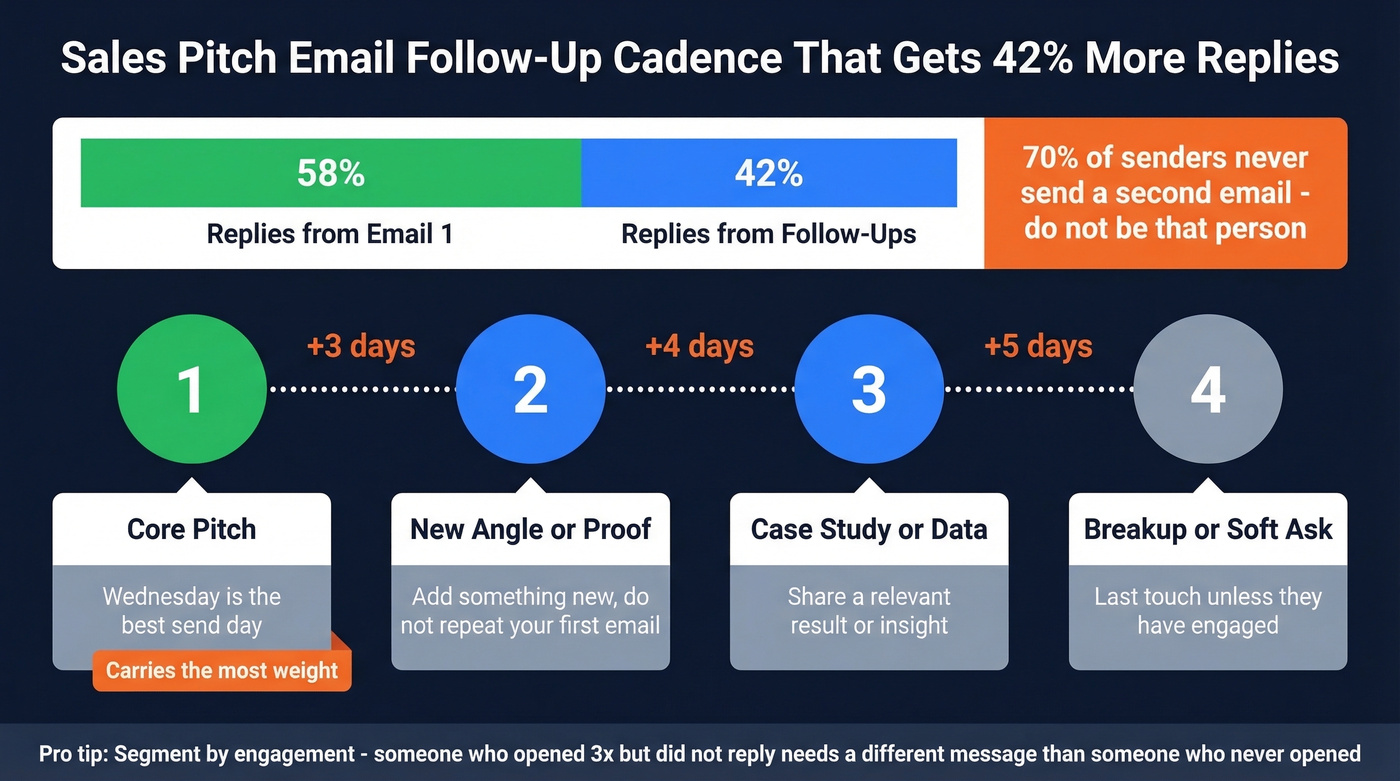
58% of replies come from the first email. That means your initial pitch carries the most weight - get it right. But the remaining 42% come from follow-ups, and 70% of senders never send a second email. That's the single easiest win in cold outreach.
Just keep going.
The sweet spot is 4-7 touchpoints spaced 3-4 days apart. Beyond seven, you hit diminishing returns unless each touch adds genuinely new value.
| Touch | Timing | Purpose |
|---|---|---|
| Email 1 | Day 1 (Wed preferred) | Core pitch |
| Email 2 | Day 4 | New angle or proof |
| Email 3 | Day 8 | Case study or data |
| Email 4 | Day 13 | Breakup or soft ask |
Wednesday consistently outperforms other send days. Tuesday and Thursday are solid alternatives.
Segment by engagement. Someone who opened three times but didn't reply needs a different follow-up than someone who never opened at all. Adjust the message, not just the timing.
If you want more plug-and-play options, steal a few from these follow-up templates.
Fix Your Data Before You Send
None of the templates above matter if your emails bounce. One practitioner on r/Entrepreneur dropped their bounce rate from 11% to under 2% by ditching purchased lists and verifying every address. That single change protected their sender reputation and unlocked the reply-rate gains from everything else they'd improved.
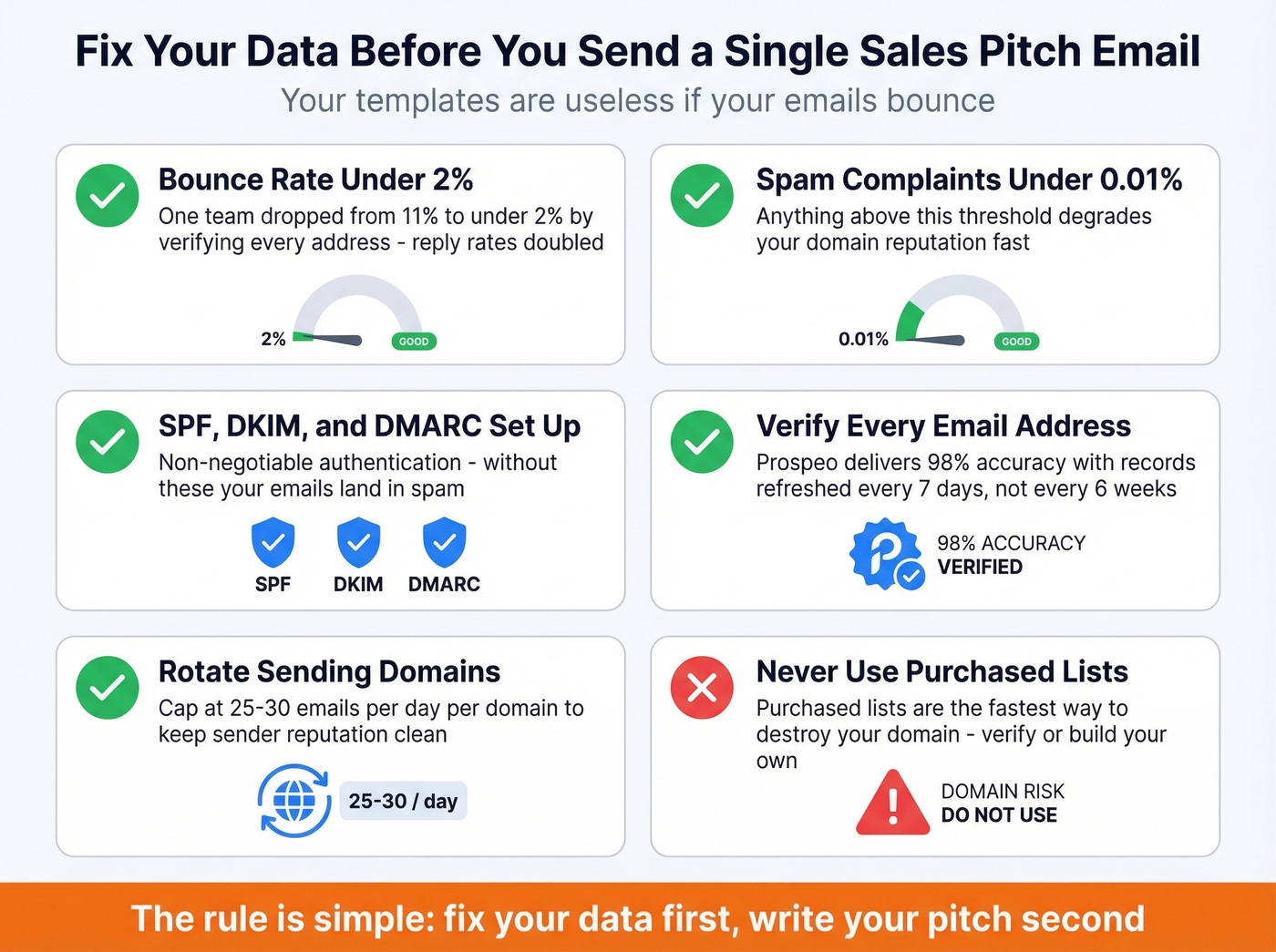
The threshold is clear: keep bounce rates below 2% and spam complaints under 0.01%, or your domain reputation degrades fast. (If you want the deeper breakdown, start with email bounce rate.)
Pair verification with proper domain infrastructure. Set up SPF, DKIM, and DMARC authentication. If you're sending volume, rotate domains - one practitioner uses 7 domains at 26 emails/day max per domain to keep each sender reputation clean. For a full checklist, see this email deliverability guide and how to improve sender reputation.
Trigger-based sales pitch emails only work when you know what's actually happening at your prospect's company. Prospeo tracks 15,000 intent topics, job changes, funding rounds, and headcount growth - so every first line you write is anchored to a real signal, not a guess. 300M+ profiles, 30+ filters, all self-serve.
Find the trigger. Find the email. Send the pitch that gets a reply.
Compliance Isn't Optional
CAN-SPAM applies to all commercial email, including B2B. There's no exception. Violations carry penalties of up to $53,088 per email.
Every commercial email must include a valid physical postal address, a clear opt-out mechanism, opt-out processing within 10 business days, honest subject lines, and accurate headers. You're accountable even if you outsource sending to an agency or VA.
If you're selling into the EU, GDPR adds fines up to 4% of global annual revenue or EUR 20M, whichever is higher. Real talk: most small teams ignore compliance until something goes wrong. Don't be that team.
FAQ
How long should a sales pitch email be?
Under 80 words. 2026 benchmark data shows short emails consistently outperform longer ones. One practitioner cut from 141 to 56 words and doubled their reply rate from 3% to 6%. Say less, say it better.
What's a good reply rate for cold outreach emails?
The average is 3.43% based on 2026 benchmarks. Top quartile hits 5.5%+, and elite senders exceed 10.7%. If you're consistently above 6%, you're outperforming most outbound teams.
How do I keep sales emails out of spam?
Verify every email address before sending - tools like Prospeo catch invalid addresses before they tank your sender reputation. Authenticate your domain with SPF, DKIM, and DMARC. Keep bounce rates below 2% and spam complaints below 0.01%.
What makes a sales pitch email different from a marketing email?
A sales pitch email targets a specific person with a specific problem and asks for a conversation. Marketing emails broadcast to a list. The sales version is shorter, more personalized, and built around a single CTA - not a newsletter with five links.