

Sales Productivity: A Data-Backed Guide to What Actually Works
A RevOps lead we know ran a time audit last quarter. Her 12-person sales team was "busy" - 200+ dials a day, pipeline reviews every Monday, CRM fields dutifully updated. Revenue was flat. When she mapped where hours actually went, reps spent about 28% of their week selling. The rest was admin, bad data cleanup, and tool-switching. That's not a motivation problem. It's a systems problem, and it's the core of why sales productivity stays broken at most B2B companies.
McKinsey analyzed nearly 500 B2B companies and found a 2.5x gross margin gap between top-quartile and bottom-quartile sales orgs for every dollar invested in sales. Salesforce reports 67% of sellers don't expect to hit their annual quota. The gap between the best and the rest isn't closing. It's widening.
Here's the short version: fix your data quality first - it's the invisible tax on every other investment. Redesign account prioritization before adding tools. Deploy AI for research and personalization, but only after those two steps are handled.
What Is Sales Productivity?
The definition is simple on paper: Output / Input. Revenue per rep, deals per quarter, pipeline generated per hour of selling time. But most teams confuse sales efficiency (fewer steps, less time per task) with productivity (more revenue per unit of effort). You can be extremely efficient at unproductive activities.
The real problem shows up in the denominator. Salesforce's 2026 State of Sales data puts non-selling time at 60% of a rep's week. Bain's estimate is worse - roughly 25% of time actually selling. Either way, the math is brutal: you're paying full-time salaries for part-time selling.
What's Actually Killing Productivity
Most articles on this topic hand you a list of tips. They skip the four systemic problems that make those tips irrelevant until you fix them.
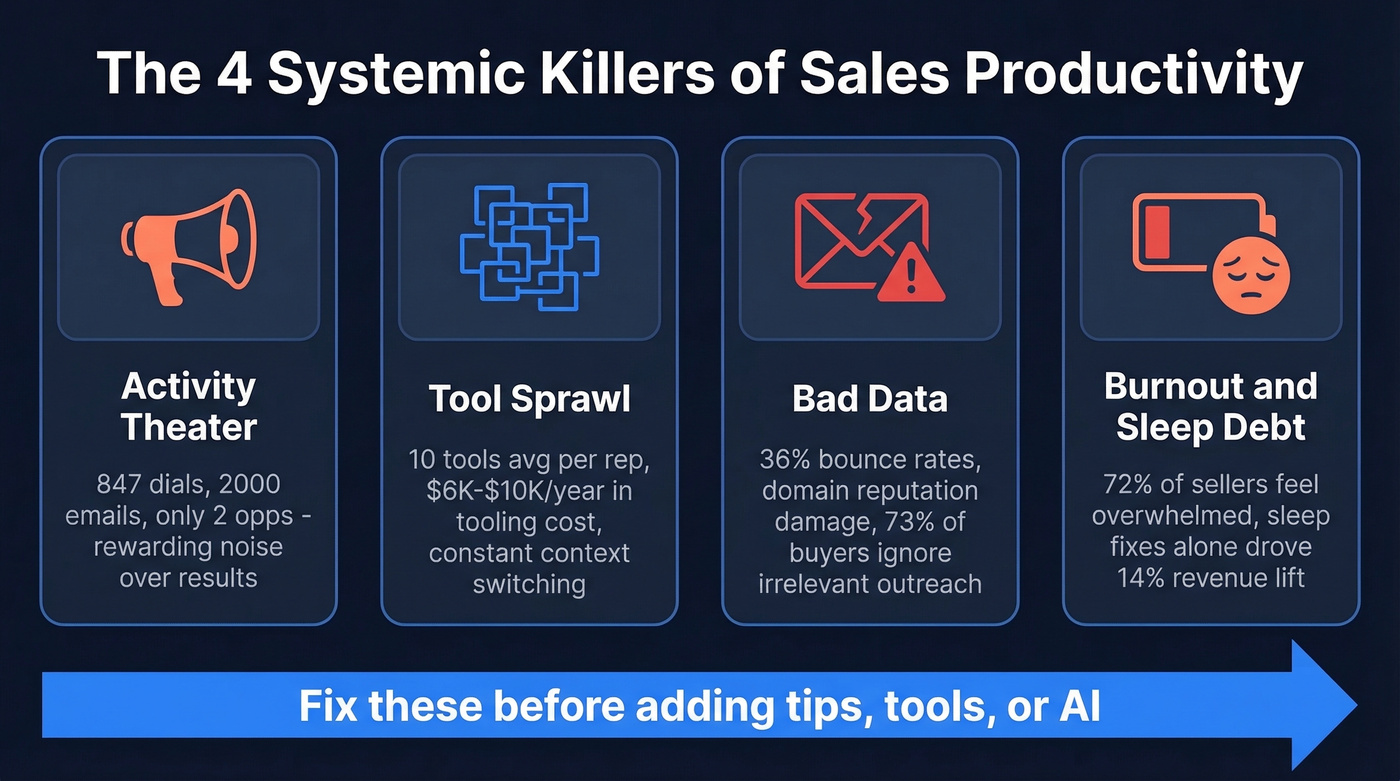
Activity Theater
Monday pipeline review. Your SDR team logged 847 dials last week. Emails sent? Over 2,000. The dashboard looks green. But meetings booked? Seven. Opportunities created? Two.
TheSalesBlog calls this the activity-over-results trap - managers rewarding volume because it's measurable, even when it produces nothing. The consensus on r/sales is that the enterprise prospecting playbook is fundamentally broken, and the threads debating it aren't kind to leaders who celebrate dial counts. High activity with no meetings isn't hustle. It's noise. The fix isn't more dials - it's better targeting, better data, and honest conversations about what "productive" actually means.
Tool Sprawl
Salesforce data shows sales teams use an average of 10 tools. Every tool switch is a context switch. Every context switch is lost momentum. And 53% of sales ops professionals are planning to consolidate, which tells you how bad the sprawl has gotten.
We estimate the aggregate cost at $500-$800/user/month when you stack a CRM, sequencer, dialer, data provider, conversation intelligence platform, and the handful of point solutions that somehow became "essential." That's $6,000-$10,000 per rep per year in tooling alone - before you even count the productivity drain of switching between them.
Bad Data: The Invisible Tax
An SDR spends 45 minutes building a list of 50 contacts. They load the sequence, hit send, and 18 emails bounce. That's a 36% bounce rate. The sequence gets flagged. Domain reputation takes a hit. The next campaign - even with good data - lands in spam.
And 73% of B2B buyers actively avoid sellers who send irrelevant outreach, so the damage extends well beyond deliverability. Salesforce estimates 19% of company data is inaccessible to the teams that need it. But "inaccessible" is generous. A lot of it is just wrong: stale emails, disconnected phone numbers, people who changed jobs six months ago. We'll come back to this because it's the biggest lever most teams ignore.
Burnout and Sleep Debt
72% of sellers feel overwhelmed by the number of skills required for their job. That's not just a morale stat - it's a performance stat. Burned-out reps don't prospect. They coast.
Here's a wild one: a Fortune 200 company using Rise Science tracked sellers over eight months and saw a 14% lift in monthly revenue and 50% more outbound calls after minimizing sleep debt. Sleep. Not a new CRM. Not AI. Sleep.
Benchmarks That Matter in 2026
Before you can fix anything, you need to know what good looks like.
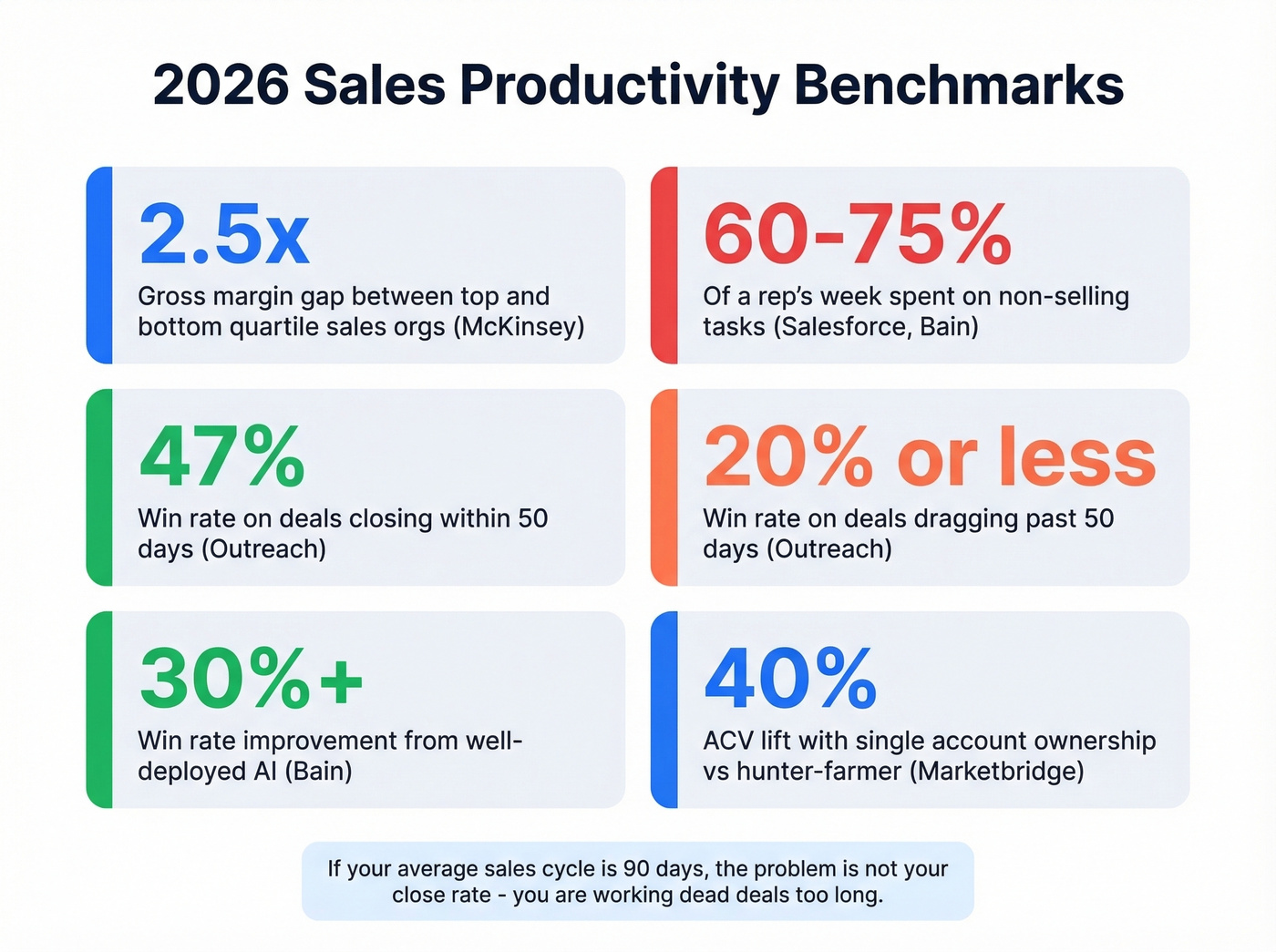
| Benchmark | Finding | Source |
|---|---|---|
| Productivity gap | 2.5x gross margin, top vs. bottom quartile | McKinsey |
| Non-selling time | 60-75% of rep time | Salesforce / Bain |
| Shared services impact | +20% capacity, up to +30% productivity | McKinsey |
| Win rate by speed | 47% within 50 days, 20% or less after | Outreach |
| AI win-rate lift | 30%+ improvement | Bain |
| Account ownership | 40% ACV lift with single owner vs. hunter-farmer | Marketbridge |
| Sales cycle trend | 57% say cycles are getting longer | Salesforce |
The Outreach finding is particularly actionable: deals that close within 50 days have a 47% win rate. After that threshold, win rates drop to 20% or lower. If your average cycle is 90 days, the problem isn't your close rate. You're working dead deals too long.

That 36% bounce rate scenario isn't hypothetical - it's the reality for teams running on stale data. Prospeo's 98% email accuracy and 7-day refresh cycle eliminate the invisible tax killing your reps' productivity. Stop paying full-time salaries for part-time selling.
One agency tripled pipeline from $100K to $300K/week by fixing their data first.
How to Measure by Sales Motion
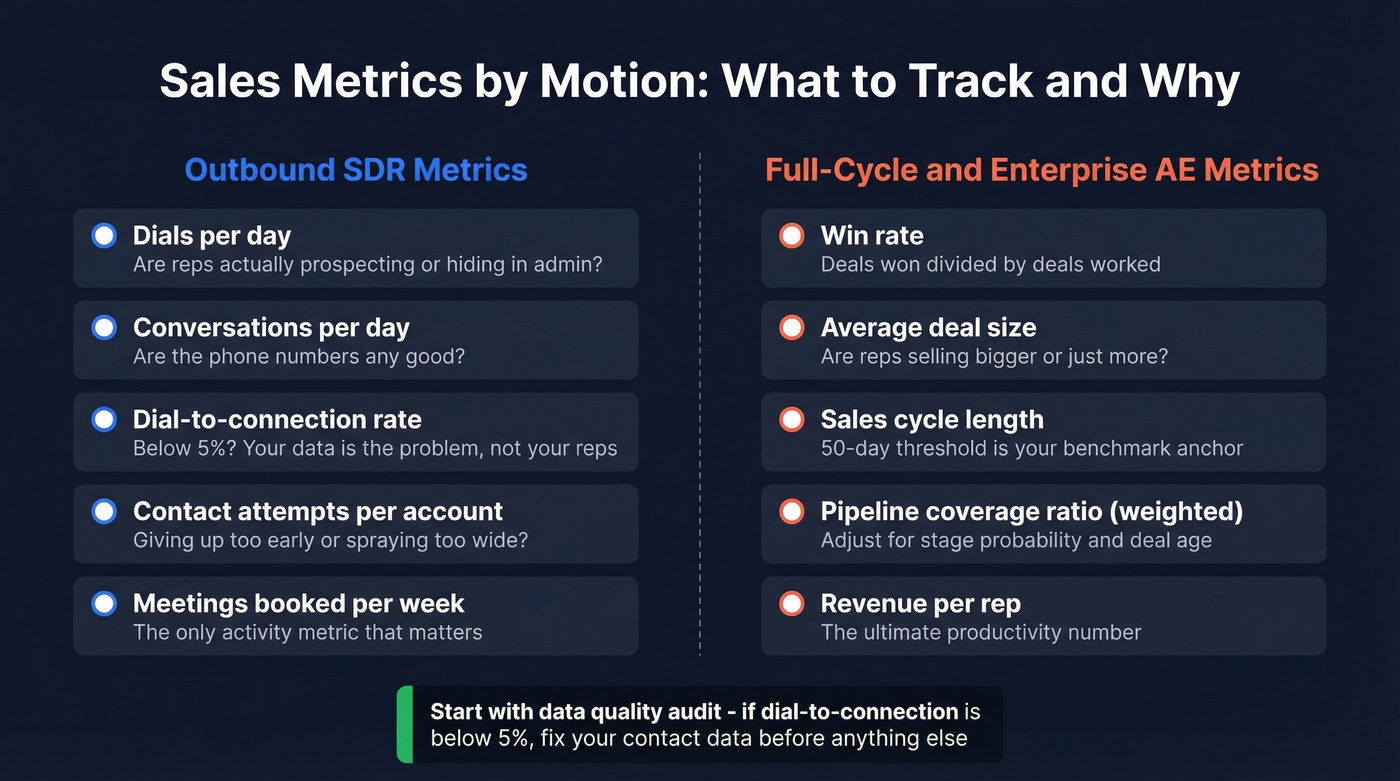
Not every team should track the same metrics. An outbound SDR team and a full-cycle enterprise AE team have fundamentally different levers.
Outbound Metrics
Revenue.io's KPI framework breaks outbound into the metrics that actually diagnose problems. Dials per day tells you if reps are actually prospecting or hiding in admin. Conversations per day tells you if the phone numbers are any good. Dial-to-connection rate below 5%? Your data is the problem, not your reps. And contact attempts per account reveals whether reps are giving up too early or spraying too wide.
Start by auditing your contact data accuracy. If your dial-to-connection rate sits below 5%, the bottleneck is your phone numbers, not your people.
Full-Cycle and Enterprise Metrics
For AEs running complex deals, the metrics shift to outcomes: win rate, average deal size, sales cycle length, pipeline coverage ratio, and revenue per rep. The Outreach 50-day threshold is a useful benchmark anchor - if most deals drag past 60-90 days, look at qualification criteria and whether reps are spending time on accounts that'll never close. Weighted pipeline, adjusted for stage probability and deal age, tells a much more honest story than raw coverage ratios.
Strategies That Actually Improve Sales Productivity
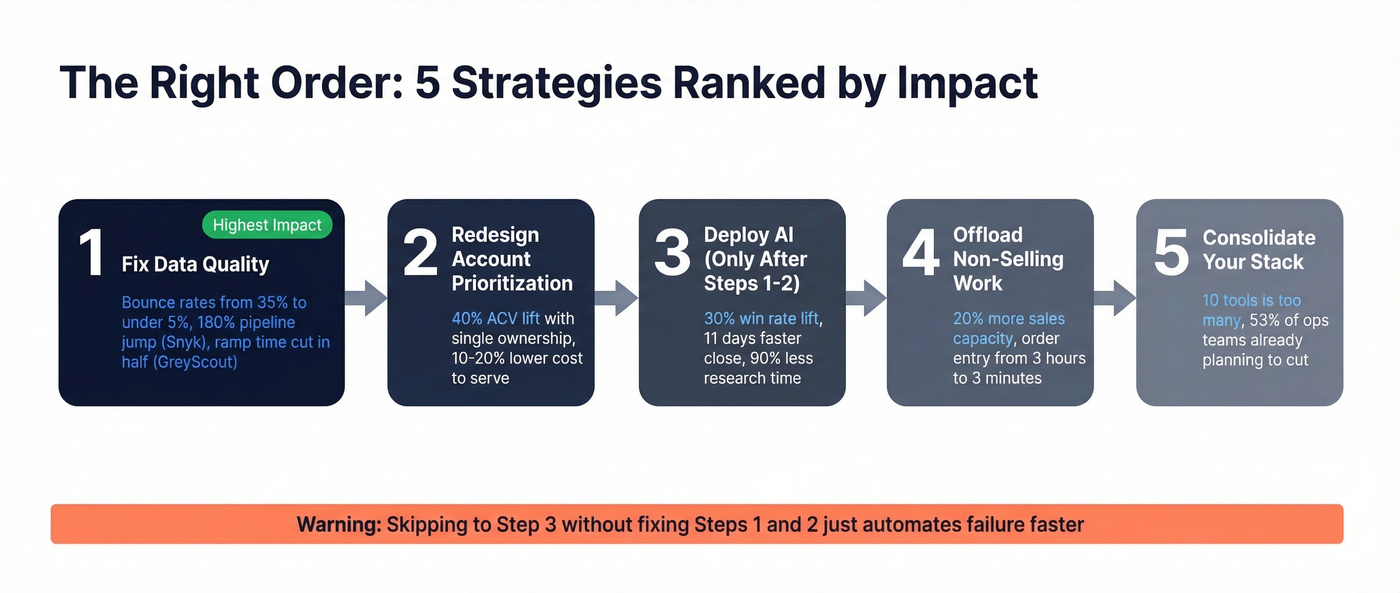
Let's rank these by impact, not by how exciting they sound. The boring stuff works best.
1. Fix Your Data Quality First
This is strategy #1 for a reason. Snyk had 50 AEs prospecting 4-6 hours per week with bounce rates running 35-40%. After switching their data source, bounce rates dropped under 5%, AE-sourced pipeline jumped 180%, and the team generated 200+ new opportunities per month. GreyScout cut rep ramp time from 8-10 weeks to 4 weeks - largely because new reps weren't wasting their first month learning which contacts in the CRM were actually reachable.
Salesforce's own data backs this up: 74% of sales teams with AI prioritize data hygiene, because AI amplifies whatever you feed it. Including garbage.
Prospeo refreshes 300M+ professional profiles every 7 days - compared to the 6-week industry average - which means your sequences hit live contacts, not ghosts. At 98% email accuracy and roughly $0.01 per lead, the ROI compounds across every other metric downstream: better sequences, higher connect rates, fewer bounced emails tanking your domain reputation.
2. Redesign Account Prioritization
McKinsey found that underperforming sales orgs spend more than 50% of their time on customers contributing 20% or less of revenue. That's not a time management problem. It's a territory design problem. Prioritizing high-value accounts can lower cost-to-serve by 10-20% and increase revenue per sales FTE by 3-15%.
Marketbridge's 2025 B2B SaaS benchmarks show that single account ownership boosts ACVs by 40% compared to hunter-farmer models. Growth leaders also operate with roughly 3 customer segments versus 2 or fewer for lower performers. More granular segmentation plus clear ownership equals bigger deals. Most teams know this intuitively but never restructure because it's politically painful.
3. Deploy AI Where It Compounds
Skip this section if your data quality is still broken. AI on bad data just automates failure faster.
Bain reports 30%+ win-rate improvement when AI improves conversion rates across funnel steps - but only when companies redesign end-to-end processes, not just bolt AI onto existing workflows. Outreach's platform data shows deals supported by their AI coaching assistant close 11 days faster, with up to a 10 percentage-point win-rate lift on deals over $50K. Sellers using those AI tools cut research and personalization time by 90%.
The biggest predictor of AI adoption isn't the technology itself. A Purdue-published summary of a 2025 peer-reviewed study found that managerial encouragement was the central driver of GenAI becoming embedded in daily sales work. Not training programs. Not tech comfort. Leadership support. If your managers aren't using the AI tools themselves, your reps won't either, and change fatigue will kill adoption before it starts.
4. Offload Non-Selling Work
McKinsey's top performers have offloaded up to 50% of non-selling tasks to shared services, unlocking roughly 20% more sales capacity. One case study showed RPA reducing order entry from 3 hours to 3 minutes.
You don't need to build a shared services team overnight. Start by identifying the three tasks your reps hate most and spend the most time on. Proposal formatting? CRM data entry? Lead list building? Each one has a solution that doesn't require your $150K/year AE to do it manually.
5. Consolidate Your Stack
Look, most sales teams don't have a tools problem - they have a tools addiction problem. You don't need 10 tools. You need 3 that work together: a CRM, a sequencer, and a data platform with verified contacts. Everything else is either a nice-to-have or actively creating friction.
We've seen teams cut their stack from 8 tools to 4 and see gains purely from reduced context-switching - before any process changes kicked in. When your reps spend less time toggling between tabs and more time in conversations, the numbers move on their own.
The 30-Day Productivity Audit
Don't try to fix everything at once. Here's a week-by-week diagnostic.
Week 1 - Audit data quality. Pull your last 500 outbound emails and check the bounce rate. If it's above 10%, you have a data problem silently undermining every other metric.
Week 2 - Where does the time actually go? Have every rep track their hours for one week. Selling vs. admin vs. meetings vs. tool time. The numbers will be uncomfortable. That's the point.
Week 3 - Review account prioritization. Map revenue concentration against time allocation. If your top 20% of accounts aren't getting 50%+ of rep attention, you have a misallocation problem that no amount of coaching will fix.
Week 4 - Evaluate tool ROI. For every tool in your stack, answer one question: does this directly drive pipeline or revenue? If the answer is "it helps with reporting" or "we've always had it," it's a consolidation candidate.
Dial-to-connection rate below 5%? The article said it: your data is the problem, not your reps. Prospeo delivers 125M+ verified mobile numbers with a 30% pickup rate - that's 3x the industry average. Give your team numbers that actually connect.
Stop burning rep hours dialing dead numbers. Get verified direct dials for $0.10 each.
FAQ
What's the difference between sales productivity and sales efficiency?
Productivity measures output per input - revenue per rep, pipeline per hour. Efficiency measures waste reduction - fewer steps, less time per task. You can be highly efficient at unproductive activities. A rep sending 200 perfect emails to the wrong people is efficient but not productive.
How much time do sales reps actually spend selling?
About a third, at best. Salesforce puts it at around 40%, Bain estimates around 25%. The consensus: reps spend the majority of their week on admin, data entry, internal meetings, and tool management rather than buyer conversations.
What's the fastest way to improve sales productivity?
Audit your contact data. If more than 10% of emails bounce, you've got a data quality problem undermining sequence performance, domain reputation, connect rates, and rep confidence. Fix the data first, then optimize everything else.
Does AI actually improve sales performance?
Yes - Bain reports 30%+ win-rate improvement, and Outreach shows 11-day faster closes on deals over $50K. But only when paired with clean data and redesigned workflows. AI amplifies whatever you feed it, including garbage.