

How to Write a Sales Proposal That Actually Wins (2026 Data)
Your prospect just said "send me a proposal." You've got a short window before momentum fades - and what you send determines whether this deal closes or joins the 55% that don't.
Most sales proposals fail for the same reason: they're about the seller, not the buyer. The data backs this up. Let's fix it.
Three Changes That Move the Needle Most
Before the full breakdown, here's where to focus first:
- Offer multiple pricing options. Proposals with two or three packages win 36% more often than single-price proposals. It shifts the buyer's decision from "yes or no" to "which one."
- Stop defaulting to PDFs for serious deals. Dynamic proposals with engagement tracking, embedded demos, and adjustable pricing remove version confusion and make it easier for buyers to review and decide.
- Verify your contacts before you hit send. Known-contact deals close at 37% vs. 19% for cold outreach. A polished proposal sent to a bounced email or the wrong stakeholder is wasted work.
What Is a Sales Proposal?
A sales proposal isn't a price list. It's a persuasion document - your approach, your timeline, your understanding of the buyer's problem, and why you're the right fit to solve it. The price is in there, but it's not the point.
Here's the distinction that trips people up:
- Estimate: An early-stage price range when scope isn't fully defined. Think ballpark.
- Quote: A fixed price based on specific, known requirements. Valid for a set window, often 30 days.
- Proposal: The full package - approach, timeline, pricing, and the argument for why you're the best choice. It persuades. The other two just inform.
If your "proposal" is really just a quote with a cover page, you're leaving money on the table.
What 50,000 Proposals Reveal About Winning
An analysis of 50,000 proposals surfaced patterns that most guides ignore. The findings aren't surprising once you see them, but most teams still get them wrong.
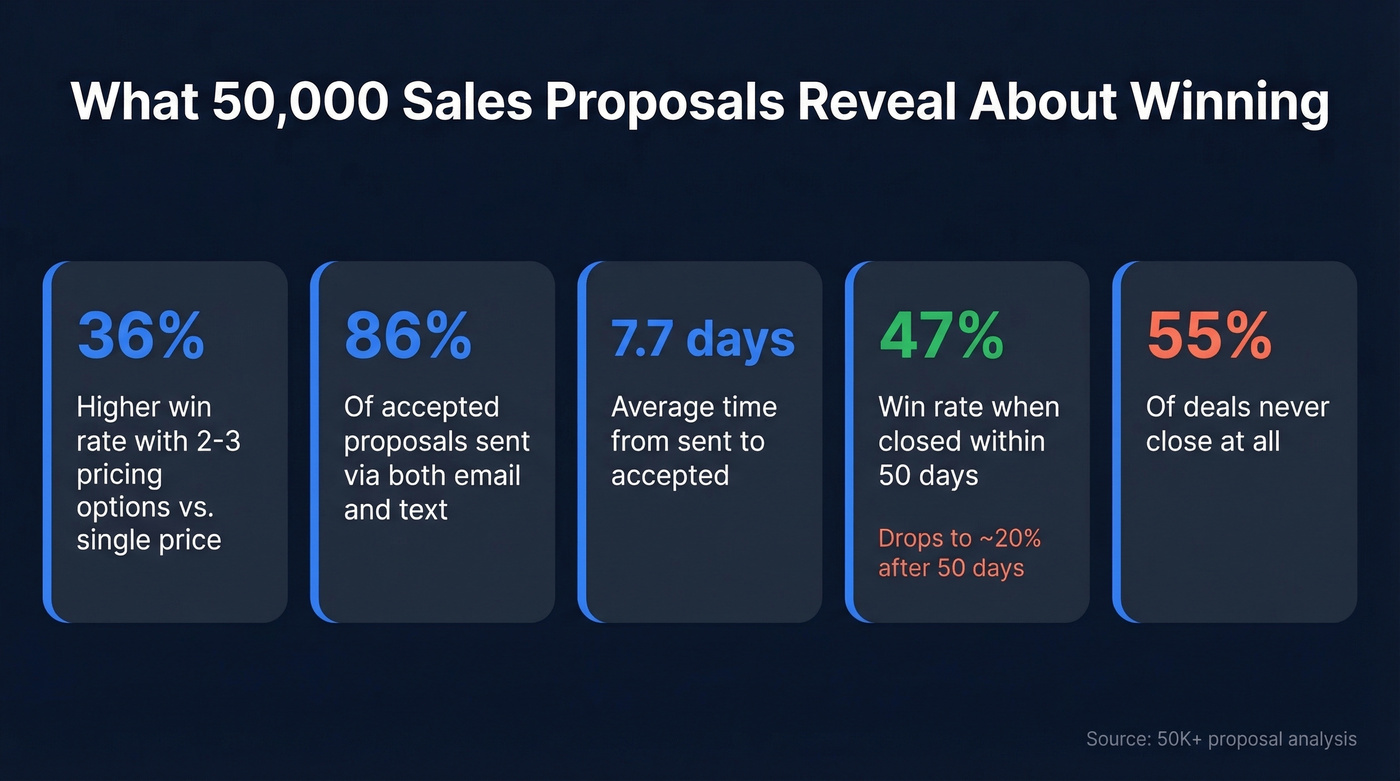
Shorter proposals win more. Accepted proposals had shorter average text length - but the content was more accurate and specific. This isn't about cutting corners. It's about cutting fluff.
Multi-channel delivery is the norm for winners. 86% of accepted documents were sent via both email and text. If you're only emailing your proposal, you're already behind the majority of deals that close.
The clock starts immediately. Average time from sent to accepted: 7.7 days. Proposals don't age well. They lose urgency, get buried, and invite competitors to swoop in.
Design matters more than you think. Branded, professionally designed proposals won at higher rates than plain-looking ones. If your proposal looks like a Word doc from 2014, you're undermining your own credibility before anyone reads a word.
Multiple pricing options are mandatory. Offering two or three packages increased win rates by 36%. This is the single highest-leverage change you can make to an existing proposal template.
And here's the kicker: opportunities closed within 50 days have a 47% win rate. After that threshold, win rates drop to roughly 20%. Your proposal is the accelerant or the bottleneck. There's no neutral.
What to Include in Your Proposal
One practical tip most guides skip: pull your discovery call notes and CRM data before drafting. The best proposals don't just reference what the buyer said - they use the buyer's exact language. If your CRM has call recordings or notes from the discovery session, mine them for the specific phrases your prospect used to describe their problem. That language is gold.
Also, verify who's actually reading it. We've seen deals stall because a proposal went to someone who'd changed roles two months earlier. Tools like Prospeo can confirm verified emails and job titles for every stakeholder on the buying committee, so you're not sending a polished document into the void.
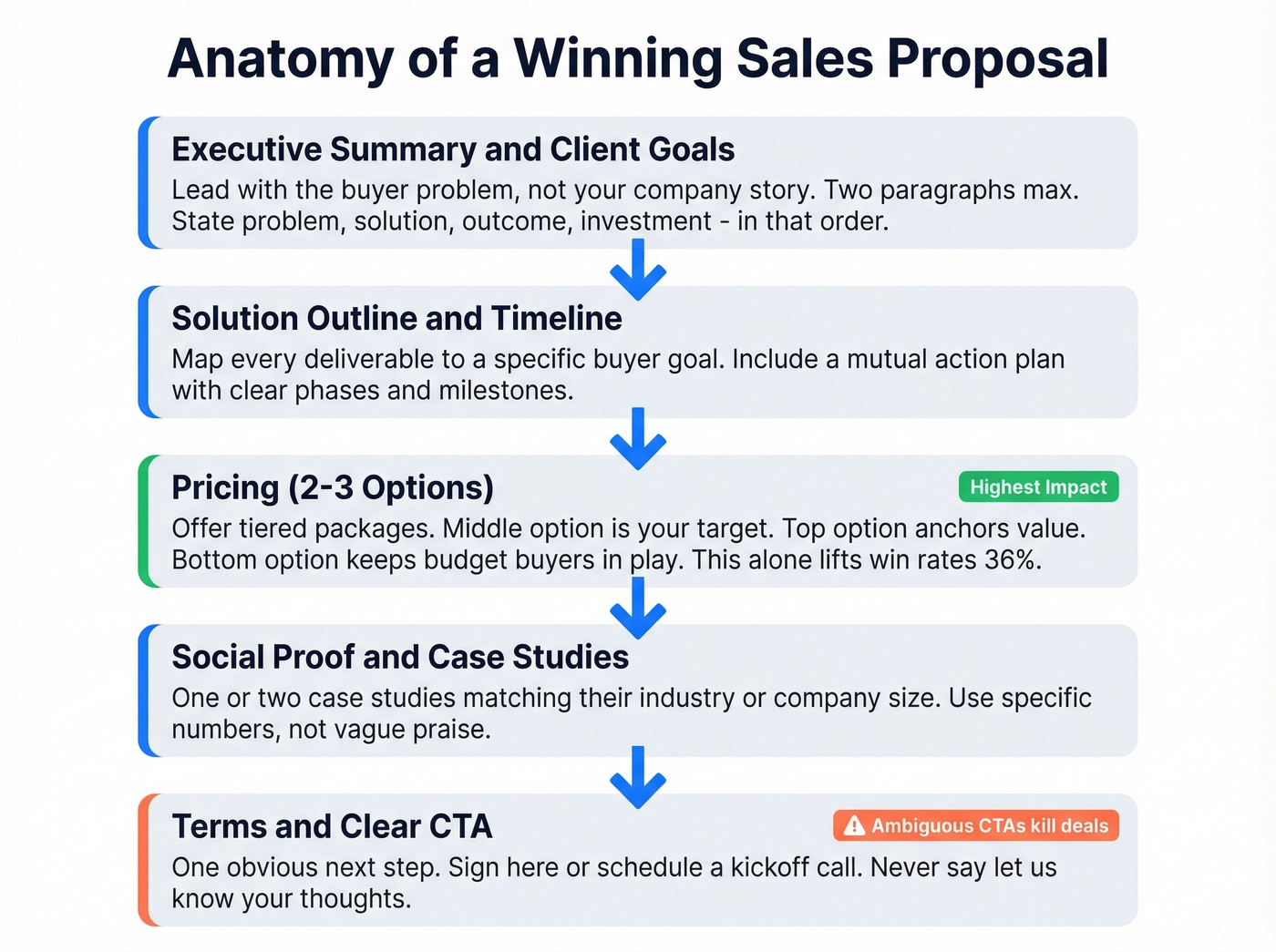
Now, the structure. Here's what belongs in every B2B proposal:
Executive Summary & Client Goals
Lead with the buyer, not yourself. Your executive summary should state the prospect's problem, your proposed solution, the expected outcome, and the investment - in that order. Two paragraphs max.
Here's what a strong executive summary looks like, annotated:
Acme Corp is losing 22% of inbound leads to slow response times - Opens with the buyer's problem, using their number from discovery
across its three regional offices, costing an estimated $1.4M in annual pipeline. - Quantifies the pain in dollars, making the investment feel small by comparison
We propose deploying ResponseIQ across all three offices over 6 weeks, - Specific solution mapped to their scope
targeting a 40% reduction in lead response time and a projected $560K in recovered pipeline within the first quarter. - Outcome framed as ROI, not features
The total investment is $84,000/year - a 6.7x return on the recovered pipeline alone. - Price anchored against the value, not stated in isolation
Notice what's missing: no company history, no founding story, no "we're the leading provider of..." The entire paragraph is about the buyer's world. That's the standard.
Client goals deserve their own section. Restate what they told you in discovery, using their language. If you can't articulate their goals better than they can, you haven't done enough discovery to send a proposal yet.
Solution Outline & Timeline
Map your solution directly to the goals you just listed. Every feature or deliverable should connect to a specific outcome the buyer cares about. Skip the product tour - this isn't a brochure.
Include an execution timeline with clear phases. Buyers want to know when they'll see results, not just what you'll deliver. A mutual action plan - a shared checklist of steps both sides need to complete - works even better because it turns the proposal from a pitch into a collaboration.
Pricing: Where the 36% Lift Lives
Present two or three packages. Not to confuse, but to anchor. The middle option is usually where you want them. The top option makes the middle feel reasonable. The bottom option gives budget-constrained buyers a way in.
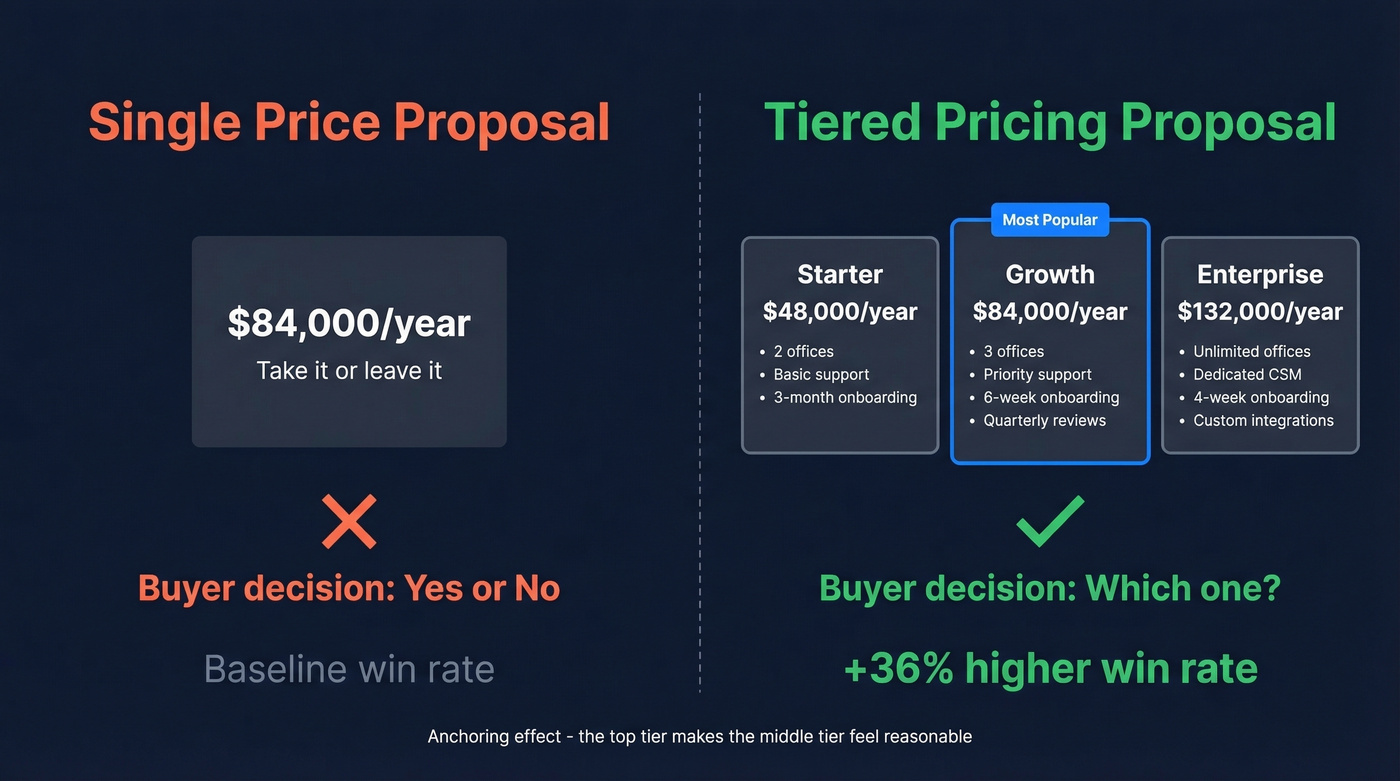
Include adjustable inputs where possible: term length, number of users, add-ons, volume discounts. Interactive pricing converts better than static tables because it gives the buyer control. Most proposal tools support this natively now.
Social Proof & Terms
Case studies and testimonials go here - not buried in an appendix. Pick one or two that mirror the prospect's industry, company size, or use case. Specific numbers beat vague praise every time. "Reduced bounce rate from 35% to under 4%" is more persuasive than "great product, highly recommend."
Close with clear terms of agreement and a single, obvious call to action. "Sign here" or "schedule a kickoff call" - not "let us know your thoughts." Ambiguous CTAs kill deals.

Known-contact deals close at 37% vs. 19% for cold outreach. Before you send that proposal, make sure every stakeholder on the buying committee has a verified email and current job title. Prospeo's 300M+ profiles with 98% email accuracy ensure your proposal reaches the right person - not a bounced inbox.
Stop sending winning proposals to dead email addresses.
Sales Proposal Benchmarks for 2026
Let's ground expectations with real numbers so you can tell whether your proposals are performing or underperforming.
| Metric | Benchmark |
|---|---|
| Avg RFP win rate | 45% |
| Enterprise win rate | 47% |
| Mid-market win rate | 45% |
| Known-contact win rate | 37% vs. 19% cold |
| $100K+ ACV win rate | 15-20% |
| $50-100K ACV win rate | 20-25% |
| AI adoption in proposals | 68% |
| Unfinished RFPs/year cost | $725K |
Two numbers jump out. First, 20% of RFPs go unfinished - costing the average organization $725K per year in lost revenue. That's not a proposal problem. That's a prioritization problem. If you can't finish it, don't start it.
Second, 68% of teams now use generative AI somewhere in their proposal workflow. If you're still writing every section from scratch, you're spending time your competitors aren't. Here's our take: AI is great for first drafts of boilerplate sections like terms and company overviews, but the executive summary and pricing rationale should always be hand-written. Those are the sections that win or lose the deal, and buyers can smell generic AI copy from a mile away. (If you're building this into your workflow, start with generative AI sales tools that support sales-specific use cases.)
PDF vs. Dynamic Proposals
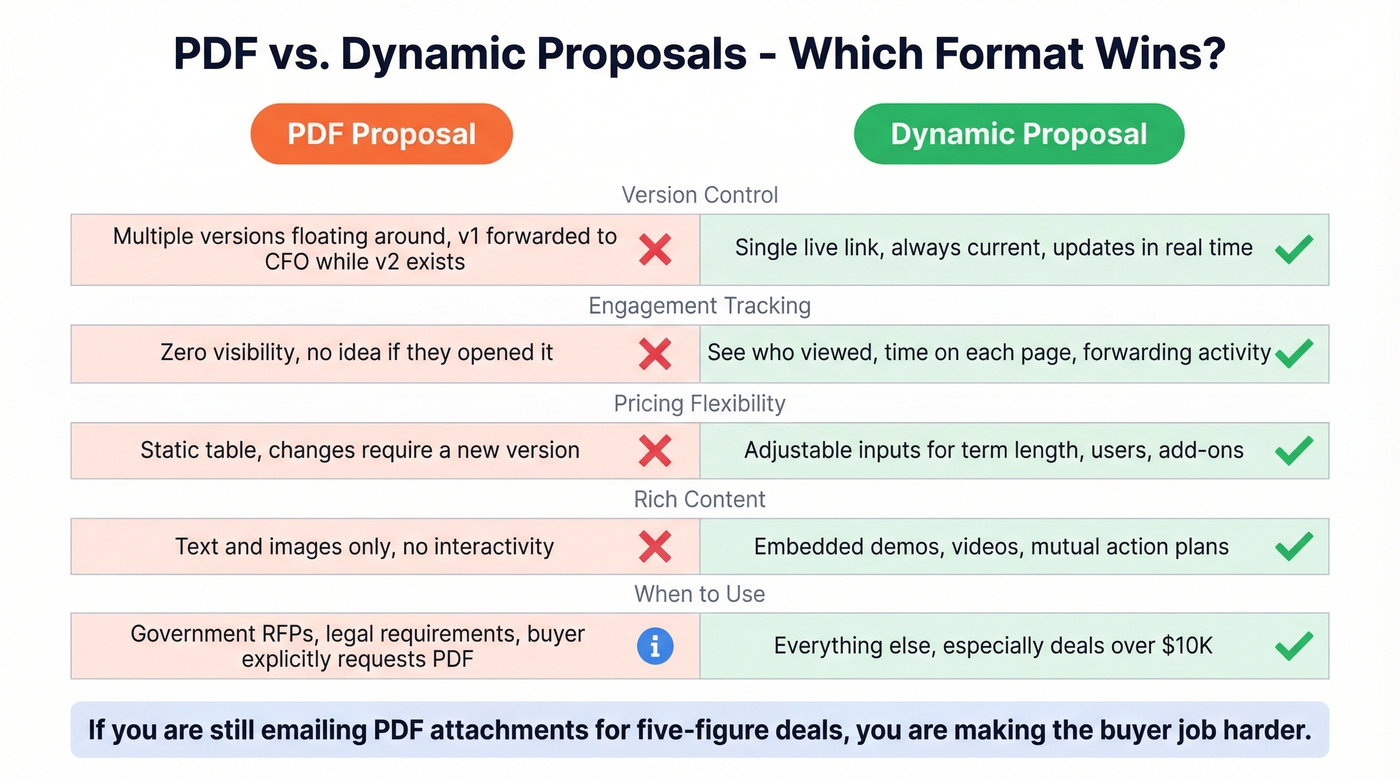
Use a PDF if: the buyer explicitly asked for one, or your industry requires a specific document format like government or legal RFPs.
Skip the PDF for everything else.
PDFs create version confusion. You send v1, the buyer asks for changes, you send v2, they forward v1 to their CFO. Now two versions are floating around and nobody knows which is current. We've seen this torpedo deals that were otherwise won.
PDFs also give you zero visibility. You don't know if the buyer opened it, how long they spent on the pricing page, or whether they forwarded it to other stakeholders. You're flying blind on follow-up.
Dynamic proposals - hosted on a single link that updates in real time - solve all of this. They support embedded product demos, adjustable pricing inputs, mutual action plans, and engagement analytics that tell you exactly who viewed what and when. Tools like Dock, Qwilr, and PandaDoc all offer this. If you're still emailing PDF attachments for five-figure deals, you're making the buyer's job harder. And making the buyer's job harder is never a winning strategy.
Mistakes That Kill Your Proposal
Your proposal doesn't need to be longer. It needs to be more specific. Sales reps on r/sales consistently ask for proposal examples that go beyond slide decks - the demand is for concrete, filled-out templates they can actually adapt. Here are the mistakes that sink most of them:
- Making it about you. Nobody cares about your founding story on page two. Lead with the buyer's problem.
- Not addressing stated requirements. If they asked for X in discovery and X isn't in the proposal, you've already lost.
- Jargon overload. Technical depth is fine. Acronym soup is not. Write for the CFO who'll also read this, not just the technical champion.
- Burying the benefits. Features go in the solution section. Benefits - the outcomes the buyer actually cares about - belong front and center in the executive summary.
- Missing a clear CTA. "Let us know" isn't a call to action. "Sign by Friday to lock in Q1 pricing" is.
- No social proof. A proposal without testimonials or case studies is just a price list with extra steps.
- Spelling and formatting errors. This sounds basic because it is. And it still kills deals. If you can't proofread a 6-page document, why would they trust you with a six-figure contract?
The common thread: they all signal you didn't put in the work.
Follow-Up After Sending
The follow-up matters as much as the proposal itself. That 7.7-day acceptance window means your document is hottest right after you send it. After that, attention decays fast - and deals stretching past 50 days see win rates crater from 47% to roughly 20%.
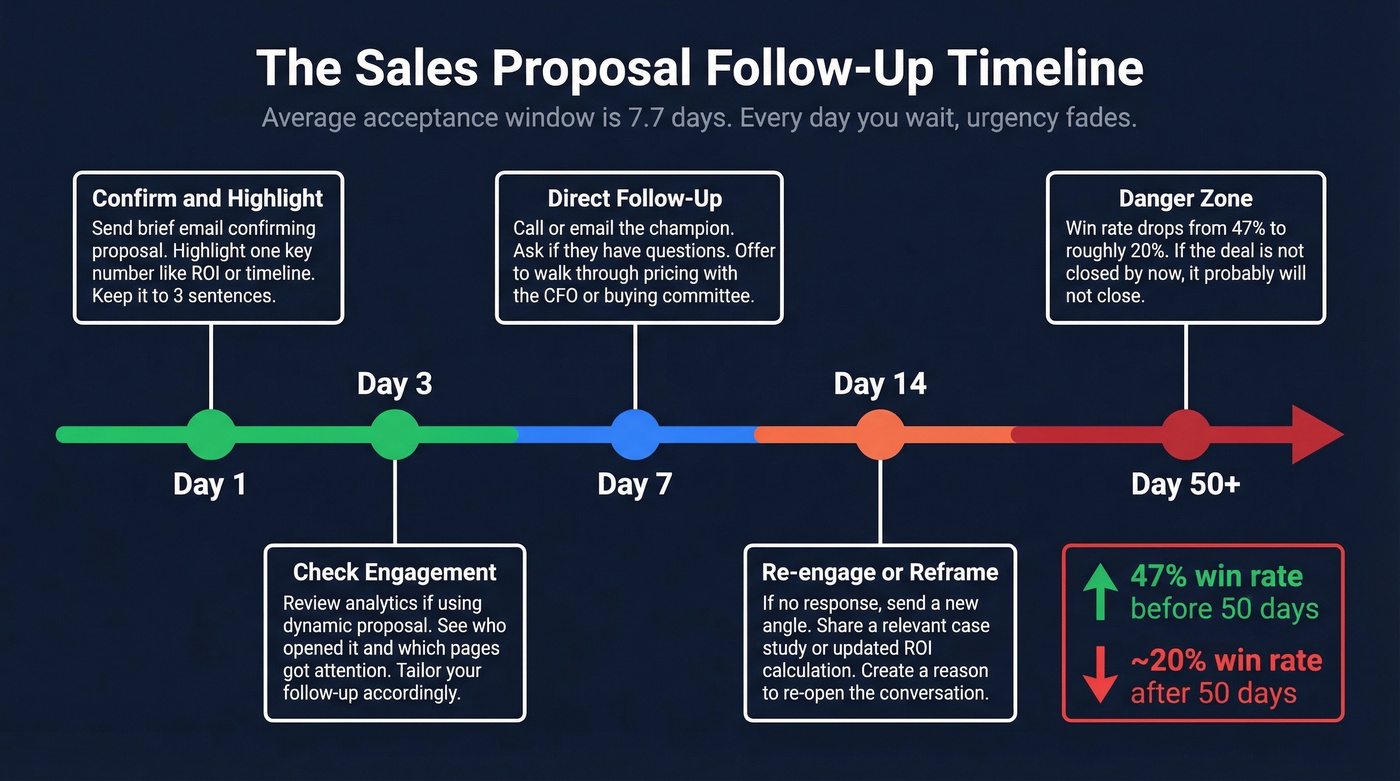
Day 1: Send a brief email confirming the proposal, highlighting one key number - the ROI, the timeline, or the price they'll care about most. Don't recap the whole thing.
Day 2-3: Switch channels. Call the primary contact. If you're using a dynamic proposal tool, reference engagement data: "I noticed you spent time on the pricing page - want to walk through the options together?"
Day 5-7: Loop in a second stakeholder. Forward a relevant case study. Ask if there are questions from others on the buying committee.
Day 10-14: If there's no response, send a direct "should I close this out?" message. This creates urgency without being pushy. (If you want plug-and-play copy, use these sales follow-up templates.)
Multi-channel follow-up only works if your phone numbers are real. Prospeo's database includes 125M+ verified mobile numbers with a 30% pickup rate, so your follow-up call actually connects instead of hitting a switchboard or dead line.
You just spent hours crafting the perfect proposal with tiered pricing and buyer-specific language. Don't let it stall because someone on the buying committee changed roles. Prospeo confirms job titles, verified emails, and direct dials for every stakeholder - refreshed every 7 days, not 6 weeks.
Confirm every decision-maker before you hit send - starting at $0.01 per email.
Best Proposal Software Tools
33% of sales teams still don't use proposal software. If that's you, here's where to start - sorted by team size and deal complexity.
| Tool | Best For | Starting Price |
|---|---|---|
| PandaDoc | All-rounder, free tier | Free / $35/user/mo |
| Proposify | Mid-size teams | $29/mo |
| Qwilr | Interactive proposals | $35/mo |
| Better Proposals | Solo / small teams | $19/mo |
| Dock | Digital sales rooms | First 5 free |
| GetAccept | E-sign + tracking | $49/mo |
| DealHub | Enterprise CPQ | Custom pricing |
Solo reps or small teams: Start with Better Proposals at $19/mo or PandaDoc's free tier. Both handle templates and basic tracking. PandaDoc also supports e-signatures. You don't need more until you're sending 20+ proposals a month.
Teams of 5+ reps do better with Proposify or Qwilr. Proposify's team plan at $49/mo adds approval workflows and content libraries that keep proposals consistent across reps. Qwilr shines if you want interactive, web-based proposals that feel more like landing pages than documents - great for mid-market SaaS deals where visual polish matters.
Enterprise or complex deals call for Dock or DealHub. Dock's digital sales rooms combine proposals, mutual action plans, and stakeholder tracking in one shared workspace. DealHub adds CPQ for complex pricing models. Both require real budget - Dock's free tier is limited, and DealHub is custom-priced. Skip these unless your average deal size justifies the investment. If you're standardizing your stack, it also helps to align proposal workflows with your contact management software.
FAQ
How long should a sales proposal be?
Shorter wins. The 50,000-proposal analysis found accepted proposals were shorter and more specific - not longer. Aim for 8-20 pages depending on deal size. Cut the company history, expand client-specific sections. Every page should answer "why should the buyer care?"
What's the difference between a sales proposal and a quote?
A quote is a fixed price for defined requirements - it informs. A sales proposal includes the approach, timeline, social proof, and pricing together - it persuades. If your document doesn't argue why you're the best fit, it's a quote with a cover page.
How do I find the right stakeholders to send my proposal to?
Use a B2B data platform to identify every person on the buying committee by job title, verified email, and direct dial. This avoids sending to bounced addresses or the wrong contact - which wastes every hour you spent writing.
Do I need proposal software or is a PDF fine?
For deals under $5K with a single decision-maker, a clean PDF works. For anything larger, dynamic proposal tools like PandaDoc, Dock, or Qwilr give you engagement analytics, version control, and interactive pricing - all of which correlate with higher close rates in the 50,000-proposal dataset.