

How to Write a Sales Prospecting Letter That Gets Replies
You've copied a template, sent 200 emails, and gotten 2 replies. The problem isn't you - nobody taught the structure.
A well-crafted sales prospecting letter doesn't sell. It starts a conversation. Direct mail pulls a 4.4% response rate vs. 0.12% for email, and MIT Sloan attributes the gap to digital ad fatigue: inboxes are so crowded that physical mail sits on a desk for days while emails vanish in a scroll. Here's how to write one that actually works, whether you're sending physical mail or email.
What You Need (Quick Version)
Physical letter? Use the PAS framework, keep it to one page. Email prospecting letter? Keep it under 125 words with one question and one CTA. Either way, verify your contact data first - a perfect letter sent to a dead address is a wasted letter.
- Physical mail: one page, PAS structure, handwritten envelope if possible
- Email: 50-125 words, third-grade reading level, one clear ask
- Both: verify the recipient's contact info before you hit send
Physical vs. Email: Which Format Wins?
Direct mail averages a 4.4% response rate vs. 0.12% for email - about a 37x difference. But 80% of B2B buyers prefer email contact, and the cost gap is enormous. The right format depends on your deal size.
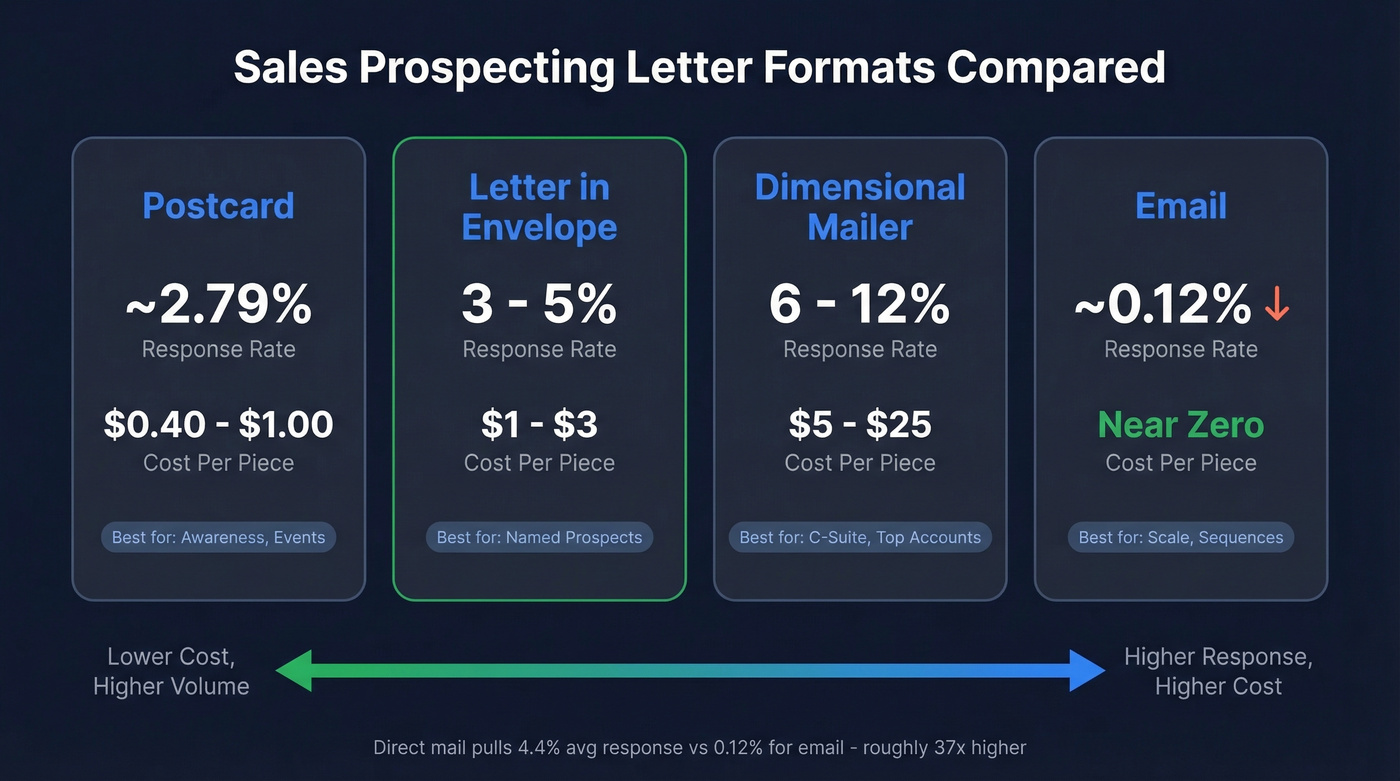
| Format | Response Rate | Cost Per Piece | Best For |
|---|---|---|---|
| Postcard | ~2.79% | $0.40-$1.00 | Awareness, events |
| Letter in envelope | ~3-5% | $1-$3 | Named prospects |
| Dimensional mailer | ~6-12% | $5-$25 | C-suite, top accounts |
| ~0.12% | Near zero | Scale, sequences |
Direct mail response rates vary by industry - tech averages 4.30%, real estate 3.32%.
If you're selling six-figure deals, a $3 letter that pulls 3-5% is a steal. For contracts under $10k, email wins on unit economics every time. Most teams should use both: physical mail for high-value accounts, email for everything else.
Two Frameworks That Write It for You
PAS (Problem - Agitation - Solution) works best when your prospect already knows they have a problem. You name it, twist the knife, then offer the fix.
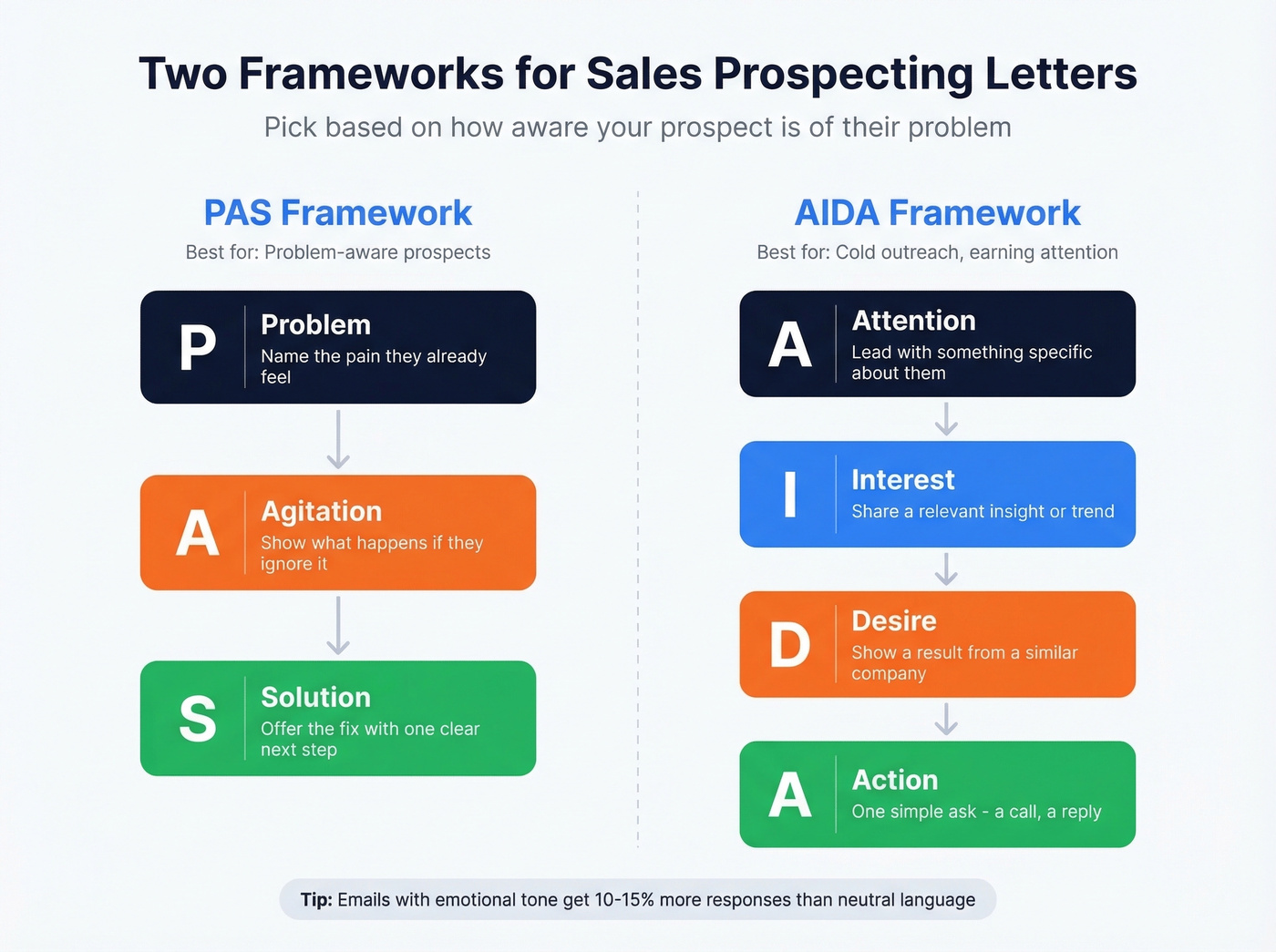
Example: "Most VP Sales teams lose 15+ hours a week to manual data entry (problem). That's 780 hours a year your closers aren't closing (agitation). We cut that to zero with automated CRM enrichment - want to see how? (solution)"
AIDA (Attention - Interest - Desire - Action)) is stronger for cold introductions where the prospect doesn't know you yet. Lead with something that earns attention, build interest with a relevant insight, create desire with a result, and close with one action.
Example: "Your engineering team shipped 14 releases last quarter (attention). Companies scaling that fast usually hit a hiring bottleneck by Q3 (interest). We helped [similar company] fill 23 engineering roles in 60 days (desire). Worth a 15-minute call? (action)"
Use PAS for problem-aware prospects, AIDA for cold outreach where you need to earn the first few seconds. And don't be afraid to sound like a human - emails with positive or negative emotional tone pull 10-15% more responses than neutral, clinical language.

A perfect prospecting letter sent to a bad email destroys your domain reputation. Prospeo verifies every address through a 5-step process - catch-all handling, spam-trap removal, honeypot filtering - with 98% accuracy. Teams using Prospeo drop bounce rates from 30%+ to under 4%.
Stop wasting great copy on dead addresses.
Templates You Can Steal
Physical Letter (PAS)
Dear [Name],
Every week, your sales team sends hundreds of emails that bounce. Each bounce chips away at your domain reputation - and your pipeline.
Over a quarter, that's thousands of wasted touches and a sender score that puts even your good emails in spam.
We built a verification system that catches bad addresses before you hit send. Companies like yours typically see bounce rates drop from 30%+ to under 4%.
I'd love 15 minutes to show you how. I'll follow up by email next Tuesday - or grab time here: [link].
[Your name]
Email Template (Under 125 Words)
Subject: Quick question about [company]'s outbound
Hi [Name],
Noticed [company] is hiring 3 new AEs - congrats on the growth.
Quick question: how's your team handling prospect data quality? Most teams scaling outbound hit a wall when 20-30% of their emails bounce.
We help companies like [similar company] keep bounce rates under 4% without slowing down reps.
Worth a 10-minute call this week?
Emails written at a third-grade reading level get 36% better response rates than college-level writing, and emails with 1-3 questions are 50% more likely to get a reply. Short words, short sentences, one question.
The Handwritten Edge
Handwritten envelopes hit nearly 99% open rates. Think about it - when was the last time you threw away a hand-addressed letter without opening it? Adding a handwritten sticky note to a request increased response rates by 76%.
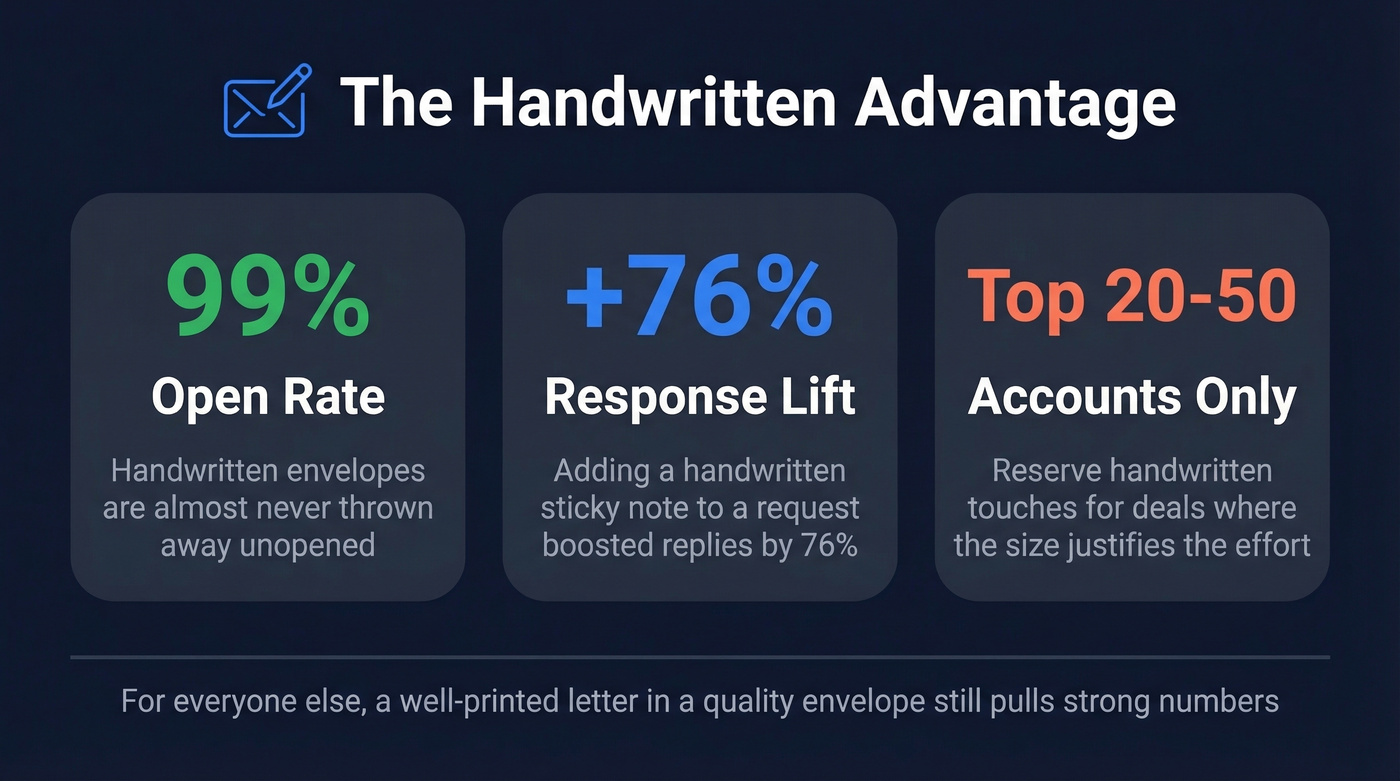
You can't handwrite 500 letters. Reserve this for your top 20-50 accounts where the deal size justifies the effort. One rep on r/sales shared that personalized physical letters consistently outperformed email, and that envelope presentation matters as much as the copy inside. For everyone else, a well-printed letter in a quality envelope still pulls strong numbers.
Verify Before You Send
Here's the thing: the #1 reason prospecting letters fail isn't the copy. It's the data.
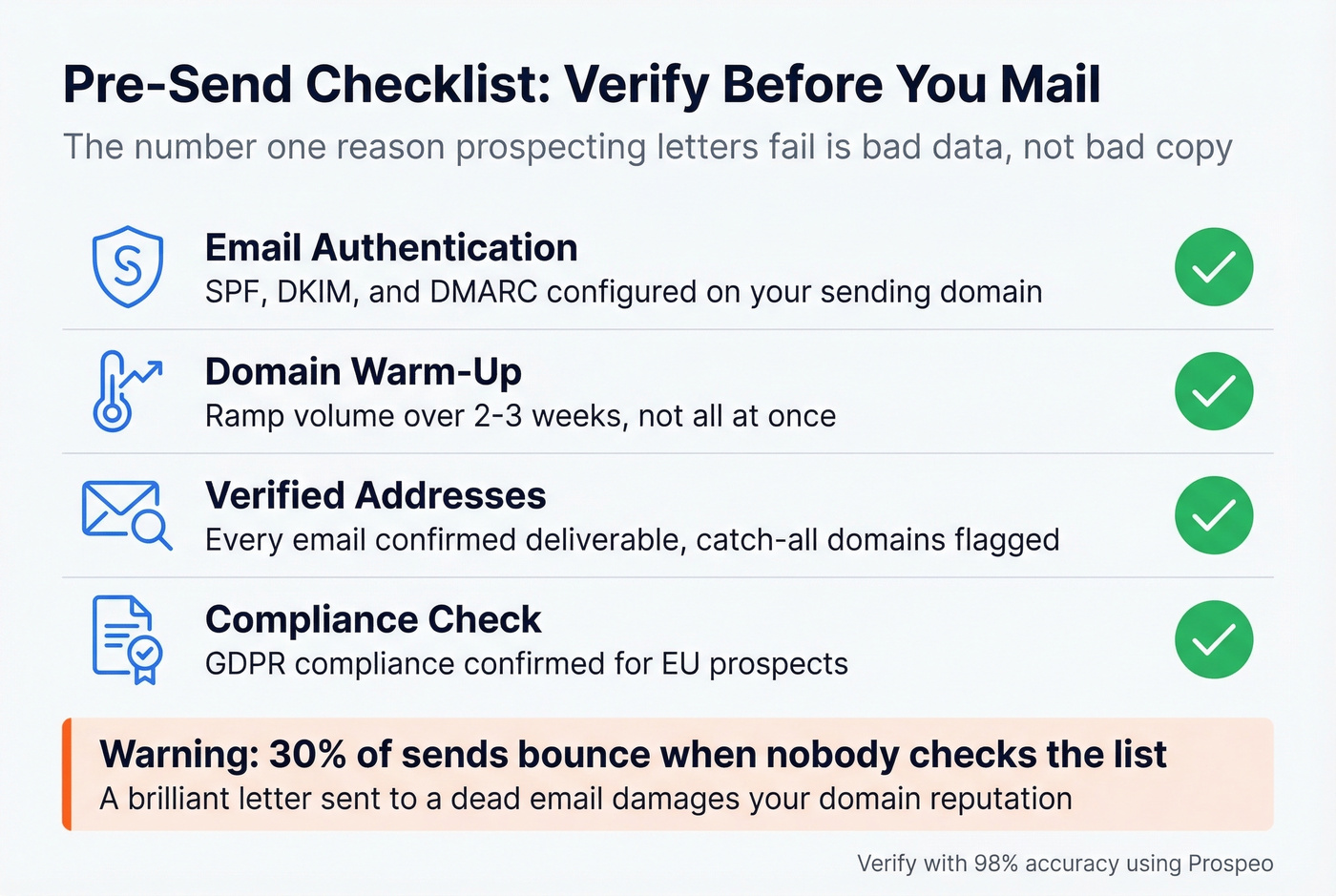
A brilliant letter sent to a dead email address damages your domain reputation. A $3 physical letter sent to someone who left the company six months ago is money in the trash. We've seen teams pour hours into perfecting their messaging only to watch 30% of their sends bounce because nobody bothered to check the list.
Run this checklist before anything goes out:
- Email auth: SPF, DKIM, and DMARC configured on your sending domain
- Domain warm-up: ramp volume over 2-3 weeks, not all at once
- Verified addresses: every email confirmed deliverable, catch-all domains flagged
- Compliance: if you're emailing prospects in the EU, confirm GDPR compliance
Prospeo handles that verification piece - upload your prospect list, and it checks every email with 98% accuracy through a 5-step process that includes catch-all handling, spam-trap removal, and honeypot filtering. The 7-day data refresh cycle means you're not sending to addresses that were valid three months ago but aren't anymore.

Follow-Up Cadence
It takes an average of 5 touches to engage a prospect - roughly 9 for executives. One letter, physical or digital, isn't a strategy. It's a lottery ticket.
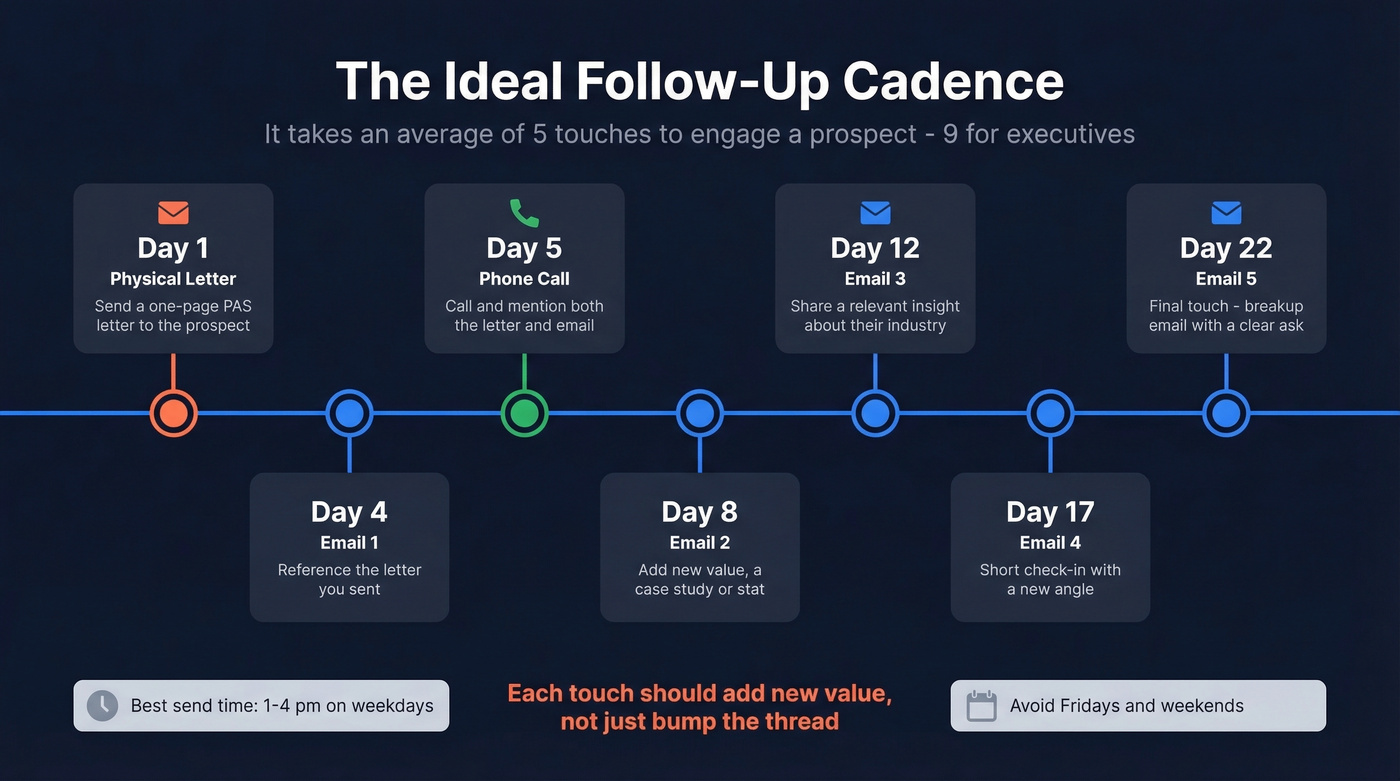
The best cadence we've seen: physical letter first, email follow-up 3-4 days later referencing the letter, then a call. Build 4-5 follow-up emails into the sequence after that. Each touch should add new value, not just "bumping this to the top of your inbox." Send emails between 1-4 pm on weekdays - avoid Fridays and weekends.
Let's be honest about the math: if your average deal is under $10k, skip the physical letter entirely and put that budget into better data and more email touches. The ROI on physical mail only works when the contract size absorbs the cost per piece.
Writing a sales prospecting letter that converts starts with knowing who you're writing to. Prospeo's database gives you 300M+ profiles with 30+ filters - job changes, hiring signals, intent data - so every letter lands with the right person at the right moment. Data refreshed every 7 days, not 6 weeks.
Find the right prospects before you write a single word.
FAQ
How long should a prospecting letter be?
Physical letters should be one page max, 200-250 words. Emails perform best at 50-125 words. In both formats, shorter copy consistently outperforms longer - every sentence needs to earn its place.
Do physical prospecting letters still work in 2026?
Yes. Direct mail averages a 4.4% response rate vs. 0.12% for email, roughly 37x higher. Digital fatigue has made physical mail more effective, not less. Reserve it for accounts where the deal size justifies the $1-$3 cost per piece.
How do I verify contact data before sending?
Use an email verification tool that checks deliverability and flags catch-all domains. For physical mail, confirm the recipient's current company and title through recent job-change signals - stale addresses are the fastest way to burn budget.
What's the best framework for a sales prospecting letter?
PAS (Problem-Agitation-Solution) works best for prospects who already feel the pain you solve. AIDA (Attention-Interest-Desire-Action) is stronger for cold outreach where you need to earn attention first. Pick based on how aware the prospect is of their problem.