

The Best Sales Questions to Ask - According to 845K+ Analyzed Calls
You've got an empty CRM record, 15 minutes with a VP who's already checking her phone, and you're about to wing it. That discovery call could open a six-figure pipeline or die in a polite "we'll circle back." The difference almost never comes down to your product. It comes down to the sales questions you ask - and when you stop talking.
Teams with strong questioning skills report 20-30% win rates; script-heavy teams convert in the low teens. Here's what the data says actually works, organized by stage, plus the questions you should retire immediately.
What Call Data Reveals About Questioning
Let's start with numbers, because most "best questions" articles skip them entirely.
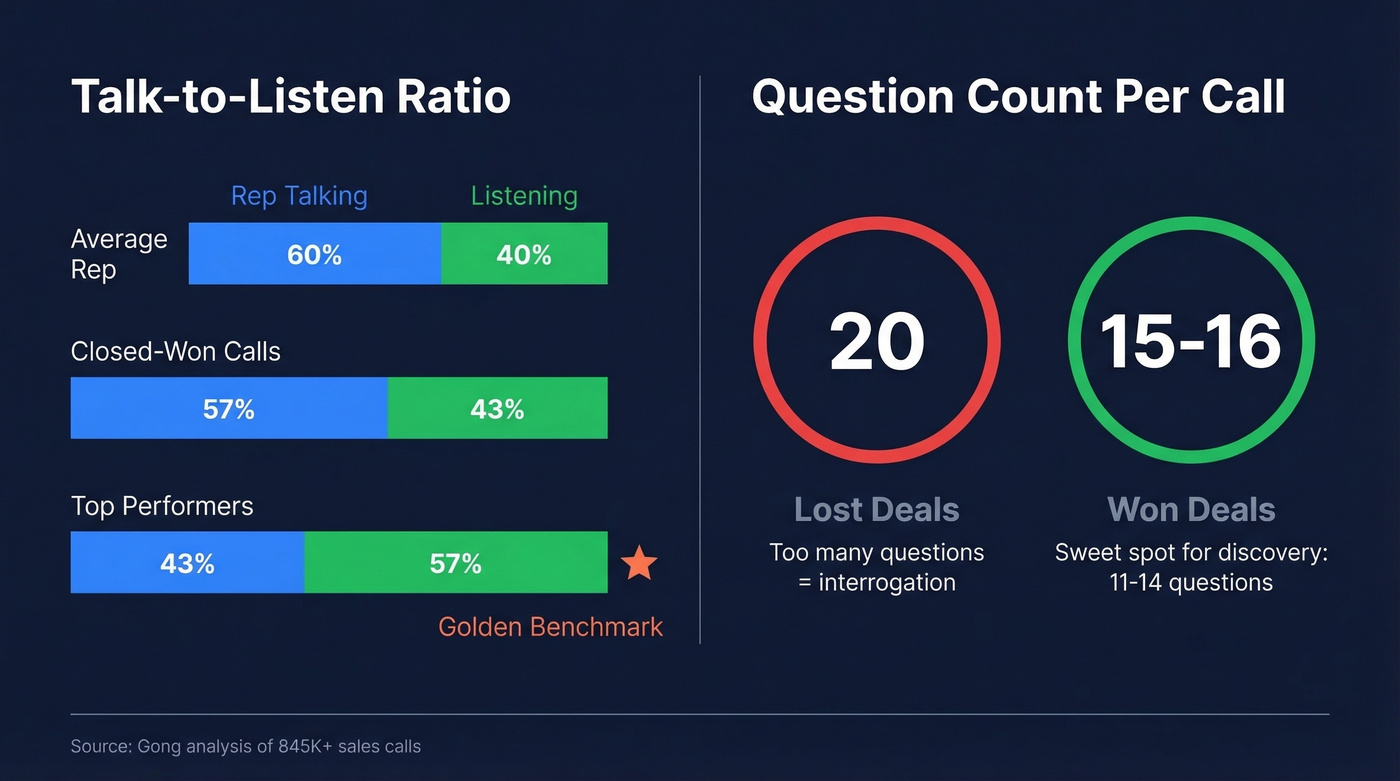
Gong analyzed 326,000 sales calls and found the average rep talks 60% of the time. Closed-won calls averaged 57% rep talk time - still majority talking, but five points lower than the 62% on lost deals. Top performers pushed further, hitting the 43% talk / 57% listen split that Gong calls the golden benchmark. Five percentage points doesn't sound like much until you realize it compounds across every call, every week, every quarter.
The question count matters too, but not the way you'd think. Reps who won asked roughly 15-16 questions per call. Reps who lost asked around 20. More questions didn't mean better discovery. It meant interrogation.
A separate analysis of 519,000 discovery calls drilled deeper: the sweet spot for discovery-specific questions is 11-14, and the most effective calls uncovered 3-4 distinct business problems - not one, not seven.
How top sellers distributed those questions mattered enormously. Average reps frontload questions in the first five minutes. Top performers spread them evenly, creating a natural "tennis match" where speaker switches per minute stay high throughout. With C-suite buyers, too many discovery questions actually hurt win rates - executives expect you to arrive with insight, not run basic discovery.
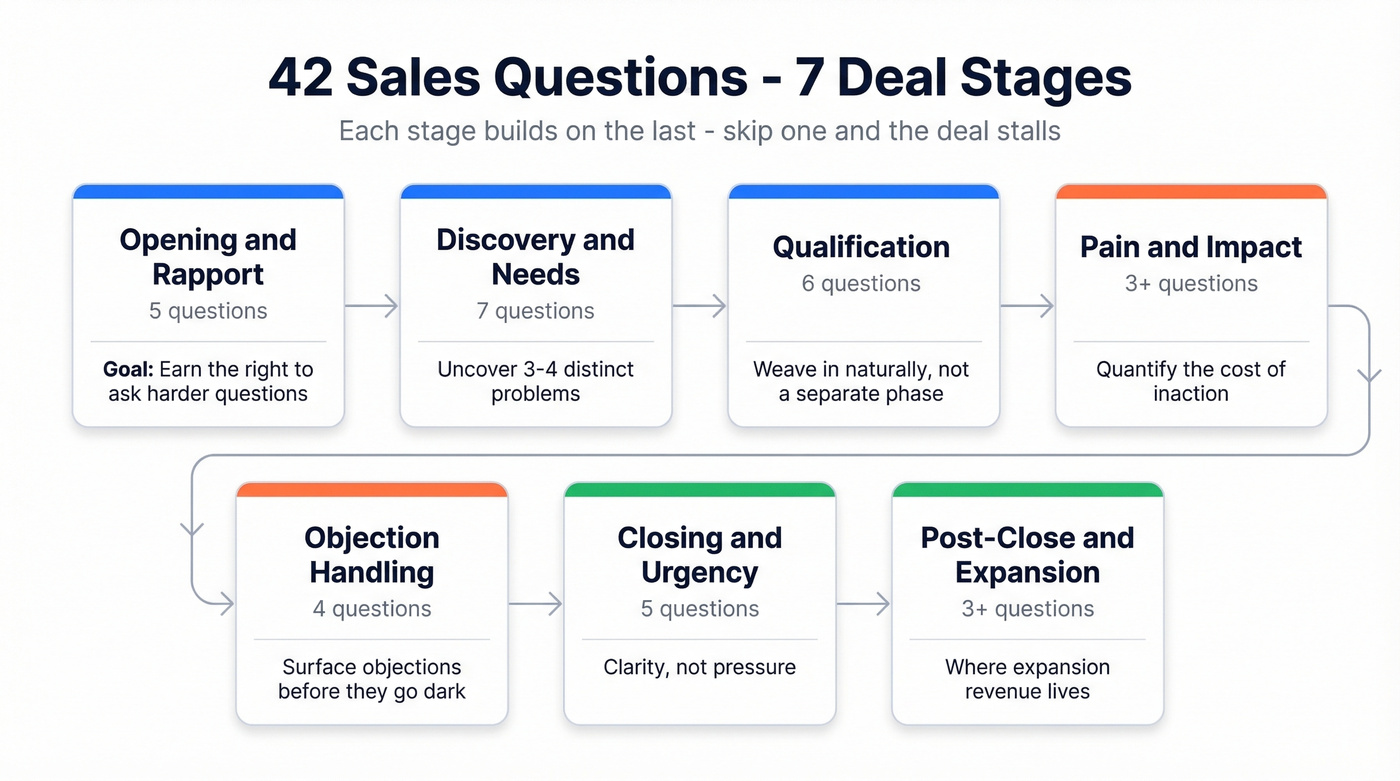
Sales Questions by Deal Stage
Each stage below has the questions that actually move deals forward.
Opening and Rapport
The first two minutes set the tone. Your goal isn't small talk - it's earning the right to ask harder questions later.
- "What's going on in your world that made you decide to talk to me?"
- "What's the number one thing you want to get out of this call?"
- "Before we get into it - what do you already know about us?"
- "I've done some research on [company], but I'd love to hear your version - what's the team focused on right now?"
- "If at any time you feel like this isn't a fit, are you comfortable telling me no?"
That last one disarms the prospect and signals you're not going to hard-close them into something they don't want.
Discovery and Needs
This is where deals are won or lost. Aim for 3-4 distinct problems uncovered, and spread your questions across the conversation.
- "Can you walk me through how you're currently handling [process] today?"
- "Why now? What changed that made this a priority?"
- "Have you tried to solve this before? What happened?"
- "Who feels the pain most on your team?"
- "What would success look like 12 months from now?"
- "How does your team typically evaluate software purchasing decisions?"
- "Walk me through what happens when [specific problem] occurs - what's the downstream impact?"
"Why now" is the most underrated discovery question in sales. In our experience, it reveals urgency, internal politics, and budget timing in a single answer. If the prospect can't articulate why now, you probably don't have a real deal.
Qualification
Don't treat these as a separate phase - weave them naturally as the conversation progresses.
| Question | What It Really Tells You |
|---|---|
| "Who else should be involved in this decision?" | Whether you've found the economic buyer |
| "Is this project funded, or are we building a business case together?" | Budget reality vs. aspiration |
| "What's your timeline for making a decision?" | Real urgency or tire-kicking |
| "How does your approval process typically work?" | How many gates you'll hit |
| "Are you evaluating other solutions right now?" | Competitive landscape |
| "What would need to be true for you to move forward this quarter?" | The actual close criteria |
Pain and Impact
Discovery uncovers problems. Pain questions quantify the cost. This is where you build the business case - and the difference between a weak question and a strong one is night and day.
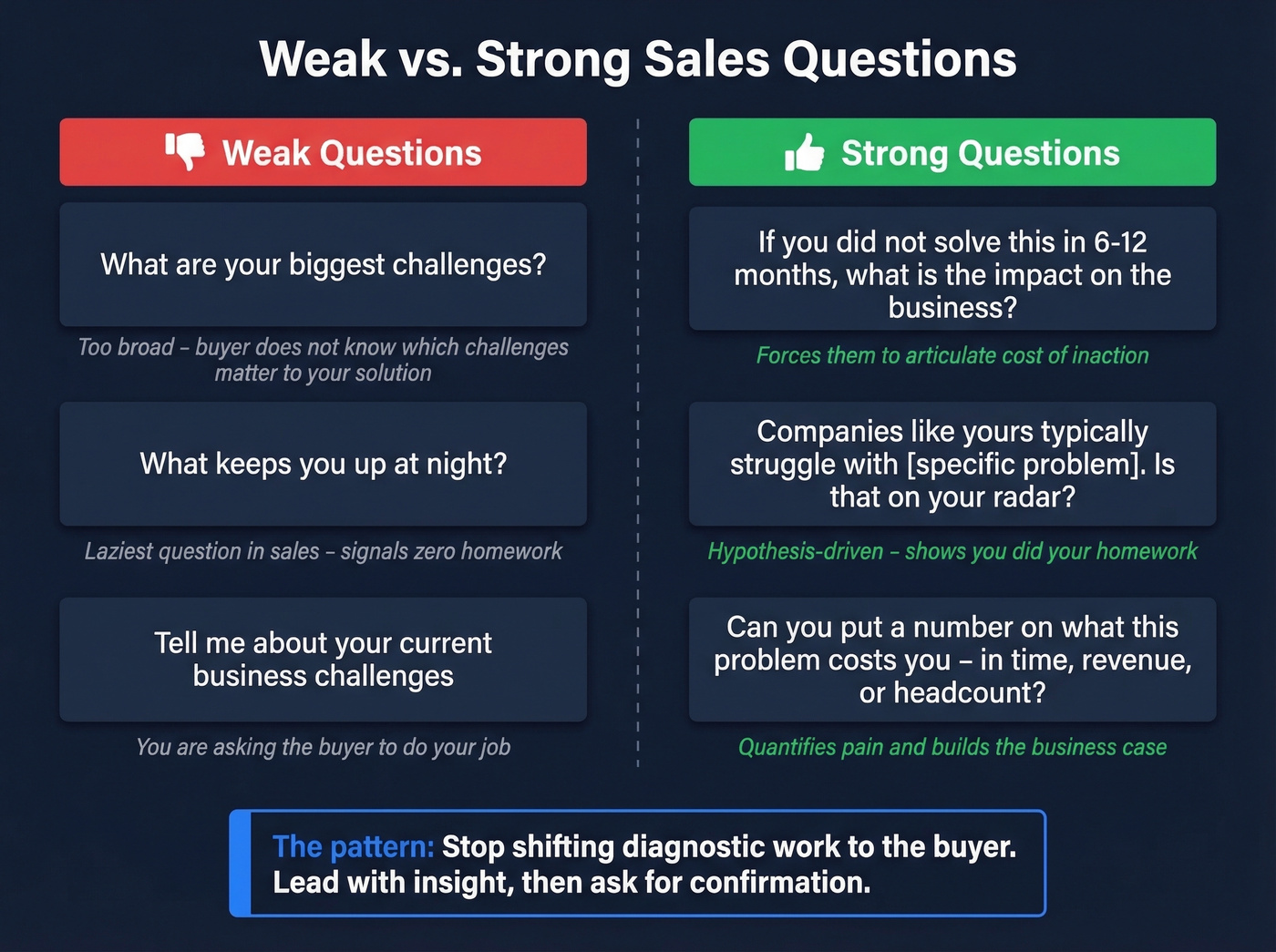
Weak: "What are your biggest challenges?" Too broad. The prospect doesn't know which challenges matter to your solution.
Strong: "If you didn't solve this in 6-12 months, what's the impact on the business?" Forces them to articulate the cost of inaction, which is your real competitor in most deals.
More strong pain questions:
- "Can you put a number on what this problem costs you - in time, revenue, or headcount?"
- "How does this affect you personally? Your team's goals?"
- "What's the ripple effect when [specific process] breaks down?"
Objection-Handling
The best time to handle an objection is before it becomes one.
- "What's the main reason you would hesitate?"
- "What concerns do you have that we haven't addressed?"
- "If your team pushed back on this, what would they say?"
- "What's worked - and what hasn't - with vendors you've used before?"
Proactively surfacing objections feels counterintuitive, but it builds trust and gives you time to address concerns before the prospect goes dark.
Closing and Urgency
Closing questions aren't about pressure. They're about clarity - for both sides.
- "Is this a problem worth solving?"
- "Is it a problem worth solving now?"
- "What needs to happen between now and [date] to get this done?"
- "If we can solve [specific problem], is there anything else standing in the way?"
- "What would you need to see in a proposal to feel confident saying yes?"
That two-part urgency test - "worth solving?" then "worth solving now?" - comes from Mor Assouline via Jen Allen-Knuth. The first question is easy to say yes to. The second reveals whether you have a real timeline or a "maybe next year."
Post-Close and Expansion
Most question lists stop at closing. That's a mistake, because this is where expansion revenue lives.
Picture a QBR with your biggest account - the customer is happy but hasn't expanded. Instead of running through a slide deck, try: "If you were pitching this internally to another department, what would you say?" That single question turns a satisfied customer into an active champion. Follow it with "Are there other teams facing similar challenges?" and "What's coming up next quarter that we should know about?" You'll surface upsell opportunities months before the renewal conversation.
Questions That Don't Sound Like Questions
The most advanced sellers don't always ask direct questions. They use techniques that invite the prospect to share information without feeling interrogated.
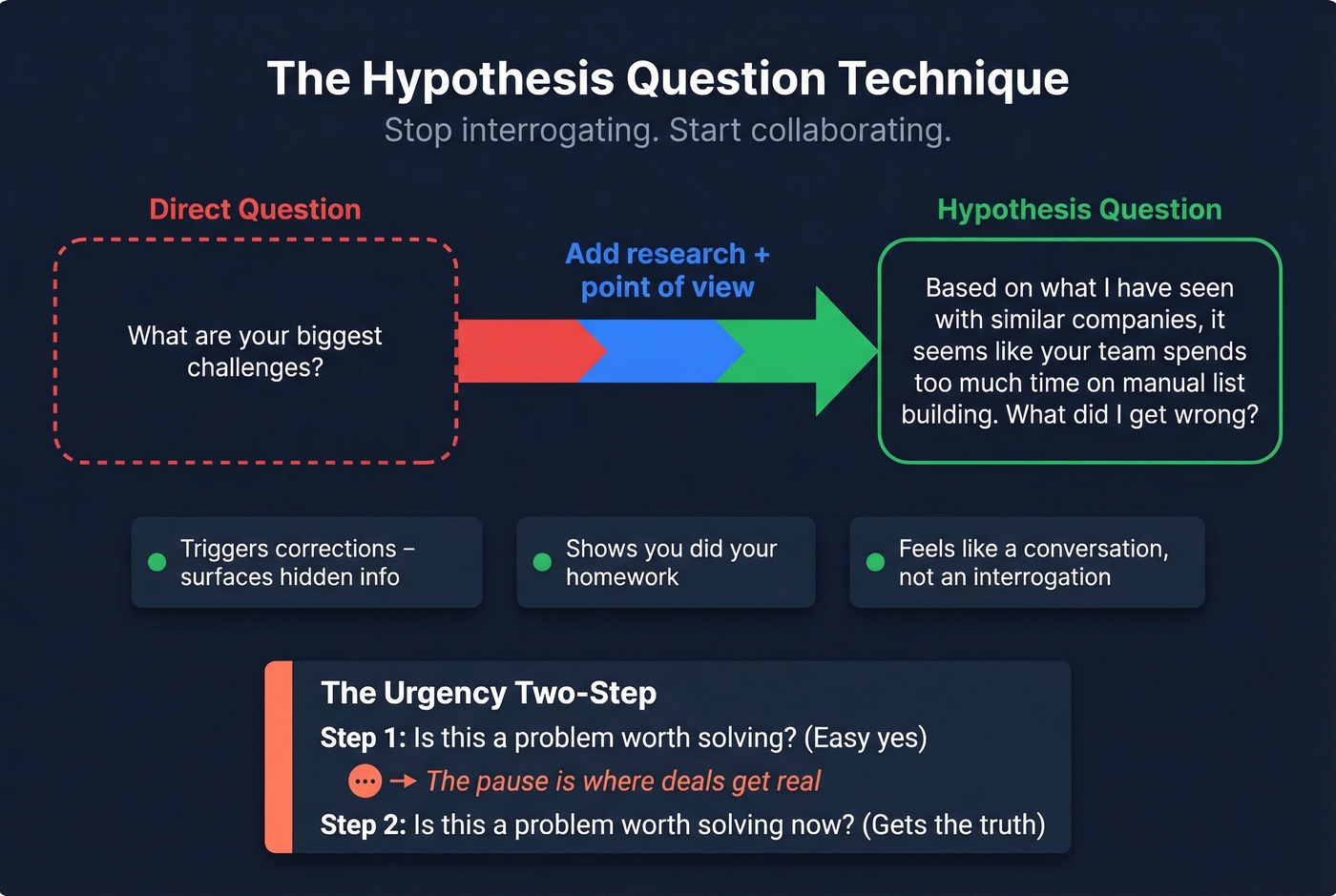
Hypothesis questions are the most powerful tool in a consultative seller's kit. Instead of asking "What are your biggest challenges?" you lead with a point of view: "Based on what I've seen with similar companies, it seems like your team is spending too much time on manual list building. What did I get wrong?" This triggers corrections, which surface information you'd never get from a direct question. As Jen Allen-Knuth puts it, questions fill in the blanks on what you couldn't find in prep - and hypothesis questions do this better than anything else.
The urgency two-step deserves its own mention. "Is it a problem worth solving?" gets a yes. "Is it a problem worth solving now?" gets the truth. The pause between those two questions is where deals get real.

You just crafted the perfect discovery questions. Now you need the right people to ask them. Prospeo gives you 300M+ profiles with 98% verified emails and 125M+ direct dials - so every call slot goes to a real decision-maker, not a dead end.
Stop wasting perfect questions on bad contact data.
Match Your Questions to a Framework
| Framework | Best For | Deal Size | Cycle | Key Questions |
|---|---|---|---|---|
| BANT | Transactional | <$50K | <60 days | Budget, Authority, Need, Timeline |
| SPIN | Mid-market+ | $25K-$500K | 30-180 days | Situation, Problem, Implication, Need-Payoff |
| MEDDIC | Enterprise | >$100K | 90-270 days | Metrics, Economic Buyer, Decision Criteria/Process, Pain, Champion |
| Challenger | Complex/insight | >$50K | 60-180 days | Teach, Tailor, Take Control |
| Sandler | Consultative | Any | Any | Pain, Budget, Decision |
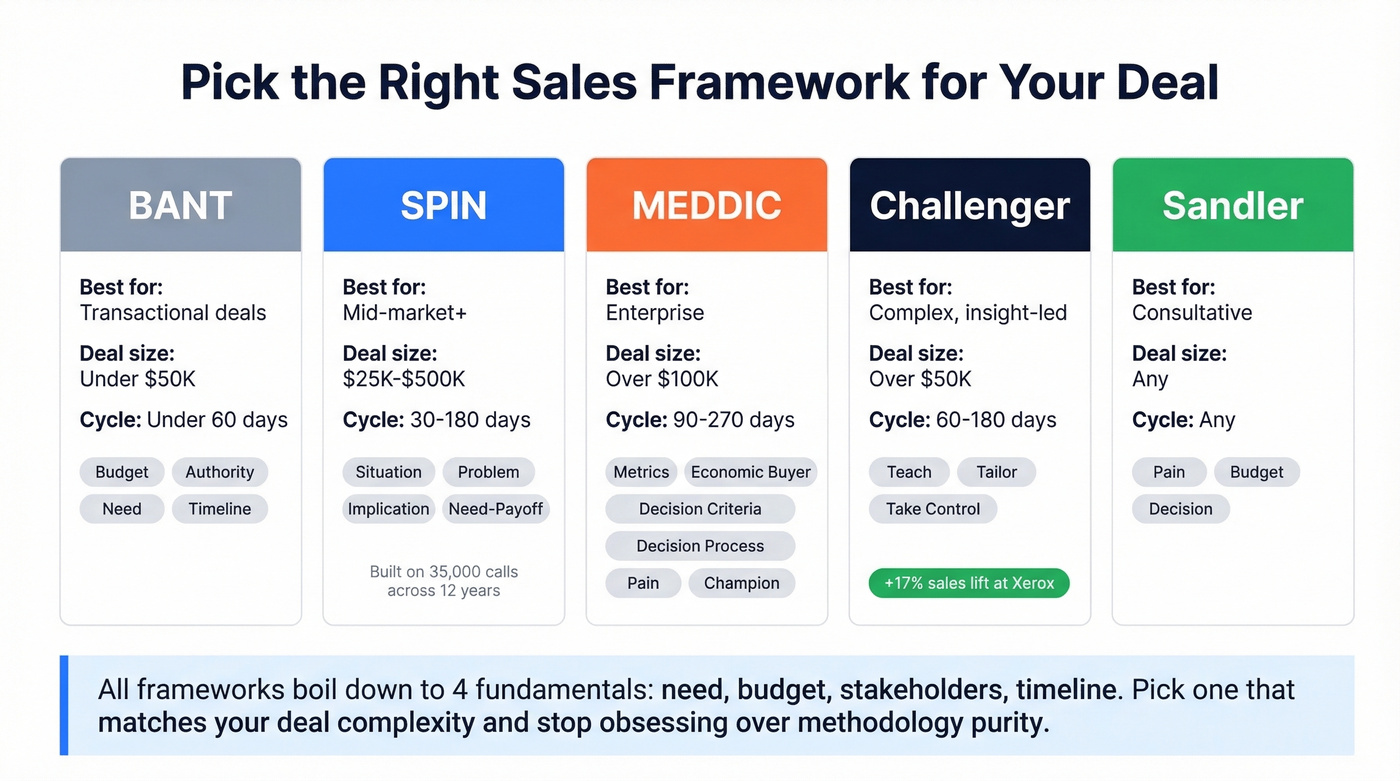
BANT works for transactional sales with short cycles and few stakeholders. It's the framework most SDRs learn first, and it's fine for deals under $50K. For anything more complex, it falls short.
SPIN - built on 35,000 sales calls across 20+ countries over 12 years - is the best starting point for mid-market sellers. Its structure maps naturally to how buyers actually think about change. MEDDIC dominates enterprise SaaS. If you're selling above $100K ARR, it's non-negotiable.
Challenger works best when your buyers don't know they have a problem yet. Xerox reported a 17% increase in sales and $65M in contract value after implementing it.
Here's the thing: the consensus on r/sales is that all these frameworks boil down to four fundamentals - need, budget, stakeholders, timeline. Pick the one that matches your deal complexity, internalize it, and stop obsessing over methodology purity. For sub-$15K deals, you probably don't need MEDDIC-level rigor. The framework is scaffolding, not scripture.
Questions You Should Stop Asking
"What keeps you up at night?" The laziest question in sales. It forces the buyer to self-diagnose, signals zero homework, and creates buyer fatigue because every rep asks it. Replace it with a hypothesis: "Companies like yours typically struggle with [specific problem]. Is that on your radar?"
"What does your company do?" If you're asking this, you've already lost credibility. Basic company research is table stakes.
"Tell me about your current business challenges." Too broad. You're asking the buyer to do your job. Lead with insight, then ask for confirmation.
The pattern is clear: stop asking questions that shift the diagnostic work to the buyer. You can't ask a hypothesis question if you don't know anything about the prospect. Pre-call research is the prerequisite - and most reps skip it because their data is stale or incomplete.
Pre-Call Research and Data Quality
The "empty CRM record" problem kills more discovery calls than bad questions do. You can memorize every question on this page, but if you walk into a call without knowing the prospect's title, company size, tech stack, or recent funding signals, you'll default to those lazy questions we just told you to stop asking.
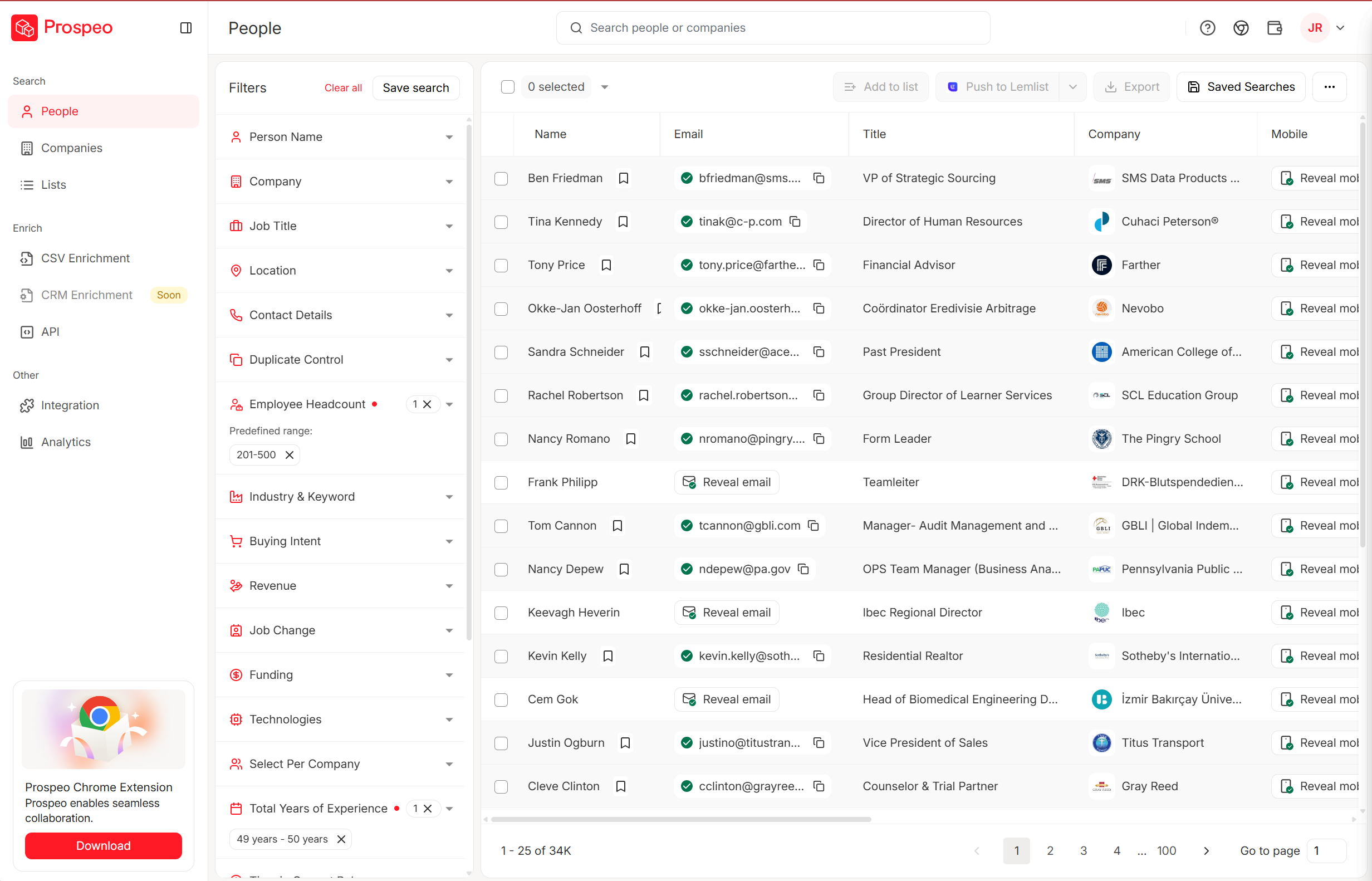
We've seen reps who arrive with a hypothesis perform measurably better than those who wing it - especially with C-suite buyers. Prospeo makes this easy: 300M+ professional profiles, 50+ data points per contact, plus filters for technographics, funding, and headcount growth, all on a 7-day refresh cycle. Build a hypothesis before you ever pick up the phone. The free tier gives you 75 emails per month to start, plus 100 Chrome extension credits, no contracts required.
Sales Interview Questions (Bonus)
If you landed here looking for questions you'll be asked in a sales interview rather than on a sales call, here's a quick list.
- "Tell me about a deal you lost and what you learned." Show self-awareness, not excuses.
- "Walk me through your discovery process." Describe your framework and how you adapt it.
- "How do you handle a prospect who goes dark?" Multi-channel follow-up with a new value angle (and strong sales follow-up).
- "How do you prepare for a first call?" Research, hypothesis, agenda. In that order.
Data says top reps ask 11-14 questions and uncover 3-4 problems per discovery call. But none of that matters if your prospect list is full of bounced emails and wrong numbers. Prospeo's 7-day data refresh means you're always reaching people who actually pick up.
Book 26% more meetings with data that connects you to real buyers.
FAQ
How many questions should I ask on a discovery call?
Aim for 11-14 discovery questions per call, based on Gong's analysis of 519,000 calls. Across all call types, winners average 15-16 total questions while reps who lose ask around 20. Fewer, sharper questions beat a long checklist every time.
What's the best sales methodology for beginners?
Start with SPIN Selling. It's based on 35,000 real calls across 20+ countries and maps naturally to how buyers think about change. The Situation, Problem, Implication, Need-Payoff structure is intuitive. Add MEDDIC when you start selling enterprise deals above $100K.
What's the ideal talk-to-listen ratio on a sales call?
The benchmark is 43% talking, 57% listening. Analysis of 326,000 calls found closed-won deals averaged 57% rep talk time versus 62% on lost deals. Top performers push toward that 43/57 split consistently across every call rather than swinging between good and bad habits.