

Sales Strategy Meeting Agenda: Timed Templates You Can Steal Today
It's Monday morning. Your VP asks everyone to go around the room and share their top deals. Forty-five minutes later, nothing has changed except everyone's energy level.
That's what happens without a real sales strategy meeting agenda. Half of all salespeople spend over five hours a day in meetings, and meeting time costs roughly $29,000 per employee per year - with 35% of those meetings considered a total waste. Sales teams don't have a meeting problem. They have an agenda problem.
The Status-Update Trap
Most "strategy meetings" are dashboards read out loud with extra steps. Someone shares a screen, everyone nods, and the only real decision is what to talk about next week. If your meeting kicks off with 20 minutes of people reading slides they could've sent as a pre-read, you've already lost. Strategy requires decisions, tradeoffs, and a short list of bets - not a group email performed live.
Here's the thing: the weekly sales meeting is the most overrated ritual in B2B. Many teams pour all their energy into it and skip the monthly strategy session entirely. Flip that priority and your win rate will thank you.
What You Need (Quick Version)
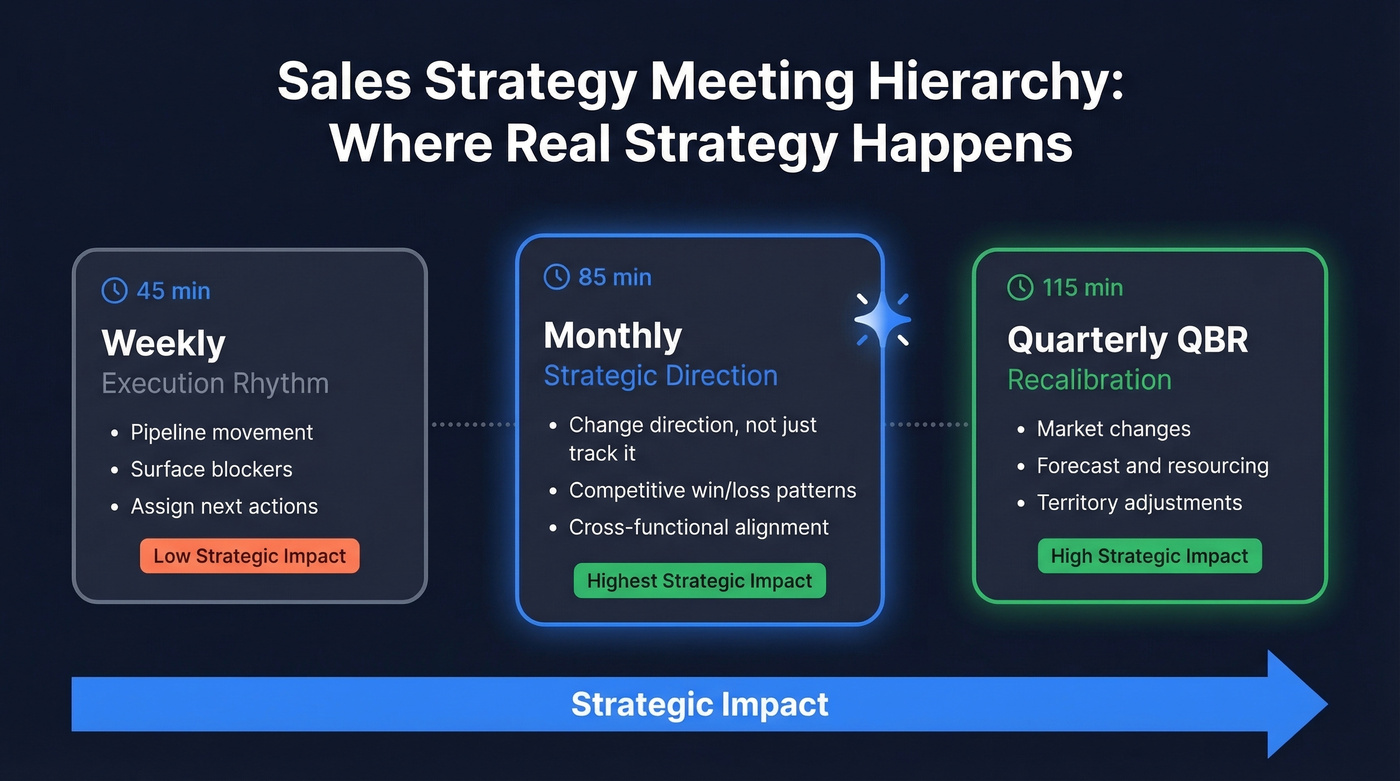
- Monthly (highest strategic impact): your real strategy meeting - where you change direction, not just track it.
- Quarterly / QBR (high impact): recalibration and resourcing. Bigger decisions, fewer of them.
- Weekly (lowest strategic impact): execution rhythm. Operational, not strategic - cap it at 45 minutes.
Jump to templates: Weekly | Monthly | Quarterly/QBR
Timed Agenda Templates by Cadence
We push a simple hierarchy: weekly keeps the machine moving, monthly decides what the machine should do, QBRs reset the machine when reality changes.
| Weekly | Monthly | Quarterly (QBR) | |
|---|---|---|---|
| Duration | 45 min | 85 min | 115 min |
| Purpose | Execution rhythm | Strategic direction | Recalibration |
| Focus | Pipeline movement, blockers | Competitive insights, deal deep-dives | Forecast, adjustments |
| Who leads | Sales manager | VP/Director Sales | Sales + cross-functional |
| Strategic value | Low (ops) | High | High |
Weekly Sales Meeting (45 Min)
Treat this like a standup with teeth: surface blockers, move pipeline, assign next actions. RAIN Group's research shows top-performing sales managers are 42% more likely to excel at leading valuable sales team meetings - and the difference is structure, not charisma. If there's nothing meaningful to discuss, cancel the meeting and give reps their time back.
| Time | Section | Owner | Purpose |
|---|---|---|---|
| 5 min | Welcome | Manager | Set outcomes + pace |
| 10 min | Performance snapshot | Manager/Ops | KPIs vs target |
| 15 min | Pipeline updates | AEs | Movement + next steps |
| 10 min | Challenges/solutions | Team | Unblock deals fast |
| 5 min | Action items | Manager | Owners + deadlines |
Monthly Strategy Meeting (85 Min)
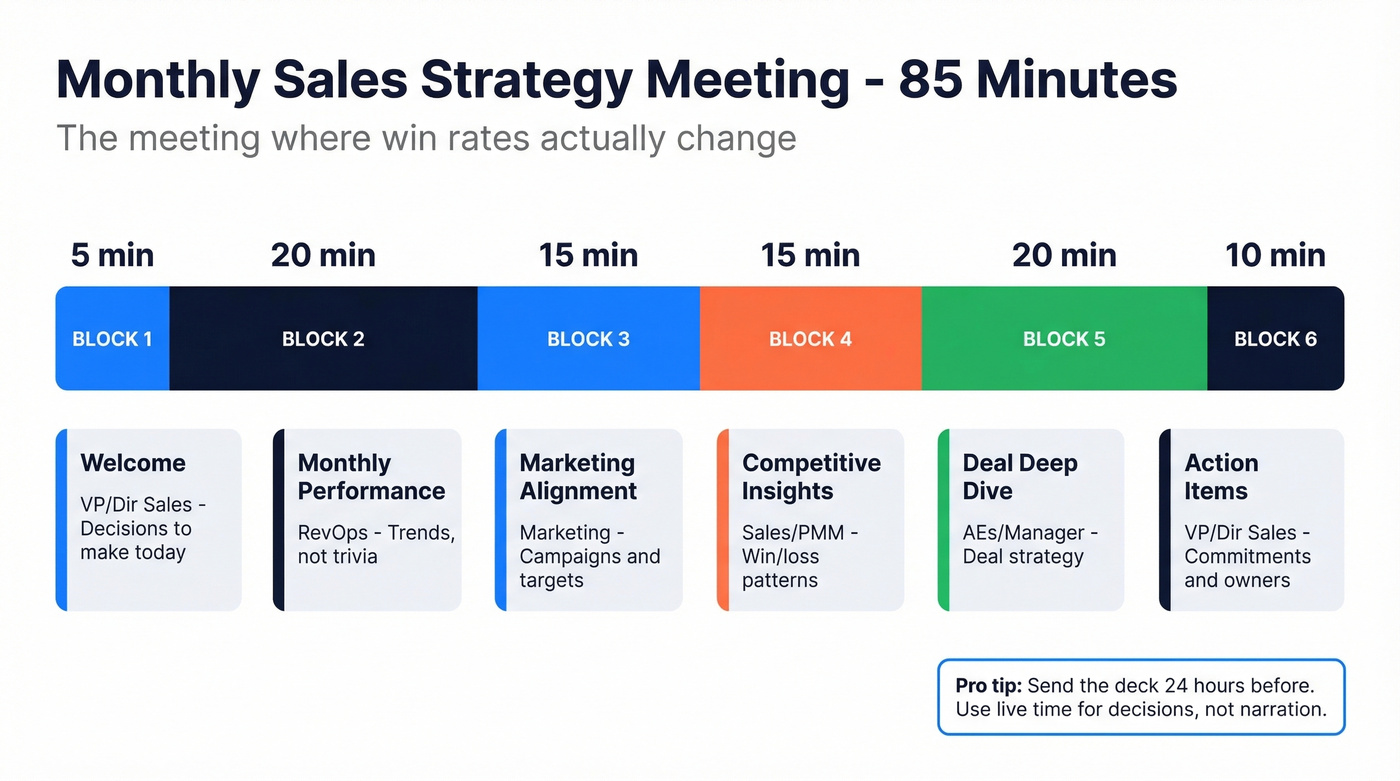
If you only run one structured meeting a month, make it this one. In our experience, the monthly strategy meeting is where win rates actually change - not in the weekly standup. We've seen teams double down on weekly cadences while their competitive positioning drifts for months. Don't be that team.
Keep it cross-functional but not crowded: one marketing lead, one CS/AM lead, and whoever owns RevOps data quality. Use structured facilitation - voting on priorities or silent brainstorming before discussion - to prevent the loudest voice from dominating every session.
| Time | Section | Owner | Purpose |
|---|---|---|---|
| 5 min | Welcome | VP/Dir Sales | Decisions to make |
| 20 min | Monthly performance | RevOps | Trends, not trivia |
| 15 min | Marketing alignment | Marketing | Campaigns + targets |
| 15 min | Competitive insights | Sales/PMM | Win/loss patterns |
| 20 min | Deep dive: major deals | AEs/Manager | Deal strategy |
| 10 min | Action items | VP/Dir Sales | Commitments + owners |
Quarterly Business Review (115 Min)
A QBR is for strategic alignment and future planning - not a retrospective status dump. You're asking three questions: what's changing in the market, what's changing in your pipeline, and what you'll do differently next quarter.
Pre-meeting prep that actually matters: Verify your pipeline contacts are current before this meeting. Reviewing pipeline built on people who changed jobs means your forecast is fiction. Run key accounts through a data verification tool with a short refresh cycle so your territory and resourcing calls start from reality, not stale CRM records.
| Time | Section | Owner | Purpose |
|---|---|---|---|
| 5 min | Kickoff | VP Sales | Goals + decisions |
| 20 min | Pipeline health | RevOps | Flow + bottlenecks |
| 15 min | KPI recap | VP/RevOps | Quota, win rate, ASP |
| 10 min | What worked | Managers | Repeatable plays |
| 20 min | Forecasting | VP Sales | Next quarter targets |
| 15 min | Adjustments | Sales + cross-functional | Tactics/territories |
| 10 min | Wrap-up | VP Sales | Owners + next steps |
The consensus on r/sales is that annual SKOs work best as alignment, motivation, and inspiration between the company, the team, and the individual rep. Build from the QBR template, then extend into half-day blocks for enablement, product narrative, and role-play.

Your strategy meeting is only as sharp as the pipeline data behind it. Stale contacts mean stale forecasts. Prospeo refreshes all 300M+ profiles every 7 days - not the 6-week industry average - so your monthly deep-dives and QBRs start from verified reality, not CRM decay.
Stop strategizing around contacts who left the company two months ago.
Adapt by Sales Motion
SMB cycles are fast with one real decision-maker. The weekly 45-minute cadence is enough, paired with a monthly strategy meeting to keep targeting and messaging honest.
Enterprise deal cycles can run up to 18 months, which means you need longer monthly deal reviews and QBRs that include territory design, account plans, and cross-functional resourcing. Mid-market sits in the middle - keep the weekly tight, but don't skip monthly deep-dives.
For field teams where reps only join meetings sporadically, record the strategy session and send a 3-minute Loom summary. Don't redesign the agenda around attendance gaps. If your team is hybrid or remote - and 86% of meetings now include at least one remote participant - default to video-first and send the agenda 24 hours ahead so async prep replaces live catch-up.
KPIs Worth Reviewing
Don't review everything. Review the few metrics that predict next month, not last month. Reps already spend only about 30% of their time actually selling - don't eat more of it with metrics theater.
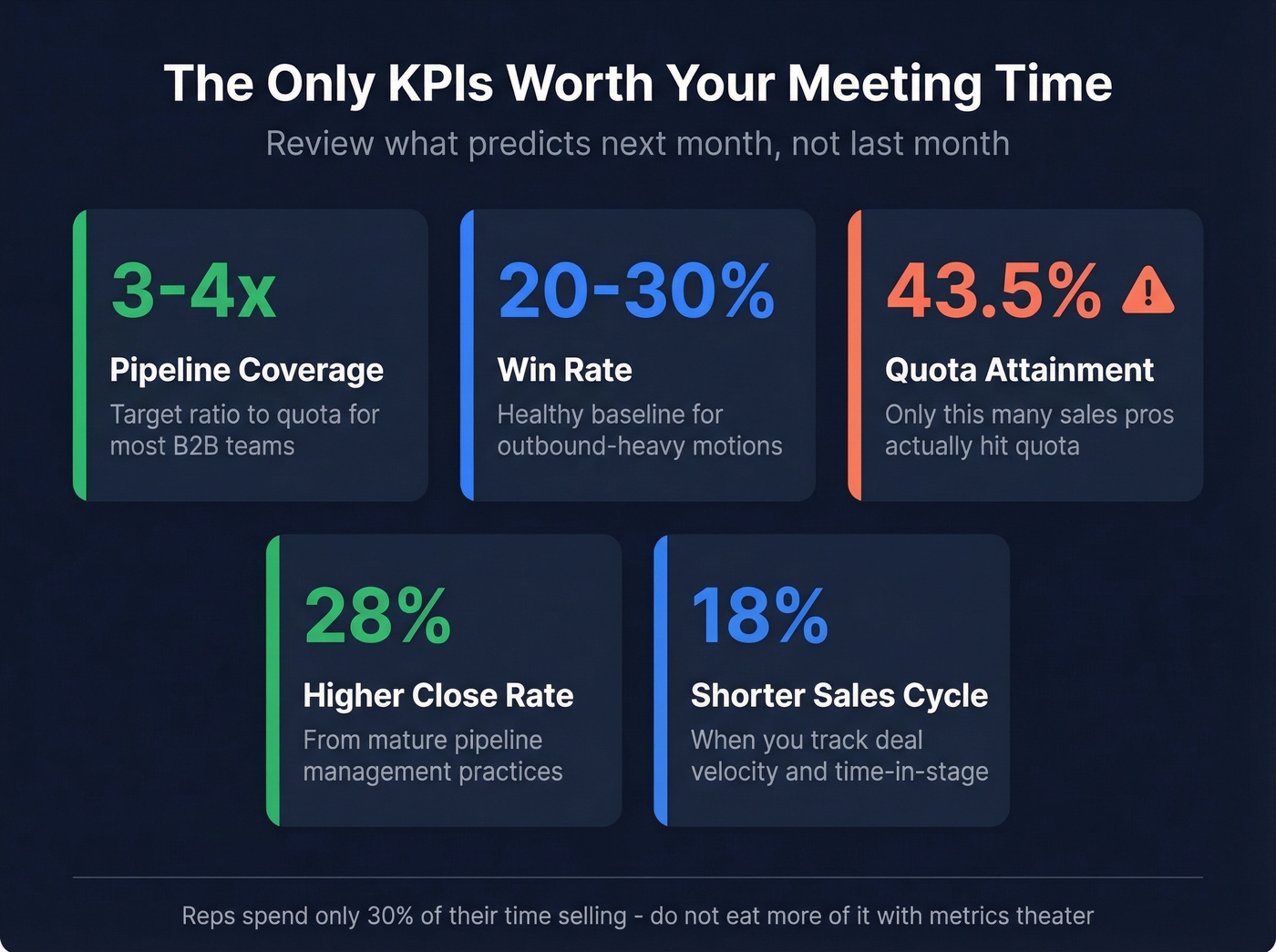
Pipeline coverage should sit at 3-4x quota for most B2B teams, less if you've got high win rates and short cycles. Win rate in the 20-30% range is a healthy baseline for outbound-heavy motions. Quota attainment is brutal right now - only 43.5% of sales pros hit quota according to Salesforce's State of Sales report - so plan capacity accordingly rather than pretending everyone will hit 100%.
Beyond those three, track deal velocity (stage-to-stage conversion plus time-in-stage) and pipeline maturity. Mature pipeline management drives a 28% higher close rate and an 18% shorter sales cycle, which is a far better use of meeting time than rehashing last month's closed-lost deals.
Mistakes That Kill Strategy Meetings
Status-update syndrome. If it feels like a group email read aloud, kill it or move it async.
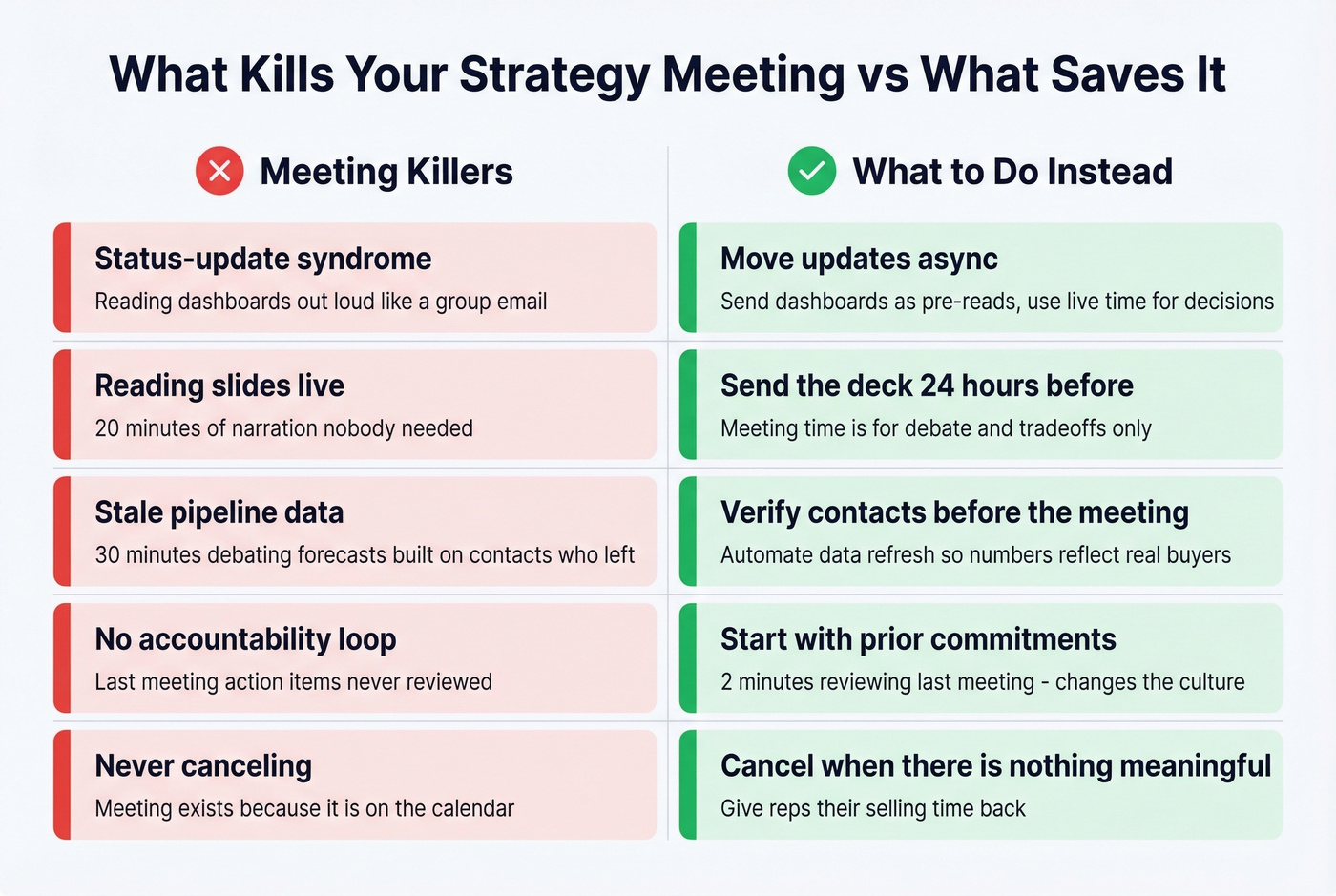
Reading slides that could be a pre-read. Send the deck 24 hours before. Use meeting time for decisions and debate, not narration.
Stale pipeline data corrupting decisions. I've watched teams spend 30 minutes reviewing pipeline that's 40% dead contacts - that's not strategy, it's theater. Automate the cleanup so you're not debating numbers built on ghosts. Prospeo's 7-day data refresh cycle handles this automatically, but whatever tool you use, the point is the same: verify before you review.
No accountability loop. If last meeting's action items don't get reviewed first, you're training the team that commitments are optional.
Never canceling. Skip this if you've got nothing meaningful to discuss. Give reps their selling time back. That's a better outcome than a meeting that exists because it's on the calendar.
The Follow-Up System
A good sales strategy meeting agenda without follow-through is performance art. Keep notes lightweight and consistent:
- Date and attendees
- Decisions made (not discussion summaries - decisions)
- Action items with owner + deadline
- Follow-ups from prior meeting: done, blocked, or overdue
Let's be honest - most teams skip the "follow-ups from prior meeting" step, and that's exactly where accountability dies. Start every meeting by reviewing last meeting's commitments. It takes two minutes and changes the culture.
Before every pipeline review, run your contact list through a verification pass. With tools like Prospeo offering 98% email accuracy on a 7-day refresh cycle, the numbers you review reflect reality instead of padded records and bounced outreach.
If you want to tighten the post-meeting loop, use sales follow-up templates and standardize your sales meeting follow-up email so action items turn into next steps, not forgotten bullets.
You just blocked 85 minutes for your monthly strategy meeting. Don't waste the deal deep-dive on bounced emails and wrong numbers. Prospeo delivers 98% email accuracy and 125M+ verified mobiles so every action item from your meeting actually connects reps to real buyers.
Turn meeting action items into booked conversations at $0.01 per verified email.
FAQ
How often should sales teams hold strategy meetings?
Monthly meetings (85 minutes) deliver the highest strategic impact - that's where you change direction on targeting, messaging, and competitive positioning. Pair them with a 45-minute weekly for execution rhythm and a 115-minute QBR each quarter for recalibration. Most teams over-index on weekly updates and skip monthly strategy entirely. Flip that priority.
What's the ideal length for a weekly sales meeting?
Cap it at 45 minutes. If you can't cover blockers, pipeline movement, and action items in that window, you're doing status updates that belong in a dashboard or async written update - not a live meeting burning your whole revenue team's selling time.
How do you prevent stale data from derailing pipeline reviews?
Verify contacts before the meeting, not during it. Automated verification tools refresh records on short cycles so your pipeline numbers reflect real, reachable buyers. Without that hygiene step, teams routinely waste 20-30 minutes debating forecasts built on contacts who've already changed jobs.