

Sales Tasks: A Prioritized Framework for What Actually Moves Deals
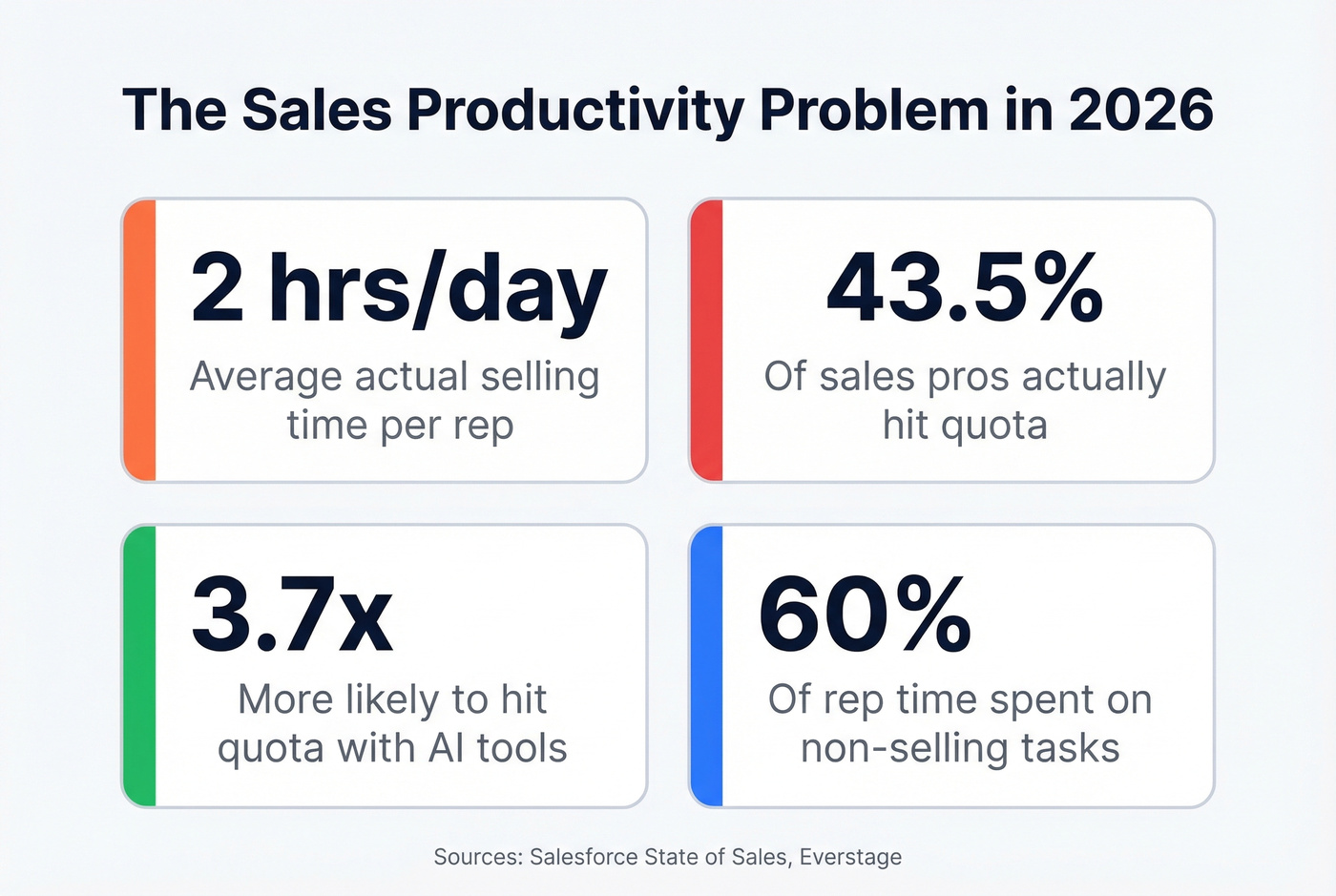
It's 10 AM on a Tuesday. You've updated your CRM, sat through a pipeline standup, replied to 14 internal emails, and you haven't talked to a single prospect. Sales reps spend 60% of their time on non-selling tasks, and actual selling time clocks in at around 2 hours a day. The problem isn't workload - it's sequence. You're doing the wrong sales tasks first.
The Five-Second Version
- Only 43.5% of sales professionals hit quota - the rest are buried in low-impact work.
- Organize every activity into three tiers: Line, Above the Line, Below the Line.
- Do five core things well: prospect, qualify, discover, present, close.
- Everything else either supports those five or steals time from them.
- Automate admin ruthlessly - AI-partnered sellers are 3.7x more likely to meet quota.
The Prioritization Framework
Most "sales activities" articles hand you a flat list of 20-30 items and call it a day. That's useless without a priority system. Anthony Iannarino's framework from The Sales Blog fixes this by splitting every activity into three tiers.
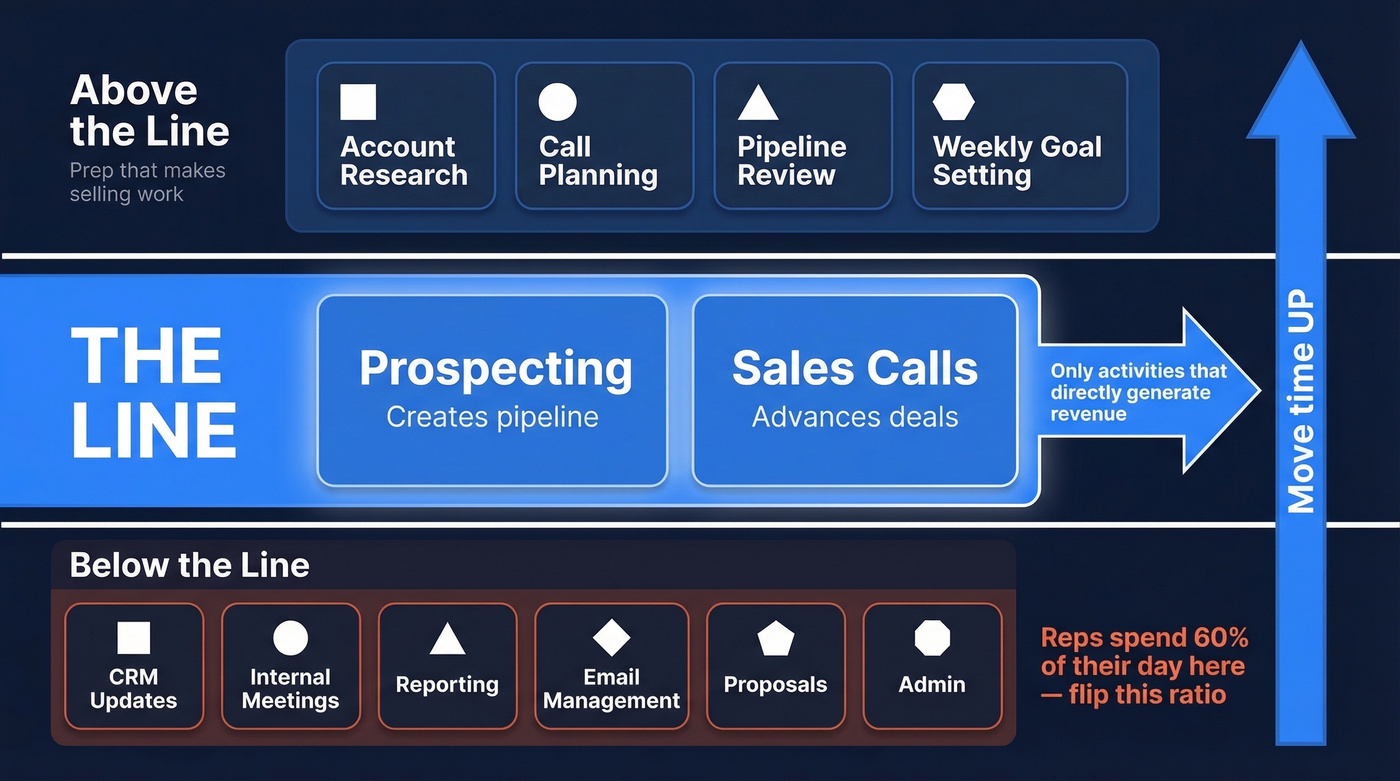
The Line is actual selling - prospecting and sales calls. These are the only two activities that directly create and advance pipeline.
Above the Line is preparation - account research, call planning, pipeline reviews, weekly goal-setting. Important, but only because it makes Line activities more effective.
Below the Line is everything else - CRM updates, internal meetings, proposals, reporting, email management. Necessary, but dangerous when it expands unchecked.
Here's the thing: most reps spend around 60% of their day below the line. Flip that ratio and quota attainment follows. Whether you run MEDDIC, Challenger, or SPIN, the Line activities stay the same - only the discovery questions change.
Activities That Close Deals
These are your Line tasks - the only ones that directly generate revenue.
Prospecting
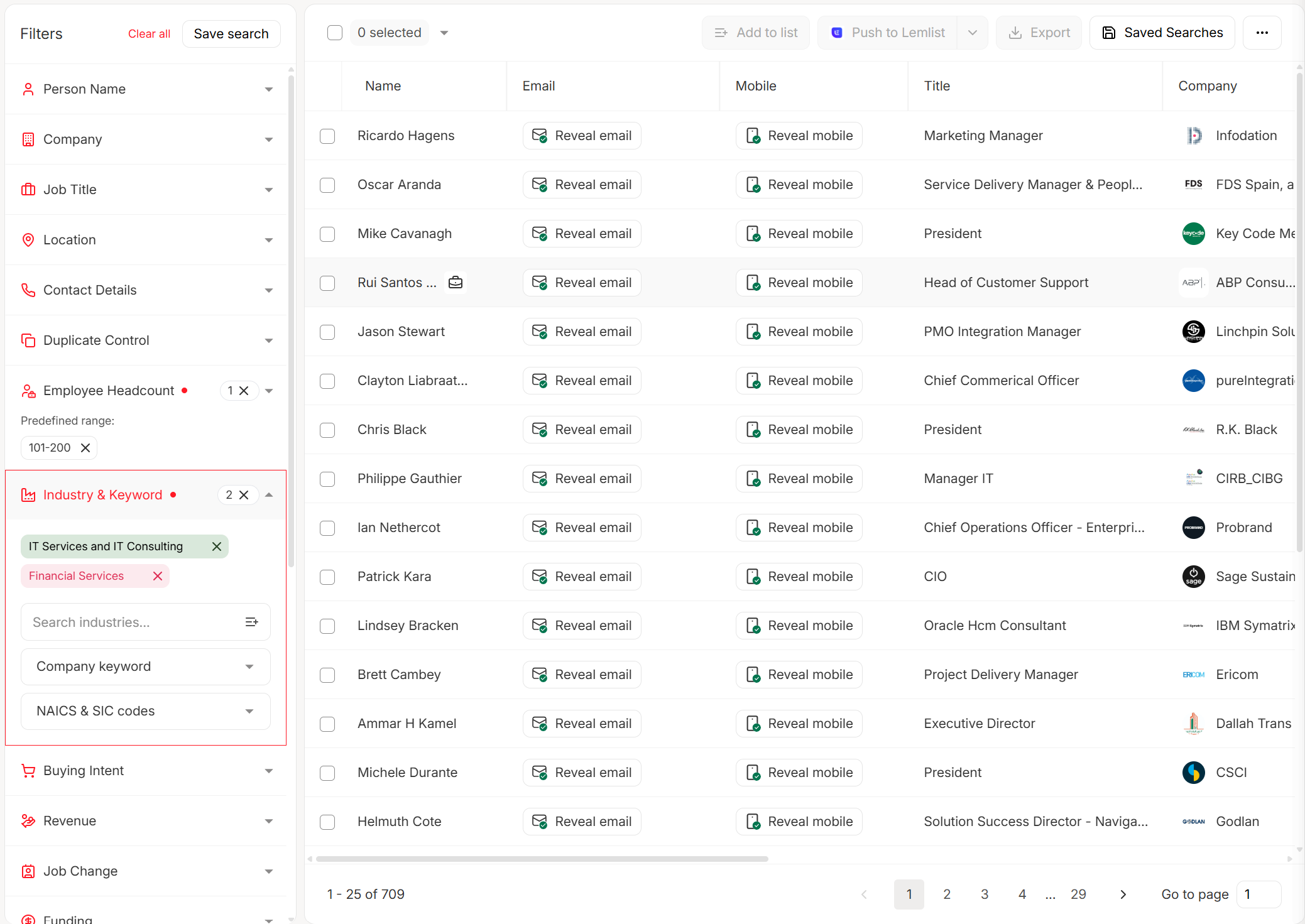
No prospects, no pipeline, no quota. Good prospecting means targeted outreach to verified contacts - not blasting 500 generic emails and hoping 30 land. The overlooked sub-task is data verification. We've watched this play out dozens of times: a rep spends 90 minutes building a list, writes personalized emails to 40 people, and 14 bounce. That's 35% of their effort wasted before a single conversation starts.
Prospeo eliminates this with 98% email accuracy and a 7-day data refresh cycle, so you reach real inboxes instead of dead addresses. Snyk's 50-person AE team saw their bounce rate drop from 35-40% to under 5% after switching, and AE-sourced pipeline jumped 180%. Meritt experienced something similar - pipeline tripled from $100K to $300K per week once their bounce rate fell below 4%. Verify before you outreach. It's the highest-ROI habit in prospecting.
Sales Calls and Discovery
Gong's data shows top-closing reps talk 43% of the time and listen 57%. Average performers flip that to 65/35. Discovery isn't about running through BANT questions - it's about understanding the buyer's world well enough to position your solution as the obvious answer. Ask about their current process, what's broken, and what happens if nothing changes. Then shut up.
Demos, Presentations, and Closing
Tailor every demo to the specific pain points uncovered in discovery. Generic feature tours kill momentum - if you can't connect each feature to something the buyer said in the previous call, you're presenting too early.
Speed matters more than most teams realize. Outreach's data shows opportunities closed within 50 days have a 47% win rate. Push past that window and win rates crater to 20% or lower. Teams using AI-assisted deal coaching close deals 11 days faster and see win rates jump 10 points on deals over $50K. Closing isn't a single event - it's the cumulative result of doing every Line activity well, fast.
Prep That Makes Selling Work
Above the Line tasks are your force multiplier. Thirty minutes of focused prep before a call can double your close rate.
Account research now takes a fraction of the time it used to - AI tools cut research time by up to 90% compared to manual methods. Company news, recent funding, tech stack, org chart: get it all before you dial. Call planning means specific questions for this buyer, objection prep, and a defined next step. Pipeline review is a weekly audit of every active deal - what's moving, what's stuck, what's dead. And weekly goal-setting ties activity targets to quota math, not vibes.
Don't forget post-sale work that belongs here too: renewal check-ins, referral requests, and upsell identification. These feed future pipeline and deserve a regular slot on your calendar.
Keep all of this tight. The moment prep becomes procrastination disguised as productivity, you've crossed below the line.

Prospecting is your highest-impact Line task - don't waste it on dead addresses. Prospeo's 98% email accuracy and 7-day data refresh mean every outreach hits a real inbox. Snyk's 50 AEs cut bounce rates from 35% to under 5% and grew pipeline 180%.
Stop losing Line time to bad data. Verify before you outreach.
Defining Next Steps in the Process
Every deal that stalls shares the same root cause: no one agreed on what happens next.
The best reps end every call with a concrete, calendar-locked next step - not "I'll follow up next week" but "I'm sending the proposal Tuesday at 2 PM and we'll review it together Thursday at 10." This is the single cheapest way to improve deal velocity without changing anything else about your process, and it costs exactly zero dollars.
The sequence should make this automatic. After discovery, the next step is a tailored demo. After the demo, it's a proposal review with the economic buyer. After the proposal, it's a negotiation call with procurement. When reps internalize this sequence, deals stop stalling in no-man's-land between stages.
Below the Line: Necessary but Dangerous
This is where selling time goes to die.
68% of reps say data entry is their most time-consuming task, and 43% report admin work eating 10-20 hours per week. That's one to two and a half full days gone. CRM updates, internal meetings, reporting, email management, proposal formatting - all necessary, all destructive to quota if they expand unchecked. Top-performing reps protect their morning hours for outbound and push admin to end-of-day. Those who let admin creep into prime selling windows consistently underperform.
Look - if your sales cadence involves more than 30 minutes of daily admin before noon, your process is broken, not your discipline. Fix the system before blaming the rep.
Every hour below the line is an hour you're not selling. The question isn't whether to do these things - it's whether a human needs to do them.
SDR vs. AE: Same Enemy, Different Days
The framework applies to both roles, but time allocation shifts dramatically.
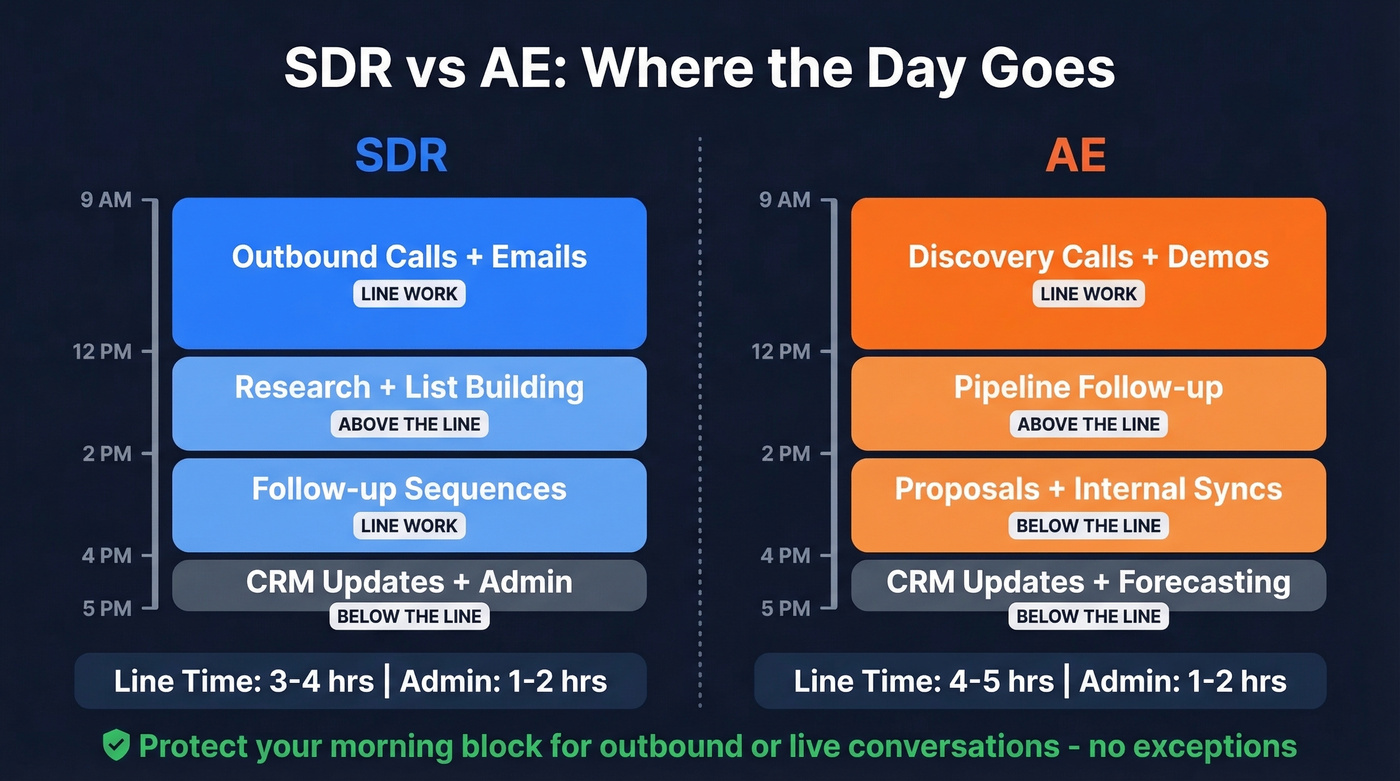
| Time Block | SDR | AE |
|---|---|---|
| Morning (9-12) | Outbound calls + emails | Discovery calls + demos |
| Early PM (12-2) | Research + list building | Pipeline follow-up |
| Late PM (2-4) | Follow-up sequences | Proposals + internal syncs |
| End of day (4-5) | CRM updates + admin | CRM updates + forecasting |
| Line time | ~3-4 hrs | ~4-5 hrs |
| Admin time | ~1-2 hrs | ~1-2 hrs |
The morning block is your highest-energy window - protect it for outbound or live conversations, no exceptions. In our experience, reps who block their first 90 minutes for uninterrupted cold calls or discovery consistently outperform peers who start with email triage. The consensus on r/sales backs this up: "morning power hours" are the most commonly cited habit among top performers.
SDRs live and die by outbound volume and qualification quality. AEs spend more time in live conversations and deal velocity management. Both roles share the same enemy: admin creep stealing Line hours.
Which Sales Tasks to Automate in 2026
Sellers who partner with AI tools are 3.7x more likely to meet quota - that number alone should settle any debate about automation. And 45% of teams now run a hybrid AI-SDR model where automation handles initial outreach and humans take over once a prospect engages. Automation frees up roughly 20-30% of a rep's capacity - that's an extra day or more per week.
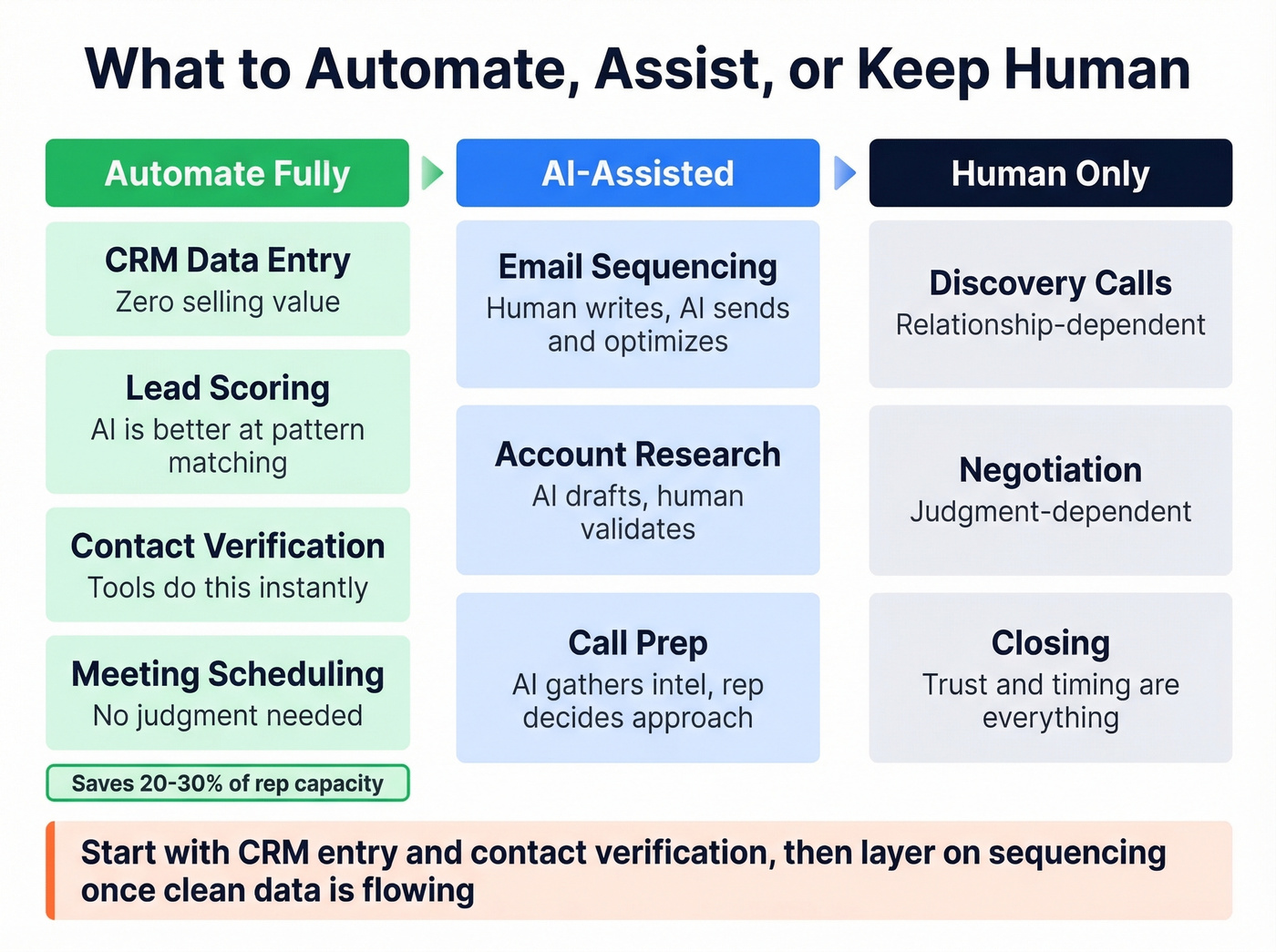
We've tested most of these tools across different team sizes. Here's what to automate, what to AI-assist, and what stays human:
| Task | Approach | Why |
|---|---|---|
| CRM data entry | Automate fully | Zero selling value |
| Lead scoring | Automate fully | AI is better at pattern matching |
| Email sequencing | AI-assist | Human writes, AI sends + optimizes |
| Contact verification | Automate fully | Tools do this instantly |
| Discovery calls | Human only | Relationship-dependent |
| Negotiation | Human only | Judgment-dependent |
| Account research | AI-assist | AI drafts, human validates |
Skip the "all-in-one" platforms if you're a team under 20 reps - they're overbuilt and overpriced for what you actually need. Instead, stack purpose-built tools:
| Category | Tool | Starting Price |
|---|---|---|
| CRM | HubSpot | Free; Sales Hub ~$20-$100+/user/mo |
| CRM | Pipedrive | ~$15-$30/user/mo |
| Prospecting Data | Prospeo | Free (75 emails/mo); ~$0.01/email |
| Prospecting Data | Apollo.io | Free tier; ~$49/user/mo |
| Sales Engagement | Outreach | ~$100-$200+/user/mo |
| Sales Engagement | Instantly | ~$30-$100+/mo |
| AI Coaching | Gong | ~$100-$200+/user/mo |
| Writing Assist | Lavender | ~$27/user/mo |
Let's be honest: the biggest time savings come from automating the stuff nobody wants to do anyway. Start with CRM entry and contact verification, then layer on sequencing once you've got clean data flowing.
Your Above the Line prep - account research, org charts, tech stacks - shouldn't eat into selling time. Prospeo returns 50+ data points per contact at $0.01/email, so reps spend minutes on research instead of hours.
Move every admin task below the line where it belongs.
Sales Tasks FAQ
What are the most important daily sales tasks?
Prospecting and sales calls - the only two activities that directly create and advance deals. Block your morning for Line work, prep in the early afternoon, and push admin to end-of-day to protect peak selling hours.
How many hours a day do reps actually spend selling?
Around 2 hours. Reps spend 60-70% of their day on non-selling activities like CRM updates and internal meetings. The fix isn't working longer - it's ruthlessly protecting selling hours from admin creep.
What should you automate first?
CRM data entry, lead scoring, email sequencing, and contact verification - these deliver the highest time savings with zero quality loss. Pair a verified data tool with a sequencer like Outreach or Instantly for end-to-end automation that reclaims 20-30% of rep capacity.
What's the best next step after a discovery call?
A tailored demo or proposal review with a specific date and time on the calendar - never leave a call without one. Mapping clear next steps for every stage keeps deals from going dark and compresses your average sales cycle by days or weeks.