

How to Build a Sales Team Development Plan That Actually Moves Pipeline
Your newest AE has been ramping for four months. They've sat through product training, shadowed a dozen calls, and completed every onboarding module. They still can't run a discovery call without a cheat sheet, and their pipeline is empty.
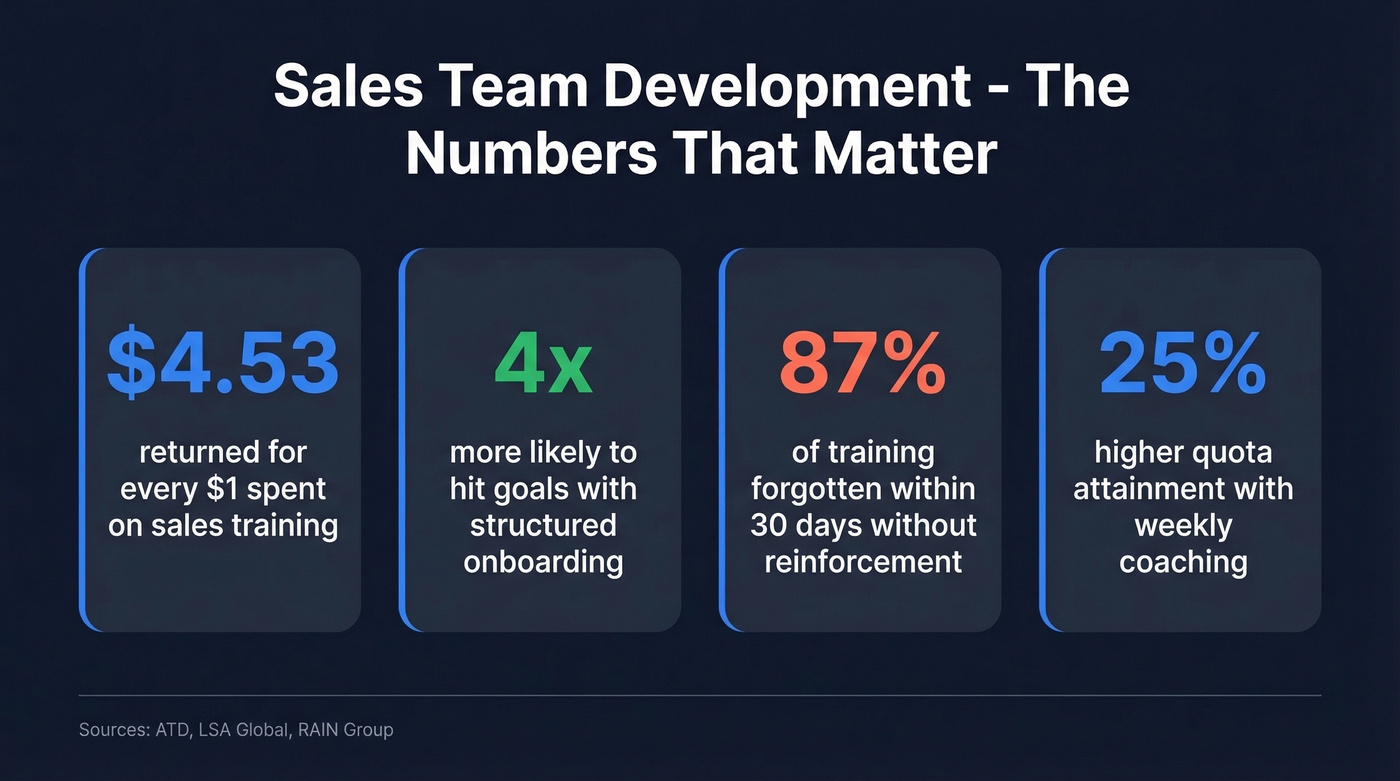
Whether you're a founder who's been closing every deal yourself and trying to hand off the motion, or a VP scaling a team of 20, the math is the same: you're burning $15k+ per month in fully loaded comp on someone who hasn't closed a deal. Sales team development isn't abstract - effective training done right returns $4.53 for every $1 spent. Done wrong, it's expensive babysitting.
Three Moves That Separate Great Teams From Revolving Doors
- Implement a 30/60/90 onboarding plan with clear milestones. Reps with structured plans are 4x more likely to achieve objectives than those left to figure it out.
- Mandate weekly 1:1 coaching. Only 26% of reps get it. Those who do hit 25% higher quota and close 30% more deals.
- Give reps verified prospect data from day one. The best training in the world doesn't matter if half your emails bounce. We've seen teams cut ramp time in half just by fixing their data infrastructure before a single coaching session happens.
Why Most Sales Training Fails
Here's the uncomfortable truth: only 1 in 5 sales reps actually change their on-the-job behavior after standalone training. LSA Global's research puts it that bluntly. You can run the best workshop in the world, but without reinforcement, coaching, and practice, reps forget 87% of what they learned within 30 days.
The buyer side is equally damning. Only 18% of buyers believe salespeople are well-prepared for meetings. That's not a training problem - it's a training execution problem.
One Reddit thread from an MSP leader captures this perfectly: "We do weekly meetings to go over the tools, but it doesn't always feel like that investment is turning into revenue." That's the training-to-revenue gap, and it's everywhere. Most companies invest in enablement but never close the loop between what reps learn and what they do in live pipeline.
The fix isn't more training. It's better systems around the training you already have.
Five Pillars of Effective Rep Development
Build a Competency Model First
You can't develop skills you haven't defined. RAIN Group's research across 100 skills and behaviors identifies five critical competency categories for top sellers: selling across the sales cycle, opportunity management, account management, relationships and influence, and productivity.
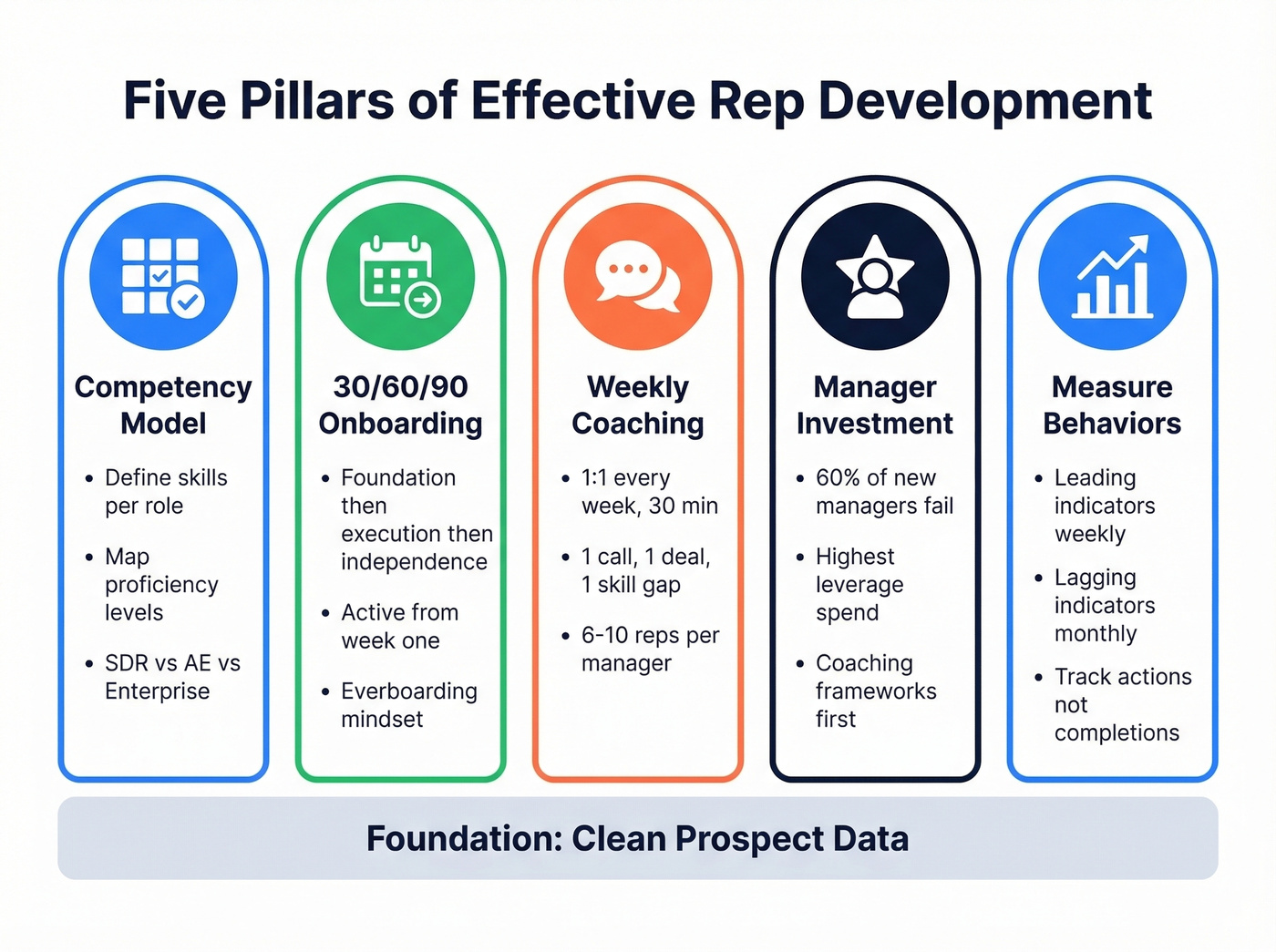
Map these categories to proficiency levels - beginner, competent, advanced - for each role. An SDR's competency model looks nothing like an enterprise AE's. Without this foundation, your training is a buffet with no menu. Reps eat whatever looks interesting, not what they actually need.
Onboard With a 30/60/90 Plan
The average SaaS rep takes 5.7 months to ramp - up 32% from 4.3 months in 2020. Enterprise reps take 9-12 months. That's a lot of runway to burn without structure.
| Segment | Avg. Ramp Time |
|---|---|
| SaaS | 5.7 months |
| Enterprise B2B | 9-12 months |
| Mid-Market | 4-6 months |
| SMB | 1-3 months |
| SDR | 3.2 months |
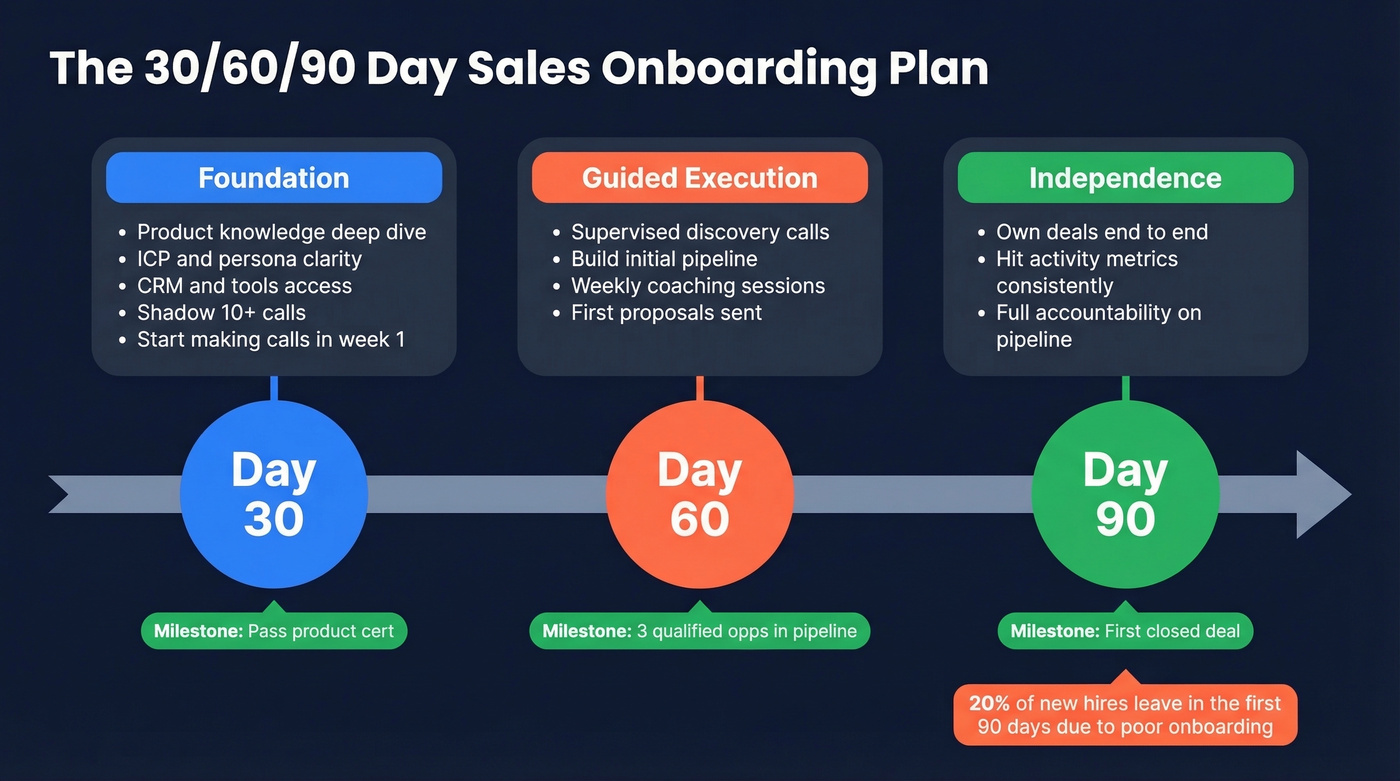
A 30/60/90 plan breaks ramp into digestible phases. Days 1-30 are foundation: product knowledge, ICP clarity, systems access, and shadowing. Days 30-60 shift to guided execution - supervised discovery calls, initial pipeline building, and structured coaching. Days 60-90 target independence: own deals, consistent metrics, and accountability.
The key word is active. Reps should be making calls in week one, with support.
Here's the benchmark that should scare you straight: 20% of new sales hires leave within their first 90 days due to poor onboarding. Think of onboarding as "everboarding" - education and skill-building don't stop at day 90. The best teams treat ramp as the first phase of a continuous cycle, not a finish line.
Coach Weekly, Not Quarterly
Only 26% of sales reps receive weekly coaching. That's a staggering gap, because the data on coaching frequency is unambiguous: weekly coaching drives 25% higher quota attainment and 30% more deals closed. Reps who receive regular, structured coaching outperform peers 4-to-1 in quota attainment.
The ratio that works best is one frontline manager for every 6-10 reps. Go above 10 and coaching becomes triage. Go below 6 and you're overspending on management overhead.
Weekly 1:1s don't need to be hour-long affairs - thirty minutes reviewing one call recording, one deal, and one skill gap is enough to move the needle.
Invest in Your Managers
60% of new sales managers fail within their first year. Only about 30% of companies invest in manager training.
That math doesn't work. One frontline manager touches 6-10 reps. Developing that manager is the single highest-leverage investment in your entire enablement budget.
One sales leader on Reddit put it plainly - they were "flexible" and "caring" but still couldn't stop the churn. The issue wasn't attitude; it was the absence of a coaching framework. We've seen teams pour money into rep-level training while their managers have zero structure for feedback or pipeline reviews. The reps improve in the classroom and walk back into an environment that reinforces old habits. Manager development isn't optional - it's the multiplier that makes everything else stick.
Measure Behaviors, Not Just Revenue
Revenue is a lagging indicator. By the time you see it drop, the problem started months ago. Only 25% of sales organizations directly measure leading-indicator sales behaviors.
Leading indicators tell you whether development is working now: executive meetings booked per week, discovery questions asked per call, follow-up cadence adherence, proposal-to-close ratio. Lagging indicators - revenue, win rate, cycle length - tell you what already happened. You need both, but most teams only track the lagging ones and wonder why they can't course-correct fast enough.
Budget Benchmarks for 2026
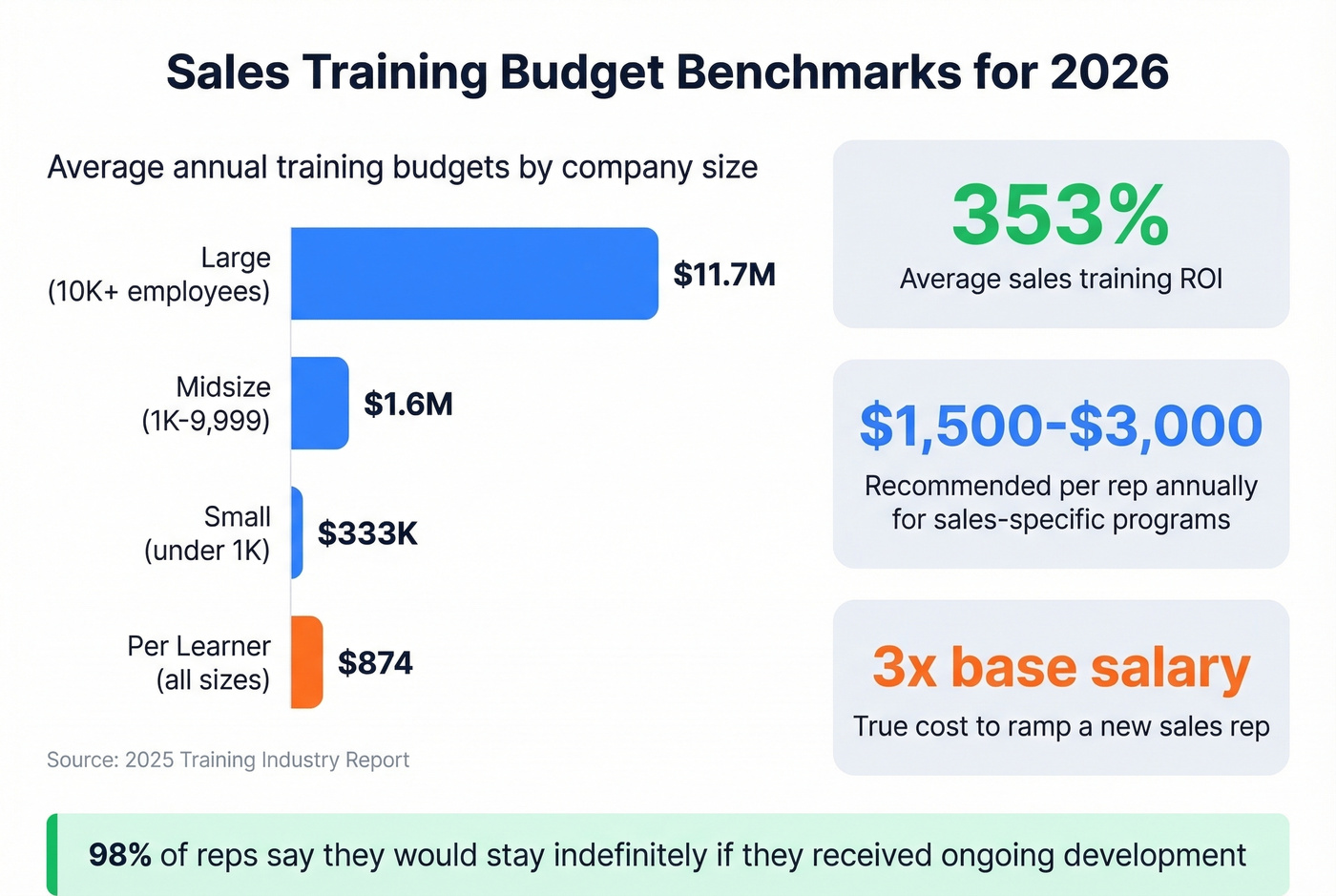
Based on the 2025 Training Industry Report - the most recent available data - total U.S. training expenditures hit $102.8B, with an average of $874 per learner and 40 hours of training per year.
| Company Size | Avg. Annual Budget |
|---|---|
| Large (10K+) | $11.7M |
| Midsize (1K-9,999) | $1.6M |
| Small (<1K) | $333K |
| Per learner (all) | $874 |
For sales-specific programs that include coaching tools, external vendors, and AI platforms, plan $1,500-$3,000 per rep annually. That sounds steep until you consider the sales training ROI benchmark of 353% and the fact that ramping a new sales rep costs roughly 3x their base salary when you factor in recruiting, onboarding, and lost pipeline.
The global sales training market is projected to nearly double from $10.3B to ~$19B by 2032. The industry is betting heavily on development because the retention math alone justifies the spend - 98% of reps say they'd stay indefinitely if they received ongoing development.

You're investing $1,500-$3,000 per rep on training. Don't let bad data waste it. Teams using Prospeo cut bounce rates from 35% to under 4% and tripled AE-sourced pipeline - because reps spent time selling, not chasing dead emails.
Fix your data before your next coaching session. 98% email accuracy at $0.01 per lead.
AI Coaching Tools - What Actually Works
Organizations using AI sales coaching tools see 20-25% improvement in rep proficiency and 15% faster ramp times. Some high-performance programs report win rate lifts of 32%. Those numbers are compelling, but let's be honest: AI supplements manager coaching. It doesn't replace it.
The best use cases are AI-powered roleplay for practicing objection handling without burning a live prospect, call scoring to identify skill gaps across hundreds of conversations, and personalized learning paths that adapt to each rep's proficiency level.
| Tool | Starting Price | Primary Use |
|---|---|---|
| Cirrus Insight | ~$14-21/user/mo | CRM capture + coaching |
| Spekit | From $25/user/mo | In-app enablement |
| Hyperbound | From $40/user/mo | AI roleplay |
| Highspot | ~$50-80/user/mo | Content enablement |
| Chorus (ZoomInfo) | ~$100-150/user/mo | Conversation intel |
| Gong | ~$1,200-1,600/user/yr | Full conversation suite |
You need both coaching cadence and tools, but the sequence matters: coaching cadence first, then AI tools for scale. Buying Gong before your managers know how to run a coaching session is like buying a gym membership before you've learned to walk.
The Data Quality Multiplier
Here's a development problem that rarely makes it into training decks: bad prospect data destroys rep confidence faster than any skill gap.
Picture this. A new rep sends 200 emails in their first week. 70 bounce. They get flagged by their sequencer. Their manager asks why activity is low. The rep starts doubting whether outbound works at all. That's not a training failure - it's an infrastructure failure.
GreyScout lived this. Their bounce rate sat at 38%, and new reps took 8-10 weeks to ramp. After switching to Prospeo, bounce rates dropped below 4% and ramp time was cut to 4 weeks. Pipeline jumped 140%.
For any sales team development plan, clean data isn't a nice-to-have. It's the foundation that makes every other investment - coaching, training, onboarding - actually convert into pipeline. Fix the infrastructure before you blame the rep.

GreyScout cut rep ramp time from 8-10 weeks to 4 weeks after switching to verified prospect data. When new hires get 300M+ profiles with 30+ filters on day one, your 30/60/90 plan actually works.
Stop burning $15K/month on reps who can't reach real buyers.
Anti-Patterns That Kill Training ROI
Treating training as an event. A two-day workshop changes behavior for 1 in 5 reps. The other four go back to what they were doing before. Training needs reinforcement loops - coaching, practice, accountability - to stick.
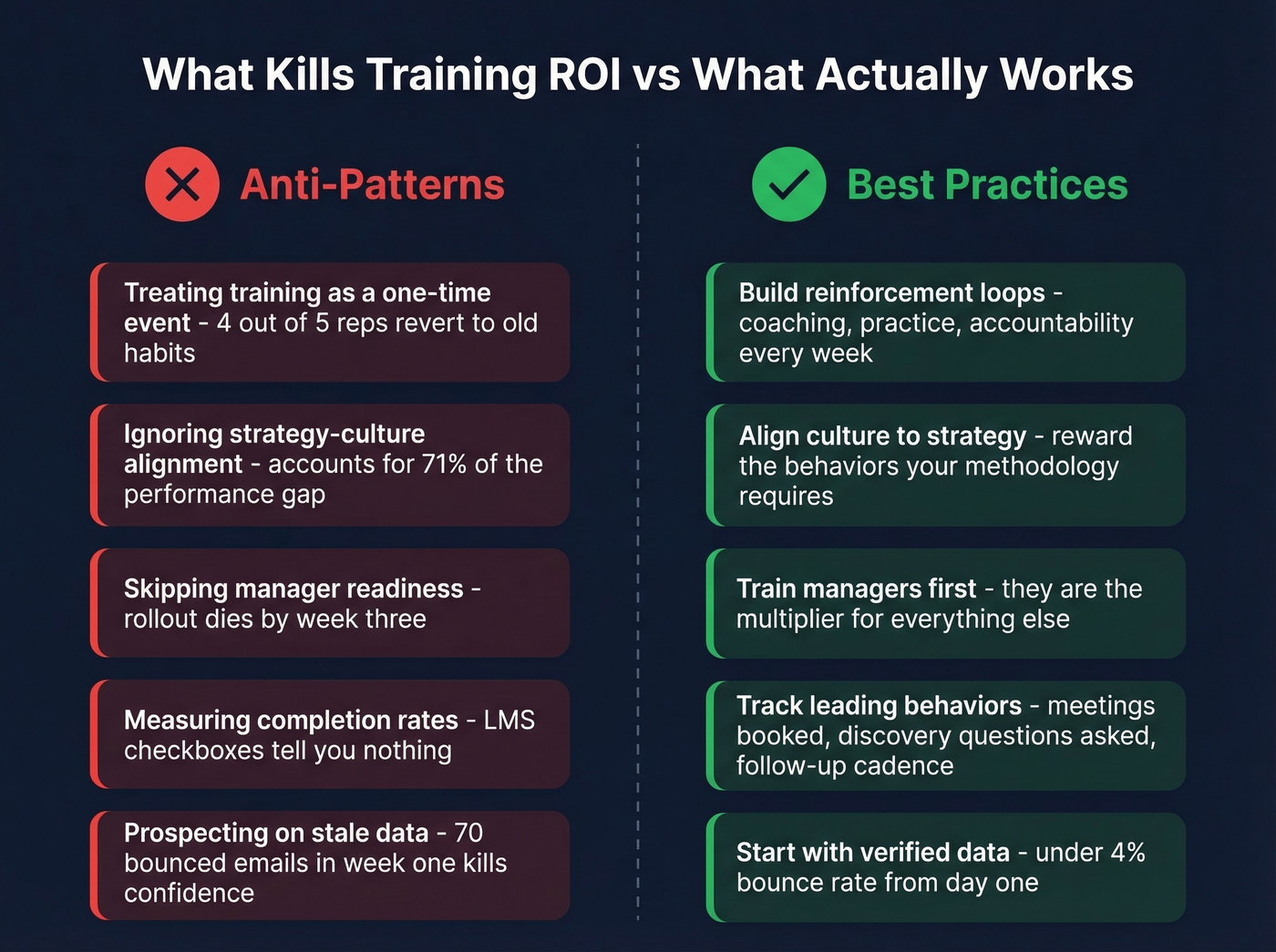
Ignoring strategy-culture alignment. LSA Global's research shows that alignment between sales strategy and organizational culture accounts for 71% of the performance gap in revenue growth, profitability, and customer loyalty. This is the most underrated stat in all of sales enablement. If your culture rewards lone wolves but your strategy requires team selling, no amount of training fixes that disconnect.
Skipping manager readiness. Launching a new methodology without preparing managers to coach it is like deploying software without training the admins. The rollout dies in week three.
Measuring completion rates instead of behavior change. "95% of reps completed the training" tells you nothing about whether they're doing anything differently on calls. Track leading behaviors, not LMS checkboxes.
Prospecting on stale data. Only 50% of reps feel they get the training needed to be successful - but sometimes the problem isn't the training at all. It's that they're working with emails that bounce and phone numbers that ring dead.
Look, most teams don't have a training problem. They have a coaching frequency problem stacked on top of a data quality problem. Solve those two and the "training" largely takes care of itself through reps learning by doing with real pipeline.
Adapting by Growth Stage
Not every team needs the same approach. The methods that work for a 5-person startup look nothing like those for a 200-rep enterprise org.
Early stage (1-5 reps): Focus on founder-led coaching and live deal reviews. Skip the LMS - train through ride-alongs and real pipeline. Document what works so it's repeatable. If you're spending money on anything at this stage, spend it on clean prospect data so reps aren't wasting their first weeks chasing dead contacts.
Growth stage (6-30 reps): Introduce a formal 30/60/90 plan, hire or promote a frontline manager, and invest in one AI tool for call review. This is where structured sales team development starts paying dividends. The consensus on r/sales is that this is also where most teams stall - they hire reps faster than they can coach them.
Scale stage (30+ reps): Layer in competency models, manager development tracks, and conversation intelligence platforms. Standardize without killing the creativity that got you here.
FAQ
How long does it take to ramp a new sales rep?
The SaaS average is 5.7 months, enterprise B2B runs 9-12 months, and SMB reps typically ramp in 1-3 months. Structured 30/60/90 onboarding with active selling in week one can cut ramp time by 50%.
What's a reasonable development budget per rep?
The U.S. average across all industries is $874 per learner annually. For sales-specific programs including coaching tools and external vendors, plan $1,500-$3,000 per rep. The 353% ROI benchmark makes this one of the highest-return line items in your budget.
Can AI replace sales coaching?
No. AI tools like Gong and Hyperbound improve call scoring and roleplay practice, but they supplement manager coaching - they don't replace the 1:1 relationship that drives real behavior change. Start with a weekly coaching cadence, then layer in AI for scale and consistency.
What's the biggest mistake in building a rep development program?
Treating development as a one-time event rather than an ongoing system. Companies that run a single workshop see behavior revert within 30 days. Teams that succeed pair initial training with weekly coaching, reinforcement exercises, and verified prospect data so reps practice on real pipeline from the start.