

Sales Team Hierarchy: Every Role, Reporting Line, and Layer Explained
Thirteen percent of all full-time U.S. jobs are in sales, yet most companies wing the hierarchy that's supposed to make those sellers productive. You're staring at a blank org chart, a headcount budget, and a Slack thread from your CEO asking why deals keep slipping. The companies that tried going flat - GitHub, Zappos, Buffer - all reversed course. Hierarchy isn't bureaucracy. It's how deals close predictably.
The Quick Version
Under $5M ARR? You need a Head of Sales, not a VP. Between $5M and $20M? Hire the VP. Past $20M with real cross-functional friction between sales, marketing, and CS? That's when the CRO conversation starts.
The minimum viable hierarchy for a startup is a couple SDRs/BDRs, a couple AEs, and one Sales Manager. Add layers only when the data tells you to - not when a board member suggests it.
Why Flat Sales Orgs Fail
The flat-org experiment has been tried at scale. We've watched teams attempt it. It always ends the same way.
GitHub abandoned its flat structure in 2016 after internal turmoil made it clear that nobody owned decisions. Buffer publicly wrote about what they got wrong. Medium dropped holacracy because, in their own words, it "was getting in the way of the work." Zappos - the poster child - lost almost a third of its employees after rolling out holacracy and offering severance to anyone who didn't want to stay.
Here's the thing: without explicit hierarchy, an implicit one forms anyway. The loudest voices make decisions. Coordination becomes a full-time job. Reps don't know who to escalate to, managers don't exist to coach, and pipeline reviews become free-for-alls.
Sales runs on accountability, coaching, and clear ownership of numbers. Flat structures undermine all three. The question isn't whether you need hierarchy - it's how many layers, and when to add each one.
The Complete Sales Title Ladder
Every sales org, from a five-person startup to a 500-rep enterprise, draws from the same role library. The difference is how many layers you activate and when.
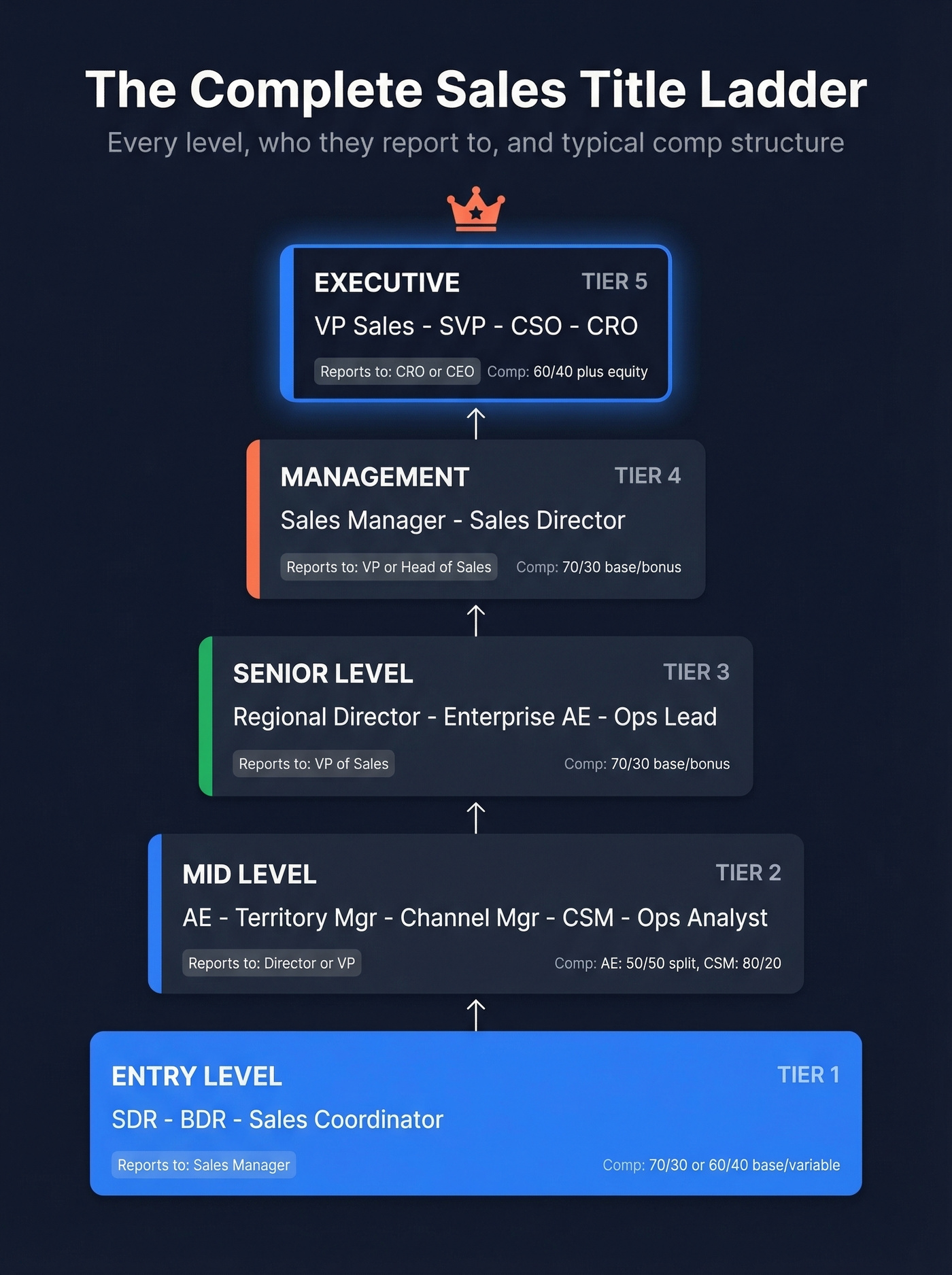
| Level | Key Roles | Reports To | Typical Comp |
|---|---|---|---|
| Entry | SDR, BDR, Sales Coordinator | Sales Manager | 70/30 or 60/40 base/var |
| Mid | AE, Territory Mgr, Channel Mgr, CSM, Ops Analyst | Director or VP | AE: 50/50; CSM: 80/20 |
| Senior | Regional Dir, Enterprise AE, Ops Lead | VP of Sales | 70/30 base/bonus |
| Management | Sales Manager, Sales Director | VP or Head of Sales | 70/30 base/bonus |
| Executive | VP Sales, SVP, CSO, CRO | CRO or CEO | 60/40 + equity |
Entry Level: SDRs, BDRs, and Coordinators
The functional split between SDRs and BDRs is simpler than most people make it. SDRs typically handle inbound lead qualification - demo requests, content downloads, hand-raisers. BDRs run outbound prospecting through cold email, cold calls, and social touches. That said, only about 25% of companies strictly separate the two roles. Most teams blend them.
The operational reality is brutal. Average SDR tenure is roughly 1.5 years according to Bridge Group research, with a 3+ month ramp before they're fully productive. Comp is usually 70/30 or 60/40 base-to-variable. That means SDRs live or die by data quality during a very short window - every minute spent chasing bounced emails or disconnected numbers is a minute not spent learning the pitch and the ICP.
Mid Level: The Uncomfortable Truth
Let's start with the number that should keep every sales leader up at night: the most recent benchmark data shows overall quota attainment at just 43.14%, with 76.6% of sellers missing even lowered quotas. That's not a people problem. It's a structural one.
AEs own the close and typically sit on a 50/50 base-to-commission split, with the SaaS median commission rate around 11.5% of ACV. Territory Managers do the same job within a geographic or vertical boundary. CSMs sit on the post-sale side with an 80/20 or 90/10 comp structure - mostly base, with a bonus tied to retention and expansion.
When AEs spend time sourcing their own pipeline because the SDR layer is under-resourced or working with bad data, the whole hierarchy breaks down. The structure above them has failed before they even get on a call.
Senior Level: Two Divergent Paths
At this tier, careers fork. Regional Directors manage multiple teams or territories - they're operators who live in dashboards, forecasts, and headcount planning. Enterprise AEs handle high-value, complex deals with longer cycles and bigger buying committees - they're individual contributors who happen to earn more than some directors.
Heads of Sales Ops and Enablement Managers sit here too. They're the infrastructure that keeps the revenue machine running, and they typically report to the VP of Sales.
We've found the best orgs promote from within for Regional Director roles and hire externally for Enterprise AEs. The skill sets are fundamentally different.
Executive Level: VP, SVP, CSO, CRO
This is where title inflation causes the most damage. The standard ladder runs Director, VP, SVP/EVP, CSO, CRO. A Pearl Meyer survey of 400+ organizations found that 92% believe companies use inflated titles, 54% use titles specifically to attract talent, and 15% of candidates accepted lower pay in exchange for a bigger title.
The VP of Sales reports to the CRO or CEO and owns sales execution. The CRO reports to the CEO and owns end-to-end revenue across sales, marketing, and customer success. The CSO is the top of the sales-specific hierarchy - focused on closing and sales strategy, typically at large enterprises. In most companies under $50M ARR, the VP of Sales reports directly to the CEO.
Hot take: most companies under $30M ARR that hire a CRO actually need a strong VP of Sales. The CRO title sounds impressive, but if you don't have separate sales, marketing, and CS teams generating real cross-functional friction, you're paying CRO comp for VP-level scope.
CRO vs. VP of Sales vs. CSO
This decision trips up the most founders and boards. Here's how to think about it.
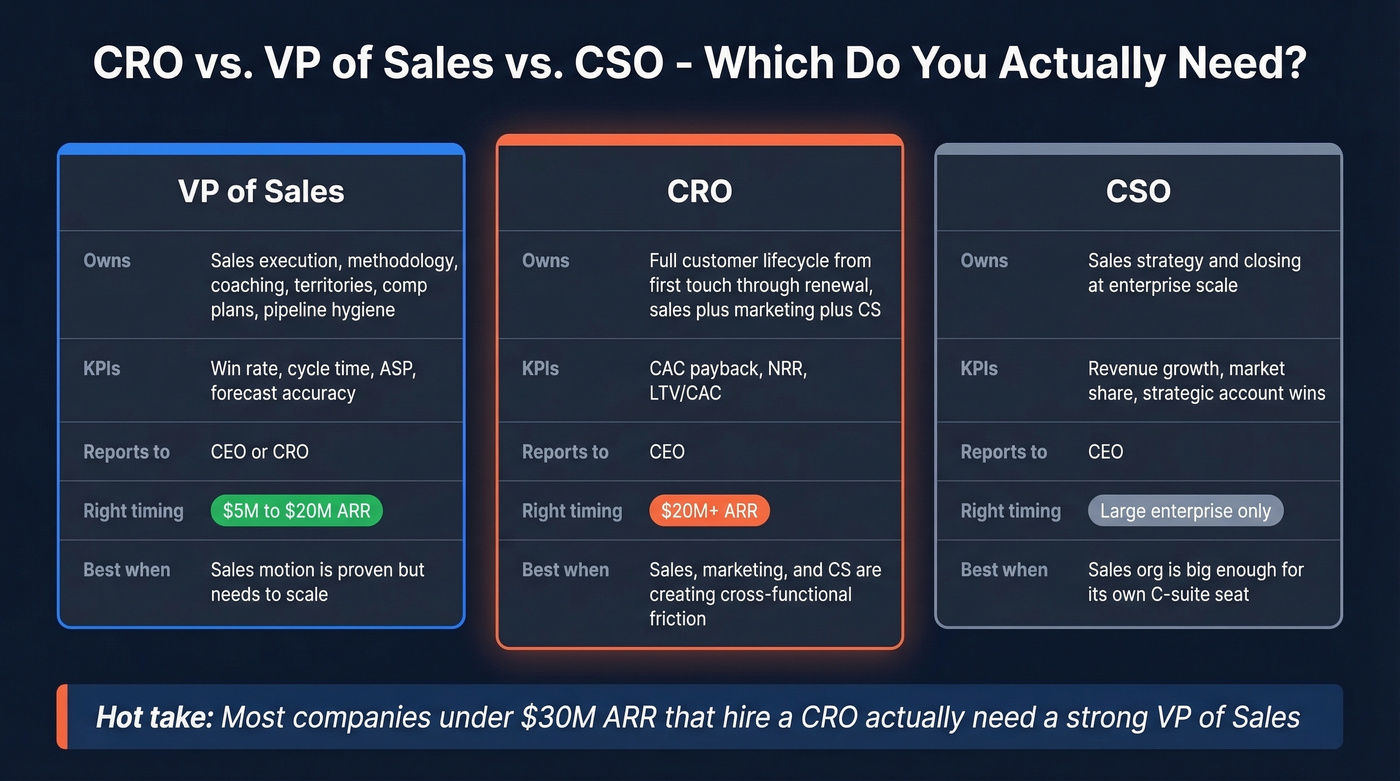
Your sales motion is proven but needs to scale - hire a VP of Sales. They own methodology, coaching, territories, comp plans, and pipeline hygiene. KPIs: win rate, cycle time, ASP, forecast accuracy. Right timing: $5-20M ARR.
Sales, marketing, and CS are generating friction instead of alignment - hire a CRO. They own the full customer lifecycle from first touch through renewal. KPIs: CAC payback, NRR, LTV/CAC. Right timing: $20M+ ARR.
Your sales org is big enough to warrant its own C-suite seat separate from the broader revenue function - that's the CSO. This is a large-enterprise role, and most companies never need it.
Reps spend only about 30% of their week actually selling. The rest goes to admin, internal meetings, and data entry. A CRO's job is to fix the system so that percentage goes up. And on the retention side, a 5% increase in customer retention can boost profits by 25-95% - which is why the CRO owns CS, not just new bookings.

You just read that SDRs have 1.5-year tenure and 3+ months to ramp. Every bounced email and disconnected number burns that window. Prospeo gives your reps 143M+ verified emails at 98% accuracy and 125M+ mobile numbers with a 30% pickup rate - so new hires start real conversations from week one, not month three.
Stop wasting your hierarchy's most expensive resource: seller time.
Org Charts by Company Stage
The right hierarchy depends on where you are. Skip to your stage.
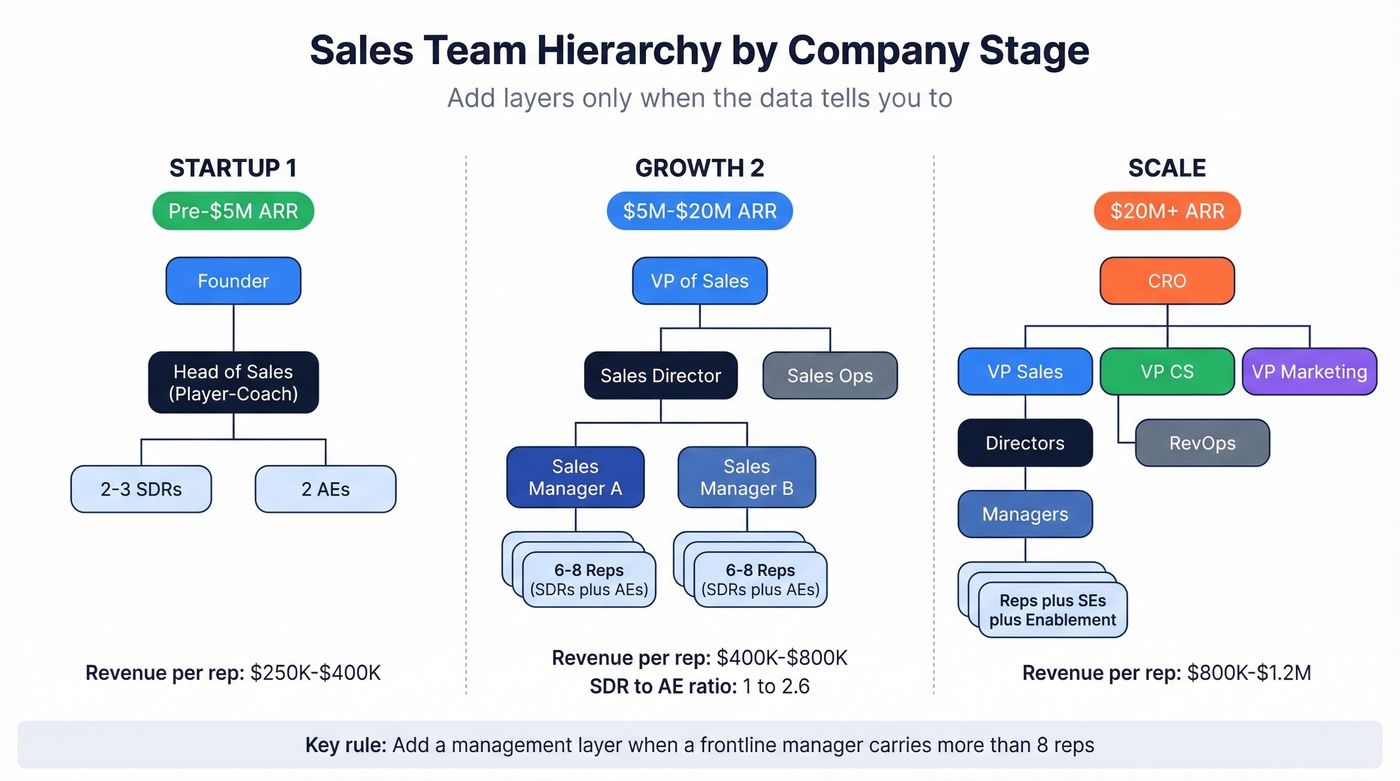
Startup (Pre-$5M ARR)
The founder closes the first 5 to 20 customers. This isn't optional. The consensus on r/salestechniques is consistent: if a founder can't sell their own product, nobody can. Don't hire a VP of Sales to find product-market fit.
Your first real hierarchy: Founder, then Head of Sales as a player-coach, then 2-3 SDRs and 2 AEs. Revenue per rep at this stage runs $250K-$400K. The Head of Sales should be closing deals themselves while building the playbook and hiring the first reps.
Growth ($5M-$20M ARR)
This is when you hire a VP of Sales to scale a proven motion. The org expands: VP Sales at the top, Directors below, Managers under them, Reps plus Sales Ops at the base. Revenue per rep climbs to $400K-$800K. Add a management layer when a frontline manager is carrying more than 8 reps.
The benchmark SDR:AE ratio is 1:2.6 - roughly 2-3 AEs per SDR. Pipeline sourcing at this stage typically breaks down to marketing contributing 25-30%, SDRs generating about 40%, and AEs self-sourcing the remaining 30%.
Scale ($20M+ ARR)
Now the CRO enters. The hierarchy becomes CRO at the top, with VP Sales, VP CS, and VP Marketing reporting in, then Directors, Managers, Reps, Specialists, and a dedicated RevOps function. Revenue per rep reaches $800K-$1.2M. You're adding enterprise AEs, sales engineers, enablement managers, and real operational infrastructure.
| Stage | Revenue per Rep | Headcount Heuristic |
|---|---|---|
| Seed | $250K-$400K | 3-5 quota carriers |
| Series A | $400K-$600K | 8-12 quota carriers |
| Series B | $600K-$800K | 15-30 quota carriers |
| Series C+ | $800K-$1.2M | 30+ quota carriers |
When to Restructure
Stage isn't the only trigger. High attrition? Move to pods - they're more resilient when people leave. Entering a new market? Add a territory layer before hiring more reps. Launching a second product line? Split your AEs by product before they become generalists who sell neither well.
Where RevOps Fits
RevOps isn't optional anymore - it's a structural layer that determines whether your hierarchy actually functions.
| Model | Best For | Risk |
|---|---|---|
| Centralized | Consistency; orgs under ~200 reps | Bottlenecks as the org specializes |
| Federated | Speed; teams needing tailored ops | Silos and inconsistent processes |
| Hybrid | Scale orgs needing both governance and speed | Complexity in role definitions |
Most companies that reach the scale stage land on hybrid. You get standardized tooling and reporting with local execution speed.
Hierarchy vs. Structure
These are different decisions, and conflating them is a common mistake. Hierarchy is about titles, layers, and reporting lines - who reports to whom. Structure is the organizational model: assembly line with SDR-to-AE-to-CSM handoffs, pod-based with cross-functional teams owning accounts end-to-end, or island where each rep handles everything. A pod structure still has a hierarchy within it. An assembly-line model still needs clear reporting lines. Don't confuse choosing a structure with designing your hierarchy.
Benchmarks for Right-Sizing
Use these numbers to gut-check whether your org is properly staffed.
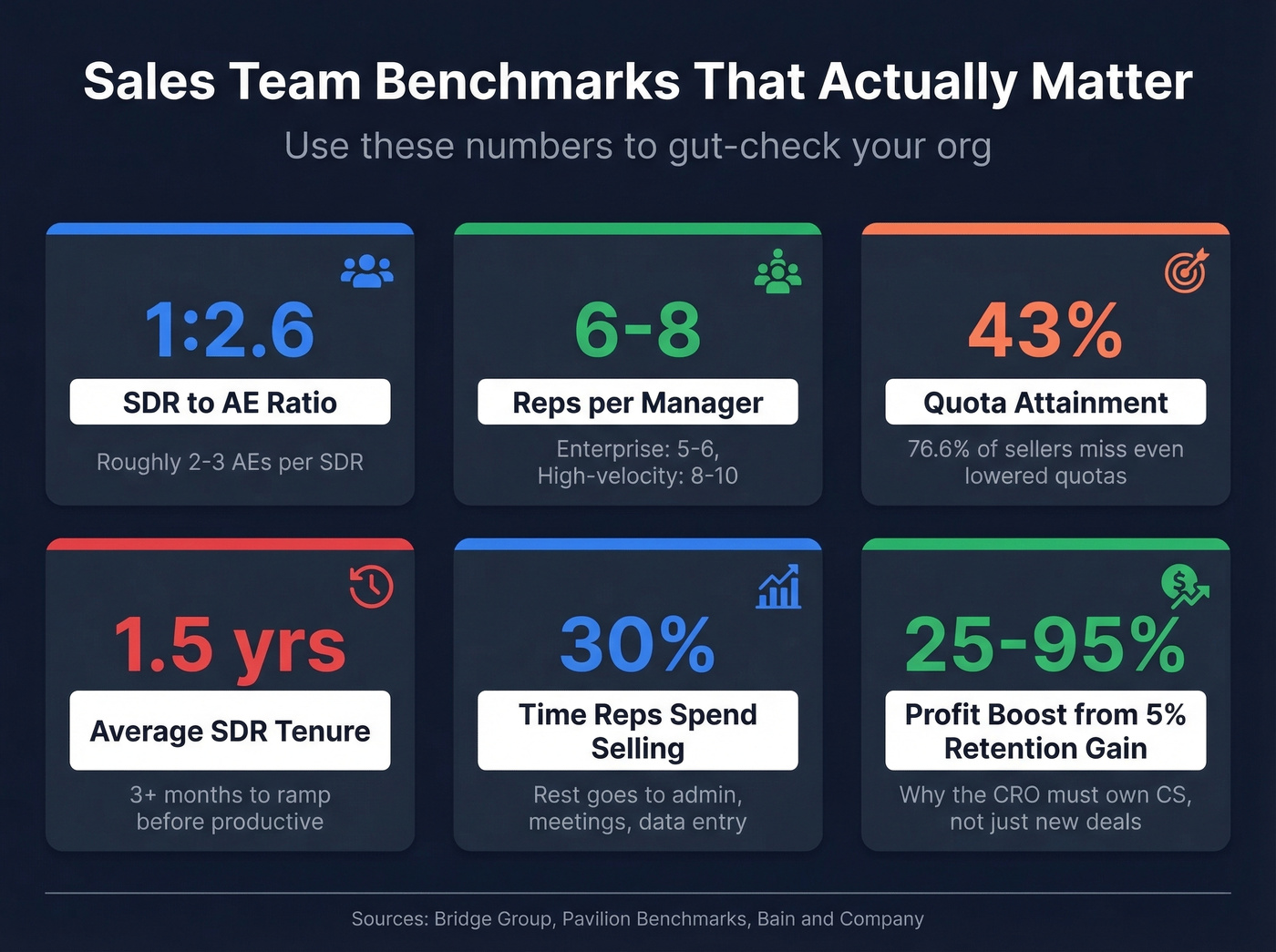
SDR:AE ratio: 1:2.6 - roughly 2-3 AEs per SDR.
Manager span: 6-8 reps per frontline sales manager. Enterprise teams trend toward 5-6, high-velocity teams can stretch to 8-10.
Quota attainment: 43.14% overall in the most recent benchmark data. SDRs generate 46-73% of pipeline. Activity benchmarks sit at 16 touches per account, 75-125 accounts per rep, and 18+ dials to connect.
Title inflation: 92% of organizations perceive inflated titles, and 15% of candidates accepted lower pay for a bigger one.
Look, if more than half your reps are missing quota, the problem probably isn't the reps. It's the hierarchy above them - insufficient coaching layers, unclear territories, or a pipeline generation engine that isn't feeding enough qualified opportunities. As one r/sales commenter put it: "Bad managers create bad reps. Bad reps don't create bad managers."
Common Hierarchy Mistakes
Hiring a VP of Sales too early. The founder should be the VP of Sales until the motion is proven. Hiring a VP to find product-market fit is one of the most expensive mistakes a startup can make. They'll build process around a motion that doesn't work yet.
Title inflation creating comp and scope confusion. When your "Head of Sales" at a 15-person startup has the same title as a Head of Sales managing 40 reps at a Series C company, expectations diverge wildly. Titles should map to scope, not to recruiting leverage.
Skipping the Sales Manager layer. This one drives us crazy. Hire a sales manager before you hire executives. Reps need day-to-day coaching, pipeline reviews, and deal support. A VP of Sales shouldn't be doing one-on-ones with eight individual contributors - that's a manager's job. Invest in frontline leadership before adding executive layers on top.
Arming Your Reps with Clean Data
You've mapped the reporting lines. Now make sure the people in your sales team hierarchy can actually do their jobs. SDRs generate roughly 40% of pipeline, but they need 18+ dials just to connect and 16 touches per account to create an opportunity. Every minute spent on bad data - bounced emails, disconnected numbers, stale records - is a minute not spent selling.
Tools like Prospeo exist to solve exactly this problem. With 125M+ verified mobile numbers delivering a 30% pickup rate and 98% email accuracy across 300M+ professional profiles, SDRs spend less time cleaning lists and more time in conversations that move pipeline. The 7-day data refresh cycle means your team isn't calling numbers that went stale six weeks ago.
If you're building the outbound engine behind that SDR layer, start with proven sales prospecting techniques and a stack of SDR tools that reduces admin time.

With 76.6% of sellers missing quota, the problem isn't your org chart - it's what your reps are working with. Prospeo's 7-day data refresh and 30+ search filters let AEs, SDRs, and managers across every layer of your hierarchy target the right buyers with data that's actually current.
Build the pipeline your sales hierarchy was designed to close.
FAQ
What's the difference between a sales team hierarchy and a sales team structure?
Hierarchy refers to titles, layers, and reporting lines - who reports to whom. Structure refers to the organizational model: assembly line, pod-based, or island. You need both. A pod structure still has a hierarchy within it, and an assembly-line model still needs clear reporting lines for coaching and accountability.
How many reps should one manager oversee?
The standard is six to eight reps per frontline sales manager. Enterprise teams with complex, long-cycle deals trend toward five or six. High-velocity inside sales teams can stretch to eight or ten. Beyond ten, coaching quality drops sharply and pipeline reviews become superficial.
When should a startup hire its first VP of Sales?
After the founder has closed the first 5-20 customers and proven the sales motion works - typically around $5M ARR. Before that, a Head of Sales or player-coach is the right hire: someone who can close deals and build the playbook simultaneously.
What's a healthy SDR-to-AE ratio?
The industry average is 1:2.6 - roughly 2-3 AEs per SDR. Enterprise motions with longer sales cycles may need closer to 1:1, while high-velocity SMB teams can run with more AEs per SDR. Adjust based on deal complexity and average cycle length.
How do SDR teams get accurate contact data at scale?
B2B data platforms are the standard approach. SDRs upload target account lists, filter by role and seniority, then export verified contacts into their sequencer. The key factors to evaluate are accuracy rates, mobile coverage, and refresh frequency - stale data burns domain reputation fast.