

The Only Sales Tools Small Businesses Actually Need in 2026
A RevOps lead we know audited his team's sales stack last quarter. They were paying for a pile of tools - CRMs, sequencers, data providers, scheduling apps. The reps used maybe three of them. The rest? Auto-renewing quietly, draining budget nobody noticed until the quarterly review. That's not an edge case. It's the norm.
Sales reps spend only 30% of their time actually selling. The rest disappears into admin, data entry, and toggling between tools that don't talk to each other. And 29% of sales pros say reducing their tech stack would make them more efficient. The CRM market alone is projected to hit $46B by 2028, but small businesses need a fraction of enterprise features at a fraction of enterprise cost.
We've mapped out exact stacks - with monthly costs - for solo founders, 2-5 rep teams, and 6-15 rep teams. Let's get into it.
Our Top Picks at a Glance
| Category | Tool | Starting Price | Why |
|---|---|---|---|
| Best CRM | HubSpot CRM | Free | Ecosystem + integrations |
| Best Budget CRM | Freshsales | Free (3 users) | Built-in phone + AI from $9/user |
| Best Prospecting Data | Prospeo | Free (75 emails/mo) | 98% accuracy, no contract |
| Best Pipeline CRM | Pipedrive | $14/seat/mo | Visual pipeline, fast setup |
| Best Free Stack | HubSpot + Prospeo + Calendly | $0/mo | CRM + data + scheduling |
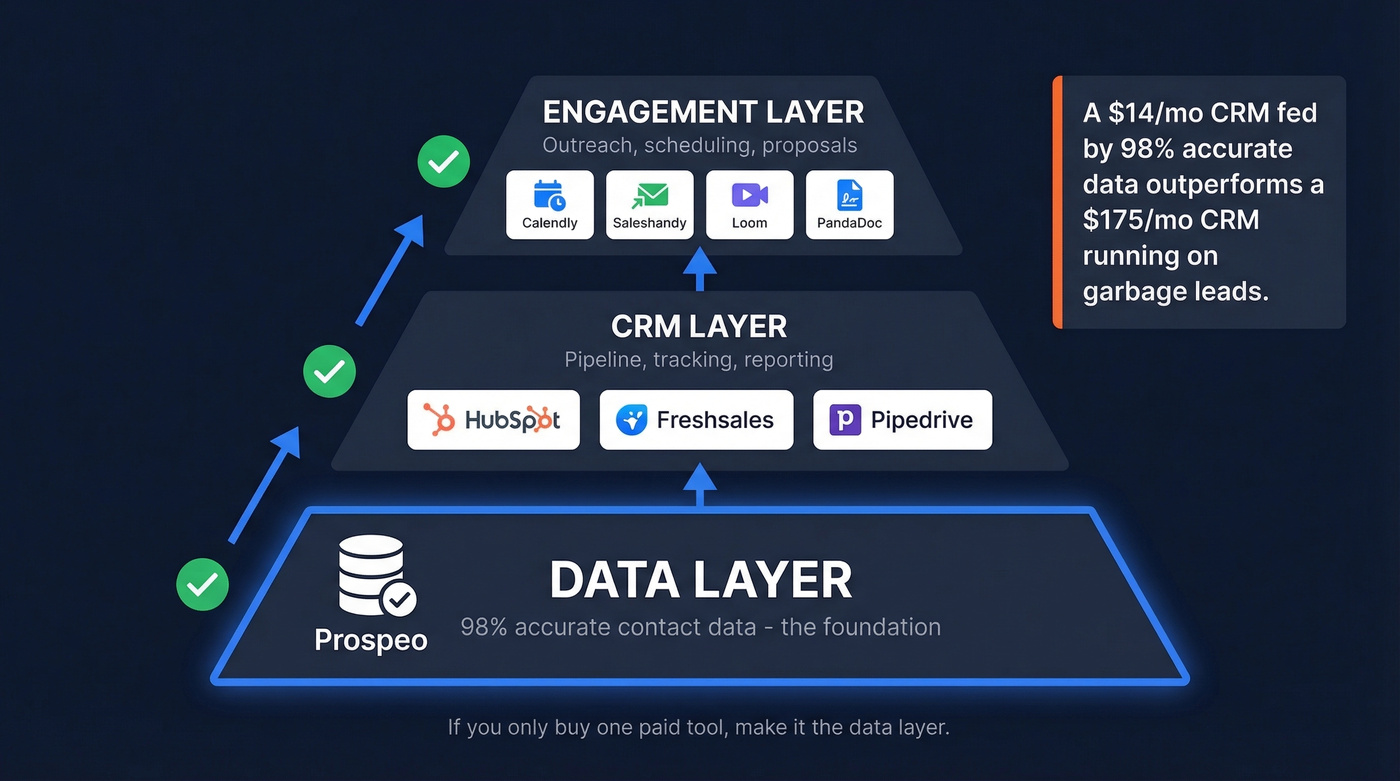
Here's our strong opinion: if you only buy one paid tool, make it the data layer. Clean data makes every other tool in your stack perform better. A $14/month CRM fed by 98%-accurate contact data outperforms a $175/month CRM running on garbage leads. Every single time.
CRM Tools for Small Teams
Your CRM is the foundation. Get this wrong and everything downstream - sequences, reporting, forecasting - breaks.
HubSpot CRM
HubSpot connects to virtually everything, and the free tier includes email tracking, a reporting dashboard, and contact management. For a 5-person team that just needs a clean CRM with email tracking, it's hard to beat.
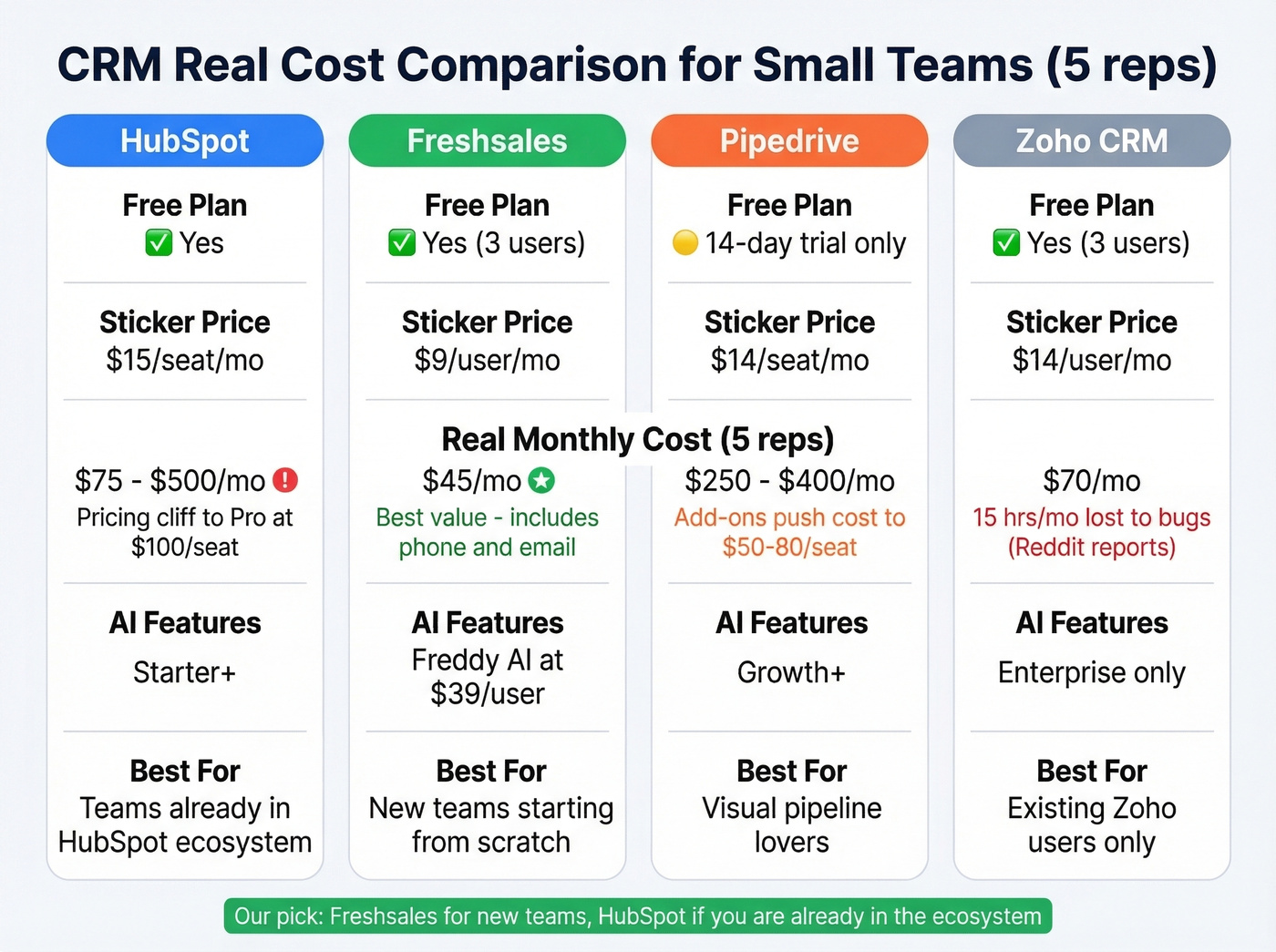
The trap is the pricing cliff. Free is genuinely functional but rigid. The moment you need real automation or custom reporting, you're looking at Starter ($15-20/seat/mo) or Professional ($100/seat/mo). That jump catches a lot of teams off guard, so budget for Professional from day one if you know you'll need workflows and sequences. We've seen teams sign up for free, build their entire process around HubSpot, then face a painful reckoning six months later when they realize the features they need cost ten times what they expected.
Freshsales
Freshsales is the most underrated CRM for small businesses, and it's not close. Free for 3 users. Growth plan at $9/user/mo. Built-in phone, email, and chat. 21-day free trial, no credit card required.
The Pro plan ($39/user/mo) unlocks Freddy AI for contact scoring, deal insights, and sales email generation - that's AI-powered pipeline management for less than what most CRMs charge for basic automation. The only reason to skip Freshsales is if you're already deep in the HubSpot or Salesforce ecosystem. For anyone evaluating small business sales software from scratch, this is the CRM we'd recommend first.
Pipedrive

Pipedrive's drag-and-drop deal management is best-in-class for visual thinkers. Lite starts at $14/seat/mo (annual), and the 14-day free trial requires no credit card.
But Pipedrive's base plans are lean. Need lead capture? LeadBooster is $32.50/mo. Email campaigns? Another $13.33/mo. Smart Docs? $32.50/mo. Budget $50-80/seat for a functional setup, not the $14 headline number. The sticker price and the real price are different animals.
The Zoho Gamble
Zoho CRM is free for 3 users, and the Zoho One bundle ($37/employee/mo) gives you 50+ apps. On paper, it's one of the best-value bundles in CRM.
In practice, reliability is a problem. The #1 complaint on Reddit is time wasted fighting the tool - reports that crash, custom fields that glitch, email threads that drop. One SMB owner reported 15 hours wasted in a single month on bugs. Cheap doesn't help if your reps are debugging instead of selling. Skip Zoho unless you're already committed to their ecosystem and willing to tolerate the rough edges.
CRM Comparison
| Tool | Free Plan | Paid From | AI Features | Best For |
|---|---|---|---|---|
| HubSpot | Yes | ~$15/seat/mo | Starter+ | Ecosystem + integrations |
| Freshsales | Yes (3 users) | $9/user/mo | Pro ($39) | Value + built-in comms |
| Pipedrive | 14-day trial | $14/seat/mo | Growth+ | Visual pipeline |
| Zoho CRM | Yes (3 users) | $14/user/mo | Enterprise | Zoho ecosystem only |
Prospecting & Data Tools
Your CRM is only as good as the data inside it. This is where most small businesses cut corners - and where the damage compounds fastest.
Prospeo
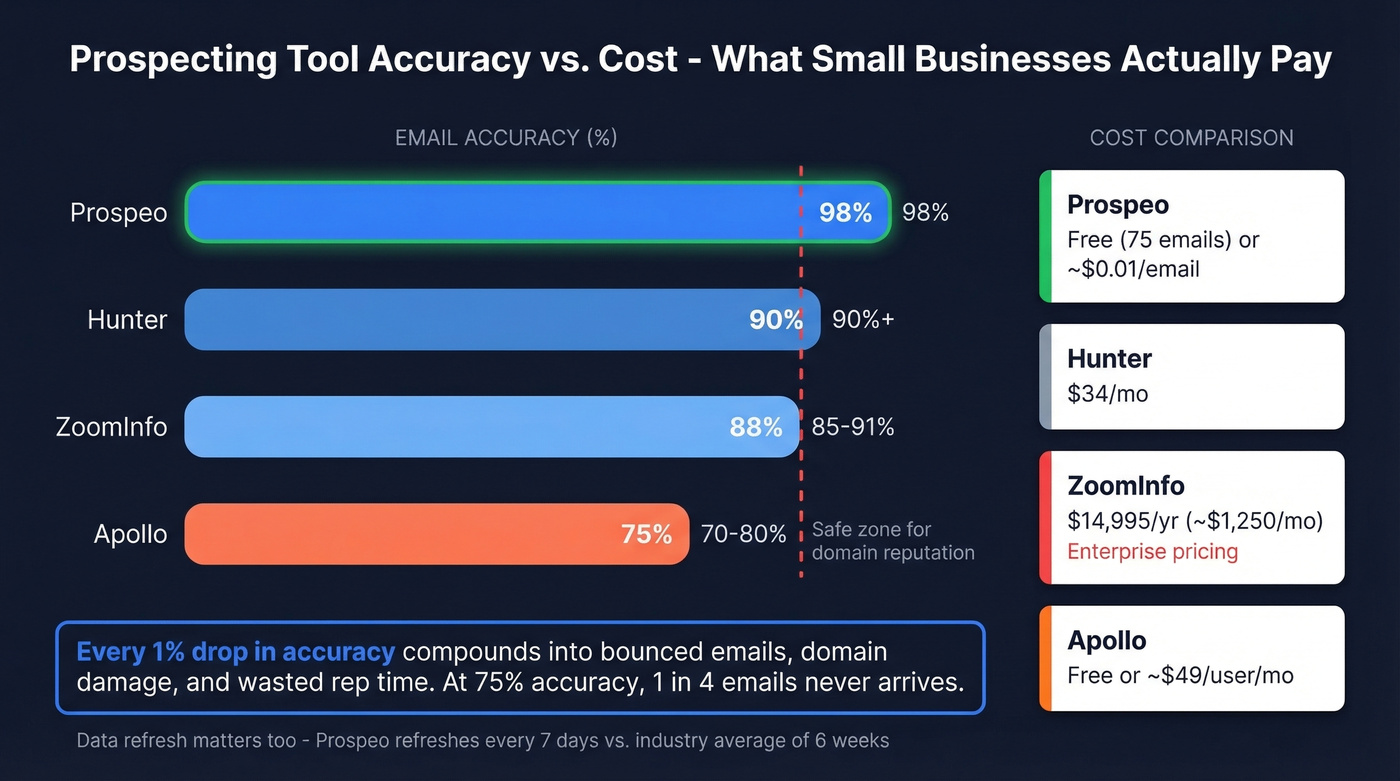
Prospeo covers 300M+ professional profiles, 143M+ verified emails, and 125M+ verified mobile numbers with a 30% pickup rate. Data refreshes every 7 days, while the industry average sits around 6 weeks. That gap compounds fast for outbound - stale data means bounced emails, which means domain reputation damage, which means your entire outreach program degrades even when you do have the right address.

The 5-step verification process includes spam-trap removal, catch-all handling, spam-trap removal, and honeypot filtering before an email ever hits your list. The free tier gives you 75 verified emails and 100 Chrome extension credits per month. Paid plans run roughly $0.01/email with no contracts. Integrations cover HubSpot, Salesforce, Instantly, Lemlist, Zapier, and Make - so it slots into whatever stack you're already running.
For teams doing outbound at any real volume, the intent data layer (15,000 topics powered by Bombora) is worth calling out. It lets you identify in-market buyers before your competitors do, which means your reps spend time on accounts that are actually ready to buy instead of spraying emails into the void.
Apollo
Apollo's free tier is functional, and paid plans start around $49/user/mo. The all-in-one approach - CRM and prospecting in one place - can save money on separate tools.
The risk is accuracy. Independent tests put Apollo's email accuracy at 70-80%, which means roughly 1 in 5 to 1 in 3 emails never arrives. For teams sending high-volume outbound, that accuracy gap compounds into real deliverability problems. If bounce rates above 10% would hurt your domain, look elsewhere.
Kaspr
Kaspr claims a database of 500M+ phone numbers and emails, with unlimited B2B email addresses on every plan including free. The catch: you only get 5 phone credits and 5 direct email credits per month on the free tier. It's strongest for European B2B data, with a Chrome extension for prospecting on professional profiles. Paid plans typically start around $40-60/mo.
A note on Clay: Clay ($185/mo) is popular with RevOps teams, but it's overkill for most small businesses. It's a workflow orchestration layer - powerful if you have the technical chops, expensive if you don't. Save it for when you've got a dedicated ops person.

The article says it plainly: a $14/mo CRM fed by 98%-accurate data outperforms a $175/mo CRM running on garbage leads. Prospeo gives small businesses 75 free verified emails per month, 7-day data refresh, and integrations with HubSpot, Pipedrive, and every sequencer on this list - no contract required.
Fix your data layer first. Everything else gets better automatically.
Prospecting Accuracy Comparison
Email accuracy varies wildly across providers. Here's what independent tests show:
| Tool | Starting Price | Email Accuracy | Phone Coverage | Data Refresh |
|---|---|---|---|---|
| Apollo | Free / ~$49/user/mo | 70-80% | 30-60% | Varies |
| ZoomInfo | ~$14,995/yr | 85-91% | 60-75% | Varies |
| Hunter | $34/mo | 90%+ (limited find) | None | Varies |
Most small businesses can't afford a 20-30% bounce rate torching their domain reputation. Prospeo's 5-step verification delivers 98% email accuracy at roughly $0.01/email - 90% cheaper than enterprise providers and built to slot into the exact stacks we mapped above.
Stop paying enterprise prices for small business outbound.
Outreach, Scheduling & Proposals
Once you've got clean data in a CRM, you need tools to actually engage prospects. Keep this layer lean.
Calendly
Calendly eliminates the 4-email back-and-forth to book a meeting. Free tier handles basic one-on-one scheduling. Paid plans start at $10/seat/mo for team features, round-robin routing, and CRM integrations. If your team takes any inbound meetings, this is non-negotiable.
Email Automation
Saleshandy is a solid starter outreach tool for Gmail users - free plan includes email tracking and up to five templates, with paid plans from ~$25/mo adding scheduling, sequences, and analytics. For most small teams, this kind of lightweight email automation replaces the need for a dedicated enterprise sequencer like Outreach or Salesloft, which run $100+/seat and require implementation time you probably don't have.
Loom
Free for 25 videos, paid plans from $12.50/user/mo. Record a quick walkthrough instead of writing a 500-word follow-up email. In our experience, a 90-second Loom often closes deals that a text-heavy email would lose - especially for demos and proposal walkthroughs where showing beats telling.
PandaDoc
Free e-signatures with proposal templates starting around $19-35/user/mo. PandaDoc fills a gap most sales tool lists ignore - the proposal and contract stage. If you're sending more than five proposals a month, the time savings on template management and e-signatures pay for themselves quickly.
AI in 2026 sales software: AI features are showing up everywhere - contact scoring, email generation, deal insights. The good news is you don't need a separate AI tool. Freshsales includes Freddy AI at $39/user, and most prospecting platforms now use algorithmic verification. Skip standalone AI add-ons until your team exceeds 10 reps.
Choosing the Right Stack by Team Size
Don't build a stack based on features. Build it based on your team size and what you can actually implement.
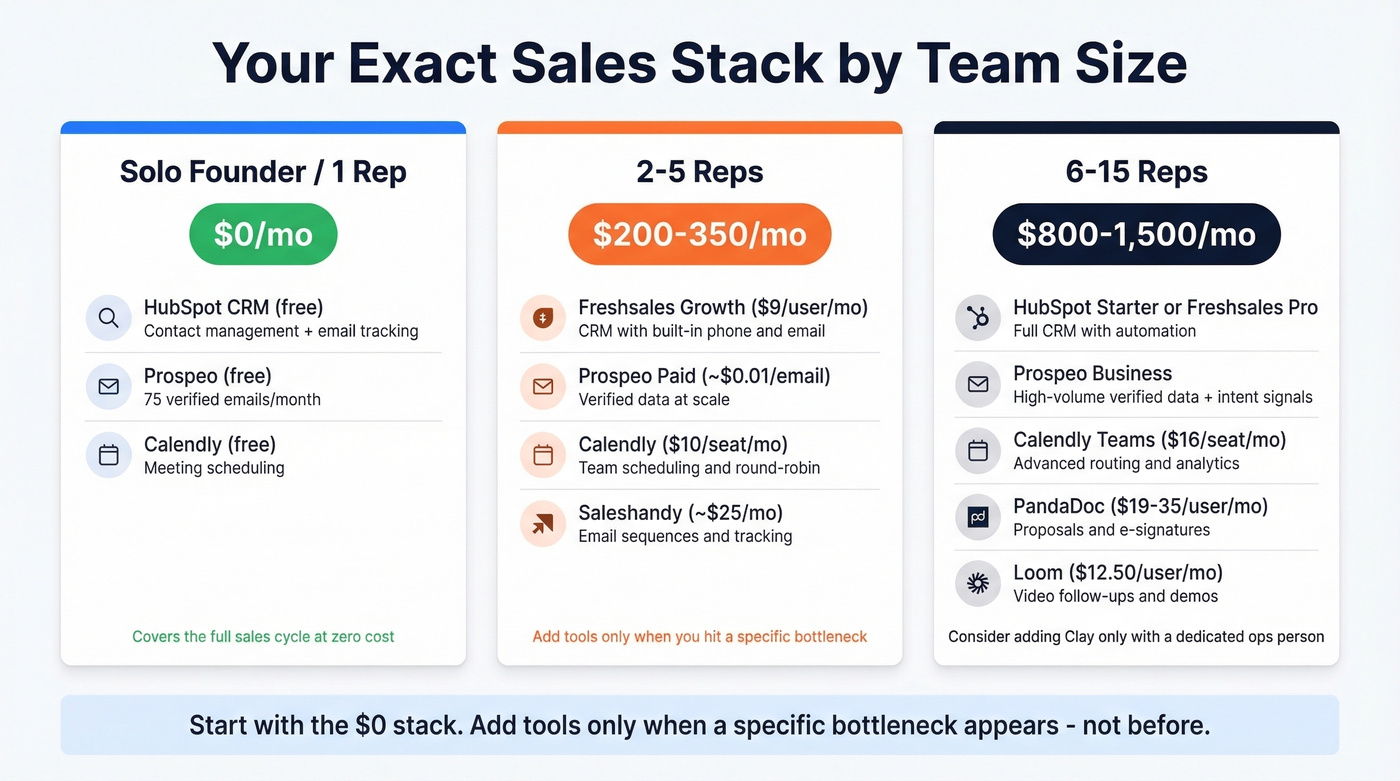
Solo founder / 1 rep - $0/month:
- HubSpot CRM (free) - contact management + email tracking
- Prospeo (free) - 75 verified emails/month for prospecting
- Calendly (free) - meeting scheduling
This stack costs nothing and covers the entire sales cycle from prospecting to booked meeting. Start here. Add tools only when you hit a specific bottleneck.
2-5 reps - ~$200-$350/month (example: 3 reps):
- Freshsales Growth ($9/user/mo) - CRM with built-in phone and email
- Prospeo paid (~$0.01/email) - verified prospecting data at scale
- Calendly ($10/seat/mo) - team scheduling with round-robin
- Saleshandy (~$25/mo) - email sequences and tracking
This is the sweet spot for early-stage teams. You get AI-powered CRM, verified data, automated scheduling, and basic outreach for less than one ZoomInfo contract.
6-15 reps - ~$700-$1,000+/month (example: 10 reps):
- Pipedrive Growth ($39/seat/mo) - visual pipeline + automation
- Prospeo - data layer for the whole team
- Calendly ($10/seat/mo) - scheduling across the org
- PandaDoc (~$19-35/user/mo) - proposals and e-signatures
At this size, you need pipeline visibility and a repeatable proposal process. Pipedrive paired with accurate prospecting data gives you deal management fed by clean contacts - the foundation for predictable revenue. Teams at this stage also benefit from connecting pipeline data to campaign performance, so your sales and marketing efforts actually inform each other.
Stack Blueprint Summary
| Team Size | Tools | Monthly Cost | Best For |
|---|
Mistakes That Waste Your Budget
Buying enterprise tools for a 5-person team. Salesforce is overkill for most small businesses. The $25/user Starter plan exists, but real automation pushes you to $100+/user fast. A 5-person Salesforce setup can run $1,500-$6,000/year on Starter, or $6,000+/year on higher tiers, before services or customization. Freshsales or Pipedrive deliver most of what SMBs need at a fraction of that cost.
Ignoring data quality. Bad data costs US companies an average of $15M/year - and while that's an enterprise figure, the proportional damage for small businesses is bounced emails, wasted call blocks, and tanked domain reputation. Invest in the data layer before you invest in anything else.
Tool sprawl. 1 in 4 sales leaders say they have too many tools. 43% of reps report spending 10-20 hours per week on admin - much of it toggling between disconnected systems. If you're paying for six tools and your team uses two, audit before you add.
FAQ
How many tools do I actually need?
Three to four. A CRM, a prospecting/data tool, a scheduler, and optionally an outreach sequencer. Anything beyond that needs to justify its cost every quarter. The teams we've seen succeed keep their stack tight and their data clean.
Is Salesforce worth it for a small business?
Rarely. The Starter plan ($25/user/mo) is limited, and meaningful automation starts at $100+/user. Freshsales or Pipedrive deliver 80-90% of what SMBs need at 10-40% of the cost. Save Salesforce for when you've genuinely outgrown everything else.
Why do my cold emails keep bouncing?
Your prospecting data is likely inaccurate. Tools with 70-80% email accuracy mean 1 in 5 to 1 in 3 emails never arrives. That damages your sender reputation, which pushes future emails to spam even when the address is correct. Switch to a provider with 95%+ verified accuracy and watch bounce rates drop below 3%.
The best sales stack for small businesses is the one your team actually uses. Start with three tools, master them, and add only when you hit a wall. Everything else is noise.