

How to Build a Sales Training Process That Actually Changes Rep Behavior
You've sat through the training. The two-day offsite with the binder nobody opens again. The LMS modules reps click through at 2x speed. The "certification" that certifies nothing. 85-90% of sales training has no lasting impact after 120 days, and only 1-in-5 reps actually change their on-the-job behavior - regardless of how good the content was.
The problem isn't the content. It's the sales training process around it.
Reddit threads on r/sales paint a painfully familiar picture. One rep described their company's training as "a string of recorded product demonstrations made by someone not actually successfully selling." Another called it "hour-long presentations nobody listened to." These aren't outliers. They're the norm, and it's maddening how much money gets torched on programs that evaporate in a month.
Building a program that sticks isn't complicated - it's disciplined, and most organizations skip the discipline part. What follows is a step-by-step framework covering the methods, reinforcement strategies, and measurement techniques that separate programs that change behavior from programs that waste budget.
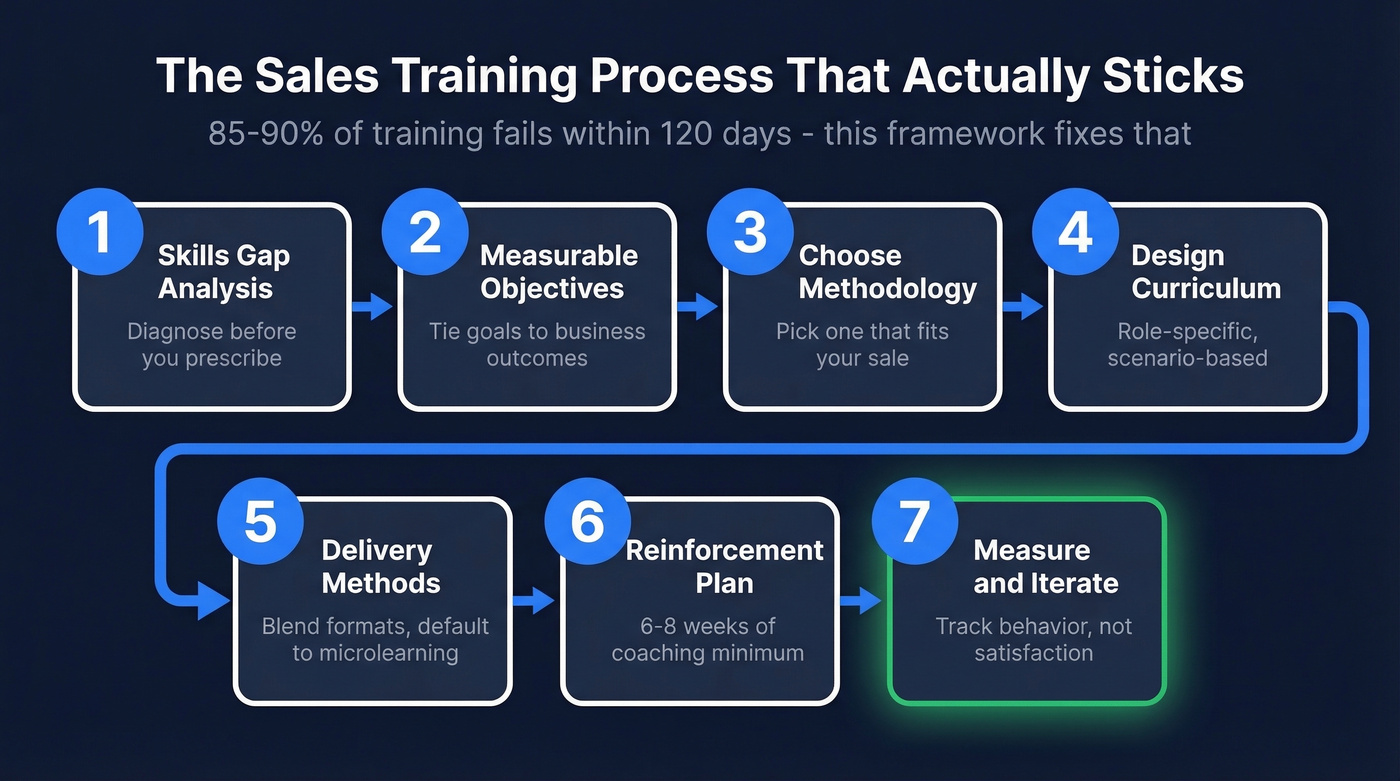
The 7-Step Sales Training Process
- Run a skills gap analysis - diagnose before you prescribe
- Set measurable objectives - tie goals to business outcomes, not completion rates
- Choose a methodology - pick one that fits your sale
- Design the curriculum - role-specific paths with scenario-based practice
- Pick delivery methods - blend formats; default to microlearning over lectures
- Build the reinforcement plan - budget 6-8 weeks of post-training coaching minimum
- Measure and iterate - track behavior change, not satisfaction scores
Process vs. Methodology
A sales process defines what happens and when - stages, milestones, handoffs. A methodology defines how reps execute within each stage - discovery techniques, objection handling, closing frameworks.
You need both. The process is the skeleton; the methodology is the muscle. This distinction matters because most failed training programs teach methodology without a process to hang it on. When teams actually adopt a methodology at scale, Korn Ferry's research shows quota attainment jumps 21%, win rates improve 15%, and revenue grows 6%. The keyword there is adoption - not exposure, not certification.
Building Your Program Step by Step
Step 1 - Skills Gap Analysis
You can't fix what you haven't diagnosed. Litmos outlines a clean five-step framework that works well for sales teams: define scope, identify crucial skills, measure current proficiency, analyze gaps by business impact, and create an action plan.
Direct observation is the most underused method here. Sitting in on calls, reviewing recorded demos, and watching how reps actually run discovery tells you more than any self-assessment survey ever will. Reps will rate themselves a 4/5 on objection handling while fumbling the pricing conversation on every deal. Trust what you see over what they report.
Step 2 - Measurable Objectives
Every training objective should connect directly to a business outcome from your gap analysis. Vague goals like "improve selling skills" are useless.
Good targets look like this: increase average deal size by 20%, improve customer satisfaction scores by 15%, reduce average sales cycle length by 10%. If you can't draw a line from the training objective to a number the CFO cares about, rethink the objective. Clear objectives also shape your training strategies - they tell you whether to invest in sales prospecting drills, negotiation workshops, or deal-stage coaching.
Step 3 - Choose a Methodology
A recurring theme on r/sales is that methodologies "all pretty much sound the same" - and there's truth to that. Sandler, BANT, Challenger, MEDDIC - they all boil down to understanding need, budget, stakeholders, and timeline. The difference is in the emphasis and the rigor.
The bigger mistake is jamming a methodology down a new rep's throat before they've learned fundamentals. One practitioner compared it to teaching a complex offense before a player knows how to tackle. Get the basics right first - active listening, qualifying questions, pipeline hygiene - then layer in methodology.
Here's how we'd break it down:
- MEDDIC for complex enterprise B2B with multiple stakeholders
- SPIN for consultative, solution-heavy sales
- Challenger for teams that already have strong fundamentals and need to level up commercial insight
- BANT for high-volume transactional sales where speed matters more than depth
Step 4 - Design the Curriculum
One-size-fits-all training wastes everyone's time. SDRs need prospecting and qualifying skills. AEs need discovery, negotiation, and closing. CSMs need expansion and retention playbooks. Build role-specific learning paths that reflect what each role actually does day-to-day, and consider inviting actual customers into training sessions so reps hear buying perspectives firsthand - not just internal assumptions about what buyers want.
Scenario-based training improves retention up to 70% compared to lecture-based formats. That means role-plays, live deal reviews, and simulated objection handling. Not slide decks. These techniques force reps to practice under pressure, which is the only way skills transfer to real calls.
Step 5 - Delivery Methods
Blended learning is the default now. Microlearning makes transfer from classroom to job 17% more efficient, per research published in the Journal of Applied Psychology. Your delivery mix should include:
- Live workshops for methodology rollout
- Virtual sessions for distributed teams
- Microlearning modules under 5 minutes for daily skill drills
- Shadowing experienced reps on real calls
- Role-play with structured feedback rubrics
AI role-play tools are worth adding to this mix. Platforms like Second Nature and Rehearsal let reps practice discovery calls and objection handling against AI buyers, getting instant feedback without burning a manager's calendar. They don't replace live coaching, but they fill the gap between workshop days.
The ratio shifts over time. Early training is heavier on workshops and shadowing. Reinforcement leans on microlearning and coaching.
Step 6 - The Reinforcement Plan
This is where most programs die. The workshop ends, everyone goes back to their desks, and within 30 days the training might as well not have happened.
Let's be honest: among all sales training best practices, reinforcement is the one that separates programs producing ROI from expensive team outings.
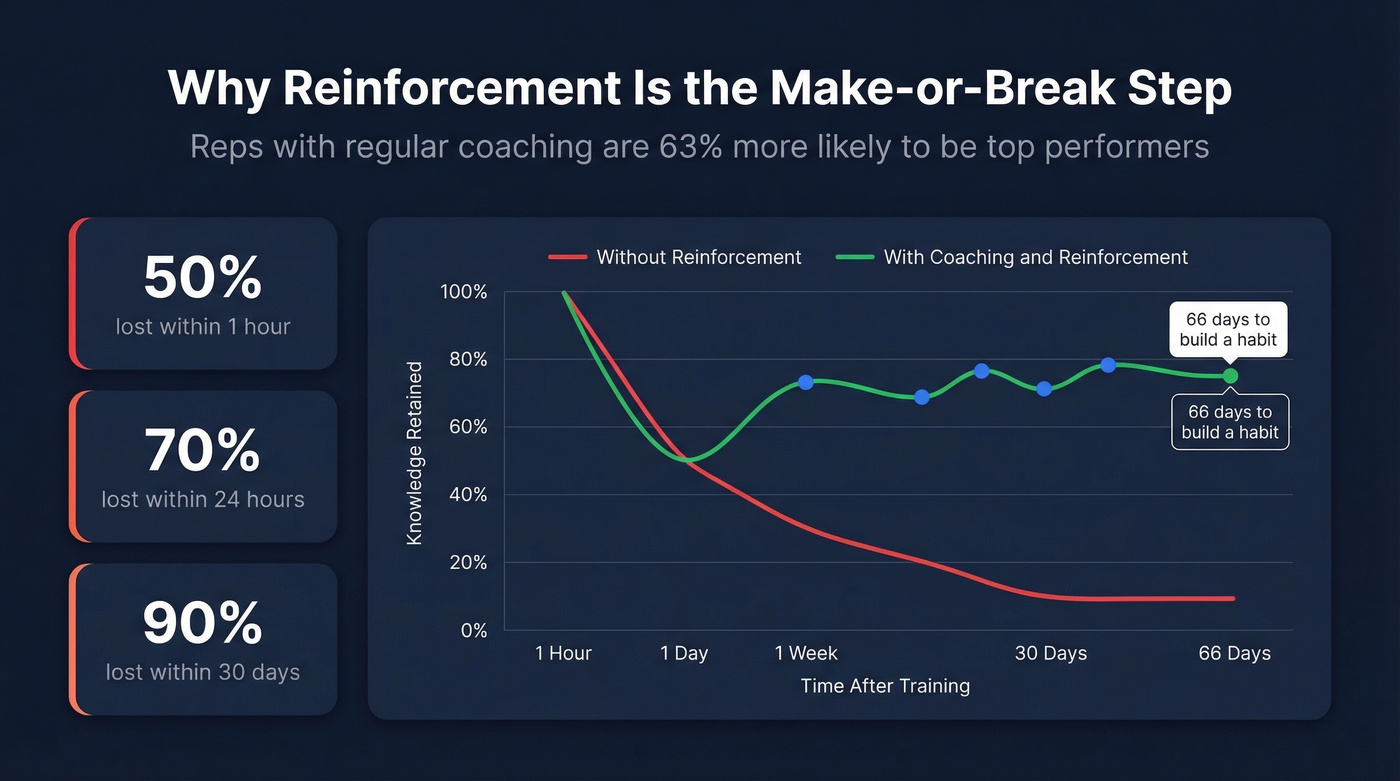
The forgetting curve is brutal. Learners lose roughly 50% of new information within one hour, 70% within 24 hours, and 90% within 30 days. If you aren't budgeting for 6-8 weeks of reinforcement, don't bother with the workshop.
It takes an average of 66 days for a new behavior to become a habit. Reps who get effective training plus a regular coaching rhythm are 63% more likely to be top performers. Coaching sessions should happen at the same day and time weekly, run no longer than an hour, and follow a consistent format so reps know what to expect.
In our experience, this step is the silent killer of the entire program. Managers who can't coach the methodology will undo everything the workshop built. Train your managers first - or accept that your investment walks out the door on day 31.
Step 7 - Measure and Iterate
Most organizations measure training with a post-session survey. That's Kirkpatrick Level 1 - reaction. It tells you whether reps enjoyed the training, not whether it changed anything. The real value lives in Levels 3 and 4: did reps change their behavior, and did those changes produce business results.

Training teaches reps how to sell. But even the best-trained rep can't close a deal they never start. Bad contact data means wasted dials, bounced emails, and burned domains - undoing every dollar you spent on training. Prospeo delivers 98% verified emails and 125M+ direct dials so your newly trained reps actually reach buyers.
Don't let bad data waste your training investment.
How to Measure Training ROI
Only 33% of organizations rate their sales training as extremely or very effective. The organizations that rate it ineffective are 13.6x more likely not to measure it at all. The correlation is direct.
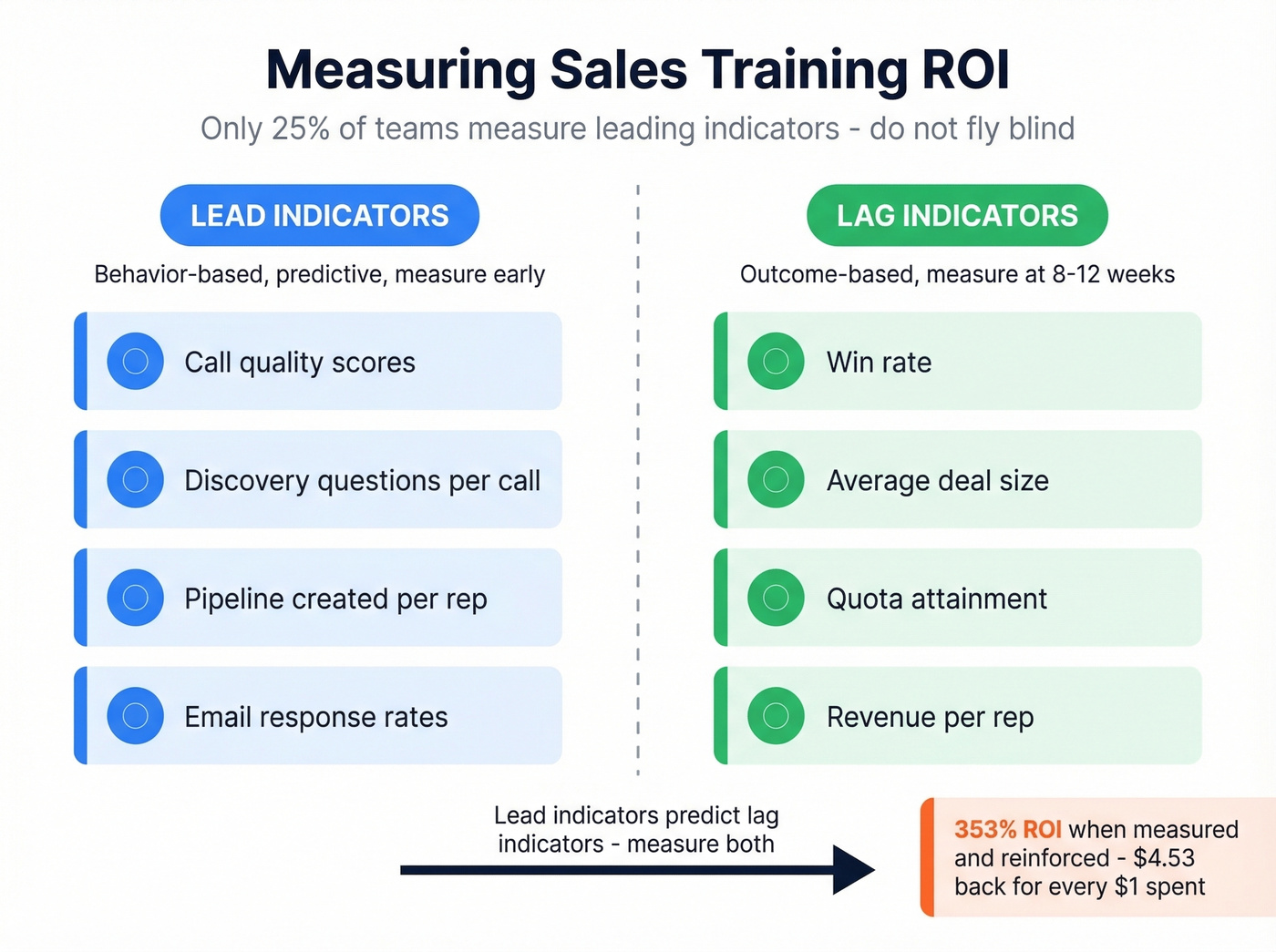
You need a clear distinction between lead and lag indicators:
- Lead indicators (behavior-based, predictive): call quality scores, discovery questions per call, pipeline created per rep
- Lag indicators (outcome-based): win rate, average deal size, quota attainment
Only 25% of sales organizations directly measure leading-indicator sales behaviors. Everyone else is flying blind, waiting for quarterly revenue numbers - by which point it's too late to course-correct.
An Accenture analysis found training delivers 353% ROI - roughly $4.53 for every $1 invested. But only with measurement and reinforcement. Here's a practical cadence:
| Checkpoint | What to Measure |
|---|---|
| Week 1 | Reaction survey + knowledge check |
| Week 2 | First behavior observation on calls/emails |
| Week 4 | Lead indicator review: pipeline, activity volume |
| Week 8 | Behavior adoption scoring |
| Week 12 | Lag indicators + ROI calculation |
Methodology Comparison
| Methodology | Research Basis | Best For | Team Size | Key Behaviors |
|---|---|---|---|---|
| Challenger | CEB, 6,000+ reps | Complex B2B | 50+ reps | Teach, tailor, take control |
| SPIN | Rackham, 35,000+ calls, 20+ countries, 12 yrs | Consultative sales | Any | Situation, Problem, Implication, Need-payoff |
| MEDDIC | PTC (origin) | Enterprise, multi-stakeholder | 20+ reps | Metrics, Econ Buyer, Champion |
| Sandler | Sandler Training | Relationship-driven | 10-50 reps | Pain funnel, up-front contracts |
| BANT | IBM (origin) | Transactional, high-volume | Any | Budget, Authority, Need, Timeline |
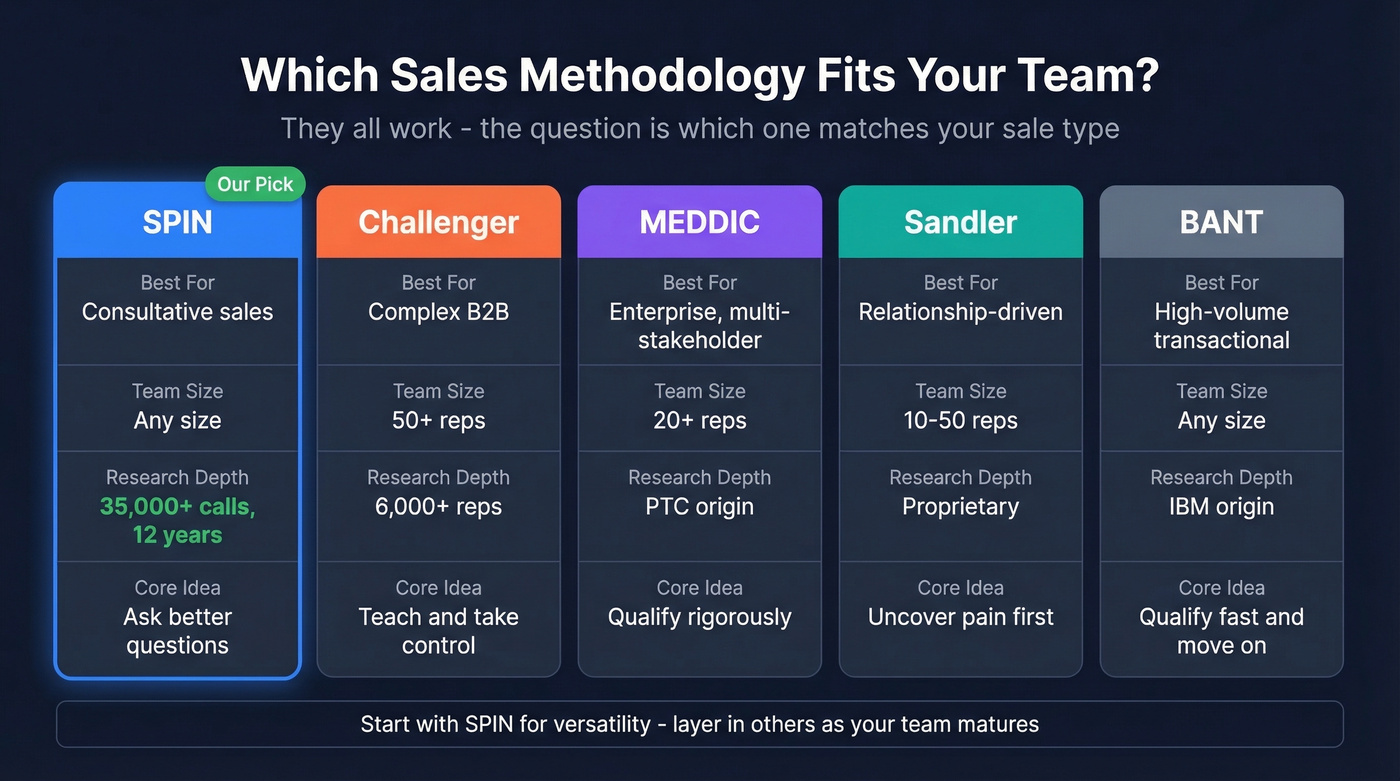
Our pick for most teams: SPIN. It's the most versatile, has the deepest research foundation, and scales from 5 reps to 500 without heavy enablement infrastructure. Xerox reported a 17% increase in sales and $65M in contract value after implementing Challenger - but that's Xerox, a massive org with the enablement team to support it. For a 15-person sales team, BANT or SPIN will get you further, faster, with less overhead.
Hot take: If your average contract value is under $25k, you don't need MEDDIC or Challenger. The implementation overhead will eat more pipeline than the methodology creates. Start with SPIN or BANT, nail the fundamentals, and graduate to a heavier framework when your deal complexity demands it.
5 Mistakes That Kill Your Program
1. Product demos disguised as training. If your "sales training" is a recording of a product walkthrough made by someone who's never carried a quota, it's not training. It's onboarding theater. (If demos are part of your motion, use a product demo checklist so practice is structured.)
2. No reinforcement plan. 85-90% of training evaporates within 120 days without reinforcement. A two-day workshop with no follow-up is an expensive team-building exercise.
3. No manager enablement. Frontline managers are the reinforcement mechanism. If they haven't been trained on how to coach the methodology, they'll default to pipeline reviews and deal interrogation. That's not coaching.
4. No executive sponsorship. Training that isn't visibly backed by leadership gets treated as optional. When the VP of Sales skips the kickoff, reps read the signal loud and clear.
5. Measuring satisfaction instead of behavior. Post-training surveys measure whether reps liked the facilitator and the lunch. If your measurement stops at "4.2 out of 5 stars," you're measuring the wrong thing entirely. The organizations with the best results obsess over lead indicators weekly, not satisfaction scores quarterly.
You just budgeted 6-8 weeks of reinforcement to make training stick. Now make sure reps spend that time selling, not hunting for contact info. Prospeo's 30+ search filters - including buyer intent, job changes, and headcount growth - put the right prospects in front of reps at $0.01 per email. No contracts, no gates.
Cut list-building from 15 hours to 2 and let reps practice on real buyers.
FAQ
How long does it take to build a sales training process?
Expect 4-6 weeks for the initial framework - from skills gap analysis through curriculum design. Budget an additional 6-8 weeks of post-launch reinforcement before you'll see measurable behavior change. Total timeline: 60-120 days depending on team size and deal complexity.
What's the difference between a sales process and a methodology?
A process defines what happens and when - stages, milestones, handoffs between roles. A methodology defines how reps execute within each stage - discovery frameworks, objection handling, closing approaches. You need both working together for training to produce lasting results.
What tools support an effective training program?
Three categories matter most: an LMS for content delivery ($5-$15/user/month), a conversation intelligence tool like Gong or Chorus for coaching on real calls ($50-$100/user/month), and a verified data platform like Prospeo so reps practice outreach on accurate contacts instead of dead emails that teach bad habits.
How often should you update your training program?
Run quarterly reviews at minimum, with a full overhaul annually. Market conditions shift, your product evolves, and buyer expectations change. The skills gap analysis from Step 1 should be a recurring exercise - teams that treat their program as a living system consistently outperform those that set it and forget it.