

How to Calculate and Prove Sales Training Return on Investment
Your VP of Sales just asked - again - what the sales training return on investment was for last quarter's program. You've got completion rates, a few positive Slack messages, and a smile-sheet survey where everyone rated the facilitator 4.5 out of 5. That's not going to cut it. 35% of L&D professionals say tracking training ROI is "very difficult," and the other 65% are probably just rounding up.
Here's the thing: the formula itself is easy. Getting honest numbers into it, isolating training's actual contribution from every other variable that shifted last quarter, and presenting it in a way that doesn't make your CFO's eyes glaze over - that's where most teams fall apart. Let's break it down.
What Sales Training Actually Costs
U.S. companies spent $102.8 billion on training in 2025, up 4.9% year-over-year. The average per-learner spend hit $874. But that number dramatically understates what sales training actually costs.
A common heuristic is 4-6% of base salary. For a rep earning $100K, that's $4,000-$6,000 per year. Multiply by a 10-person team and you're at $40K-$60K before you've counted the hidden costs.
Those hidden costs matter - and they belong in the denominator. Rep opportunity cost is the big one: Training Magazine's 2025 benchmark is 40 hours per employee per year, and those are hours not selling. Content development time, facilitator fees, travel, tool subscriptions, and CRM workflow customization all add up. Most teams undercount because they only track the line item on the training vendor's invoice. The benefits side is broader than revenue lift alone, too: reduced ramp time for new hires, lower rep turnover, and reduced concentration risk (where one salesperson carries more than half of team revenue) are all legitimate ROI categories worth quantifying.
The ROI Formula (With a Worked Example)
The formula is simple. Getting honest numbers into it is the hard part.
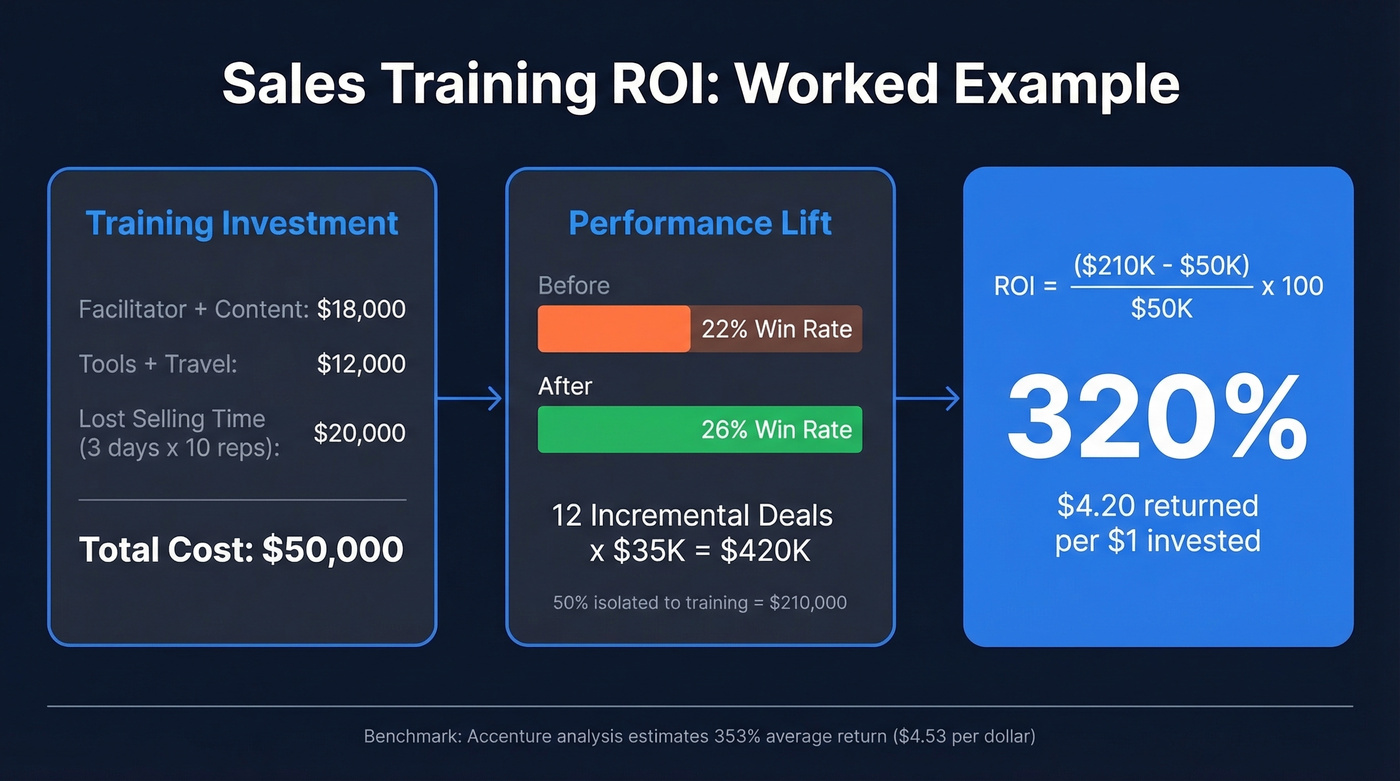
ROI (%) = (Benefits - Costs) / Costs x 100
Here's a worked example. You've got a 10-rep team. Total training investment - facilitator, content, tools, travel, and 3 days of lost selling time per rep - comes to $50,000. Each rep works about 10 new opportunities per month, giving you 300 total opportunities across the quarter. Before training, your win rate sits at 22%, producing 66 closed deals. After the program, win rate lifts 4 percentage points to 26%, producing 78 closed deals - an incremental 12 deals. At an average deal size of $35,000, that's $420,000 in incremental revenue.
Now, conservatively attribute only half of that to training (more on isolation below). That gives you $210,000 in benefits.
ROI = ($210,000 - $50,000) / $50,000 x 100 = 320%
Accenture's widely cited analysis puts the return at 353%, or roughly $4.53 returned per dollar invested. That's a useful benchmark, but your number will differ based on program quality, reinforcement, and how honestly you isolate training's contribution.
How to Isolate Training's Impact
Sales went up 15% last quarter. But you also hired a new sales manager, launched a product update, and cut pricing on your mid-market tier. How much of that 15% was training?
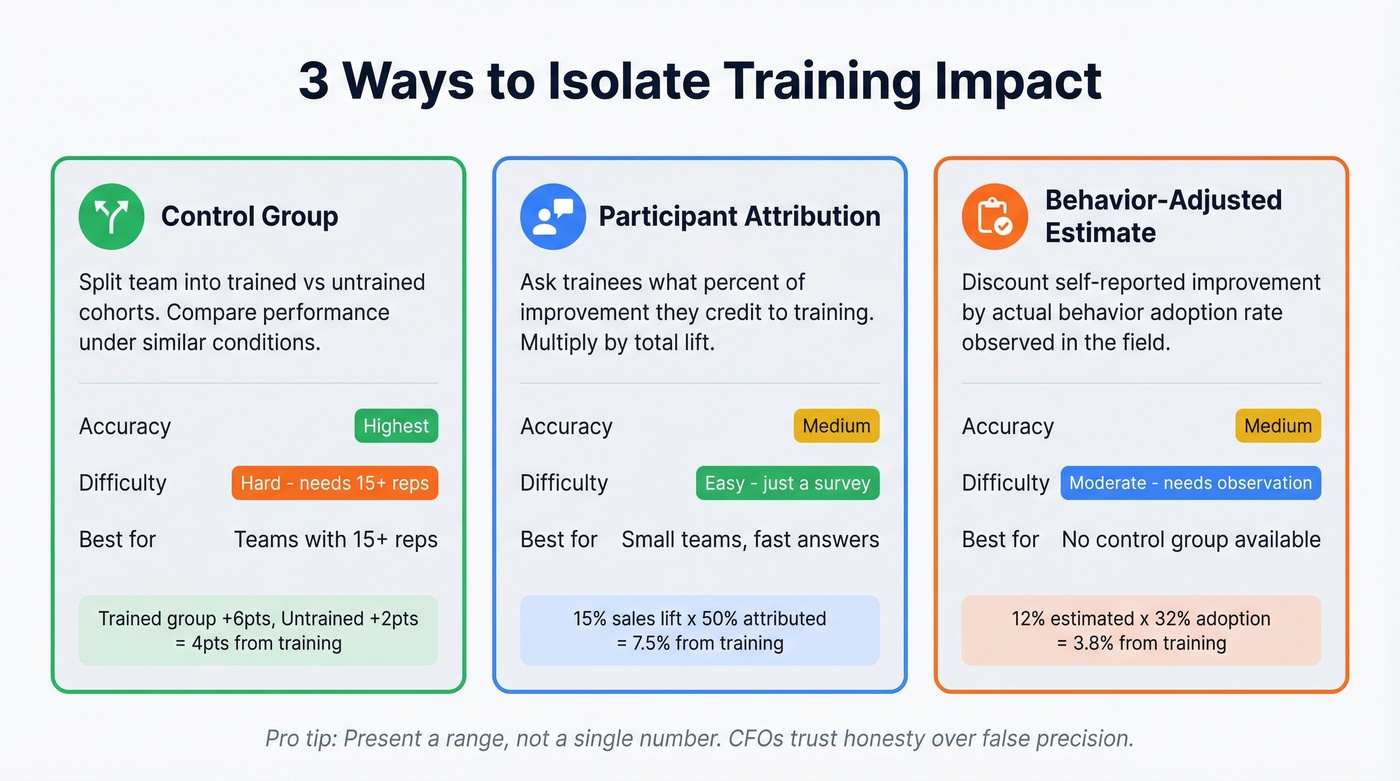
This is the step most teams skip - and it's the step that makes your ROI number defensible. Three techniques work, each with different tradeoffs:
Control group. Split your team into trained and untrained cohorts under similar conditions. If the trained group's win rate lifts 6 points and the untrained group lifts 2, the incremental 4 points is attributable to training. This is the gold standard, but it requires enough reps to split meaningfully - tough if you've got a team of eight.
Participant attribution. Ask trainees what percentage of their improvement they'd attribute to training. If sales rose 15% and trainees attribute 50% to the program, your isolated lift is 7.5%. Subjective, yes, but better than claiming the full 15%.
Behavior-adjusted estimate. When you lack a control group, adjust self-reported improvement by observed behavior change. If reps estimate a 12% improvement but only 32% are consistently applying the new behaviors, your isolated improvement is roughly 3%.
A CFO respects "12-18% revenue lift attributable to training" more than a suspiciously precise "14.7%." Present a range. It invites less scrutiny and signals intellectual honesty.

Your training ROI formula has a hidden variable: data quality. If reps spend 4-6 hours a week chasing bad emails, that's lost selling time you're not counting in the denominator. Prospeo delivers 98% email accuracy and 125M+ verified mobiles - so trained reps actually reach the buyers they're trained to close.
Stop losing trained reps' hours to bounced emails and dead numbers.
Kirkpatrick vs. Phillips: Pick the Right Framework
Most organizations evaluate training using Kirkpatrick's four levels: Reaction (did they like it?), Learning (did they retain it?), Behavior (did they apply it?), and Results (did business metrics move?). The problem is that most orgs stop at Levels 1 and 2 - smile sheets and quiz scores. That's like measuring a diet by whether you enjoyed the meals.
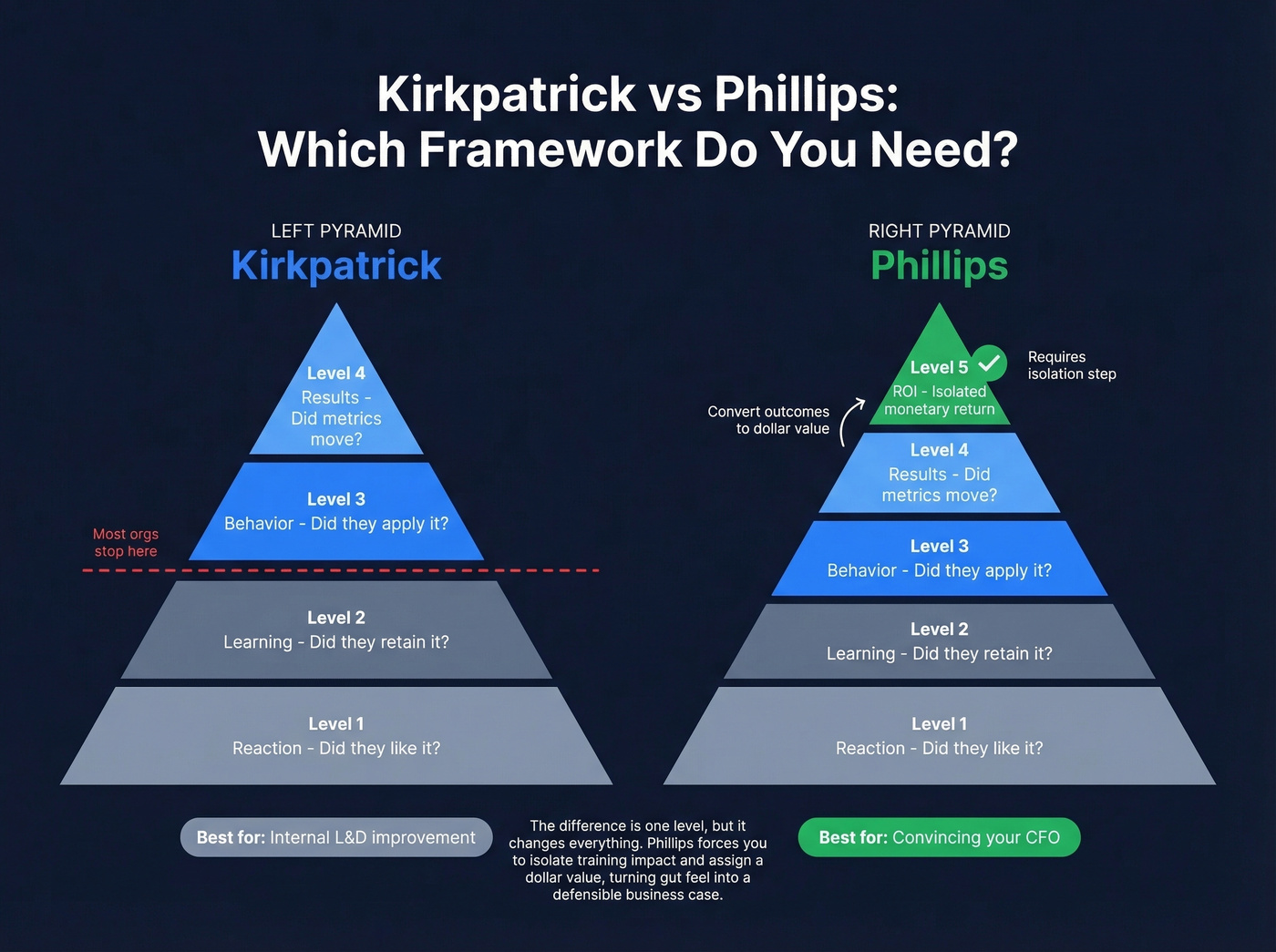
Phillips adds a fifth level - ROI - that forces you to isolate training's impact and convert outcomes to monetary value before calculating a return. That isolation step is exactly what separates "we think training helped" from "training generated $210K in incremental revenue at a 320% return."
| Kirkpatrick | Phillips | |
|---|---|---|
| Levels | 4 (Reaction through Results) | 5 (adds ROI) |
| Isolation step | No | Yes - required |
| Best for | Internal L&D improvement | Budget justification to finance |
If you're building a case for your CFO, Phillips is the framework. Kirkpatrick is for your L&D team's internal improvement cycle.
Why Most Programs Fail After 120 Days
Here's the uncomfortable truth: 85-90% of sales training has no lasting impact after 120 days. Up to 80% of new skills are lost within one week without reinforcement. If your ROI numbers look bad, the problem probably isn't measurement - it's design.
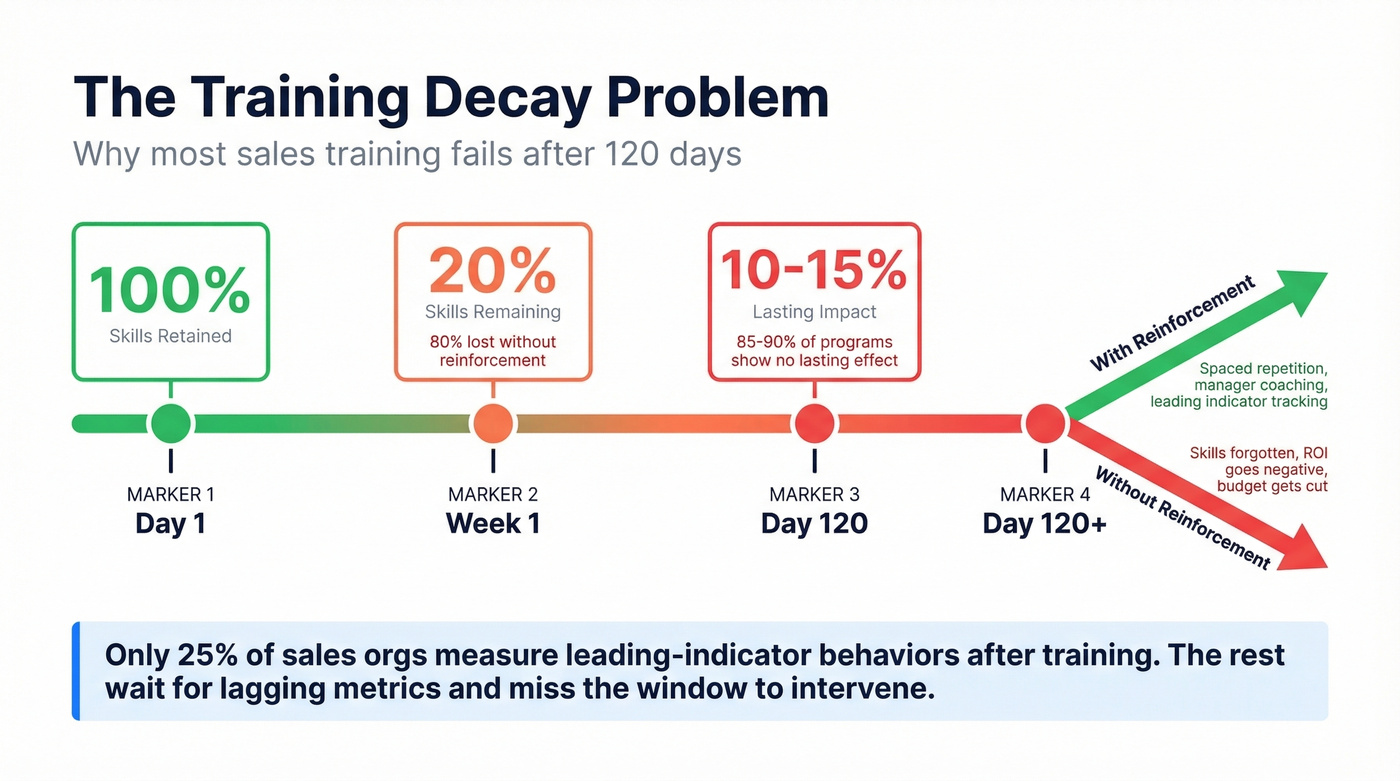
Only 25% of sales organizations directly measure leading-indicator behaviors after training. The rest wait for lagging metrics like quota attainment to move, and by the time those numbers show up (or don't), nobody remembers what caused what. The consensus on r/sales is that the ROI question comes up "at least once a quarter" - and there's never a good answer ready.
We've seen this play out dozens of times: leadership wants a quarterly ROI number but won't fund the analytics infrastructure to produce one. That's the real problem. It's solvable, but only if you treat reinforcement as part of the training investment, not an afterthought.
Hot take: If your average deal size is under $15K and your team is fewer than 10 reps, stop agonizing over precise ROI calculations. Track three leading indicators, run a simple before/after comparison, and spend the rest of your energy on reinforcement. The ROI math only justifies itself at scale.
How to Maximize Your Training ROI
The highest-ROI training programs share traits that have nothing to do with the content itself.
Manager Coaching Cadence
Weekly 1:1 coaching on the specific skills you trained is one of the fastest ways to make behavior change stick. Don't treat this as optional. Embed coaching into the program design from day one, with specific talk tracks and observation rubrics tied to the skills you just trained.
Spaced Repetition
Don't dump everything into a 2-day offsite. Spread learning across 30/60/90-day intervals with micro-reinforcements - short exercises, role plays, CRM-embedded prompts. In our experience, this is the single biggest lever for improving training effectiveness over time, and it's the one most teams skip because it feels less "eventful" than a big kickoff.
Leading Indicator Tracking
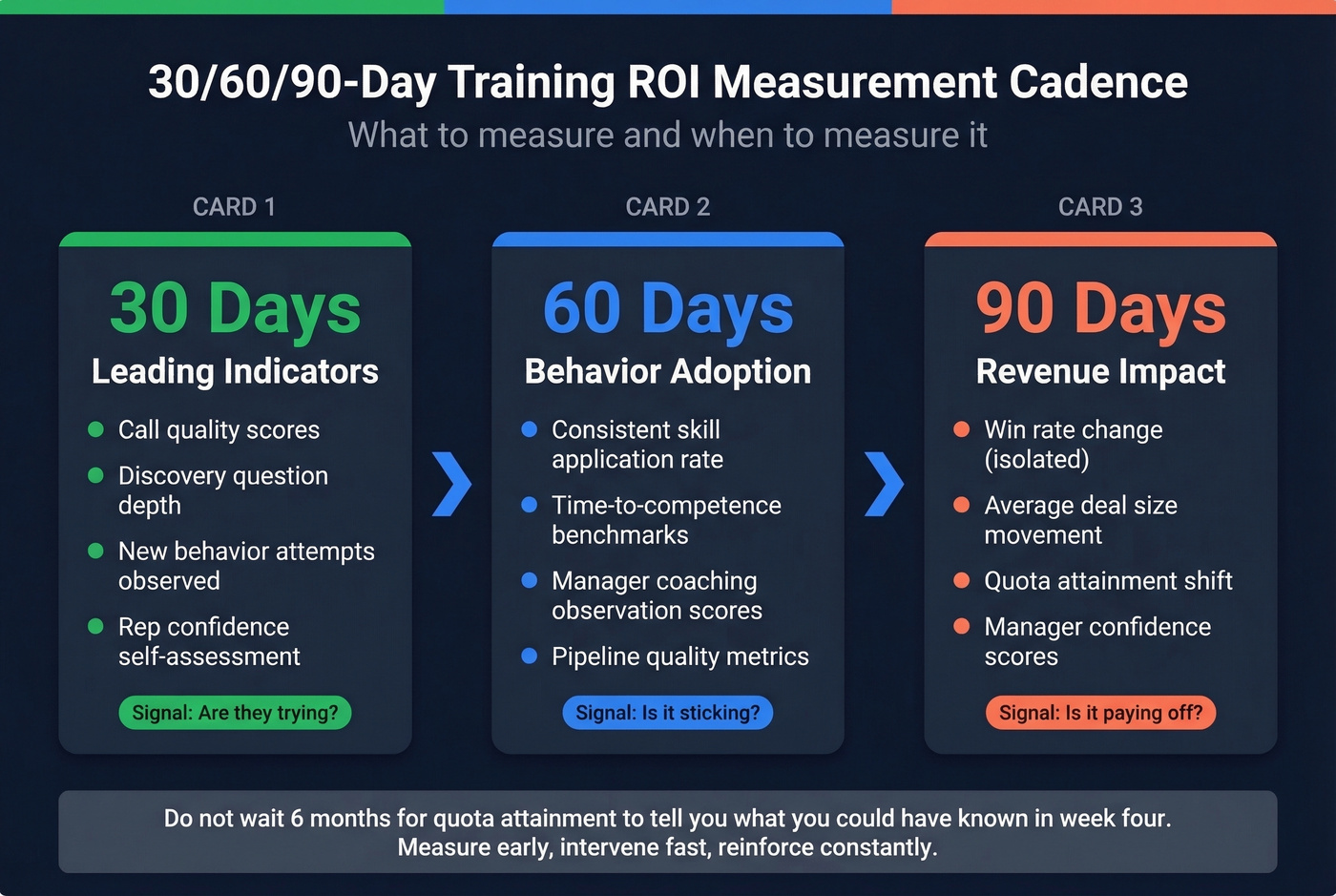
Build a 30/60/90-day measurement cadence. At 30 days, track call quality and discovery question depth. At 60 days, measure behavior adoption and time-to-competence. At 90 days, look at revenue impact and manager confidence scores. Don't wait 6 months for quota attainment to tell you what you could've known in week four.
Clean Contact Data
Look - you just invested $5,000-$6,000 per rep in better selling skills. If a chunk of their calls go to disconnected numbers or their emails bounce, that investment evaporates. We've watched teams celebrate a great training program while their reps burned hours dialing dead numbers. GreyScout cut bounce rates from 38% to under 4% after switching to Prospeo's verified data, and their pipeline jumped 140%. Skip this step if your CRM data is already clean and verified within the last 30 days, but for most teams, it isn't.
You just proved training generates a 320% return. Now multiply it. Prospeo cuts new rep ramp time by giving every AE instant access to 300M+ verified contacts with 30+ filters - intent data, job changes, headcount growth. When trained reps connect with real decision-makers on day one, your ROI compounds.
Give your trained reps the data that turns skills into pipeline.
FAQ
What's a good ROI for sales training?
A realistic range is 100-500%. Accenture's 353% benchmark ($4.53 returned per dollar) is a useful midpoint, but programs without reinforcement often deliver negative returns after accounting for opportunity cost. Track leading indicators at 30 days to forecast where you'll land.
How long does it take to see ROI from sales training?
Leading indicators like call quality and discovery depth should shift within 30-60 days. Lagging indicators - win rate, quota attainment - typically take about 3 months to show up cleanly. Without reinforcement, impact often fades by day 120, which is why spaced repetition matters more than content quality.
How do you prove training ROI to leadership?
Use the Phillips ROI framework: isolate training's impact via control groups, participant attribution, or behavior-adjusted estimates, then convert outcomes to monetary value. Present a defensible range, not a single number. And make sure your data infrastructure supports clean before/after measurement - bad CRM data will muddy any comparison you try to make.