

The 30-60-90 Day Sales Plan: Data-Backed Templates That Actually Work
You just got the email. "Before your first day, we'd love to see your 30-60-90 day plan." So you start researching, open five tabs, and find the same recycled advice: "learn the product, build pipeline, close deals." Groundbreaking.
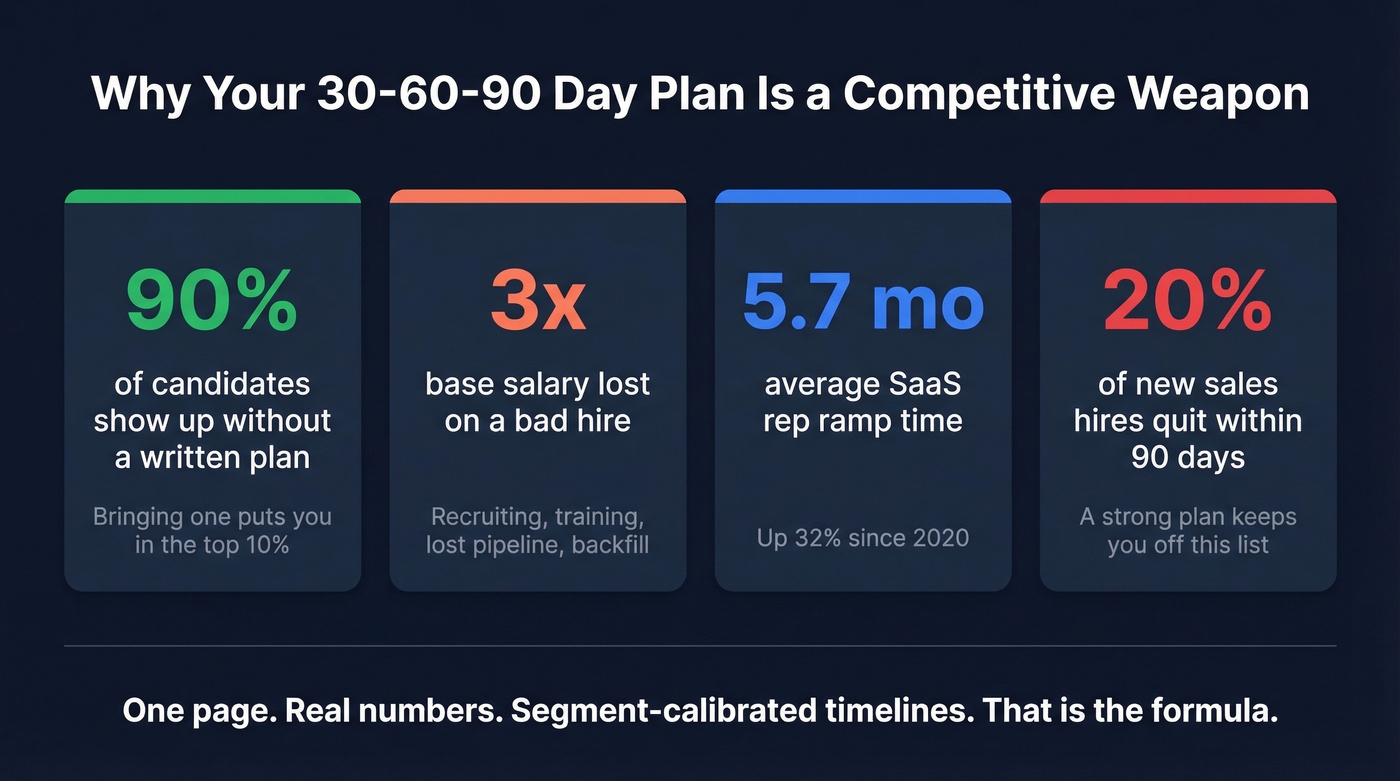
The average SaaS rep now takes 5.7 months to ramp - up 32% since 2020 - and 20% of new sales hires quit within their first 90 days. The cost of getting this wrong? Three times base salary in wasted ramp investment. A strong 30-60-90 day sales plan is the difference between ramping fast and washing out.
Here's the real filter: candidates who bring generic plans with no numbers get screened out fast. The bar is higher than most templates suggest, and your plan needs to be sharper than what's out there.
Quick Filter: What Every Plan Needs
If your plan doesn't have these three things, it's a wish list, not a strategy:
- Role-specific metrics. "Build pipeline" isn't a goal. "5+ qualified opportunities with $150K total pipeline value by day 60" is.
- Segment-calibrated timelines. Enterprise deals take 6-18 months. Promising "close 5 deals by day 90" in that world is fiction.
- One-page format. If it doesn't fit on a single page, you don't understand your priorities. Hiring managers skim. Clarity beats volume every time.
What Is a 30-60-90 Day Sales Plan?
A 30-60-90 day sales plan is a structured three-month roadmap that breaks your ramp into three phases - typically Learn, Execute, and Own. It maps specific goals, activities, and metrics to each 30-day window so you and your manager can track progress against something concrete instead of vibes.
Four situations call for one: onboarding at a new company, presenting in a sales interview, taking over a new territory, or stepping into a promotion. The format stays the same. The metrics change based on role and segment.
Most plans online run three to 10 pages. That's a document nobody reads twice. The best version fits on one page with real numbers.
Ramp-Time Benchmarks
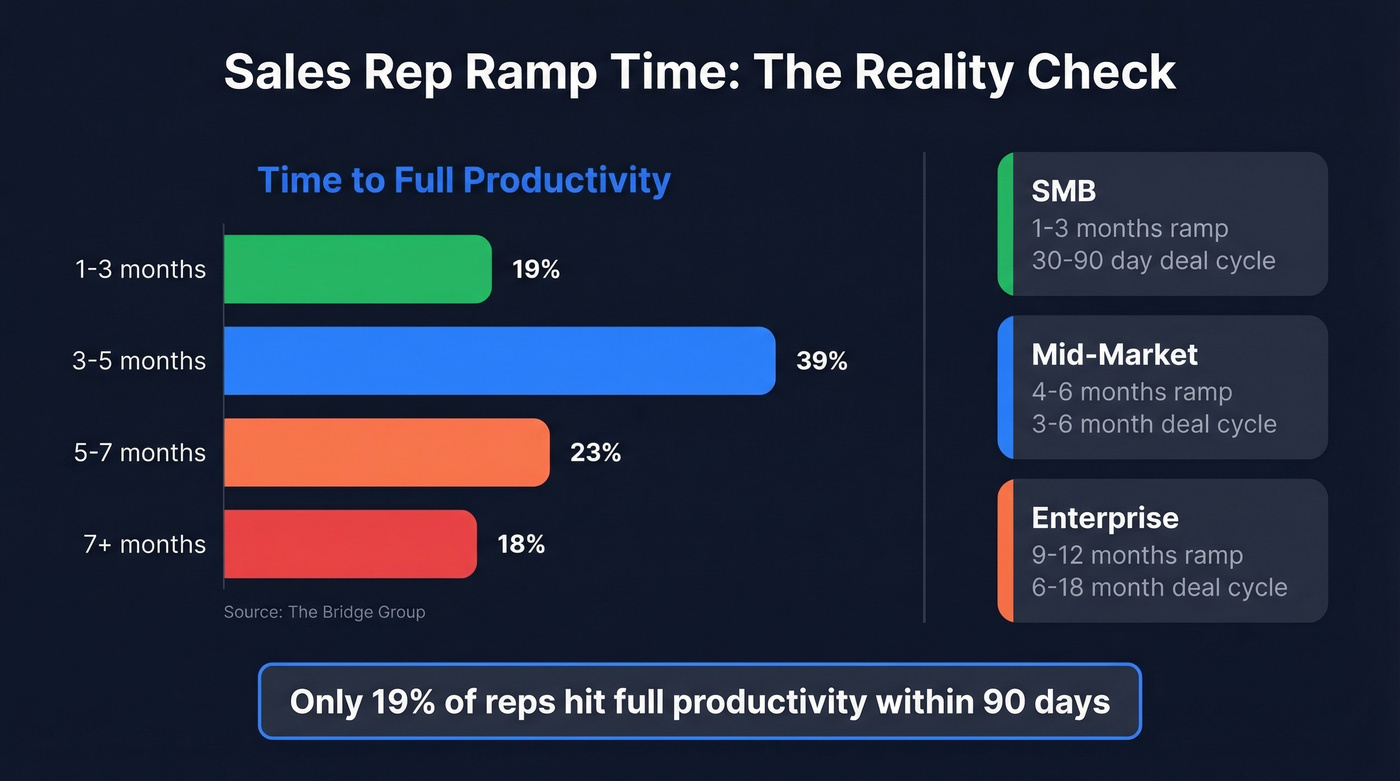
You can't set realistic 90-day goals without understanding how long ramp actually takes. The most recent distribution data from The Bridge Group shows ramp time breaking down like this:
| Time to Full Productivity | % of Reps |
|---|---|
| 1-3 months | 19% |
| 3-5 months | 39% |
| 5-7 months | 23% |
| 7+ months | 18% |
Only one in five reps hits full productivity within 90 days. That's the reality your plan needs to acknowledge. The segment you're selling into changes everything:
| Segment | Avg Ramp Time | Typical Deal Cycle |
|---|---|---|
| Enterprise B2B | 9-12 months | 6-18 months |
| Mid-market | 4-6 months | 3-6 months |
| SMB | 1-3 months | 30-90 days |
| SDR (any segment) | 3.2 months | N/A |
Let's be honest: for mid-market AEs, the 30-60-90 format is the most useful planning tool in sales. Enterprise and SMB reps should still build one, but they need to adjust expectations significantly - enterprise reps usually won't close anything in 90 days, and SMB reps may outgrow the plan by day 45. Mid-market is the sweet spot where 90 days actually maps to a full sales cycle.
The cost of a mis-hire runs 1.5-2x annual salary when you factor in recruiting, training, lost pipeline, and backfill. And 88% of companies admit their onboarding is subpar - which is exactly why a data-backed plan gives you an edge before day one.
How to Build Your Plan in Five Steps
Don't overthink this.
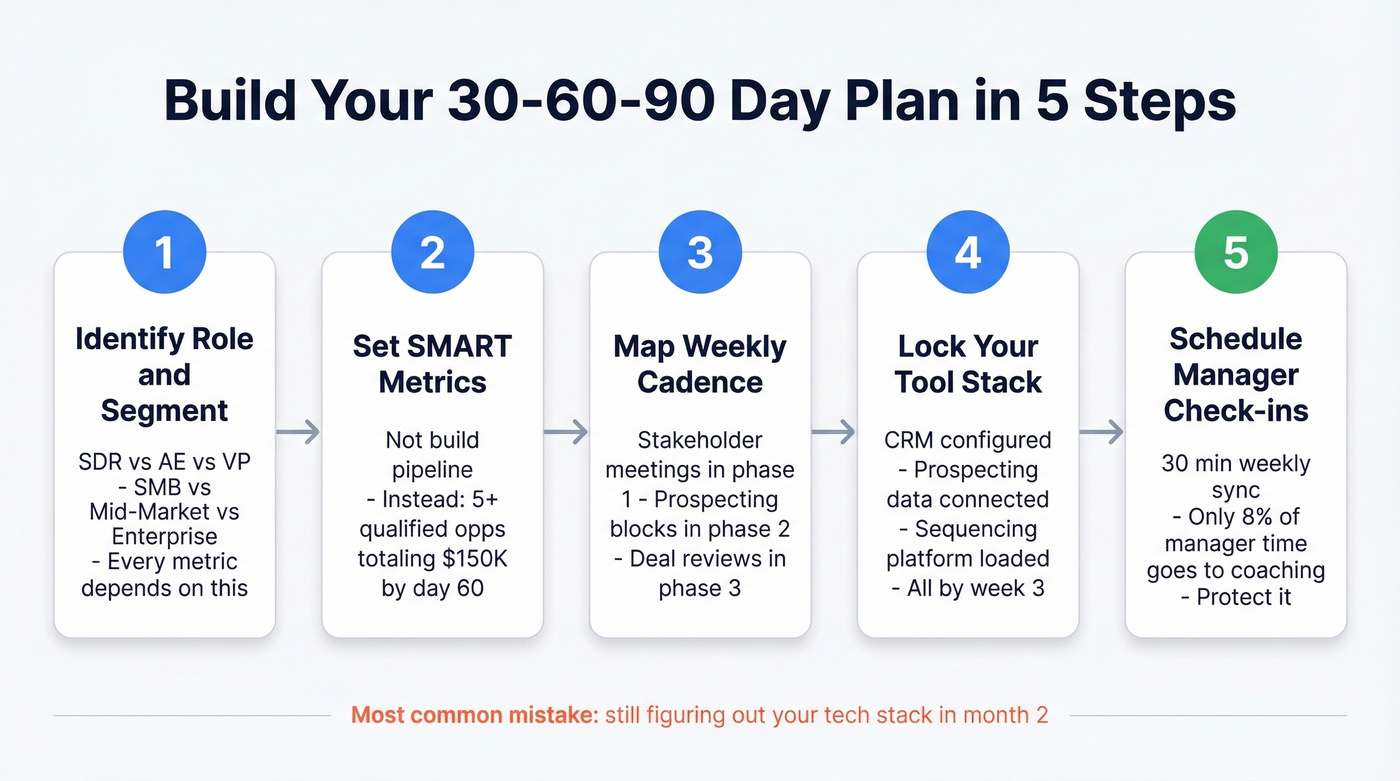
Step 1: Identify your role and segment. An SDR plan for SMB SaaS looks nothing like a VP of Sales plan for enterprise infrastructure. Start here because every metric downstream depends on it.
Step 2: Set phase-specific SMART metrics. Each 30-day block gets 3-5 measurable goals. Not "learn the product" - instead, "pass product knowledge assessment at 90%+ by day 30." Not "build pipeline" - instead, "5+ qualified opportunities totaling $150K by day 60."
Step 3: Map your weekly cadence. What does Monday look like in week 2 vs. week 8? Stakeholder meetings in phase one, prospecting blocks in phase two, deal reviews in phase three. Write it down.
Step 4: Build your tool stack by week 3. CRM configured, prospecting data source connected, sequencing platform loaded. If you're still figuring out your tech stack in month two, you've lost three weeks of productive outreach. We've seen this kill more ramp plans than any other single mistake.
Step 5: Schedule weekly manager check-ins. Less than 8% of a sales manager's time goes to coaching, per RAIN Group research. You need to protect that time on the calendar. A 30-minute weekly sync keeps your plan alive and your manager invested in your success.
One calibration note that most templates miss: enterprise deals involve 6-13 stakeholders and cycles stretching 6-18 months. SMB deals close in 30-90 days with 1-4 decision-makers. If your plan doesn't reflect this difference, you'll either sandbag or set yourself up to fail.
Phase-by-Phase Breakdown
Days 1-30: Learn
Use this phase to absorb everything. In our experience, reps who skip the ride-along phase in days 1-30 consistently underperform in month three. No shortcuts here.
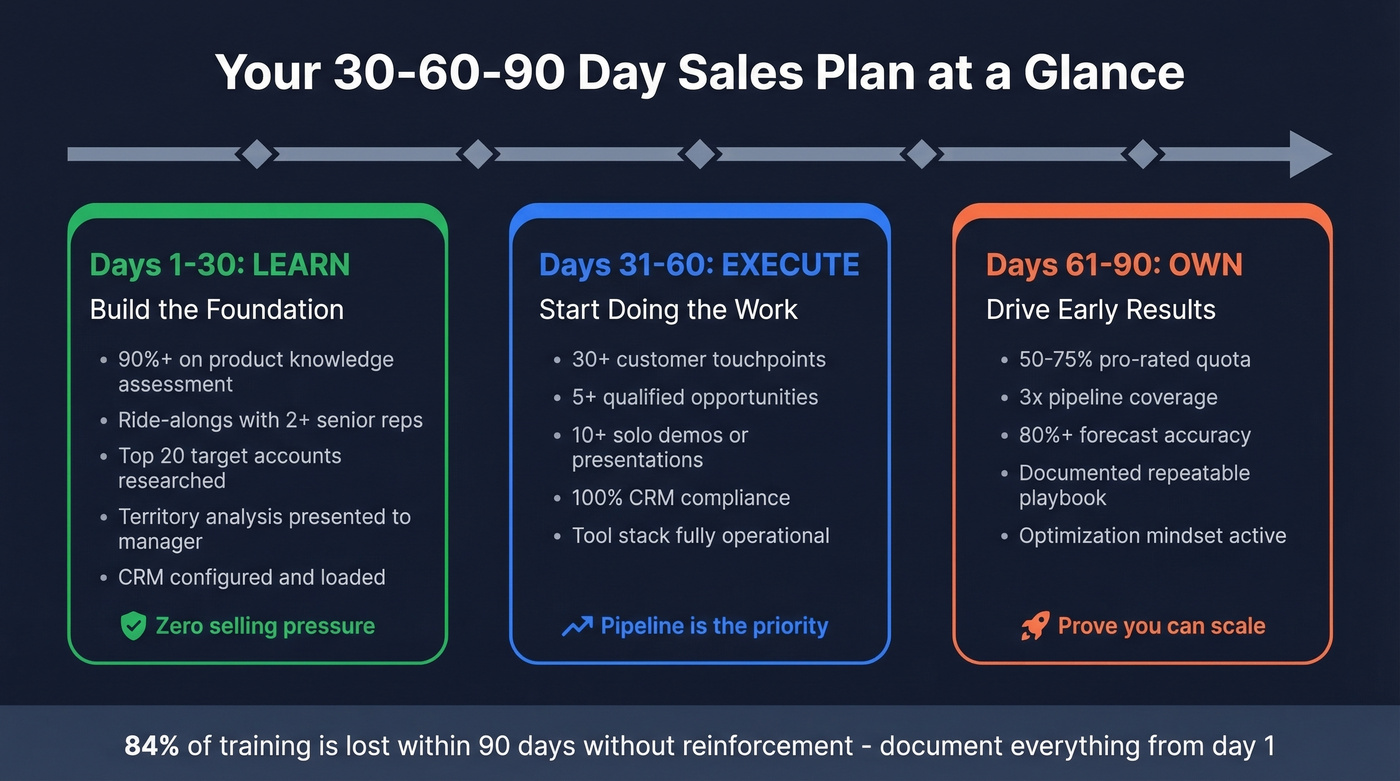
Your day-30 success metrics:
- Pass product knowledge assessment at 90%+
- Complete ride-alongs with at least 2 senior reps
- Get your CRM configured with territory accounts loaded
- Identify your top 20 target accounts with research complete
- Present your territory analysis to your manager
Weekly cadence during this phase is heavy on stakeholder meetings, training modules, and territory analysis. You're building the foundation. 84% of training knowledge is lost within three months without reinforcement - so document what you learn. Build a personal playbook from day one, not day 60.
Days 31-60: Execute
This is where the plan gets real. Your targets shift from learning to doing:
- 30+ customer touchpoints (visits for field reps, equivalent outreach volume for inside sales)
- 5+ qualified opportunities in pipeline
- 10+ solo demos or presentations
- 100% CRM compliance
Here's the thing - your tool stack matters most in this phase. Your CRM, prospecting data, and sequencing platform need to be humming by now. We've seen teams lose entire weeks to one preventable problem: bad prospect data. If 30% of your emails bounce on your first sequence, you've wasted a week of outreach and flagged your sending domain. It's the most avoidable ramp killer in sales, and the consensus on r/sales backs this up - domain reputation damage from bad data is one of the most common complaints from new reps running their first campaigns.
Prospeo handles this well - 300M+ professional profiles with 98% email accuracy means your first outreach campaign actually lands. GreyScout used it to cut rep ramp time from 8-10 weeks to 4 weeks while dropping bounce rates from 38% to under 4%.

Days 61-90: Own
Phase three is about ownership and early results. You're working toward a pro-rated quota - typically 50-75% of full quota in month three. Pipeline value should reach 3x your monthly target. Forecast accuracy should hit 80%+.
The optimization mindset kicks in here. What's working? Which sequences get replies? Which accounts are progressing? Double down on what converts and document your playbook. Your day-90 deliverable isn't just revenue - it's a repeatable process you can scale into months four through twelve.

Bad prospect data is the #1 ramp killer for new sales reps. GreyScout cut rep ramp time from 8-10 weeks to 4 weeks by switching to Prospeo's 300M+ verified profiles with 98% email accuracy. Your 30-60-90 day plan deserves data that won't torch your domain on day 31.
Don't let bounced emails destroy your first 90 days.
Role-Specific Plan Examples
SDR Plan
| Phase | Key Metrics |
|---|---|
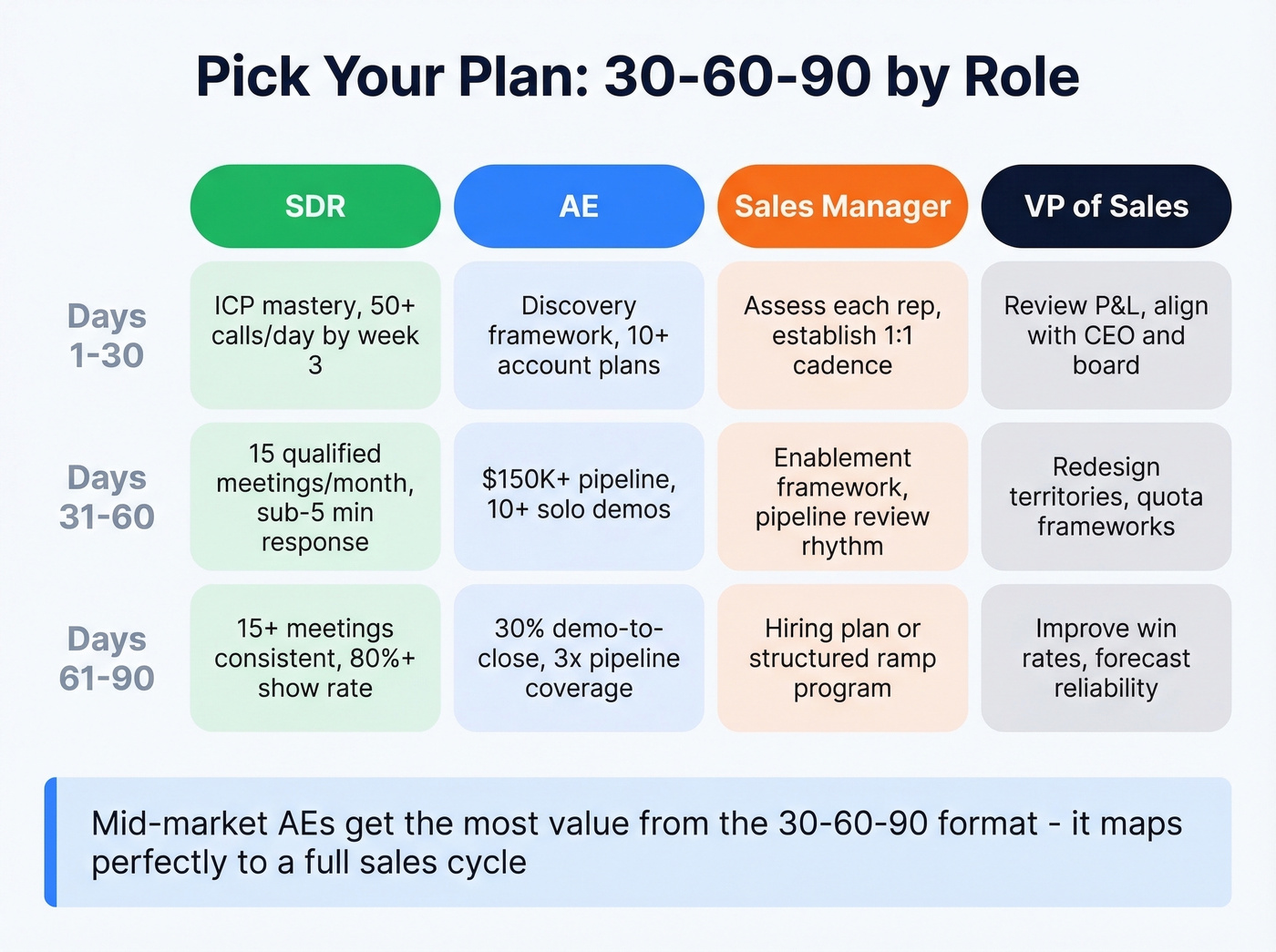
| Days 1-30 | ICP mastery, 50+ calls/day by week 3, CRM configured |
| Days 31-60 | 15 qualified meetings/month, lead response under 5 min |
| Days 61-90 | Consistent 15+ meetings, 80%+ show rate |
It takes over 7,000 activities to close a first deal for new sales hires. Your daily cadence needs to be aggressive - 50+ calls, 30+ emails, and social touches. Lead response time under 5 minutes is the benchmark that separates high-output SDRs from everyone else, and it forces the habit early.
AE Plan
| Phase | Key Metrics |
|---|---|
| Days 1-30 | Discovery framework mastered, 10+ account plans built, CRM pipeline views configured |
| Days 31-60 | $150K+ qualified pipeline, 10+ solo demos, multi-threading on top 5 accounts |
| Days 61-90 | 30% demo-to-close rate, 3x pipeline coverage, 2-3 deals in late-stage negotiation |
Skip the VP template if you're an AE - it'll confuse your hiring manager. Your plan should include specific discovery frameworks you'll use and how you'll multi-thread accounts. For mid-market, target an average sales cycle around 45 days. By day 90, you're working toward your pro-rated quota with clear evidence of deal progression.
Sales Manager Plan
Your first 30 days aren't about deals - they're about people.
- Assess each rep's strengths, pipeline health, and skill gaps
- Establish weekly 1:1 coaching cadence
- Set up bi-weekly pipeline reviews
- Audit current tech stack and data quality
- Identify top performer patterns to replicate
Less than 8% of a manager's time typically goes to coaching. Your plan should explicitly protect coaching hours on the calendar. By day 60, have an enablement framework in place. By day 90, you're either hiring to fill gaps or running a structured ramp program for existing reps.
VP of Sales Plan
A VP plan looks nothing like an IC plan. The 90 days break down into three distinct modes of operation, each building on the last.
Days 1-30 - Diagnose: Review P&L, budget, and forecasts. Align with CEO, CFO, and the board on what "good" looks like. Assess team composition and identify gaps. This phase is all listening and data gathering - resist the urge to change anything yet.
Days 31-60 - Architect: Redesign territory models, quota-setting frameworks, and governance for deal reviews and forecasting. Build the operating rhythm that'll carry the org through the next four quarters.
Days 61-90 - Launch: Execute initiatives to improve pipeline accuracy, win rates, and forecast reliability. HBR research suggests impactful onboarding reduces time to full performance by a third - from 6 months down to 4.
For VP interviews, your plan should read like a strategic diagnostic, not a prospecting playbook. The hiring committee wants systems thinking, not activity metrics.
Presenting Your Plan in an Interview
90% of candidates don't bring a written plan to their sales interview. That's your edge. Print a one-page plan and hand it across the table.
When you don't have internal data - and you won't - use industry benchmarks. State explicitly that you'll refine the plan once onboarded with real company metrics. This shows self-awareness, not weakness.
Structure your presentation like this: company research and market context, your diagnosis of the opportunity, three-phase plan with specific metrics, then questions for the hiring manager. Keep it to four slides max if you're presenting, or a single printed page if you're handing it over.
Look, the single biggest mistake I see in interview plans is promising closed revenue in an enterprise role. If the territory covers 200+ square miles, don't promise 25 in-person meetings per week either. Windshield time is real. Target 8-10 high-quality meetings instead. Hiring managers respect realism more than ambition that can't survive contact with a calendar.
Using AI to Accelerate Ramp in 2026
AI isn't a nice-to-have in your ramp plan anymore - it's a force multiplier. As of 2025, 56% of sales professionals use AI daily, and sellers who partner effectively with AI are 3.7x more likely to meet quota. HubSpot tracked AI adoption jumping from 24% in 2023 to 43% in 2024, and the trajectory hasn't slowed.
AI-human hybrid systems are cutting ramp time by roughly 30%, from 5.8 months down to 4.0 months.
Build AI milestones into each phase:
Phase 1: AI roleplay for product knowledge and objection handling. Simulate discovery calls before you're on real ones - it's the fastest way to internalize your talk track without burning live prospects.
Phase 2: AI-assisted email personalization and prospect research. Let AI draft first versions of outreach while you refine messaging based on what you're learning from real conversations.
Phase 3: AI forecasting and deal scoring. By day 60+, you should be using AI-powered pipeline analytics to prioritize deals and improve forecast accuracy.
If you're building this into your workflow, start with a simple system: AI-assisted email personalization, then add AI sales follow-ups once your sequences are stable.
Mistakes That Kill Plans
Generic goals with no numbers. "Build pipeline" isn't a goal. "5+ qualified opps totaling $150K" is. If you can't measure it, it doesn't belong in your plan.
Ignoring deal cycle length. An enterprise AE promising closed revenue by day 90 is writing fiction. Calibrate to your segment or you'll lose credibility with your manager by week six.
Starting outreach with unverified data. High bounce rates damage your sender reputation, and it takes weeks to recover. Verify every email before you send. Prospeo's free tier handles this with 75 verified emails per month - enough to validate your first target list without risking your domain. (If you need to go deeper on deliverability, use an email deliverability guide and track your email bounce rate.)
No weekly check-in cadence. Plans without accountability mechanisms die by week three. Schedule the syncs before day one.
Writing a 10-page document nobody reads. One page. Real metrics. That's it.
Your day 31-60 execution phase lives or dies on tool stack readiness. Prospeo gives you 30+ search filters, verified emails at $0.01 each, and a 7-day data refresh cycle - so your first sequences hit real inboxes, not spam traps. Snyk's 50 AEs cut bounce rates from 35% to under 5% and grew AE-sourced pipeline 180%.
Hit your 90-day pipeline targets with data that actually connects.
FAQ
How long should a 30-60-90 day sales plan be?
One page with specific, measurable metrics for each phase. Hiring managers skim - a single page with real numbers communicates more competence than a 10-page document ever will. If it doesn't fit on one page, you haven't prioritized.
What if I'm selling enterprise and can't close deals in 90 days?
Shift your phase-three goals to qualified pipeline value and multi-threaded opportunities instead of closed revenue. Target 3x pipeline coverage by day 90 and measure relationship depth, stakeholder mapping, and deal progression through stages.
How do I write a plan for a sales interview without internal data?
Use industry benchmarks from this guide and state you'll recalibrate with real company metrics once onboarded. Print a one-page plan, hand it across the table, and structure it as: market context, opportunity diagnosis, three-phase metrics, then questions for the hiring manager.
What tools should new reps set up in their first 90 days?
Three essentials by week three: a CRM (HubSpot or Salesforce), a prospecting data tool for verified emails and direct dials, and a sequencing platform like Outreach, Salesloft, or Instantly. Getting clean data from day one prevents the bounce-rate disasters that derail so many ramp plans.
How often should I update my 30-60-90 day sales plan?
Weekly. Treat it as a living document, not a static PDF you submit once and forget. Weekly updates during your manager check-in force you to confront what's working, adjust targets, and maintain accountability through all three phases.