

Saleshandy vs VerifiedEmail: Which Verifier Actually Delivers?
You exported 5,000 leads from Saleshandy, ran them through the built-in verifier, and still hit a 7% bounce rate. That's 350 hard bounces - enough to tank your domain reputation in a week. Now you're weighing whether a standalone verifier like VerifiedEmail would've caught what the bundled one missed.
Here's the thing: these two tools solve fundamentally different problems. Comparing them head-to-head is like comparing a Swiss Army knife to a scalpel.
30-Second Verdict
Saleshandy if you already use it for cold email and verify small batches - verification is baked into the workflow, but credits don't renew monthly.
VerifiedEmail if you need a dedicated, high-throughput verification API with enterprise security - fast and SOC 2 Type 2 certified, but there are no public G2/Capterra reviews and no published pricing.
What Each Tool Does
Saleshandy at a Glance
Saleshandy is a cold email outreach platform first, email verifier second. The verification feature runs 24 validation checks per email, catching invalid addresses, catch-all domains, role-based emails, and disposable inboxes. Results get labeled as Deliverable, Undeliverable, Accept-All, Role-Based, Disposable, or Unknown - and you don't get charged for unknowns.
Smart Verification skips re-checking any prospect verified within the last 15 days, saving credits. That matters because credits are one-time allotments, not monthly refreshes. We've seen teams burn through Saleshandy's starter credits in a single import of 1,200 contacts, then scramble to figure out what overage pricing even looks like.
VerifiedEmail at a Glance
VerifiedEmail is a standalone verification specialist headquartered in Los Angeles. The team says the product was built internally first to solve their own deliverability problems, led by a CTO who was behind one of the largest free email services.
It runs syntax, domain, mailbox, spam-trap, disposable email, and known-abuse checks, with "human verification built in" for real-time requests. The performance specs stand out: up to 100,000 addresses per minute, roughly 100ms API response time, and SOC 2 Type 2 certification with AES-256 encryption plus SSL/TLS in transit. Data gets auto-deleted after 60 days.
The catch? No public user reviews anywhere, and paid pricing isn't published.
Feature-by-Feature Comparison
| Feature | Saleshandy | VerifiedEmail | Winner |
|---|---|---|---|
| Accuracy claim | 98% | 99% | VerifiedEmail (on paper) |
| Speed | 100K in 45 min | 100K/min | VerifiedEmail (45x faster) |
| Checks | 24 validation checks | Syntax, domain, mailbox, spam-trap, disposable, abuse | Saleshandy (24 checks explicitly listed) |
| Result labels | 6 categories | Valid/Invalid | Saleshandy |
| Free tier | 50 credits/month | 200 credits | VerifiedEmail |
| Unknowns charged? | No | Not specified | Saleshandy |
| API / Integrations | In-platform + native outreach | REST API (~100ms) | Depends on stack |
| Security | Standard | SOC 2 Type 2, AES-256, SSL/TLS, GDPR | VerifiedEmail |
| Outreach built in | Yes | No | Saleshandy |
| Public reviews | Available on G2/Capterra | None found | Saleshandy |
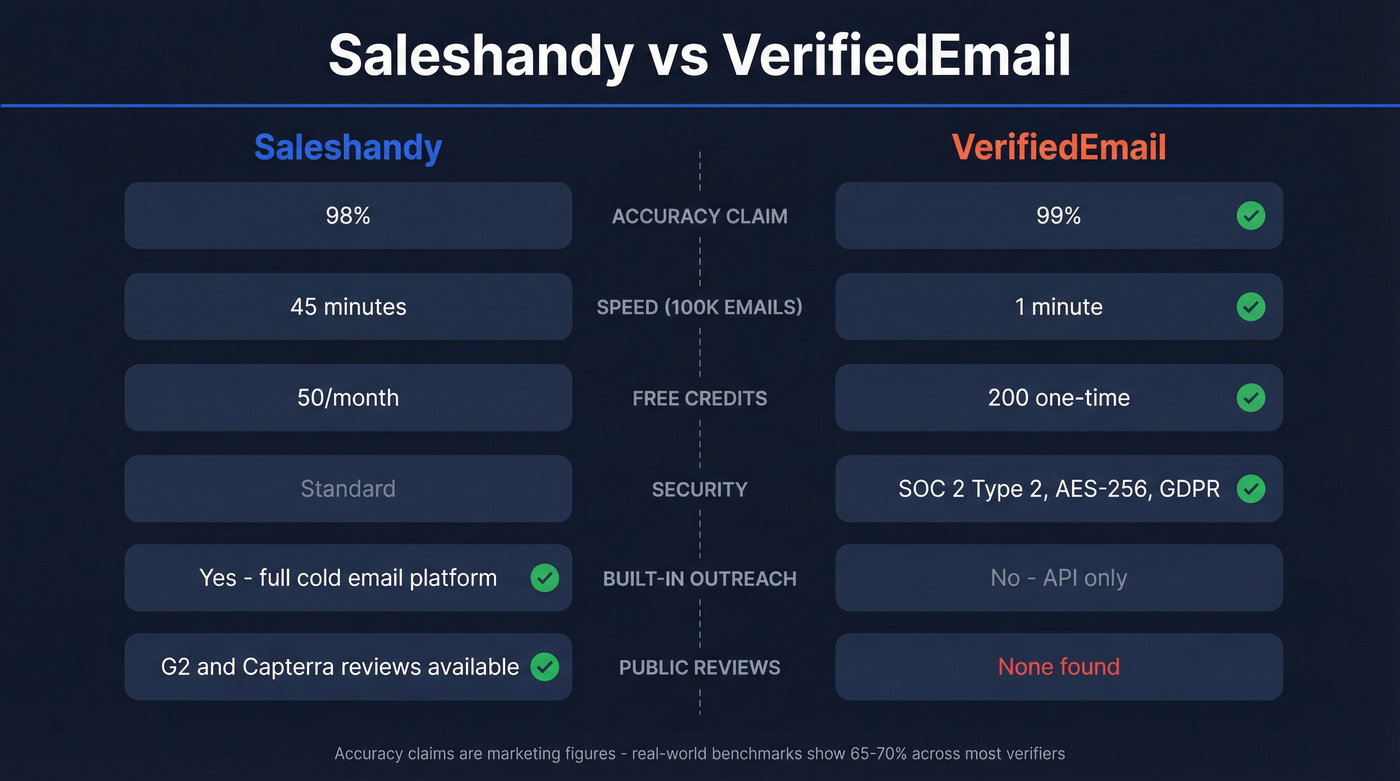
VerifiedEmail wins on raw verification specs - dramatically faster at bulk processing with stronger security certifications. Saleshandy wins on convenience and ecosystem. In our experience, the deciding factor is whether you need list cleaning as a standalone service or as part of an outreach workflow.

Saleshandy's bundled verifier misses catch-all domains. VerifiedEmail won't show you pricing. Meanwhile, Prospeo's 5-step verification handles catch-alls, spam traps, and honeypots before you ever export - 143M+ emails at 98% accuracy, refreshed every 7 days.
Stop paying twice to find and then verify the same email.
Pricing Breakdown
| Saleshandy Starter | Saleshandy Pro | Saleshandy Scale | VerifiedEmail | |
|---|---|---|---|---|
| Monthly | $36/mo | $99/mo | $199/mo | Not public |
| Annual | $25/mo | $69/mo | $139/mo | Not public |
| Credits | 1,000 (one-time) | 5,000 (one-time) | 10,000 (one-time) | 200 free; paid TBD |
| Overage | ~$0.003-0.005/ea | ~$0.003-0.005/ea | ~$0.003-0.005/ea | Est. $7-10/1K |
The critical detail with Saleshandy: verification credits are one-time. They don't renew monthly. Once you burn through your 1,000 Starter credits, you're buying overages - and third-party pricing breakdowns peg those extra credits at roughly $0.003-0.005 per verification. For a team verifying 10K+ emails monthly, that adds up fast on top of the subscription.
VerifiedEmail's pricing opacity is genuinely frustrating. They offer 200 free credits and say they'll beat competitors for lists over 1M addresses. Based on common market pricing where tools like Bouncer run around $7/1,000 and NeverBounce around $8/1,000, expect VerifiedEmail to land in that $7-10 per 1,000 range. If a tool won't show you what it costs in 2026, that's a negotiation tactic, not a feature.
Accuracy: Marketing Claims vs. Reality
Every verifier markets 98-99% accuracy. Real-world numbers tell a different story.
Hunter published a benchmark of 15 verifiers against roughly 3,000 real business emails, and the top accuracy scores landed around 65-70% when unknowns and accept-all results count against the score. That's a massive gap from the 98-99% on marketing pages.
On Reddit, a detailed Saleshandy review flagged that verification "constantly missed catch-all and invalid emails," leading to bounces that damaged sender reputation. The broader cold email community echoes this - multiple threads mention switching away from bundled verifiers to dedicated tools or platforms with pre-verified data. In our testing, catch-all domains remain the Achilles heel of most bundled verifiers.
VerifiedEmail has no public user reviews to validate or challenge its 99% number. Take both marketing figures with heavy context.
The Bounce Rate Math Nobody Does
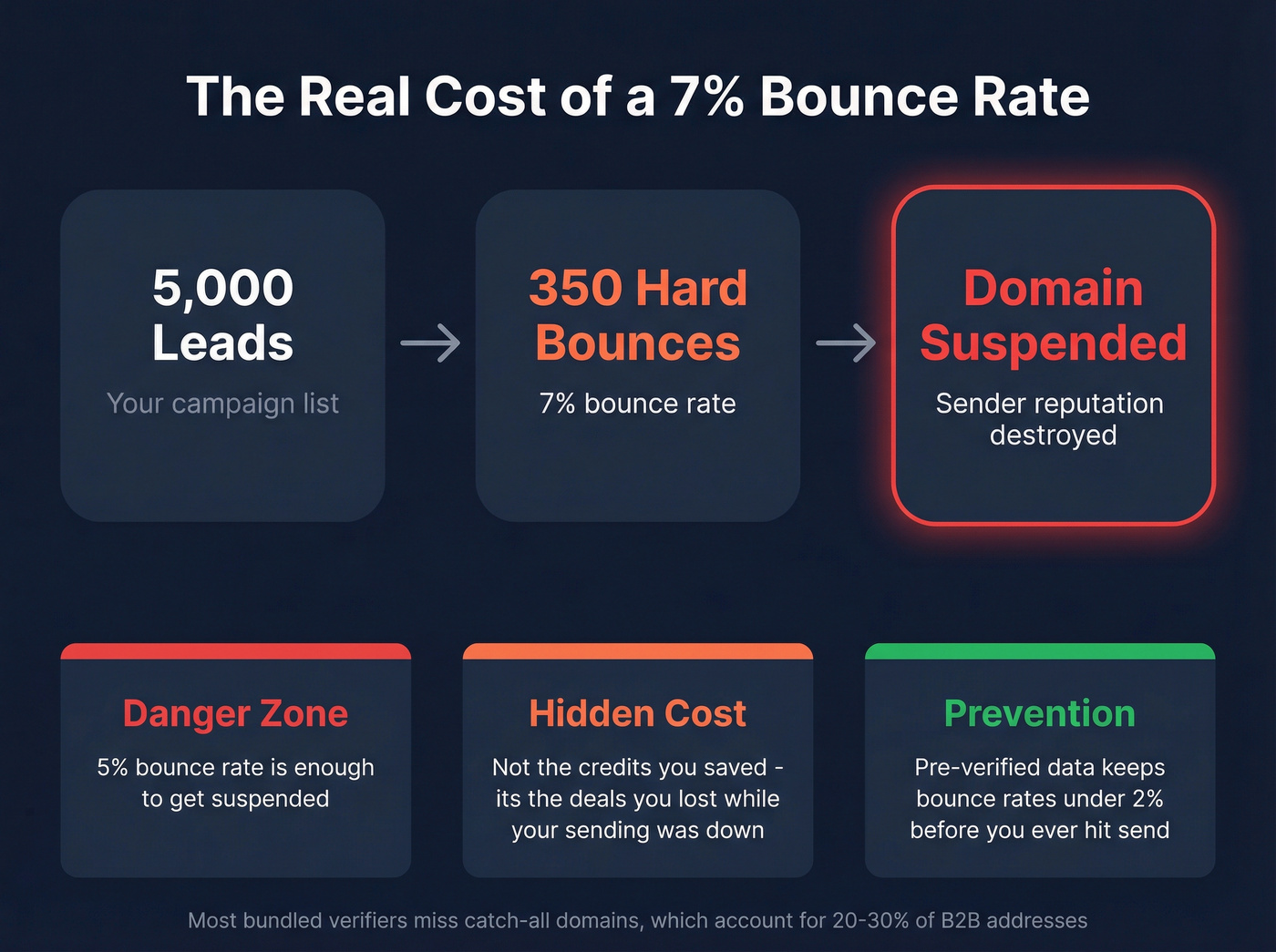
Let's break down what a 7% bounce rate actually costs. On a 5,000-lead campaign, that's 350 hard bounces. A 5% bounce rate can be enough to get a sender account suspended - so you're already past the danger zone after your first send. The cost isn't the verification credits you saved. It's the deals you didn't close while your sending infrastructure was on fire.
When to Choose Each
Choose Saleshandy if you already run cold email sequences there and want verification inside the same workflow. Just know the email hygiene quality has documented gaps with catch-all domains.
Choose VerifiedEmail if you need a standalone API verifier with high throughput and enterprise security. The specs look strong for dev teams integrating verification into custom workflows. Accept the risk of no public user reviews and opaque pricing.
Skip both if you're tired of the find-then-verify workflow entirely.
Ditch the Two-Tool Workflow
You shouldn't need a separate email verifier in 2026. Instead of finding contacts in one tool and cleaning them in another, Prospeo delivers 143M+ pre-verified B2B emails at 98% accuracy. The 7-day data refresh cycle means you aren't cleaning stale lists - the data stays fresh automatically. A 5-step verification process handles catch-all domains, spam traps, and honeypot filtering before you ever export a contact.
If you're evaluating other options in the same category, start with our breakdown of email verification tools and the broader outbound lead generation tools stack.
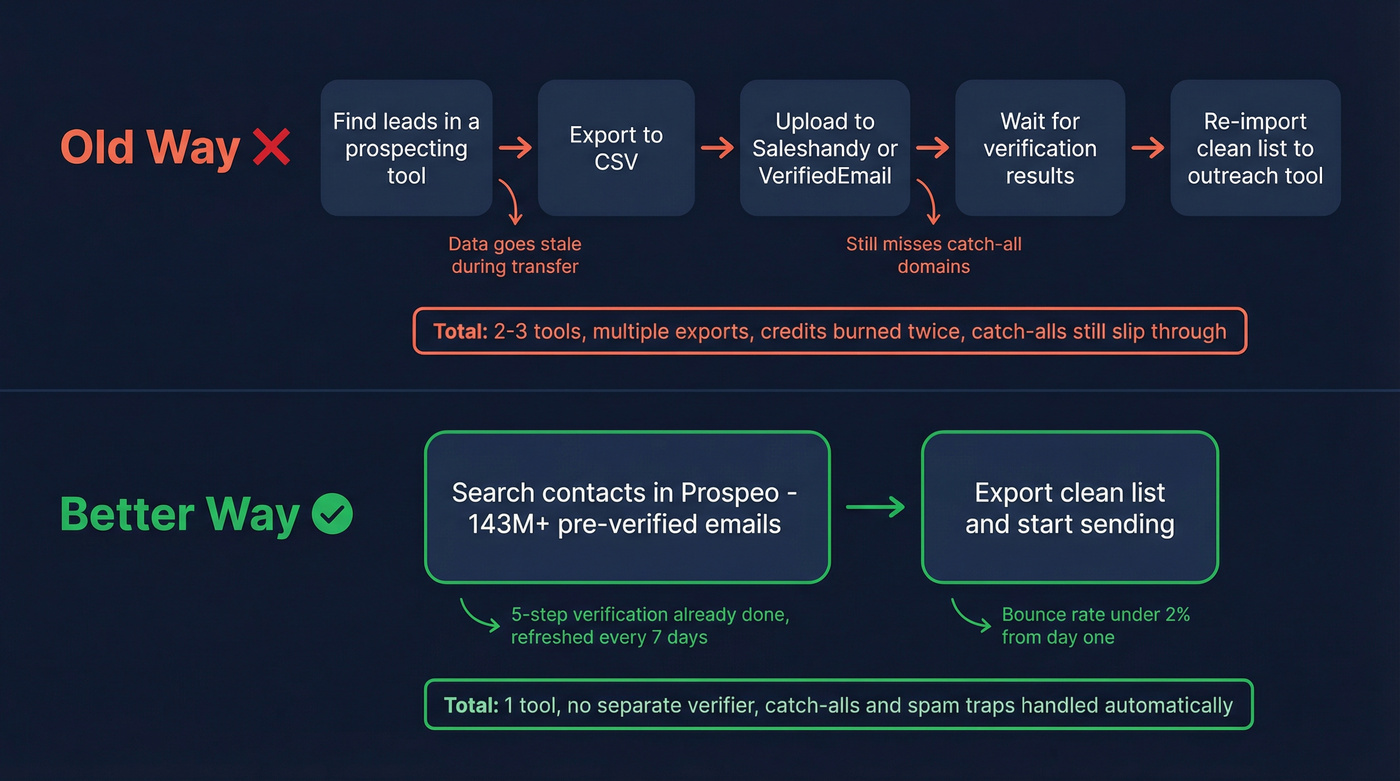
For context, teams like Snyk cut their bounce rate from 35-40% down to under 5% after switching to pre-verified data - and saw AE-sourced pipeline jump 180%. That's the difference between verifying after the fact and starting with clean data. The free tier gives you 75 emails plus 100 Chrome extension credits per month, and paid plans run about $0.01 per email with no contracts.
If you're trying to protect deliverability at scale, pair clean data with a real email deliverability guide and ongoing sender reputation work.

Snyk's 50 AEs dropped their bounce rate from 35-40% to under 5% with Prospeo's pre-verified data - no standalone verifier needed. At $0.01 per email, you spend less than Saleshandy overages and skip VerifiedEmail's hidden pricing entirely.
Ditch the two-tool workflow and start with clean data.
FAQ
Is Saleshandy's built-in verifier good enough for cold outreach?
For lists under 1,000 contacts, it's serviceable. At serious outbound volume, users consistently flag catch-all misses that cause bounces and hurt sender reputation. Supplement with a dedicated verifier or switch to a platform that delivers pre-verified data with catch-all handling built in.
Does VerifiedEmail publish pricing?
No. They offer 200 free credits and promise competitive rates for lists over 1M addresses. Based on market benchmarks, expect roughly $7-10 per 1,000 verifications. You'll need to contact their sales team for exact numbers.
Which tool is better for bulk verification?
VerifiedEmail wins on speed (100K/min vs. 45 min for the same volume) and security certifications. Saleshandy wins if you need outreach tools bundled in. For teams doing 10K+ verifications monthly, a dedicated verifier or a pre-verified data platform will outperform either option on both accuracy and total cost.