

Sandler Pain Funnel Questions That Actually Close Deals
It's Tuesday morning. You're 12 minutes into a discovery call with a VP of Sales who's clearly distracted - checking Slack, giving you one-word answers. You know the Sandler pain funnel questions. You've memorized all eight. But knowing the questions and actually moving a guarded executive from surface complaints to real, emotional pain on a live call? Completely different skill. We've coached dozens of teams through this exact gap, and the pattern is always the same: the theory clicks in training, then evaporates under pressure.
The 8 Questions (Quick Reference)
- "Tell me more about that." - Opens the thread.
- "Can you give me an example?" - Forces specificity.
- "How long has that been a problem?" - Establishes duration.
- "What have you tried to do about it?" - Reveals failed solutions.
- "Did that work?" - Exposes frustration.
- "How much do you think that's cost you?" - Quantifies the damage.
- "How do you feel about that?" - Shifts to personal/emotional.
- "Have you given up trying to deal with this?" - Tests commitment and urgency.
Below: how to deliver them without sounding scripted, the data proving they work, industry scripts, and what to do with the pain data after the call.
What Is the Sandler Pain Funnel?
David Sandler developed this framework in the late 1960s as part of the 7-stage Sandler Selling System. The pain funnel sits within the "Pain" stage - the third step - and it's the engine that makes everything else work.
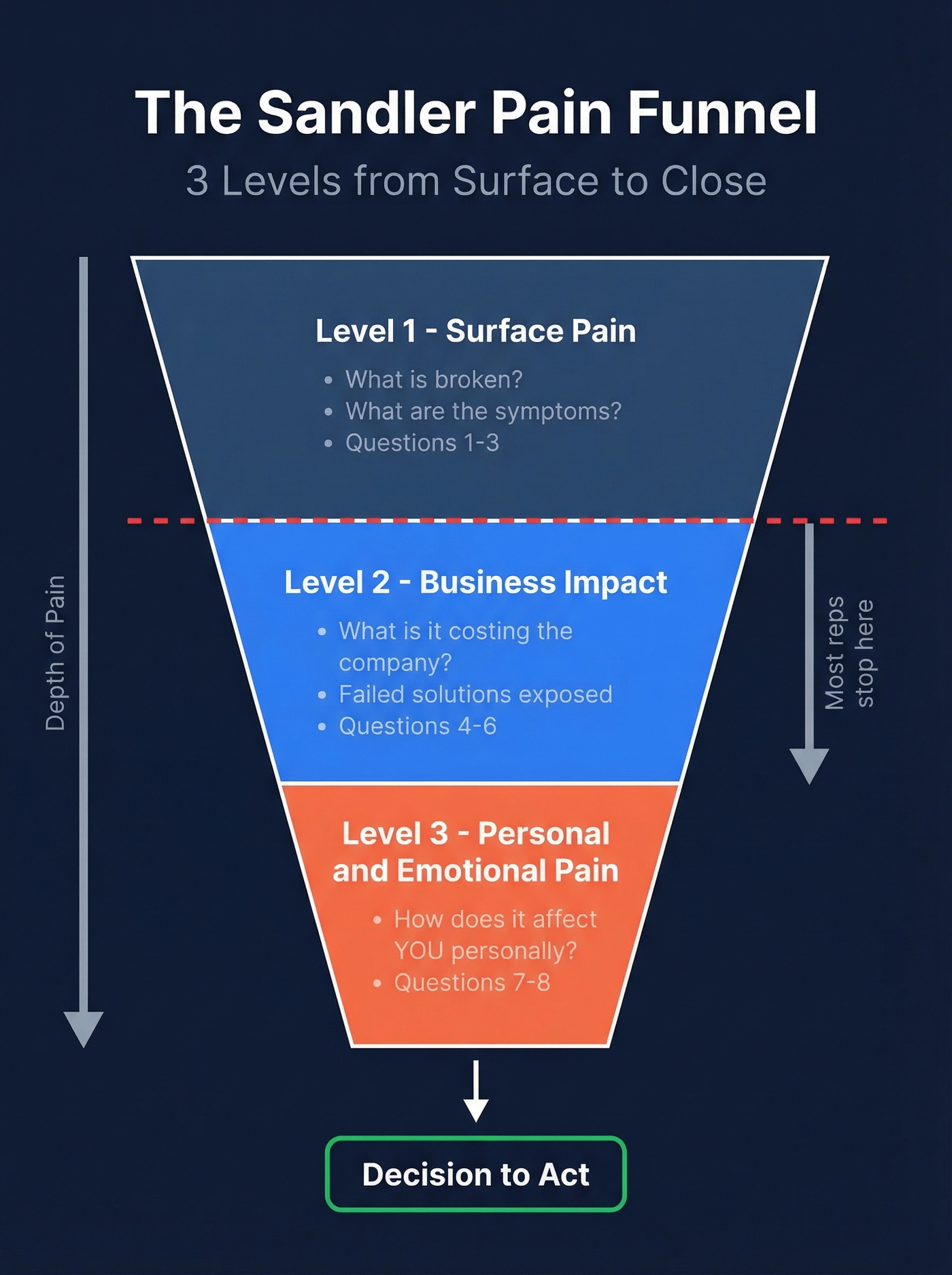
Think of it as three levels that narrow from broad to deep:
- Level 1 - Surface Pain: What's broken? What's the symptom?
- Level 2 - Business Impact: What's it costing the company?
- Level 3 - Personal/Emotional Pain: How does it affect you?
Most reps never get past Level 1. An SDR logs "prospect has pain around reporting" in the CRM. That's not pain. That's a topic. Real pain sounds like a VP admitting she spends weekends rebuilding forecasts because her team's pipeline data is garbage - and her board meeting is Thursday. The funnel's job is to get from "reporting" to "weekends and board pressure."
Delivering the 8 Questions (With Tips)
Sandler's own guidance is clear: the sequence matters more than the exact wording. Adapt the language to your voice, but don't rearrange the order.
Surface Pain (Questions 1-3)
| # | Question | Purpose | Delivery Tip |
|---|---|---|---|
| 1 | "Tell me more about that." | Opens the pain thread | Use after any complaint |
| 2 | "Can you give me an example?" | Forces specificity | Examples reveal truth |
| 3 | "How long has this been a problem?" | Establishes duration | Longer = more urgency |
These three feel safe. That's the point - they build rapport before you push deeper.
Business Impact (Questions 4-6)
This is where reps get uncomfortable and where deals get real.
| # | Question | Purpose | Delivery Tip |
|---|---|---|---|
| 4 | "What have you tried to do about it?" | Reveals failed solutions | Listen for frustration |
| 5 | "Did that work?" | Exposes the gap | Answer is almost always "no" |
| 6 | "How much do you think that's cost you?" | Quantifies damage in dollars | Let them estimate - their number beats yours |
Question 6 is the hinge of the entire funnel. When a prospect puts their own dollar figure on a problem, they've just built half your business case for you. Don't rush past it. Let the number hang in the air for a beat, then move to the emotional layer where the real buying motivation lives.
Personal/Emotional Pain (Questions 7-8)
Most reps skip these because they feel awkward. That's exactly why they work.
| # | Question | Purpose | Delivery Tip |
|---|---|---|---|
| 7 | "How do you feel about that?" | Shifts to personal stakes | Pause after - silence is your friend |
| 8 | "Have you given up trying to deal with this?" | Tests commitment | If they haven't given up, they're ready to act |
A common alternate phrasing for the final step is an impact question like: "What kind of impact does this have on you personally?" Same destination: getting the prospect to connect the problem to real stakes.
Some trainers expand this to 10 questions with extra prompts around impact and commitment. Both versions follow the same three-level structure, so pick whichever fits your selling style and commit to the sequence.
The Data Behind the Funnel
Stop memorizing the 8 questions. Start memorizing the 3 levels. Here's why.
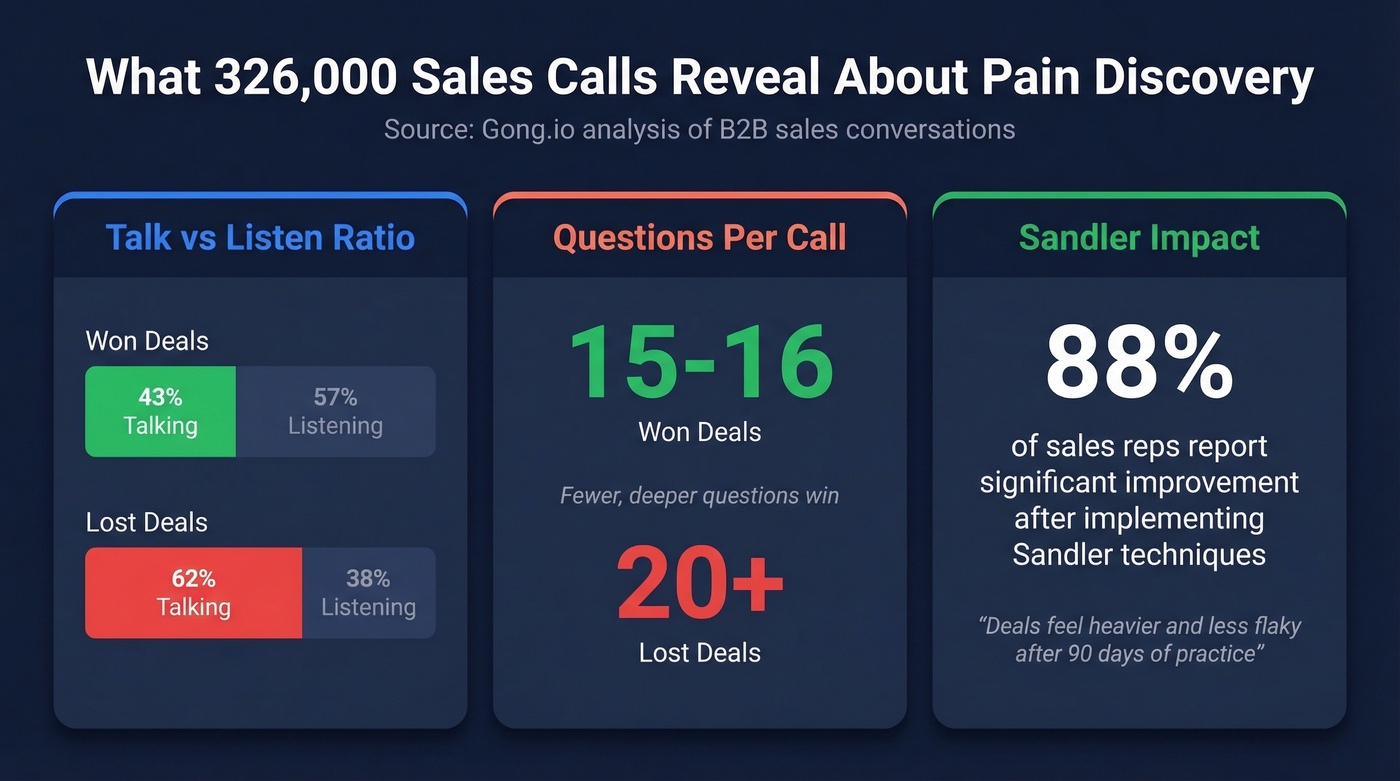
Gong's analysis of 326,000 sales calls found that reps in won deals talked 57% of the time, while reps in lost deals talked 62%. Five percentage points doesn't sound like much until you realize it represents the difference between listening to pain and steamrolling past it. The same research pegged the golden ratio at 43% talk / 57% listen - a benchmark worth tracking in your own calls.
Even more telling: won deals averaged 15-16 questions per call. Lost deals? Around 20. More questions didn't help. They created an interrogation dynamic. The reps who won asked fewer, better questions and let the prospect talk.
Hyperbound cites a stat attributed to MeetRecord that 88% of sales reps report significant improvement after implementing Sandler techniques. One practitioner on r/sales described deals feeling "heavier" and less flaky after 90 days of deliberate practice with pain quantification. The pattern is consistent: fewer, deeper questions beat a rapid-fire checklist every time.
Here's our take: if your average deal size is under $10K and your sales cycle wraps in under two weeks, you probably don't need the full pain funnel. A shortened version - questions 1, 4, 6, and 7 - gets you 80% of the value in half the time. Save the full eight for deals where emotional buy-in from a decision-maker actually determines the outcome.

Question 6 quantifies the pain. But you can't ask it if you never reach the prospect. Prospeo gives you 98% accurate emails and 125M+ verified mobile numbers so your discovery calls actually happen.
Stop perfecting your funnel questions for voicemail boxes.
Sounding Natural, Not Scripted
Sequence Over Memorization
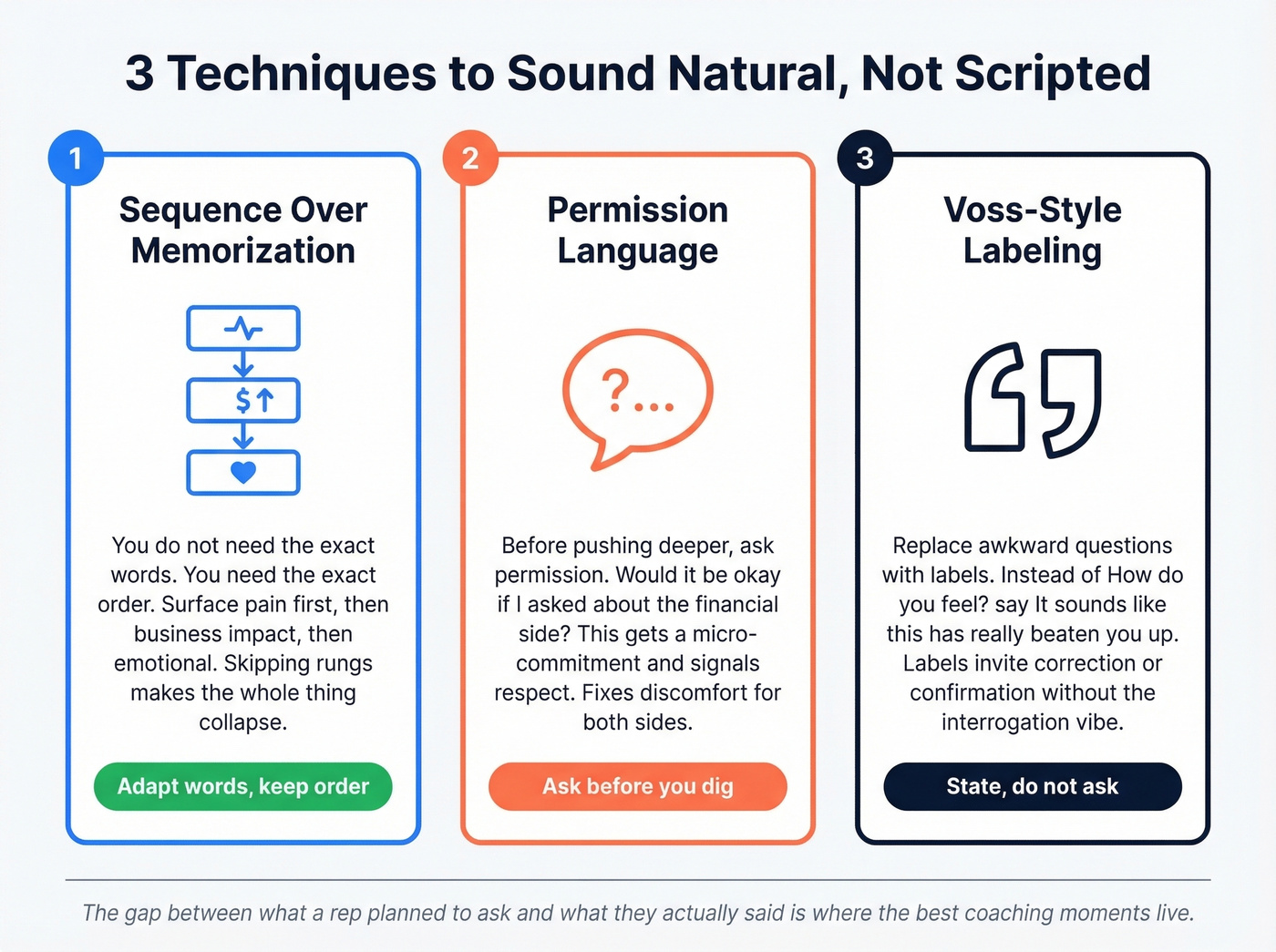
You don't need to say "Tell me more about that" verbatim. "Walk me through what happened" works just as well. What you can't do is jump from "How long has this been a problem?" straight to "How do you feel about that?" The prospect hasn't built enough momentum yet. The sequence creates a psychological ramp, and skipping rungs makes the whole thing collapse.
Permission Language
Before you push into business impact or emotional questions, ask permission. "Would it be okay if I asked about the financial side of this?" signals respect and gets a micro-commitment that makes the prospect more likely to answer honestly. Pipedrive's breakdown of common pitfalls flags "salesperson discomfort" as a top reason reps skip the hard questions. Permission language fixes that for both sides.
The Voss Labeling Technique
Here's the thing: questions 7 and 8 feel weird to ask a stranger. An enterprise cybersecurity seller on r/sales shared a technique that bridges the gap - Chris Voss-style labeling. Instead of asking "How do you feel about that?" cold, lead with a label:
- "It sounds like this has really beaten you up."
- "It sounds like this has prevented you from delivering on your strategy."
Labels aren't questions. They're statements that invite the prospect to correct or confirm - and either response gives you emotional data. Surface pain doesn't close deals. Personal stakes do.
Industry Call Scripts
SaaS: Pipeline Visibility
Rep: "You mentioned your forecast was off by 30% last quarter. Tell me more about that." Prospect: "Our reps aren't updating stages consistently. I'm basically guessing." Rep: "Can you give me an example of when that hurt you?" Prospect: "Board meeting in January. I committed to $2.4M. We closed $1.7M." Rep: "What have you tried to fix it?" Prospect: "Mandatory stage updates, weekly pipeline reviews, a new dashboard." Rep: "If you had to put a dollar number on the cost of bad forecasts - missed hires, wrong inventory, board credibility?" Prospect: "Easily $500K in misallocated resources last year." Rep: "It sounds like this has put you in a really tough spot with the board." Prospect: "Yeah. I've got one more quarter to fix it or they'll bring in a CRO."
Notice how the rep never asked "How do you feel about that?" directly. The label did the work. The prospect volunteered the emotional stakes on their own.
Financial Services: Client Retention
Rep: "You said you lost 15% of AUM to attrition last year. Walk me through what happened." Prospect: "Clients aren't hearing from us enough. They get poached by advisors who are more proactive." Rep: "How long has retention been below target?" Prospect: "Two years, maybe three." Rep: "What did you try?" Prospect: "Quarterly newsletters, a new CRM, hired a junior advisor." Rep: "What's 15% of AUM worth in fees?" Prospect: "About $1.2M annually." Rep: "It sounds like this is weighing on you personally." Prospect: "I built this practice over 20 years. Watching it erode is brutal."
Review each call transcript with your team after the fact. The gap between what a rep planned to ask and what they actually said on a live call is where the best coaching moments live.
Bridging Pain to Solution
Once you've reached the bottom of the funnel, don't pitch. Ask permission: "Would it make sense if I showed you how we've helped companies in a similar situation?" This bridges pain discovery to solution exploration without breaking the trust you just built. If the prospect says yes, they've self-selected into your demo. If they say no, you haven't uncovered enough pain yet - go back to Level 2.
Mistakes That Kill the Funnel
Firing off too many questions. Aim for around 15-16 focused questions that follow the three-level structure. The 326K-call dataset is unambiguous: 20+ questions means you're interrogating, not discovering.
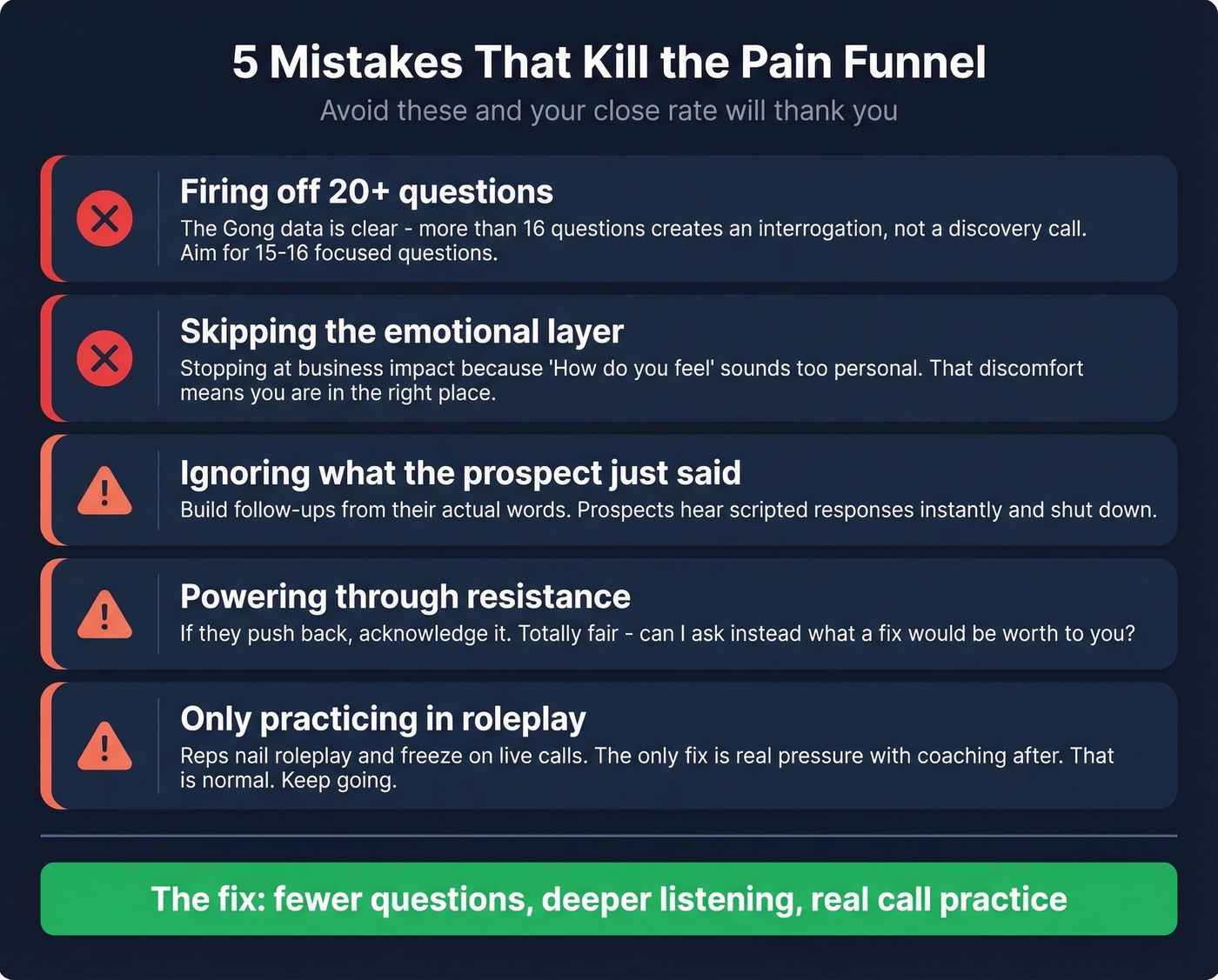
Skipping the emotional layer. Don't stop at business impact because "How do you feel about that?" sounds too personal. That discomfort is the signal you're in the right place.
Ignoring what the prospect just said. Build follow-ups from their actual words. Prospects can hear when you're running a script - they'll shut down fast.
Powering through resistance. If a prospect pushes back on a question, acknowledge it: "Totally fair - we don't have to go there. Can I ask instead what a fix would be worth to you?" You'll lose trust faster than you'll gain information by forcing it.
Only practicing in roleplay. I've watched reps nail roleplay and freeze on live calls. The only fix is real pressure with coaching after. One rep on r/sales described months of practice - recording calls, rephrasing statements into questions - and still freezing when it counted. That's normal. Keep going.
Sandler vs SPIN vs BANT vs MEDDICC
| Framework | Best For | Core Mechanism | Limitation |
|---|---|---|---|
| Sandler | Complex B2B, 2+ stakeholders | Drills one pain deep to emotion | High skill floor |
| SPIN | Consultative enterprise | 4 question types (Rackham's 35K+ call research) | Broad but can stay shallow |
| BANT | Simple qualification | Budget/Authority/Need/Timing | A relic - checklist mindset |
| MEDDICC | Enterprise deal qualification | Multi-stakeholder mapping | Qualification, not discovery |
Let's be honest: these aren't mutually exclusive. Complex B2B with 2+ stakeholders and 30+ day cycles? Start with Sandler to drill into pain. Layer SPIN when you need to map the broader landscape. Use MEDDIC for enterprise qualification once you're past discovery. BANT? Skip it. It treats discovery like a form to fill out, and your prospects can feel it.
Turning Pain Into Pipeline
A great discovery call is worthless if nothing happens after it.
Quantify urgency with a simple formula: frequency x intensity + past failed attempts = urgency. A problem that happens weekly, costs real money, and has survived three fix attempts? That's a deal with momentum. A problem that's "kind of annoying sometimes"? That's a deal that'll stall in Stage 2.
Log pain properly. Not "has pain around reporting." Create specific CRM fields: Pain Statement (verbatim quote), Business Impact ($), Personal Stakes, Failed Solutions. Your future self - and every AE who touches this account - will thank you.
Multi-thread immediately. Research across 1.8M opportunities found that 77% of deals involve multiple contacts, and closed deals have 2x as many buyer contacts as lost ones. For deals over $50K, multi-threading boosts win rates by 130%. After uncovering organizational pain, you need verified contact data for every stakeholder involved.

None of this matters if your follow-up lands in a dead inbox. After a discovery call, we use Prospeo to search by company and role - find the CFO, the end users, the champion's boss. With 98% email accuracy and a 7-day data refresh cycle, you're reaching real people, not bouncing off stale data. The free tier gives you 75 verified emails plus 100 Chrome extension credits per month, enough to multi-thread your highest-priority deals without spending a dime.
If you want to systematize what happens after discovery, steal a few sales follow-up templates and standardize your sales meeting follow-up email so pain doesn't die in the inbox.
You just learned how to turn surface complaints into pipeline-moving pain. Now make sure you're running that funnel with the right buyers. Prospeo's intent data tracks 15,000 topics so you prospect into accounts already feeling the pain - before the first question.
Reach in-market buyers who are ready to answer question 8 with urgency.
FAQ
What are the 8 Sandler pain funnel questions?
The eight questions move from surface to emotional: (1) Tell me more, (2) Give me an example, (3) How long has this been a problem, (4) What have you tried, (5) Did that work, (6) How much has it cost you, (7) How do you feel about that, (8) Have you given up trying to fix it. Aim for 15-16 total questions per call including follow-ups.
What's the difference between the 8- and 10-question versions?
Same three-level structure. The 10-question version adds extra prompts - usually around impact quantification and commitment - between the business-impact and emotional layers. Pick whichever feels natural and stick with the sequence.
Can I use the pain funnel for transactional sales?
It's overkill for simple, low-stakes purchases. Use a shortened version (questions 1, 4, 6, and 7) for deals under $10K with short cycles. The full eight-question sequence shines in complex B2B with multiple stakeholders and cycles longer than 30 days.
How do I find stakeholder contacts after a pain discovery call?
Use a B2B data platform to search by company and role immediately after discovery. Prospeo's 30+ search filters let you find verified emails and direct dials for the CFO, end users, and your champion's boss - 75 free verified emails per month, 98% accuracy, no contracts required.
How do I train my team on the pain funnel?
Teach the 3 levels first - surface, business, emotional - before introducing specific questions. Record actual calls, review them together weekly, and reward longer discovery conversations. Mastery comes from live reps, not slide decks.