

Sandler Sales Training: What It Teaches, What It Costs, and Whether It's Worth It
You just signed up for a demo with a Sandler franchise. The trainer was sharp, the methodology sounded airtight, and then you asked about pricing. Silence. A redirect. "Let's discuss that after we scope your needs." For a methodology that literally teaches you to qualify budget upfront, the irony is thick.
Quick Version
Sandler sales training is a 7-step methodology built around qualifying hard before presenting. It's best for reps in relationship-driven B2B sales with a small number of decision-makers. Expect to pay $6-7K individually or mid-five-figures for team training - and no, Sandler won't tell you that upfront. Research shows that teams reaching 75%+ methodology adoption see a 21% lift in quota attainment and 15% improvement in win rates. Sandler carries a 4.8/5 on G2 across 105 reviews, and 96% of polled clients say they'd recommend the program. The question isn't whether the training works - it's whether it works for your team, at your price point.
What Is the Sandler Selling System?
David Sandler developed his selling system in 1966 after getting frustrated with traditional "show up and throw up" sales presentations. The core insight was simple but radical for the time: stop pitching and start qualifying. Make the prospect convince you they're worth your time, not the other way around.
The methodology uses a submarine metaphor - seven sealed compartments that a deal must pass through sequentially. If one compartment floods, you don't sink the whole submarine. You stop, address it, or walk away. This stage-gating principle is what separates the Sandler approach from looser frameworks where reps skip straight to the demo.
Sandler trains 30,000+ people per year across roughly 250+ local training centers in more than 28 countries. The franchise model is both a strength and a weakness - you get local, hands-on coaching, but quality varies depending on your specific trainer. Psychologically, the system draws on Transactional Analysis, training reps to operate from an "Adult" ego state - calm, rational, peer-to-peer - rather than slipping into a submissive "Child" posture when a prospect pushes back. A common Sandler guideline is a 70/30 listen-to-talk ratio, which is a polite way of saying most reps talk too much and Sandler exists to fix that.
This isn't a two-day workshop you forget by Thursday. The flagship program runs nine months with ongoing coaching sessions, which is why it sticks better than most one-off training events.
The 7 Steps of the Sandler Method
Every Sandler deal moves through seven compartments. Skip one, and the methodology breaks.
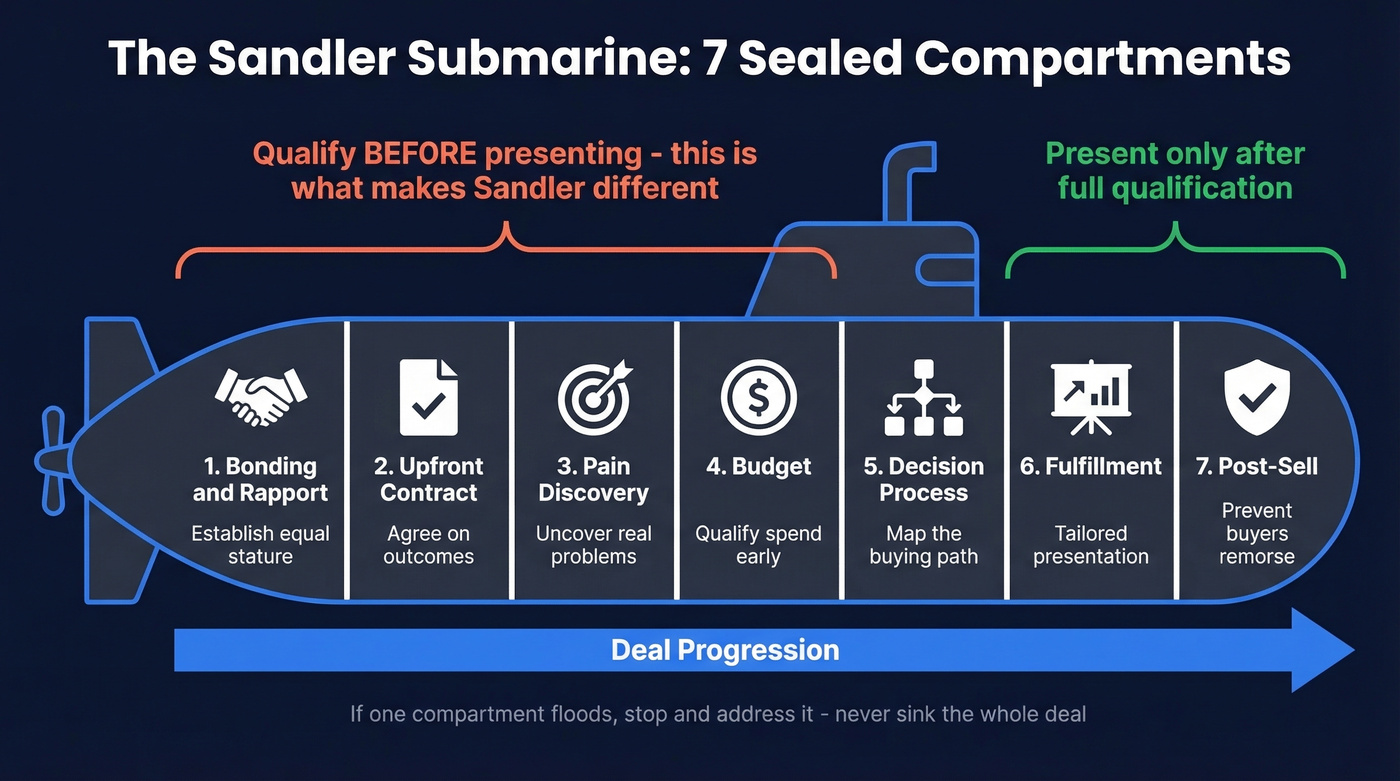
Bonding & Rapport
This isn't small talk about the weather. Sandler's bonding step establishes equal business stature - you're a peer exploring fit, not a vendor begging for time. The goal is lowering defenses so the prospect will be honest later. Example opener: "Before we get into it - what made you take this call today?"
Upfront Contract
The most distinctive Sandler concept. Before any meeting progresses, both sides agree on what'll happen, how long it'll take, and what the possible outcomes are - including "no." A typical upfront contract sounds like this: "We've got 30 minutes. I'll ask some questions, you can ask me anything, and at the end we'll decide together if there's a reason to keep talking. If not, that's totally fine. Fair?" This eliminates the "let me think about it" black hole that kills most deals.
Pain Discovery
This is where the pain funnel lives. The rep's job is to uncover not just surface-level problems, but the emotional and financial impact of those problems. You're not asking "what challenges do you face?" - you're digging until the prospect feels the cost of inaction.
Budget Qualification
Here's where Sandler diverges from almost every other methodology. You discuss budget before presenting your solution. Why build a custom proposal for someone who can't afford you? Example: "If we found something that solved this, what kind of investment would you be comfortable exploring?"
Decision Process
Map out exactly how the buying decision gets made. Who else is involved? What's the timeline? What could derail it? Sandler reps ask: "Walk me through what happens after our conversation - who else needs to weigh in, and what does their process look like?"
Fulfillment (The Presentation)
Notice this is step six, not step one. By now, you know their pain, their budget, and their decision process. The presentation is tailored precisely to what they've already told you matters. No feature dumps. No 40-slide decks.
Post-Sell
After the deal closes, Sandler trains reps to inoculate against buyer's remorse: "Is there anything that might come up in the next few days that could make you second-guess this decision?" Uncomfortable to ask, but it prevents deals from unraveling after the handshake.
The Pain Funnel - All 8 Questions
The pain funnel is Sandler's most tactical tool. It's a sequence of eight questions that progressively narrow from broad exploration to emotional impact. Here's the full sequence:
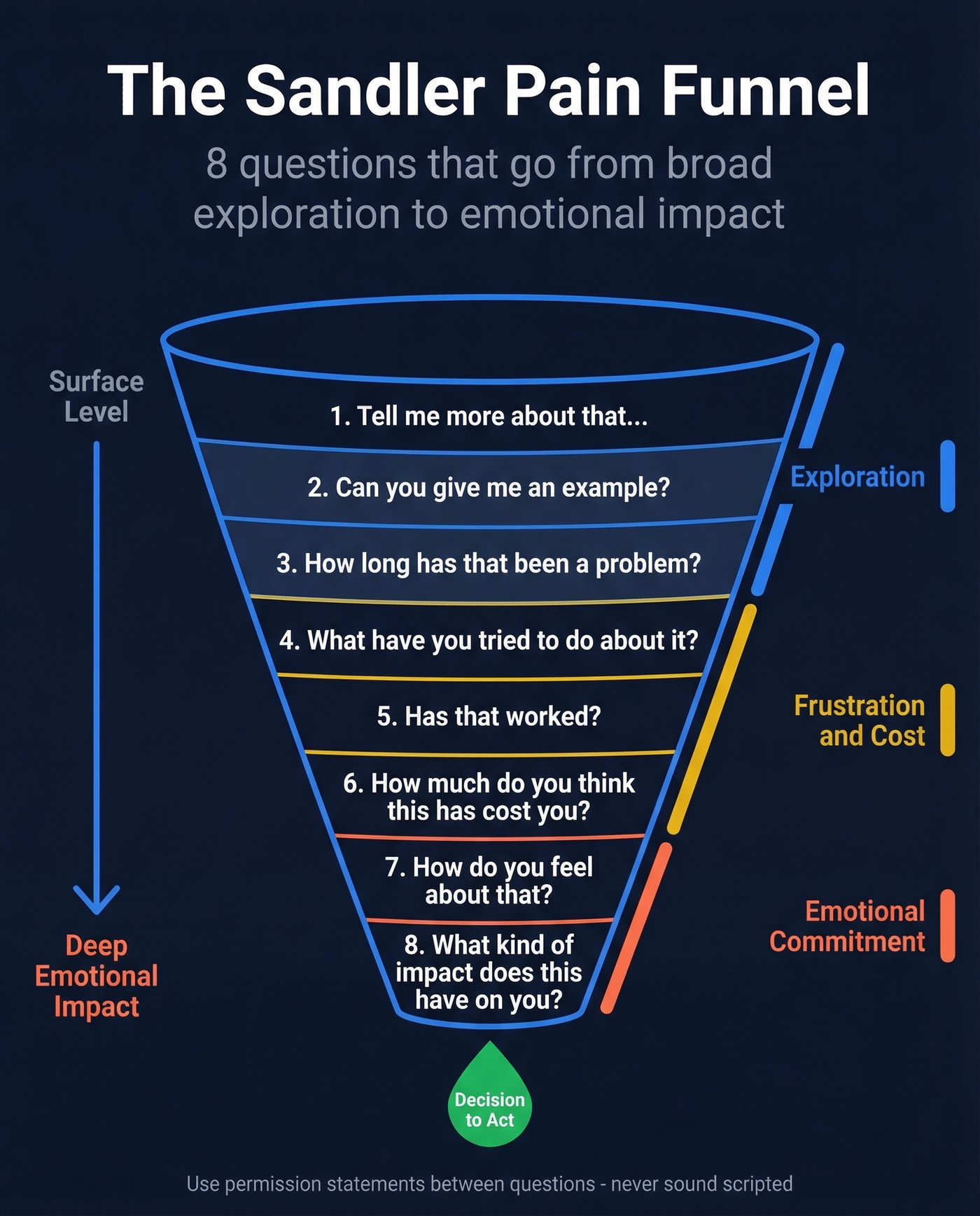
- "Can you tell me more about that?" - Opens the door without leading.
- "Can you give me an example?" - Forces specificity over vague complaints.
- "How long has that been a problem?" - Establishes duration and urgency.
- "What have you tried to do about it?" - Reveals failed solutions and frustration.
- "Has that worked?" - The answer is almost always no, which deepens the pain.
- "How much do you think this has cost you?" - Quantifies the problem in dollars.
- "How do you feel about that?" - Shifts from rational to emotional territory.
- "What kind of impact does this have on you/your business?" - Connects personal stakes to business outcomes.
The comparison to SPIN Selling is useful here. SPIN structures questions across four categories (Situation, Problem, Implication, Need-Payoff) and casts a wider net. The pain funnel drills vertically into a single problem, going deeper each time. SPIN is wider; Sandler is deeper.
The biggest risk with the pain funnel is sounding scripted. Two ways to avoid that: use permission statements ("Would it be okay if I asked about the financial side?") and build each question directly off what the prospect just said. The funnel is a framework, not a checklist.

The Sandler pain funnel only works when you're talking to the right person. Prospeo's 300M+ profiles with 30+ filters - including buyer intent, job changes, and department headcount - let you build lists of decision-makers who match your ICP before you ever pick up the phone. 98% email accuracy means your outreach actually lands.
Stop burning pain funnel reps on bad contacts. Start with verified data.
Negative Reverse Selling
This is the Sandler technique that sounds counterintuitive until you see it work. Negative reverse selling uses psychological reactance - the tendency for people to push back when they feel their freedom of choice is restricted - to get prospects to sell themselves.
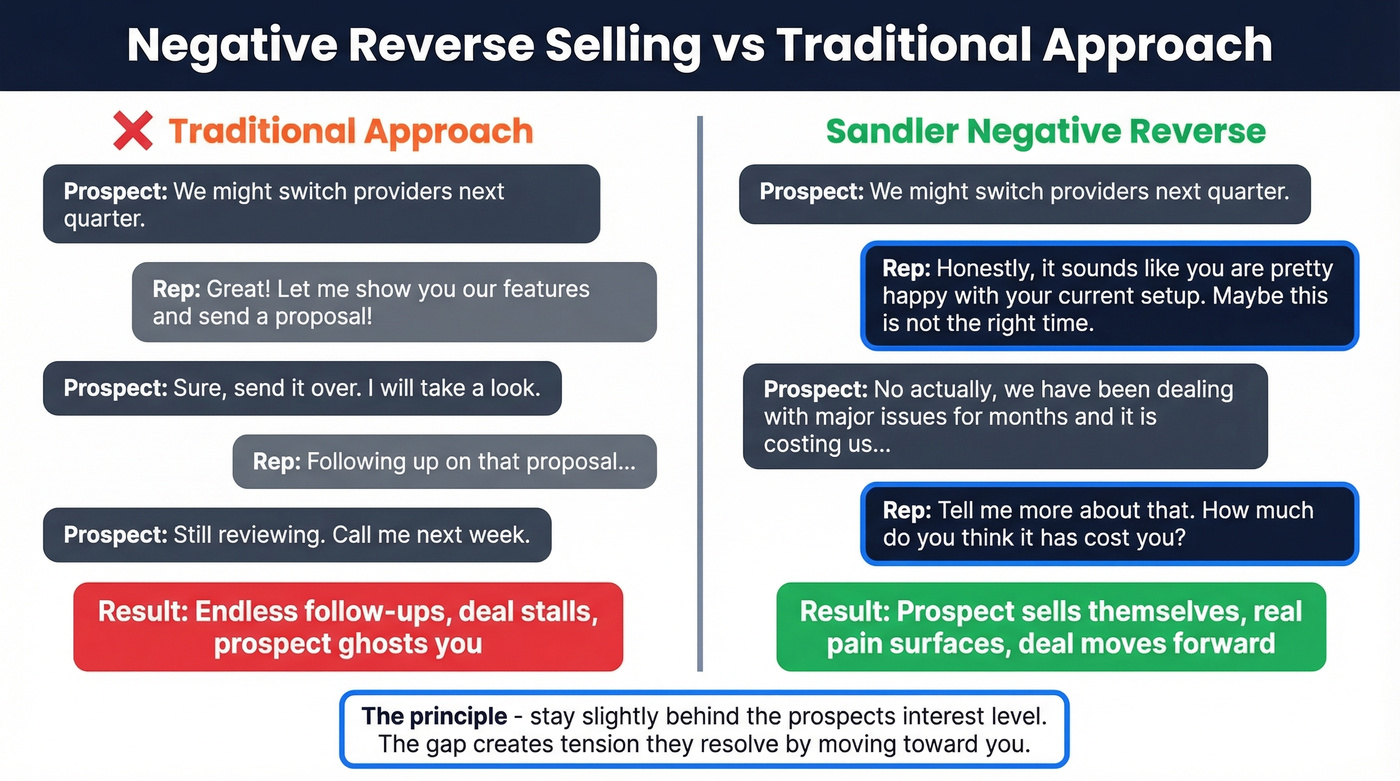
Sandler calls it pendulum theory. Position yourself slightly behind the prospect's current interest level. If they're excited, stay neutral. If they're neutral, lean slightly disinterested. The gap creates tension that the prospect resolves by moving toward you.
In practice:
Prospect: "We might be interested in switching providers next quarter."
Rep: "Honestly, it sounds like you're pretty happy with your current setup. Maybe this isn't the right time."
Prospect: "No, actually - we've been dealing with [specific problem] for months and it's costing us..."
Three classic negative reverse lines:
- "I'm not sure we're the right fit for what you need."
- "Sounds like you're 100% happy with your current solution."
- "You probably wouldn't be interested in this, would you?"
The technique is especially useful for breaking the "Hope Island" pattern - prospects who string you along with "call me back next week" or "send me a proposal" without ever committing. A well-timed negative reverse forces a real answer. But it's easy to come off rude if you overdo it. Apply it selectively - if your tone reads as sarcastic rather than genuinely curious, you'll lose the prospect.
Pricing and Certification Levels
Sandler doesn't publish pricing. Everything is custom-scoped based on participants, locations, program mix, and delivery format. There's no free trial - you're committing before you experience the full program.
Here's what we've pieced together from user reports and community discussions:
| Program | Estimated Cost | Notes |
|---|---|---|
| Sales Mastery (individual, 9 months) | $6,000-$7,000 | Based on user reports; adjust for inflation |
| Team/enterprise training | $15,000-$50,000+ | Custom by seats and duration |
| Certification (Bronze/Silver) | Added fee | Typically not included in base training |
| Franchise startup | ~$100K all-in | Franchise fee + operating runway |
Certification runs on two levels. Bronze validates foundational understanding of the Sandler system. Silver tests your ability to apply Sandler strategies in your specific role and industry. Both cost extra beyond the base training fee, which is a detail Sandler doesn't volunteer upfront - and reviewers flag it as a hidden cost.
One Reddit poster considering a Sandler franchise estimated ~$100K all-in to get started, with under $100K income in year one and potential to scale to $200-300K long-term. That's a real bet for someone leaving a six-figure tech sales role.
Training is delivered virtually, on-site, or hybrid, plus self-paced video courses and downloadable resources. Sandler also supports tech-enabled training, including an AI role-play coach and LMS integrations with platforms like HubSpot and MindTickle.
Who Should Use Sandler (And Who Shouldn't)
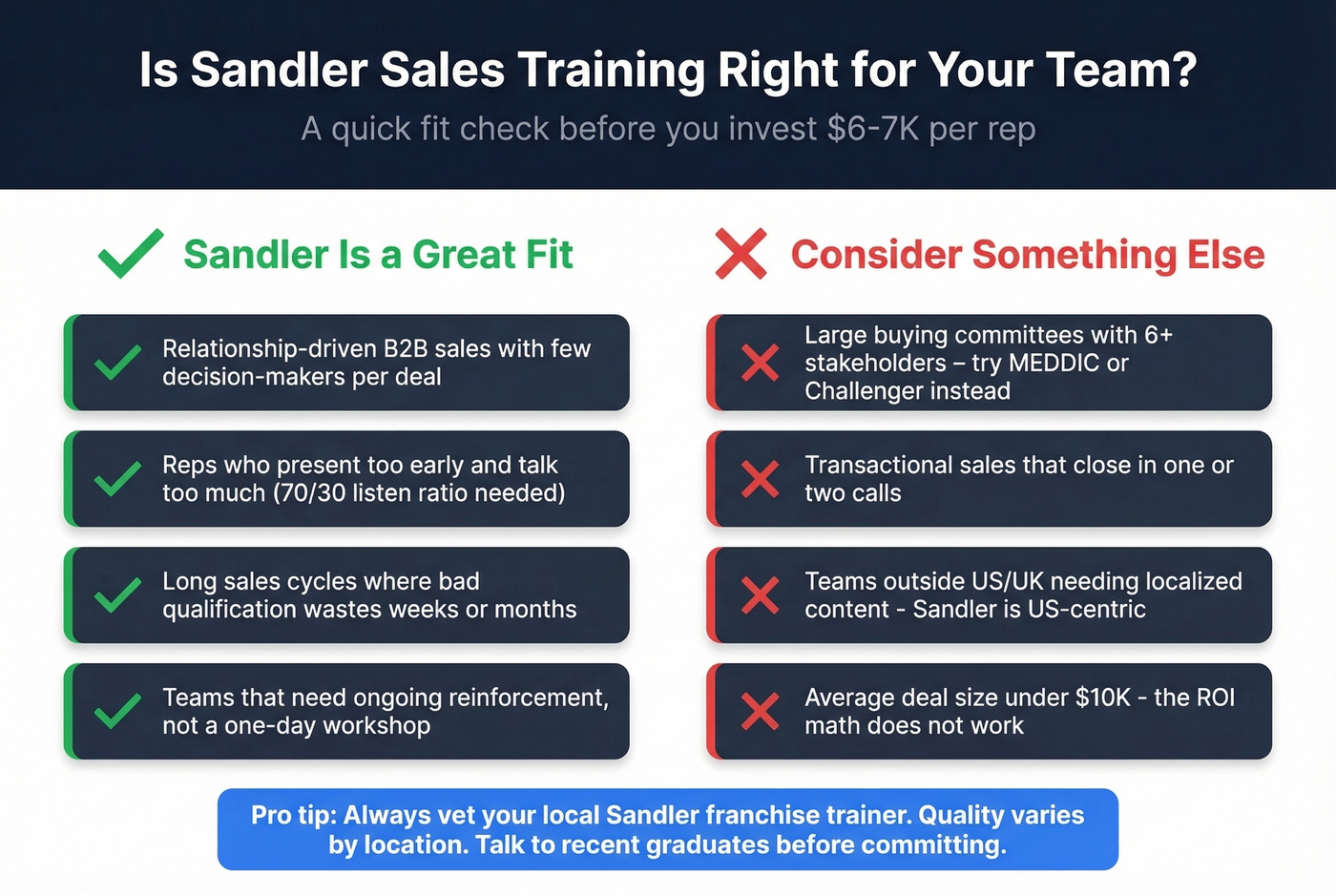
Use Sandler If...
- You're in relationship-driven B2B sales with a small number of decision-makers per deal.
- Your reps talk too much and present too early.
- Your sales cycle is long enough that qualification prevents wasted effort.
- You want reinforcement-based training, not a one-off workshop.
Skip Sandler If...
- You're selling into large buying committees with 6+ stakeholders - MEDDIC or Challenger are better fits.
- Your sales cycle is transactional and closes in one or two calls.
- Your team is outside the US or UK and needs localized content. Reviewers consistently flag that Sandler is US-centric, with one noting that "business in LatAm are done different."
- You expect consistent quality across locations. Vet the facilitator and talk to recent graduates before committing.
Here's the thing: if your average deal closes under $10K, you probably don't need Sandler-level investment. The methodology shines when a single lost deal costs you five or six figures. For smaller transactions, the nine-month commitment and mid-five-figure team pricing doesn't pencil out - grab the free content, internalize the pain funnel, and move on.
Sandler vs Other Sales Methodologies
No single methodology covers every selling scenario. We've seen teams try to force one framework across wildly different deal types, and it never ends well. Here's how the Sandler approach stacks up against the most common alternatives:
| Methodology | Best For | Research Base | Key Differentiator |
|---|---|---|---|
| Sandler | Relationship B2B, small buying groups | 50+ years, practitioner-driven | Qualify before presenting |
| SPIN | Consultative/technical sales | 35,000+ calls, 20+ countries | Structured question categories |
| Challenger | Complex enterprise deals | 6,000+ reps (CEB research) | Teach-tailor-take control |
| MEDDIC | Large buying committees | Enterprise qualification standard | Multi-stakeholder mapping |
| BANT | Quick qualification | Traditional framework | Budget-Authority-Need-Timeline |
| NEPQ | Emotional/consultative selling | Emerging methodology | Discovery before budget |
Challenger deserves a specific callout: Xerox reported a 17% sales increase and $65M in contract value after implementing it. If you're running complex enterprise deals with multiple stakeholders, Challenger or MEDDIC will serve you better than Sandler.
The Sandler vs NEPQ debate comes up frequently on r/sales. The core difference: Sandler addresses budget upfront to avoid late-stage ghosting, while NEPQ runs deeper discovery before touching money. One practitioner noted that NEPQ-style flows led to prospects saying they needed to "check with their accountant" after the presentation - then disappearing. Sandler's budget-first approach eliminates that specific failure mode.
Let's be honest: most high-performing teams blend methodologies. Use Sandler's qualification framework and pain funnel as your foundation, layer in Challenger's insight-led approach for complex deals, and pull MEDDIC's stakeholder mapping when you're selling to committees. One methodology is rarely enough.
Running Sandler with a Modern Sales Stack
Training without execution tools is expensive theater. Sandler's own benchmark data shows that 55% of sales teams sit at just 50% of quota or above, and roughly a third of managers aren't effective at coaching. In our experience, the gap between "trained" and "producing" almost always comes down to whether the team has the right infrastructure around the methodology.
Three tool categories make Sandler actually work in practice:
CRM stage-gating. Map Sandler's seven steps to your Salesforce or HubSpot pipeline stages. Require reps to complete each compartment before advancing a deal - turning the submarine metaphor into an enforceable process. (If you need examples, see CRM options by use case.)
Call recording and coaching. The pain funnel only improves with review. Record discovery calls, tag pain funnel moments, and use them in coaching sessions to spot where reps bail out early. Pair this with a tighter discovery question bank so reps don’t sound scripted.
Verified contact data. Sandler's bonding step requires pre-call research on the right person. The pain funnel requires reaching the actual decision-maker, not a gatekeeper who can't answer "how much has this cost you?" Prospeo's 30+ search filters and 98% email accuracy make it straightforward to build targeted lists of the exact decision-makers your reps need to reach, then push verified contacts straight into your sequencer. (If you’re building lists at scale, data enrichment can fill gaps fast.)
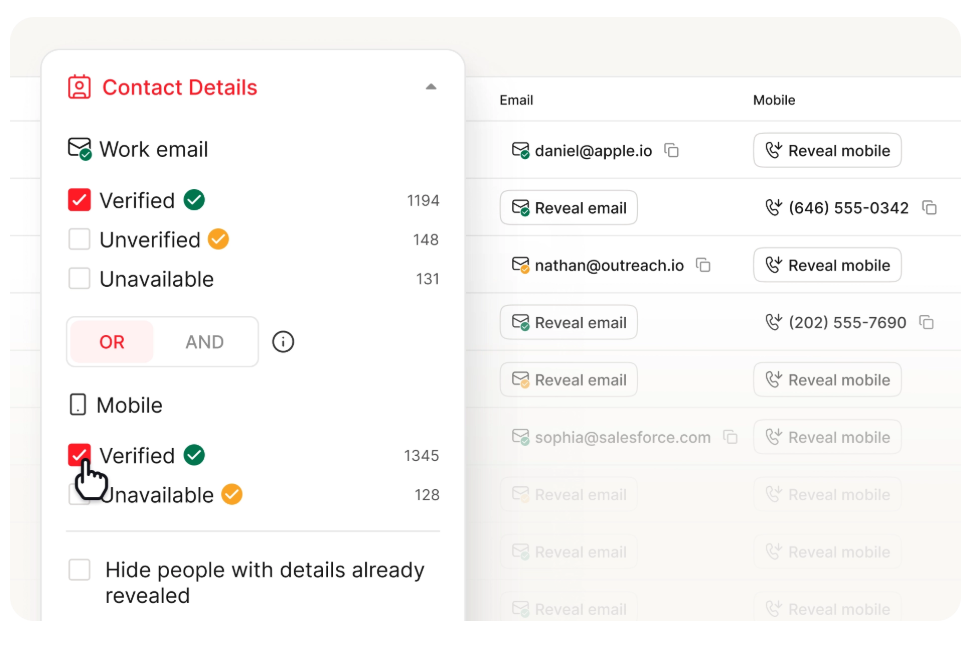
Sandler's budget qualification step falls apart when you can't reach the economic buyer directly. Prospeo delivers 125M+ verified mobile numbers with a 30% pickup rate - 3x the industry average - so you skip the gatekeeper and run your upfront contract with the person who signs the check.
Dial decision-makers directly for $0.01 per lead. No contracts, no gatekeepers.
FAQ
Is Sandler sales training worth the money?
For reps in relationship-driven B2B sales who struggle with qualification, yes - structured methodology adoption lifts quota attainment by 21%. The longer your sales cycle and the larger your deal size, the faster the investment pays for itself. Below $15K ACV, the ROI math gets shaky.
How long does the program take?
The flagship Sales Mastery program runs nine months with weekly or biweekly sessions. Expect a sustained commitment - behavior change doesn't happen in a two-day workshop, which is exactly why Sandler's reinforcement model outperforms most one-off events.
Can I learn the Sandler method for free?
Sandler publishes free podcasts, blog posts, and YouTube videos covering core concepts like the pain funnel and upfront contracts. The structured program, live coaching, and certification require paid enrollment through a local franchise - typically $6-7K for individuals.
What tools help implement Sandler effectively?
A CRM for stage-gating the seven steps, call recording software for reviewing pain funnel execution, and a verified data platform to ensure reps reach decision-makers. Prospeo's 30+ search filters and 98% email accuracy make it easy to build targeted lists of the right contacts before reps ever pick up the phone.
What are the 49 Sandler Rules?
Guiding principles that reinforce Sandler's philosophy - examples include "Don't spill your candy in the lobby" (don't reveal your solution before understanding pain) and "No mutual mystification" (never leave a meeting without both sides knowing where things stand). The full set covers attitudes, behaviors, and techniques that keep reps disciplined through the seven steps.