

SDR Burnout Is Structural, Not Personal - Here's the Proof
It's Tuesday morning. You've got 80 accounts to touch, a sequence that needs 200 emails by Friday, and a connect rate that hasn't cracked 2% in three weeks. The quota number stares at you from the dashboard. You stare back. You feel nothing.
That's not a bad week - that's SDR burnout. 83% of SDRs miss quota consistently, and over 70% of people in sales report struggling with mental health. This isn't a motivation problem. It's a structural one.
Here's the short version if you're burned out right now: turnover averages 30-39%. Burnout follows a predictable timeline around month 4, the 6-9 month mark, and months 12-15. The most fixable cause is bad data wasting your effort. And you've got more career options than you think.
What Sales Rep Burnout Actually Is
The WHO defines burnout as an occupational phenomenon with three dimensions : energy depletion, cynicism toward your work, and reduced professional efficacy. It's not "having a rough quarter." It's the point where meditation, exercise, and cutting other stressors don't produce real improvement - sometimes for months.
A 2024 study in Scientific Reports compared sales personnel to R&D workers and found sales teams scored significantly worse on somatization, depression, anxiety, and hostility measures. The role carries a mental health tax that most companies pretend doesn't exist.
The Numbers Behind SDR Turnover
These aren't edge cases. They're the median.
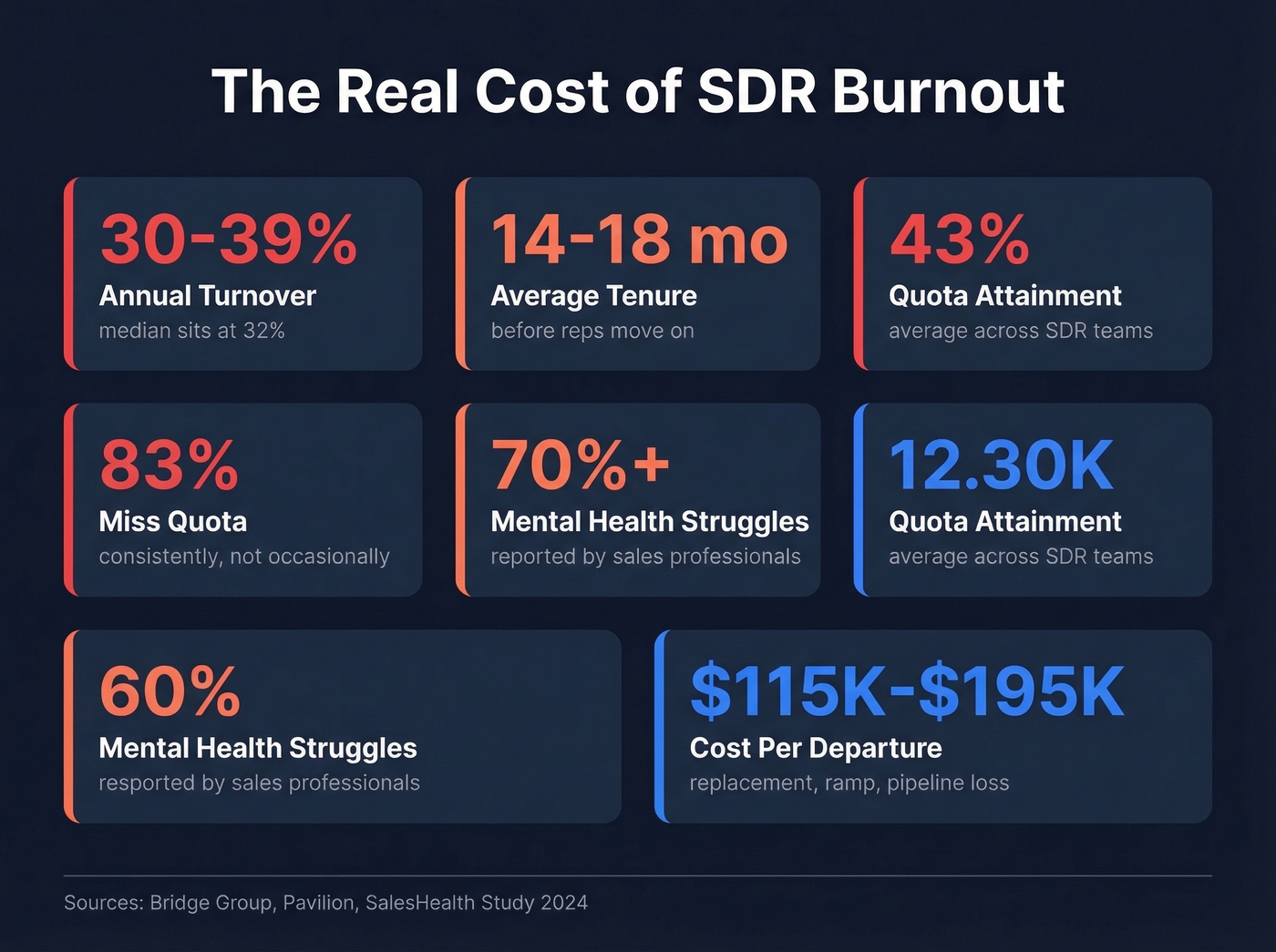
| Metric | Benchmark |
|---|---|
| Annual turnover | 30-39% (median 32%) |
| Average tenure | 14-18 months |
| Quota attainment | 43% average |
| Reps missing quota | 83% consistently |
| Mental health struggles | 70%+ |
| Cost per departure | $115K-$195K (modeled estimate) |
That cost-per-departure figure breaks down across direct replacement, vacancy pipeline loss, ramp productivity loss, team drag, and knowledge loss. Every SDR who walks out the door takes six figures of organizational investment with them. And yet most companies treat turnover as an HR line item instead of a revenue crisis.
The Burnout Timeline
Burnout doesn't arrive randomly. We've watched it follow the same pattern dozens of times.
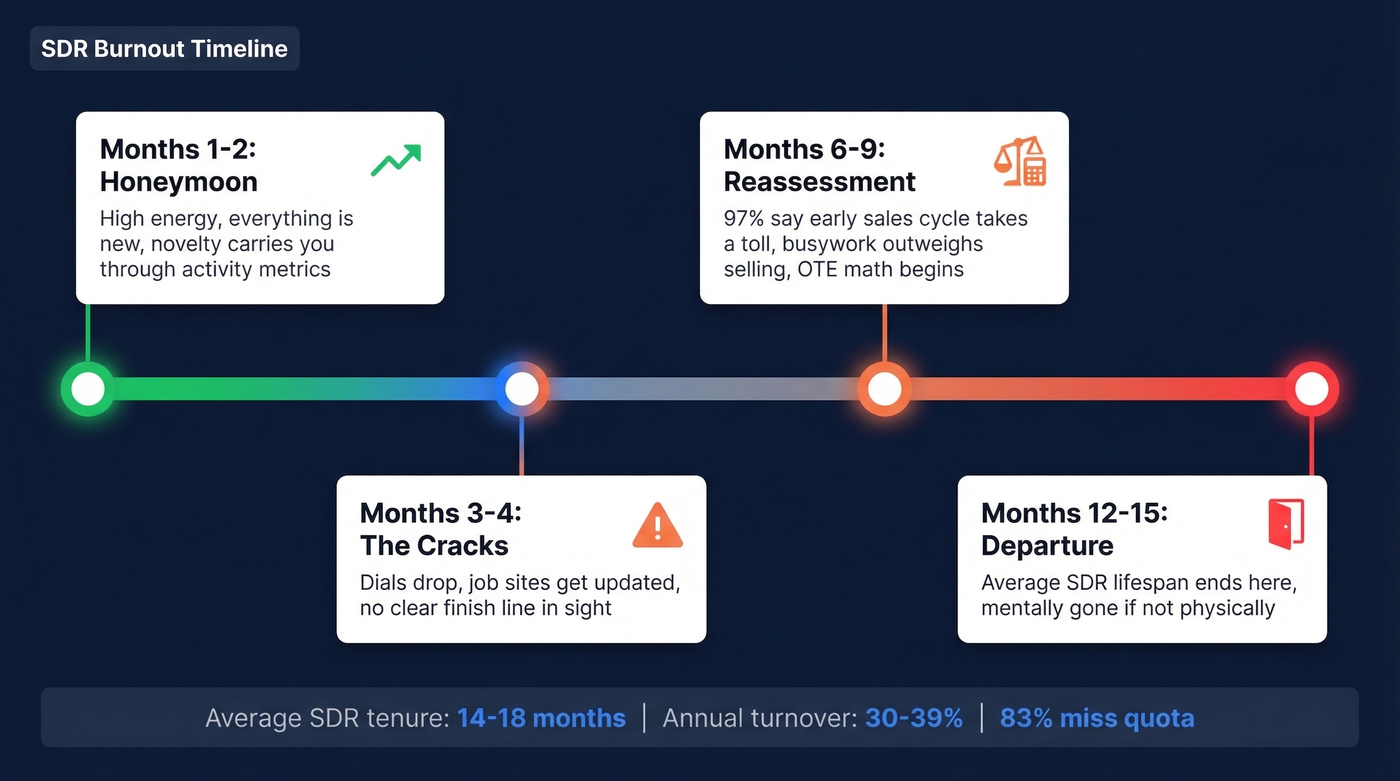
Months 1-2: High energy. Everything's new. You're learning the product, building lists, hitting activity metrics because novelty carries you.
Months 3-4: The cracks appear. Dials drop. You start updating your profile on job sites. The "no finish line" problem hits - no clear progression path, just another month of the same number staring you down.
Months 6-9: Reassessment. 97% of salespeople admit the early sales cycle takes a toll. A lot of your day is busywork, not selling. You start doing the math on whether the OTE is worth it.
Months 12-15: Departure. The average SDR lifespan is just 12-15 months. By this point, the reps who haven't been promoted are gone - mentally if not physically.

SDRs spend 64% of their time not selling - mostly cleaning lists and chasing dead contacts. Prospeo refreshes every record every 7 days and delivers 98% email accuracy, so your reps spend dial blocks talking to real buyers instead of yelling into a void.
Meritt's team went from 3% to 20-25% connect rates. Your reps deserve the same.
Why It's Worse in 2026
36% of B2B companies cut SDR headcount in the last year, per Emergence Capital's survey of 560+ venture-backed companies. Only 19% increased it - the lowest growth rate across all sales functions.
The AI SDR narrative compounds the pressure. SaaStr portfolio metrics show AI SDRs answer technical questions immediately 87% of the time vs. 15% for humans - numbers your leadership team is reading right now. Fewer reps, rising expectations, and the constant hum of "will this role exist in two years?" That combination is a burnout accelerant most companies refuse to address.
The Cause Nobody Talks About: Bad Data
Here's the thing: the most fixable cause of SDR burnout isn't quota pressure or bad managers. It's bad data. And almost nobody treats it as a burnout issue.
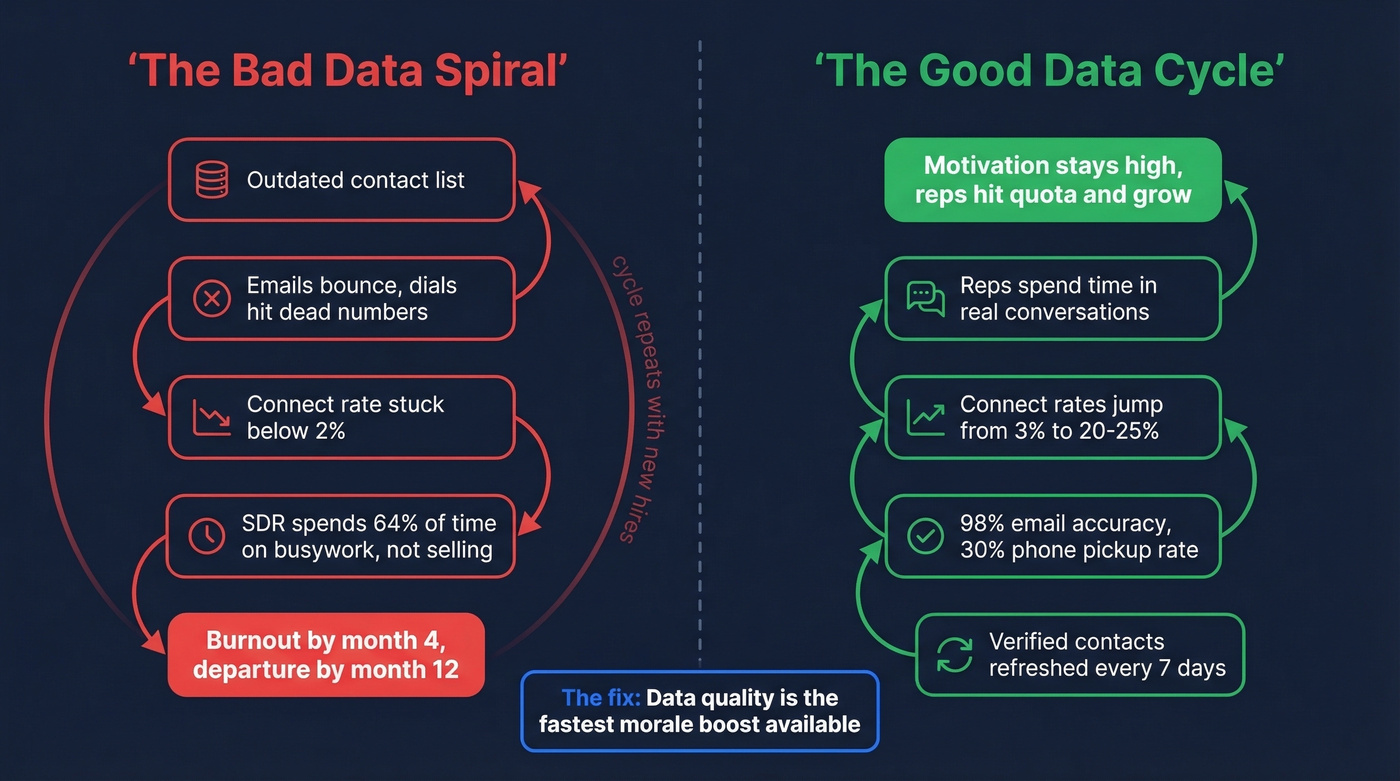
One SDR on r/sales described phone connect rates around 1% while calling household-name companies, blaming "crappy/missing ZI numbers." Another reported needing 1.5x the email activity of top performers just to stay even - not because of skill, but because half their list was dead data. When your dials go to voicemail boxes that haven't been set up and your emails bounce, the problem isn't your hustle. You're running on a treadmill that's not plugged in.
SDRs spend less than 36% of their time actually selling. The rest is researching contacts, cleaning lists, finding numbers that work. That busywork spiral is where motivation dies.
In our experience, fixing the data stack is the single fastest morale boost available - faster than coaching, faster than comp changes, faster than meditation apps. A platform like Prospeo refreshes contact data every 7 days (vs. the 6-week industry average), which means fewer bounced emails and more conversations that actually happen. When connect rates climb from 3% to 20-25% - as Meritt's team experienced after switching - the job feels fundamentally different. You're talking to people instead of yelling into a void.

Recognizing the Signs Early
If You're an SDR
The most common burnout signs are easy to dismiss as a bad stretch: dreading your morning dial block, feeling detached from wins, snapping at colleagues over minor Slack messages, and physical symptoms like headaches or insomnia that weren't there three months ago. If you're noticing several of these at once, treat them as a signal - not a phase.
Audit your career path this week. Is there a documented promotion path with clear thresholds? If the answer is vague, that tells you everything you need to know about how long you should stay.
The golden handcuffs are real. The money keeps you in a role that's wrecking your health. Name it so you can make a clear-eyed decision.
Before quitting entirely, request a segment or channel change. Moving from enterprise email-only to SMB phone-heavy can feel like a different job. If that's not an option, consider career pivots beyond AE - RevOps, Customer Success, Sales Engineering, Partnerships. Plenty of former SDRs have made the jump successfully, and the consensus on r/techsales is that the SDR-to-AE path isn't the only path worth taking.
Fix your data stack if you haven't already. Therapy isn't a weakness - over 70% of salespeople report mental health struggles. Get help.
If You're a Manager
Let's be honest: if your SDRs are burning out at month 4, that's not a hiring problem. It's a systems problem.
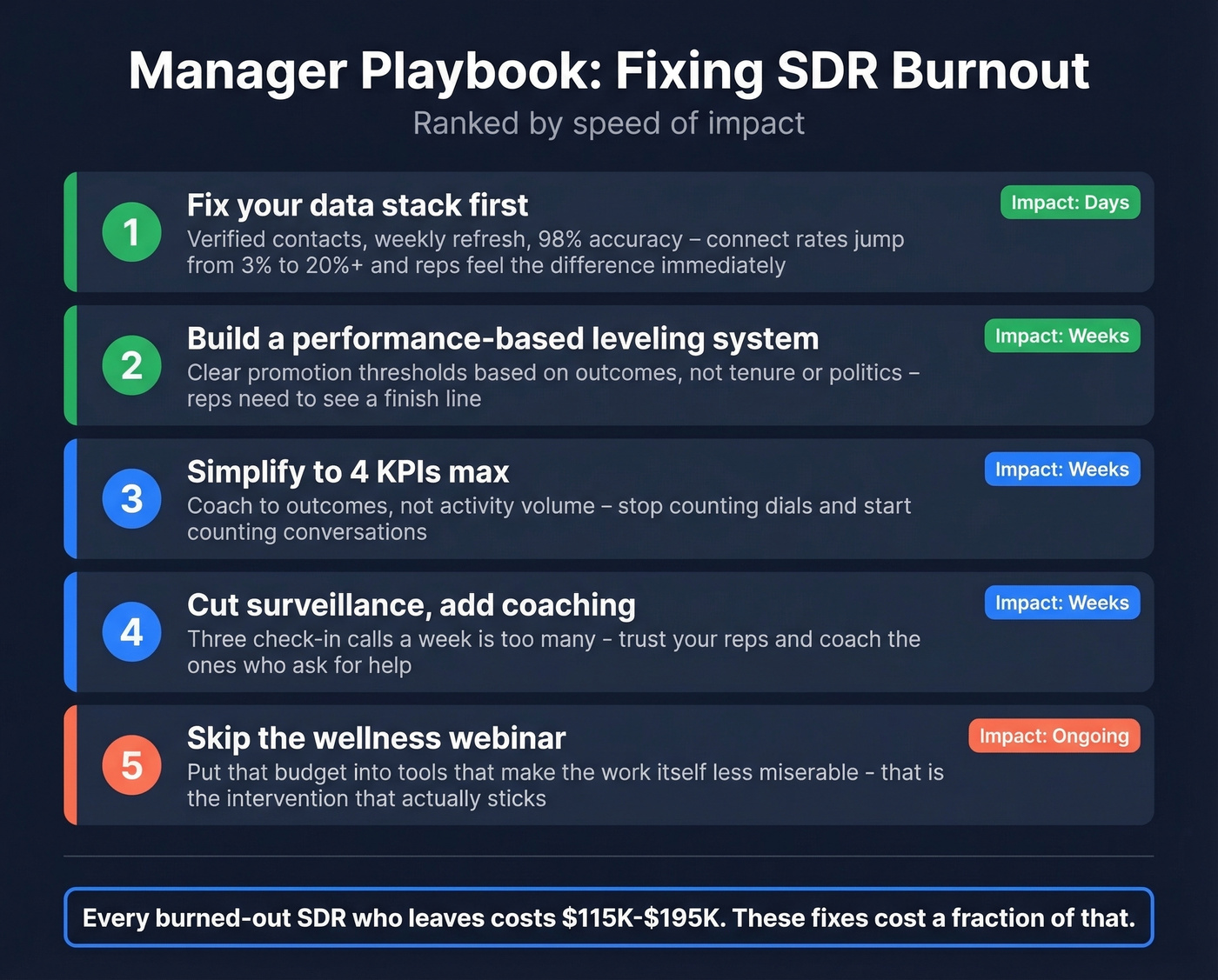
Build a performance-based SDR leveling system with clear promotion thresholds - not tenure, not politics. Simplify your dashboard to 4 KPIs and coach to outcomes, not activity volume. Three check-in calls a week is too many. Coach, don't surveil. And invest in data quality, because your reps' connect rates and their morale depend on whether their dials reach actual humans. Skip the "wellness webinar" budget and put that money into tools that make the work itself less miserable - that's the intervention that actually sticks.
Every bounced email and disconnected number chips away at your SDRs' motivation. Prospeo's 143M+ verified emails and 125M+ verified mobiles with a 30% pickup rate mean reps actually connect - cutting the busywork spiral that kills morale by month 4.
Stop losing $115K per burned-out rep. Start with data that works.
FAQ
Is SDR burnout normal?
Yes. With 30-39% annual turnover, 14-18 month average tenure, and 83% of reps missing quota, burnout is the statistical norm. The WHO classifies it as an occupational phenomenon, not a personal failing. If you're feeling it, you're in the majority.
How long does recovery take?
If you catch it at month 3-4, a segment change or boundary reset can help within weeks. At month 12+ with physical symptoms, expect months of recovery - and seriously evaluate whether the role or company is the right fit before pushing through.
Should I quit sales entirely?
Not necessarily. Many burned-out SDRs thrive in adjacent roles like RevOps, Customer Success, Sales Engineering, or Partnerships. Audit what you actually enjoy about the work. If it's the conversations but not the list-building, fixing your data tools and workflow might solve more than you'd expect.
What's the fastest way to reduce SDR burnout on a team?
Fix your data quality first. Teams switching to verified-contact platforms report connect rates jumping from 3% to 20%+, which directly reduces wasted dials and the frustration spiral. Pair that with a clear promotion path and outcome-based coaching - not activity surveillance.