

Selling to Enterprise: The Field Guide With Actual Numbers
A RevOps lead we know spent six months building a $1.2M "enterprise pipeline." Closed revenue? Zero. The deals weren't dead - they just never moved. That's selling to enterprise in a nutshell: the opportunity is real, but the motion is completely different from anything you've run before.
Enterprise Sales in 2026 - The Numbers
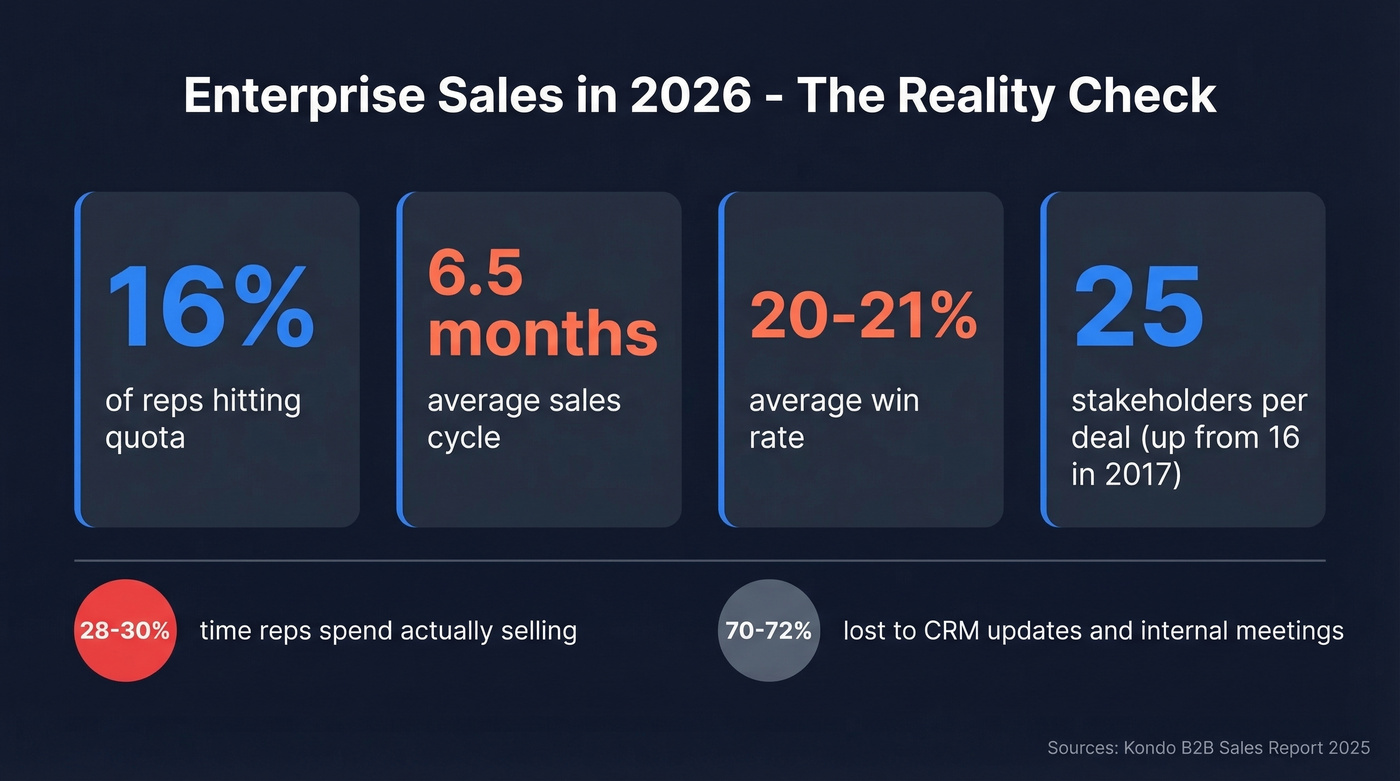
Only 16% of reps are hitting quota. Average sales cycles have stretched to 6.5 months, and win rates hover around 20-21%. The biggest structural shift? Buying committees now average 25 stakeholders - up from 16 in 2017. Reps spend just 28-30% of their time actually selling; the rest disappears into CRM updates and internal meetings. If you're entering enterprise expecting mid-market with bigger checks, you're going to have a rough year.
What You Need Before Anything Else
Nail these three before you read another word:
- Get a SOC 2 report (Type I at minimum) before you chase your first enterprise deal. Over 70% of B2B SaaS deals require one before contracts get signed. Starting from scratch when procurement asks - especially if they want SOC 2 Type II - means you're 3-5 months from closing.
- Adopt MEDDPICC for qualification. Teams using it see 18% higher win rates and 24% larger deal sizes.
- Multi-thread every deal across 3+ stakeholders. One champion isn't enough when buying committees average 25 people.
What Counts as Enterprise
| Segment | Employees | Typical ACV | Stakeholders |
|---|---|---|---|
| SMB | <100 | <$15k | 1-3 |
| Mid-Market | 500-2,000 | $15k-$50k | 3-8 |
| Enterprise | 2,000+ | $50k+ | 6-10 decision-makers, ~25 total |
The real dividing line isn't headcount. It's process. Targeting large organizations means navigating formal procurement, security reviews, legal redlines, and buying committees that move on their own timeline, not yours.
Should You Move Upmarket?
Not every company should. Benn Stancil nailed the anti-pattern in his essay on selling to enterprise - startups add an "enterprise tier" with a "contact us" button, build a million-dollar pipeline that looks incredible in board decks, and watch it sit there for months.
If your current segment can scale to $100M ARR, stay there. If it can't, moving upmarket is tempting - but it's a 12-18 month bet that could burn your runway while your core business stalls. Enterprise buyers will be there tomorrow. Your cash might not be.
Here's the thing: most Series A companies chasing enterprise are doing it because their board wants logos, not because their product is ready. If your average deal still closes in under 30 days, you haven't built the organizational muscle for 9-month cycles. Fix that first.
How Enterprise Deals Actually Work
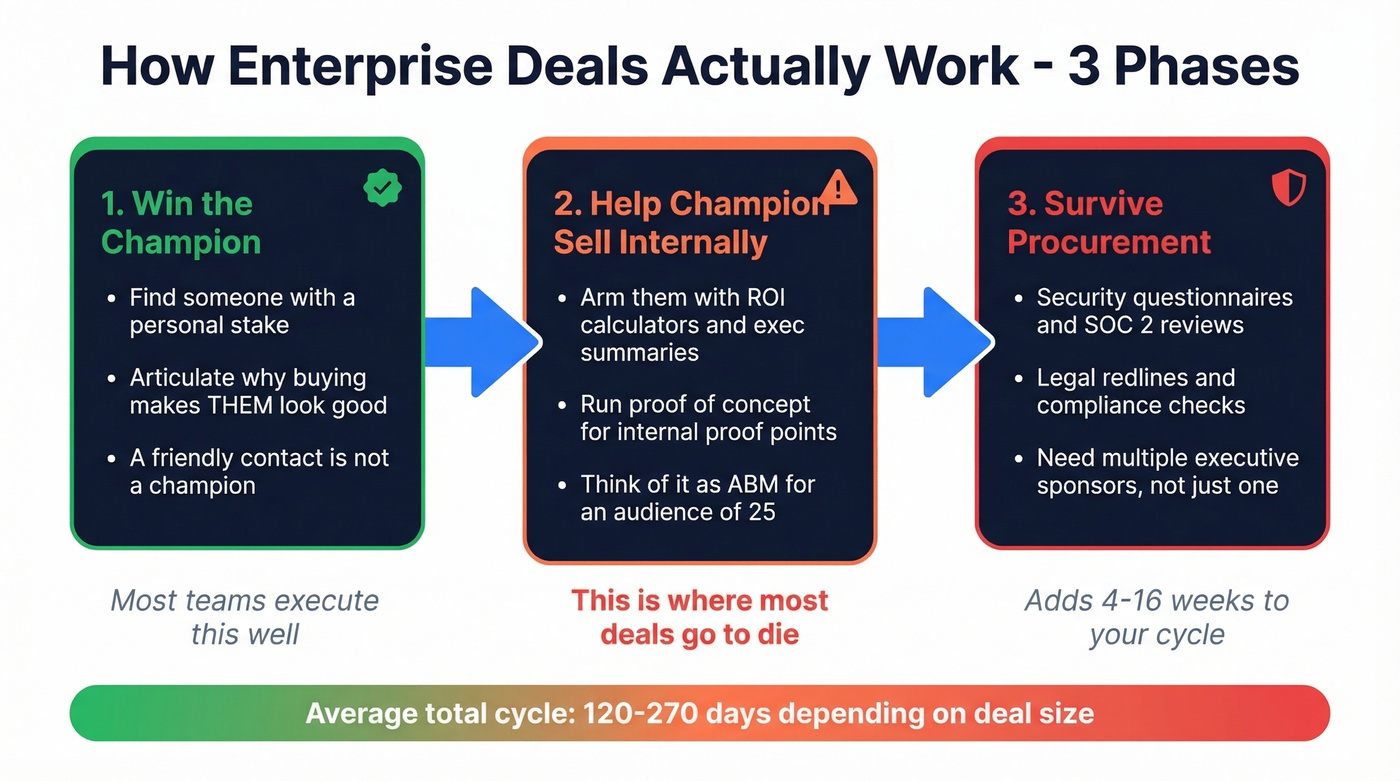
Most teams only execute the first phase well. There are three, and the second one is where deals go to die.
Win the Champion
Your champion is the internal advocate who'll spend political capital on your deal. They need a personal win - a promotion, a solved problem, a visible initiative. If you can't articulate why buying your product makes them look good, you don't have a champion. You have a friendly contact.
Help the Champion Sell Internally
This is where most deals stall. Your champion now needs to convince 5-24 other people, which means your job shifts from selling to enabling. Arm them with ROI calculators, security documentation, and executive summaries they can forward without scheduling a call. Bring in your SE for technical validation and run a proof of concept that generates internal proof points.
Think of it as an account-based campaign with an audience of 25.
Survive Procurement
Procurement doesn't care about your product. They care about risk, compliance, and price. This phase adds weeks or months. One practitioner described chasing Bank of America for months - many meetings, significant travel - only to end with a flat NO. Without multiple executive sponsors across the org, you're one reorg away from the same outcome.

Enterprise deals die when you can't reach the buying committee. With 25 stakeholders per deal, one bounced email to a CFO kills your credibility. Prospeo gives you 98% verified emails and 125M+ direct dials across 300M+ profiles - refreshed every 7 days, not every 6 weeks.
Snyk's 50 AEs cut bounce rates to under 5% and added 200+ opportunities per month.
Sales Cycle Benchmarks
Deal size is the strongest predictor of cycle length:
| ACV Range | Avg Cycle | Top Quartile | Procurement Adds |
|---|---|---|---|
| $50k-$100k | 120 days | ~94 days | 30-45 days |
| $100k-$250k | 170 days | ~130 days | 8-16 weeks |
| $250k-$500k | 220 days | ~170 days | 8-16 weeks |
| $500k+ | 270 days | ~210 days | 8-16 weeks |
If you're consistently above 170 days for the $50k-$100k band, the problem is usually qualification - you're working deals that aren't real.
MEDDPICC and Mutual Action Plans
73% of SaaS companies selling above $100k ARR use some version of MEDDPICC. The element most teams skip? Paper Process - the legal, procurement, and compliance steps that actually get a contract signed. 28% of deals fail when buyers can't secure internal approval. Map the paper process by the second meeting or you're flying blind.
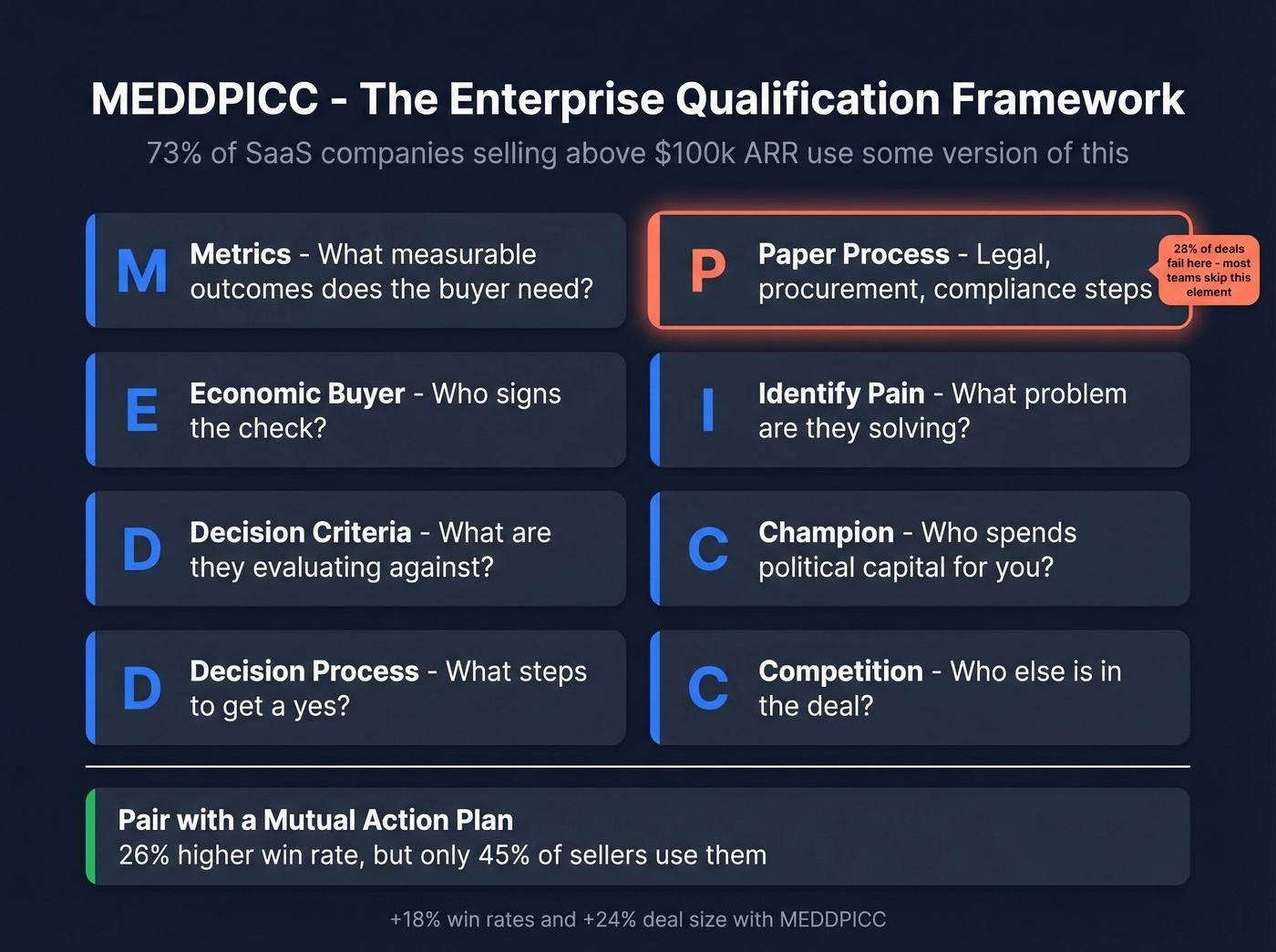
Pair MEDDPICC with a Mutual Action Plan. Deals with MAPs have a 26% higher win rate, yet only 45% of sellers use them. A MAP is a co-created roadmap with milestones, owners, and deadlines shared across stakeholders - it turns "we'll get back to you" into a trackable sequence of commitments. We've seen teams cut their average cycle by 3-4 weeks just by introducing a MAP at the second call, because it forces both sides to name the steps nobody wants to talk about early on.
Surviving Procurement
Your champion is excited. Then procurement sends a 200-item security questionnaire. 48% of software buyers rank security as the second most important factor after functionality, and over 70% of B2B SaaS deals require a SOC 2 report before contracts get signed.
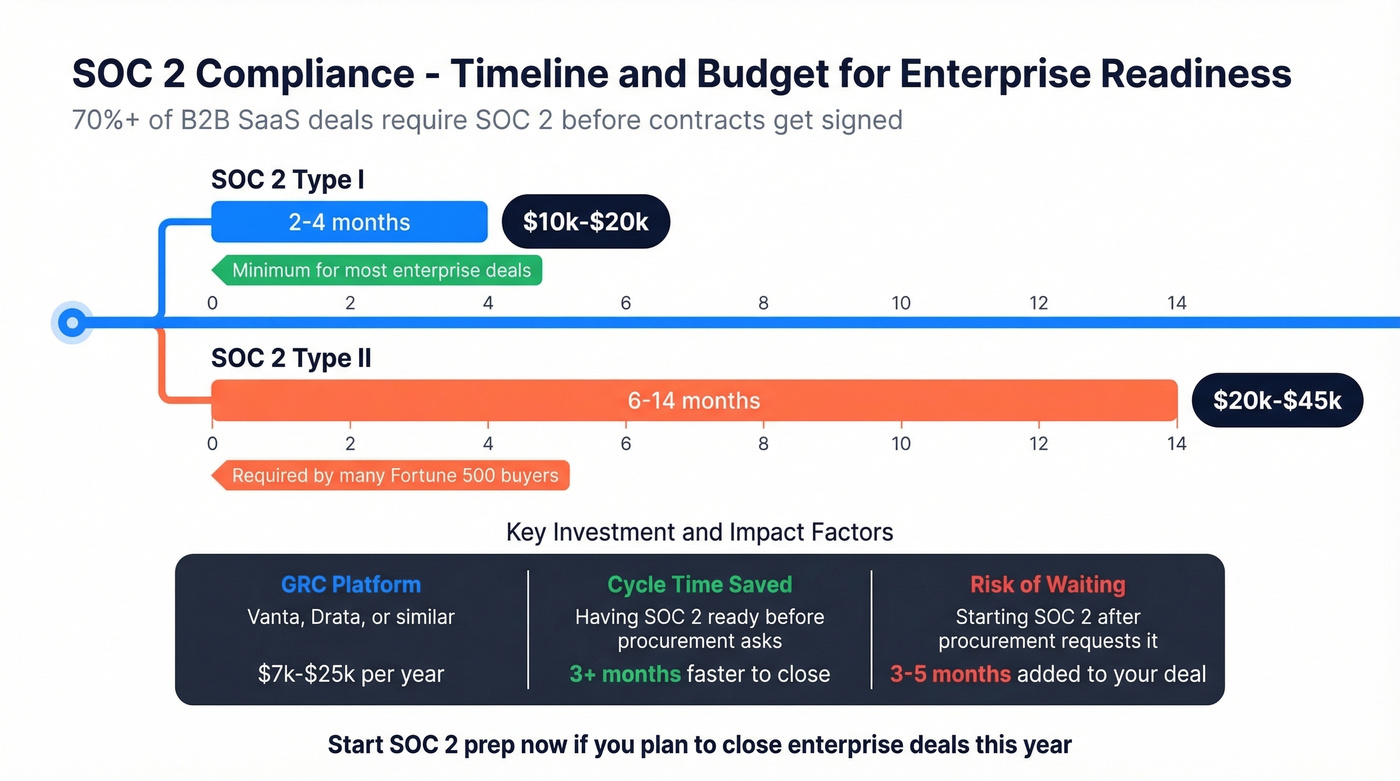
Here's what to budget:
- SOC 2 Type I: 2-4 months, $10k-$20k
- SOC 2 Type II: 6-14 months, $20k-$45k
- GRC platform (Vanta, Drata): $7k-$25k/year
If you're planning to close enterprise deals this year, start SOC 2 prep now. Having the report ready when procurement asks shrinks your sales cycle by 3+ months.
Reaching the Buying Committee
With 25 stakeholders per deal, you need verified contact data for every decision-maker - not just the champion. Bad data means bounced emails, which means lost credibility before the first meeting.
Let's be honest: we've all been in the situation where an AE sends a carefully crafted email to the CFO's office and it hard bounces. That's not just a wasted touch - it signals to the entire buying committee that you don't have your act together. When Snyk rolled out Prospeo across 50 AEs, their bounce rate dropped from 35-40% to under 5%, and they generated 200+ new opportunities per month. For enterprise multi-threading, that kind of data quality is the difference between reaching the committee and getting blocked at the gate.

Multi-threading across 25 decision-makers means you need verified contact data at scale - not one champion's email and a prayer. Prospeo's 30+ filters let you map entire buying committees by department, seniority, and job change signals, at $0.01 per email.
Stop losing 9-month deals to a bounced email. Build the full committee map now.
Mistakes That Kill Enterprise Deals
Single-threading is the #1 deal killer. One champion equals one point of failure. When they leave, your deal dies.
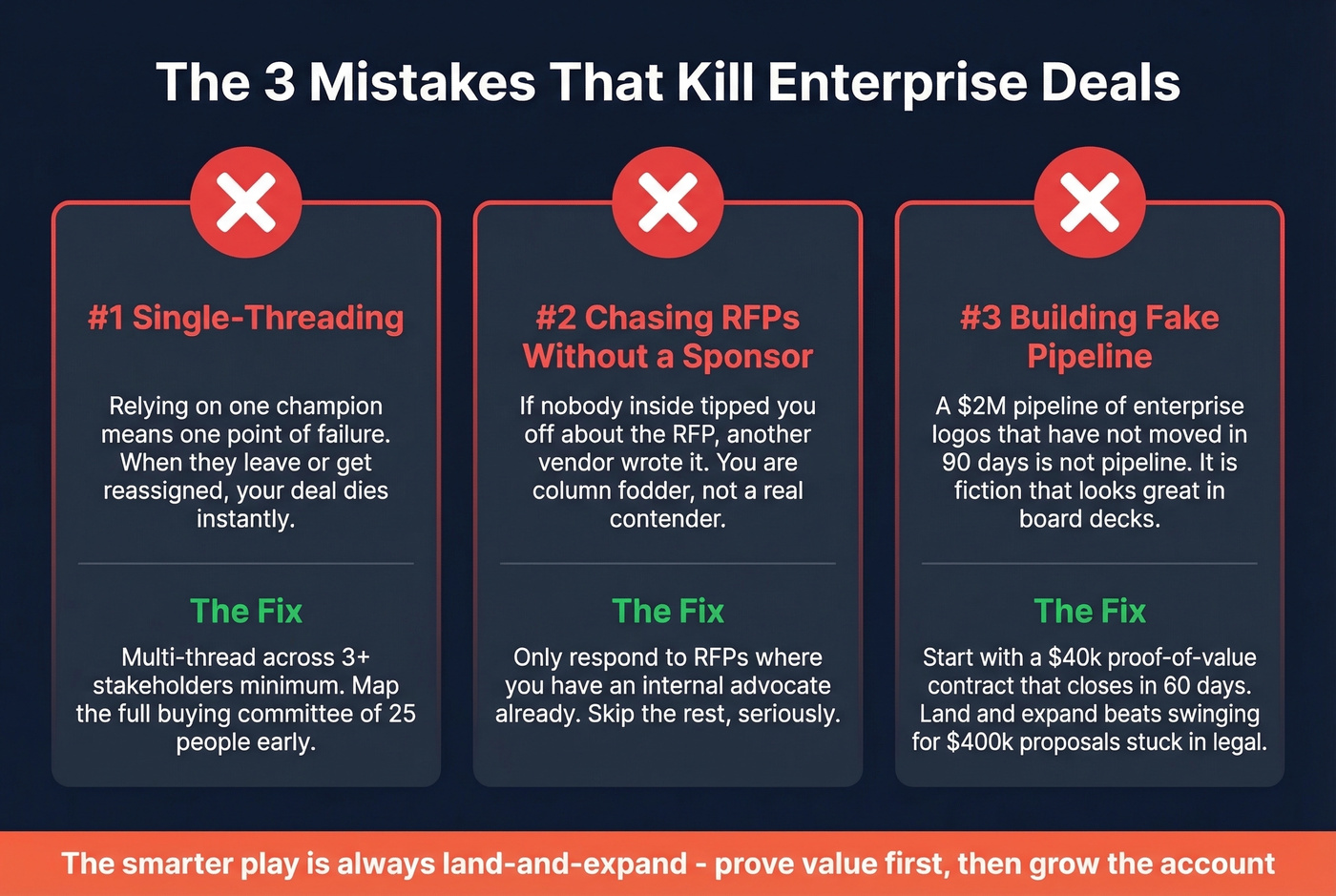
Chasing RFPs without a sponsor is equally dangerous. If you don't have an internal advocate before the RFP drops, you're column fodder. Skip it. Seriously - if nobody inside tipped you off about the RFP, another vendor wrote it.
Building "pipeline" that never closes is the subtlest trap. A $2M pipeline of enterprise logos that haven't moved in 90 days isn't pipeline. It's fiction. The smarter play is land-and-expand: prove value with a smaller initial contract, then grow from there. In our experience, teams new to selling to enterprise almost always default to swinging for the biggest possible deal, when a $40k proof-of-value contract that closes in 60 days teaches you more about the account than a $400k proposal that sits in legal for nine months.
FAQ
How long is a typical enterprise sales cycle?
Expect 120-270 days depending on deal size. A $50k-$100k deal averages 120 days; above $500k, plan for 270. Procurement reviews add 4-16 weeks on top of the core selling motion.
What separates enterprise from mid-market sales?
Mid-market deals close faster with 3-8 decision-makers and lighter procurement. Enterprise involves 6-10 decision-makers, often ~25 total stakeholders, plus formal security reviews and legal redlines. The motion shifts from convincing one buyer to enabling an internal campaign.
Do I need SOC 2 to close enterprise deals?
Almost certainly. Over 70% of B2B SaaS deals require a SOC 2 report before contracts get signed. Budget $10k-$45k and 2-14 months depending on Type I vs Type II. Start before procurement asks - it's the single biggest cycle-time reducer.
How do I find contact data for large buying committees?
Use a verified B2B data platform that prioritizes accuracy over database size. Look for real-time verification and direct dials, not just generic company addresses. Bounced emails destroy credibility with enterprise stakeholders, so a 98%+ accuracy rate and weekly data refresh aren't nice-to-haves - they're table stakes for this motion.