

Skrapp vs TrueVerify (2026): Which One Do You Actually Need?
You exported 5,000 leads, loaded them into your sequencer, and watched bounces jump past 15% on day one. Now you're comparing Skrapp vs TrueVerify, but here's the problem: these tools solve different problems. One helps you get emails. The other helps you trust the emails you already have.
Let's break this down the way we do it internally: start with the workflow, then worry about features.
30-second verdict
Use Skrapp if you need to find emails you don't have yet. It's an email finder with built-in verification: give it a name and domain, get an address back.
Use TrueVerify if you already have a list and need to clean it. It's verification-only: upload emails, get validity statuses. The 250 free checks make it easy to test.
Skip both if you want finding, verification, and verified mobile numbers in one place without stitching tools together. Tools like Prospeo cover the full loop (find + verify + mobiles) with 98% email accuracy, 125M+ verified mobiles, and a 7-day refresh cycle.
Why this comparison feels weird
Skrapp is what you use before you have a list. TrueVerify is what you use after you have one.
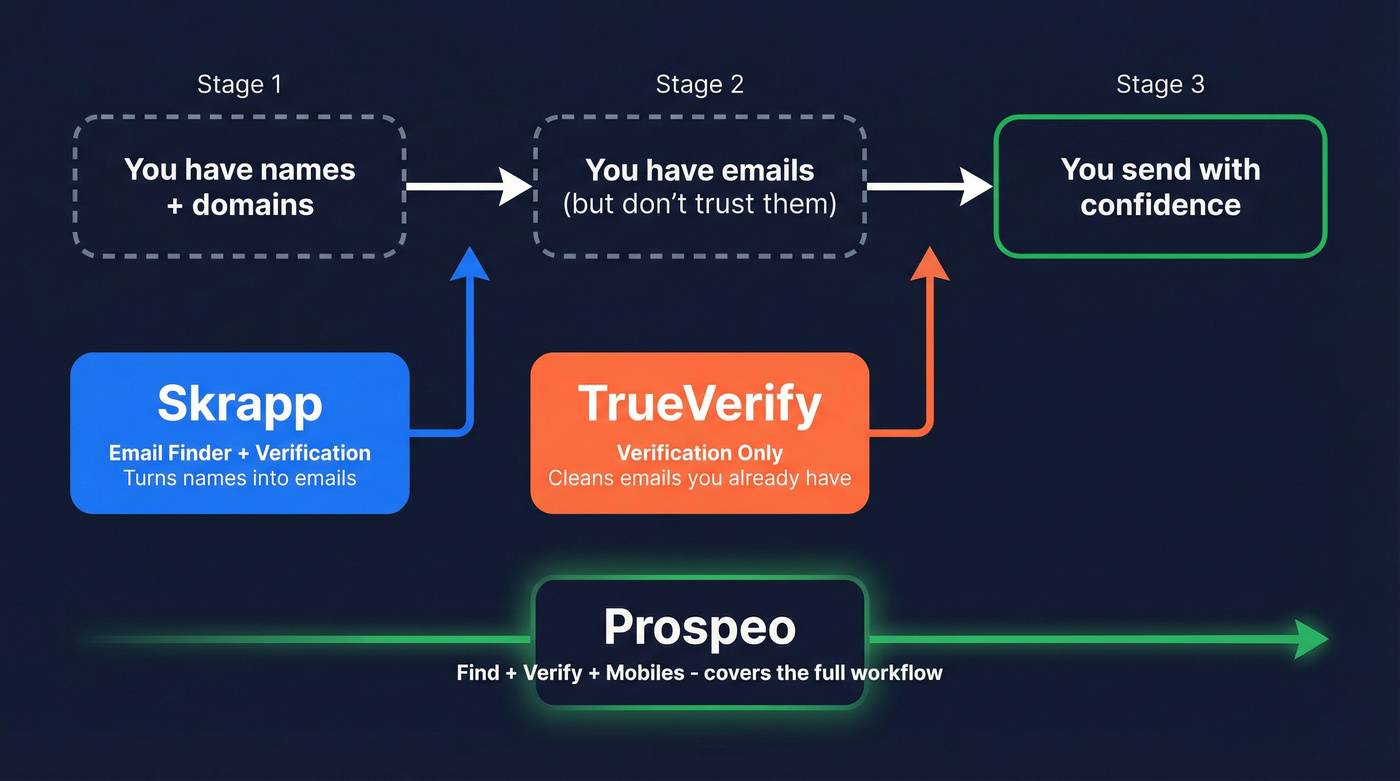
That sounds obvious, but it changes how you should evaluate them. If your bounce rate just spiked, TrueVerify can help you figure out how bad the damage is and stop it from getting worse. If you need net-new contacts, TrueVerify won't help at all.
Look, this is also why "Skrapp vs TrueVerify" threads tend to go nowhere. People argue about accuracy and pricing while talking past each other on the core question: are you missing emails, or are you missing confidence?
We checked community chatter too. The consensus on r/sales and similar subreddits is loud on the big names, but TrueVerify barely comes up, and the Skrapp mentions we saw weren't deep enough to treat as signal. In practice, you should run both on a small batch and judge them by your own bounce and reply rates.
Skrapp in 90 seconds
What it does: Skrapp finds business emails from a name + company/domain, verifies them, and helps you build lists from a large business database that Skrapp says is refreshed daily.
Who it's for: SDRs, recruiters, and founders doing outbound who need emails they don't have yet.
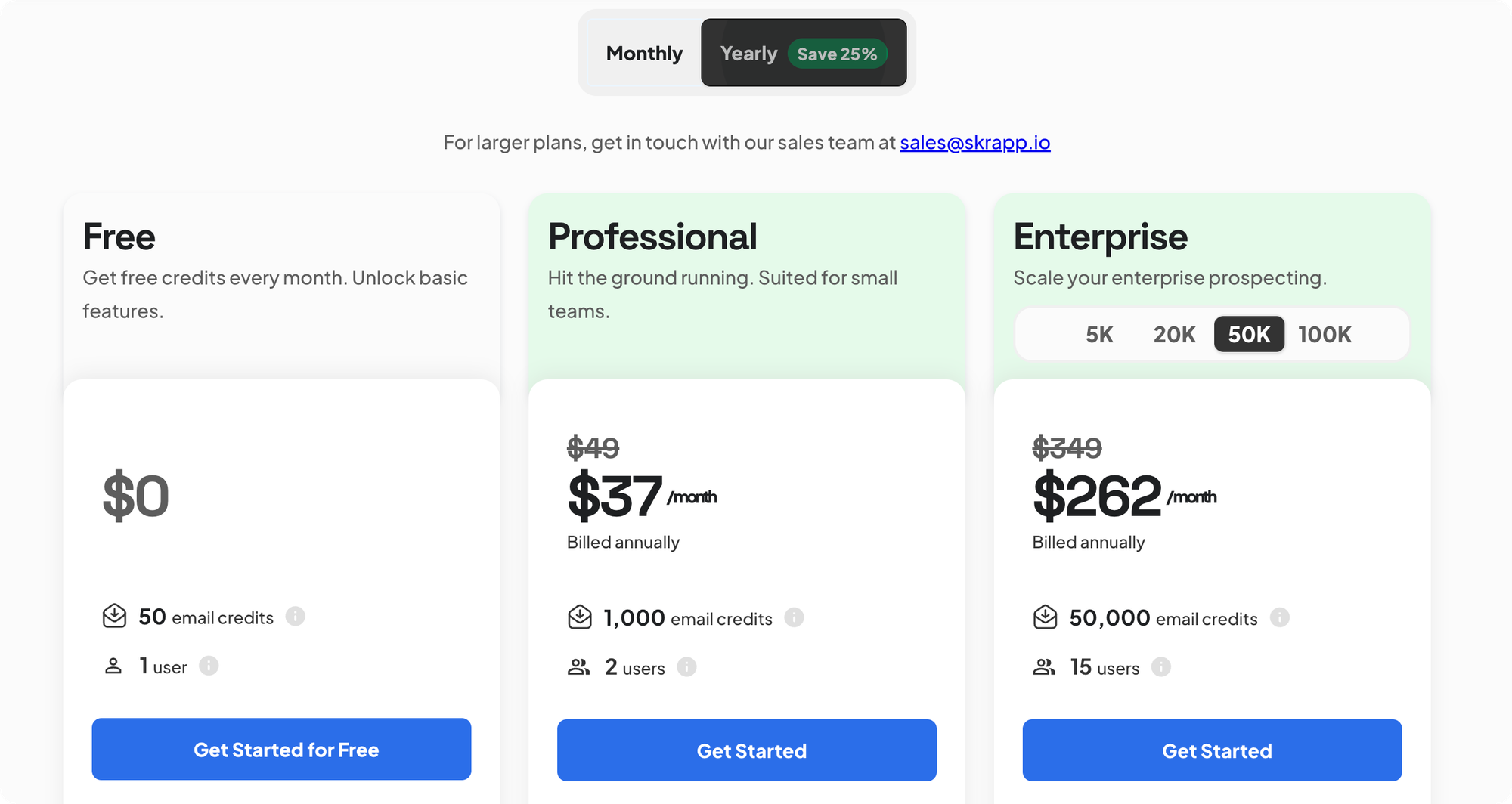
Skrapp's billing policy is the part we actually like. Credits are only charged for Valid or Catch-all results. Invalid and Unknown don't cost credits, which can drop your real cost per usable email if you're prospecting in messy industries or smaller markets.
Skrapp also claims a 92% search success rate and 97%+ verification accuracy. Treat those as vendor numbers, not gospel. In our experience, the gap between "verified" and "deliverable" shows up fast once you hit catch-all domains and older company websites.
Pricing: Skrapp has a free tier at 100 credits/month. Paid plans start at $30/month for 1,000 credits, per their pricing page: https://skrapp.io/pricing
TrueVerify in 90 seconds
What it does: TrueVerify verifies emails you already have via single checks, bulk uploads, and an API for real-time validation.
Who it's for: Marketers cleaning existing lists, ecommerce teams validating signups, and anyone staring at a CSV they don't fully trust.
TrueVerify runs the standard set of checks (syntax, MX/DNS, SMTP) and advertises spam-trap detection. It also offers a handful of free utilities (MX lookup, mail trap checker, regex checker), which is a nice touch if you're troubleshooting list issues.
Pricing: 250 free checks are included. Paid pricing isn't listed publicly. Real talk: that's annoying. In 2026, hiding pricing for a commodity-style service like verification makes comparisons harder than they need to be, and it usually means you'll spend time on emails or a call just to get a number.

Why stitch Skrapp and TrueVerify together when one platform does both? Prospeo finds emails, verifies them through a 5-step process with catch-all handling and spam-trap removal, and gives you 125M+ verified mobile numbers - all at ~$0.01/email with 98% accuracy.
Ditch the two-tool tax and prospect from a single dashboard.
Head-to-head: what you actually get
Here's the cleanest way to think about it: Skrapp is a producer (it creates new contacts). TrueVerify is a filter (it removes risk from contacts you already have).
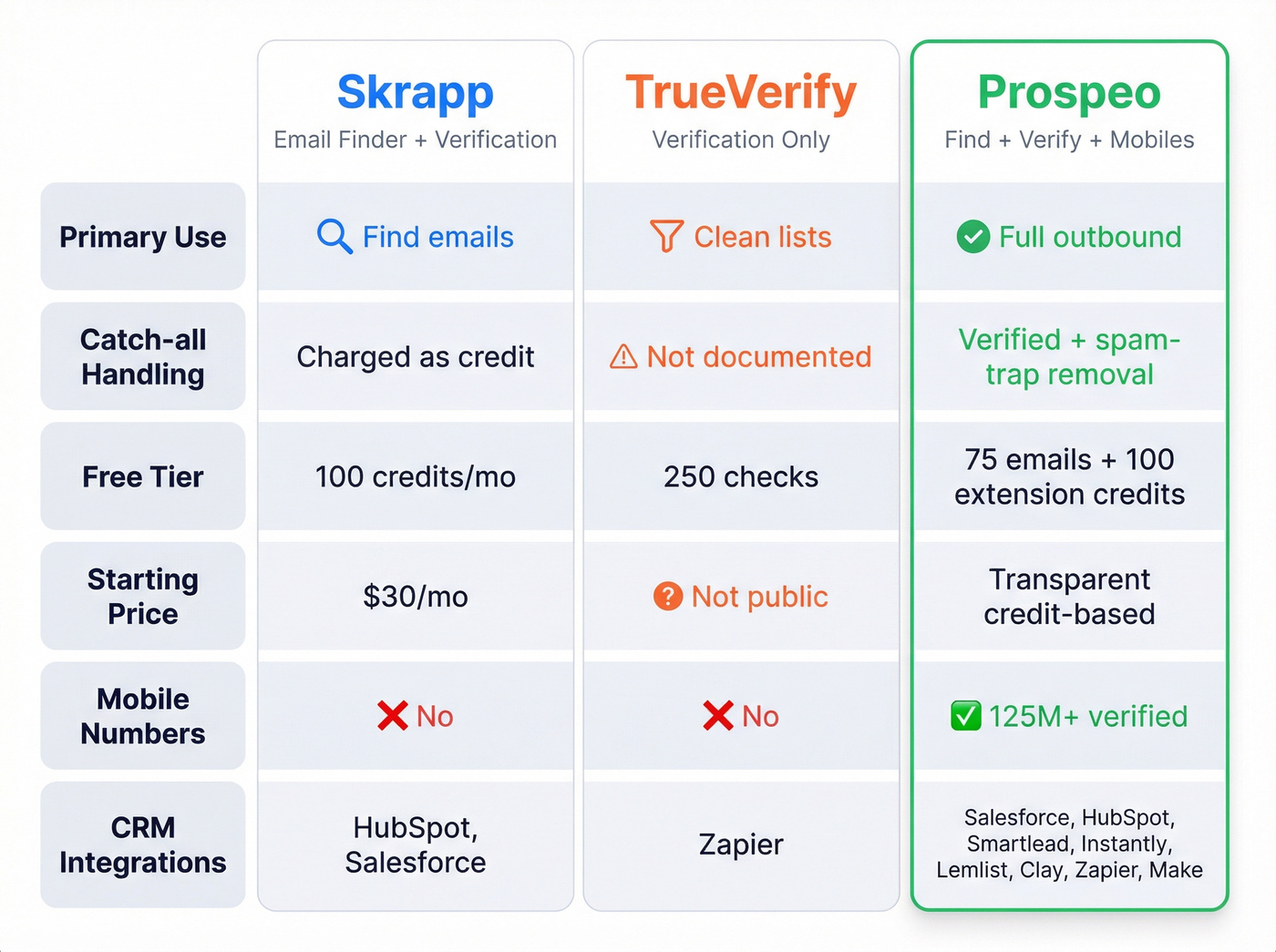
| Feature | Skrapp | TrueVerify | Prospeo |
|---|---|---|---|
| Primary job | Find + verify | Verify only | Find + verify + mobiles |
| Verification approach | Built-in verification | Syntax/MX/DNS/SMTP + spam-trap checks | 5-step verification + catch-all handling |
| Catch-all handling | Charged as a credit | Not clearly documented | Verified with spam-trap removal + honeypot filtering |
| Credit mechanics | No charge for Invalid/Unknown | 250 free, then paid | ~$0.01/email, pay only for valid |
| Free tier | 100 credits/month | 250 checks | 75 emails + 100 extension credits/month |
| Paid pricing | Starts at $30/month (1,000 credits) | Not public | Transparent, credit-based |
| Integrations | HubSpot, Salesforce | Zapier | Salesforce, HubSpot, Smartlead, Instantly, Lemlist, Clay, Zapier, Make |
| Mobile numbers | No | No | 125M+ verified mobiles |
| Accuracy claim | 97%+ verification | 99.9% | 98% email accuracy |
| Best for | Email-only prospecting | Quick list cleaning | Full outbound workflow |
One strong opinion from our side: the "tool-stitching tax" is real. Two dashboards, two billing systems, two sets of exports, and one more place for your team to mess up a column mapping. If you're sending meaningful volume, that overhead quietly becomes your most expensive line item.
What it actually costs (with a real scenario)
Let's use a scenario we see all the time.
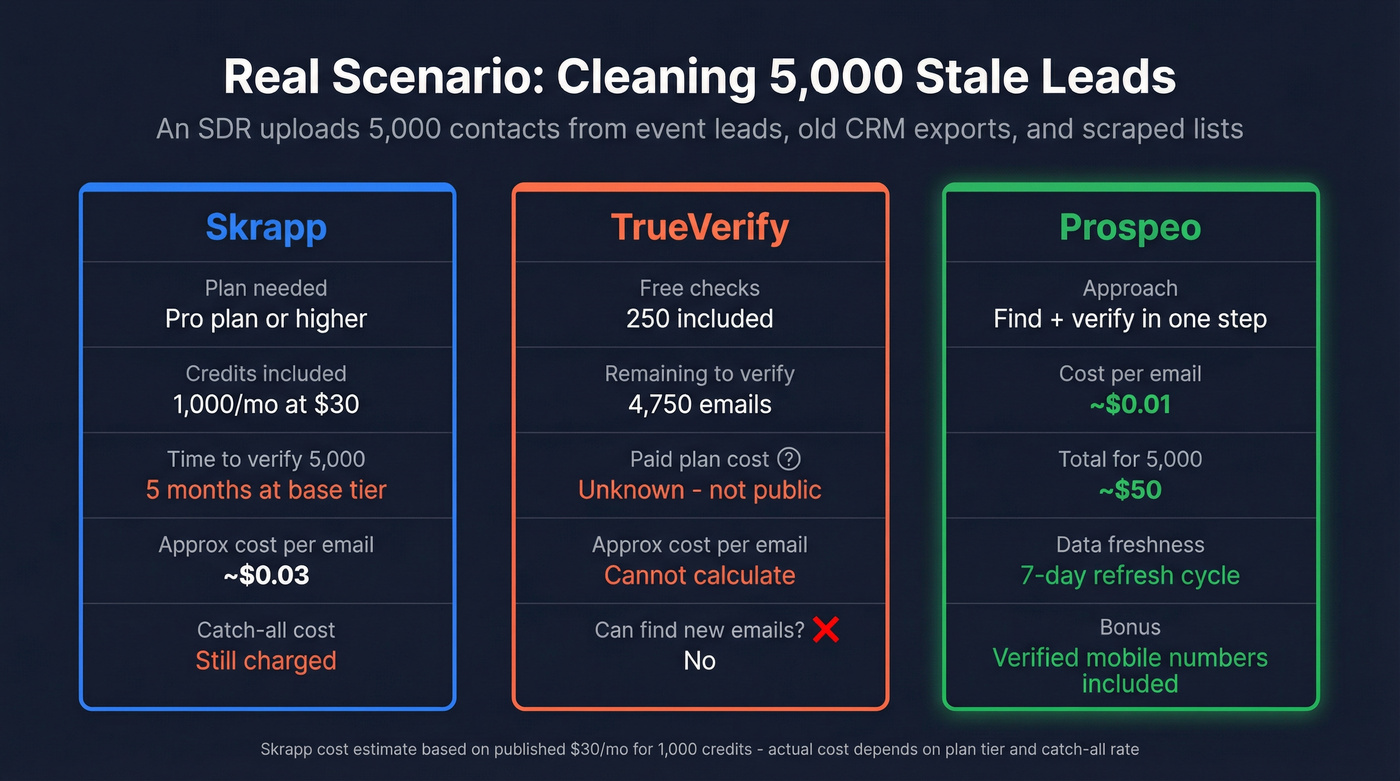
An SDR pulls 5,000 contacts from event leads, old CRM exports, and a scraped list someone swears is "pretty clean." They upload it to their sequencer, and the domain gets dinged within 48 hours. Now you're in cleanup mode, and you need to stop the bleeding before deliverability tanks for the whole team.
Verifying 5,000 emails with Skrapp: Skrapp's Pro plan includes 1,000 credits/month. If you used it purely for verification volume, you'd need 5,000 credits to run the full list, which is effectively five months of that tier unless you move up a plan. Based on the $30/month starting price, that math lands around ~$0.03 per checked email at that tier, before you factor in how many results come back as catch-all.
Verifying 5,000 emails with TrueVerify: you can test 250 for free, which is perfect for a quick "how bad is this list?" sanity check. After that, you need a paid plan, and pricing isn't public, so you can't do clean unit economics without talking to them.
Finding + verifying 1,000 new contacts: Skrapp can do this in one workflow. TrueVerify can't, because it doesn't find emails. If you're comparing them for prospecting, you're already headed toward a two-tool setup.
Accuracy: vendor claims vs what happens in the wild
Every verifier says "97%+" and hopes you don't ask "97% of what?"
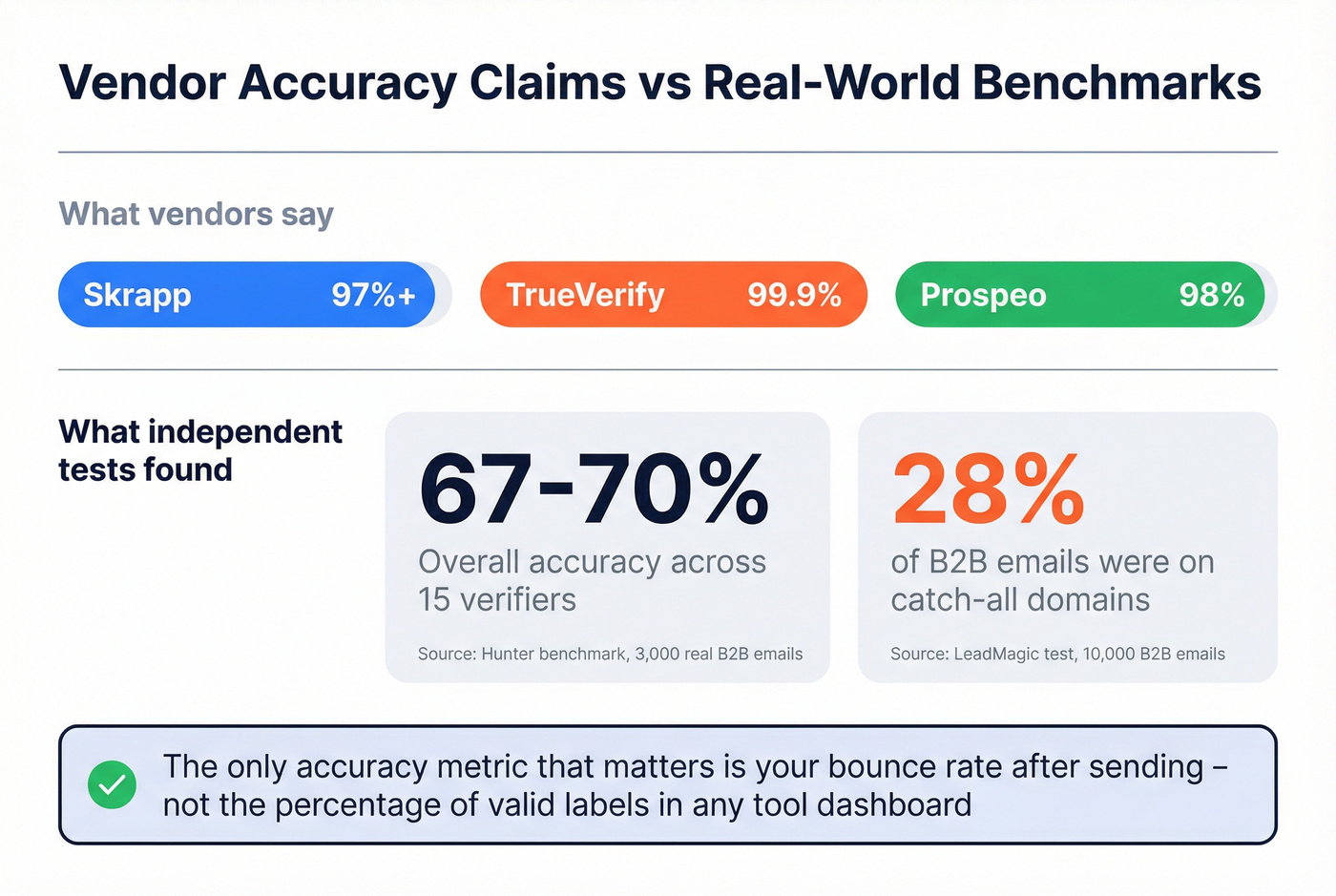
Independent benchmarks are sobering. Hunter published a benchmark across 15 verifiers using 3,000 real business emails, and the top tools landed around 67-70% overall accuracy: https://hunter.io/email-verification-guide/best-email-verifiers/
LeadMagic ran a larger test on 10,000 B2B emails and found that 28% were on catch-all domains, where no verifier can give you a definitive yes/no: https://leadmagic.io/blog/best-email-verification-tools
Here's the thing: catch-all handling is where tools quietly diverge. Some tools label catch-all as "valid" (which makes their accuracy look great on paper). Others label it "risky" or "unknown," which is more honest but less satisfying in a dashboard. Skrapp charges credits for catch-all results. TrueVerify doesn't clearly document how it labels or bills catch-all outcomes, so you should test it with a batch that includes known catch-all domains from your market.
If you want one practical rule: judge verifiers by bounce rate after sending, not by the percentage of "valid" labels in the UI. The UI is easy to optimize. Your sender reputation isn't.
Integrations quick look
Sales teams living in a CRM will lean toward Skrapp because it has native HubSpot and Salesforce integrations. That matters if your workflow is "research -> find -> push to CRM -> sequence" and you don't want CSVs floating around. If deliverability is a recurring issue, it’s also worth keeping an email deliverability checklist handy.
Ecommerce teams validating signups can use TrueVerify through Zapier. For example, Zapier has a workflow to validate emails for new Shopify customers with TrueVerify: https://zapier.com/apps/shopify/integrations/trueverify/255688696/validate-emails-for-new-customers-in-shopify-with-trueverify
One quick clarification: don't confuse TrueVerify with Truelist. Different companies, different products, and the naming overlap causes constant confusion.
So which one should you pick?
Pick Skrapp if you're doing email-only prospecting and you like the fair credit policy (no charge for Invalid/Unknown). It’s a straightforward way to turn names + domains into sendable addresses - and it pairs well with a broader set of sales prospecting techniques when you’re scaling outbound.
Pick TrueVerify if you already have emails and you need list hygiene fast. Start with the free 250 checks, then decide if the paid plan makes sense once you see your real invalid/catch-all rate. If you’re diagnosing why lists go bad, our guide on email bounce rate is a useful companion.
Skip both if your team keeps bouncing between "finding" and "cleaning" and you want one system to handle the whole workflow. Prospeo is built for that: 300M+ professional profiles, 143M+ verified emails, 125M+ verified mobiles, and a 7-day refresh cycle, plus native integrations across the outbound stack. If you’re comparing more options, see our roundup of email search tools and Bouncer alternatives.
That 5,000-lead cleanup scenario? Prospeo's 7-day data refresh means contacts stay current before they ever hit your sequencer. No stale data, no bounce spikes, no scrambling between a finder and a verifier after the damage is done.
Clean data starts at the source - not after your domain gets flagged.
FAQ
Is Skrapp an email verifier or an email finder?
Skrapp is primarily an email finder with built-in verification. You give it a name and company/domain, and it returns an email with a verification status. If you only need verification, a verification-only tool is usually the simpler choice.
What does "catch-all" mean in email verification?
A catch-all domain accepts mail for any address at that domain, even if the mailbox doesn't exist. That means SMTP checks can't confirm whether "jane@company.com" is real, because the server says "sure, send it" either way. That's why catch-all domains skew accuracy stats so heavily.
Should you trust TrueVerify's 99.9% accuracy claim?
Treat it as a marketing metric unless it's defined clearly. Real-world benchmarks show much lower overall accuracy once you include catch-all and ambiguous cases. Run your own test batch, then measure what matters: bounces, blocks, and reply rates after sending.
Are TrueVerify and Truelist the same product?
No. They're separate products from different companies. Double-check the domain so you don't buy the wrong tool: trueverify.io vs truelist.io.