

Small Business Sales Training: What Actually Works on a Real Budget
You just hired your first sales rep and realized you have no idea how to train them. Or maybe you're the founder doing all the selling yourself, and "winging it" stopped working two quarters ago. The small business sales training industry is a slice of a $10.32 billion market - and most of it is built for enterprise teams with enterprise budgets.
What follows is for everyone else: businesses with 1-10 salespeople and somewhere between $0 and $1,500 to spend on getting better at selling.
The industry wants you to believe you need a $10,000 methodology certification before you can sell. You don't. Effective training returns $4.53 for every $1 invested - a 353% return - and companies that invest see a 19% increase in win rates and a 57% boost in sales effectiveness. But those numbers only hold if you pick the right program and actually reinforce it.
What You Need (Quick Version)
On r/smallbusiness, the most common training budget people cite is $500-$1,500. Three paths based on what you can actually spend:
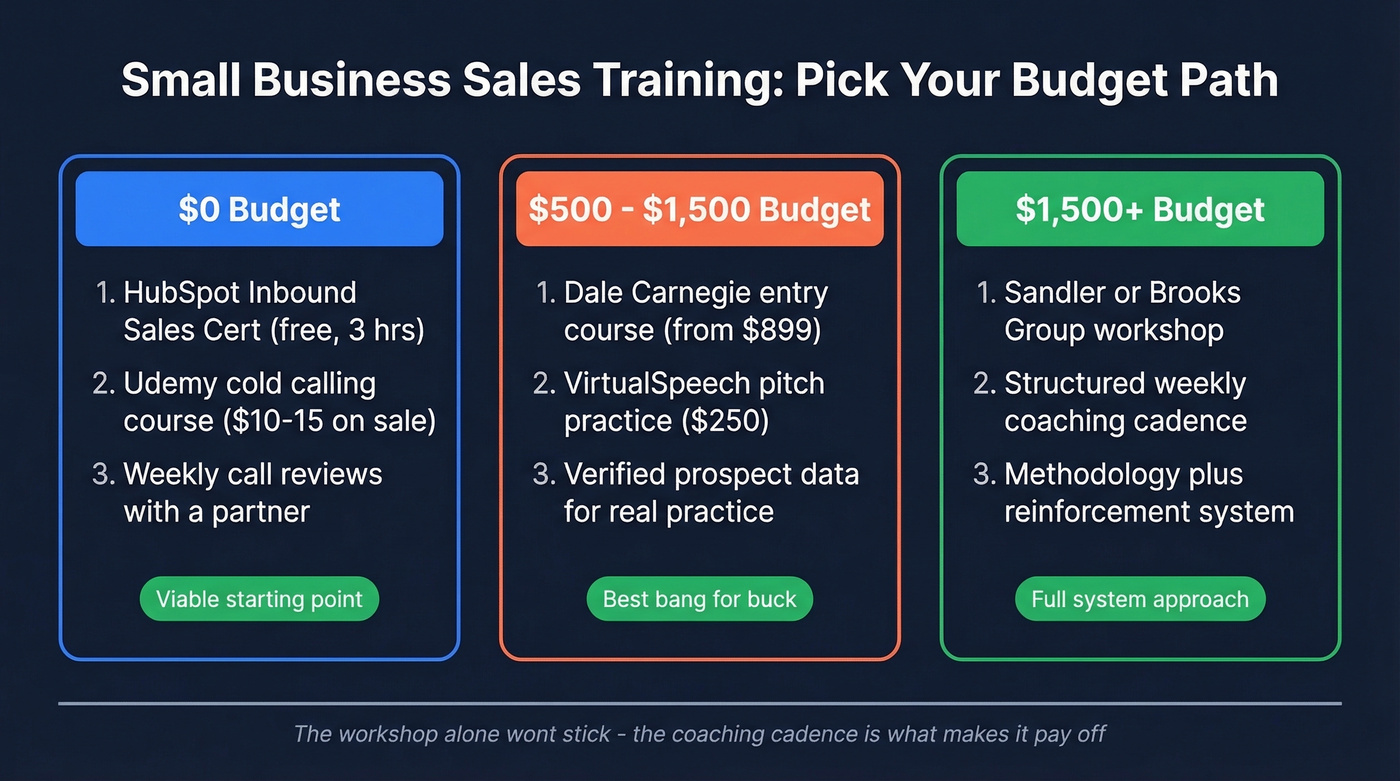
- $0 budget: HubSpot Academy certifications (free, 3 hours 6 minutes for the Inbound Sales cert) + one Udemy cold calling course ($10-$15 on sale) + weekly call reviews with a partner or your team. This is viable. Don't let anyone tell you otherwise.
- $500-$1,500 budget: Dale Carnegie's entry course (from $899) or VirtualSpeech ($250) for pitch practice, plus verified prospect data so you're practicing on real targets instead of made-up scenarios. Training without a prospect list is just theory.
- $1,500+ budget: Sandler or Brooks Group workshop for methodology, paired with a structured weekly coaching cadence. The workshop alone won't stick - the cadence is what makes it pay off.
Why Most Training Fails
Here's the uncomfortable stat: only 18% of buyers believe salespeople are well-prepared for a sales conversation. On the training side, 90% of new sales skills are lost within a year without follow-up and reinforcement. That's not a knock on the training itself - it's a knock on how companies deploy it.
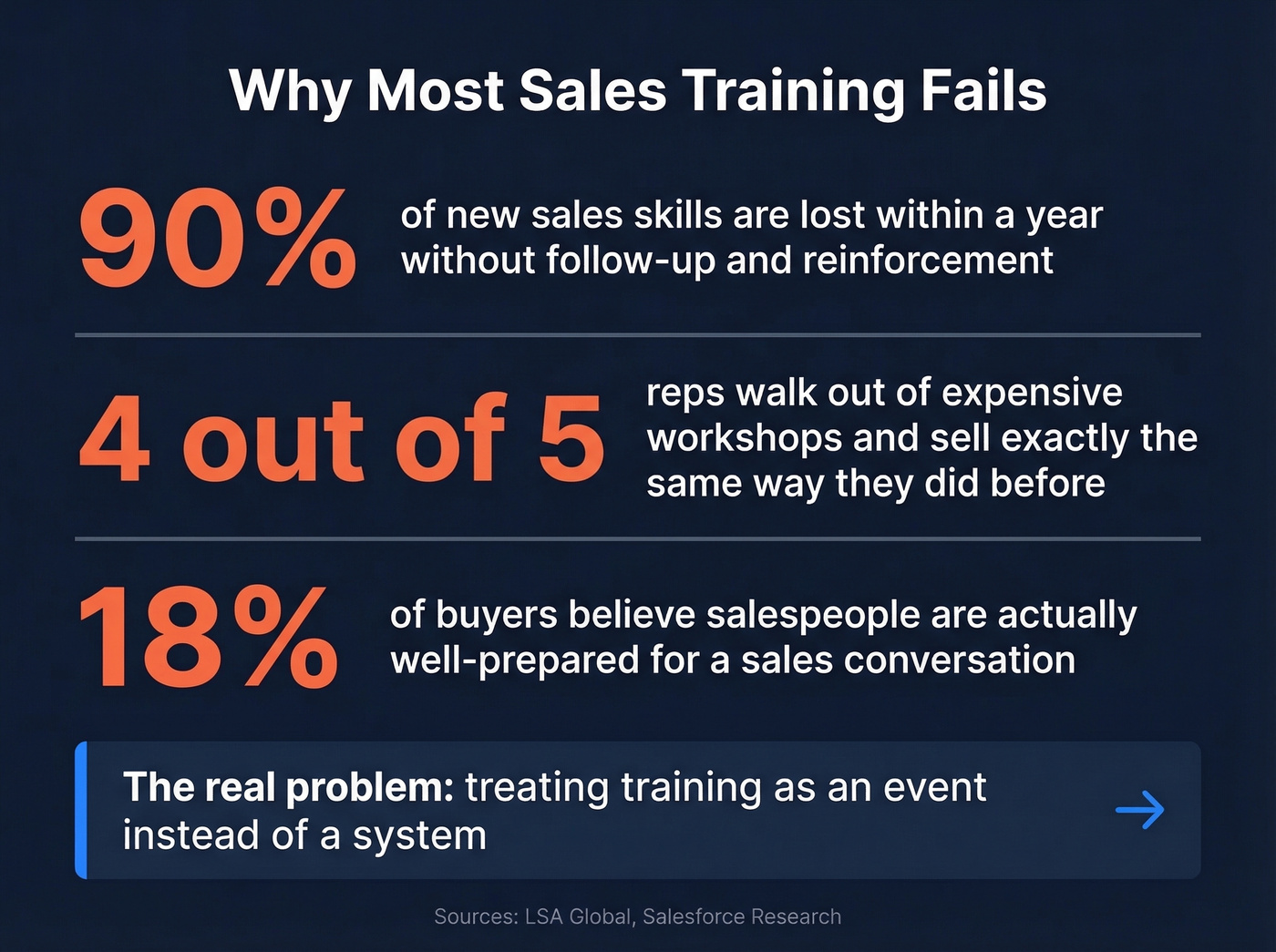
The pattern is painfully predictable. A small business owner spends $2,000 on a two-day workshop. Reps come back energized. Two weeks later, everyone's back to their old habits. The owner blames the program. The real problem was treating training as an event instead of a system.
LSA Global's research puts it bluntly: only 1-in-5 reps change their on-the-job behavior from standalone training. Four out of five people walk out of that expensive workshop and sell exactly the same way they did before.
The other trap is confusing product training with sales training. Teaching your rep how the product works isn't teaching them how to run a discovery call, handle objections, or close. Product knowledge is necessary. It's not sufficient. Small businesses blur this line constantly because the founder knows the product cold and assumes that knowledge transfers into selling ability. It doesn't.
Founder-Led Sales: Train Yourself First
Before you train anyone else, you need to sell effectively yourself. This isn't optional.
We've watched founders close deals that trained reps couldn't - not because they're better salespeople, but because prospects trust the person who built the thing. Founders often convert at 2-3x the rate of early salespeople. A founder on a discovery call carries executive credibility, deep domain expertise, and the ability to make commitments a rep can't. On r/smallbusiness, founders consistently ask for the same things: how to talk to clients, handle objections, and confidently present their offer.
Build personal credibility. Share your story. Why did you start this business? What problem did you see that nobody else was solving? This isn't fluff - it's the opening of every good sales conversation.
Put your domain expertise to work. You know your market better than any rep you'll hire. Use that knowledge to ask questions competitors can't ask and spot pain points prospects haven't articulated yet.
Use authentic storytelling. Case studies and customer wins, told in your own voice, convert better than any polished sales deck. Prospects can smell scripted pitches. They can't resist a real story about someone like them.
Create repeatable outreach. Document what works. Track your conversion rate from outreach to meeting to close. This becomes your first sales playbook - the thing you'll eventually hand to your first hire.
The biggest advantage of founder-led sales is the zero-distortion feedback loop. When you're the one talking to prospects, you hear objections firsthand. That feedback shapes your product, your positioning, and your pricing in ways that no amount of market research can replicate.
How to Train a Small Team
Enterprise programs are heavy on theory, light on application, and built for organizations with dedicated L&D teams. You don't have that. Here's what works when you've got a handful of reps and no training department.
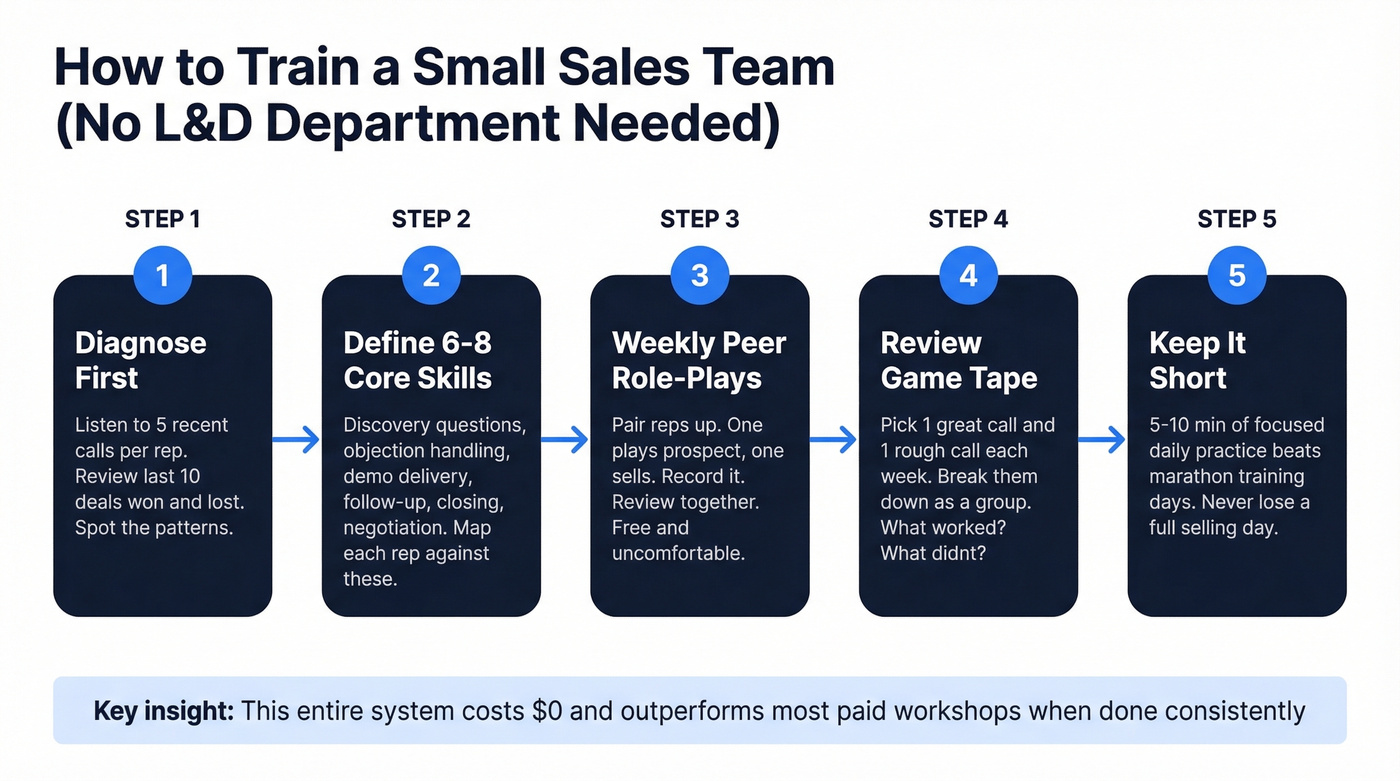
Start with diagnosis, not curriculum. Listen to five of each rep's recent calls. Review their last ten deals - won and lost. You'll spot patterns fast. Maybe they're great at discovery but terrible at asking for the close. Maybe they talk too much and listen too little. Identify the gap first, then train to it.
Define 6-8 core skills. Not twenty. Not fifty. Pick the skills that actually move deals forward in your specific sales cycle: discovery questions, objection handling, demo delivery, follow-up cadence, closing techniques, and negotiation. Map each rep against these skills and you'll see where to focus.
Run peer role-plays weekly. This is the single most underused method in small businesses. Pair reps up, one plays the prospect, one sells. Record it. Review it together. It's free, it's uncomfortable, and it works better than most paid programs.
Use call recordings as game tape. Every sports team reviews film. Your sales team should too. Pick one great call and one rough call each week. Break them down as a group. What worked? What didn't? What would you do differently?
Keep sessions short. Five to ten minutes of focused daily practice beats marathon training days. Reps retain more, and you don't lose a full day of selling.
One emerging option worth watching: AI roleplay tools like Hyperbound and Second Nature now let reps practice discovery calls and objection handling against AI-generated prospects. For a small team without enough reps to pair up, these tools fill the gap at $50-$200/month per seat. They're not a replacement for real call reviews, but they're a solid supplement for consultative selling skills.

Training your reps on fake scenarios wastes everyone's time. Pair your new sales playbook with verified prospect data - 300M+ profiles, 98% email accuracy, 30+ filters to find your exact ICP. At $0.01 per email, even a $0 training budget can afford real targets.
Stop role-playing with made-up leads. Prospect for real.
Best Programs for Small Companies
Here's every program worth considering, organized by what you'll actually pay. Structured programs often land in the $1,000-$5,000 per rep per year range, and you can get 80% of the value for a fraction of that.
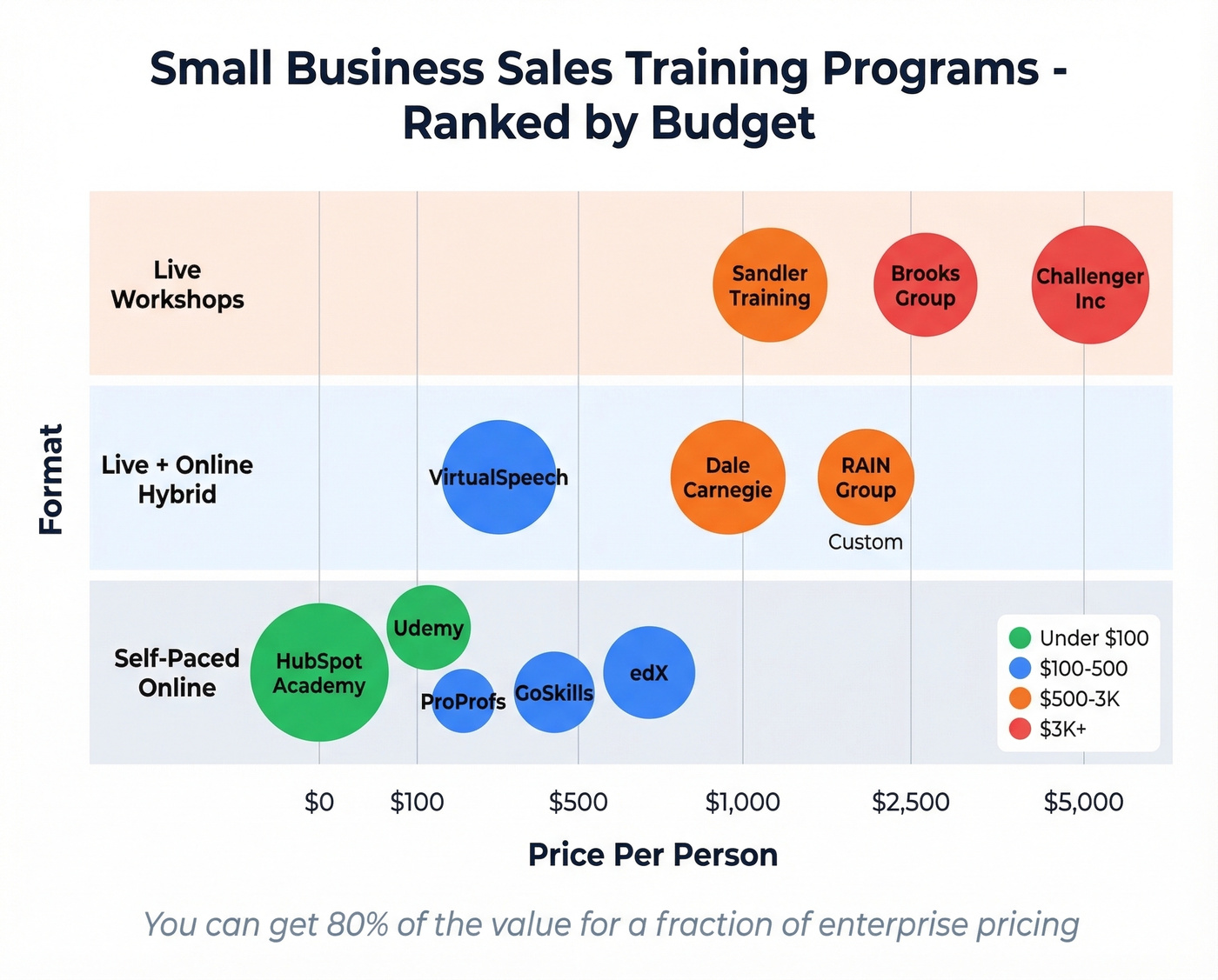
| Program | Price | Format | Best For |
|---|---|---|---|
| HubSpot Academy | Free | Online, self-paced | Foundations, inbound |
| Udemy Sales Courses | $5-$50/course | Online, self-paced | Cold calling, skills |
| GoSkills | Free-$6.36/mo | Online, self-paced | Structured paths |
| ProProfs | $1.99/learner/mo | Online, LMS | Teams needing tracking |
| VirtualSpeech | $250 one-time | Online + VR | Pitch practice |
| RAIN Group | Custom | Online | Consultative selling |
| StoryBrand | Varies by workshop | Online workshop | Messaging clarity |
| edX | $349/learner/yr | Online | Enablement foundations |
| Dale Carnegie | From $899 | Live + online | Confidence, comms |
| Sandler Training | ~$1K-$3K/person | Live workshops | Methodology-driven |
| Brooks Group | $2,500-$5,000 | Modular, 1-3 days | Structured process |
Challenger Inc (~$2K-$5K/person, custom workshops) is worth considering if you're in complex B2B sales cycles with multiple stakeholders, but it's overkill for most small businesses.
HubSpot Academy (Free)
Use this if you're starting from zero and need a recognized credential fast. The Inbound Sales cert takes 3 hours and 6 minutes. The Sales Enablement cert adds another layer. Both are good for building a foundation - don't let anyone tell you free means worthless.
Skip this if you need live coaching, roleplay practice, or anything beyond self-paced video content. HubSpot teaches methodology well but can't watch you fumble a discovery call and tell you what to fix.
Udemy Sales Courses ($5-$50)
Spencer Lodge's "Starting in Sales" is a strong pick for absolute beginners, and Aspireship's "Intro to SaaS Sales" is free and surprisingly thorough. Udemy runs frequent sales that bring $50 courses down to $10-$15, so never pay full price. The catch: nobody's checking whether you actually applied what you watched. Udemy is a la carte learning - great for filling a specific skill gap like cold calling confidence or objection handling, useless as a standalone methodology.
Dale Carnegie (From $899)
The pricing frustration here is real: the website says "from $899" but the full live experience runs $1,000-$1,800 depending on location and format. That said, if you're in a service business where confidence, communication, and relationship-building matter more than cold outbound technique, Dale Carnegie is worth every dollar. Their live courses are excellent for people who freeze up in sales conversations or struggle with executive presence.
Skip it if you need modern outbound skills - cold email sequences, social selling, pipeline management. Dale Carnegie's strength is interpersonal communication, not pipeline mechanics.
Sandler Training (~$1,000-$3,000+)
In our experience, Sandler works best for teams that want a shared sales language - a common methodology everyone uses. Their 4.8/5 rating on G2 with 105 reviews reflects satisfaction from teams that commit to the system. The frustrating part: Sandler doesn't publish pricing. Custom engagements often land in the $3,000-$20,000+ range depending on team size and duration. That's a big check to write without knowing the number upfront. If you're a solo founder or two-person team, start with their books and podcasts before committing to a workshop.
The $0 Training Stack
Let's be honest: if your budget is zero, that's fine. Plenty of successful sales teams started here and added paid programs later as revenue grew. Here's a concrete plan that costs nothing.
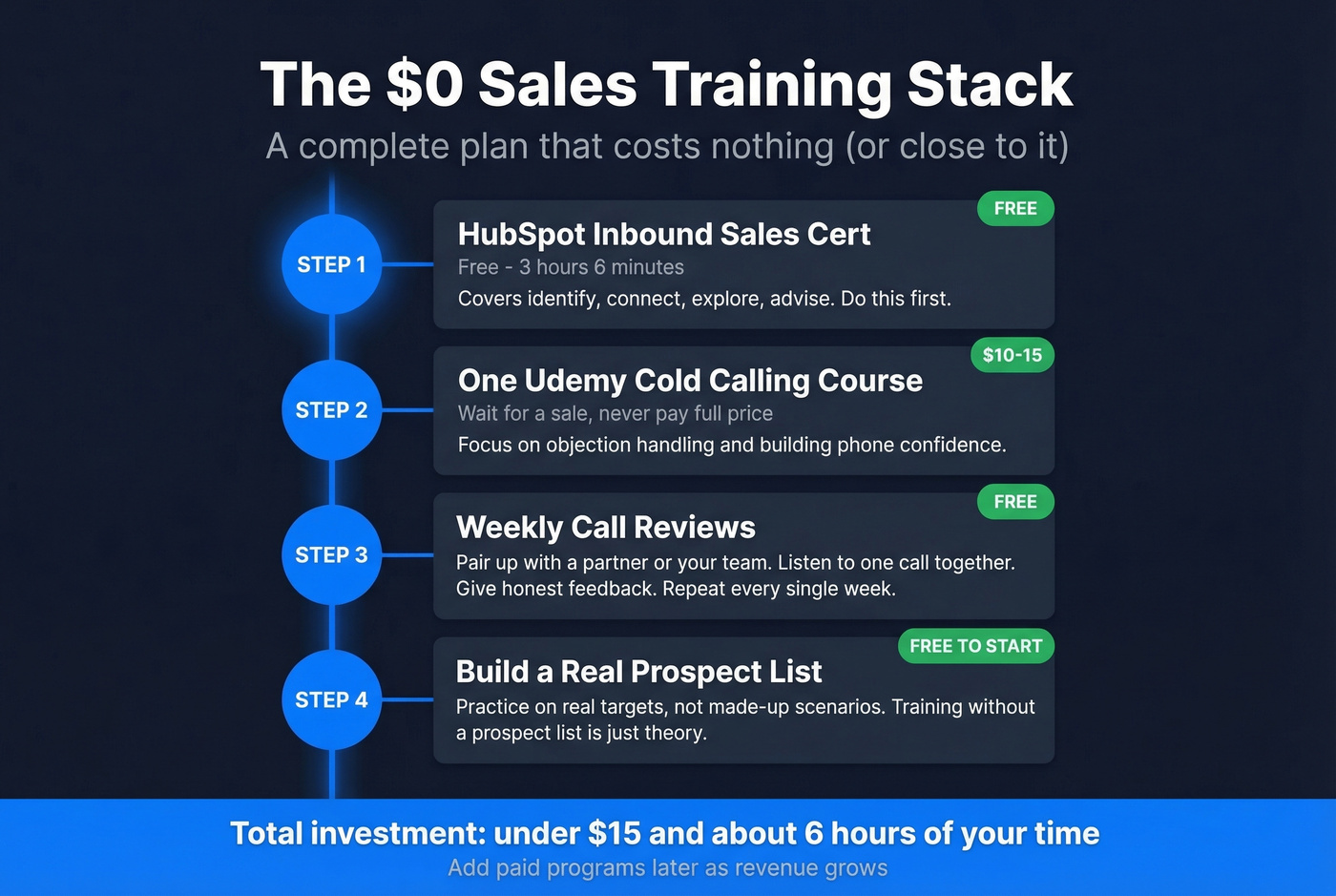
Step 1: HubSpot Inbound Sales Certification. Free. 3 hours 6 minutes. Covers the full inbound methodology from identify to connect to explore to advise. Do this first.
Step 2: One Udemy cold calling course. Wait for a sale and grab it for $10-$15. Focus on a course that covers objection handling and opening lines - the two skills that make or break cold outreach.
Step 3: Weekly call recording reviews. Record every sales call with consent. Pick one win and one loss each week. Review them with your team or an accountability partner. This is the highest-ROI training activity that exists, and it's completely free.
Step 4: Build a verified prospect list. Training without targets is academic. You need real companies and real contacts to practice on. Tools like Prospeo offer free tiers specifically so small teams can start prospecting without a budget commitment.
Step 5: Track three KPIs. Calls made. Conversations had. Meetings booked. That's it. Don't overcomplicate measurement when you're starting out.
Quick-win free courses you can finish in a single sitting:
| Course | Duration |
|---|---|
| Sales CRM Expert Certificate | 44 min |
| Sales Training with HubSpot | 1h 46m |
| Inbound Sales Certification | 3h 6m |
Making Training Stick
The single highest-ROI investment isn't a course. It's weekly call reviews.
Reps who receive regular structured coaching outperform their peers four-to-one in quota attainment. That's not a marginal improvement - it's a completely different outcome. And coaching doesn't require a $10,000 consultant. It requires a manager or founder who listens to calls and gives specific, actionable feedback every week.
Weekly, not quarterly. A quarterly training day is a morale event, not a skill-building exercise. Weekly 30-minute sessions compound in ways that quarterly workshops never will. The 90% skill decay stat only applies when training happens in isolation - consistent reinforcement breaks the decay curve entirely.
Microlearning over marathons. Five to ten minutes of focused skill practice daily beats a full-day seminar. Reps can watch one call recording segment, practice one technique, and get back to selling.
Track behavior change, not course completion. Nobody cares if your rep finished the HubSpot certification. What matters is whether they're asking better discovery questions on real calls. Measure what reps do differently, not what they watched.
Build a buddy system. Pair newer reps with stronger ones. Have them shadow calls, debrief together, and role-play weekly. This costs nothing and creates accountability that no online course can match.
Here's our take: if your average deal size is under $8,000, you probably don't need a $3,000 Sandler workshop. Weekly call reviews plus a $15 Udemy course will get you 80% of the way there. Save the big investment for when you've got five or more reps and a repeatable process worth standardizing.
Build Your Prospect List
Sales training teaches you how to sell. Skills without targets are useless though, and the teams that ramp fastest pair training with real prospect data from day one. GreyScout cut rep ramp time from 8-10 weeks to 4 weeks by combining structured onboarding with verified contact data - their reps were practicing on real prospects instead of hypothetical ones.
The free tier at Prospeo gives you 75 verified emails per month with 98% accuracy, no contracts required. Paid plans run about $0.01 per email. For a small team just starting out, that's enough to build a real pipeline while you're still sharpening your skills.
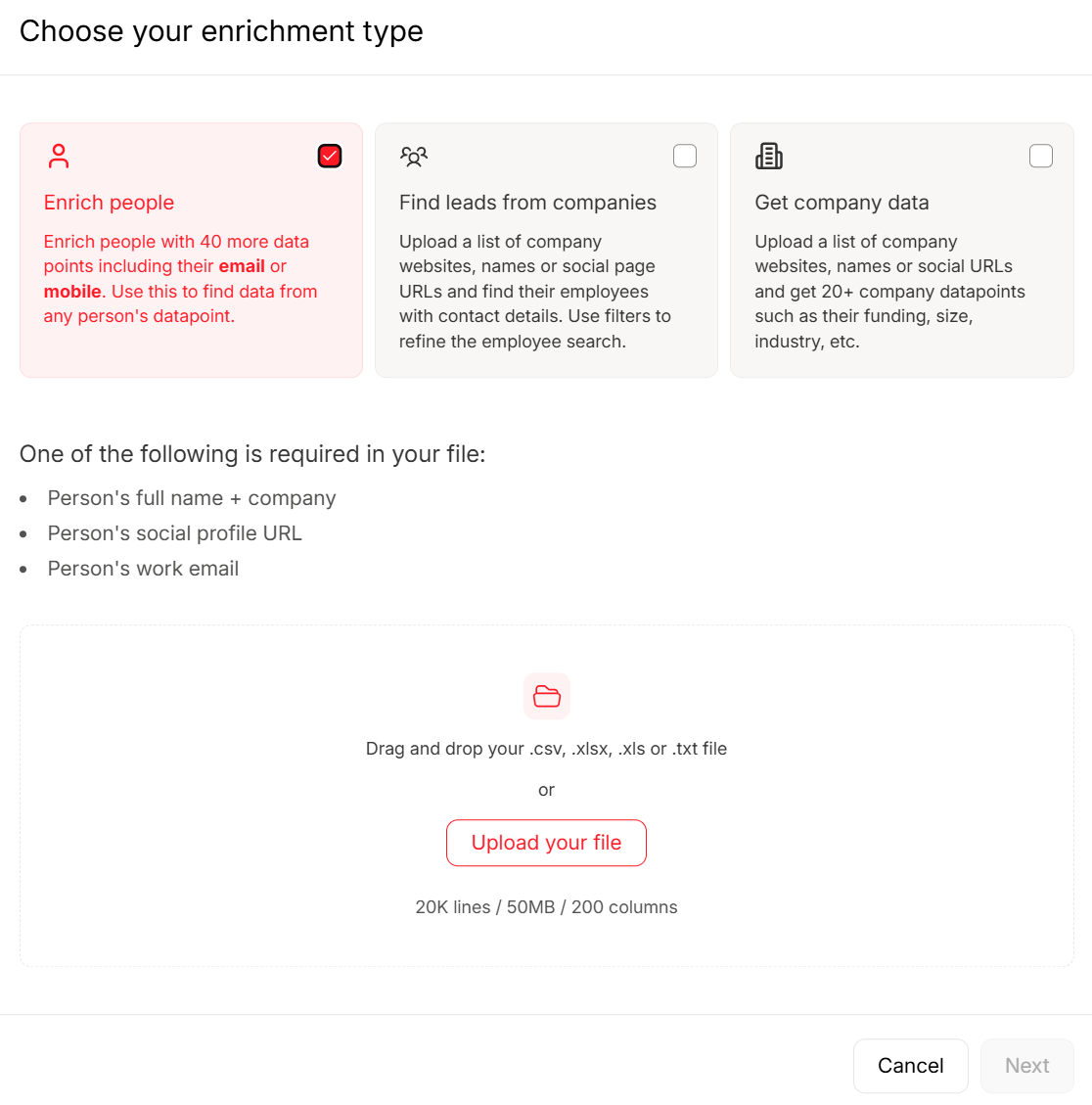
If you want to go deeper on list building, start with sales prospecting techniques and a simple Ideal Customer Profile before you pull your first export.
Founder-led sales works because you know your market cold. But even the best discovery skills stall without direct access to decision-makers. Prospeo gives small teams 125M+ verified mobiles with a 30% pickup rate and emails refreshed every 7 days - no enterprise contract required.
Your reps are trained. Now give them real numbers to dial.
FAQ
How much should a small business spend on sales training?
Most small businesses spend $500-$1,500 per rep and see strong results. Free options like HubSpot Academy cover foundations well. The $0 DIY stack above is viable - add paid programs as revenue grows past $50K/month.
What's the best free sales training program?
HubSpot's Inbound Sales Certification - free, 3 hours 6 minutes, and it teaches a complete methodology. Pair it with a $10-$15 Udemy cold calling course for a sub-$20 foundation that covers both inbound and outbound basics.
Can I train my sales team without hiring a trainer?
Yes. Weekly call reviews and peer roleplay beat most paid trainers for small teams. Reps with structured coaching hit quota at 4x the rate of those without it. Consistency matters more than budget.
How long does it take to see results?
Expect 4-8 weeks for measurable behavior change with consistent weekly coaching. Without reinforcement, 90% of skills vanish within a year. The timeline depends on call review frequency, not the program you chose.
What tools pair best with sales training?
Three essentials: a CRM (HubSpot's free tier works), a call recording tool for game tape reviews, and verified prospect data. A free prospecting tier alongside tools like Gong or Chorus for call analysis gives small teams a complete training-to-execution stack.