

Social Selling Metrics Your VP Actually Cares About
Your VP just asked for the ROI on your team's social selling program. You pull up a dashboard full of impressions, follower counts, and SSI scores. Their eyes glaze over.
Here's the uncomfortable truth: 65% of leaders want a direct line between social activity and business outcomes, but only 30% of marketers can actually measure social ROI. Meanwhile, 36% of CFOs flag vanity metrics as a top concern. With 96% of prospects researching before they ever talk to a rep, your social presence is the pitch they see first - and the social selling metrics you report determine whether your program keeps its budget or loses it.
Three KPIs That Save Your Budget
If you only track three things, make it these:
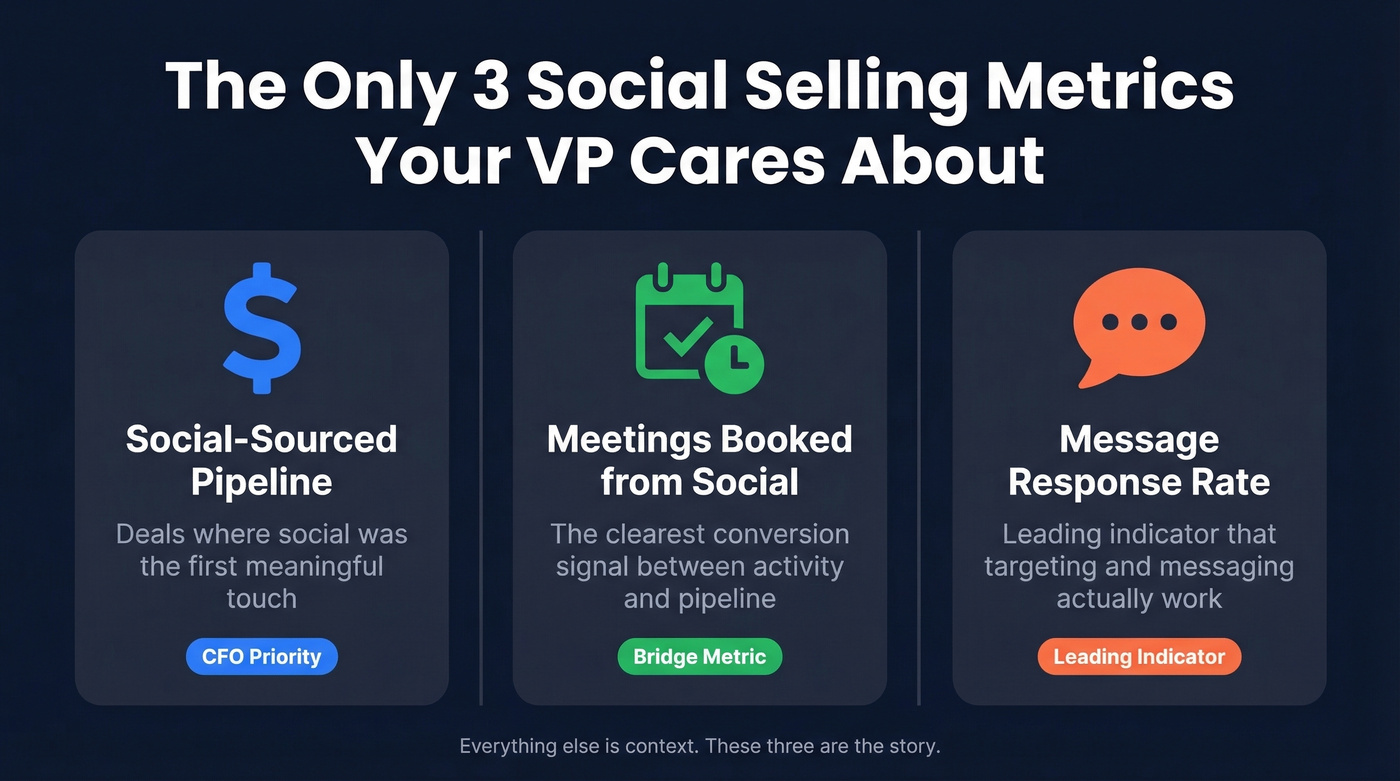
- Social-sourced pipeline - deals where social was the first meaningful touch. This is the number your CFO cares about.
- Meetings booked from social - the clearest conversion signal between activity and pipeline creation.
- Message response rate - the leading indicator that your targeting and messaging actually work.
Everything else is context. These three are the story.
Activity Metrics: Useful for Coaching, Not Board Decks
Activity metrics tell you what reps are doing. They're useful for one-on-ones, not executive reviews.
SSI (Social Selling Index) gets the most attention and deserves the least. It's scored 0-100 across four pillars of 25 points each, updates daily, and reflects a rolling 90-day window. The industry average sits around 35; 75+ puts you in strong territory. But Sales Navigator's own messaging has moved away from SSI, acknowledging it "no longer accurately reflects the modern sales environment." Use it as a self-diagnostic for reps who need coaching. Don't report it to leadership as a business KPI.
For reps below 50, daily 10-minute engagement sessions can add 8-12 points in 30 days - enough to move the needle. Beyond SSI, track network growth rate, content publishing cadence, and conversations initiated. These are the inputs. They matter for rep accountability, not revenue attribution.
Engagement Benchmarks
Engagement metrics sit in the middle of the funnel - they tell you how prospects respond before pipeline forms.
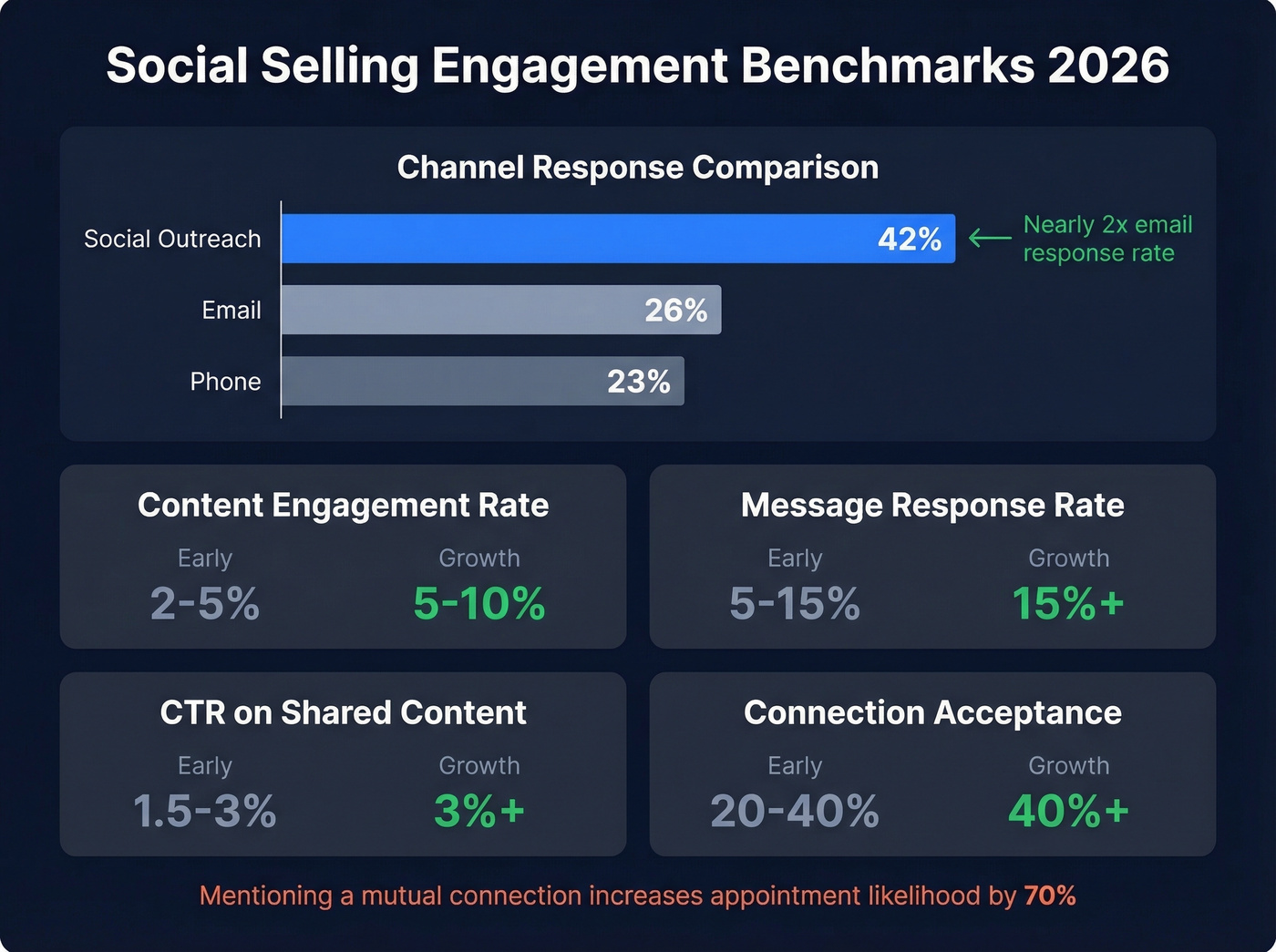
| Metric | Formula / Definition | Early Stage | Growth Stage |
|---|---|---|---|
| Content engagement rate | (Reactions + comments + shares) / impressions | 2-5% | 5-10% |
| Message response rate | Replies / messages sent | 5-15% (targeted) | 15%+ (warm) |
| CTR on shared content | Clicks / impressions (organic) | 1.5-3% | 3%+ |
| Connection acceptance | Accepted / sent | 20-40% | 40%+ |
The standout stat: social outreach pulls a 42% response rate compared to 26% for email and 23% for phone. That's not a marginal difference - it's a channel advantage. Mentioning a mutual connection increases appointment likelihood by 70%, which is another reason network quality beats network size every time.

A 42% social response rate means nothing if the email you send next bounces. Prospeo's 98% email accuracy and 7-day data refresh turn social engagement into booked meetings - the metric your VP actually reads.
Stop inflating conversations started and deflating meetings booked.
Pipeline and Revenue Metrics
This is the section your VP actually reads.
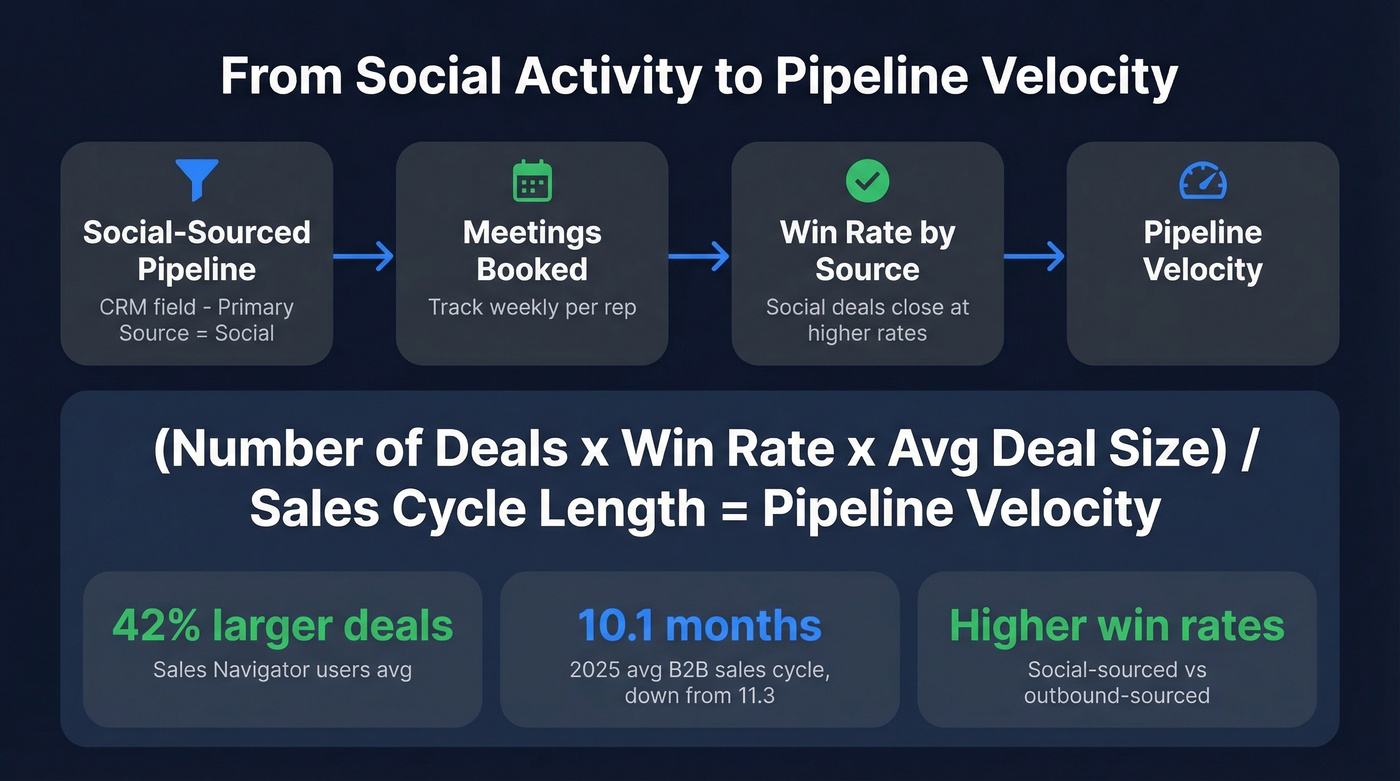
Social-sourced pipeline means deals where the first meaningful touch was social. Set up a CRM field - "Primary Source = Social" in Salesforce or HubSpot - and enforce it. No field, no attribution, no budget justification. We've seen teams skip this step and then scramble to justify their program six months later with nothing but screenshots of post impressions. Don't be that team.
Social-influenced pipeline is broader: any deal where a social touch appears in the opportunity timeline, regardless of first or last click. Multi-touch attribution is the only honest model here, because social touches are almost never the last click before a demo request.
Meetings booked from social is your bridge metric. Track it weekly per rep. If this number isn't climbing while activity metrics are, your messaging or targeting is off - and that's a coaching conversation, not a strategy problem. (If you need a system for what reps should do daily, use these sales activities as your baseline.)
Win rate for social-sourced deals typically runs higher than outbound-sourced deals because the relationship is warmer before the first call. If you aren't segmenting win rates by source, you're hiding social selling's strongest argument.
Pipeline velocity ties it all together:
(Number of Deals x Win Rate x Avg Deal Size) / Sales Cycle Length
A Forrester TEI study is commonly cited as showing Sales Navigator users closed 42% larger deals on average. Average B2B sales cycles dropped from 11.3 months to 10.1 months between 2024 and 2025 per 6sense's benchmark report, and social selling supports faster cycles as more buying happens in digital channels.
Let's be honest about one thing, though: if your average deal size is under $15k, you probably don't need Sales Navigator. But you absolutely need verified contact data to convert social engagement into booked meetings. Bad emails inflate "conversations started" and deflate "meetings booked" - which makes your entire report unreliable. That's where a tool like Prospeo matters: 98% email accuracy with a 7-day data refresh cycle means your outreach metrics reflect actual performance, not bounces from stale profiles.
What to Stop (and Start) Tracking
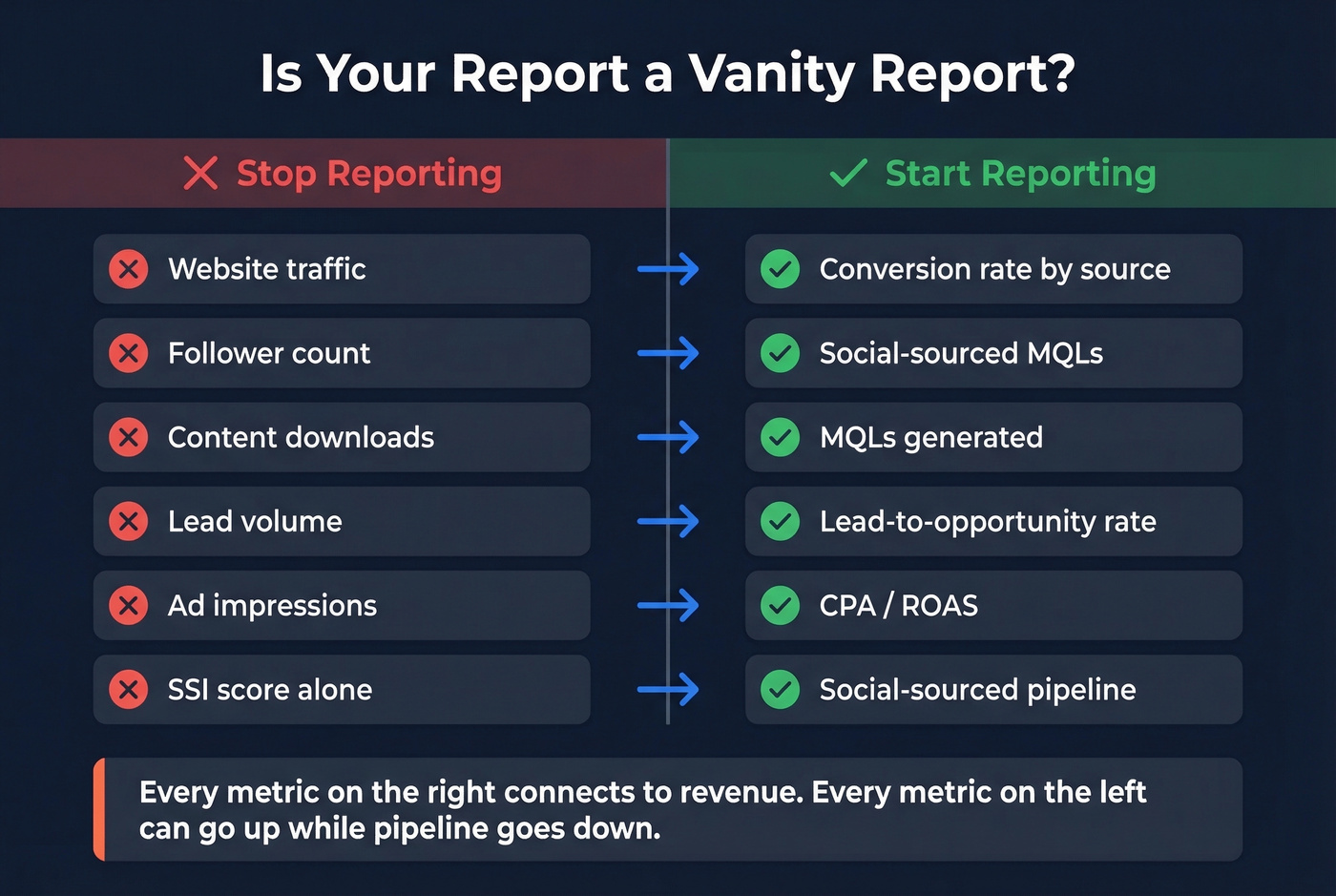
If your report includes the left column but not the right, it's a vanity report. The consensus on r/sales is blunt: marketing KPIs like traffic and CPL "incentivize low-quality lead generation and waste sales time." The fix is measuring SQLs and revenue. (If you want a clean framework for what to measure across stages, start with these funnel metrics.)
| Stop Reporting | Start Reporting |
|---|---|
| Website traffic | Conversion rate by source |
| Follower count | Social-sourced MQLs |
| Content downloads | MQLs generated |
| Lead volume | Lead-to-opportunity rate |
| Ad impressions | CPA / ROAS |
| SSI score alone | Social-sourced pipeline |
Every metric on the right connects to revenue. Every metric on the left can go up while pipeline goes down. We've watched teams celebrate a 40% increase in followers while social-sourced pipeline flatlined for two straight quarters. That's the trap.
How to Measure With Your Existing Stack
You don't need expensive tools. You need discipline and three components.
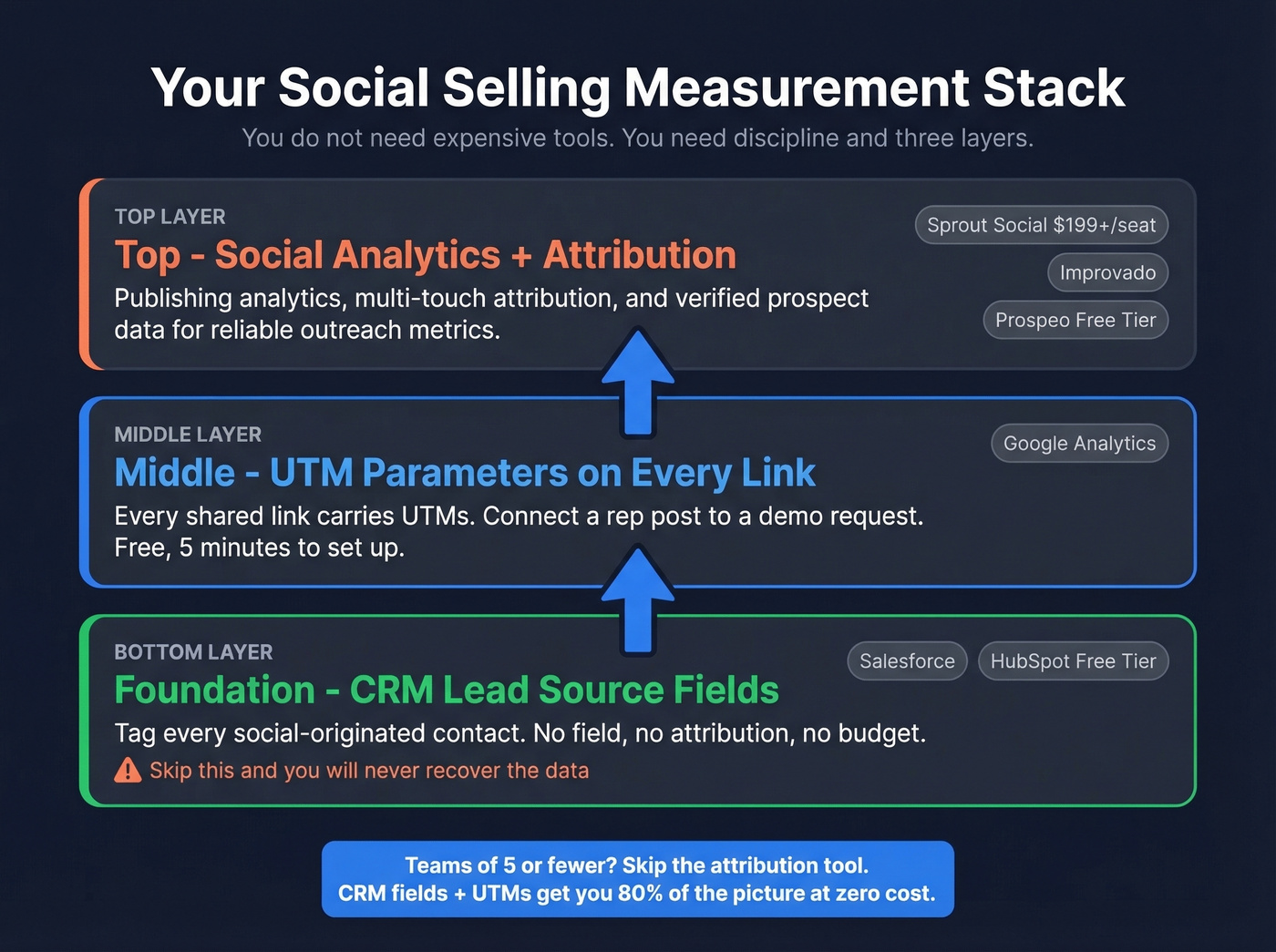
Foundation: CRM lead-source fields. Configure "Social" as a lead source in Salesforce or HubSpot (the free tier works). Every social-originated contact gets tagged. In our experience, teams that skip this step never recover the attribution data - it's gone, and no retroactive tagging exercise will fix it. (If you're standardizing your CRM setup, these examples of a CRM help align stakeholders fast.)
Middle: UTM parameters on every shared link. Every piece of content a rep shares should carry UTMs. Google Analytics tracks landing page conversions from those links, connecting a rep's post to a demo request. This is free and takes five minutes to set up with a UTM builder template.
Top: Social analytics plus attribution. Sprout Social ($199+/seat) handles publishing analytics and engagement tracking. For multi-touch attribution, tools like Improvado or HubSpot's built-in attribution reporting connect the dots across channels. And for verified prospect data to measure against, Prospeo offers a free tier with 75 emails and 100 Chrome extension credits per month - no contracts required - so your "meetings booked" metric reflects real outreach, not bounced emails. (If you're evaluating vendors, compare data enrichment services before you commit.)
Skip the attribution tool entirely if you're a team of five or fewer reps. CRM source fields plus UTMs will get you 80% of the picture at zero cost. (To tighten the outreach layer, use these sales prospecting techniques and keep your targeting consistent.)
Social-sourced pipeline only counts when reps can convert warm connections into real conversations. Prospeo gives you 143M+ verified emails and 125M+ direct dials so every social touch has a next step that actually lands.
Turn your best social selling metric into your best revenue metric.
FAQ
What's a good SSI score in 2026?
A score of 75+ is strong; the average across all users sits around 35. SSI highlights gaps in profile optimization, content engagement, and network building - but it won't tell your VP anything about pipeline. Treat it as a coaching tool, not a business KPI.
How do you prove social selling ROI?
Track social-sourced pipeline (deals where social was the first touch) and social-influenced revenue (any deal with a social touchpoint) using CRM lead-source fields. Pair this with multi-touch attribution to capture social's role across the full buyer journey, not just last-click conversions.
What tools do you need to track social selling metrics?
A CRM with lead-source fields (HubSpot's free tier works), UTM-tagged links for content tracking, and a verified data source for reliable outreach metrics. Add Sprout Social or native platform analytics for engagement data. The stack doesn't need to be expensive - it needs to be consistent.