

Soleadify vs Apollo.io: A Comparison That Shouldn't Exist
Bad data costs companies $12.9M per year on average, according to Gartner. That makes choosing the right data source more important than choosing the flashiest platform - and it's exactly why comparing Soleadify vs Apollo.io makes so little sense.
One is a firmographic data warehouse. The other is a sales engagement platform with a contact database and a dialer bolted on. They don't compete. But the question keeps coming up, so let's break it down.
30-Second Verdict
Soleadify rebranded to Veridion in February 2023, raising $6M to scale its firmographic API business. Apollo.io is an outbound platform with a built-in contact database, sequences, and a dialer.
Pick Veridion if you need company-level data on millions of SMBs for market research, KYB, or procurement workflows.
Pick Apollo if you need an all-in-one outbound platform with sequences, a dialer, and a contact database.
Soleadify Is Now Veridion
If you're searching for "Soleadify," you're looking at a product that no longer exists under that name. The rebrand happened in February 2023 alongside a $6M funding round.
Veridion now covers 130M+ companies worldwide with 220+ attributes per profile, refreshed weekly, and claims to reach 90%+ of SMBs including micro-businesses. Its G2 listing sits at 5.0/5 on just 2 reviews, with the listing flagged as inactive for over a year. Two reviews don't tell you much.

Veridion doesn't have contact data. Apollo's emails bounce 1 in 5. Prospeo gives you 300M+ profiles with 98% verified email accuracy, 125M+ direct dials, and a 7-day refresh cycle - all starting free with 75 emails/month. No enterprise contracts. No credit games.
Stop choosing between bad data and overpriced data.
Feature Comparison
| Feature | Veridion (Soleadify) | Apollo.io |
|---|---|---|
| Database size | 130M+ companies | 220M+ contacts |
| Data type | Company/firmographic | Contact-level |
| Refresh cadence | Weekly | Not published |
| Starting price | Custom (enterprise) | Free; $49/user/mo (annual Basic) |
| Usage model | API calls + datasets | Credits per action |
| Sequences & dialer | No | Yes |
| CRM integrations | API-based | Native (HubSpot, Salesforce) |
| G2 rating | 5.0/5 (2 reviews) | 4.8/5 (7,000+) |
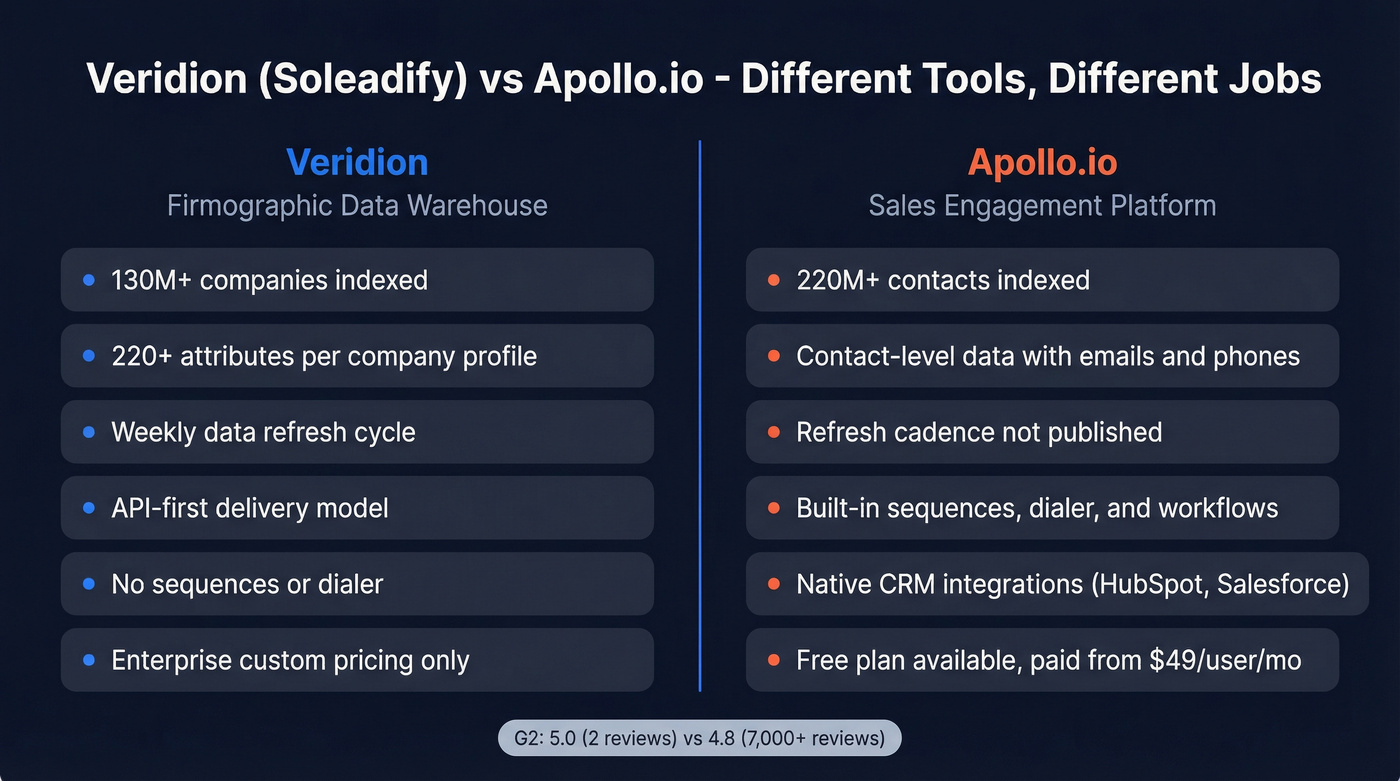
Here's the thing: this table is almost misleading because these tools don't occupy the same category. Veridion doesn't have sequences, a dialer, or even a traditional contact search - you query its API for company attributes, industry classifications, and SMB profiles. Apollo is where reps live day-to-day, building lists and running sequences.
We've tested both platforms, and the real gap comes down to this: Veridion's strength is depth on SMBs that mainstream databases miss entirely - micro-businesses, local companies, niche verticals that Apollo and ZoomInfo simply don't index well. Apollo's strength is breadth of contacts and the workflow layer on top.
Users on SaaSHub flag Apollo's data accuracy as a recurring issue, with one reviewer noting they could find prospects on professional profiles but not in Apollo's database. That's a meaningful gap if your outreach depends on finding the right people at the right companies.
Pricing Breakdown
Apollo offers a free plan with 5 mobile credits per month - barely enough to test the product. Paid tiers run $49/user/mo for Basic, $79 for Professional, and $119 for Organization on annual billing. The credit system is where costs sneak up: Basic gets 75 mobile credits/month, Professional gets 100, Organization gets 200. For a 5-rep team on Professional, that's $4,740/year in base seats alone, before a single overage at $0.20/credit with a 250-credit minimum purchase.
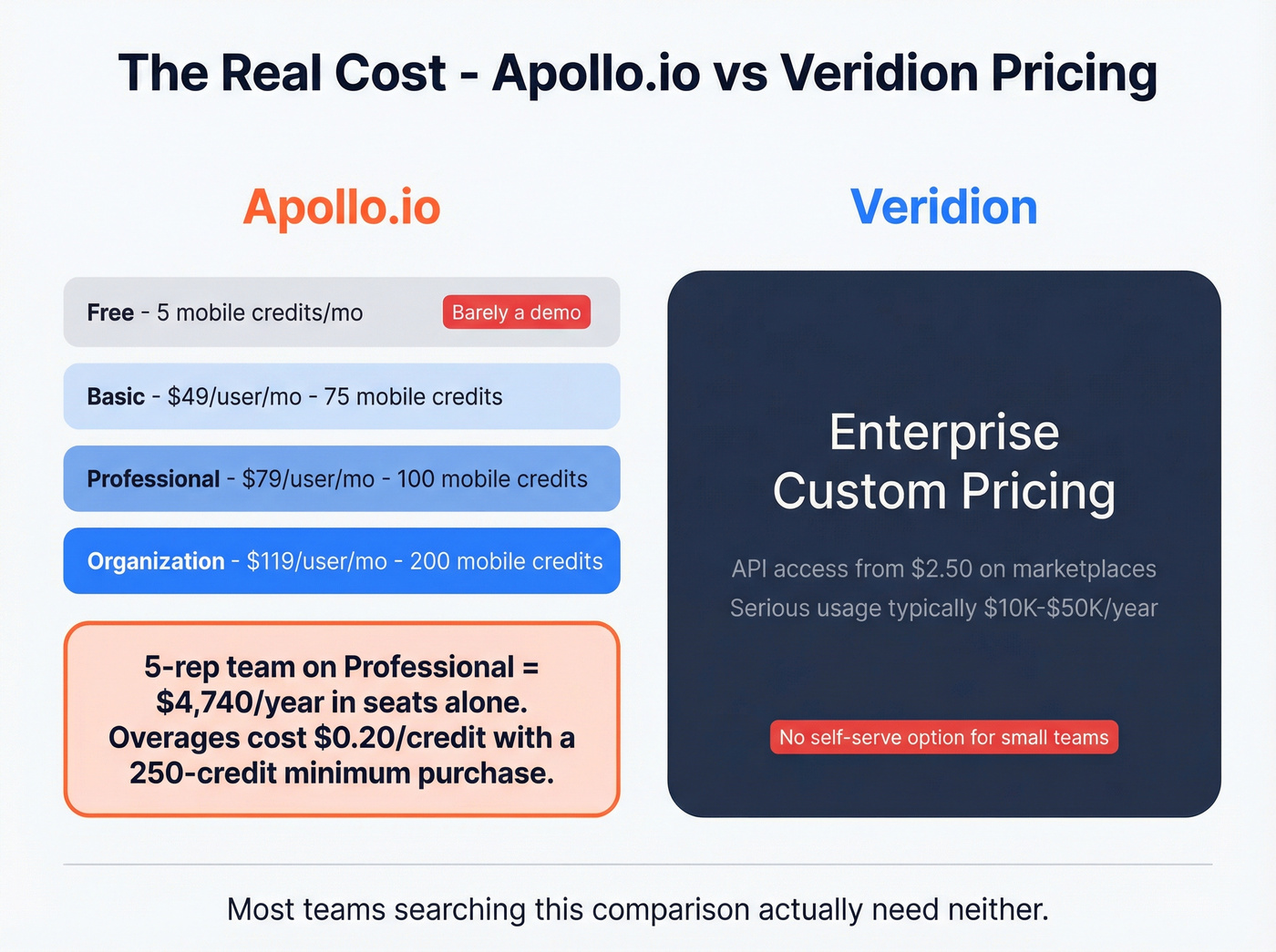
Veridion is enterprise-first. The old Soleadify Basic plan ran $99/user/mo, but current pricing is custom. API access starts at $2.50 on marketplace listings, and serious enterprise usage typically lands in the $10K-$50K/year range. If you just need 500 verified emails for next week's campaign, this isn't the tool.
Let's be honest: Apollo's free plan is a demo, not a product. And Veridion's enterprise-only model prices out 90% of the people searching for this comparison. In our experience, most teams comparing these two actually need neither.

Who Should Use Which
Veridion is built for market intelligence, procurement, and KYB teams that need firmographic data on millions of SMBs - especially micro-businesses that mainstream databases ignore entirely. If you're building a sales list of decision-makers to email next Tuesday, Veridion won't help you.
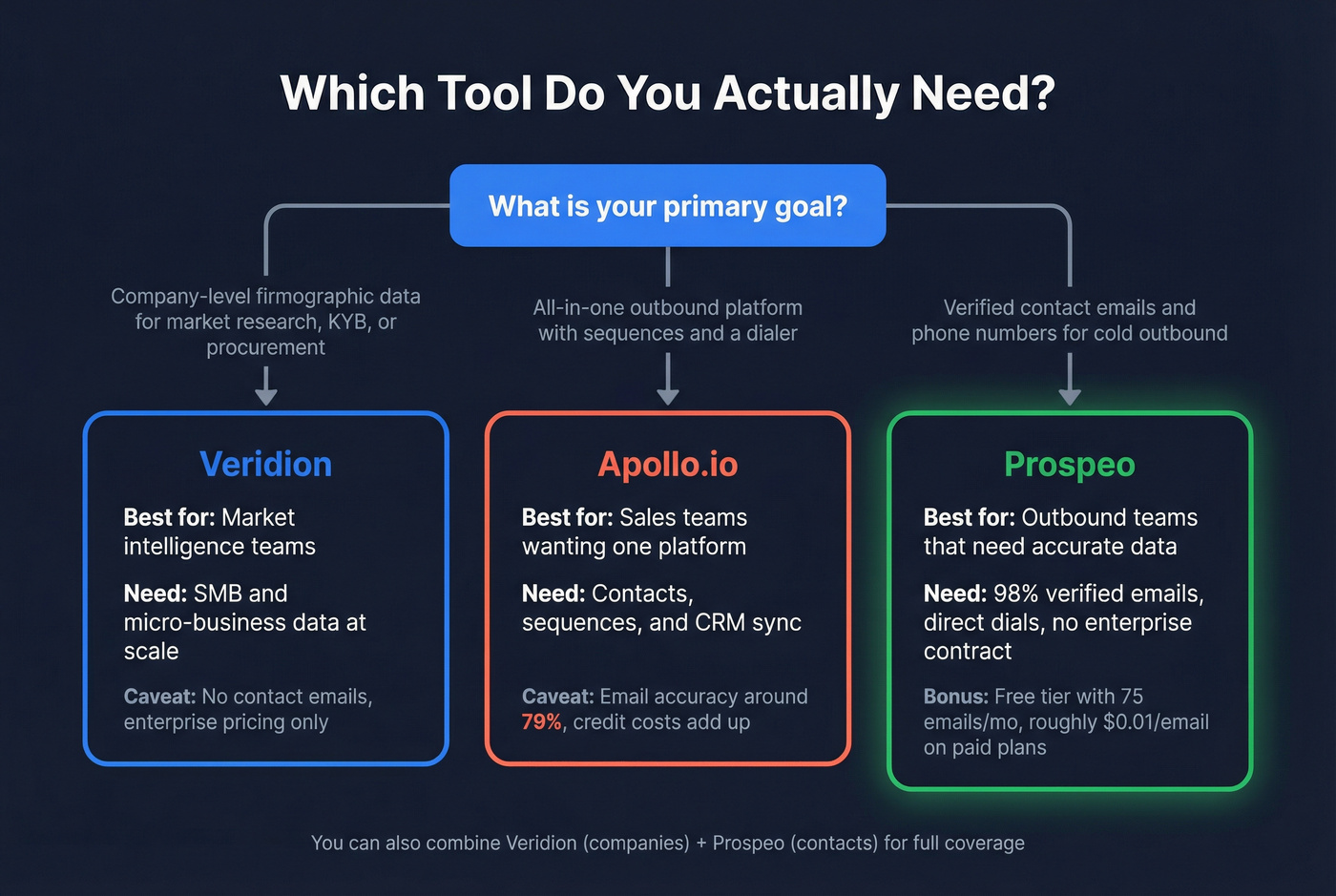
Apollo works for sales teams that want sequences, a dialer, and a contact database in one platform and don't mind navigating a credit system. Just go in knowing the data accuracy won't match a dedicated provider. Apollo's email accuracy sits around 79%, which means roughly 1 in 5 emails bounce. Over time, that wrecks your sender reputation.
Apollo's 79% accuracy means every 5-rep team is burning sender reputation on thousands of bad emails per month. Prospeo's 5-step verification and proprietary email infrastructure deliver 98% accuracy at roughly $0.01/email - 90% cheaper than ZoomInfo, measurably more accurate than Apollo.
Teams using Prospeo book 35% more meetings than Apollo users.
FAQ
Is Soleadify still available?
Soleadify rebranded to Veridion in February 2023. The product still exists under the new name with 130M+ companies and 220+ attributes per profile, but it's now enterprise-only with custom pricing.
Can I use Veridion and Apollo together?
Yes. Use Veridion for company-level intelligence and Apollo for contact-level outreach with sequences. They complement rather than compete, though you'll pay for two separate platforms.
What's the cheapest way to get verified emails for outbound?
Prospeo offers a free tier with 75 verified emails per month, no credit card required. Paid plans run about $0.01 per email with 98% accuracy and a 7-day data refresh cycle - the lowest-friction entry point for outbound teams that need reliable contact data without enterprise contracts.
Is Apollo.io accurate enough for cold outbound?
Apollo reports 220M+ contacts, but independent tests put its email accuracy around 79%. That means roughly 1 in 5 emails bounce, which damages sender reputation over time. For high-volume outbound, pairing Apollo's sequences with a dedicated verification tool - or switching to a higher-accuracy provider - significantly reduces deliverability risk.