

The SPIN Selling Script Nobody Else Will Give You
Most SPIN guides hand you the four question types and tell you to "adapt them to your situation." That's not a SPIN selling script - that's homework. Below is a full dialogue script with realistic prospect responses, stage annotations, objection handling, and an implication framework for generating questions on the fly. Print it, customize it, use it Monday morning.
Why Every SPIN Guide Fails You
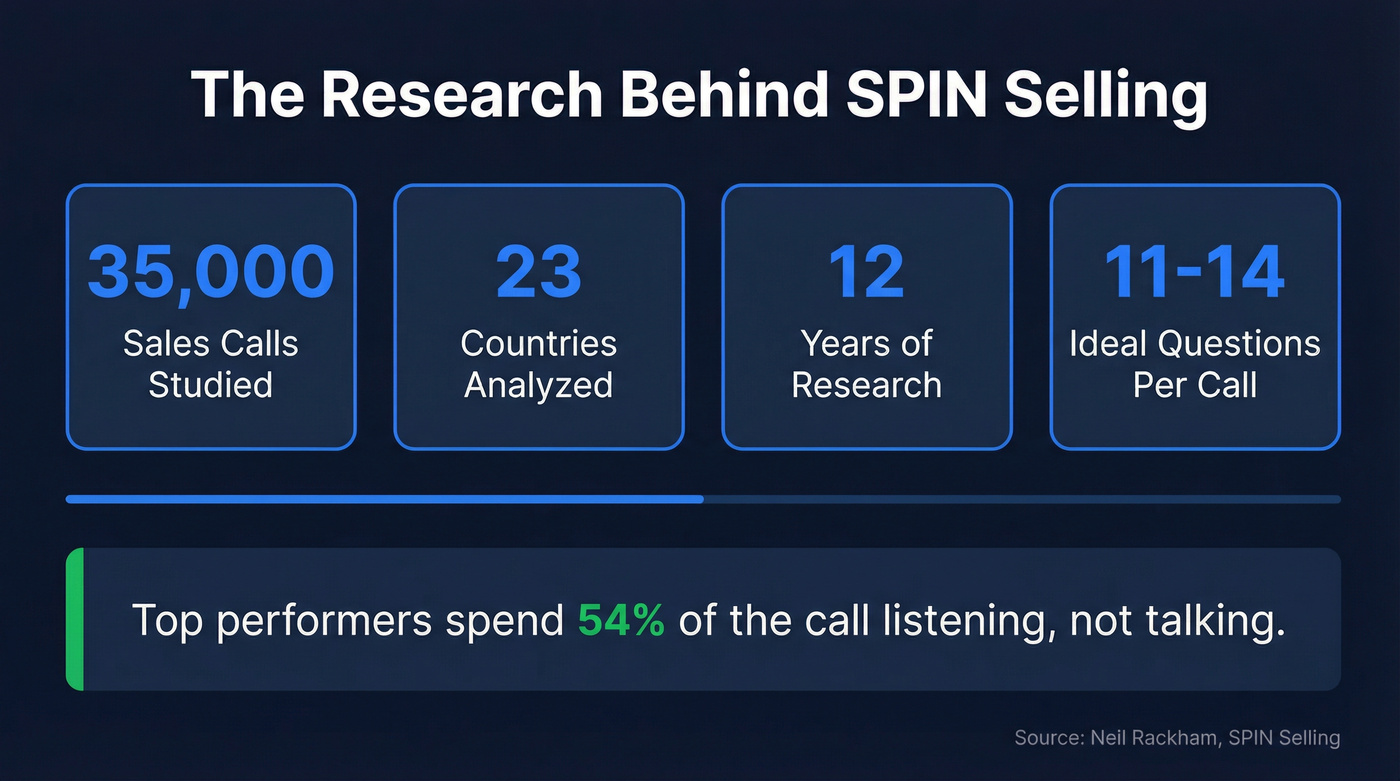
Neil Rackham's research spanned 35,000 sales calls across 23 countries over 12 years. The methodology works - enterprises like Nutreco have built entire sales cultures around it. The problem isn't SPIN itself. It's that every blog post gives you a question bank and calls it a day. Nobody shows you what the prospect actually says back, how to transition between stages, or when to shut up and listen.
That's what a real talk track is for.
The Full Talk Track
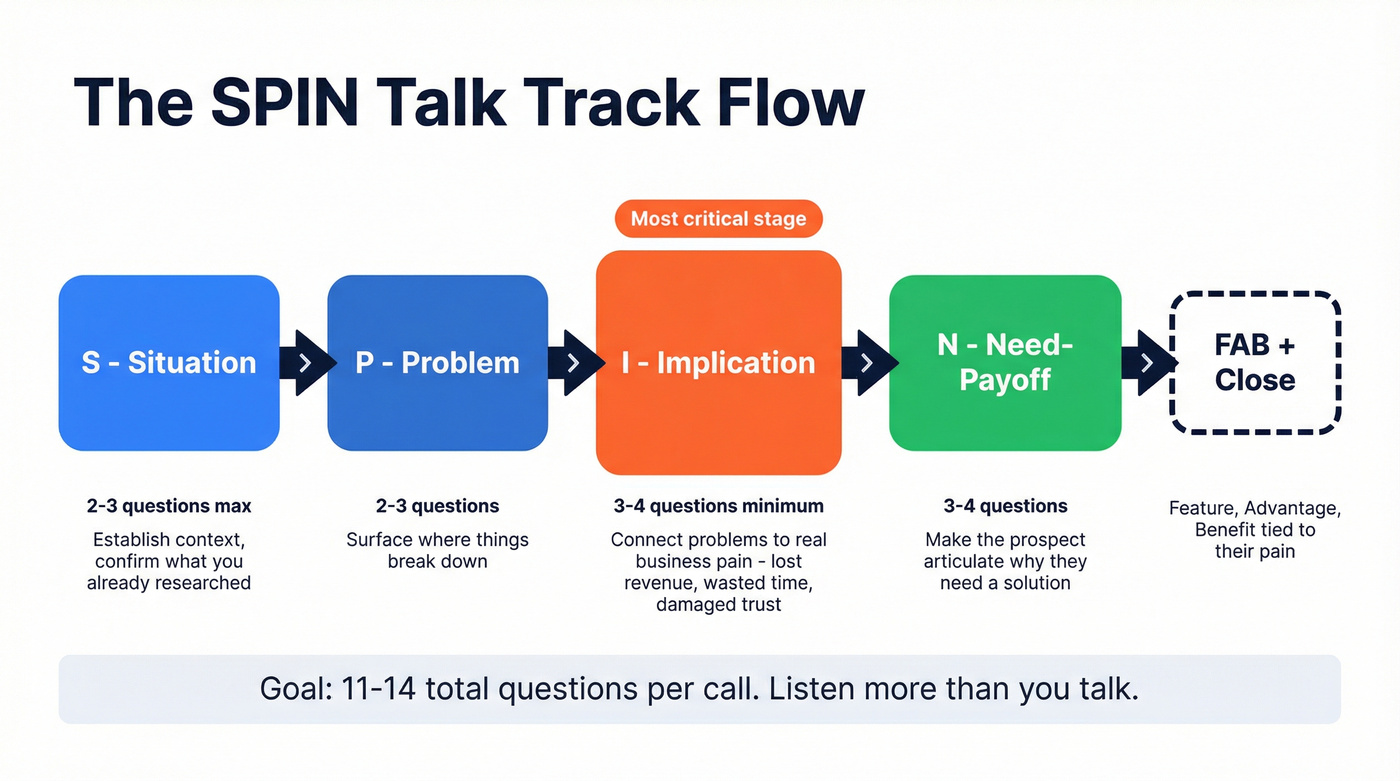
The goal isn't to recite lines verbatim. It's to internalize the flow so you can riff naturally. Aim for 11-14 questions per discovery call, and spend 54% of the call listening. Here's the full talk track for a B2B software sale. Before you dial, fill out a SPIN selling worksheet for each account so you walk into the call with pre-researched context and a shortlist of tailored questions.
Opening & Situation Questions
Start warm. An analysis of 90,000 cold calls found that reps who opened with a friendly greeting like "How have you been?" saw 6.6x higher response rates than those who launched straight into a pitch.
| Rep | Prospect |
|---|---|
| "Hey Sarah, it's Mike from Acme. How've you been?" | "Good, busy - what's up?" |
| "Totally get it, I'll keep this tight. Quick question - how's your team currently handling [specific process]?" | "We use [Tool X], plus a lot of spreadsheets honestly." |
| "Got it. And roughly how many people touch that workflow day to day?" | "Maybe six or seven, depending on the week." |
| Stage note: Situation questions establish context. Keep it to 2-3 max - overusing these is a common rookie mistake. Do your pre-call research so you're not asking things you could've found on their website. |
Problem & Implication Questions
This is where the call gets real. Implication is the engine - without it, SPIN collapses into polite discovery with no consequence. We've watched reps nail Situation and Problem questions, then skip straight to pitching. Those calls die every time.
| Rep | Prospect |
|---|---|
| "When those spreadsheets break or get out of sync, what happens?" | "Usually someone catches it, but we've had data go to clients with errors. Not great." |
| "When that happens, what's the downstream impact on the team?" | "People scramble. It kills half a day, sometimes more. And the client loses confidence." |
| "Has that ever cost you a renewal or delayed a deal?" | "...Yeah, actually. We lost a mid-size account last quarter partly because of a reporting mistake." |
| Stage note: Implication questions connect a surface problem to real business pain - lost revenue, wasted time, damaged trust. This is where decision-makers start caring. Force yourself to ask at least two "what happens when..." questions before moving on. |
Need-Payoff Questions
Now flip the conversation. Instead of telling the prospect what your product does, make them articulate why they need it. Top performers ask 10x more Need-Payoff questions than average reps.
| Rep | Prospect |
|---|---|
| "If your team could eliminate those manual sync errors entirely, what would that free up?" | "Honestly? Probably 8-10 hours a week across the team. And way fewer fire drills." |
| "And if clients never saw another reporting error - what does that do for retention?" | "It'd be huge. That's the kind of thing that keeps accounts sticky." |
Demonstrating Capability (FAB)
Once the prospect has articulated the need themselves, you've earned the right to show how you solve it. Use the Feature, Advantage, Benefit structure, and tie every benefit back to the pain they just described.
| Rep | Prospect |
|---|---|
| "Makes sense. So here's what we built: [Product] runs automated sync between your data sources - that's the feature. The advantage is zero manual handoffs, which means your team never touches a spreadsheet again. Based on what you said, the benefit is getting those 8-10 hours back and eliminating the reporting errors that cost you that account last quarter." | "Yeah, that's exactly the problem." |
Stage note: FAB works because you're mapping your product directly to pain the prospect already owns. If you pitch features without this bridge, you sound like every other vendor.
Handling Objections & Closing
Here's where most scripts abandon you. The prospect won't always say "let's do it." You need a plan for the three most common responses.
If they give you an advance (best case):
| Rep | Prospect |
|---|---|
| "Want to see a 20-minute demo Thursday with your ops lead?" | "Yeah, let's do it. I'll loop in Jamie." |
If they give you a continuation ("send me some info"):
| Rep | Prospect |
|---|---|
| "Happy to send a one-pager. But quick question - you mentioned losing that mid-size account over reporting errors. If this keeps happening next quarter, what's the exposure?" | "...Probably another account or two at risk, honestly." |
| "Then let's get 20 minutes with Jamie this week so she can see the fix firsthand. Does Thursday or Friday work better?" | "Friday's probably easier. I'll check with her." |
The move: when a prospect tries to push you to email, callback their biggest implication and re-anchor on the cost of waiting. Then ask for a specific time with a second stakeholder. That turns a continuation into an advance.
If they say "not interested right now":
| Rep | Prospect |
|---|---|
| "Totally fair. Out of curiosity - what's the team focused on this quarter instead?" | "We're heads-down on [other priority]." |
| "Makes sense. When that wraps up, the spreadsheet problem will still be there. Mind if I check back in [timeframe]?" | "Sure, ping me in six weeks." |
An advance moves the deal forward - a demo with a second stakeholder, a trial, a signed next step. A continuation keeps the deal alive but stalls it. Always push for the advance first.
The Implication Framework
If you freeze on implication questions mid-call - and everyone does - map every problem to these four downstream impacts:
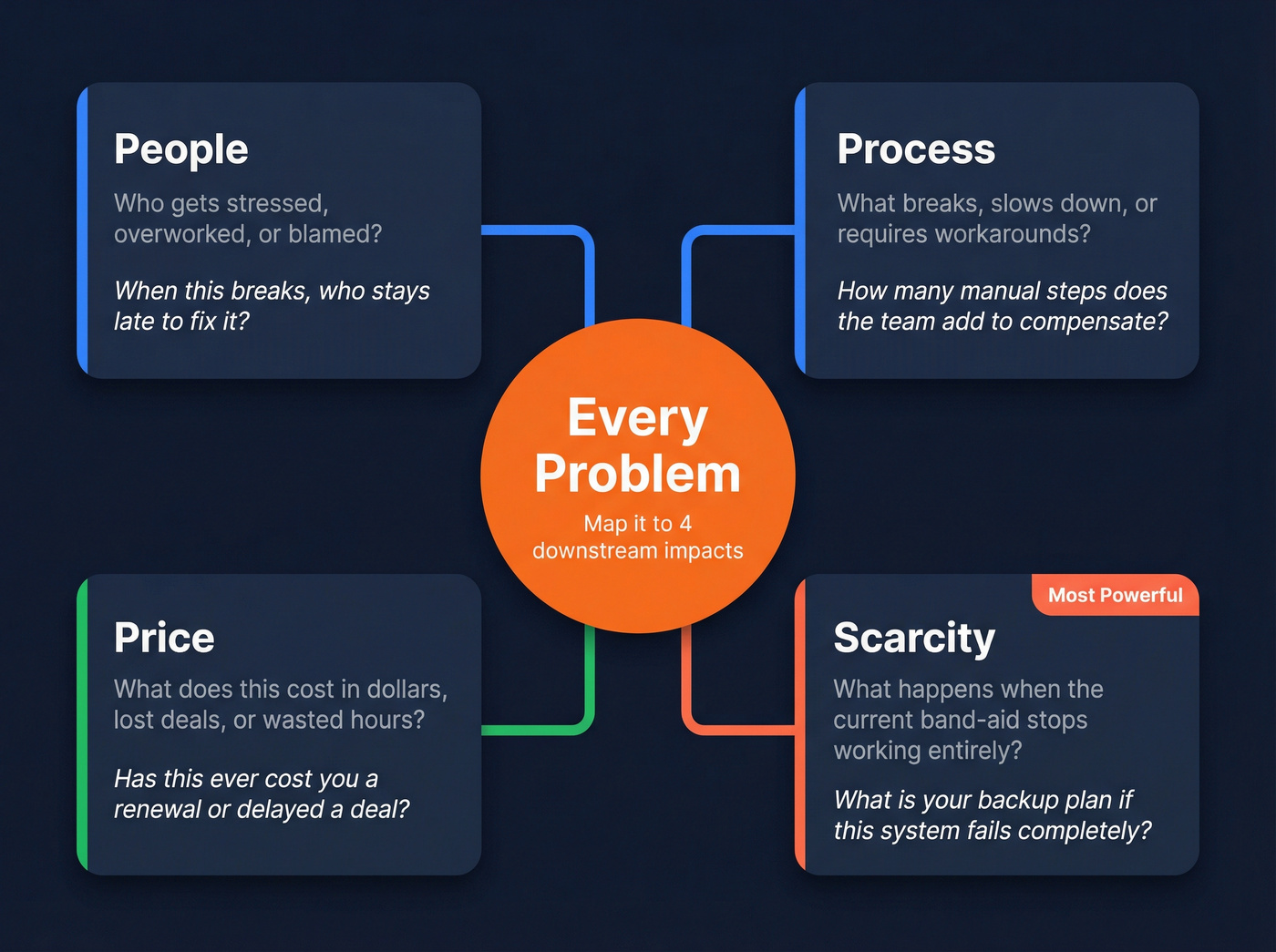
People - Who gets stressed, overworked, or blamed?
Process - What breaks, slows down, or requires workarounds?
Price - What does this cost in dollars, lost deals, or wasted hours?
Scarcity - What happens when the current band-aid stops working entirely?
That scarcity angle is the most underused and the most powerful. A practitioner on r/sales selling office equipment described it perfectly - an old copier breaks, replacement parts don't exist anymore, and suddenly the whole office is dead in the water. That's not a "problem." That's urgency.
We've seen reps double their implication question quality just by running every problem through these four lenses before the call. Capture those answers on a SPIN selling worksheet so you have them in front of you when the conversation shifts.

A perfect SPIN script is worthless if you're calling the wrong person. Prospeo gives you 300M+ verified profiles with 30+ filters - buyer intent, job changes, department headcount - so you walk into every discovery call with the right stakeholder and pre-researched context.
Fill your SPIN worksheet with real data, not guesswork.
Industry-Specific Variations
SaaS Script Variation
| Stage | Example Question |
|---|---|
| Situation | "How many hours per week does your team spend on [process]?" |
| Problem | "Where does that workflow break down most often?" |
| Implication | "When delivery slips because of that, how does it affect cash flow or renewals?" |
| Need-Payoff | "If you could cut that cycle time in half, what would your team ship instead?" |
The key with SaaS SPIN is quantifying time and money lost. Decision-makers in software companies think in sprint cycles and burn rates - frame implications in those terms and you'll hold their attention far longer than with vague "how does that make you feel" questions.
Insurance & Financial Services
Insurance SPIN works differently because the prospect already has a solution - they're paying a competitor. Your job is to make the cost of their current plan feel like a problem worth solving.
Start with what they're paying, surface what that money could do elsewhere, then let them do the math. A strong sequence looks like this: confirm their current provider and tenure, ask whether they feel they're overpaying, connect that overpayment to something tangible they're missing out on (paying down debt, funding another line item), and then ask what a 10% reduction would mean for their budget. The Need-Payoff question almost writes itself when the prospect has already admitted the money could go somewhere better.
Three Mistakes That Kill Your Script
Skipping implication questions. This is the most common failure mode. Both Highspot and Sybill flag it explicitly - without implications, you're just doing a survey. Force yourself to ask at least two "what happens when..." questions before moving to Need-Payoff.
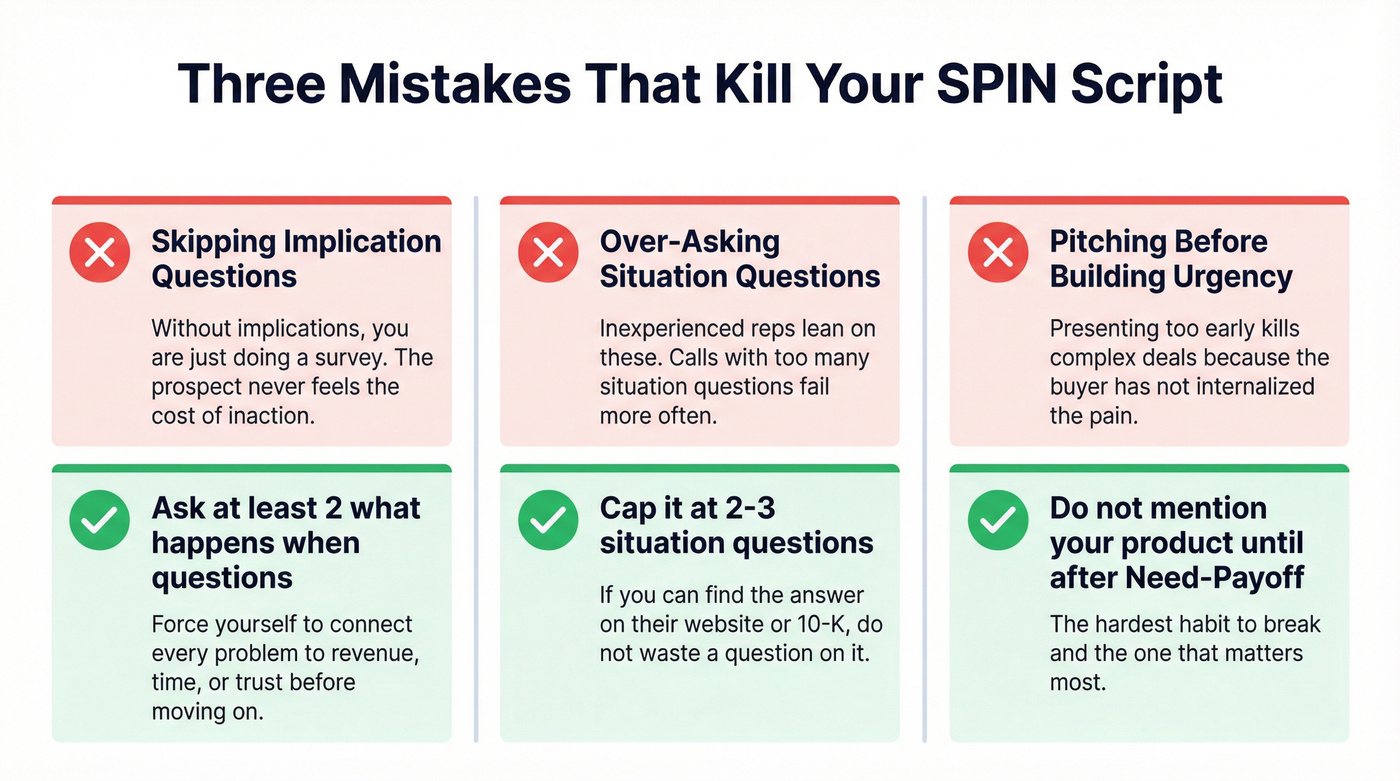
Over-asking situation questions. Rackham's research found that inexperienced reps lean heavily on situation questions, and those calls fail more often. Do your homework before the call so you only need 2-3 situation questions max. If you can find the answer on the company's website or in their 10-K, don't waste a question on it.
Pitching before building urgency. For complex B2B sales, presenting too early kills the deal because the buyer hasn't internalized the cost of inaction. Don't mention your product until after Need-Payoff questions. This is the single hardest habit to break, and it's the one that matters most.
Here's the thing: SPIN is the best discovery framework for larger, complex deals. Below that threshold, you're probably overthinking it - a Sandler-style disqualification call will get you to "yes" or "no" faster. But for complex B2B where multiple stakeholders need to feel the pain? Nothing else comes close.
Build Your Call List First
This script only works if someone picks up. 49% of buyers prefer phone contact for initial outreach, and 82% accept meetings with salespeople who proactively reach out - but you need real numbers to reach them. Prospeo's database includes 125M+ verified mobile numbers with a 30% pickup rate and 98% email accuracy for multi-touch sequences. The free tier gives you 75 email lookups per month plus 100 Chrome extension credits, enough to build a clean call list and start running this talk track on real conversations.
If you're building lists at scale, tighten your sales prospecting techniques so your SPIN calls start with the right accounts.
You just built implication questions that surface real pain. Don't let bad contact data kill the deal before the call starts. Prospeo's 98% email accuracy and 125M+ verified mobile numbers mean your talk track actually reaches decision-makers - not dead inboxes.
Every SPIN call needs a live number on the other end.
SPIN vs Other Frameworks
| Framework | Best For | Deal Size | Core Move |
|---|---|---|---|
| SPIN | Discovery & urgency | Complex B2B | Question sequence |
| MEDDIC | Forecast accuracy | Enterprise ($100K+) | Stakeholder mapping |
| Challenger | Reframing status quo | Mid-market+ | Insight delivery |
| Sandler | Early disqualification | Any size | Mutual commitment |
If you want a deeper set of prompts for qualification, borrow from MEDDIC and keep a bank of discovery questions ready for when the call goes off-script.
The consensus on r/sales is that all methodologies boil down to need, budget, stakeholders, and timeline. That's fair. But SPIN gives you a better question sequence for making the buyer realize the cost of inaction themselves - and that's the hardest part of complex sales. Skip SPIN if you're running transactional one-call closes where the buyer already knows what they want.
FAQ
Does SPIN selling work for cold calls?
Yes, but you need a warm opener before jumping into Situation questions. The script above bridges that gap with a friendly greeting that produces 6.6x higher response rates. Lead with "How've you been?" and earn the right to ask discovery questions - don't open with "What CRM do you use?"
How many questions should I ask on a SPIN call?
Aim for 11-14 discovery questions total. Prioritize 2-3 Implication and 2-3 Need-Payoff questions - those drive the deal forward. Situation questions should be minimal (2-3 max) if you've done pre-call research using a worksheet.
How do I find verified phone numbers for SPIN calls?
Start with your CRM's existing data - you'd be surprised how many direct dials are buried in old records. For gaps, use a verified data provider. Upload a CSV of target accounts and get verified direct dials back in minutes, with no contract required. Prospeo's Chrome extension also pulls contact data while you research accounts before a call.