

How to Build a Startup Sales Team in 2026
You're doing founder-led sales, and it's working - sort of. Demos are stacking up, follow-ups are slipping, and you just realized you forgot to reply to a prospect who asked for pricing three days ago. That's not a failure. That's the signal it's time to build a real startup sales team.
Here's the stage-by-stage playbook.
What You Need (Quick Version)
- Founder closes the first 10-30 deals personally. Don't outsource learning your own market.
- Hiring order: full-cycle AE, then SDR, then CSM, then VP Sales. Each hire solves a specific capacity bottleneck.
- Process + clean data + fast follow-up beat headcount every time. Two reps with verified contacts and a tight CRM will outperform five reps working garbage lists.
Founder-Led Sales Comes First
Every SaaS founder wants to skip this part. Don't.
The SaaStr playbook is clear: founders should close the first 10-30 deals themselves. You're not just selling - you're learning objections, refining pricing, and building the repeatable process your future team will run.
The biggest mistake we see? Hiring a VP of Sales to "figure it out." That's a $200k-$350k/year experiment that almost always fails because a VP Sales scales what's working - they don't invent the motion from scratch. Wait until you've got at least two reps consistently hitting quota, typically around $1M-$3M ARR, before you make that hire. And when you do hire reps, look for salespeople who've succeeded at $10M-$20M ARR companies. Big-company reps rarely survive the chaos of early-stage selling.
Hiring Sequence That Actually Works
The right question isn't "how many salespeople do I need?" It's "what's the bottleneck right now?" One Reddit founder put it well: "If we got 10 more opportunities this month, how many would we drop the ball on?" The higher that number, the more urgent your next hire.
| Hire | When to Pull the Trigger | Role Focus |
|---|---|---|
| Full-cycle AE | Dropping follow-ups; 10+ opps/mo | Close deals, run full cycle |
| SDR | AE pipeline-constrained | Outbound prospecting, qualify inbound |
| CSM | Churn risk is real; expansion on the table | Onboard, retain, expand |
| VP Sales | 2 reps hitting quota; repeatable process (~$1M-$3M ARR) | Scale what works |
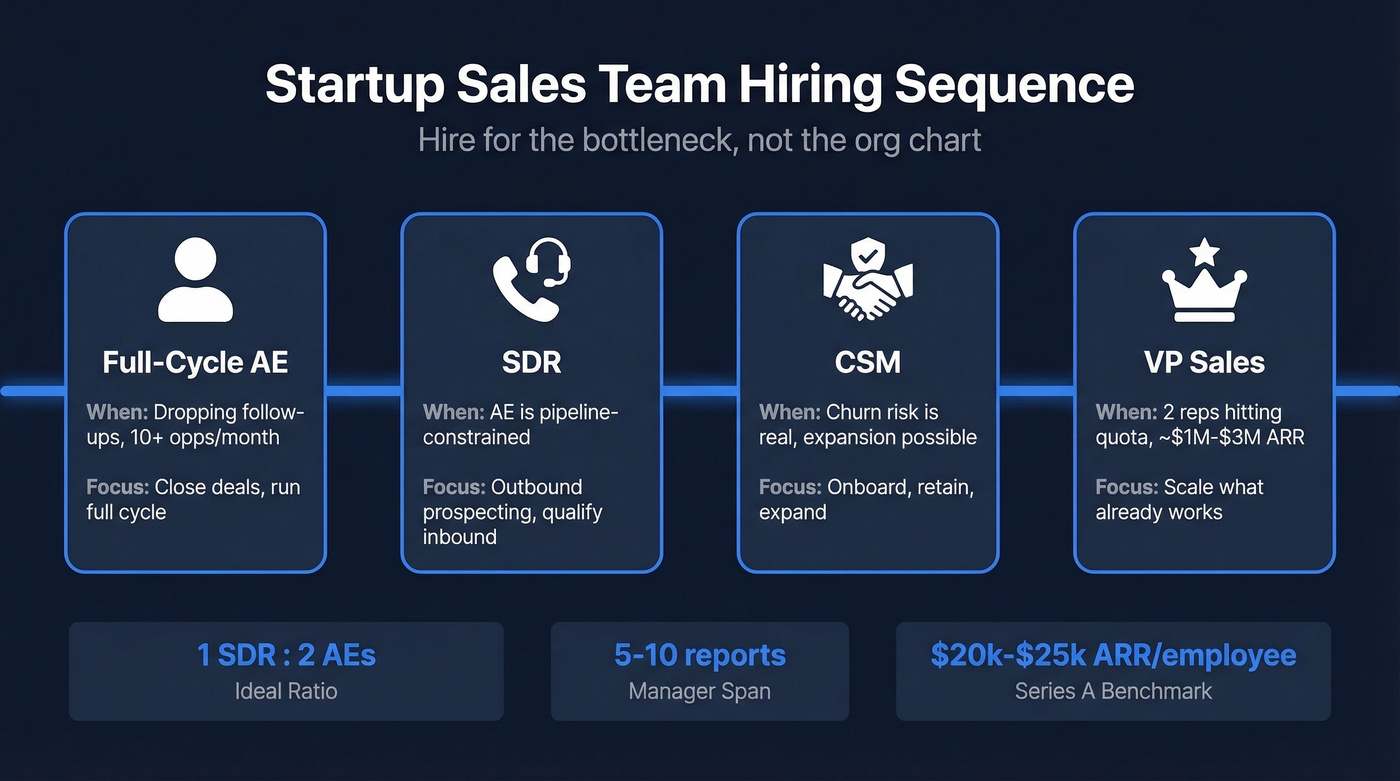
A few ratios to keep in your back pocket: plan for roughly 1 SDR per 2 AEs, and keep manager spans at 5-10 direct reports. Use ARR-per-employee as a sanity check - aim for $20k-$25k at Series A, $40k-$50k at Series B, and $50k-$66k at Series C. If you're well below those benchmarks, you're over-hiring relative to revenue.
Before adding headcount, run the COCA math. Spend $25k to acquire 10 customers, and your COCA is $2,500. Scale only when LTV is a clear multiple of that number - otherwise you're just burning cash faster. Inside sales gets tricky below $500/mo price points, and outside sales doesn't pencil out below $10k deals. If your ACV doesn't support the motion, no amount of hiring fixes that.
Here's the thing: most seed-stage startups hire salespeople too early and fire them too late. If you can't write your repeatable close process on a napkin, you don't have a hiring problem. You have a product-market-fit problem.

Two reps with verified contacts beat five reps working garbage lists - you said it yourself. Prospeo gives your startup sales team 300M+ profiles with 98% email accuracy at $0.01/email. No contracts, no sales calls. Just clean data your first AE can run with from day one.
Stop burning your ramp period on bad data.
Comp Bands for 2026
Comp is where most founders either overpay out of desperation or underpay and wonder why nobody stays.
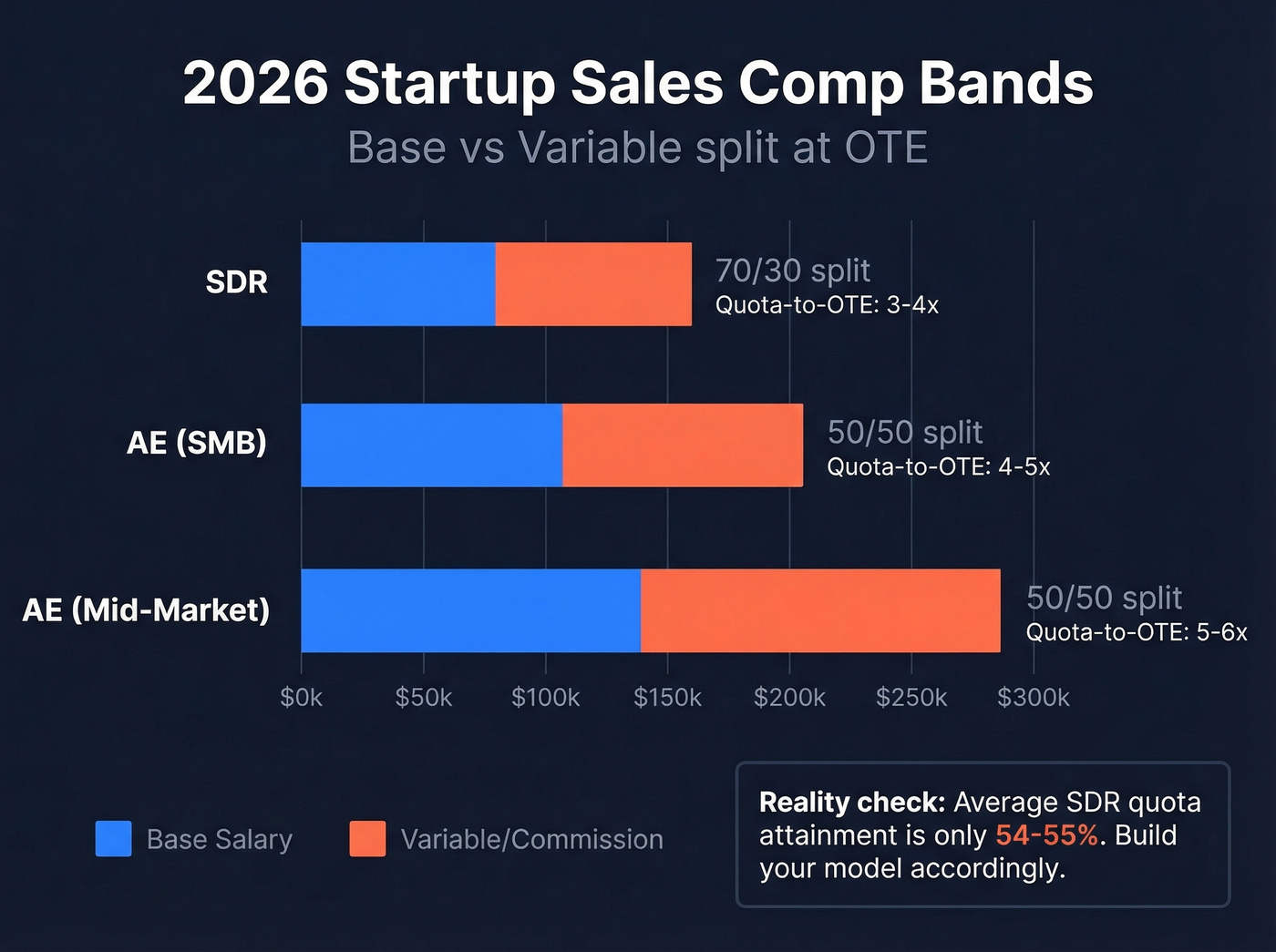
| Role | Base | OTE | Split | Quota-to-OTE |
|---|---|---|---|---|
| SDR | $50k-$70k | $70k-$100k | 70/30 | 3-4x |
| AE (SMB) | $70k-$100k | $140k-$200k | 50/50 | 4-5x |
| AE (Mid-market) | $100k-$140k | $200k-$280k | 50/50 | 5-6x |
Average SDR quota attainment runs about 54-55%. That's not a failure - it's the reality of outbound. Build your capacity model assuming roughly half your SDRs hit full quota in any given quarter.
Keep comp plans simple. If yours requires a multi-tab spreadsheet to explain, you've already lost your reps' trust. And plan career paths: the average SDR promotion timeline has stretched to 15-16 months post-pandemic, so your best SDRs will leave for companies that offer a clear path to AE if you don't map one out yourself.
The 30/60/90 Ramp Plan
Average sales ramp time is 3.2 months, with 39% of reps taking 3-5 months to hit full productivity. We've found that founders who invest heavily in the first 30 days - structured product training, call shadowing, ICP deep-dives - see dramatically faster ramp than those who hand a new rep a laptop and say "go sell."
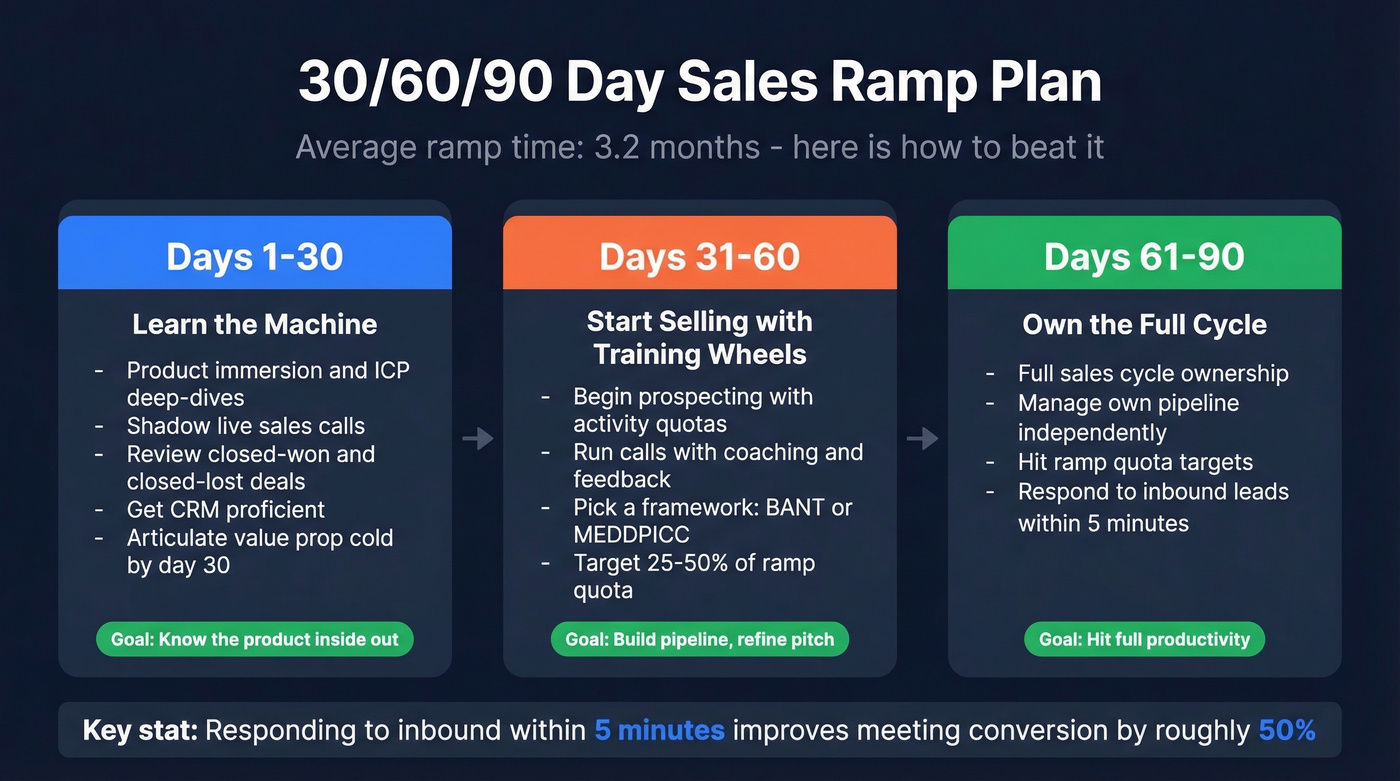
Days 1-30: Product immersion, ICP definition, CRM proficiency. Have new reps shadow calls and review closed-won and closed-lost deals. By day 30, they should articulate the value prop cold.
Days 31-60: Reps begin prospecting with activity quotas and run calls with coaching. Target 25-50% of ramp quota. Pick a qualification framework - BANT or MEDDPICC - and commit to it across the team.
Days 61-90: Full sales cycle ownership. Reps manage their own pipeline and hit ramp quota targets. One stat worth internalizing: responding to inbound leads within 5 minutes improves meeting conversion by roughly 50%, and inbound leads close 2-3x faster than outbound. Make sure your ramp plan prioritizes speed-to-lead from day one.
Minimum Viable Sales Stack
The average outbound team runs 5.6 tools. At the startup stage, you need three. That's it.

CRM - HubSpot's free tier or Pipedrive ($15-$100/user/mo). You need deal stages and activity tracking, not an enterprise platform. If you’re still evaluating, here are a few examples of a CRM to sanity-check your shortlist.
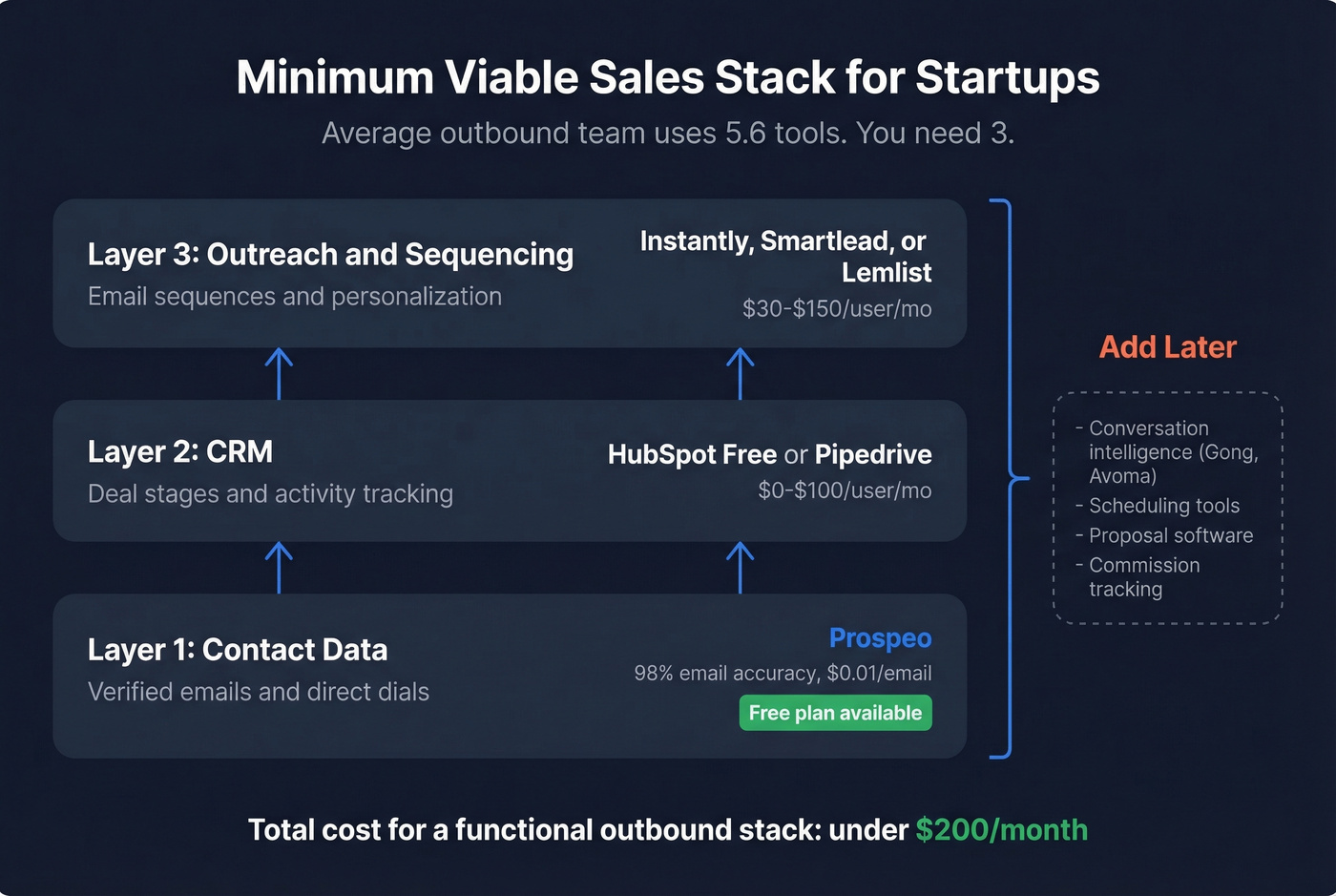
Outreach/sequencing - Instantly, Smartlead, or Lemlist ($30-$150/user/mo). Pick one that handles email sequences and basic personalization. If you want a broader shortlist, start with SDR tools and narrow from there.
Add later: conversation intelligence like Gong or Avoma ($100-$200/user/mo), scheduling tools, proposals, and commission tracking.
Let's be honest - we've seen startups blow $2k/mo on tools before they've closed their 10th deal. Skip the bloated stack. Three tools, clean data, and disciplined follow-up will outperform a twelve-tool Frankenstein setup every single time.
Your minimum viable sales stack needs clean data underneath it. Prospeo integrates natively with HubSpot, Instantly, Smartlead, and Lemlist - the exact tools in your lean stack. 98% verified emails, 125M+ direct dials, refreshed every 7 days. One less thing for your founding team to worry about.
Plug verified data into your stack in under five minutes.
FAQ
Do startups need a sales team?
Not immediately. Founders should close the first 10-30 deals themselves to validate the sales motion. Once follow-ups are slipping and pipeline exceeds what one person can manage - typically around 10+ qualified opportunities per month - it's time to hire your first full-cycle AE.
What do salespeople do in a startup?
Early-stage salespeople own the entire pipeline from first touch to signed contract: prospecting, running demos, negotiating, and closing. Unlike enterprise roles with narrow specializations, they also feed product feedback to the founding team and often help shape positioning. It's a generalist role, and that's the point.
When should a startup hire a VP of Sales?
After two reps are consistently hitting quota and you have a repeatable process, typically at $1M-$3M ARR. Hiring a VP before that point is a $200k-$350k/year gamble that almost always fails because there's no proven motion to scale.
What's the cheapest way to build an outbound stack?
HubSpot free CRM, a sequencing tool like Instantly ($30/user/mo), and Prospeo's free plan for 75 verified emails per month. That's a functional outbound stack for under $200/month - enough to run real campaigns while keeping bounce rates below 3%.