

Strategic Sales: The Definitive Guide for B2B Teams
You're a territory manager at a large med device company in the EU. Your manager pulls you aside and says they want you in a "more strategic sales role." You ask what that means. They say, "It'll be more strategic." No examples. No framework. No definition. Just vibes.
This is the problem with strategic sales - everyone uses the phrase, almost nobody operationalizes it. It gets thrown around in performance reviews, job postings, and board decks without anyone agreeing on what it actually requires day-to-day. Reps think "strategic" means "bigger deals." Managers think it means "think harder." Both are wrong.
What follows is the full breakdown - the definition, the framework that works, the math behind pipeline coverage, the mistakes that kill six-figure deals, and the tools worth paying for.
What You Need (Quick Version)
- Fewer, larger accounts with multi-stakeholder buying committees and 6+ month cycles - that's the core of a strategic selling approach.
- The framework: Miller Heiman Strategic Selling. Learn the Blue Sheet. Map the four buying influences. Identify red flags early.
- The math: 25 stakeholders per deal, ~20% win rates, 3x pipeline coverage minimum. If your target is $1M, you need $3M in qualified pipeline.
- The tool stack: A CRM like Salesforce or HubSpot, a verified data platform like Prospeo for multi-threading into buying committees, and a sales engagement tool such as Outreach or Salesloft. That's it. Everything else is optional.
What Is Strategic Selling?
This B2B selling approach focuses on high-value, complex deals involving multiple decision-makers and extended cycles. Winning depends on navigating organizational politics and aligning stakeholder-specific outcomes - not just demonstrating product value.
That definition separates strategic selling from three other approaches that get conflated with it constantly.
Strategic vs. Transactional vs. Consultative
| Approach | Deal Size | Cycle Length | Stakeholders | Best For |
|---|---|---|---|---|
| Transactional | <$5K | Days-weeks | 1-2 | SaaS self-serve, SMB |
| Consultative | $5K-$50K | 1-3 months | 2-5 | Mid-market B2B |
| Strategic | $50K-$500K+ | 6-18 months | 10-25 | Enterprise accounts |
| Enterprise | $500K-$5M+ | 12-36 months | 25-50+ | Fortune 500 deals |
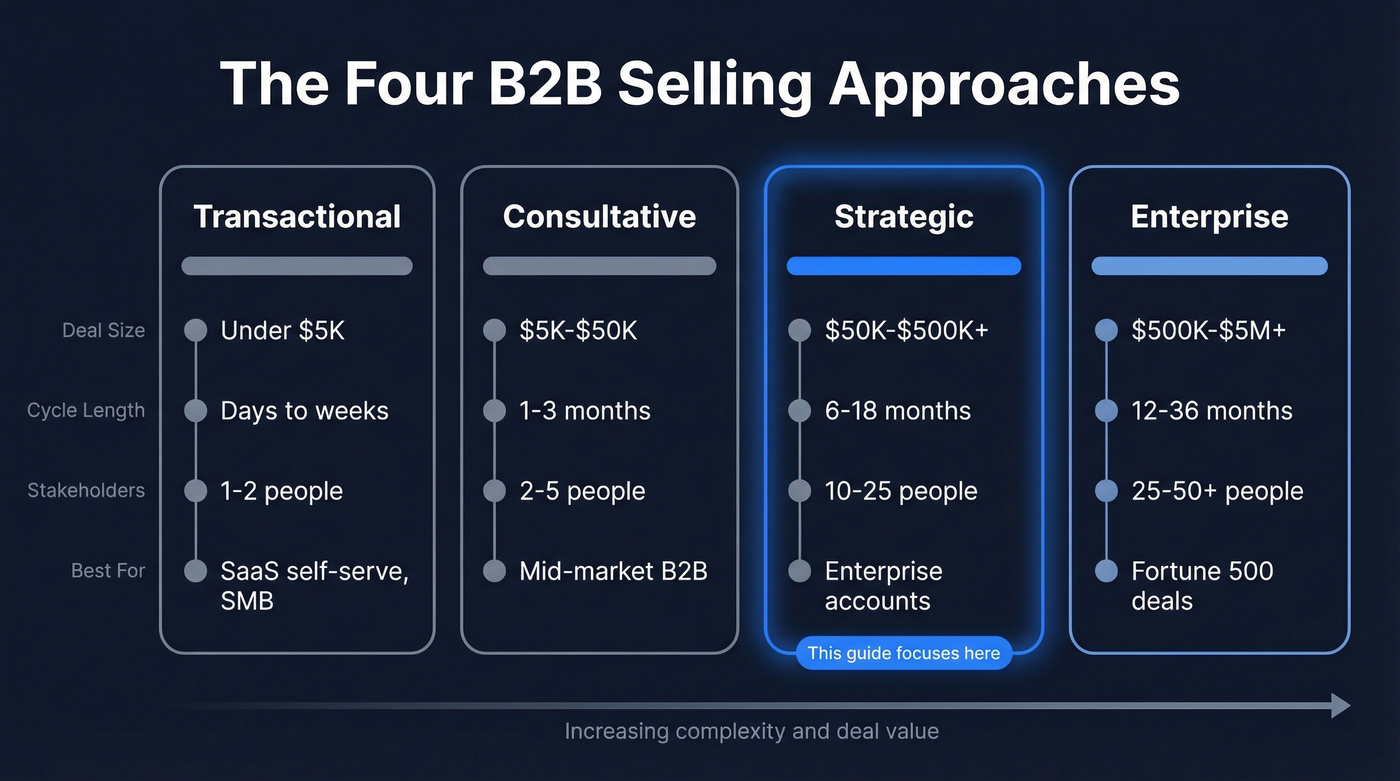
The key distinction: consultative selling is a technique you use inside conversations. The strategic selling methodology is a system for managing the entire deal across every stakeholder over months or years. Most strategic sellers use consultative techniques, but consultative sellers don't necessarily run strategic processes.
A Career in Complex B2B Deals
Moving into a strategic role means going from ~250 mid-market accounts to roughly 15 named accounts. Your cycles stretch from weeks to 3-5 years. You might not close a deal for a full year.
The tradeoff is real. In mid-market, you've got carryover pipeline and lots of at-bats. In enterprise-level selling, you're building from scratch with fewer swings. The upside? Deals that pay out six figures in commission. AEs in these roles often earn $150K-$250K OTE, and top performers clear $300K+ in a good year.
What "Be More Strategic" Actually Means
When your manager says "be more strategic," they're usually asking you to do four things they can't articulate:
- Map buying committees. Don't just sell to your champion. Identify every Economic Buyer, User Buyer, Technical Buyer, and Coach in the account. Know who has veto power and who's just along for the ride.
- Run Blue Sheets. Document your deal strategy on paper - strengths, red flags, competitive position, action plan. We'll cover this in detail below.
- Multi-thread. Build relationships with 3-5 stakeholders minimum per deal. Single-threading is how complex deals die.
- Forecast at the opportunity level. Not "I feel good about Q3." Instead: "The Economic Buyer has verbally committed, the Technical Buyer's evaluation is complete, and we're scheduled for legal review on the 15th."
That's what strategic means in practice. Not "thinking bigger." Doing more rigorous work per deal.
Strategic Sales by the Numbers
The data tells a clear story: B2B deals are getting harder, slower, and more crowded with stakeholders.
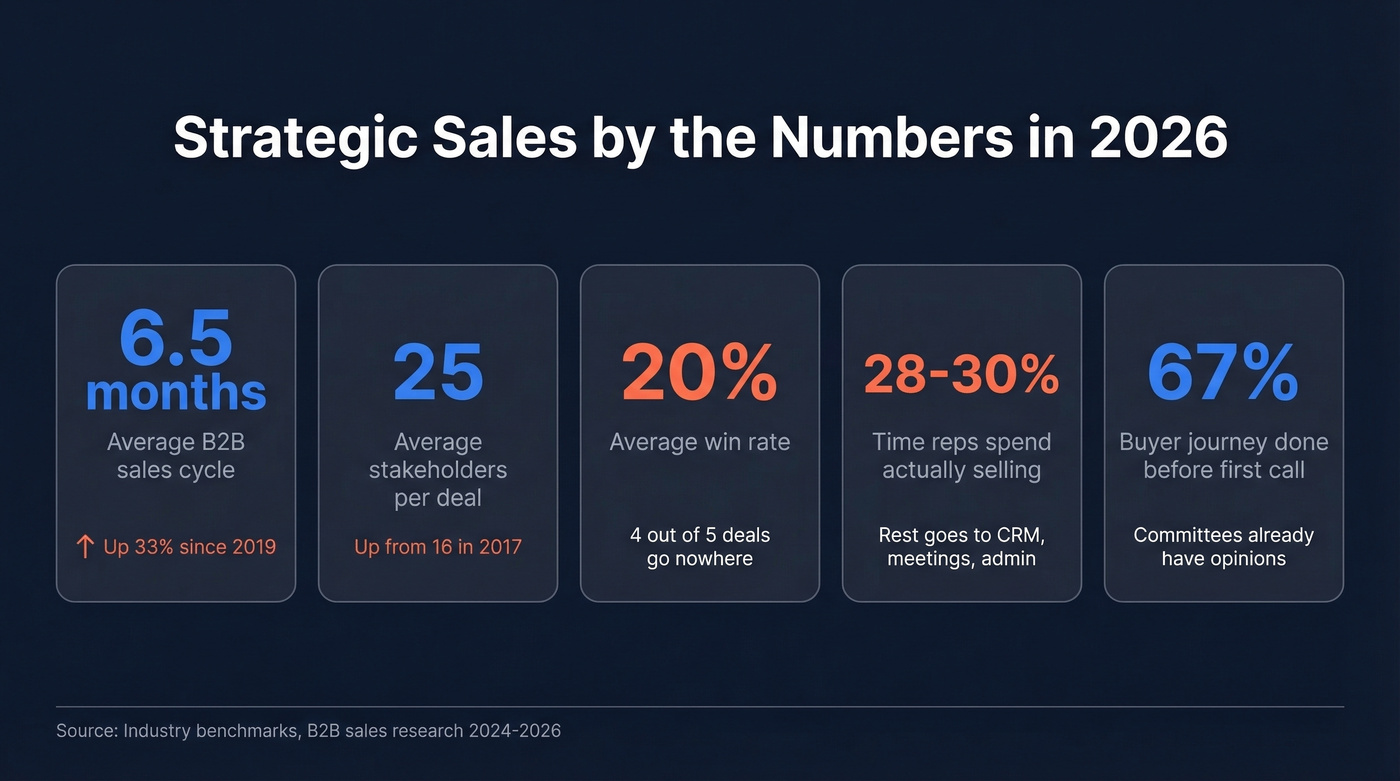
The average B2B sales cycle is now 6.5 months, up from 4.9 months in 2019 - a 33% increase in five years. For enterprise-level deals specifically, 12-18 months is common.
Buying committees have ballooned to 25 stakeholders on average, up from 16 in 2017. Each of those people has different concerns, different success metrics, and different political motivations. Missing even one key stakeholder can kill a deal you've worked for months.
Win rates hover around 20-21%. Four out of five qualified opportunities go nowhere. There's a sharp cliff: deals closed within 50 days hit a 47% win rate, while anything past that threshold drops to ~20% or lower. Time kills deals.
Reps spend only 28-30% of their time actually selling. The rest goes to CRM updates, internal meetings, and admin. And 67% of the buyer's journey is completed before a prospect even talks to a salesperson - by the time you get the meeting, the committee has already formed opinions.
These numbers aren't abstract. They're the operating environment for every seller working complex accounts. If your process doesn't account for 25 stakeholders, 6+ month timelines, and sub-30% selling time, you're flying blind.
The Miller Heiman Framework
Miller Heiman Strategic Selling, originally published in the 1985 book Strategic Selling by Robert Miller and Stephen Heiman, remains one of the most widely adopted frameworks for complex B2B deals. It's not the only methodology worth knowing - we'll compare others below - but it's the one we'd start with for any team selling deals over $50K with multiple stakeholders.
The framework has two complementary halves: Strategic Selling (planning the deal) and Conceptual Selling (running the conversations). Most teams focus on the planning side, which centers on the Blue Sheet and the four buying influences. The updated approach, often called strategic selling with perspective, adds a layer of insight-driven engagement - reps don't just map the deal, they bring a unique point of view to each stakeholder conversation.
The Four Buying Influences
Every complex deal has four types of buyers. Your job is to identify and engage all of them. Critical caution: don't infer the role from someone's title. A VP of Engineering might be the Economic Buyer on one deal and the Technical Buyer on another.
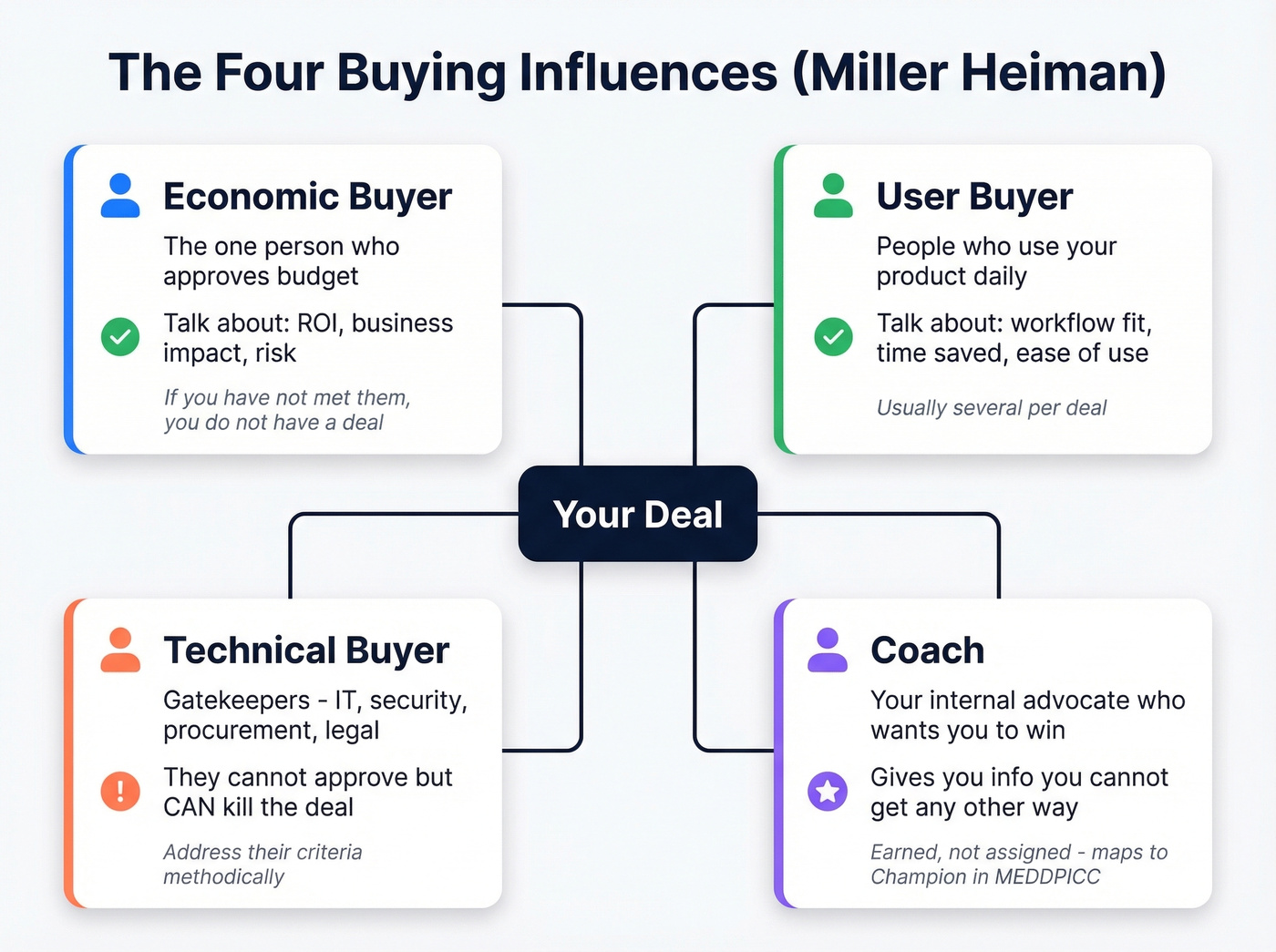
Economic Buyer. Usually the single person who can approve budget and make the final call. Your messaging to them should focus on business impact, ROI, and risk mitigation. If you haven't met this person, you don't have a deal.
User Buyer. The people who'll use your product daily. They care about workflow fit, ease of adoption, and whether this makes their job easier or harder. There are usually several. Speak to their day-to-day pain.
Technical Buyer. The gatekeepers who evaluate whether your solution meets specifications - IT, security, procurement, legal. They can't approve the deal, but they can kill it. Address their criteria methodically.
Coach. Your internal advocate who wants you to win and guides you through the organization's politics. Coaches are earned, not assigned. They give you information you can't get any other way - who the real decision-maker is, what the budget process looks like, which competitor has the inside track. If you're also running MEDDPICC, the Coach maps directly to the "Champion" role, so don't double-count.
The Blue Sheet
The Blue Sheet is Miller Heiman's "strategy on a page" - a living document you create for each major opportunity. It covers the single sales objective, all buying influences and their degrees of influence, your strengths and red flags, win-results for each stakeholder, ideal customer criteria, your action plan, and what you don't know yet.
Here's the thing: a Blue Sheet takes 3-5 hours to complete properly. New reps need 90-120 days to reach proficiency. That's a real investment, which is why it's best suited for deals exceeding $50K. For smaller, faster deals, use BANT or a lighter qualification framework and save the Blue Sheet for opportunities that justify the rigor.
Red Flags That Kill Deals
You're six months in. Your champion loved every demo. Then the Economic Buyer killed the deal in a meeting you didn't know happened.
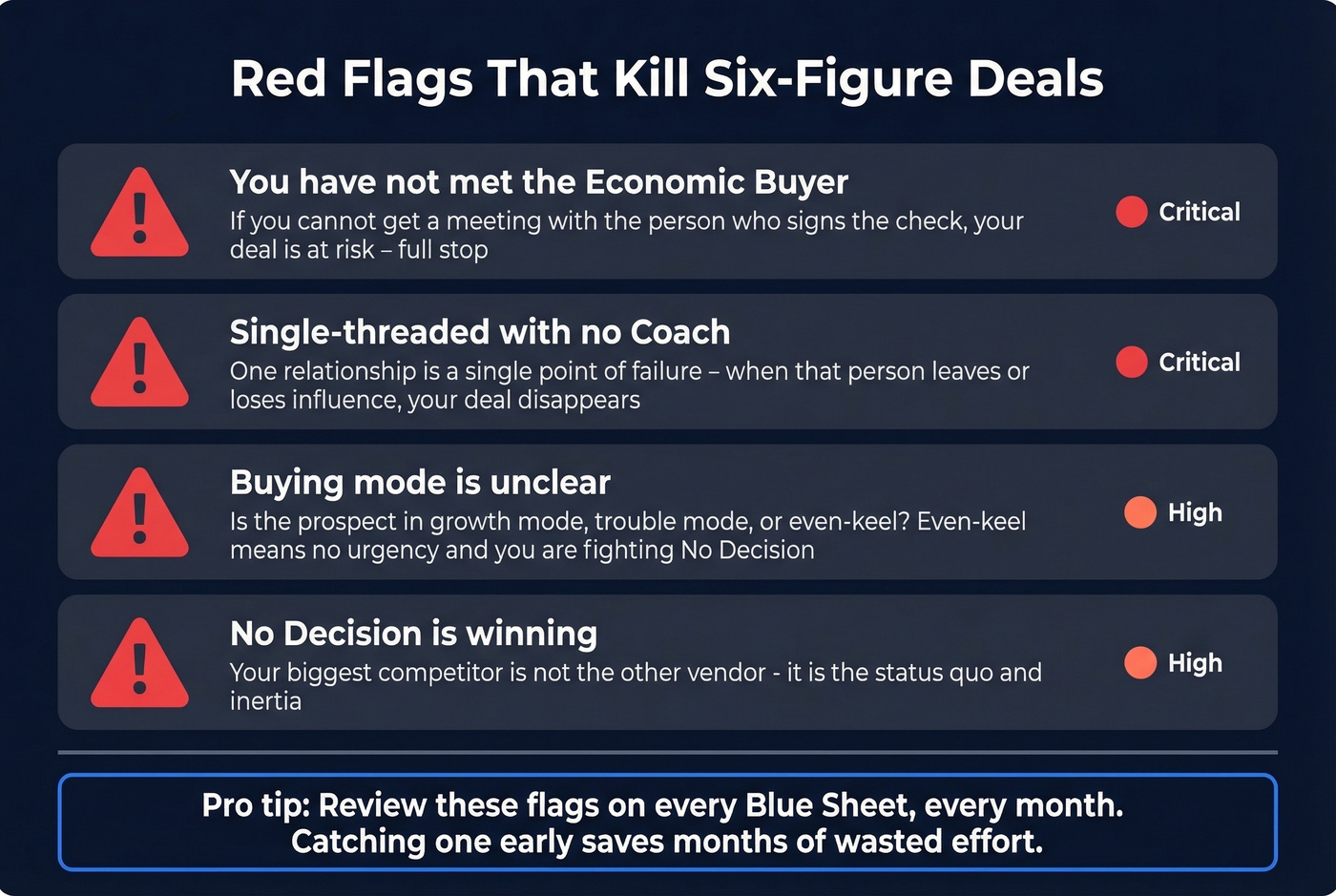
This nightmare scenario happens because of predictable red flags:
- You haven't met the Economic Buyer. If you can't get a meeting with the person who signs the check, your deal is at risk. Full stop.
- You're single-threaded with no Coach. One relationship is a single point of failure. When that person goes on vacation, changes roles, or loses political capital, your deal evaporates.
- The buying mode is unclear. Is the prospect in growth mode, trouble mode, or even-keel? If they're even-keel - things are fine, no urgency - you're fighting "No Decision," which is the real competitor in most complex deals.
- "No Decision" is winning. Your biggest threat isn't the other vendor. It's the status quo. If you can't articulate why acting now is better than waiting, you'll lose to inertia.
Win-Results
Each buying influence needs a different "win" articulated. The Economic Buyer's win might be a 15% reduction in operational costs. The User Buyer's win is saving two hours per day on manual reporting. The Technical Buyer's win is clean integration with their existing stack. The Coach's win is looking good internally for championing the right vendor.
If you're pitching the same value proposition to all four, you're not doing strategic selling - you're doing a demo with extra steps.

You can't multi-thread into a 25-person buying committee without verified contact data. Prospeo gives you 98% accurate emails and 125M+ verified mobile numbers - so you reach every Economic, User, and Technical Buyer directly.
Stop single-threading six-figure deals. Start multi-threading with data that connects.
How to Build a Strategic Sales Plan
A strategic sales plan isn't a quota spreadsheet with a mission statement stapled on top. It's a living system that connects revenue targets to daily activities. The best plans are built on core selling principles: map every stakeholder, qualify rigorously, and align your actions to the buyer's decision process rather than your own internal timeline.
Basic Plan vs. Strategic Plan
| Dimension | Basic Plan | Strategic Plan |
|---|---|---|
| Horizon | Quarterly | 12-18 months, 3-5 yr projections |
| Review cadence | End of quarter | Monthly adjustments, quarterly reviews |
| Components | Quotas, territories | Market analysis, ICP, KPIs |
| Stakeholders | Sales manager + reps | Sales, marketing, RevOps, finance |
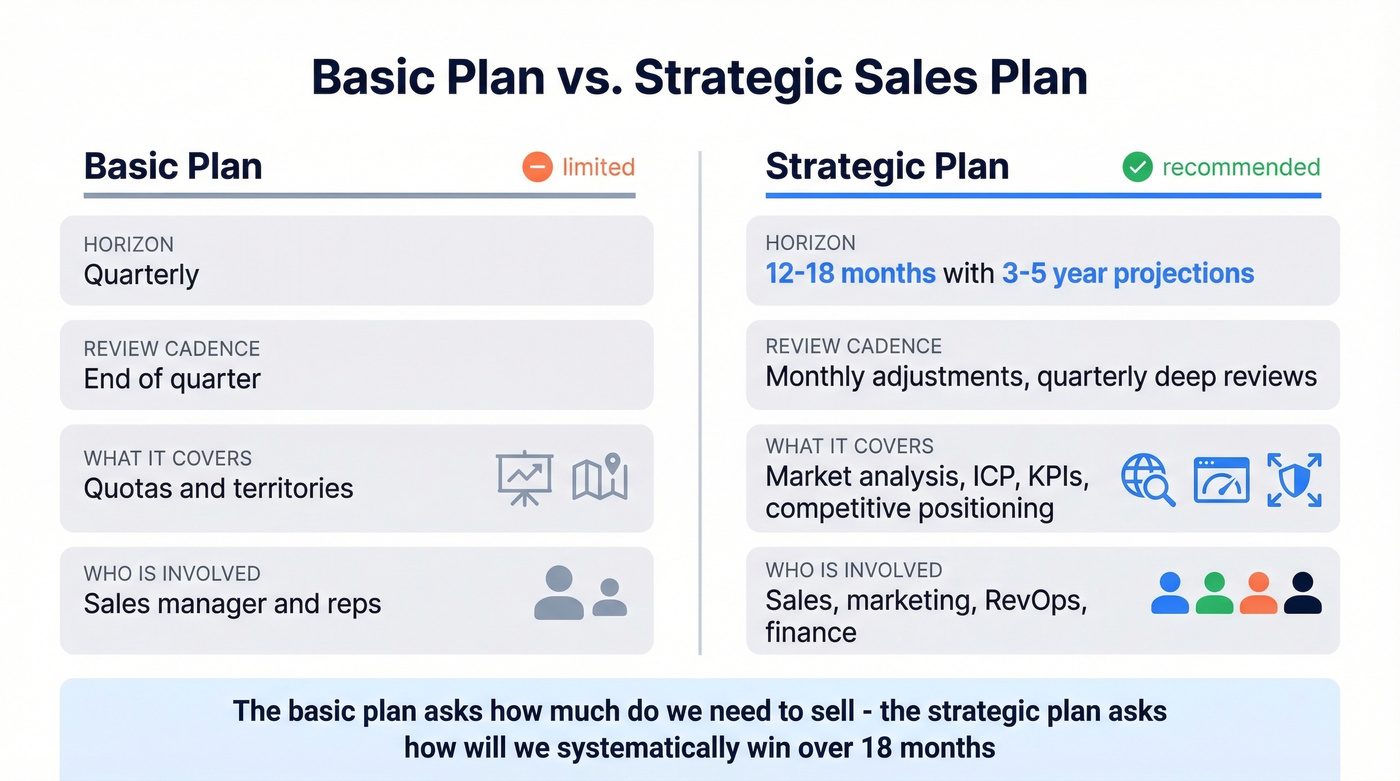
The basic plan asks "how much do we need to sell?" The strategic plan asks "how will we systematically win in our target market over the next 18 months, and what needs to be true for that to happen?"
Pipeline Math for Complex Deals
Let's work a real example. Say your annual target is $1M and your average deal size is $50K. That's 20 closed deals needed. At a 20% win rate, you need 100 qualified opportunities in your pipeline. With 3x coverage as your safety margin, you're looking at $3M in total pipeline value.
Now layer in the time dimension. If your average cycle is 6.5 months, you need those 100 opportunities entering the pipeline by mid-Q2 to have any shot at closing them by year-end. Deals closed within 50 days carry a 47% win rate, while longer deals drop to ~20%. Speed matters - not rushing the buyer, but eliminating dead time between stages.
For SaaS teams specifically, the benchmarks shift: the median sales cycle is 84 days with a typical win rate of 20-30% and a median deal size around $26K. The biggest conversion bottleneck is MQL to SQL at 15-21%, meaning your pipeline math needs to account for massive top-of-funnel volume even before you get to qualified opportunities.
The math gets uncomfortable fast. Most teams don't have enough pipeline, and they realize it too late. Build your coverage model in January, not July.
Template Components
A complete plan includes revenue and pipeline objectives broken down by quarter, segment, and product line; ICP and segment definitions with firmographic and behavioral criteria; your chosen methodology and process stages - whether that's Miller Heiman, MEDDPICC, or a hybrid; clear role ownership and quotas; tactics and channels covering outbound, inbound, partnerships, events, and ABM; KPIs and review cadence; and budget and resources including headcount, tools, training, and travel.
Example KPIs worth tracking: pipeline coverage at 3x, average cycle length of 45 days, demo-to-close rate of 30%, lead response time under 5 minutes, CAC under $500 for SMB segments, MRR growth of 8% month-over-month. These aren't universal targets - they're starting points you calibrate to your business.
Keep the plan in a living doc and update it weekly. A PDF that lives in a shared drive is a decoration, not a plan.
Methodologies Compared
Miller Heiman isn't the only game in town.
| Methodology | Core Idea | Best For | Deal Complexity |
|---|---|---|---|
| Miller Heiman | Map buying influences, plan the deal | Complex B2B, $50K+ | High |
| SPIN Selling | Structured questioning framework | Mid-market discovery | Medium |
| Challenger | Teach, tailor, take control | Commoditized markets | Medium-High |
| Consultative | Advisory relationship building | High-trust, long-cycle | Medium |
| Solution Selling | Diagnose pain, prescribe solution | Technical products | Medium |
MEDDIC/MEDDPICC sits on top of these as a qualification layer, not a selling methodology. It tells you whether a deal is real. Pair it with any of the above.
The decision framework is straightforward: if you're selling deals over $50K with 3+ stakeholders, start with Miller Heiman. Smaller and faster? SPIN or Challenger. Need a qualification layer on top? Add MEDDPICC. Most mature teams use a combination - Miller Heiman for deal planning, Challenger for messaging, MEDDPICC for qualification.
Our hot take: if your average contract value is under $25K, you probably don't need Miller Heiman-level rigor. A solid MEDDPICC qualification process with Challenger messaging will get you 80% of the way there at a fraction of the training investment. Save the Blue Sheets for the deals that justify five hours of planning.
Mistakes That Kill Complex Deals
We've seen these patterns destroy deals that teams spent months building. Every one is avoidable.
1. Single-threading. This is the most common and most fatal mistake. You build a great relationship with one champion, and when they leave, lose influence, or go on parental leave, your deal dies overnight. Multi-thread into at least 3-5 contacts per account from day one. The consensus on r/sales is pretty clear on this - single-threading is the number one deal-killer in enterprise, and yet reps keep doing it because it feels efficient.
2. Talking instead of listening. Buyers in high-stakes evaluations don't want a pitch. They want someone who understands their problem deeply enough to co-create a solution. If you're talking more than 40% of the time in discovery calls, you're doing it wrong.
3. Responding to low-value RFPs without decision-maker access. If you can't get a meeting with the Economic Buyer before submitting a proposal, you're column fodder. Someone else wrote the RFP requirements, and they wrote them for their preferred vendor. Walk away or demand access.
4. Selling to the wrong stakeholders. As buying committees grow to 25 people, it's easy to spend months building consensus with User Buyers who love you while the Economic Buyer has never heard your name. Map the org chart before you map the deal.
5. Ignoring "No Decision" as the real competitor. Your biggest threat isn't the other vendor in the evaluation. It's the committee deciding to do nothing. Build urgency around cost of inaction, not just ROI of adoption.
6. Prospecting with bad data. You can't multi-thread into a 25-person buying committee if 35% of your emails bounce. Snyk's 50 AEs cut their bounce rate from 35-40% to under 5% after switching to Prospeo, generating 200+ new opportunities per month. A 7-day data refresh cycle is the difference between reaching the Economic Buyer and landing in a spam trap.
7. Over-serving a few accounts. Strategic doesn't mean obsessive. If you're spending 80% of your time on two accounts and neglecting the other 13, you're concentrating risk. Spread your effort proportionally to deal probability and size.
Tools for Strategic Sales Teams
You don't need ten tools. You need three categories covered well, plus a lightweight option for founders running their own deals.
Data and Prospecting
When you're mapping a 25-person buying committee, you need verified contact data for every stakeholder role - Economic Buyer, User Buyers, Technical Buyers, and potential Coaches. Prospeo's database covers 300M+ professional profiles with 98% email accuracy and 125M+ verified mobile numbers that deliver a 30% pickup rate.

The 30+ search filters are what make it practical for complex deal planning specifically. Filter by buyer intent across 15,000 topics via Bombora, technographics, job changes, department headcount, and funding stage - all critical signals for identifying which accounts are in-market and which stakeholders matter. The 7-day data refresh cycle means you're not chasing contacts who changed roles two months ago. Pricing is transparent and self-serve: the free tier gives you 75 emails per month, paid plans run roughly $0.01 per email with no contracts.
CRM
Salesforce Sales Cloud runs about $25-$330/user/month depending on edition and add-ons. Pipeline visibility, forecasting, stakeholder mapping, and the ecosystem of integrations make it hard to beat at scale. It's also complex and expensive - budget for implementation.
HubSpot Sales Hub includes a free CRM, with paid Sales Hub tiers on top. The learning curve is gentler and the free tier is genuinely useful for mid-market teams scaling into more complex selling for the first time.
Pipedrive ($14-$79/seat/month) keeps things visual and lightweight. Good for smaller teams that want pipeline clarity without Salesforce's overhead. Budget-conscious teams should also look at Zoho CRM starting at around $29/user/month for a full-featured alternative.
Sales Engagement
Outreach typically costs around $100-$150/user/month with custom pricing. Beyond sequencing, their AI coaching tool Kaia shaves 11 days off sales cycles and can lift win rates by up to 10 percentage points on deals over $50K. For teams running long-cycle deals, that time compression matters enormously.
Salesloft lands in a similar $100-$150/user/month range depending on package. Pick based on which integrates better with your CRM.
Lightweight Options
Close starts at $9/month for solo plans and includes built-in calling and email. If you're a founder running your own complex deals and don't need enterprise infrastructure, it's a solid starting point. Skip it if you've got more than 10 reps - it won't scale the way you need.
Strategic sellers spend only 28% of their time selling. Prospeo's 30+ search filters - buyer intent, job changes, department headcount - let you map entire buying committees in minutes, not hours. At $0.01 per email, enterprise-grade data doesn't require enterprise pricing.
Spend your time selling to stakeholders, not searching for them.
FAQ
What is strategic selling?
Strategic selling is a B2B methodology for high-value deals where multiple decision-makers control the outcome. It requires mapping entire buying committees, running structured deal plans like the Blue Sheet, and aligning unique win-results to each stakeholder over cycles that often stretch 6-18 months. Miller Heiman's framework is the most widely adopted version.
How does strategic differ from consultative selling?
Strategic selling navigates complex buying committees across long cycles using frameworks like Miller Heiman and MEDDPICC. Consultative selling builds trust through deep questioning within individual conversations. They're complementary - most enterprise AEs use consultative techniques inside a broader deal-planning system.
What is a Blue Sheet in sales?
A Blue Sheet is Miller Heiman's one-page deal strategy document mapping every buying influence, their concerns, red flags, competitive position, and your action plan. It takes 3-5 hours to complete properly and is best reserved for opportunities exceeding $50K where the rigor justifies the investment.
How do you multi-thread into large buying committees?
Start by identifying all four buying influences - Economic, User, Technical, and Coach - then source verified contact data for each. Use filters for seniority, department, and intent signals to pinpoint the right people. Aim for 3-5 active threads per deal minimum to avoid single-point-of-failure risk.
How long is a typical strategic sales cycle?
The average B2B cycle is 6.5 months in 2026, up 33% from 4.9 months in 2019. Enterprise-level deals routinely stretch to 12-18 months. Deals closed within 50 days carry a 47% win rate - velocity matters even in long-cycle selling, so eliminate dead time between stages.