

Miller Heiman Strategic Selling: 2026 Guide
Miller Heiman strategic selling exists to prevent one specific failure: selling to the wrong person. A RevOps lead we know ran a deal review on a $200K opportunity that had stalled for three months. The team had never identified the Economic Buyer - they'd been demoing for a User Buyer who couldn't sign anything.
Sales orgs with a formalized methodology achieve 27% higher win rates and 21% higher quota attainment than teams winging it. Yet only 30% follow one consistently. That gap between knowing a framework and executing it is where revenue disappears.
Quick Version
- Miller Heiman's methodology is a deal-orchestration framework for complex B2B sales - $50K+ deals, at least six decision-makers.
- Core concepts: four buying influences, the Blue Sheet, Win-Results, buying modes, and red flags.
- Best paired with MEDDIC for qualification and Challenger for messaging. Complements, not competitors.
- Overkill for transactional deals with a single decision-maker.
- The book: The New Strategic Selling (2005 edition, about $10 on Amazon).
What Is the Strategic Selling Methodology?
Robert Miller and Stephen Heiman published Strategic Selling in 1985 as a framework for navigating complex B2B deals where multiple decision-makers control the outcome. Korn Ferry now owns the methodology and delivers the training globally.
The framework's signature artifact is the Blue Sheet - a deal-planning document that maps every stakeholder, their motivations, your competitive position, and your action plan. The name comes from a printer running out of white paper during an early workshop in Reno, NV. Forms came out on blue stock, and it stuck.
This methodology doesn't tell you what to say on a call (that's Challenger) or whether a deal is qualified (that's MEDDIC). It tells you who matters, what they care about, and how to build a strategy that accounts for every stakeholder before you're blindsided.
The Four Buyer Types
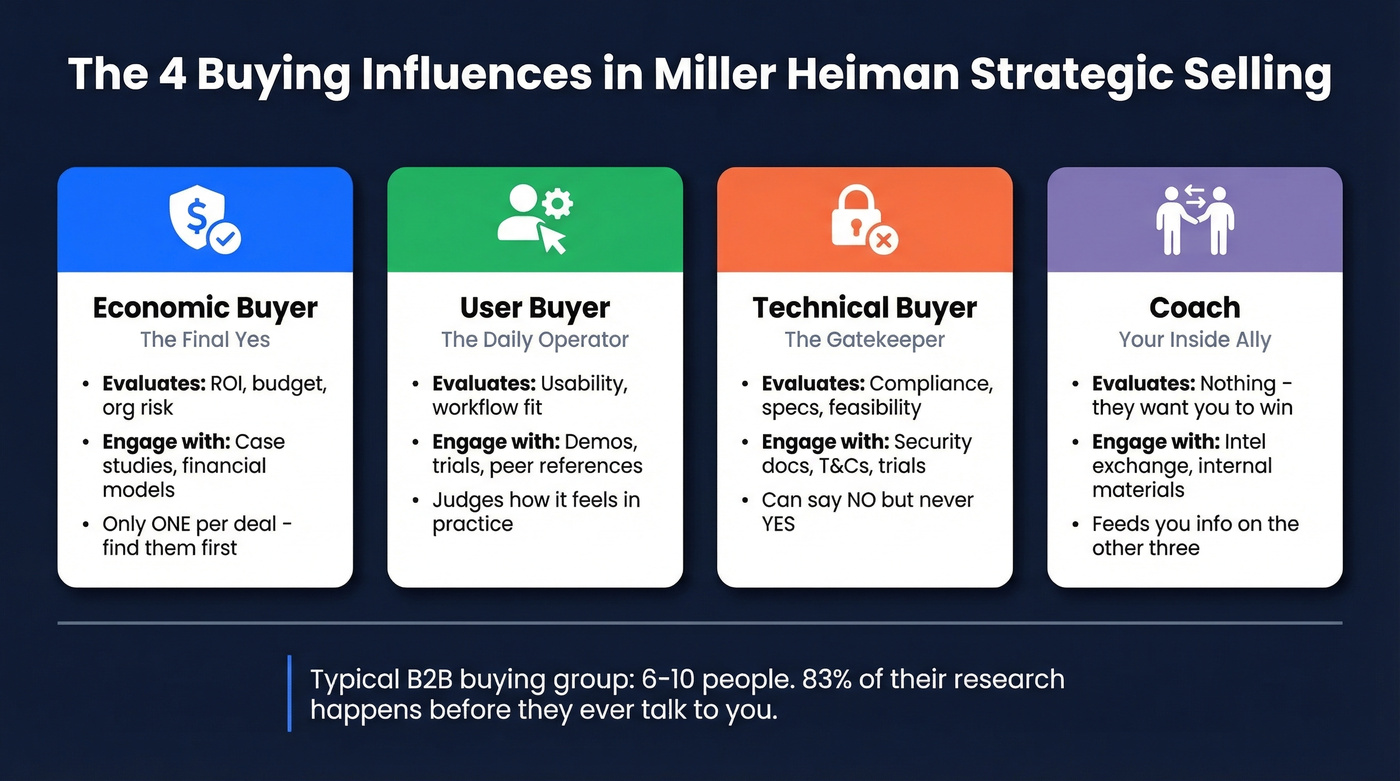
Every complex deal has four types of buying influence. B2B buying groups typically run 6-10 people, and buyers self-source around 83% of their information before engaging a vendor - meaning stakeholders are forming opinions about you before your first call.
| Role | What They Evaluate | How to Engage |
|---|---|---|
| Economic Buyer | ROI, budget impact, org risk | Case studies, financial models. Only one per deal. |
| User Buyer | Day-to-day usability, workflow fit | Demos, trials, peer references |
| Technical Buyer | Compliance, feasibility, specs | Security docs, trials, T&Cs. Can say "no" but not "yes." |
| Coach | Wants your solution to win | Internal-facing materials, intel exchange |
The Economic Buyer can say yes when everyone else says no. Finding them early - and getting direct access - is the single highest-leverage activity in any complex deal.
Technical Buyers are gatekeepers who screen you out on specs, compliance, or procurement criteria. Your Coach is an insider who feeds you intelligence on the others. Understanding these buyer types and how they interact is what separates a mapped deal from a hopeful one.
How the Blue Sheet Works
Here's the thing: a deal strategy isn't a Blue Sheet. The Blue Sheet documents your strategy after rigorous analysis. Filling in the worksheet without the thinking is the most common failure mode - teams treat it as a checkbox exercise and wonder why win rates don't move.
Start With Five Questions
Before you touch the Blue Sheet, run through this opportunity analysis:
- What's the business problem, and what's driving urgency?
- Who initiated the evaluation, and what was the trigger event?
- What's the evaluation process - alternatives, procurement rules, incumbent?
- Do you have coverage across all four buying influences?
- What's the realistic, buyer-controlled timeline?
If you can't answer these confidently, you don't have enough information for a Blue Sheet. Go get it first. In our experience, teams that skip this analysis and jump straight to the worksheet get the least value from the methodology.
Eight Blue Sheet Components
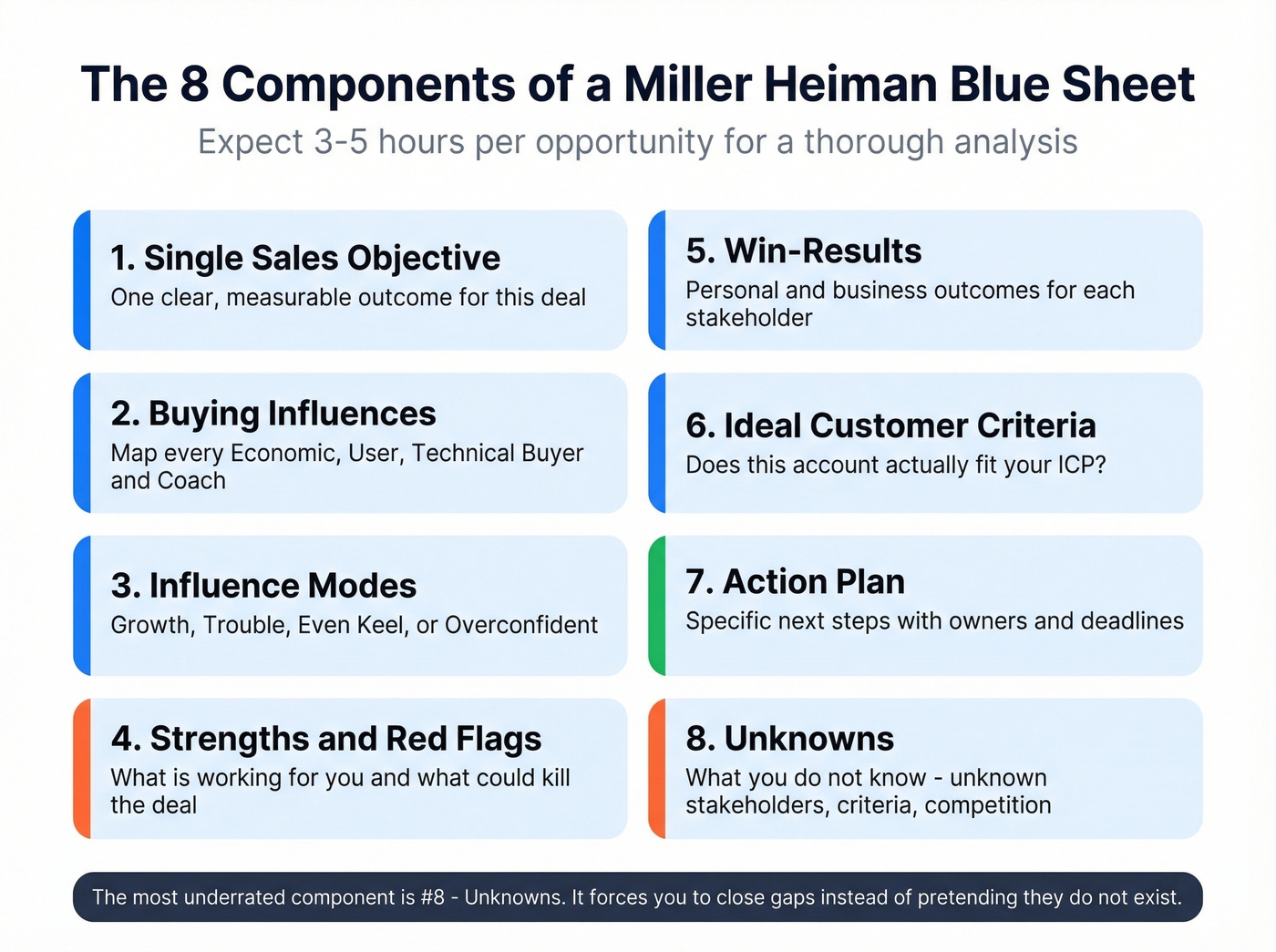
The full Blue Sheet covers: single sales objective, buying influences, influence modes, strengths/red flags, Win-Results, ideal customer criteria, action plan, and unknowns. That last one is underrated. It forces you to categorize what you don't know - unknown stakeholders, unknown criteria, unknown competition - so you can systematically close those gaps instead of pretending they don't exist.
Win-Results in Practice
Win-Results connect your solution to personal and business outcomes for each stakeholder:
| Stakeholder | Role | Win-Result |
|---|---|---|
| CMO | Economic Buyer | 30% faster time-to-market on campaigns |
| Marketing Ops Lead | User Buyer | 5 hrs/week freed from manual workflows |
| CFO | Technical Buyer | 20% cost reduction consolidating 3 vendors |
| Dir. of Demand Gen | Coach | Positioned as change agent internally |
Expect 3-5 hours to complete a thorough Blue Sheet on a single opportunity. New reps typically reach proficiency in 90-120 days. That's real investment, which is exactly why it only makes sense for deals where the payoff justifies the effort.
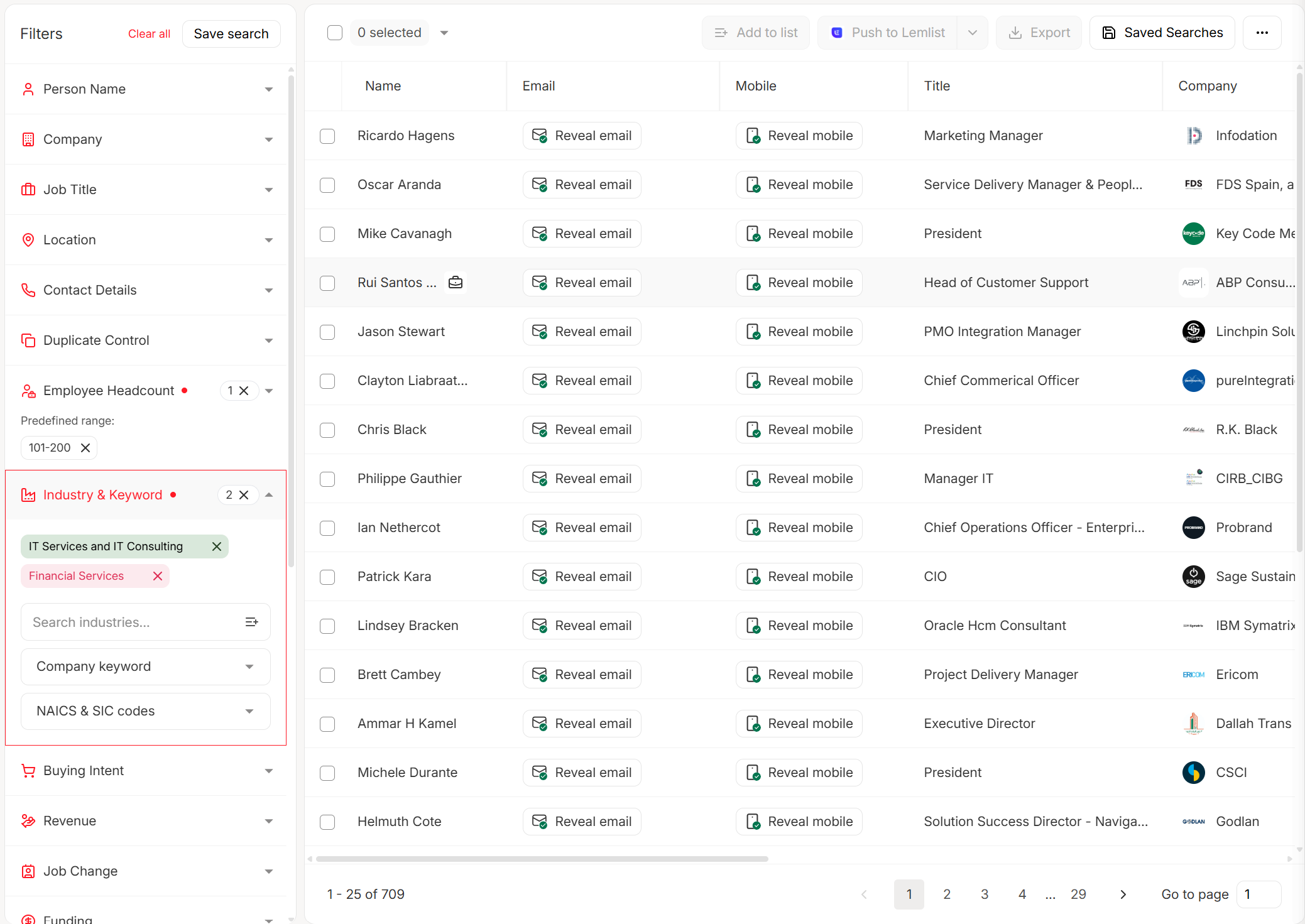

You just mapped four buying influences on your Blue Sheet. Now you need direct contact data for every one of them. Prospeo gives you 98% accurate emails and 125M+ verified mobile numbers - filtered by job title, department, and seniority across 300M+ profiles.
Stop mapping stakeholders you can't actually reach.
Buying Modes and Red Flags
Each stakeholder sits in one of four modes that determine how receptive they are to change:
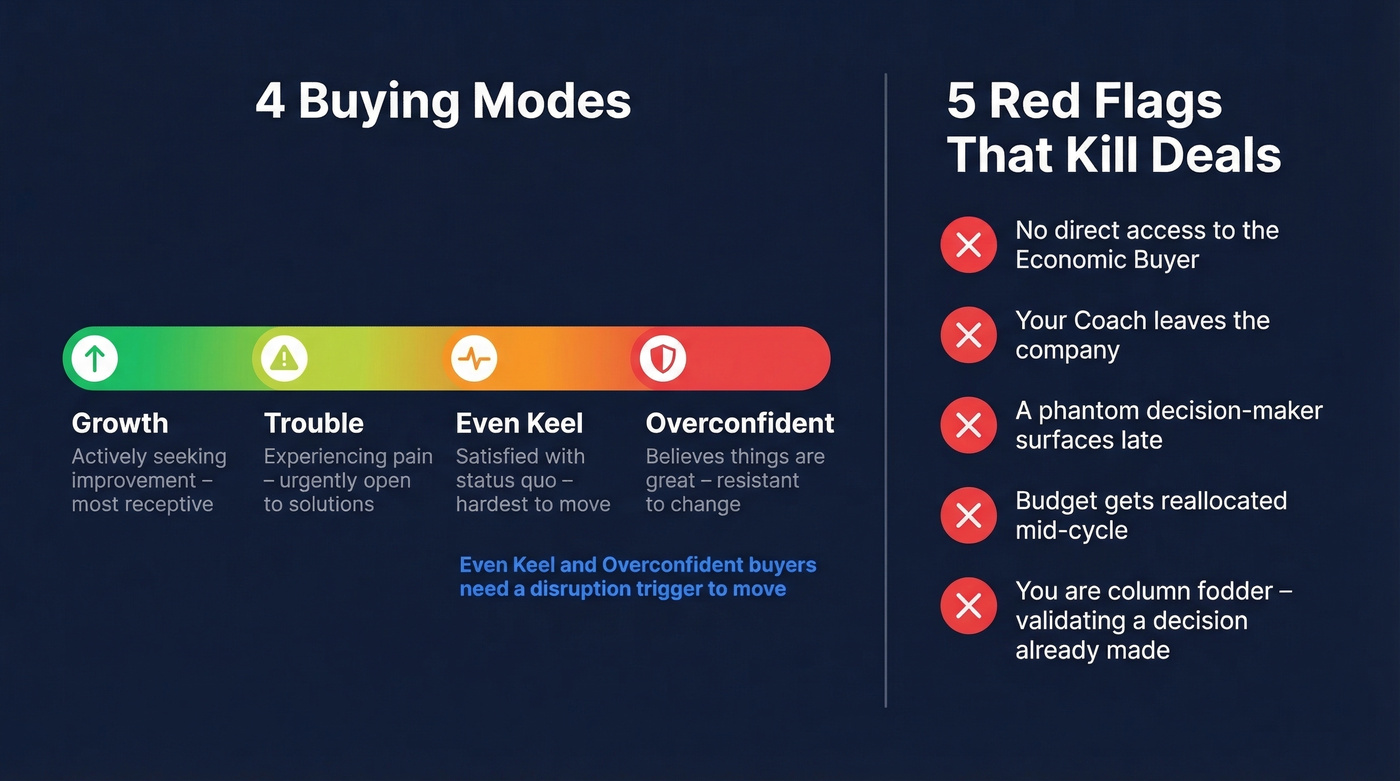
- Growth - actively seeking improvement, most receptive
- Trouble - experiencing pain, urgently open to solutions
- Even Keel - satisfied with the status quo, hardest to move
- Overconfident - believes things are better than they are, resistant to change
Even Keel and Overconfident buyers are where deals stall. You need a compelling disruption to their comfort - a competitor move, a regulatory shift, a board mandate. Without that trigger, no amount of feature pitching moves the needle.
Red flags that kill deals: no direct access to the Economic Buyer, your Coach leaves the company, a phantom decision-maker surfaces late, budget gets reallocated mid-cycle, or you're "column fodder" - invited to validate a decision that's already been made. Any single one of these can sink an opportunity, and we've watched teams ignore them until it's too late more times than we can count.
When to Use It (and When Not To)
Use this framework when deals exceed $50K, involve at least six decision-makers, and run multi-month cycles. Enterprise software, professional services, and complex infrastructure are the sweet spot.
Skip it when you're selling transactional or SMB deals with one or two stakeholders. It's overkill for anything under $50K with a single decision-maker - you'll spend more time on the Blue Sheet than the deal is worth.
Let's be honest: if your average contract value is under $25K, you don't need this methodology. You need a tighter ICP and faster outbound. The framework's power scales with deal complexity, and below a certain threshold, the overhead eats the margin.
One cultural risk worth flagging: rigid Blue Sheet enforcement can frustrate experienced reps who already run sophisticated deal strategies. Give veterans flexibility on format while holding them to the underlying analysis. Track Blue Sheet adoption rate, red flag resolution speed, and win rate on 6+ stakeholder deals to measure whether the methodology is actually moving numbers.
Strategic Selling vs. MEDDIC vs. Challenger
These frameworks aren't competitors - they're complements. We've seen the best enterprise teams layer all three, and the consensus on r/sales backs this up: pick one for qualification, one for messaging, one for deal orchestration.
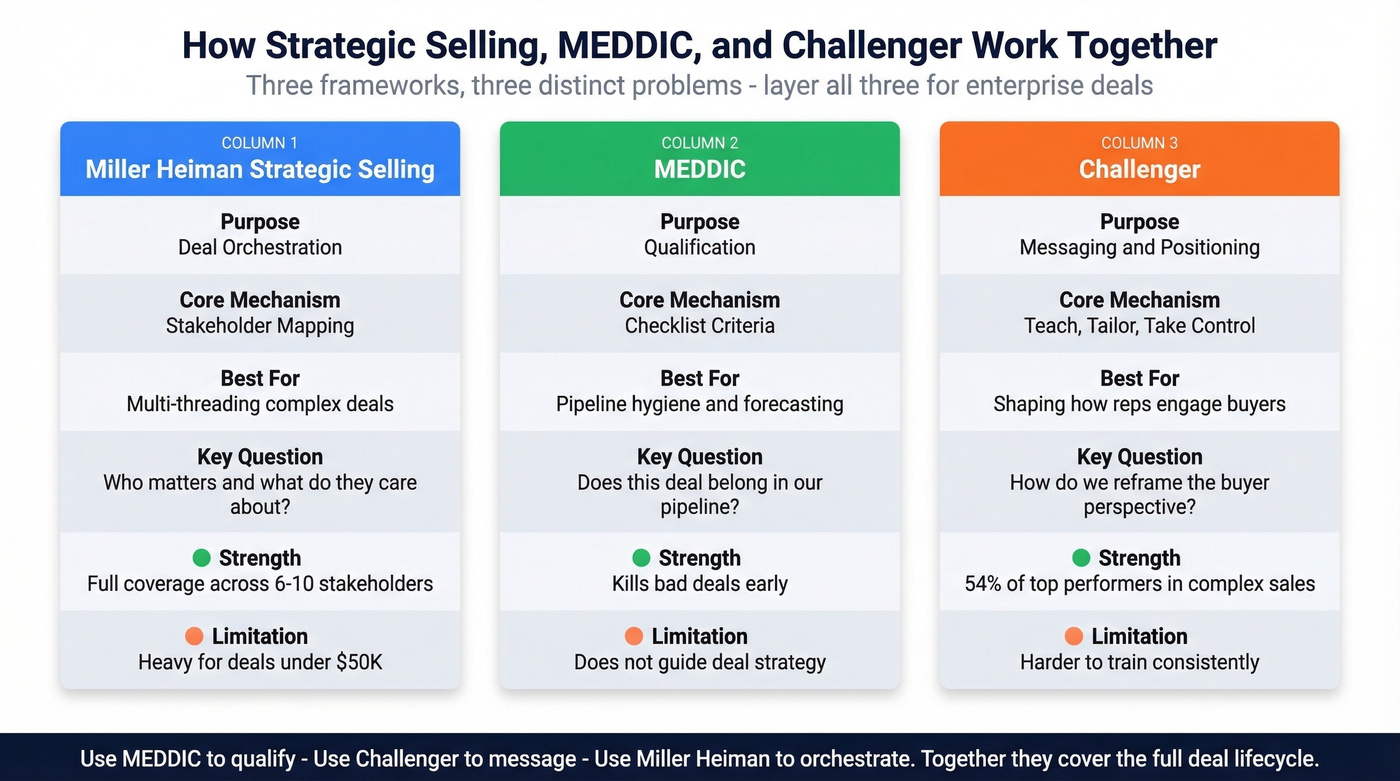
| Framework | Best For | Core Mechanism | Strength | Limitation |
|---|---|---|---|---|
| Miller Heiman | Deal orchestration | Stakeholder mapping | Multi-thread coverage | Heavy for small deals |
| MEDDIC | Qualification | Checklist criteria | Pipeline hygiene | Doesn't guide strategy |
| Challenger | Messaging | Teach-tailor-take control | 54% of top performers in complex sales | Harder to train |
Use MEDDIC to decide if a deal belongs in your pipeline. Use Challenger to shape how reps engage. Use Miller Heiman's approach to orchestrate across every stakeholder. Together, they cover qualification, messaging, and strategy - three distinct problems that no single framework solves alone.
How to Get Trained
Korn Ferry runs the official program: Strategic Selling and Conceptual Selling with Perspective. It's available onsite, virtual, and as digital e-learning.
Format is usually 1-3 days instructor-led, plus reinforcement coaching. Expect $1,500-$5,000 per learner depending on format - onsite engagements with tailored content run higher. Gartner Peer Insights rates Korn Ferry's sales training 4.5/5 across 23 ratings. Practitioners consistently call it "not theory - extremely practical and applicable," though some flag that customization for niche industries can feel thin.
If budget's tight, start with The New Strategic Selling for $10. It won't replace facilitated training, but it'll give your team the foundation to start mapping deals immediately.
Red flag #1 in Strategic Selling: no direct access to the Economic Buyer. Prospeo's 30+ search filters - including department headcount, seniority, and buyer intent - help you identify and reach every decision-maker before a phantom stakeholder kills your deal.
Find the Economic Buyer before your competitor does.
FAQ
Is Miller Heiman strategic selling still relevant in 2026?
Yes. B2B buying groups now average 6-10 people, making stakeholder mapping more critical than ever. Korn Ferry continues to update the training, and the core framework has been refined over four decades of enterprise deal cycles.
How long does it take to complete a Blue Sheet?
Expect 3-5 hours per opportunity for a thorough Blue Sheet. Start with the 5-question analysis first - it forces the strategic thinking that makes the document useful rather than a checkbox exercise.
What are the four Miller Heiman buyer types?
The framework defines four buying influences: Economic Buyer (final budget authority), User Buyer (daily user of the solution), Technical Buyer (screens for compliance and feasibility), and Coach (your internal champion). Every complex deal has all four, sometimes spread across 6-10 stakeholders.
What tools help execute a Miller Heiman strategy?
A CRM to track buying influences and deal stages - teams combining CRM with methodology see 4x more wins. For stakeholder contact data, tools like Prospeo find verified emails and direct dials across 300M+ profiles so you can reach every mapped decision-maker without relying on gatekeepers.