

How Stripe Built a $159B Go-to-Market Engine - Phase by Phase
Patrick Collison would sit down with a founder who expressed interest in Stripe, and instead of sending a follow-up email, he'd say: "Right then, give me your laptop." He'd install Stripe on the spot. That scrappy, borderline-aggressive onboarding tactic - later coined the "Collison installation" by Paul Graham - happened in a world where Stripe had zero revenue and zero brand. Fast-forward to 2026: Stripe processed $1.9T in total volume in 2025, roughly 1.6% of global GDP, and carries a $159B valuation. The distance between those two moments is the Stripe go-to-market strategy worth studying.
Most "Stripe GTM" articles give you three paragraphs about documentation and call it a day. That's not a strategy breakdown. We've watched dozens of companies try to replicate this playbook and miss the core insight: Stripe's GTM genius isn't "developer-first." It's layering enterprise sales on top of product-led growth without killing the self-serve engine. That's what this piece dissects - phase by phase, with the numbers behind each transition.
The GTM Thesis in 30 Seconds
Stripe built four distinct GTM motions, each one compounding on the last - and never retired the earlier ones.
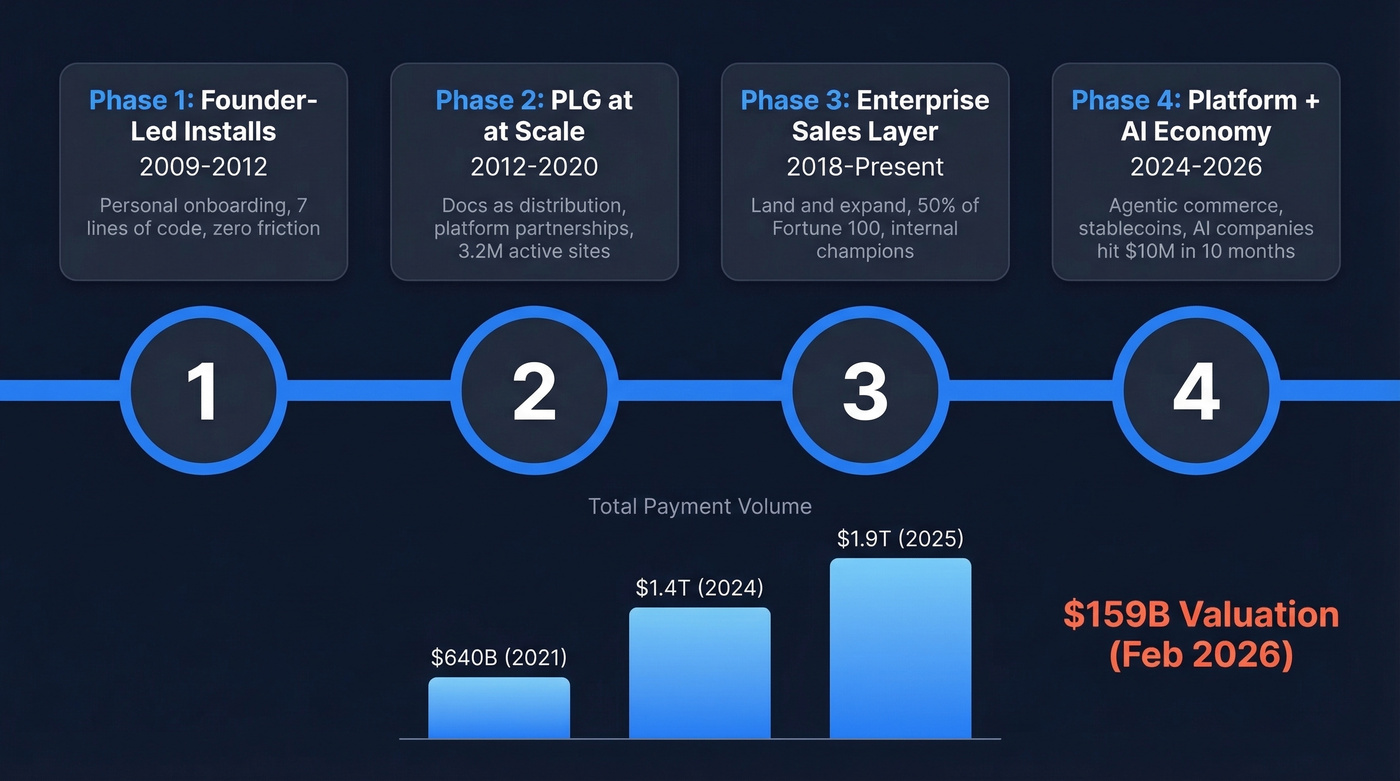
The four phases:
- Founder-led installs (2009-2012) - the Collisons onboard early users personally
- PLG at scale (2012-2020) - documentation as marketing, platform partnerships as distribution
- Enterprise sales layer (2018-present) - sales expands accounts that already use the product
- Platform + AI economy (2024-2026) - revenue suite, agentic commerce, stablecoin rails
The trajectory: $640B volume (2021) to $1.4T (2024) to $1.9T (2025). Valuation: $95B (2021) to $106.7B (Sept 2024) to $159B (Feb 2026).
How Stripe's GTM Evolved
Phase 1 - Founder-Led Sales (2009-2012)
The Collison installation wasn't just a cute anecdote. It was a deliberate strategy to compress the feedback loop between "interested" and "integrated" to zero. Most payment companies in 2010 required weeks of paperwork, underwriting calls, and integration projects. Stripe's founders eliminated every step they could - and personally handled the ones they couldn't.
Their beta pricing told the same story. At 5% + $0.50 per transaction, Stripe was deliberately more expensive than incumbents. That wasn't a mistake. Higher pricing filtered for serious builders who valued speed over pennies, and it gave Stripe a revenue cushion to reinvest in product. The pitch was simple: seven lines of code and you're processing payments. No sales calls, no contracts, no waiting.
This phase worked precisely because the Collisons were doing things that didn't scale. Every laptop they touched was a data point about what developers actually needed. By the time they stopped doing personal installs, they'd built the product intuition that powered the next decade.
Phase 2 - PLG at Scale (2012-2020)
Here's where Stripe did something most developer tools get wrong. They treated documentation as the product, not as marketing for the product. Stripe's docs became the gold standard in fintech - clear, copy-pasteable, and designed so a developer could go from zero to first transaction without talking to anyone. That's not a content strategy. That's a distribution channel.
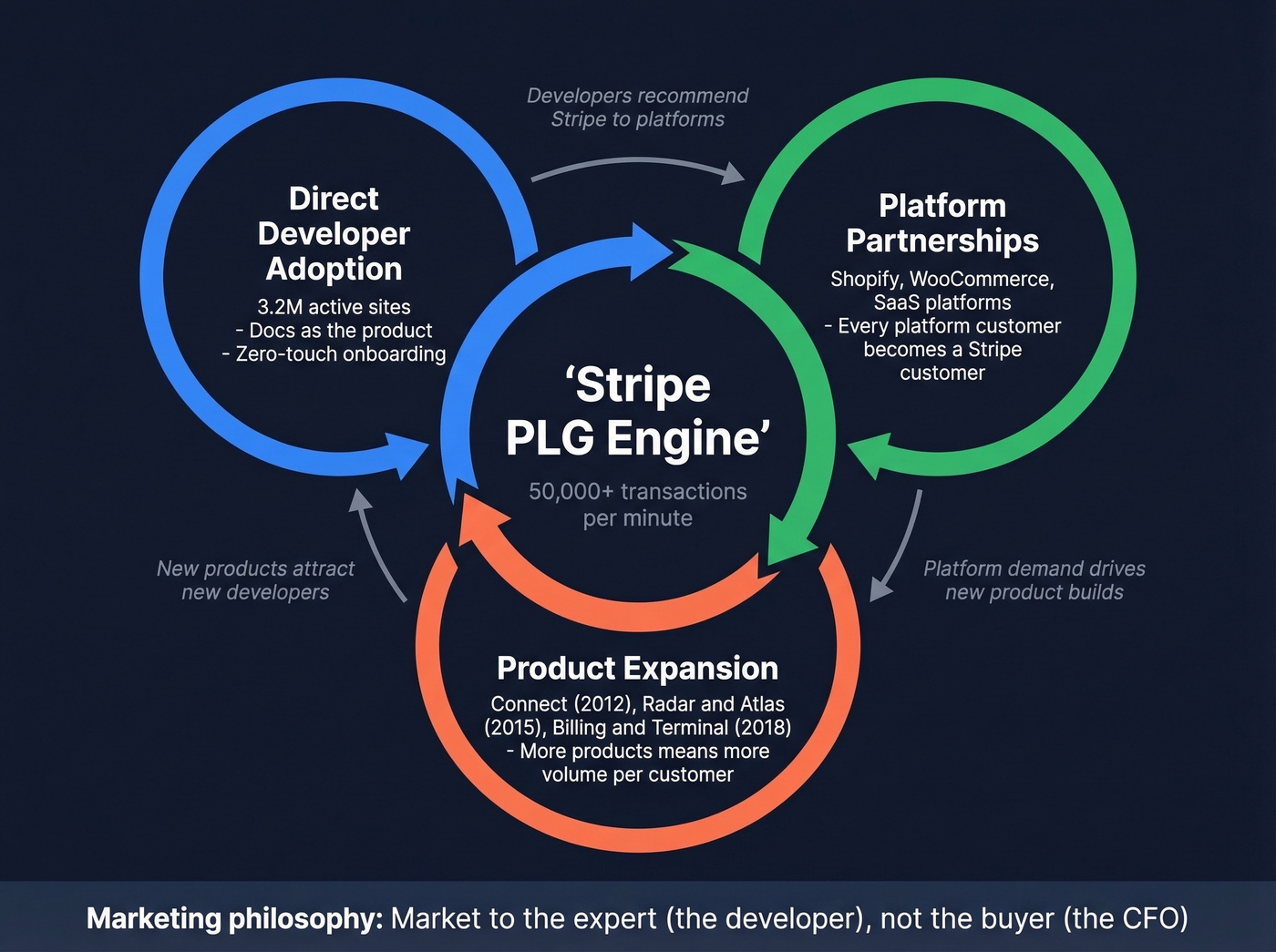
The self-serve engine scaled through three reinforcing loops. First, direct developer adoption - 3.2M active sites eventually ran on Stripe. Second, platform partnerships. Shopify, WooCommerce, and thousands of SaaS platforms embedded Stripe as their payment rail, turning every platform customer into a Stripe customer by default. Third, product expansion created stickiness: Connect (2012) for marketplaces, Radar and Atlas (2015) for fraud and incorporation, Billing and Terminal (2018) for subscriptions and in-person payments. Each new product gave existing customers a reason to send more volume through Stripe - and gave new customers a reason to choose Stripe over simpler alternatives.
Stripe's marketing philosophy during this era was "market to the expert" - the developer who evaluates the API, not the CFO who signs the check. The CFO comes later, after the developer has already integrated. Side bets like Stripe Press and Stripe Climate built cultural credibility with that developer audience, signaling that Stripe thinks beyond payments. The flywheel was spinning at 50,000+ transactions per minute before Stripe ever built a traditional sales team.
Phase 3 - Enterprise Sales Layer (2018-Present)
Most companies sacrifice PLG when they go enterprise. Stripe didn't.
Here's the insight: product adoption creates the pipeline, and sales expands accounts that are already using the product. This is land-and-expand in its purest form. By the time a Stripe AE talks to a Fortune 500 company, that company's engineering team has usually been running Stripe in at least one division for months.
Half of the Fortune 100 now uses Stripe - Amazon, Ford, Zara among them. These aren't cold-outbound wins. They're expansion deals built on internal champions who already trust the product. Stripe Sessions, their annual conference, functions as enterprise marketing disguised as a developer event, giving those internal champions ammunition to push for broader adoption.
The talent this sales motion produces is remarkable. A thread on r/techsales noted that roughly 50% of OpenAI's early sales hires came from Stripe. When your GTM alumni are the most sought-after hires in tech, you've built something beyond a sales playbook - you've built a school.
Phase 4 - Platform + AI Economy (2024-2026)
Stripe is betting that the next wave of payment volume comes from AI-native businesses and agentic commerce. The data supports the bet: the median top-100 AI company on Stripe hits $10M in revenue in 10 months, compared to 3 years for the median top-100 SaaS company. That's 3.5x faster.
The Revenue suite - Billing, Invoicing, Tax - is set to reach $1B in annual run rate. Stripe's Agentic Commerce Protocol enables AI agents to transact autonomously. Stablecoin micropayments open up use cases that traditional card rails can't handle economically. Partnerships with OpenAI and Microsoft embed Stripe into AI-powered shopping experiences before competitors even have a product to pitch. Internally, Stripe says 50%+ of its code is now written by LLMs - a signal of how deeply AI has penetrated even their own operations.
Behind all of it, Stripe deploys to production 1,400+ times per day. That product velocity is the real moat - not any single feature, but the speed at which they ship new ones.
Our take: Stripe is still the best all-in-one payments platform. But most startups don't need all-in-one. If you're pre-Series A with deal sizes under $15k, you're paying for infrastructure you won't touch for two years. Start with Stripe's core payments, skip the suite, and invest the savings in distribution.

Stripe's land-and-expand worked because developers were already using the product. Your land-and-expand works when you reach the right decision-makers first. Prospeo gives you 300M+ profiles with 30+ filters - buyer intent, technographics, funding, headcount growth - so you find accounts ready to buy, not just accounts that exist.
Stop cold-emailing into the void. Start with data that connects.
Stripe by the Numbers
| Metric | Figure |
|---|---|
| Volume trajectory | $640B (2021) to $1.4T (2024) to $1.9T (2025) |
| Valuation trajectory | $95B (2021) to $106.7B (Sept 2024) to $159B (Feb 2026) |
| Gross revenue | ~$12B (2021) |
| Net revenue | ~$2.5B (2021) |
| Transactions/minute | 50,000+ |
| Fortune 100 penetration | 50%+ |
| Countries | 50+ |
| Currencies supported | 135+ |
| Link MAU | 200M |
Pricing as a GTM Lever
Stripe's standard US rate - 2.9% + $0.30 per successful charge - is dead simple. Compare that to Adyen's model: a EUR 0.11 processing fee plus a variable payment-method fee that changes by scheme and region, with add-ons priced separately. PayPal charges comparable headline rates, but the terms underneath get complicated fast.
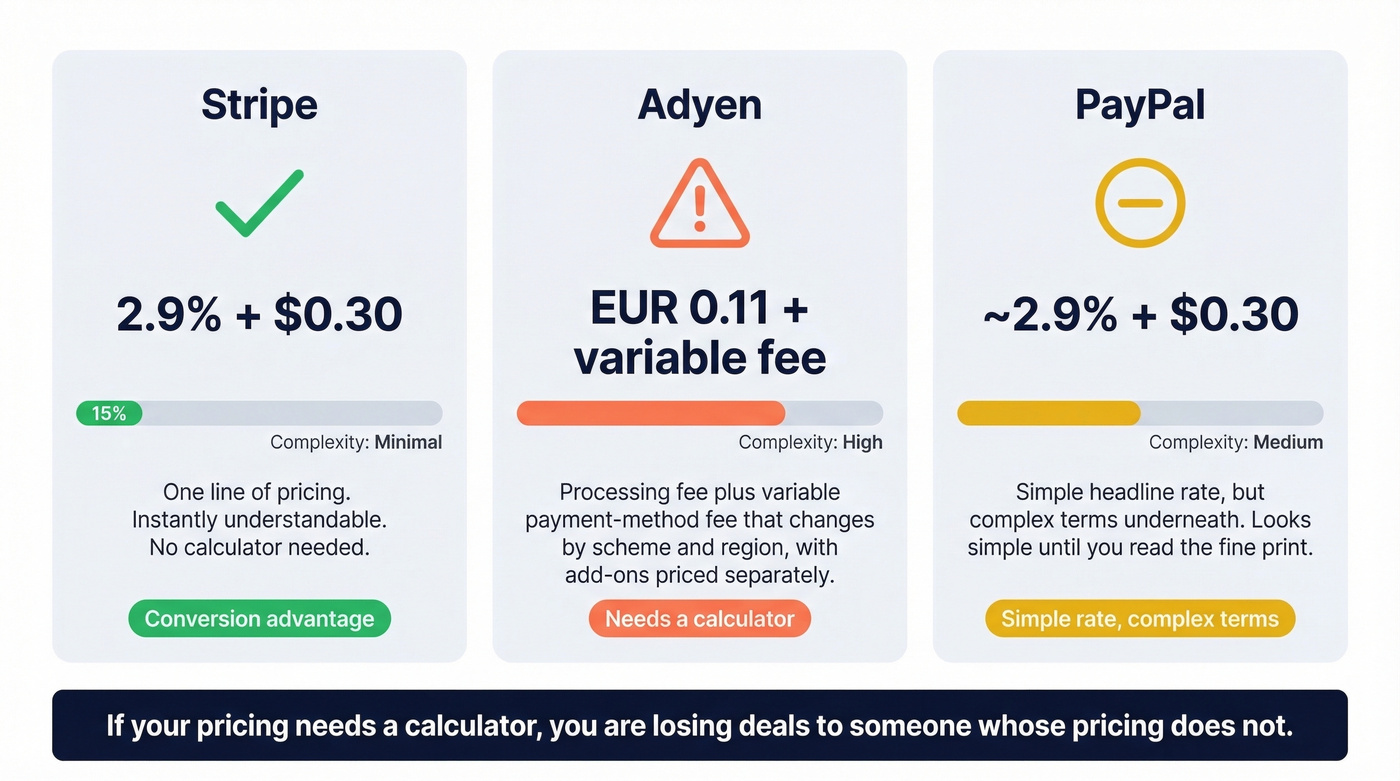
| Provider | Pricing model | Complexity |
|---|---|---|
| Stripe | 2.9% + $0.30 (US) | One line |
| Adyen | EUR 0.11 + variable fee | Needs a calculator |
| PayPal | ~2.9% + $0.30 | Simple rate, complex terms |
If your pricing needs a calculator, you're losing deals to someone whose pricing doesn't. The Collisons understood this from day one - even their beta pricing, while higher than competitors, was instantly understandable. Transparent pricing isn't just a finance decision. It's a conversion rate decision. This principle applies far beyond payments: every "contact us for pricing" page is a leak in your funnel.
Applying Stripe's GTM Strategy to Your Business
Look, you don't need $159B in valuation to apply these principles. Say you're a SaaS founder at $2M ARR with a product that sells itself to small teams but stalls at enterprise. Here's what you steal from Stripe's playbook.
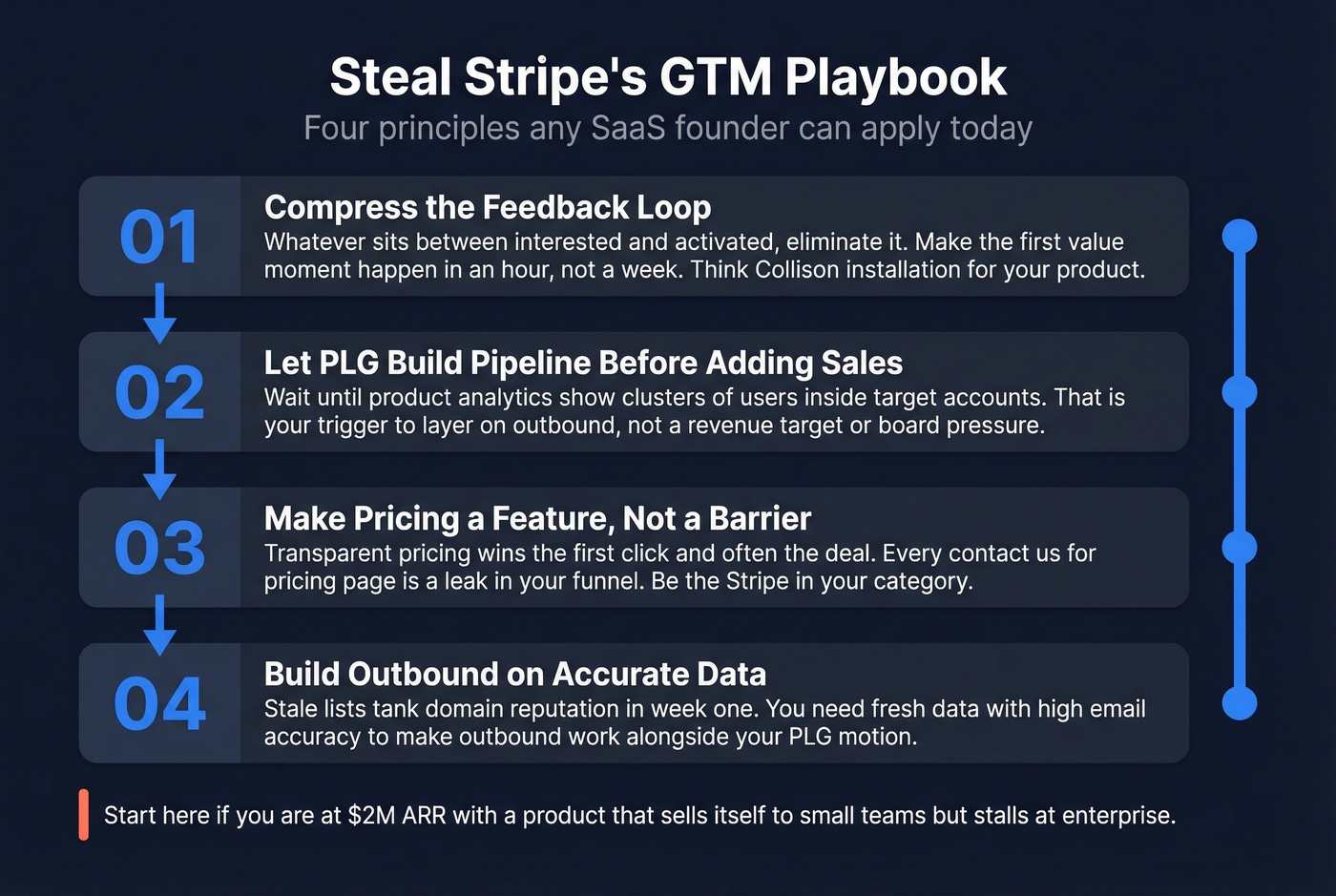
Compress the feedback loop. The Collison installation principle applies to any product. Whatever sits between "interested" and "activated," eliminate it. If your onboarding takes a week, figure out how to make the first value moment happen in an hour. Stripe's own GTM guide reinforces the importance of getting customers to value quickly.
Let PLG build the pipeline before layering sales. Stripe built a dedicated enterprise motion around 2018-2020, when product adoption at large companies created enough internal champions to justify outbound expansion. The trigger wasn't cold outreach - it was existing usage signaling readiness for a bigger contract. If your product analytics show clusters of users inside target accounts, that's your trigger.
Make pricing a feature, not a barrier. If a prospect has to request a quote, you've added friction. Transparent pricing is a competitive advantage, especially against incumbents who hide behind "contact sales." We've seen this play out across dozens of B2B categories - the vendor with public pricing wins the first click, and often the deal.
Build your outbound on accurate data. When you're ready to add an outbound layer to your PLG motion, the foundation is prospect data that doesn't bounce. We've seen teams tank their domain reputation in the first week of outbound because they launched with a stale list. A 7-day data refresh cycle and 98% email accuracy aren't nice-to-haves - they're what separates a successful outbound launch from one that gets your domain flagged before you've booked a single meeting. If you're building this motion, start with sales prospecting techniques and a clean lead generation workflow, then lock in email deliverability before you scale volume.
FAQ
What type of GTM strategy does Stripe use?
Stripe runs a hybrid model: product-led growth drives self-serve adoption among developers, an enterprise sales layer expands Fortune 100 accounts already using the product, and 12,000+ partner platforms embed Stripe into their payment flows. All three motions run simultaneously and compound on each other - no single channel was ever retired.
When did Stripe start enterprise sales?
Stripe began building a dedicated enterprise sales motion around 2018-2020, after product adoption at large companies created enough internal champions to justify outbound expansion. The trigger was existing usage signaling readiness for a bigger contract, not cold outreach - half the Fortune 100 now runs on Stripe.
What tools do you need to build a similar GTM motion?
You need a product with self-serve onboarding, documentation that doubles as marketing, and analytics to track activation. When you add outbound, start with a data platform like Prospeo for verified prospect emails so your first sequences don't bounce. Layer in a CRM, a sequencing tool, and intent data to prioritize accounts showing buying signals.
How did Stripe's pricing support its go-to-market approach?
Stripe's flat 2.9% + $0.30 rate eliminated the friction of custom quotes and complex fee schedules that competitors required. Transparent, one-line pricing converted developers instantly - no sales calls needed. Even during beta at 5% + $0.50, the simplicity filtered for speed-focused builders who became Stripe's strongest advocates.
Stripe's AEs never made cold calls - they expanded accounts where champions already existed. Build that same pipeline by reaching verified decision-makers with 98% email accuracy and 125M+ direct dials. At $0.01 per email, you get enterprise-grade data without the enterprise contract.
Your GTM deserves better data than 79% accuracy from Apollo.