

How to Define Your Target Audience for Email Marketing
Your unsubscribe rate just crossed 0.5%. You sent the same Memorial Day promo to 80,000 contacts - one subject line, one offer. Opens dropped. Complaints spiked. The problem isn't your copy. It's that you're treating your list like one audience when it's actually five or six distinct groups who want completely different things.
Defining the right target audience for email marketing is the difference between $38 ROI per dollar spent and a list that burns out in six months. Demographic-only segmentation doesn't cut it anymore. An r/Emailmarketing thread that keeps resurfacing tells the same story: ecommerce senders relying on basic demographic heuristics watch their lists decay while ROI flatlines. The fix is better targeting, not better subject lines.
The Short Version
- Stop segmenting by demographics alone. Layer behavioral and lifecycle data on top. Segmented campaigns have driven a 760% increase in email revenue compared to one-size-fits-all sends, and personalized subject lines are 26% more likely to be opened.
- Build 3-5 segments, not 15. We've seen teams with a dozen segments end up sending the same generic email to all of them. Fewer, sharper segments win.
- Clean your list before you segment. Targeting is useless if a big chunk of your emails bounce. Verification comes first.
What Is a Target Audience in Email Marketing?
Your target audience isn't your whole list. It's the group - defined by what they've done, where they are in the buying cycle, and who they are - that will actually care about what you're about to send.
A B2C cart abandonment nudge and a B2B product launch aimed at VP-level buyers require completely different audiences, even if both live in the same database. The audience is the strategic decision; the list is just the container.
How to Identify Your Audience
1. Analyze your existing data. Purchase history, email engagement patterns, website behavior, CRM records. Most teams sit on months of behavioral data they've never segmented against. Your ESP and CRM stack already hold the answers - you just need to query them.
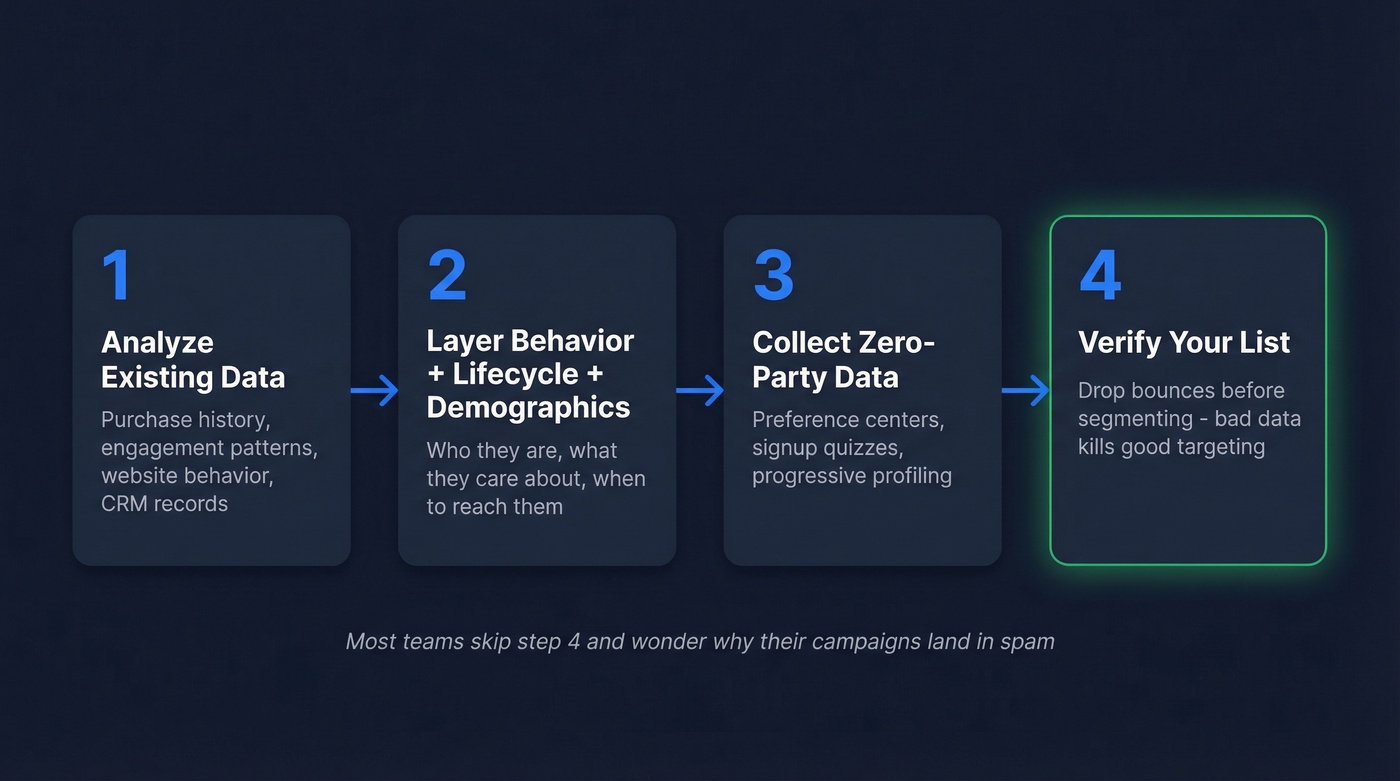
2. Define segments by behavior + lifecycle + demographics. Demographics tell you who someone is. Behavior tells you what they care about. Lifecycle tells you when to reach them. A first-time buyer and a five-time repeat customer shouldn't get the same email, even if they share the same job title and zip code.
3. Collect zero-party data. Preference centers, signup quizzes, and progressive profiling let subscribers tell you what they want. An audit of 65 email accounts found that many teams collect zero-party data and then never act on it. Don't be that team.
4. Verify your list before segmenting. High bounce rates hurt sender reputation and can push even perfectly targeted campaigns into spam. One customer, Meritt, dropped their bounce rate from 35% to under 4% after switching to verified data through Prospeo - and their pipeline tripled in the process.


Your segments are only as good as the data behind them. Meritt dropped their bounce rate from 35% to under 4% with Prospeo's 98% verified emails - and tripled their pipeline. At $0.01 per email, cleaning your list before you segment costs almost nothing.
Stop sending perfectly targeted emails to invalid addresses.
Segments That Drive Results
Not all segments move revenue equally. Here are the ones that consistently do.
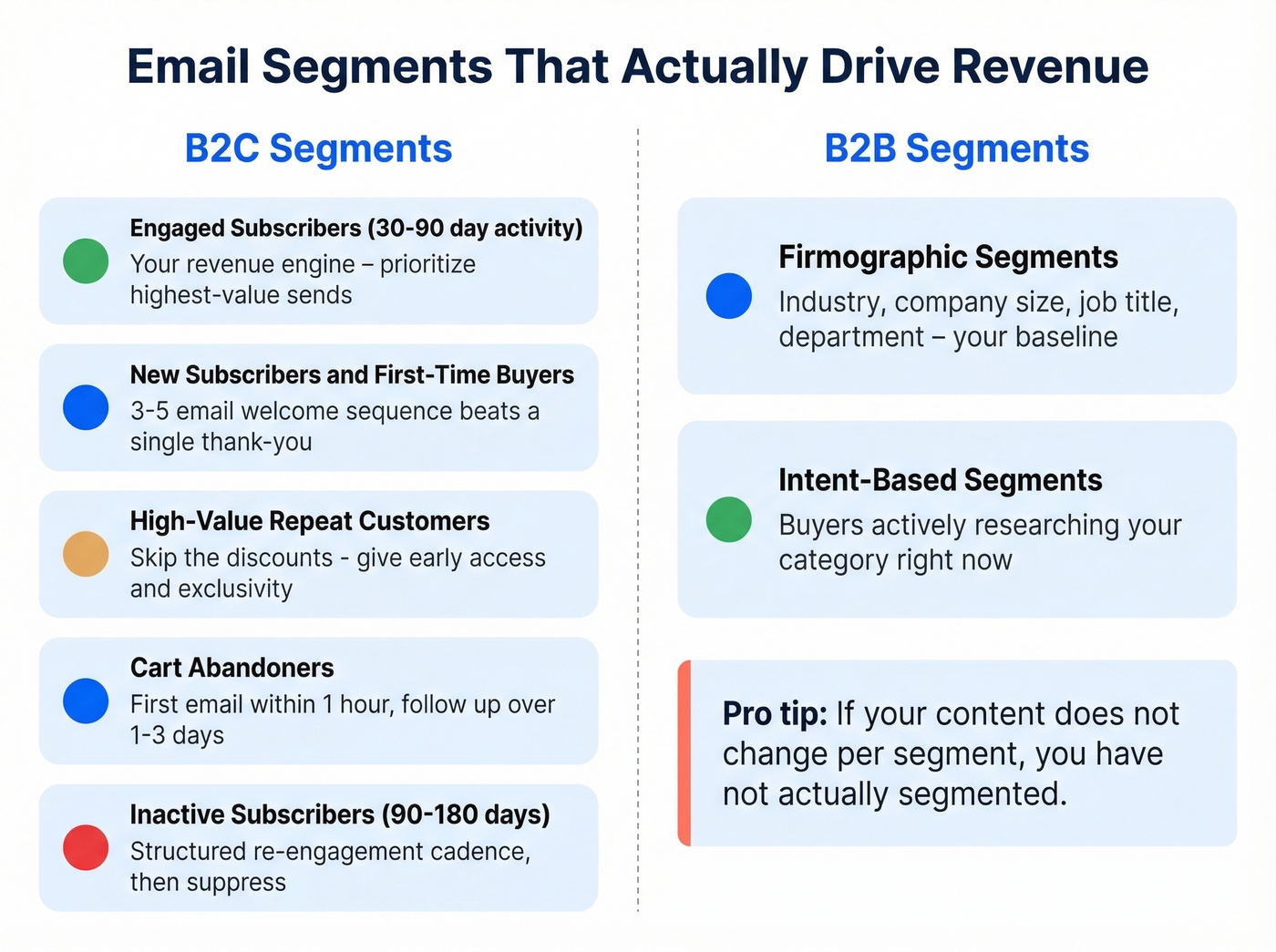
B2C Segments
Engaged subscribers are your revenue engine - contacts who've opened or clicked in the last 30-90 days. Jenni Kayne split apparel vs. home goods subscribers using browsing and purchase history and saw +14.5% email revenue YoY. Prioritize this group for your highest-value sends.
New subscribers and first-time buyers are in their highest-attention window. A 3-5 email welcome sequence usually beats a single "thanks for signing up" message. Use this window to collect preferences and drive a second purchase.
Here's a hot take: high-value repeat customers don't need discounts. RFM scoring identifies your top 10-20%, and most brands waste margin by sending them the same 20%-off coupon everyone else gets. Give them early access, loyalty perks, and exclusivity instead. Compass Coffee took this approach with engagement-driven campaigns and saw 3.7x more customer photos quarter-over-quarter plus a 70.5% increase in total reviews.
Cart abandoners remain one of the highest-converting automated flows. Timing is everything here: send the first email within an hour, then follow up over the next 1-3 days with a nudge or incentive.
Inactive subscribers deserve a structured re-engagement cadence, not an indefinite drip. Contacts who haven't engaged in 90-180 days get a Day 1 soft reminder, a Day 7 value-driven offer, and a Day 14 final "should we remove you?" email. If they don't re-engage, suppress them. Huda Beauty fixed deliverability issues and doubled YoY email-attributed revenue partly by cleaning up engagement-based segmentation.
B2B Segments
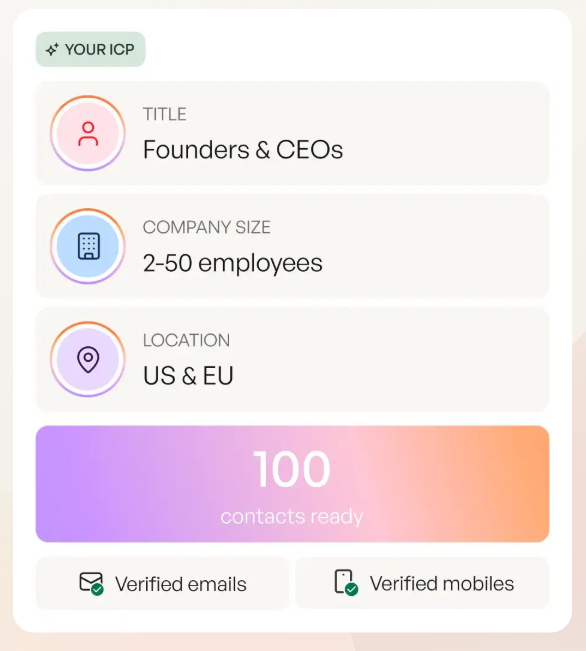
Firmographic segments - industry, company size, job title, department - are the baseline for any B2B email program. A CFO at a 50-person startup and a CFO at a Fortune 500 company have wildly different pain points, and your emails should reflect that.
Intent-based segments are where B2B targeting gets powerful. These are contacts actively researching your category right now. Layering intent signals on top of firmographic filters means you're reaching buyers while they're still in-market, not months after they've already signed with a competitor. In our experience, teams that combine intent data with firmographic targeting see dramatically higher reply rates than those using either signal alone.
Common Targeting Mistakes
Based on an audit of 65 email accounts, here's what separates good targeting from bad:
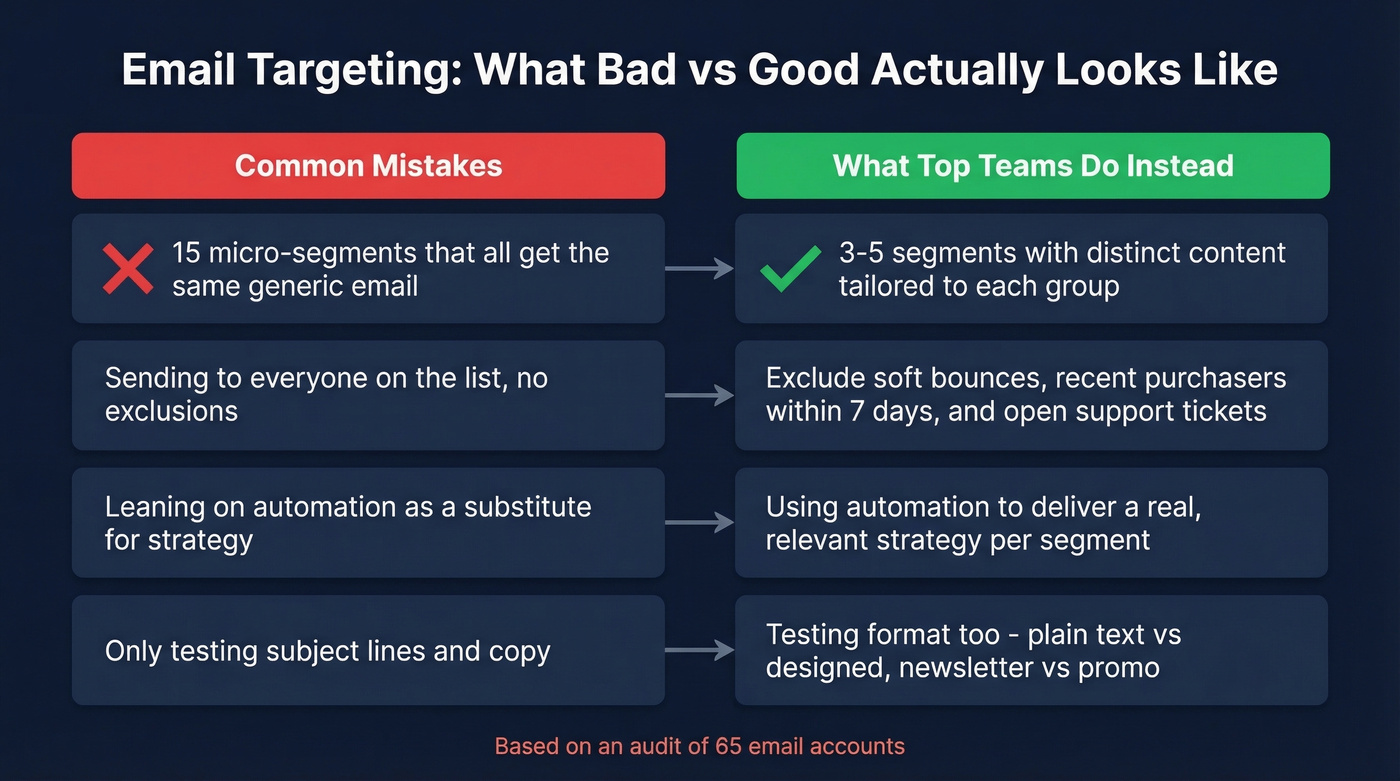
- Build 3-5 segments with distinct content for each. Don't create 15 micro-segments that each get the same generic email.
- Exclude subscribers who soft bounced in the last 30 days, recent purchasers within 7 days, and contacts with active support tickets. Ignoring exclusion rules hurts deliverability more than most marketers realize.
- Use automation as a delivery mechanism for strategy, not a substitute for relevance. The consensus on Reddit is blunt: marketers are "leaning on automation instead of strategy... output instead of relevance."
- Test format, not just content. Plain text vs. designed, newsletter vs. promo - the container matters as much as the message.
Let's be honest: the most common mistake we see isn't bad segmentation logic. It's teams that build segments, feel good about it, and then send the same email to every segment anyway. If your content doesn't change per segment, you haven't actually segmented.
Benchmarks That Matter
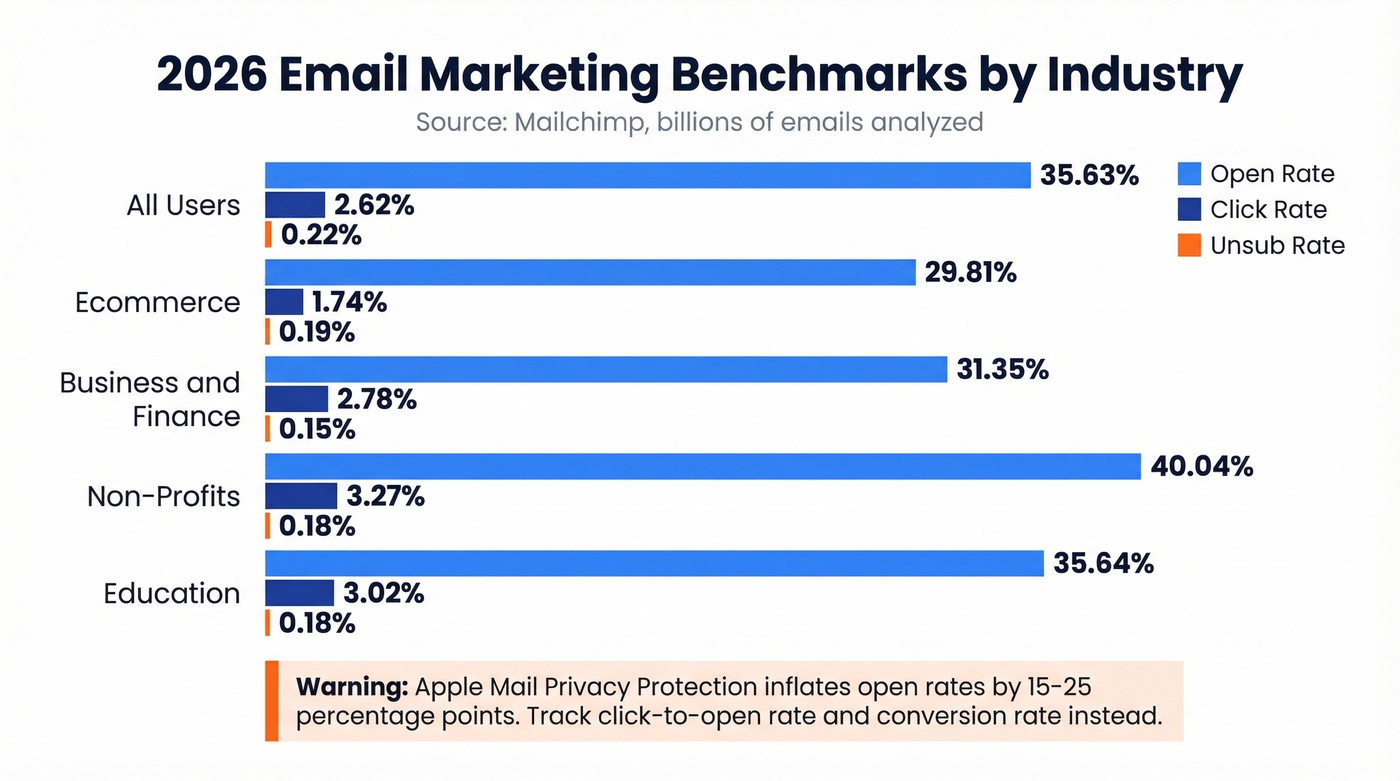
Mailchimp's latest benchmarks, based on billions of emails analyzed:
| Industry | Open Rate | Click Rate | Unsub Rate |
|---|---|---|---|
| All Users | 35.63% | 2.62% | 0.22% |
| Ecommerce | 29.81% | 1.74% | 0.19% |
| Business & Finance | 31.35% | 2.78% | 0.15% |
| Non-Profits | 40.04% | 3.27% | 0.18% |
| Education | 35.64% | 3.02% | 0.18% |
One major caveat: Apple Mail Privacy Protection inflates open rates by roughly 15-25 percentage points depending on your audience's device mix. If you're benchmarking off open rates alone in 2026, you're measuring noise. Track click-to-open rate and conversion rate instead - those metrics can't be faked by a privacy proxy.
Compliance Essentials
Targeting requires data, and data requires consent. GDPR demands explicit opt-in for EU contacts, with fines up to EUR 20M or 4% of global turnover. CCPA operates on an opt-out model - you can collect, but you must provide a clear "Do Not Sell" mechanism, with penalties up to $7,500 per intentional violation.
Skip the compliance shortcuts. A Cisco survey found that 81% of consumers judge brands by how they handle personal data. Brands that handle consent well also tend to have cleaner lists, which means better deliverability and sharper audience targeting. It's a virtuous cycle - or a vicious one, depending on which direction you're headed.
B2B segmentation by firmographics and intent sounds great until your contact data is six weeks stale. Prospeo refreshes 300M+ profiles every 7 days and tracks 15,000 intent topics - so your segments hit real buyers who are actually in-market right now.
Reach the right audience while they're still buying, not after.
FAQ
How many segments should I start with?
Three to five, each receiving distinct content. Start with engaged subscribers, new contacts, and inactive contacts, then expand as your content capacity grows. Most teams that jump to 10+ segments end up sending the same email to all of them - which defeats the entire purpose.
Are open rates still reliable in 2026?
No. Apple MPP inflates them by 15-25 percentage points depending on your audience's device mix. Track click-to-open rate and conversion rate instead. Those metrics reflect genuine engagement.
How do I build a B2B email list with accurate targeting?
Use a B2B data platform to filter by job title, company size, intent signals, and technographics, then verify every email before sending. The key is combining multiple signal types - firmographic, behavioral, and intent - so you're not just reaching the right person, but reaching them at the right time.