

Click to Open Rate vs Click Through Rate: Which Metric to Trust in 2026
A marketer on r/Emailmarketing shared an A/B test that perfectly captures this debate. The winning variant had lower opens but a 10% click rate and 8% form submissions - crushing every previous campaign. The losing variant? Higher opens, fewer clicks, zero pipeline impact.
This isn't academic. It determines which campaigns you kill and which you scale. And in 2026, the answer is messier than most guides admit, because both metrics are partially broken.
Quick Definitions
CTR = clicks / delivered. It measures overall campaign pull. It's the more reliable metric in 2026, though bot clicks can inflate it.
CTOR = clicks / opens. It isolates content quality among people who opened. It used to be a go-to engagement metric, but Apple Mail Privacy Protection made opens noisy starting in 2021 - so raw CTOR can mislead you.
The real answer: track both, trust neither alone, and anchor decisions to conversions and revenue per email.
Formulas and Examples
You send a campaign to 10,000 contacts. All 10,000 are delivered. 3,000 show as opened. 150 people click a link.
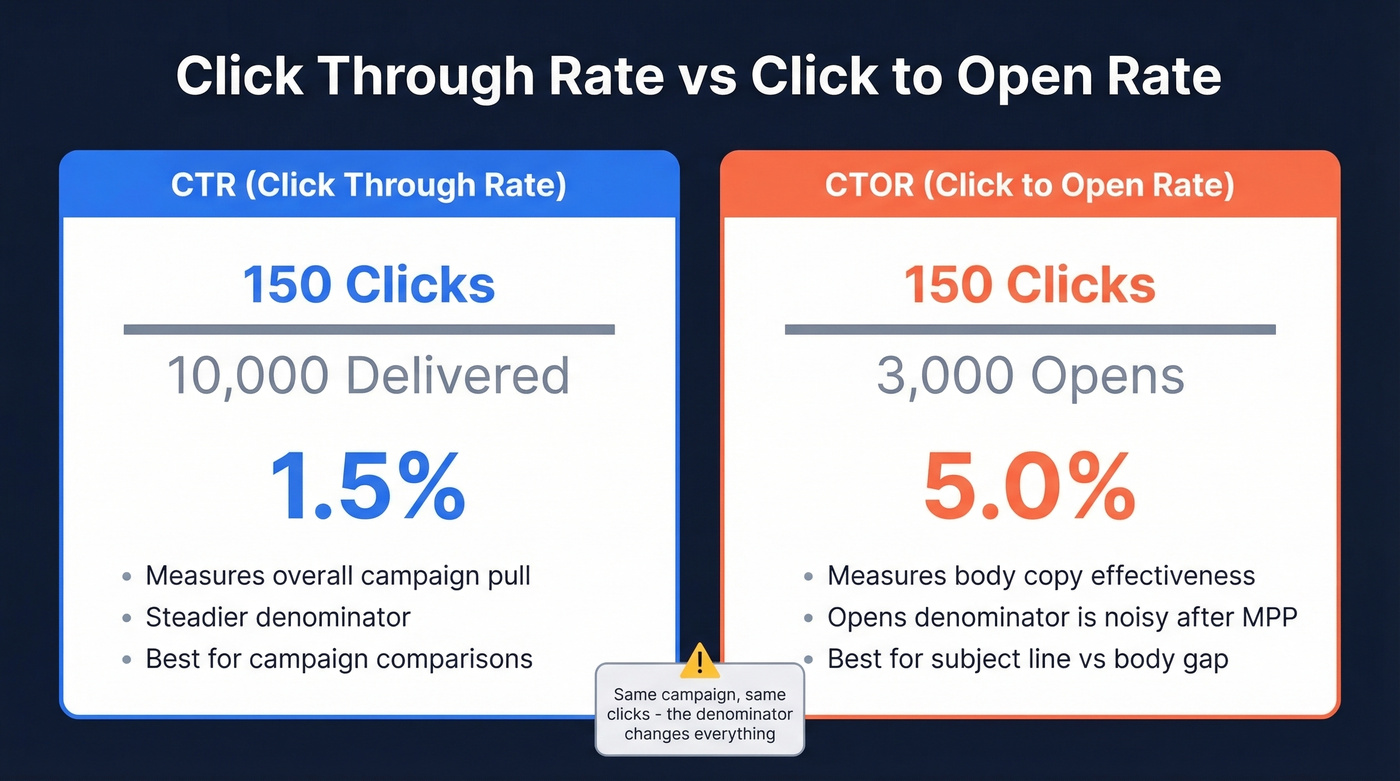
CTR = 150 clicks / 10,000 delivered x 100 = 1.5% CTOR = 150 clicks / 3,000 opens x 100 = 5.0%
Same campaign, same clicks - but the denominator changes everything. CTR tells you how the campaign performed against your entire audience, while CTOR tells you how the email body and CTA performed among people who actually opened (or appeared to open).
One thing worth flagging: some online guides get the CTOR formula backwards, listing it as opens / clicks instead of clicks / opens. If the number you're calculating is above 100%, the formula's inverted.
| CTR | CTOR | |
|---|---|---|
| Formula | Clicks / Delivered | Clicks / Opens |
| Denominator | All delivered emails | Only opened emails |
| Measures | Overall campaign pull | Body copy effectiveness |
| Best for | Campaign health, deliverability | Subject line vs body gap |
| 2026 reliability | Moderate (bot clicks inflate) | Low (MPP inflates opens) |
When to Use Each Metric
Use CTR when you're comparing campaigns against each other, monitoring deliverability trends, or reporting overall channel health to leadership. It's the steadier denominator. Remember that A/B test from the intro? CTR told the real story. CTOR would've been misleading.
Use CTOR when you're trying to isolate whether your email body and CTA are working independently of your subject line. If CTR is flat but CTOR is climbing, your subject line might be the bottleneck. Treat CTOR as directional, though - the opens denominator is noisy.
Neither metric replaces conversion tracking. A campaign with a 4% CTR and zero pipeline impact is still a failure.
Why Your ESP Uses Different Names
Here's the thing: every ESP uses different names for the same metric, and it's genuinely maddening. HubSpot's "click-through rate" actually means clicks / opens - what most marketers call CTOR. Their "click rate" is what everyone else calls CTR. Klaviyo follows the same convention.
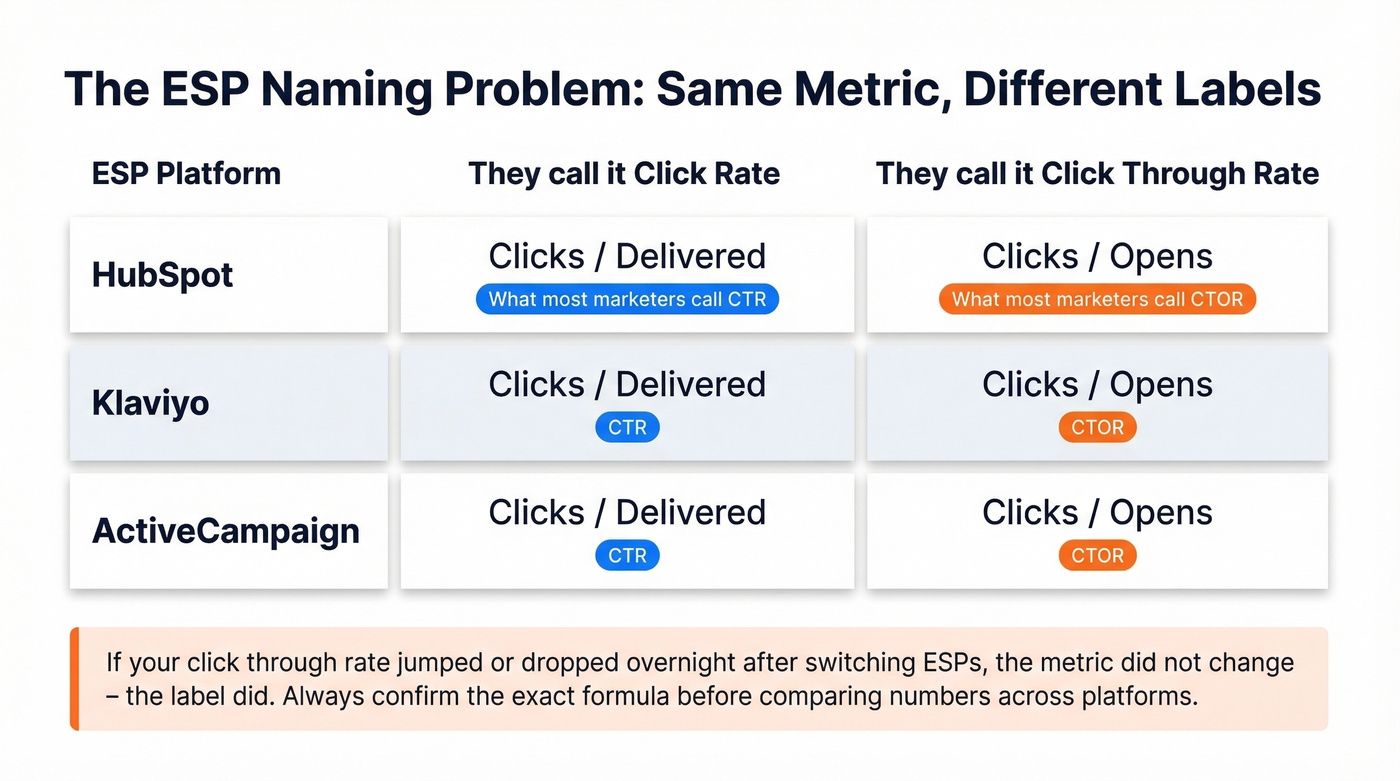
The confusion between click rate, click-through rate, and click-to-open rate across platforms has caused real reporting disasters. We've watched teams panic over CTR drops that turned out to be nothing more than an ESP migration. If you've ever switched platforms and watched your "click-through rate" jump or plummet overnight, the metric didn't change - the label did.
One more nuance from Klaviyo's documentation: "delivered" means accepted by the receiving server, not inbox placement. Your email can be "delivered" straight to spam.
| ESP | "Click rate" means | "Click-through rate" means |
|---|---|---|
| HubSpot | Clicks / Delivered | Clicks / Opens |
| Klaviyo | Clicks / Delivered | Clicks / Opens |

Your CTR and CTOR are only meaningful if the emails actually land. Prospeo's 98% email accuracy and 5-step verification - including spam-trap removal and honeypot filtering - mean fewer bounces inflating your denominators and cleaner data behind every metric you track.
Fix the data before you fix the dashboard.
Why CTOR Got Less Reliable After 2021
On September 20, 2021, Apple rolled out Mail Privacy Protection. Apple's proxy servers preload tracking pixels when an email arrives, firing an "open" event regardless of whether a human ever reads the message. MPP also masks IP addresses, timestamps, geolocation, and device data.
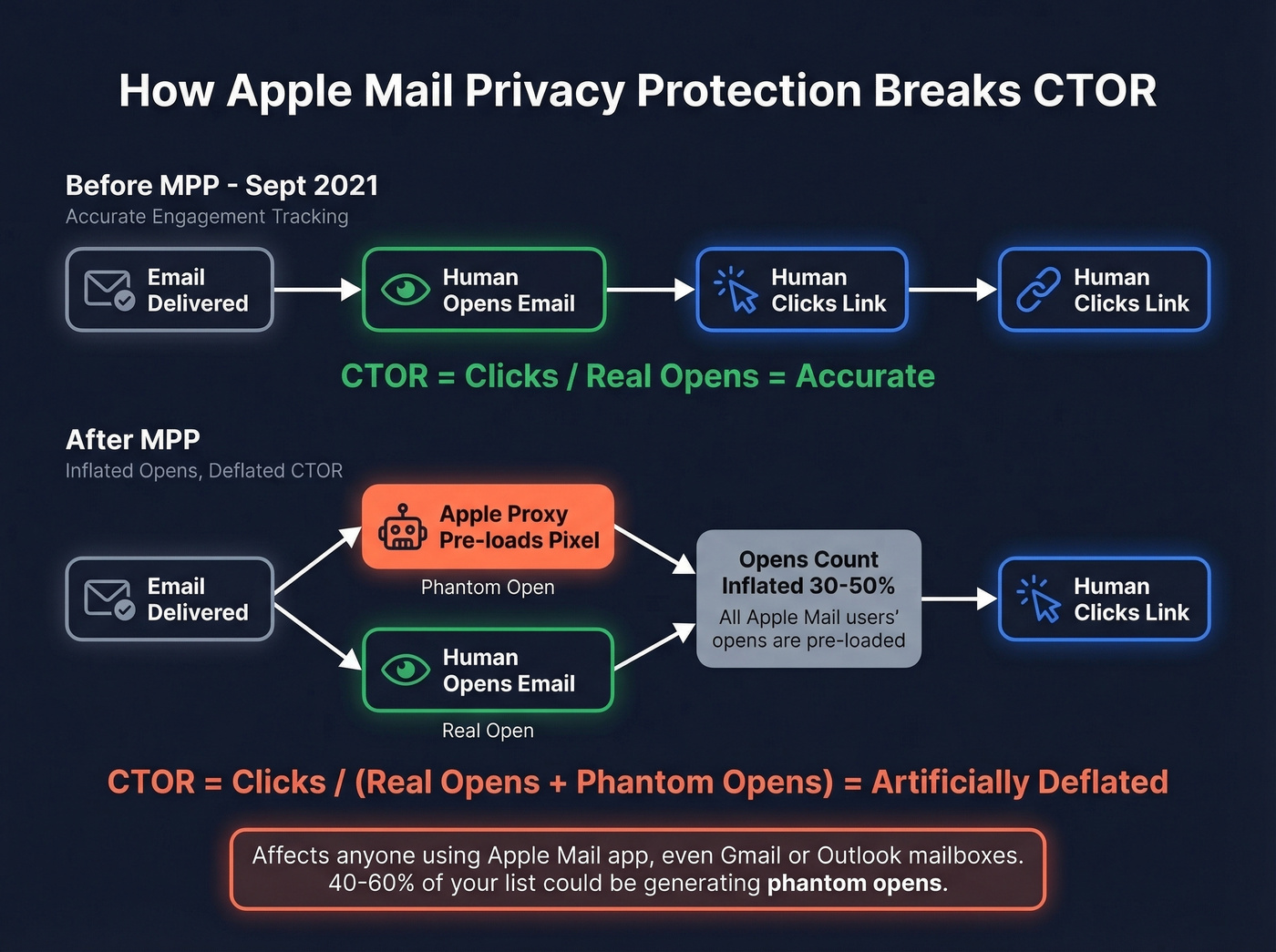
What catches people off guard is that MPP applies to anyone using the Apple Mail app, even if their mailbox is Gmail or Outlook. It's about the mail client, not the email provider. Depending on your audience, 40-60% of your list could be generating phantom opens.
The damage to CTOR is mechanical. If your opens denominator is inflated by 30-50% with machine opens, CTOR gets artificially deflated. A "declining" CTOR might just mean more of your audience upgraded to iOS 15+. It gets worse: Apple's Link Tracking Protection can strip tracking parameters from links in Mail and Safari, complicating attribution beyond just open tracking. iOS 18 introduced inbox UX changes like AI previews and category sorting that affect whether emails get noticed at all.
The Bot Click Problem
MPP broke opens. Bots are breaking clicks.
Security scanners and corporate email gateways routinely click every link in an email to check for phishing and malware. This inflates both CTR and CTOR. One documented example: enabling Brevo's bot filter dropped a newsletter's CTR by 9.4% - nearly a tenth of all measured clicks were fake.
Signs you've got a bot problem:
- Clicks registering within one second of delivery
- Every link in the email getting clicked, including footer and legal links
- Click spikes that don't correlate with site traffic or conversions
Many ESPs now offer bot-detection features. ActiveCampaign has BotSense, Klaviyo separates bot filtering for reporting and attribution, Constant Contact filters by default, and HubSpot supports filtering with known bots plus custom rules by IP and domain. The honeypot link technique - hiding a link humans wouldn't click - works but can hurt deliverability. Use it cautiously.
2026 Benchmarks Worth Trusting
Most benchmark articles cite Campaign Monitor's 2021 data - CTR 2.3%, CTOR 10.5% - as if it's current. It's not. Those numbers predate widespread MPP adoption and represent a different measurement era. If your benchmarking source doesn't mention Apple MPP, throw it out.
More useful benchmarks come from recent, large-scale datasets. Mailchimp's numbers (updated December 2023, billions of emails, with an explicit MPP caveat on open rates):
| Industry | Avg Click Rate | Avg Open Rate* |
|---|---|---|
| All users | 2.62% | 35.63% |
| Ecommerce | 1.74% | 29.81% |
| Business & Finance | 2.78% | 31.35% |
| Nonprofits | 3.27% | 40.04% |
*Open rates inflated by Apple MPP.
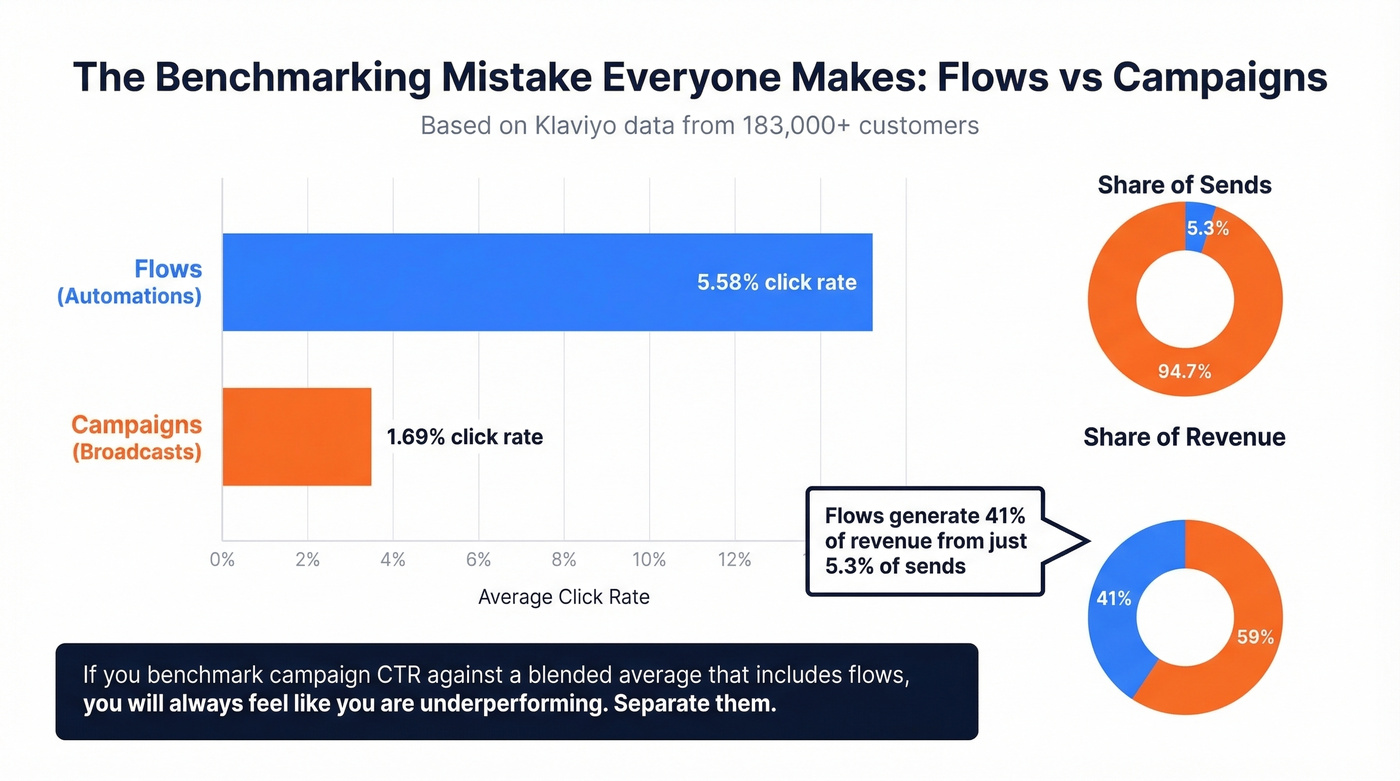
In our experience, the single most overlooked benchmarking mistake is blending flows and campaigns. Klaviyo's latest benchmarks (183,000+ customers) make the gap obvious:
| Email Type | Avg Click Rate | Share of Sends | Share of Revenue |
|---|---|---|---|
| Flows (automations) | 5.58% | 5.3% | ~41% |
| Campaigns (broadcasts) | 1.69% | 94.7% | ~59% |
Flows generate 41% of email revenue from just 5.3% of sends. If you're benchmarking your campaign CTR against a blended average that includes flows, you'll always feel like you're underperforming. Separate them.
Campaign Monitor's "good ranges" - CTR 2-5%, CTOR 6-17% - still work as directional guides, just don't treat them as current baselines.
How to Improve Both Metrics
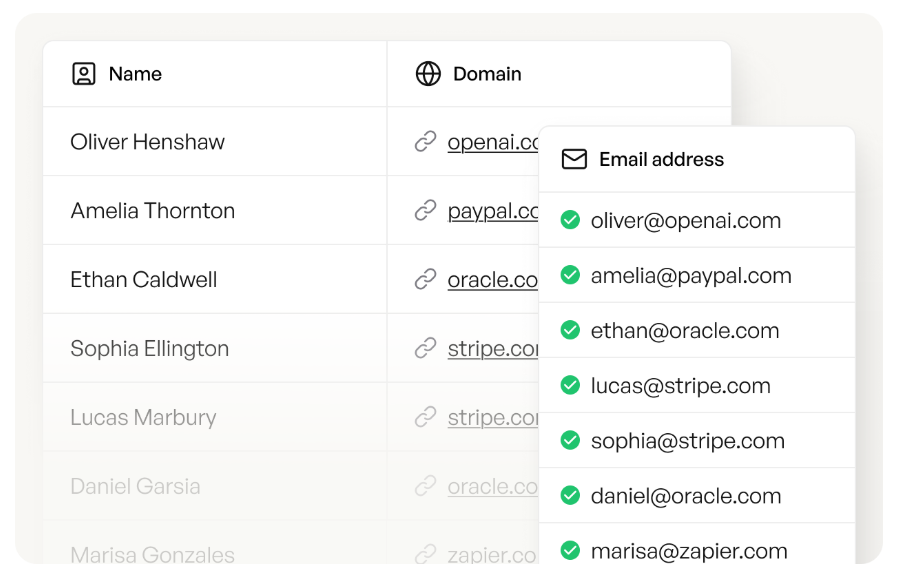
Clean your list first. Dirty lists inflate your "delivered" count with soft bounces and spam-folder deliveries, depressing both CTR and CTOR. Prospeo verifies emails at 98% accuracy on a 7-day refresh cycle, so your denominator reflects real, reachable contacts. A free tier (75 verifications/month) is enough to test the impact on a single segment.
Segment aggressively. A single blast to your entire list will always underperform targeted sends. Even basic segmentation by engagement recency lifts CTR measurably - especially for targeted sends.
One CTA per email. Multiple CTAs split attention and dilute click rates. Pick the one action you want and make it obvious (more rules and examples in our guide to email call to action).
A/B test beyond subject lines. Everyone tests subject lines. Fewer teams test body copy, CTA placement, or button color. CTOR - despite its flaws - is useful here because it isolates body performance from subject line performance. If you need ideas, pull from these email subject line examples and then test the body separately.
Separate flow and campaign reporting. Blending them makes campaigns look bad and flows look average. They're different animals.
Optimize send timing. Send-time optimization based on individual engagement patterns consistently lifts open and click rates by 5-15%. If you’re doing cold outreach, start with the best time to send cold emails and adapt from there.
What to Track Instead in 2026
CTR and CTOR are intermediate metrics. They tell you something happened, not whether it mattered. The modern measurement stack is clicks + conversion rate + revenue per email + reply rate + site visits from email. Opens and raw CTOR are directional signals at best - useful for subject line testing and deliverability monitoring, not for making strategic decisions.
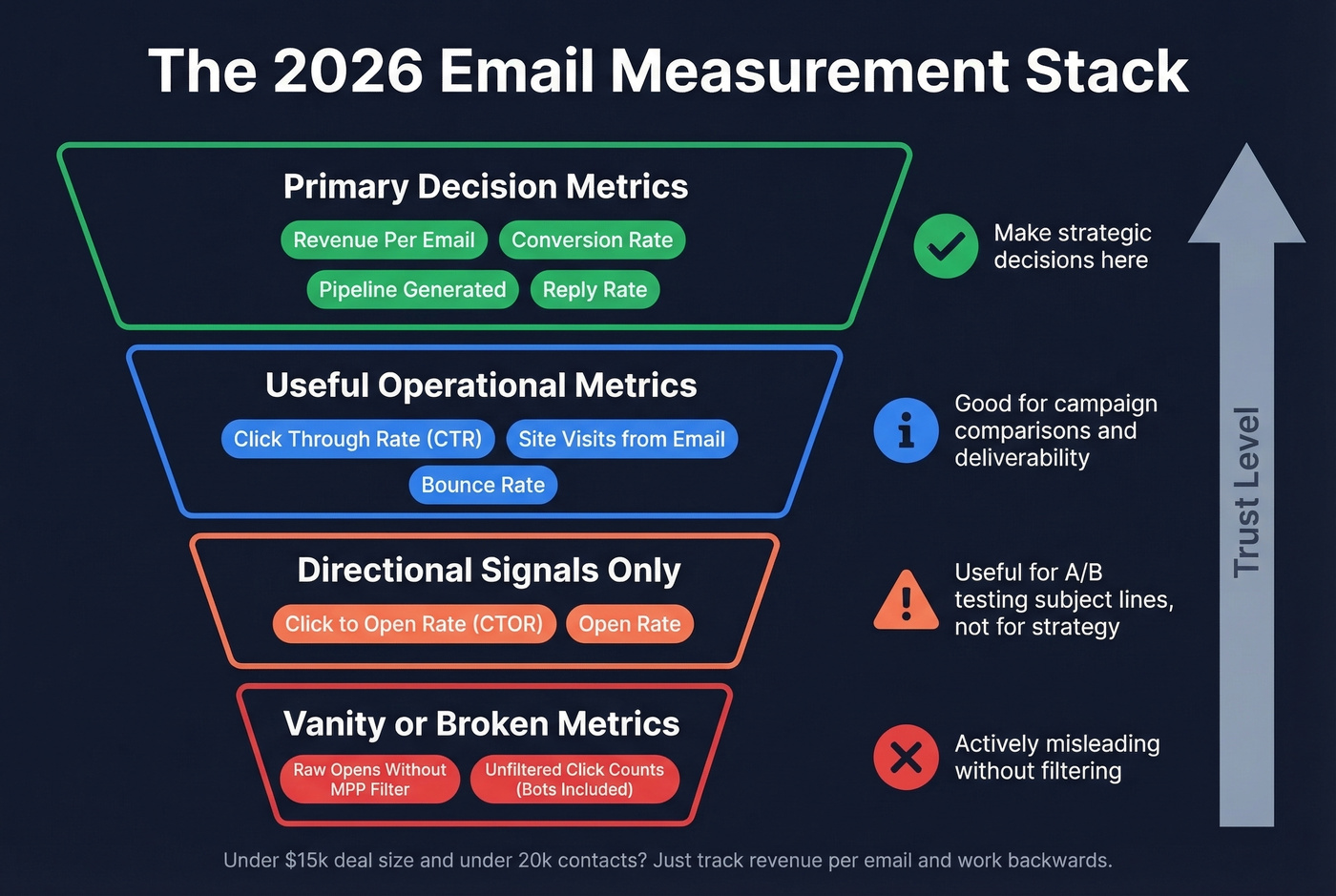
Let's be honest: if your average deal size is under $15k and your list is under 20,000 contacts, stop obsessing over the click-to-open rate vs click-through rate distinction entirely. Just track revenue per email sent and work backwards. The metric debate is a distraction from the only question that matters - did the email make money? (If you want a broader KPI set, use these funnel metrics as your baseline.)
Benchmarking against inflated opens and bot clicks is a losing game. The real lever is list quality. Teams using Prospeo cut bounce rates from 35%+ to under 4% - giving CTR and CTOR numbers you can actually trust for decisions.
Clean data makes every email metric honest.
FAQ
Is a 2% click-through rate good?
For broadcast campaigns, 2% CTR is roughly average - Mailchimp reports 2.62% overall. Automated flows typically hit 5%+. Always separate flows from campaigns before benchmarking, and compare against your own historical performance first.
Should I stop tracking open rate entirely?
No. Open rate still works as a directional signal for subject line testing and deliverability monitoring. Just don't use it as a primary success metric or as the CTOR denominator without adjusting for machine opens. It's a thermometer, not a diagnosis.
Why did my CTR change when I switched ESPs?
ESPs define "click rate" and "click-through rate" differently. HubSpot's "click-through rate" means clicks / opens (CTOR), while "click rate" means clicks / delivered. Confirm each platform's exact formula before comparing numbers across tools - the label changed, not your performance.