

Targeted B2B Marketing: The 2026 Playbook for Reaching the Right Accounts
Marketing generated 500 MQLs last quarter. Sales accepted 40. That's not a volume problem - it's a precision problem. And sloppy targeted B2B marketing is costing you pipeline, credibility with your sales team, and budget you won't get back.
84% of reps missed quota in 2025. Buyers spend just 17% of their purchasing time talking to vendors - the rest is independent research across roughly 10 channels. If your targeting can't reach the right people during that other 83%, you're invisible when it matters most.
Three Priorities Before You Touch a Campaign
- Rebuild your ICP using Fit + Intent + Timing - not just firmographics.
- Map the buying committee at your top 50 accounts - target 5+ roles per account.
- Verify your contact data before spending another dollar on campaigns.
Bad data kills good targeting. Everything below unpacks these three priorities with frameworks, benchmarks, and the specific mistakes that burn budget.
Build Your ICP: Fit + Intent + Timing
Firmographic-only ICPs are a 2018 artifact. Knowing a company has 500 employees and is in fintech tells you nothing about whether they're ready to buy right now.
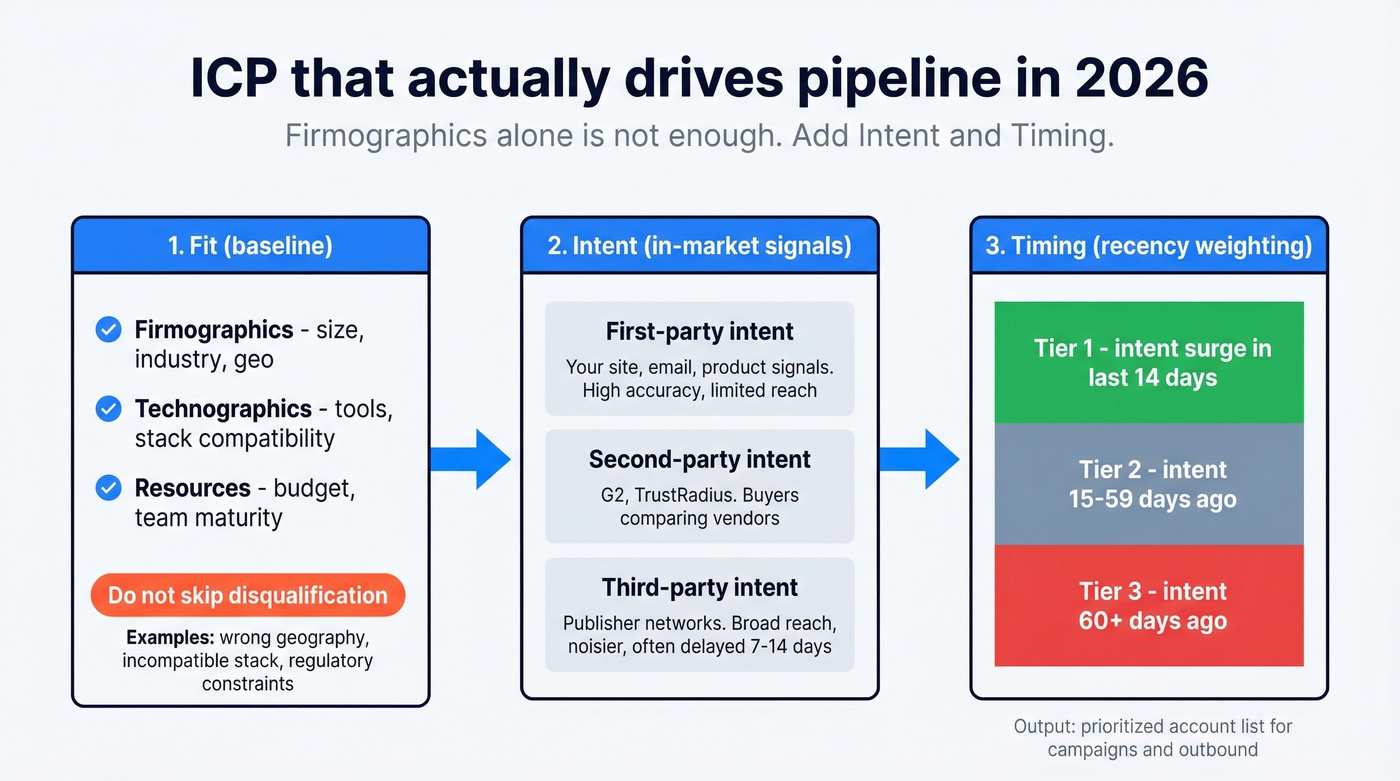
Gartner's ICP framework breaks attributes into six categories: firmographics, technographics, psychographics, business situation, operating model, and resources. That's the foundation. But the model that actually drives pipeline layers three dimensions on top of it, and most teams stop before they get there.
Fit is your baseline - does this account match your firmographic and technographic profile? Intent asks whether they're actively researching your category. Timing weights recency: an account surging on intent signals in the last 14 days goes into Tier 1; an account that showed intent 60 days ago drops to Tier 3.
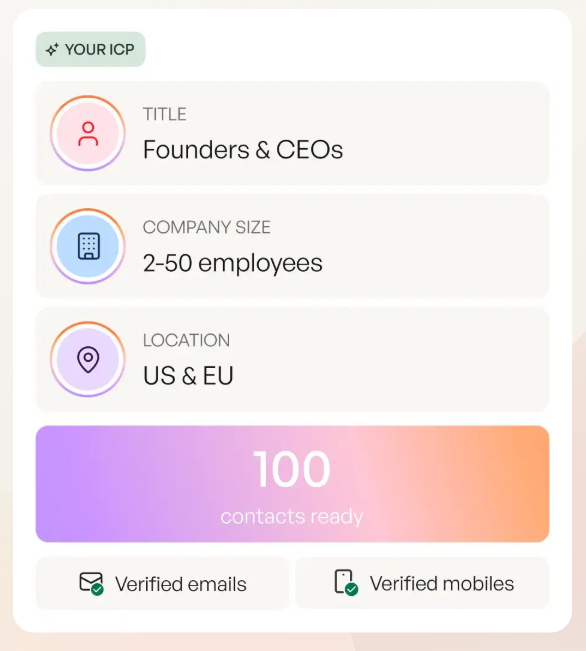
Don't skip the disqualification step. Explicitly define accounts you can't sell to - wrong geography, incompatible tech stack, regulatory constraints. Most teams skip this and end up chasing accounts that were never closeable.
The payoff is real. Marketo research shows that sales and marketing alignment on ICP yields 36% higher retention, 38% higher win rates, and 208% growth in marketing-generated revenue. Those aren't marginal gains. That's a different business.
Map the Buying Committee
You're not selling to a person. You're selling to a committee.
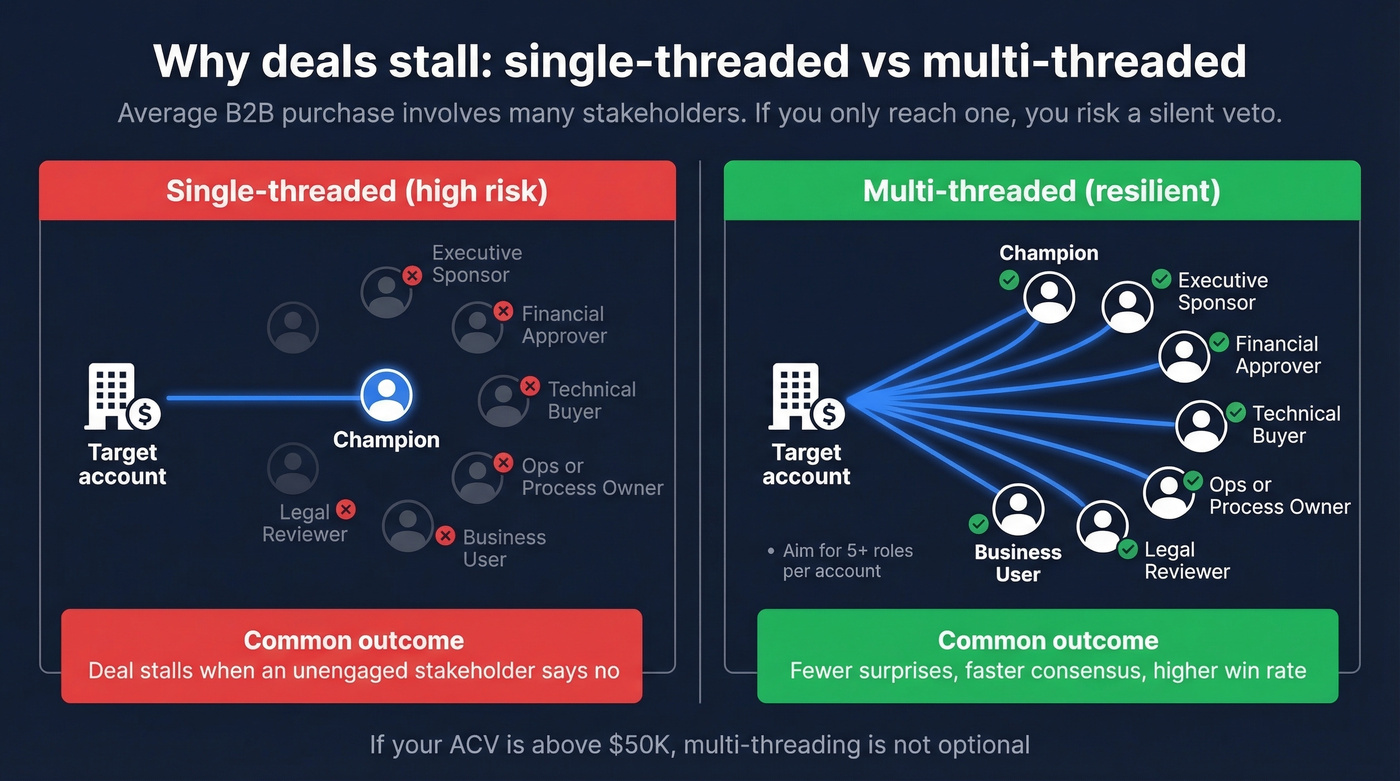
Forrester reports an average of 13 stakeholders per B2B purchase. Gartner puts the typical buying group at 6-10 decision-makers, each bringing 4-5 pieces of independent research. And 86% of B2B purchases stall at some point - usually because a stakeholder you never engaged vetoes the deal.
The fix is multi-threading: mapping and engaging multiple roles within each target account. A practical taxonomy covers Champion, Executive Sponsor, Financial Approver, Technical Buyer, Ops/Process Owner, Business User, Legal Reviewer, Influencer, Project Sponsor, and Final Authority. You don't need all 10 on day one, but if you're only talking to one person per account, you're single-threaded. That's the #1 reason deals die.
ABM approaches that engage the full buying committee drive 87% higher ROI than traditional marketing, with 91% of marketers reporting larger deal sizes. If your ACV is above $50K, multi-threading isn't optional.

You just mapped the buying committee - now you need verified contact data for every stakeholder. Prospeo gives you 300M+ profiles with 30+ filters including buyer intent, technographics, and job changes, so you can multi-thread target accounts without a single bounce killing your campaign.
Stop losing deals to stakeholders you never reached.
Use Intent Data to Find In-Market Buyers
Up to 70% of the buyer journey happens before anyone fills out a form. That's the dark funnel. Intent data is how you see into it - or at least parts of it. The B2B intent data market hit $4.5B in 2026, growing at 15.9% CAGR, because every serious marketing team is chasing this visibility.
The taxonomy matters. First-party intent is your own website and email engagement data - highest accuracy, limited reach. Second-party intent comes from platforms like G2 Buyer Intent or TrustRadius, where buyers actively compare vendors. Third-party intent aggregates signals from publisher networks - broad reach, but noisier and typically delayed 7-14 days.
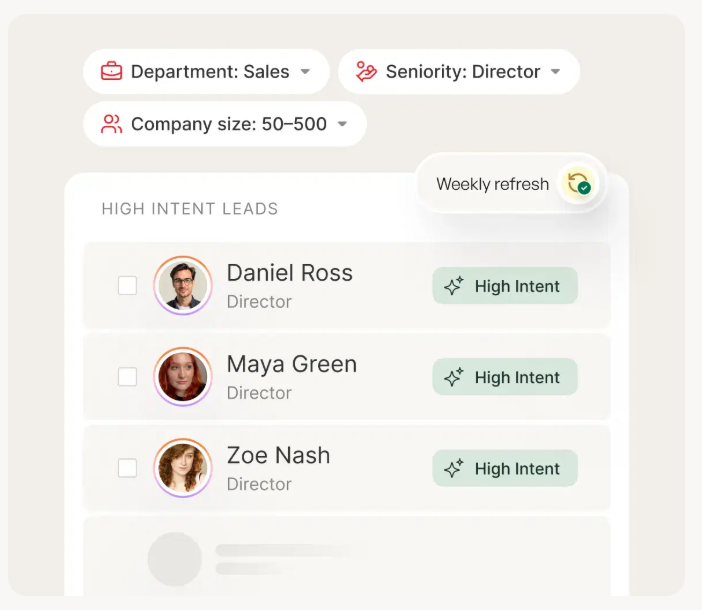
Major third-party providers like Bombora, 6sense, and Demandbase run $25K-$100K+/year as standalone contracts. Our recommendation: start with your own website analytics and layer in second-party sources like G2 before committing to a six-figure contract. Prospeo bundles Bombora-powered intent data across 15,000 topics directly inside its search filters, so you can pair intent signals with verified contact data in one workflow without a separate platform deal.
Pick Your Channels (With Benchmarks)
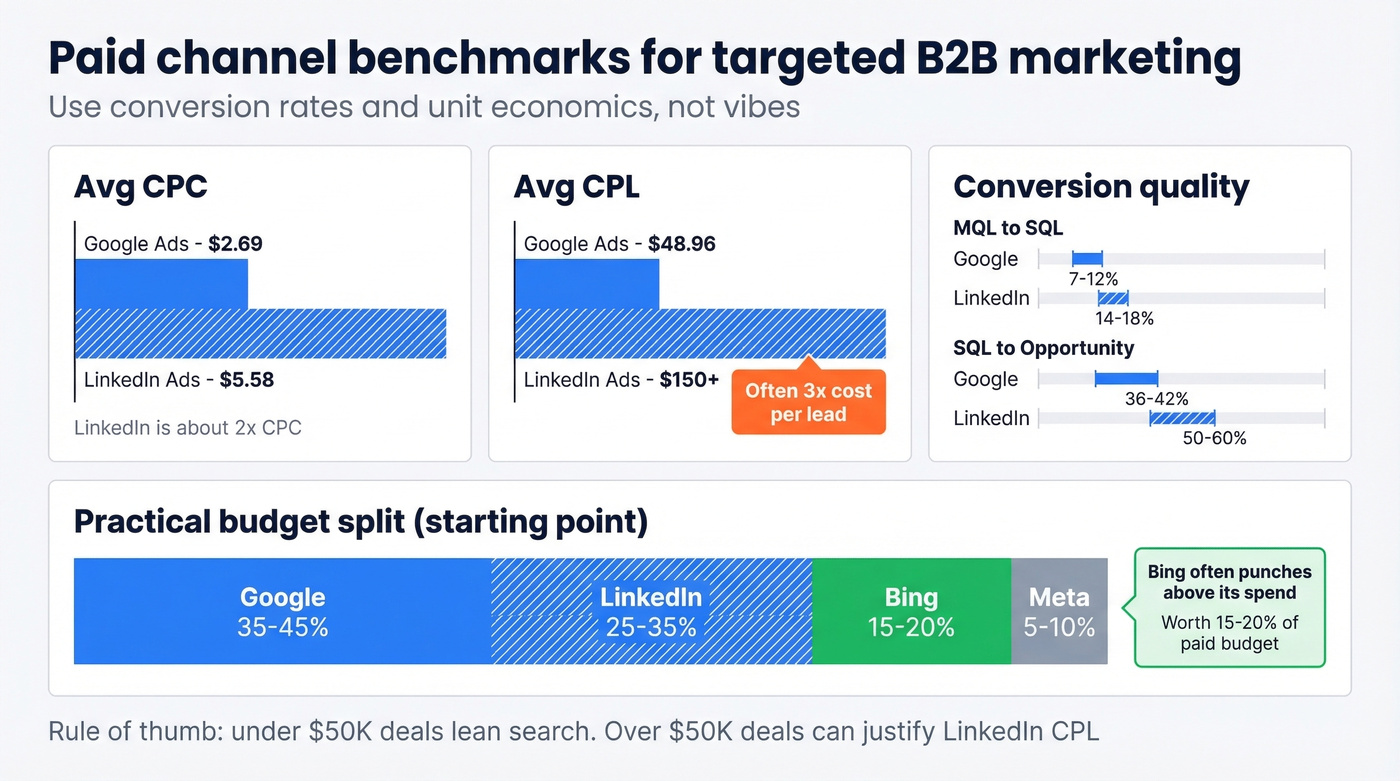
A channel list isn't a strategy - it's a media plan. Here's what the numbers actually say about B2B audience targeting across paid platforms.
| Metric | Google Ads | LinkedIn Ads |
|---|---|---|
| Avg CPC | $2.69 | $5.58 |
| Avg CPL | $48.96 | $150+ |
| MQL-to-SQL | 7-12% | 14-18% |
| SQL-to-Opp | 36-42% | 50-60% |
LinkedIn converts better - 14-18% MQL-to-SQL versus Google's 7-12% - but at 3x the cost per lead. The math only works if your deal sizes justify it.
For deals under $50K, Google and Bing deliver better unit economics. Bing specifically returns a 253% ROI average - worth 15-20% of your paid budget. For enterprise deals above $50K, LinkedIn's SQL-to-Opportunity rate of 50-60% makes the CPL premium worth it.
A reasonable budget allocation: Google 35-45%, LinkedIn 25-35%, Bing 15-20%, Meta 5-10%.
Your ABM tier should dictate channel investment:
| Model | Deal Size | Accounts | Approach |
|---|---|---|---|
| Strategic (1:1) | $500K+ | 10-50 | Fully custom |
| ABM Lite (1:few) | $50K-$500K | 50-200 | Cluster-based |
| Programmatic (1:many) | $10K-$100K | 500+ | Automated |
Here's the thing: if your average deal is under $15K, you don't need ABM platforms or six-figure intent contracts. A clean contact database, solid ICP, and disciplined outbound will outperform any programmatic ABM stack at that deal size. Skip the tooling arms race and invest in data quality instead.
Your Data Is the Weakest Link
None of the frameworks above matter if your contact data bounces.
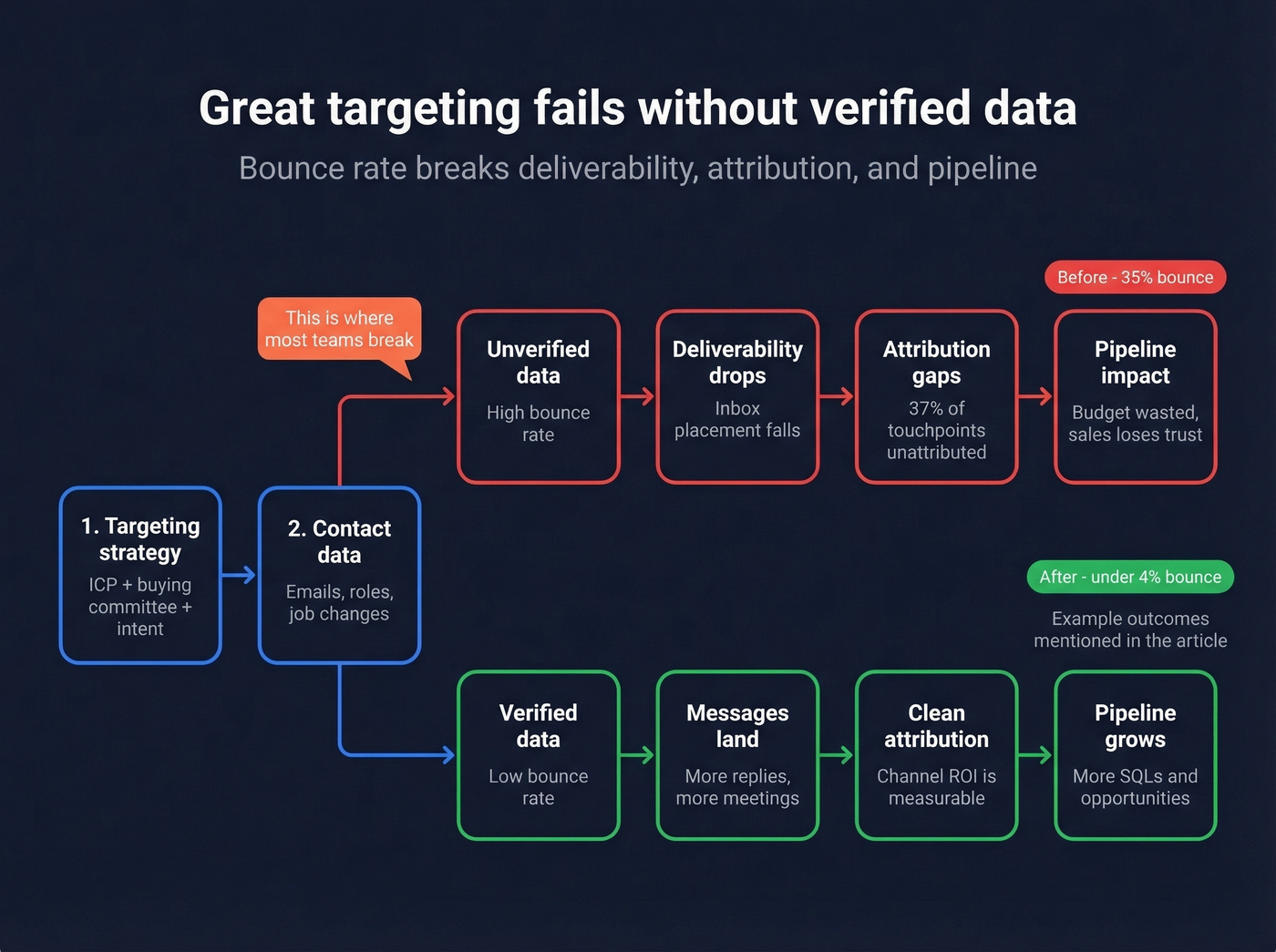
We've watched this play out dozens of times: a team builds a sharp ICP, maps the buying committee, layers in intent signals - then watches their first sequence hit a 35% bounce rate. All that targeting precision dies at the data layer, and without unified data, 37% of touchpoints go unattributed entirely. It's genuinely frustrating to see good strategy wrecked by something this fixable.
The proof points are stark. Meritt was running a 35% bounce rate before switching to Prospeo - bounce dropped under 4% and pipeline tripled from $100K to $300K per week. Snyk had 50 AEs prospecting 4-6 hours a week with 35-40% bounce rates; after fixing the data layer, bounces dropped under 5% and AE-sourced pipeline jumped 180%.

Meritt went from 35% bounce to under 4% and tripled pipeline to $300K/week. Snyk's 50 AEs cut prospecting time in half while growing AE-sourced pipeline 180%. The difference wasn't strategy - it was data quality. Prospeo's 7-day refresh cycle and 98% email accuracy mean your targeted campaigns actually land.
Great targeting with bad data is just expensive failure.
Five Targeting Mistakes That Burn Budget
1. Firmographics-only ICP. Industry + company size isn't targeting. It's a starting point. Without intent and timing signals, you're spraying budget at accounts that aren't in-market.
2. Tactic-first planning. How many teams pick LinkedIn Ads before defining their audience? Channel selection should follow ICP and buying committee mapping, not precede it. We see this constantly - teams spending $20K/month on a channel before they've agreed on who they're trying to reach.
3. Vanity metrics over pipeline metrics. Impressions and MQLs feel good in a dashboard. Sales-accepted opportunities and pipeline velocity are what fund your next quarter's budget.
4. Siloed sales and marketing. In our experience, this is the root cause of mistakes #1 through #3. When marketing targets one ICP and sales prospects a different one, you get the 500 MQLs / 40 accepted scenario from the top of this article.
5. Single-threaded outreach. Targeting one person per account when buyers are 70% through their process before engaging sellers is a recipe for stalled deals. Multi-thread into 5+ roles - and make sure your contact data is verified so outreach doesn't die on bounced messages.
FAQ
What's the difference between targeted marketing and ABM?
Targeted B2B marketing focuses on specific segments based on ICP criteria like firmographics, intent, and timing. ABM is a subset that treats individual accounts as markets of one with custom content and outreach. All ABM is targeted marketing, but you can run targeted campaigns at the segment level without 1:1 account focus.
How much does B2B intent data cost?
Major third-party providers like Bombora, 6sense, and Demandbase run $25K-$100K+/year for standalone contracts. Second-party sources like G2 Buyer Intent are cheaper. Some platforms bundle intent data into existing plans - Prospeo, for example, includes Bombora-powered signals across 15,000 topics starting on its free tier.
How many people should I target per account?
Forrester reports 13 stakeholders per average B2B purchase. At minimum, target 5+ roles: Champion, Executive Sponsor, Financial Approver, Technical Buyer, and at least one end-user. Fewer than five contacts per account means you're single-threaded and vulnerable to a single veto killing the deal.
What's a good MQL-to-SQL conversion rate?
LinkedIn Ads convert at 14-18% MQL-to-SQL, while Google Ads convert at 7-12%. If your overall rate is below 5%, your targeting criteria or lead qualification definitions need rework - start by auditing ICP alignment between sales and marketing.