

8 TED Talks on Sales That Will Change How You Sell
Every "best TED talks for sales" article includes the same five talks with the same two-sentence summaries. You've read them. You didn't change anything about how you sell on Monday morning.
That's because motivation fades by lunch - frameworks stick. We pulled from TED's topic hubs and practitioner forums to find talks that actually hold up under scrutiny, and the eight below were chosen for one reason: each contains a specific, testable framework you can apply to a real sales scenario this week.
Here's the thing: most salespeople don't have a motivation problem. They have a framework problem. These talks fix frameworks.
If You Only Have 60 Minutes
If your calendar's packed, these three talks deliver the highest return per minute watched:
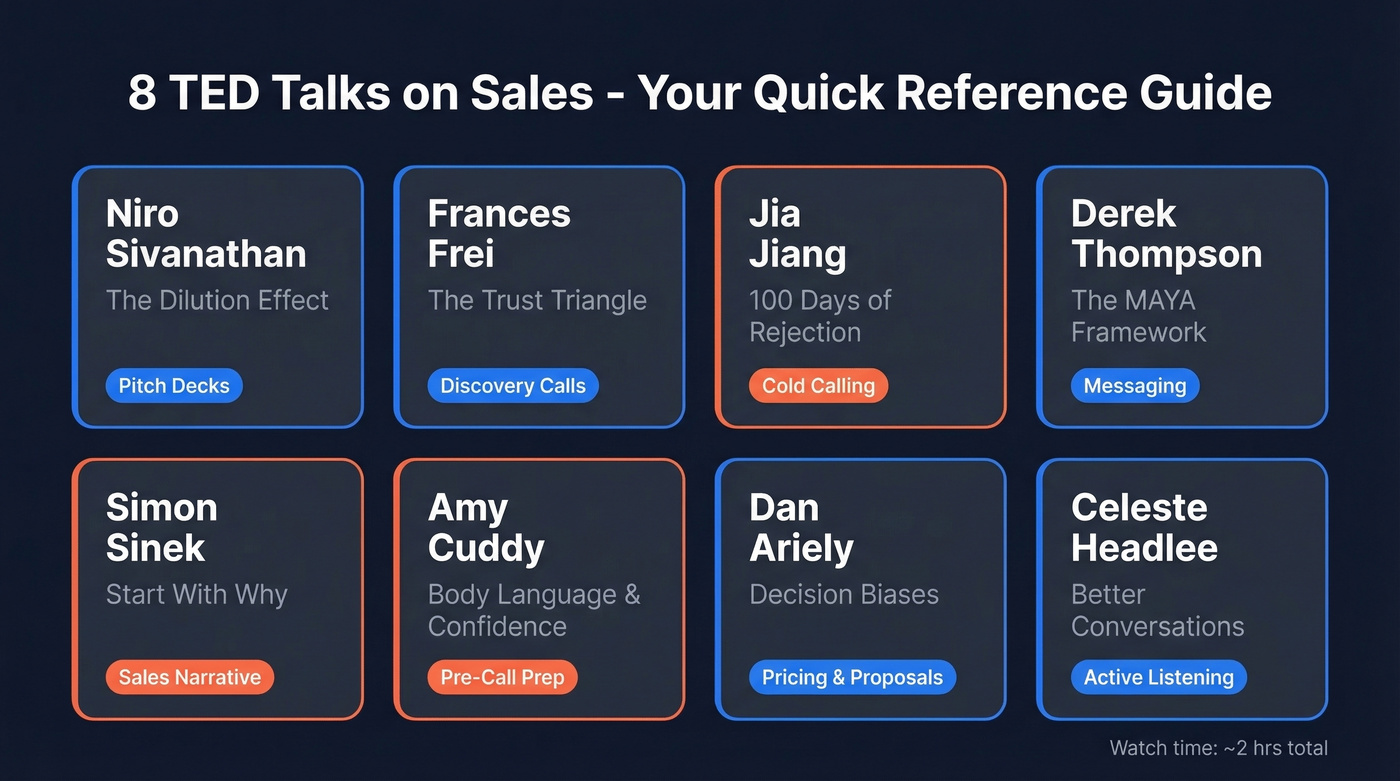
- Niro Sivanathan - the dilution effect. It'll fix your pitch deck by teaching you that fewer arguments beat more arguments every time.
- Frances Frei - The trust triangle. It'll fix your discovery calls by diagnosing exactly where trust breaks down.
- Jia Jiang - 100 days of rejection. It'll fix your fear of the phone by reframing "no" as a trainable muscle.
Quick-reference table for all eight:
| Speaker | Talk | Best For |
|---|---|---|
| Niro Sivanathan | The Counterintuitive Way to Be More Persuasive | Pitch decks & proposals |
| Frances Frei | How to Build (and Rebuild) Trust | Discovery & stakeholder trust |
| Jia Jiang | What I Learned From 100 Days of Rejection | Cold calling confidence |
| Derek Thompson | The Four-Letter Code to Selling Anything | Messaging & positioning |
| Simon Sinek | How Great Leaders Inspire Action | Sales narrative & purpose |
| Amy Cuddy | Your Body Language May Shape Who You Are | Pre-call confidence |
| Dan Ariely | Are We in Control of Our Own Decisions? | Pricing & proposal design |
| Celeste Headlee | 10 Ways to Have a Better Conversation | Discovery & active listening |

These TED talks fix your frameworks - now aim them at the right accounts. Prospeo finds decision-makers with 30+ filters and verifies emails at 98% accuracy on a 7-day refresh.
Build a list that matches your new pitch - then hit send.
The 8 Best Sales TED Talks
Niro Sivanathan - The Dilution Effect
You just bombed a discovery call. The prospect went cold after your third slide. You had six case studies, four ROI stats, and a competitive teardown. That was the problem.
Sivanathan's talk introduces the dilution effect: when you add weak or even moderately strong arguments to your strongest ones, the overall persuasiveness of your message drops. That "nice to have" slide about your company's founding story? It's actively undermining the slide about your 3x ROI. In our experience, the dilution effect is the single most actionable concept on this entire list - the application is immediate and concrete, no mindset shift required, just a red pen.
Watch this, then do this: Open your current pitch deck. Identify your two strongest proof points - the ones that make prospects lean forward. Now cut everything else that doesn't directly support those two. If your deck goes from 18 slides to 9, you're on the right track.
Frances Frei - The Trust Triangle
Frei breaks trust into three components: authenticity, logic, and empathy. When trust breaks down in a deal, it's almost always because one of these three vertices is wobbling - and diagnosing which one changes how you recover.
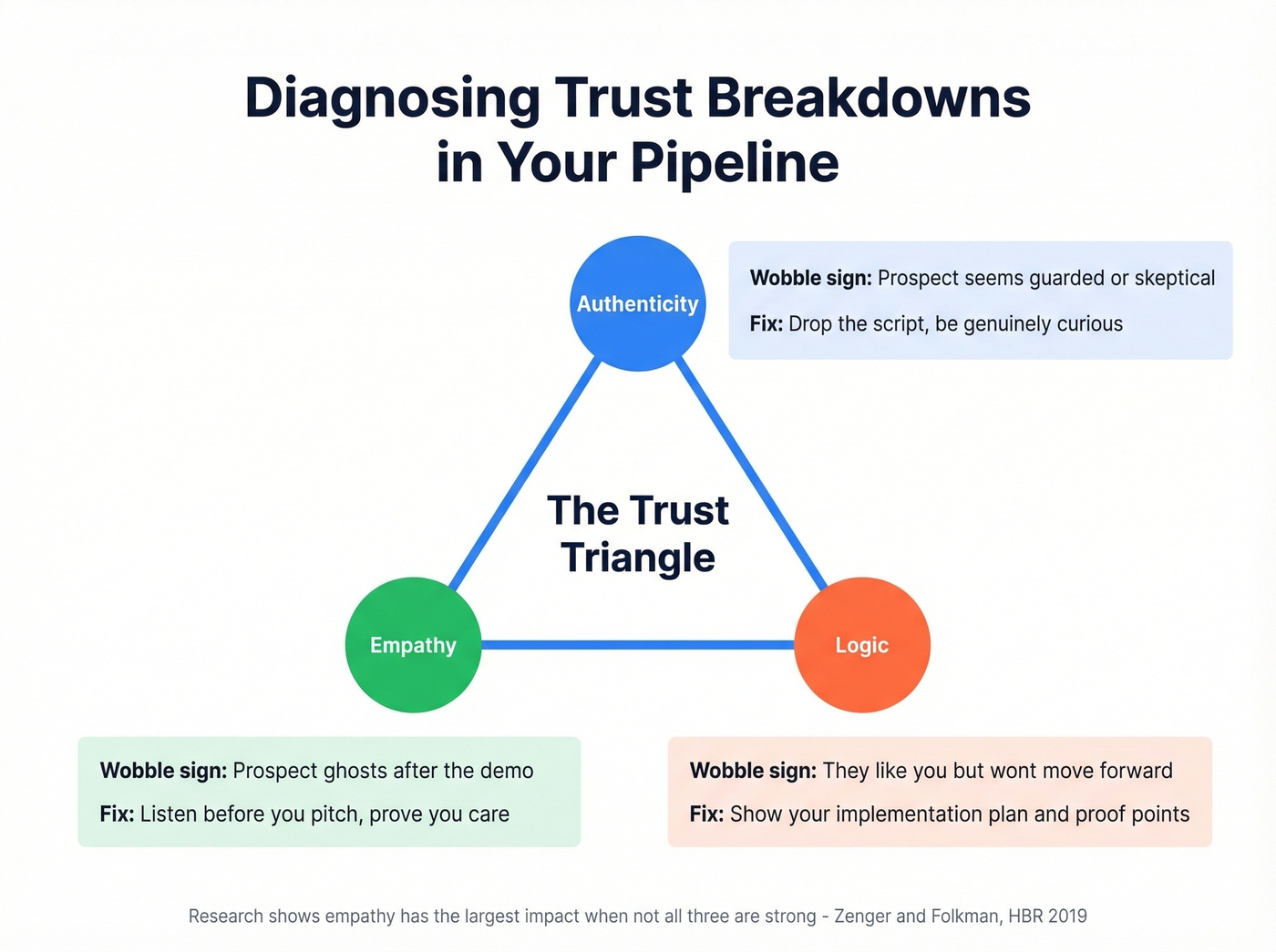
Map the diagnostic to your pipeline and patterns emerge fast:
- Prospect ghosts after a demo? Usually an empathy wobble. They didn't feel you understood their problem. You were pitching features, not listening.
- They like you but won't move forward? Logic wobble. They doubt your rigor, your implementation plan, or your ability to deliver.
- They respect the product but seem guarded? Authenticity wobble. Something about the interaction feels overly scripted or strategic.
Zenger & Folkman's research on trust drivers found that when not all three vertices are strong, empathy - the relationships lever - has the largest impact. For sellers, that means discovery calls aren't about demonstrating competence first. They're about proving you care about the prospect's problem before you prove you can solve it.
Watch this, then do this: After your next lost deal, run a trust wobble debrief. Ask yourself which vertex failed. Was it empathy, logic, or authenticity? Pattern-match across your last five losses. You'll likely find a consistent wobble - and that's where your coaching energy should go.
Jia Jiang - 100 Days of Rejection
Your SDR team is in week two and half of them are already dreading the phone. They're not bad at selling - they're bad at getting rejected.
In November 2012, Jiang set out to get deliberately rejected every day for 100 days. He asked a Krispy Kreme employee to make donuts shaped like the Olympic rings, tried to be a greeter at Starbucks, and requested to plant a flower in a stranger's backyard. The result: 51 yeses and 49 nos. More than half of his ridiculous requests were granted.
The mechanism is exposure therapy. Rejection fear is a conditioned response, and repeated exposure reduces its intensity. Jiang's insight for salespeople is that rejection is almost never about you - it's situational, contextual, and often reversible if you stay in the conversation instead of retreating. We've seen SDR teams cut call anxiety significantly after just one week of deliberate rejection exercises.
Watch this, then do this: This week, make one absurd request per day. Ask for a discount at a coffee shop. Ask a stranger for a book recommendation. Ask your manager for an extra day off. The point isn't to get a yes - it's to feel the "no" and realize you're still standing. After five days, cold calls feel different.
Derek Thompson - The MAYA Framework
Skip this if your product is already well-known in your market. This talk matters most when you're selling something new or unfamiliar.
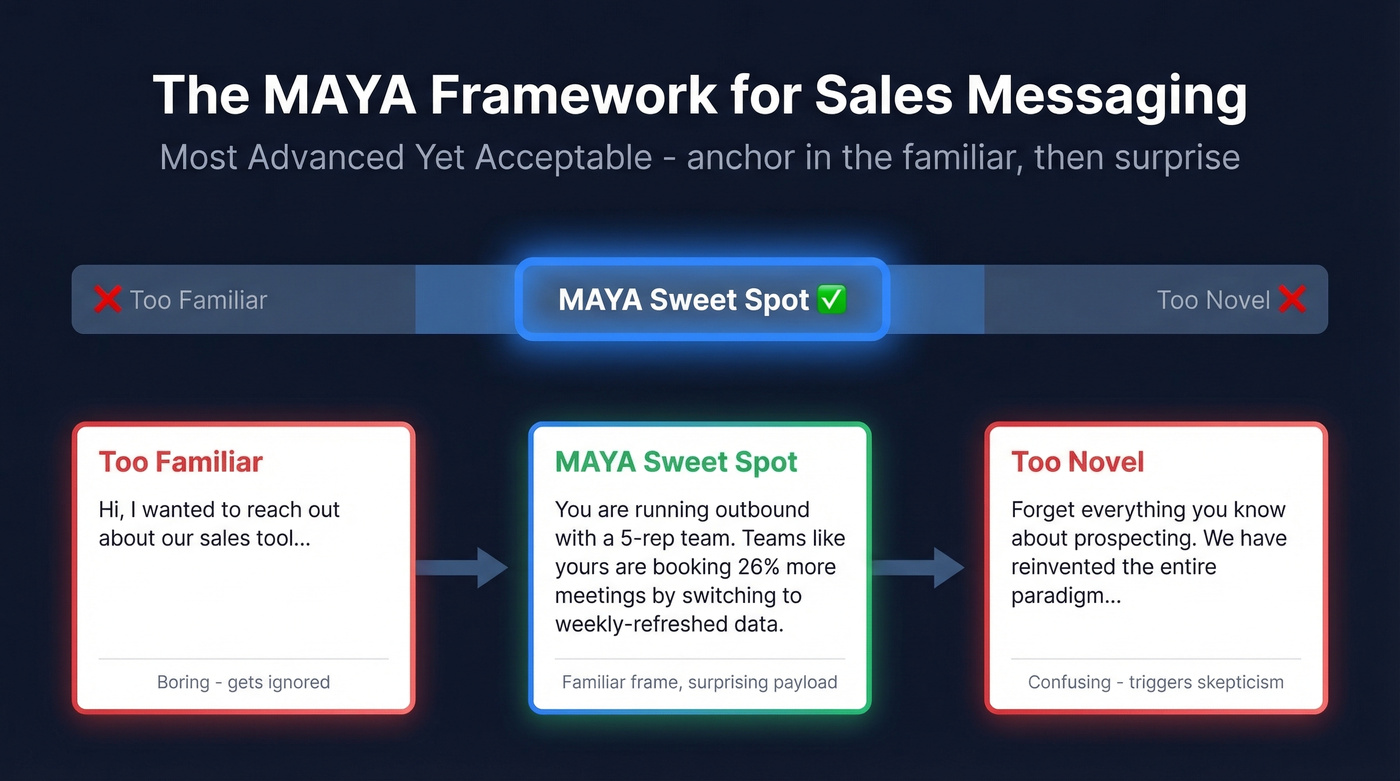
Thompson's talk unpacks Raymond Loewy's design principle: MAYA, or Most Advanced Yet Acceptable. Loewy designed everything from the Studebaker to the look of Air Force One for JFK, and his secret was finding the sweet spot between novelty and familiarity. The psychology underneath is the mere-exposure effect - we prefer things we've seen before. But pure familiarity is boring. The magic happens when something feels familiar enough to trust but surprising enough to notice.
For sales messaging, this changes how you write cold emails and position demos. Don't lead with how radically different your product is. Anchor in what the prospect already knows and believes, then introduce the new. "You're already doing X. Here's how Y makes X work 3x better" beats "Forget everything you know about X" every time. Familiar frame, surprising payload.
Watch this, then do this: Rewrite your next cold email using the MAYA structure. Open with something the prospect already believes or does ("You're running outbound with a 5-rep team"). Then introduce your differentiator as an evolution, not a revolution ("Teams like yours are booking 26% more meetings by switching to weekly-refreshed data"). Test it against your current template for one week.
Simon Sinek - Start With Why (With a Caveat)
You've seen this one. The Golden Circle - start with Why, then How, then What. It's the most-watched TED talk for a reason, and the core insight is real: people don't buy what you do, they buy why you do it.
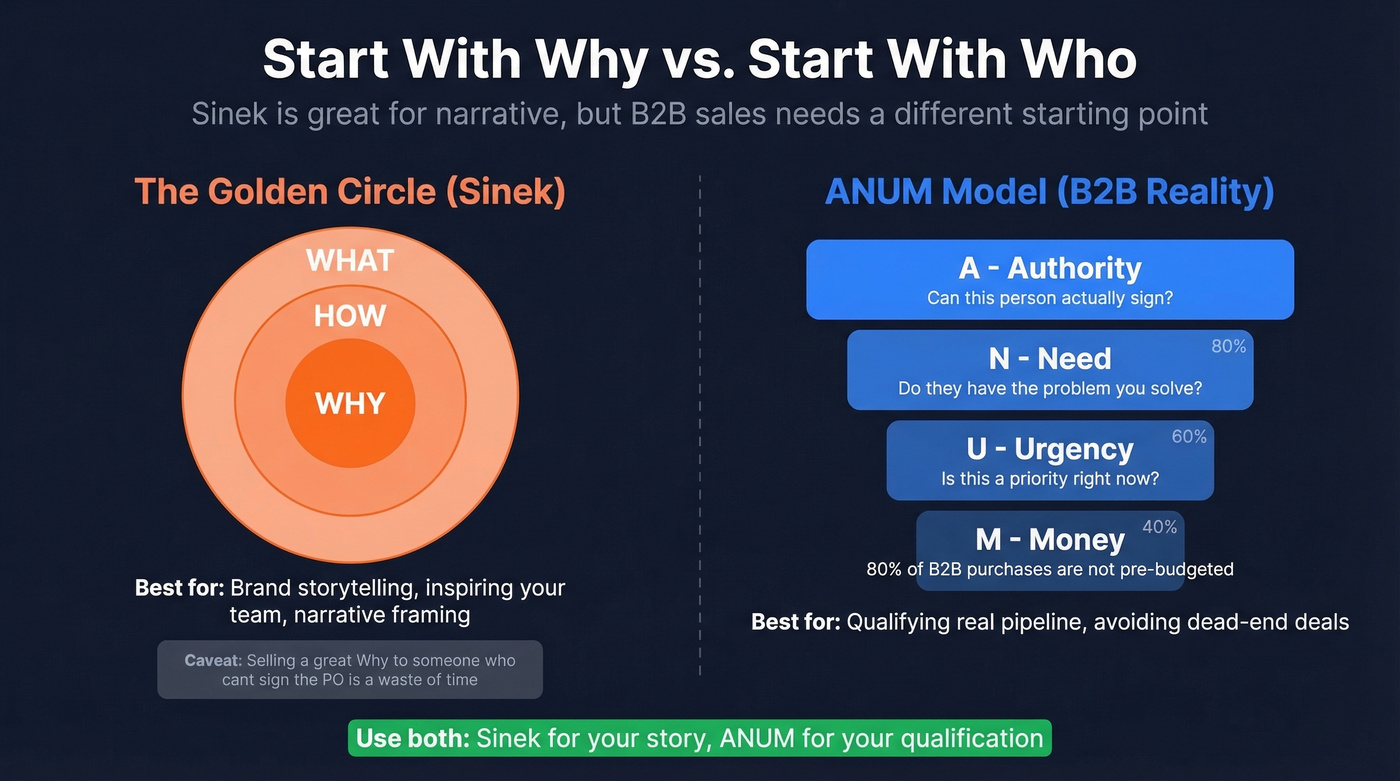
Here's the caveat every listicle skips: in B2B sales, starting with Why is often the wrong move. A Forbes analysis of Sinek's framework argues that great salespeople start with WHO - finding the person with actual authority to buy. Selling to someone with no purchasing power is a massive time sink, regardless of how inspiring your "why" is. The ANUM qualification model (Authority, Need, Urgency, Money) puts authority first for exactly this reason.
There's also the budget myth. A DemandGen study found that roughly 80% of B2B purchases aren't pre-budgeted - buyers build a use case and then obtain budget. Leading with "do you have budget?" (classic BANT) can disqualify deals that would've closed.
The r/sales consensus on Sinek is mixed - practitioners respect the talk's motivational power but question the experimental rigor behind some of his assertions. Watch it for the narrative framework, but don't treat it as a sales methodology.
Watch this, then do this: Before your next outbound push, audit your prospect list. For each account, ask: am I talking to someone with authority to sign? If you can't answer yes, find the right person first. The best "why" story in the world won't close a deal with someone who can't approve the PO.
Amy Cuddy - The Science of Confidence
Cuddy's talk sits at 75M+ views - third most-watched in TED history. The premise: holding a "power pose" for two minutes makes you feel more confident and more willing to take risks. But the science is complicated, and we think you deserve the full picture.
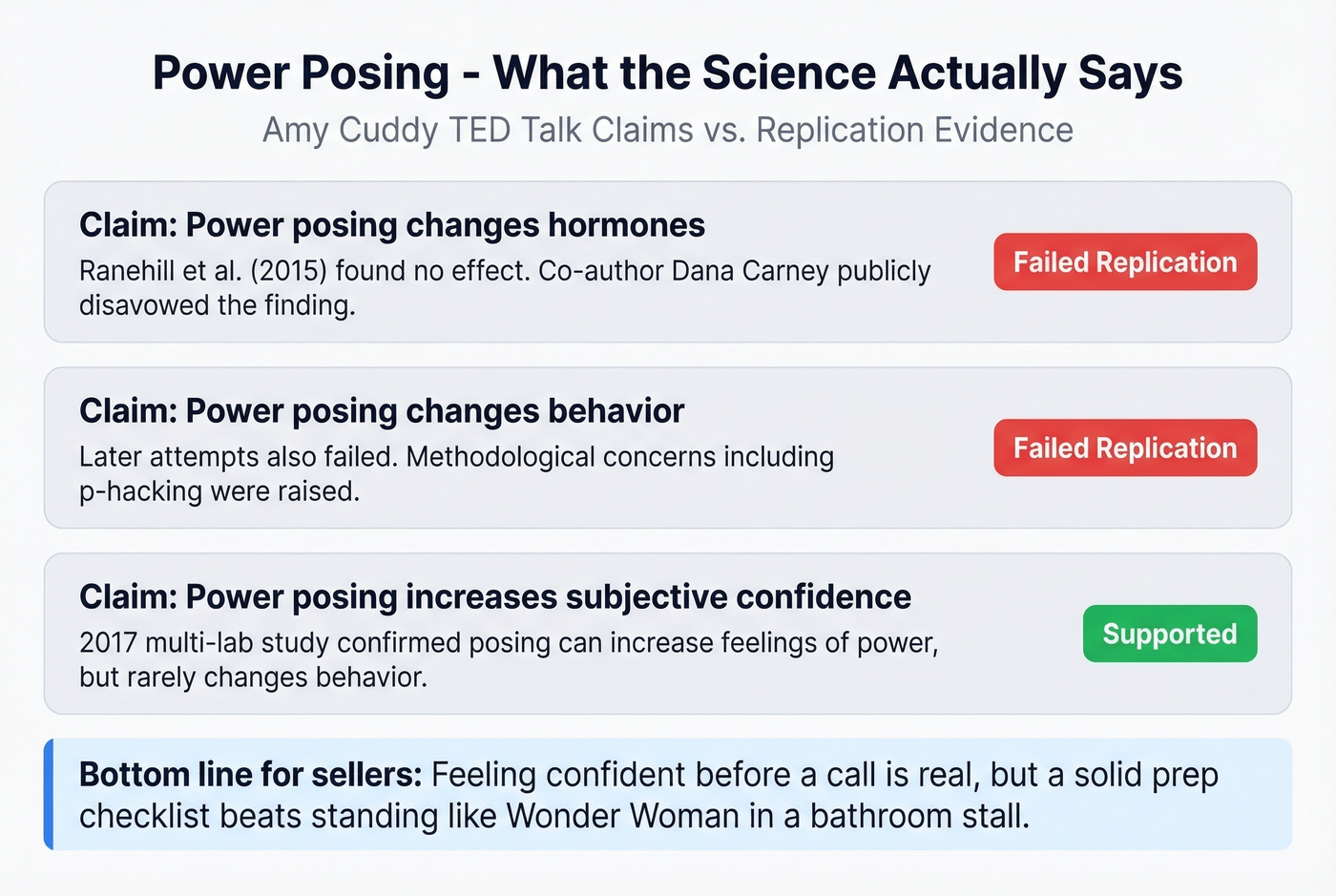
| Claim | Evidence |
|---|---|
| Power posing changes hormones | Failed replication. Ranehill et al. (2015) found no effect. Co-author Dana Carney publicly stated: "I do not believe that 'power pose' effects are real." |
| Power posing changes behavior | Failed replication. Later attempts also failed; methodological concerns including p-hacking were raised. |
| Power posing increases subjective confidence | Supported. A 2017 multi-lab resolution found posing can increase feelings of power, but rarely produces meaningful behavior change. |
The subjective confidence finding held up, and that's not nothing before a high-stakes call. Still worth watching for the reminder that your physical state affects your mental state. Just don't build your pre-call routine around it. A solid call prep checklist - reviewing the prospect's 10-K, checking recent news, mapping the org chart - will do more for your confidence than standing like Wonder Woman in a bathroom stall.
Dan Ariely - Decision Biases
Ariely's core insight is straightforward: we're not rational decision-makers, and the context around a choice shapes the choice itself.
The sales application is in pricing and proposal design. The classic illustration: Amsterdam's Schiphol Airport printed a small fly target inside urinals and saw an 80% decrease in spillage. Nobody was told to aim better. The environment did the work. Your proposals should work the same way - use decoy pricing (a deliberately unattractive middle option), anchor high before presenting your recommended tier, and make the desired action the default.
Watch this, then do this: Add a decoy option to your next proposal. If you're selling a $50K package, create a stripped-down $30K option that's clearly insufficient and a $75K premium option that's more than they need. The $50K option suddenly looks like the smart middle ground. Test this on your next three proposals and track which tier prospects choose.
Celeste Headlee - Better Conversations
Headlee's talk is the one your AEs need to watch before their next discovery call. The core principle: listening is harder than talking, and most people are terrible at it.
One practical heuristic from call-coaching research: in good conversations, the volume and energy rise over time. In bad ones, they fall. If you're reviewing call recordings and hear the prospect's energy dropping, that's your signal - you talked too much, asked a closed question, or missed a cue. Let's be honest, most reps already know this intuitively but don't act on it because they've never measured it.
Watch this, then do this: Record your next discovery call. When it's done, time how many seconds you talked versus how many seconds the prospect talked. If you're above 50%, you're pitching, not discovering. Aim for a 30/70 talk ratio - you talk 30%, they talk 70%.
What to Actually Do on Monday
Watching eight presentations without changing a single behavior is just entertainment with a productivity alibi.
Before your first cold call: Watch Jiang (rejection therapy) and Cuddy (confidence priming). Then make your first dial without rehearsing a script. The goal isn't a perfect call - it's proving to yourself that rejection doesn't end your day.
Before your next pitch: Watch Sivanathan (dilution effect). Open your deck, identify the two strongest proof points, and cut everything that doesn't serve them. Send the shorter version to your next prospect.
Before your next discovery call: Watch Frei (trust triangle) and Headlee (better conversations). Set a timer on your next call and aim for the 30/70 talk ratio. After the call, run a trust wobble check - which vertex was weakest?
After a lost deal: Watch Sinek (start with who, not why) and Thompson (MAYA framework). Ask yourself: were you talking to someone with authority? Was your message anchored in something familiar before introducing the new?
These frameworks only work if you're reaching the right person. A perfect pitch delivered to a bounced email address is just practice. Before you sharpen your messaging, verify your list - Prospeo checks emails in real time with 98% accuracy, so your carefully crafted outreach actually lands in an inbox instead of bouncing. The free tier gives you 75 verified emails a month with no contract, enough to test whether better data changes your connect rates.

We deliberately excluded newer TEDx talks that haven't been stress-tested by practitioners. These eight have been - and each one earns its spot by giving you something you can use this week, not just something that feels good to watch.
Practice rejection without burning your domain. Prospeo gives you 143M+ verified emails (pay only for valid) plus 125M+ mobiles with a 30% pickup rate - so every rep gets real at-bats.
Call and email real buyers, not dead data.
FAQ
Are TED talks effective for sales training?
Yes, but only when you extract the framework and apply it to a specific scenario. Watching passively is entertainment, not training. Pair each talk with a concrete exercise - revise a deck after Sivanathan, record a call after Headlee, make one uncomfortable ask after Jiang. The framework-to-action loop turns a 15-minute video into a real skill upgrade.
What's the best TED talk for cold calling?
Jia Jiang's "100 Days of Rejection" reframes rejection as a muscle you train through deliberate exposure, not a personality trait you're stuck with. After 100 deliberate rejections, Jiang got 51 yeses. SDR teams that practice rejection therapy for even one week consistently report less call anxiety and higher dial volume.
Which talk helps most with B2B deals?
Frances Frei's trust triangle talk. B2B deals live and die on trust, and Frei gives you a diagnostic - empathy, logic, authenticity - that pinpoints exactly where a deal went sideways. Pair it with Sivanathan's dilution effect for pitch optimization, and you've covered the two biggest failure points in B2B: broken trust and bloated messaging.
How do I make sure my outreach reaches the right people?
The best sales frameworks fail when your contact data is wrong. Use a verification tool before every outbound campaign. Prospeo's 5-step email verification catches bounces, spam traps, and stale addresses on a 7-day refresh cycle - so the messaging skills you build from these talks actually reach decision-makers.