

Territory Management: The 2026 Practitioner's Guide
It's Q1 planning. You've got 2,000 accounts, 14 reps, and a massive spreadsheet held together by zip codes, tribal knowledge, and eyeballing. Some reps are thin. Others are drowning. One practitioner on r/SalesOperations described this exact scenario as "a nightmare" - and that's generous. The problem isn't that territory management is hard. It's that most teams skip the math and wonder why half the squad misses quota.
The short version: This is an optimization problem - balance account potential, rep capacity, and data quality across every segment. Use the capacity formula and A/B/C/D tiering template below to replace eyeballing with math. And before reps start working new territories, verify the contact data. Industry estimates peg annual B2B data decay around 30%.
What Is Territory Management?
Territory management is the ongoing process of dividing your market into defined segments, assigning reps to each, and continuously optimizing those assignments as conditions change. That last part matters. Territory planning is a one-time design exercise - you draw the lines, assign the accounts, and ship it. Territory management is what happens after: monitoring performance, rebalancing workloads, and adjusting when the model breaks.
It operates on two levels. Reps manage territories day-to-day - prioritizing accounts, routing meetings, working their pipeline. Managers and RevOps own the strategic layer: designing the model, scoring accounts, measuring balance, and deciding when to blow it up and start over. Most guides conflate these two levels. They're different jobs with different tools. Reps need route optimization and account prioritization. Managers need balancing algorithms and performance dashboards.
Why Getting Territories Right Matters
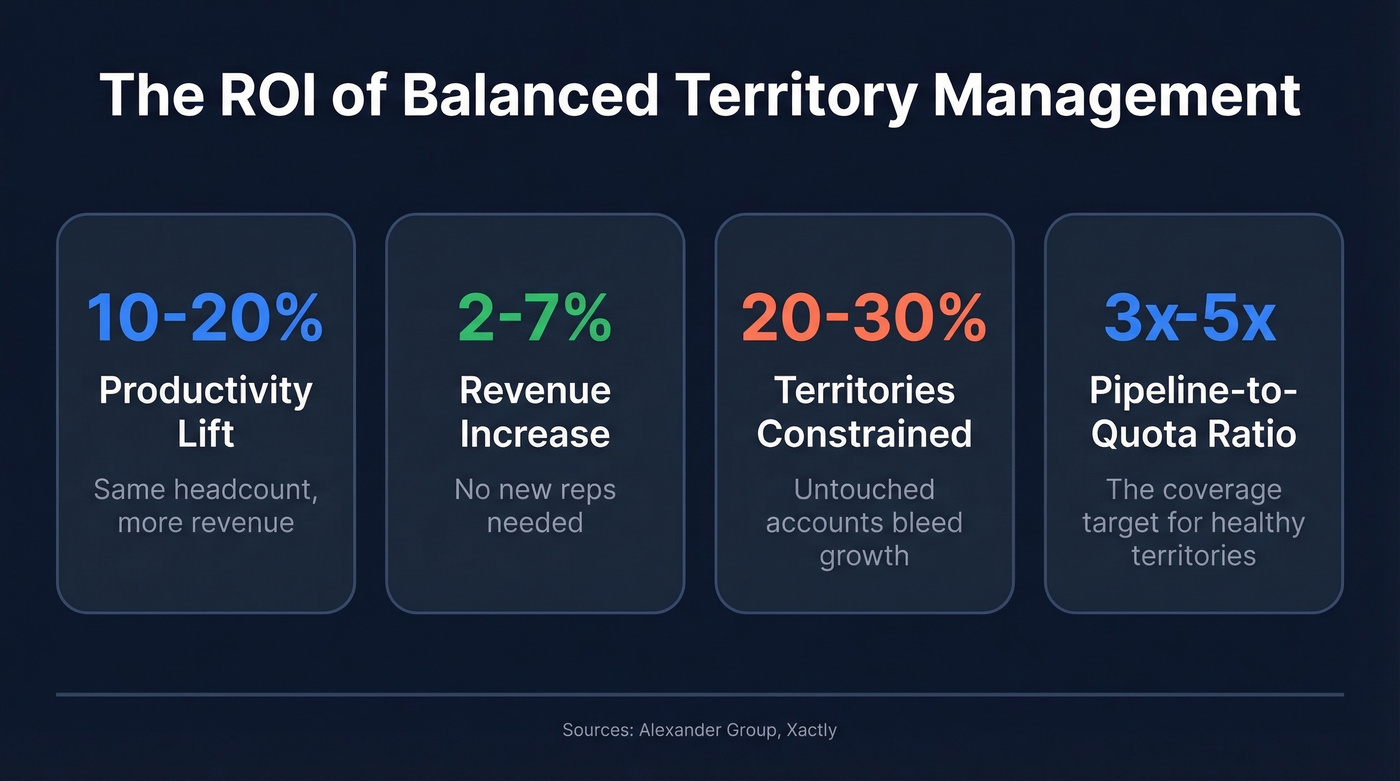
The ROI of balanced territories isn't theoretical. Here are the benchmarks worth knowing:
| Benchmark | What It Means |
|---|---|
| 10-20% productivity lift | Reps sell more with the same headcount |
| 2-7% revenue increase | Top-line growth without adding reps |
| 20-30% of territories constrained | Untouched territories bleed growth |
| Pipeline-to-quota ratio: 3x-5x | The coverage target for healthy territories |
The Alexander Group's finding is the one that gets cited most, and for good reason. A 10-20% productivity increase from territory optimization alone - no new hires, no new tools, no new comp plans - is one of the highest-leverage moves sales leaders can make. The flip side is equally telling: without periodic adjustment, 20-30% of territories become constrained because large territories spend all their capacity maintaining existing business instead of hunting new logos.
The pipeline-to-quota ratio is your health check. If a territory can't sustain 3x pipeline coverage, the rep in that territory is structurally set up to miss. That's not a coaching problem. That's a design problem.
Territory Models - Which One Fits?
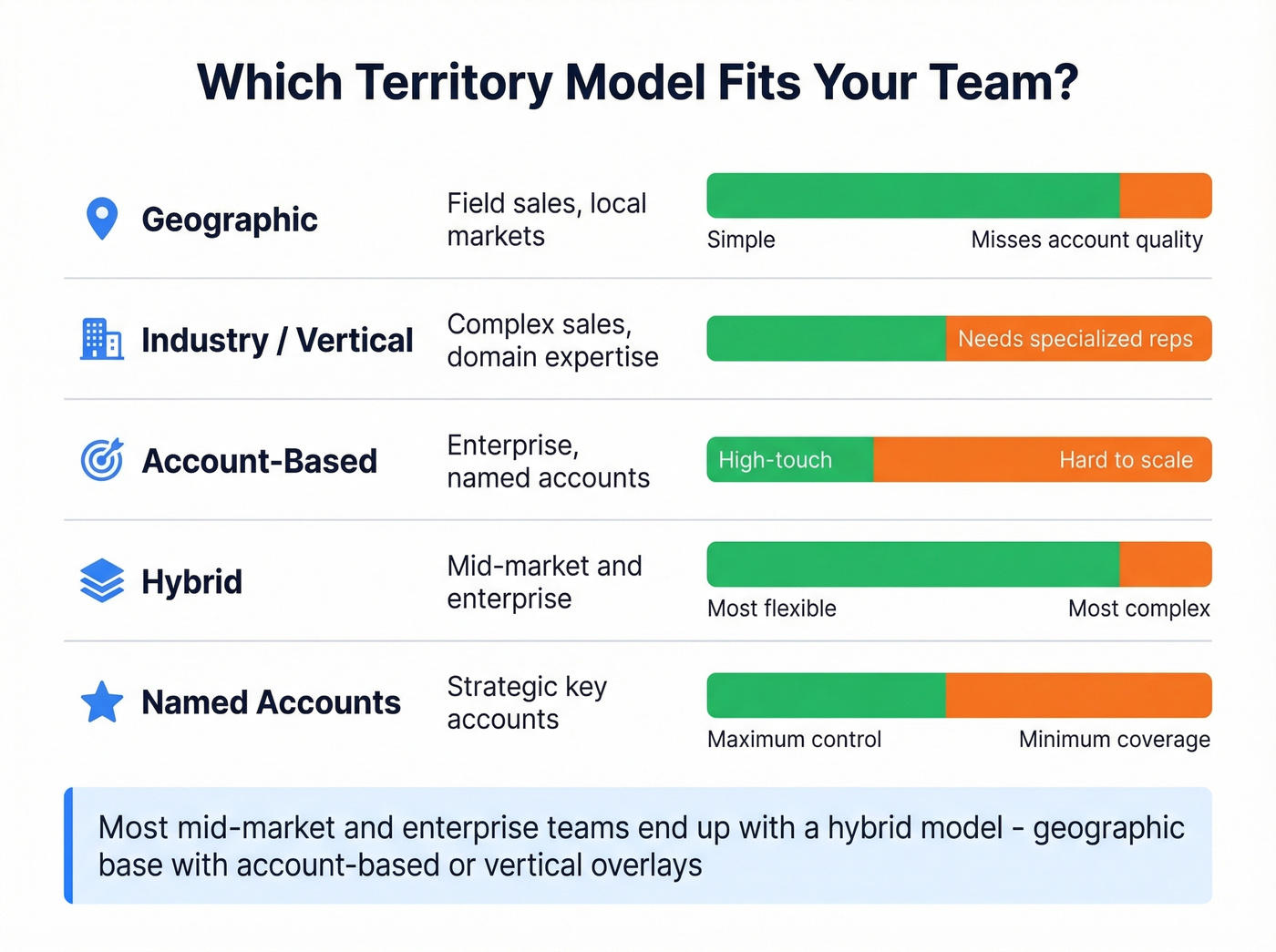
There's no universal model. The right one depends on your selling motion, deal size, and how much complexity your ops team can maintain.
| Model | Best For | Key Tradeoff |
|---|---|---|
| Geographic | Field sales, local markets | Simple; misses account quality |
| Industry/Vertical | Complex sales, domain expertise | Requires specialized reps |
| Account-Based | Enterprise, named accounts | High-touch but hard to scale |
| Hybrid | Mid-market and enterprise | Most flexible, most complex |
| Named Accounts | Strategic/key accounts | Maximum control, minimum coverage |
Most mid-market and enterprise teams end up with a hybrid model - geographic at the base layer, with account-based or vertical overlays for high-value segments. That's the right instinct. Pure geography is the fastest way to create imbalanced territories because it ignores the variable that actually matters: account potential.
The overlooked variable in all of these models is rep-account fit. Assigning a rep who's spent five years selling into healthcare to a territory full of fintech accounts is a design failure, not a performance issue.
Here's the thing: if your average deal closes under $10k, you probably don't need a sophisticated model at all. A simple round-robin with geographic clustering will outperform a complex model that nobody trusts and everyone overrides. Save the multi-variable optimization for deal sizes that justify the ops investment.
One emerging trend worth watching is AI-assisted territory balancing. Modern territory mapping tools can reduce drive time by 20% and fit two more meetings per day into field reps' schedules. The technology is still maturing, but algorithmic balancing tools from vendors like Xactly are closing the gap between "good enough" and genuinely optimized.
How to Build a Territory Plan
Six steps turn a spreadsheet of accounts into a defensible, balanced model. These strategies scale from 5-rep teams to 500-rep orgs - the math is the same, only the tooling changes.
Define Objectives and Analyze TAM
Start with the three-stage framework the Alexander Group recommends: Assessment, Design, and Implementation with change management. Most teams nail the first two and skip the third - which is why reps revolt when new territories drop in January.
During Assessment, define what you're optimizing for. Growth into new segments? Headcount expansion? Specialization by vertical? The answer shapes every downstream decision. Map your total addressable market by pulling every account that fits your ICP, scoring them on firmographic and technographic criteria, and getting a full picture of available opportunity before you start drawing lines.
During Implementation, plan for disruption tolerance. Leadership should iterate on outlier territories before rollout and build a communication plan that explains why territories changed - not just how. We've seen rollouts go sideways purely because reps felt blindsided, even when the new design was objectively better.
Score and Tier Accounts
Not all accounts deserve equal attention. Use an A/B/C/D tiering model to allocate rep time proportionally:
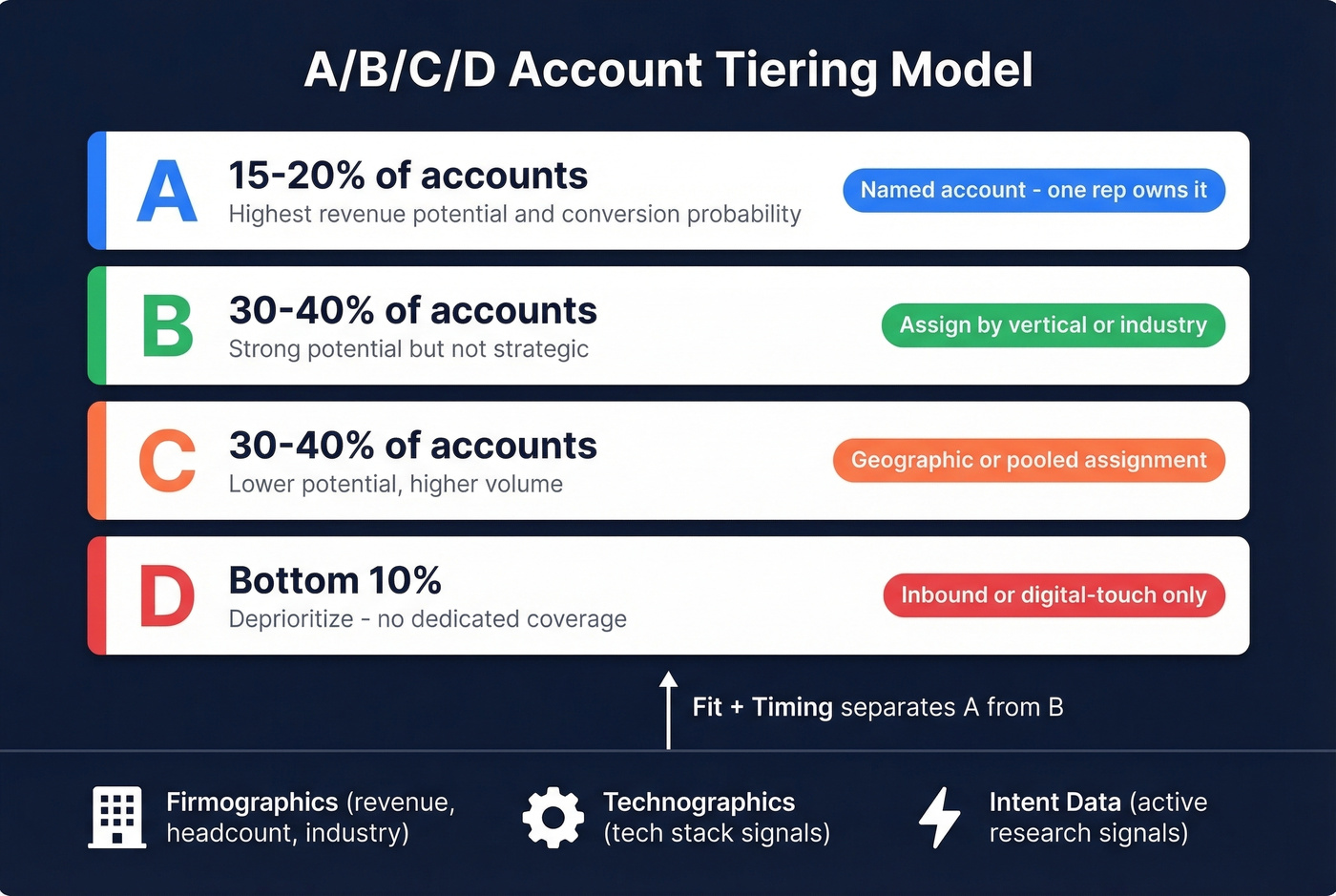
- A-tier (top 15-20%): Highest revenue potential and conversion probability. Named-account treatment - one rep owns the relationship end-to-end.
- B-tier (30-40%): Strong potential but not strategic. Assign by vertical or industry to match rep expertise.
- C-tier (30-40%): Lower potential, higher volume. Geographic or pooled assignment - efficiency over personalization.
- D-tier (bottom 10%): Deprioritize. No dedicated coverage. Let these come inbound or route to a digital-touch motion.
The scoring inputs matter as much as the tiers. Firmographic data like revenue, headcount, and industry is table stakes. Layer in technographic signals and intent data to identify accounts actively researching solutions - the combination of fit + timing separates A-tier from B-tier far better than revenue alone. Clean firmographics, verified contacts, and up-to-date technographics are what separate a tiering model that holds up from one that falls apart by February.
Model Rep Capacity
Here's where most territory plans fall apart: they assign accounts without modeling whether reps can actually cover them. Use this formula from eSpatial's capacity planning guide.
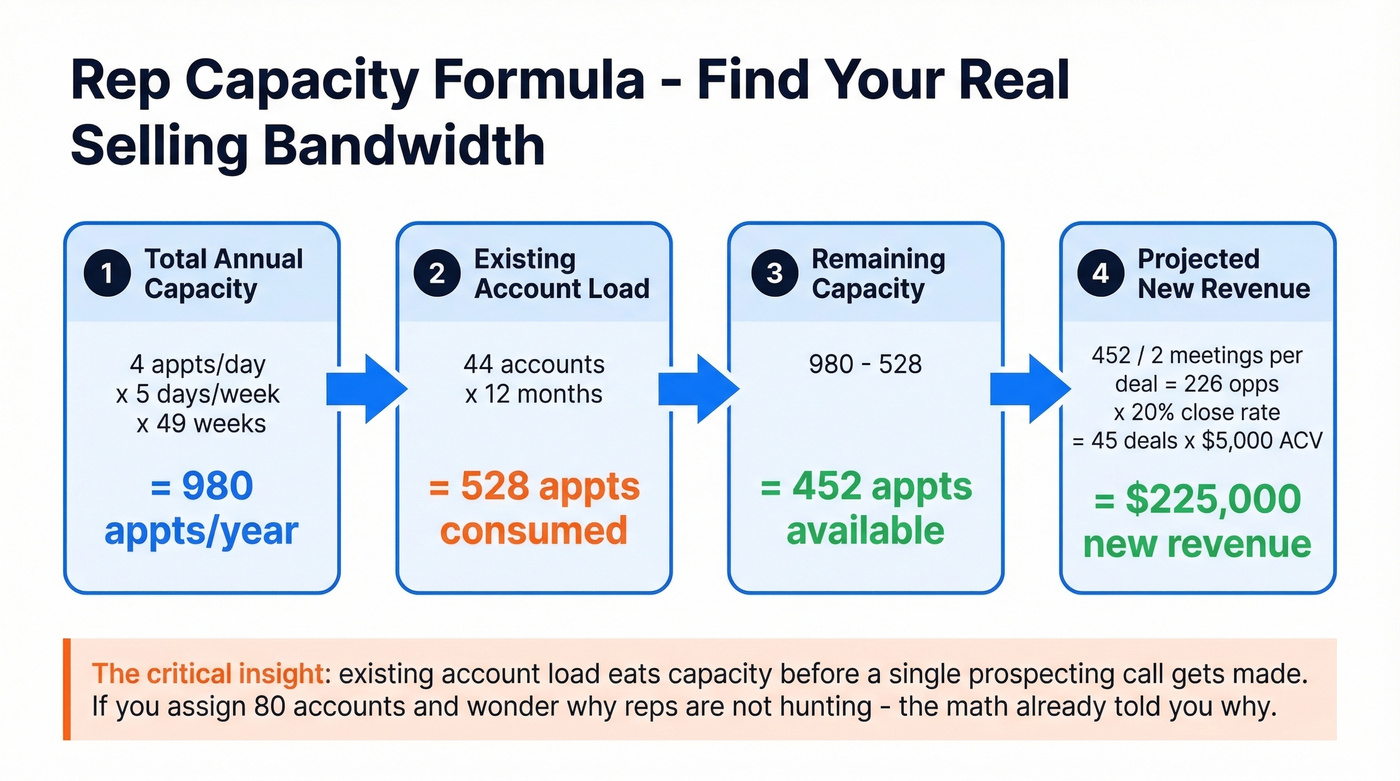
Step 1: Calculate total annual capacity. 4 appointments/day x 5 days/week x 49 selling weeks = 980 appointments/year per rep.
Step 2: Subtract existing account coverage. If a rep manages 44 existing accounts needing 1 meeting/month, that's 44 x 12 = 528 appointments/year consumed by existing business.
Step 3: Calculate remaining capacity for new business. 980 - 528 = 452 appointments available for prospecting and new logo acquisition.
Step 4: Project revenue from remaining capacity. If it takes 2 meetings to close a deal and your close rate is 20%, that's 452 / 2 = 226 opportunities x 20% = ~45 new deals. At a $5,000 average deal size, that's $225,000 in new revenue per territory.
Plug your own numbers in. The critical insight is that existing account load eats capacity before a single prospecting call gets made. If you're assigning 80 existing accounts to a rep and wondering why they're not hunting, the math already told you why.
Estimate Account Potential
Historical revenue is a lagging indicator. What you actually need is potential - the uncapped spend an account could represent if you won the full relationship. Forma.ai calls this "potentialization", and it's the concept that separates good territory plans from great ones.
Segment accounts into size buckets, estimate potential spend ranges for each, and build a territory index score that quantifies imbalance across your model. This forward-looking balance check catches problems before you assign a single rep.
Balance and Assign Territories
With accounts scored, capacity modeled, and potential estimated, balance territories using weighted variables: account revenue, account potential, and travel time, each weighted by importance to your selling motion.
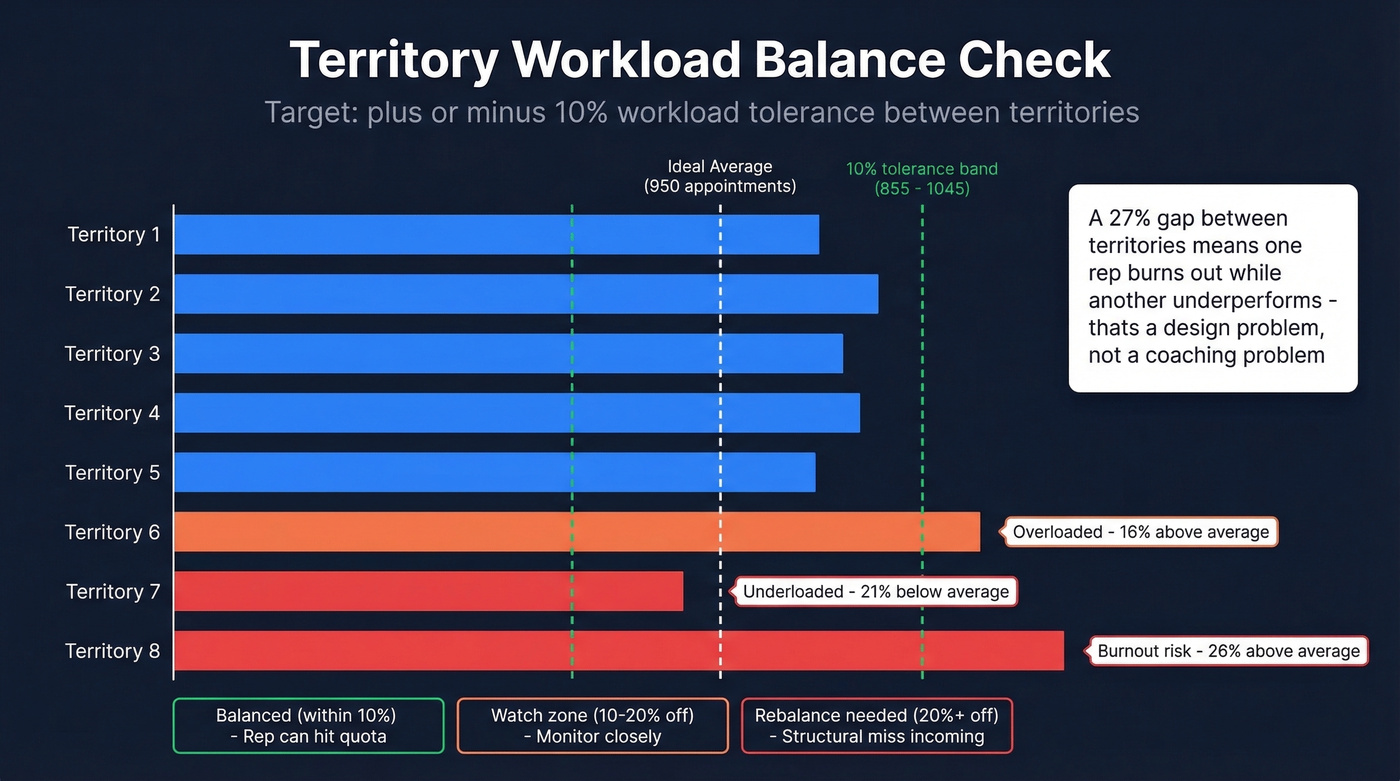
The target is a +/-10% workload tolerance between territories. If one territory requires 1,100 appointments/year and another requires 800, you've got a 27% gap - and the rep in the heavy territory will burn out while the light territory underperforms.
Don't just balance on numbers. Rep-account fit is a design variable, not an afterthought. A rep with deep fintech relationships should own fintech accounts even if it means a geographic territory looks uneven on a map. Balance workload, but optimize for affinity.
Set Territory-Specific KPIs
Every territory needs its own targets. A blanket quota across territories with different account mixes is a recipe for sandbagging in rich territories and frustration in lean ones.
Track pipeline coverage ratio (target 3x-5x of quota), quota attainment distribution, and accounts-per-rep by segment. A practical starting point: SMB reps handle 200-400 accounts, mid-market reps 50-150, enterprise reps 10-30. If more than 10-15% of your team is on override exceptions, your model is broken.

You just scored and tiered 2,000 accounts. Now your reps need verified contacts to actually work them. Prospeo's 300M+ profiles with 98% email accuracy and 125M+ verified mobiles mean every A-tier account ships with real decision-maker data - not decayed records from six months ago.
Stop assigning territories with 30% data decay baked in.
Common Mistakes That Kill Territories
We've seen the same five mistakes destroy territory plans across dozens of organizations.
Relying on geography alone. It's the default because it's easy. But a Xactly report found that territories with revenue-per-account under $50k have 23% higher churn rates than territories with accounts above $100k. Geography tells you where accounts are. It tells you nothing about whether they're worth a rep's time.
Never revisiting the model. Set-and-forget plans constrain growth in 20-30% of territories within a year. Markets shift, reps leave, new products launch. If your territories haven't been touched since last January, they're already wrong.
Override creep. One practitioner on r/SalesOperations reported that 15% of their sales team was covered by override exceptions - and the number was growing every quarter. If your plan requires a separate override table that grows every quarter, you don't have a territory plan. You have a suggestion that everyone ignores.
Ignoring data quality. Gartner estimates poor data quality costs organizations $12.9M annually. Bad data means reps waste capacity chasing disconnected numbers and bounced emails instead of selling.
Over-engineering. I've watched teams build 15-variable scoring models that no one trusts and everyone overrides. Start with three to five variables. Add complexity only when the simple model demonstrably fails.
Fix Your Data Before Your Territories
Territories look perfect on paper. Then Q1 ends and three reps missed quota by 40% because a third of their phone numbers were disconnected and a quarter of emails bounced. The territory design was fine. The data underneath it was garbage.
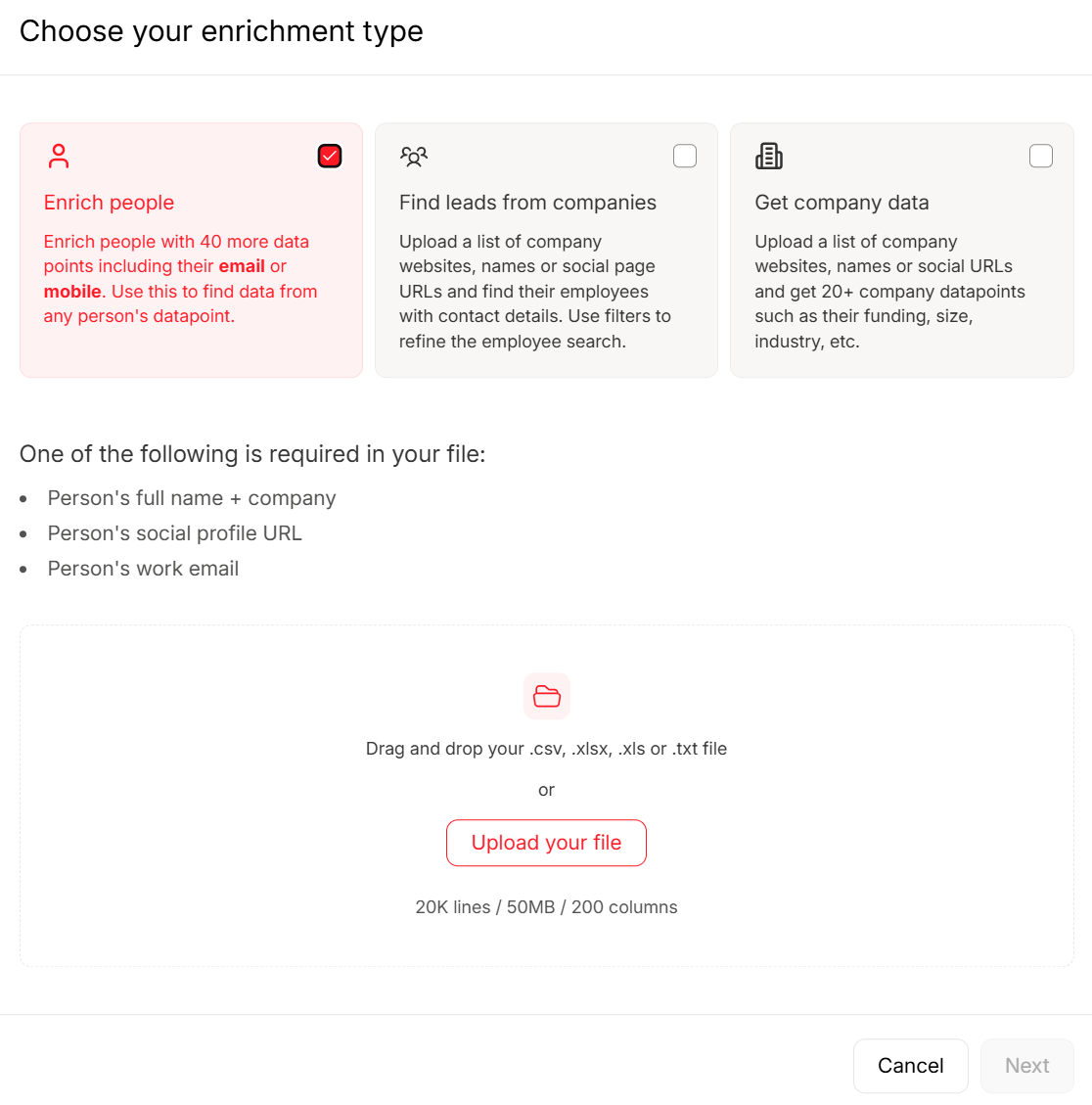
You can nail the capacity model, balance workloads within +/-10%, tier every account perfectly - and still fail because reps can't reach anyone. Run your territory account lists through Prospeo before reps start working them. Upload a CSV of territory accounts, enrich in bulk with 98% email accuracy and a 7-day refresh cycle, and push clean data back to your CRM before the quarter starts. The 125M+ verified mobile numbers carry a 30% pickup rate, which means reps get conversations instead of voicemails.
Territory Management Tools
Most guides recommend one tool. Here's the full stack by category, with realistic pricing:
| Tool | Category | Pricing | Best For |
|---|---|---|---|
| Prospeo | Data quality | Free tier; ~$0.01/email | Contact verification at scale |
| Salesforce Maps | CRM add-on | ~$75-150/user/mo | Enterprise on Salesforce |
| eSpatial | Mapping | From $1,295/user/yr | Mid-market visualization |
| Maptive | Mapping | ~$1,000-$2,000/yr | Budget-conscious mapping |
| Badger Maps | Field sales | ~$49-$79/user/mo | Route optimization |
| Xactly | Planning/comp | $30k-$100k+/year | Algorithmic balancing + comp |
| Monday CRM | CRM | ~$12-30/seat/mo | Small teams, built-in CRM |
Top territory mapping tools sit around 4.3-4.7/5 on major review sites, with the biggest complaints centering on implementation complexity and data integration. One RevOps practitioner on Reddit described Salesforce Maps as powerful but "pretty steep" - and the route-planning features are overkill if you're not running field sales.
Skip Xactly if you're under 50 reps. The implementation cost alone will eat your first year's ROI. For teams that size, a well-structured spreadsheet plus a mapping tool like eSpatial or Maptive gets you 80% of the way there.
For most teams, the real gap isn't visualization. It's the data feeding the visualization. A beautifully balanced territory map built on stale contact records is just a pretty picture.
Tips for Ongoing Optimization
Don't wait for the annual planning cycle if the model is already broken. These triggers should prompt a redesign:
- Start of a new fiscal year or quarter
- Major market shift - new competitor, regulatory change, M&A
- Geographic expansion into new regions
- Adding or losing reps (even one changes the math)
- Post-performance review reveals systematic misses
- Override exceptions exceed 10-15% of your team
- Pipeline coverage drops below 3x in multiple territories
Let's be honest: override exceptions above 10-15% mean your model is dead. Stop patching and redesign. Every exception you grant teaches the team that the rules are negotiable, and by Q3 you'll have more exceptions than assignments. In our experience, the teams that treat territory management as a continuous discipline - not a once-a-year event - consistently outperform those that don't.
Balanced territories fail when reps can't reach the buyers inside them. Prospeo refreshes every record on a 7-day cycle - not the 6-week industry average - so your Q1 territory rollout doesn't launch on stale data. Layer in intent data across 15,000 topics to prioritize accounts actively in-market.
Turn territory plans into pipeline with data that's never more than a week old.
FAQ
What is territory management in sales?
Territory management is the process of dividing a company's market into defined segments - by geography, industry, account size, or a hybrid - and assigning sales reps to each with ongoing optimization. The goal is to balance workload, maximize coverage, and ensure every high-potential account gets appropriate attention throughout the year, not just at planning time.
How often should you revisit sales territories?
At minimum, revisit territories at the start of each fiscal year and whenever you add or lose reps. High-growth organizations review quarterly. If override exceptions exceed 10-15% of your team or pipeline coverage drops below 3x in multiple territories, redesign immediately - patching a broken model only makes it worse.
How many accounts should one rep manage?
SMB reps typically handle 200-400 accounts, mid-market reps 50-150, and enterprise reps 10-30. Use the capacity formula - total appointments per year minus existing coverage load - to calculate the right number for your team's selling motion rather than relying on generic benchmarks.
How does data quality affect territory performance?
Bad contact data - bounced emails, disconnected phone numbers - wastes rep capacity and makes even well-designed territories underperform. Gartner estimates poor data costs $12.9M annually. Verifying emails and phone numbers before reps start working territories is the single cheapest way to protect your territory investment.