

The Basic Objective of Sales Prospecting Is to Prioritize - Here's Why
The basic objective of sales prospecting is to provide salespeople with a list of prioritized sales prospects. Not to motivate the team. Not to schedule calls. Not to analyze competitors. Prioritization - that single word carries the entire discipline, and everything below explains why that answer matters beyond the textbook, the frameworks that make it work, and the data that proves it.
Why Prioritization Is the Core Objective
The common textbook-style MCQ answer is clear: prospecting exists so reps focus limited selling hours on the people most likely to buy. The strategic process follows a sequence - generate leads, qualify them, prioritize the survivors, prepare your sales dialogue. Every step narrows the funnel. Skip prioritization and you're dialing a phone book.
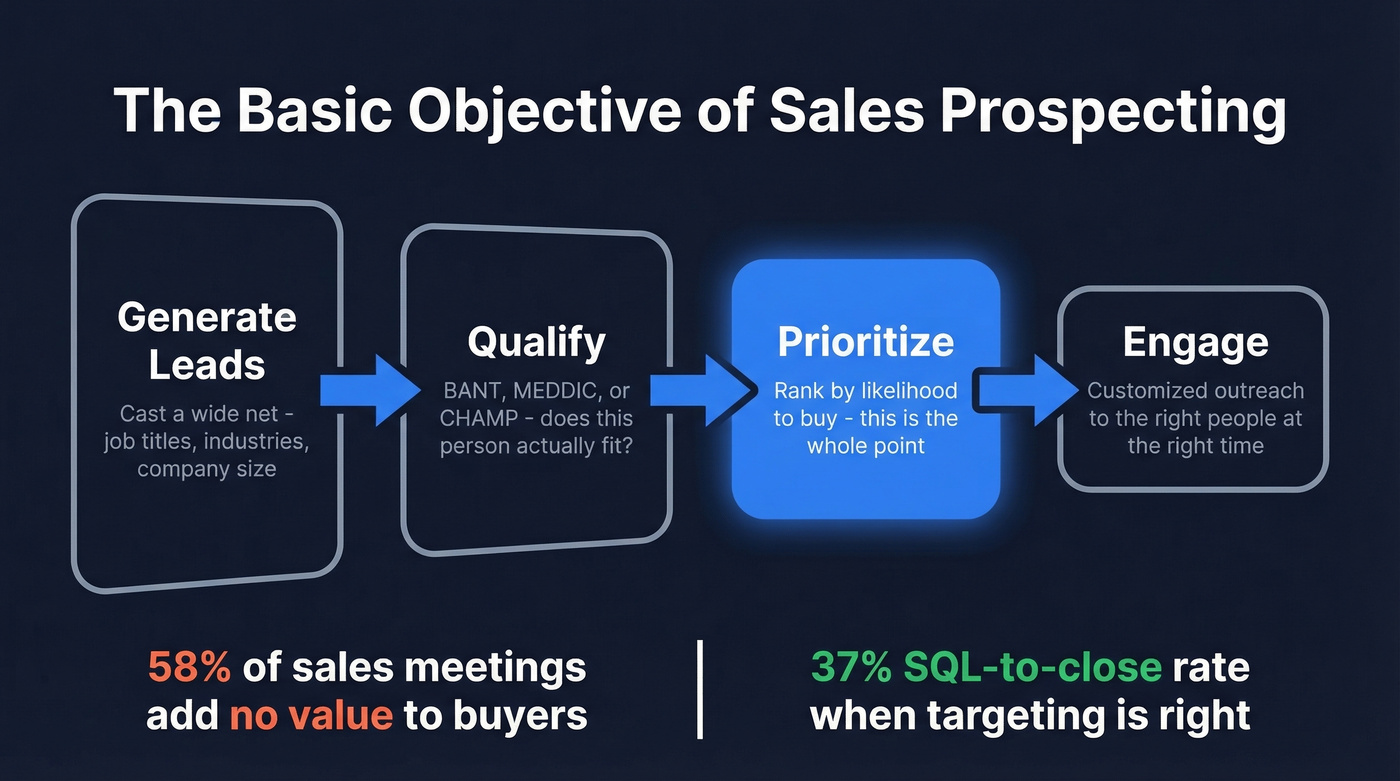
The numbers make the case bluntly. Buyers say 58% of sales meetings aren't valuable to them. That's a targeting problem, not a meeting problem. Meanwhile, B2B SaaS companies that get prospects to SQL stage close around 37% of them. The bottleneck isn't closing. It's getting the right people into the pipeline in the first place.
What Is a Prospector in Business?
The prospector meaning in business is straightforward: a sales prospector systematically identifies, qualifies, and prioritizes potential buyers before passing them to closers or advancing them through the pipeline. The day-to-day breaks into four steps.
Research - Identify companies and contacts matching your ICP. Reps spend up to 40% of their time just trying to find the right people, before a single conversation happens. That stat alone should make every sales leader rethink their tech stack.
Qualify - Does this person have budget, authority, need, and timing? If not, they're a lead, not a prospect. Move on.
Outreach - High-growth organizations average 16 touch points per prospect over 2-4 weeks. Each touch should set an appointment, gather information, build familiarity, or keep you top of mind. One email isn't a strategy.
Follow up - 80% of sales require five or more follow-ups, but 92% of reps quit after four. And here's the kicker: 43% of buyers say they're fine with five-plus contact attempts. The persistence gap is real, and it's where deals go to die.
Inside sales reps spend only 30% of their time actually selling. Prioritization isn't just strategic - it's a time management survival skill.

Reps spend 40% of their time finding the right people. Prospeo's 300M+ profiles with 30+ filters - including buyer intent, technographics, and headcount growth - let you build a prioritized prospect list in minutes, not hours. Every email is 98% verified so your outreach actually lands.
Cut list-building from 15 hours to 3 and prospect smarter.
Qualification Frameworks That Drive Results
BANT is the classic - Budget, Authority, Need, Timing. IBM built it in the 1950s, and it still works for transactional sales. The general rule: three out of four criteria qualifies a lead as worth pursuing. But it's not the only framework worth knowing.
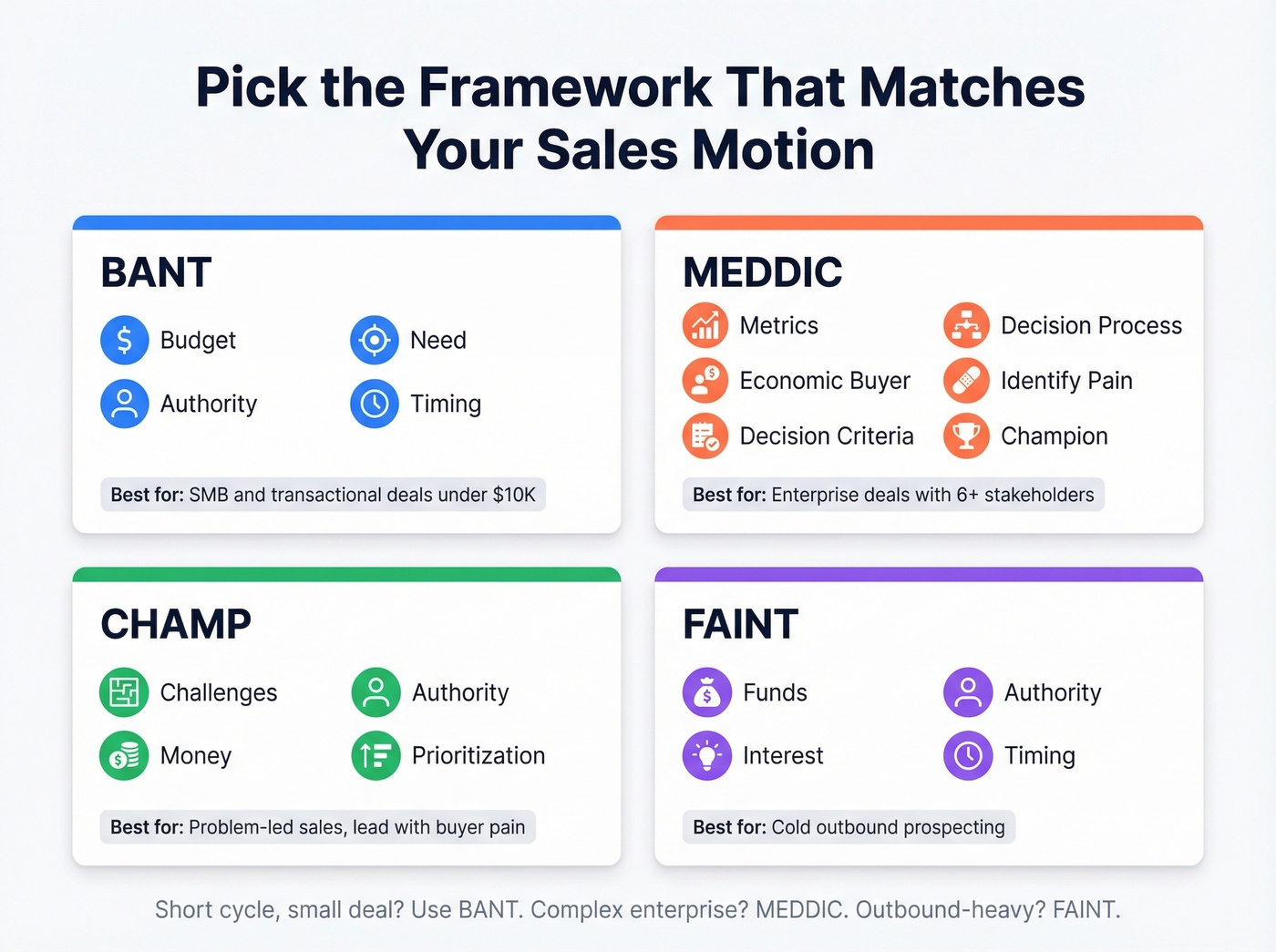
| Framework | Best For | Key Focus |
|---|---|---|
| BANT | Transactional / SMB | Budget, Authority, Need, Timing |
| MEDDIC | Enterprise / complex | Metrics, Econ. Buyer, Decision Process, Pain, Champion |
| CHAMP | Problem-led sales | Challenges, Authority, Money, Prioritization |
| FAINT | Outbound prospecting | Funds, Authority, Interest, Need, Timing |
Here's the thing: BANT works when deals are straightforward and buying committees are small. MEDDIC shines in six-figure enterprise deals where you need a champion inside the account and a mapped decision process that might involve eight stakeholders across three departments. CHAMP flips the script by leading with the buyer's problem rather than your budget question. Pick the one that matches your sales motion - don't default to BANT just because it's familiar.
If you're running a short sales cycle with deal sizes under $10K, skip MEDDIC entirely. It'll slow your reps down with process overhead that doesn't match the deal complexity.
What Top Performers Do Differently
RAIN Group studied 488 buyers representing $4.2B in purchases across 25 industries. Top performers generated 2.7x more conversions and 1.8x more quality meetings. What separated them wasn't talent - it was preparation: a strong value proposition, targeting the right buyers at the right levels, and delivering customized first meetings.
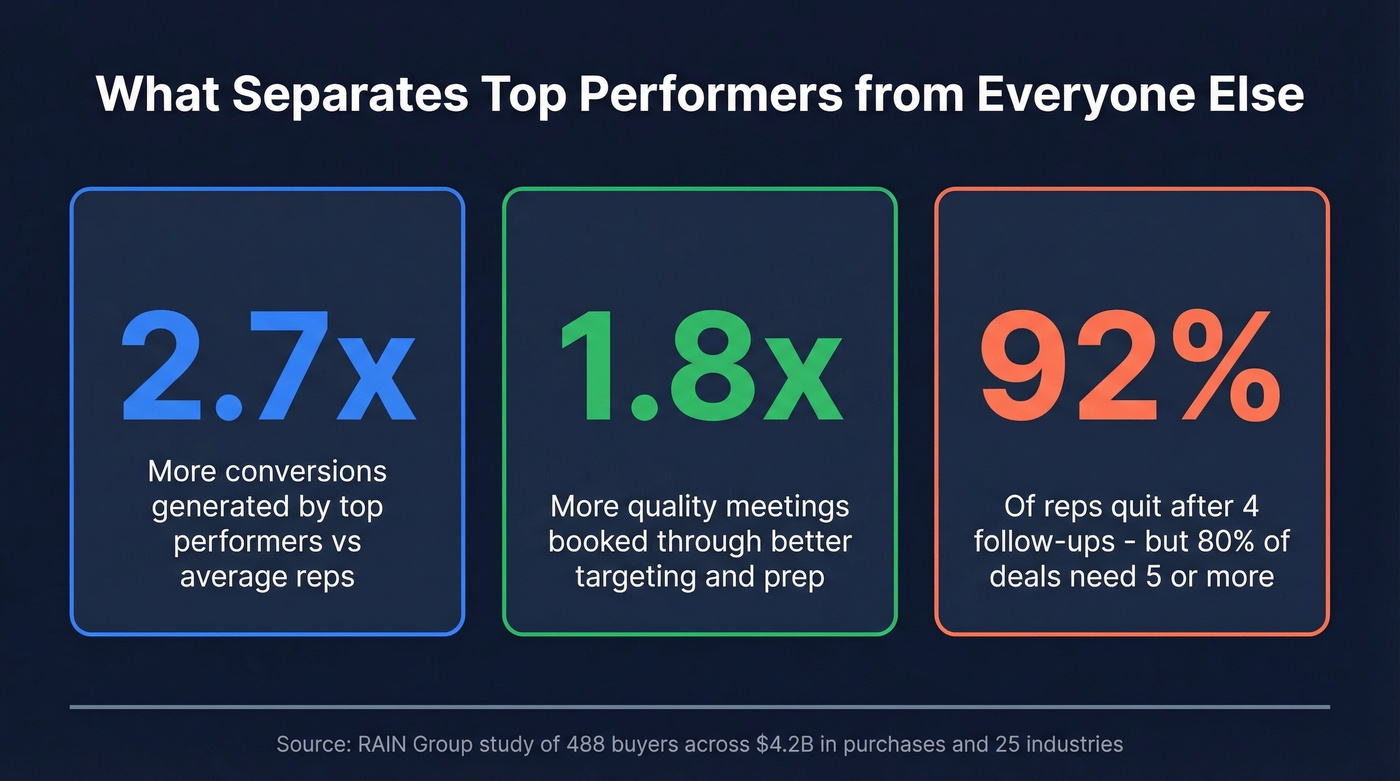
Ask any SDR community what kills their pipeline and the answer is always the same: bad data and quitting too early. The consensus on r/sales echoes this constantly - most reps don't have a sales prospecting problem, they have a follow-up problem. They quit at touch four when the data says touch five is where meetings happen.
Let's walk through a common prospect example. A prospect calls a sales rep at a consulting firm after reading a case study. That inbound signal is gold. But without a prioritization system, that warm lead sits in the same queue as a cold contact scraped from the web. Top performers treat those two very differently - the inbound lead gets a same-day call and a customized deck, while the cold contact enters a nurture sequence. Same rep, same hour, completely different playbooks.
Why Data Quality Makes or Breaks Prioritization
You can nail your ICP, pick the right framework, and build a perfectly prioritized list. Then half your emails bounce, your domain reputation tanks, and your sequences land in spam. We've seen this happen to teams that had everything else dialed in.
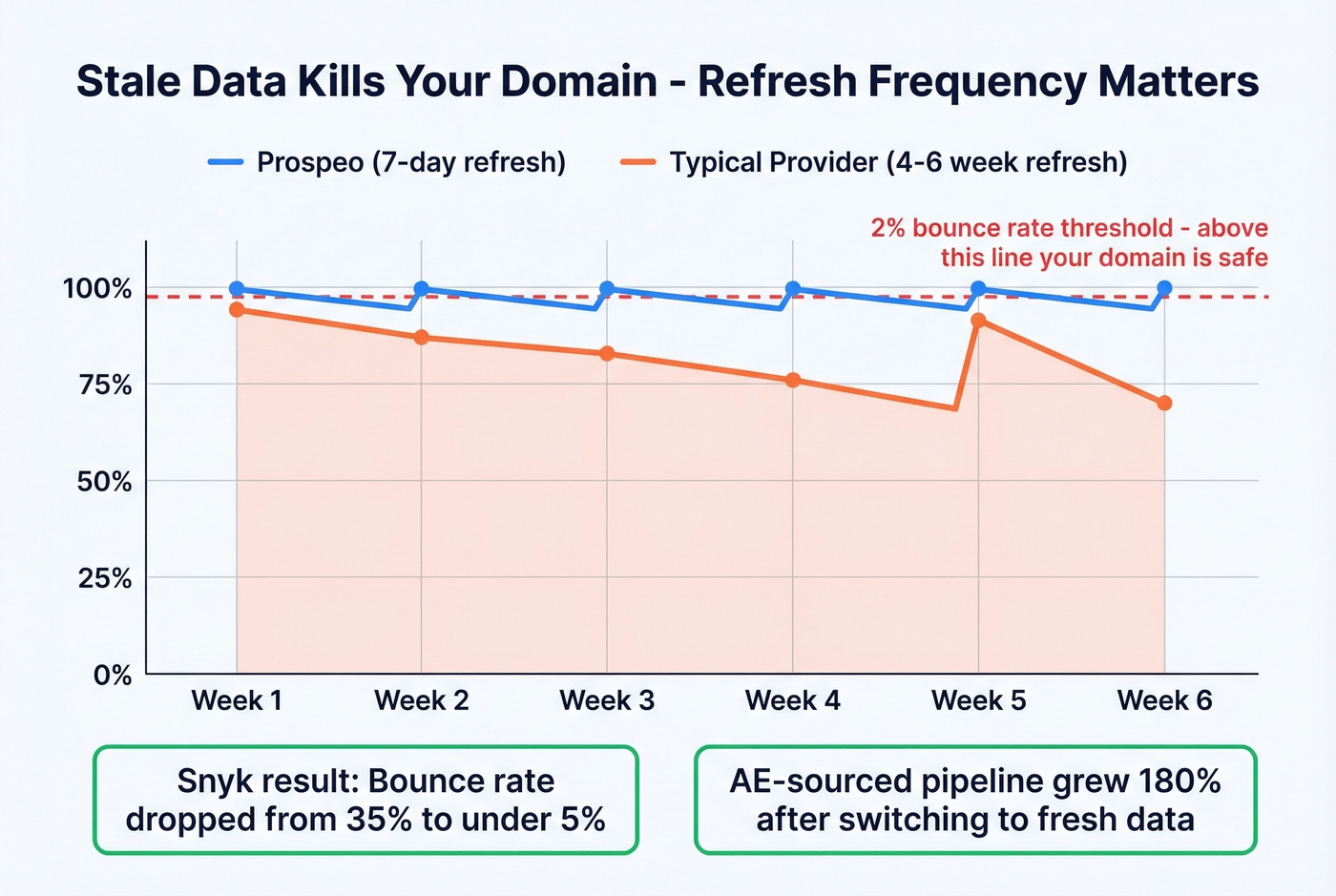
Deliverability guardrails aren't optional: keep bounce rates below 2% and spam complaints under 0.01%. GDPR violations can cost up to EUR 20M or 4% of global revenue, so compliance matters too - something teams prospecting across the EU learn the hard way.
Prospeo delivers 98% email accuracy on a 7-day refresh cycle, with 300M+ professional profiles and a free tier of 75 verified emails per month. That weekly refresh matters because most providers update every 4-6 weeks, which means your "fresh" list is already decaying by the time reps start dialing. One of our customers, Snyk, cut their bounce rate from 35-40% to under 5% and saw AE-sourced pipeline jump 180% after switching.

Look - the biggest threat to your prospecting isn't a weak pitch or a bad framework. It's stale data. A perfectly prioritized list built on six-week-old contacts is just an organized way to burn your domain.
If you want to go deeper on keeping bounce rates low, see our email deliverability guide and the benchmarks in Email Bounce Rate.
A perfectly prioritized list built on stale data is just an organized way to burn your domain. Prospeo refreshes every 7 days - 6x faster than the industry average. Snyk dropped their bounce rate from 35% to under 5% and grew AE-sourced pipeline 180%.
Stop letting six-week-old data sabotage your prospecting.
FAQ
What's the difference between a lead and a prospect?
A lead is anyone who fits your target profile or has shown initial interest. A prospect has confirmed budget, need, and authority to purchase. Prospecting is the process of turning raw leads into qualified, prioritized buyers worth your selling time.
How many follow-ups should you send?
Research shows 80% of sales require five or more follow-ups, and 43% of buyers who take meetings are fine with five-plus contact attempts. Most reps quit after four. Don't be most reps.
What is a sales appointment setter?
A sales appointment setter is a specialized SDR or BDR whose sole job is booking qualified meetings for closers. They handle research, outreach, and follow-up so account executives focus entirely on demos and closing. It's one of the most common entry points into a sales career, and a good one - you'll learn pipeline mechanics faster than in almost any other role.
What tools do you need for prospecting in 2026?
Three essentials: a CRM for pipeline management, a verified data provider for accurate contact info, and a sequencing tool for multi-touch outreach. Everything else is optional until those three are working together.