


TheirStack Review 2026: Pricing, Pros, Cons, and Verdict
Most technographic tools crawl websites and tell you what's on the front end. TheirStack takes a different angle - it reads job postings to figure out what companies are using internally. That distinction matters more than you'd think, especially if you're prospecting into accounts running specific CRMs, ERPs, or internal databases that never show up in a website scan.
We've spent time inside TheirStack's platform and API, and here's the short version: it's a sharp, affordable tool for sales teams that prospect by tech stack and hiring intent. At $59/mo, it's roughly 5x cheaper than BuiltWith's $295/mo entry plan. The catch? It surfaces accounts, not contacts. You'll still need a separate tool for emails and phone numbers.
Pricing Breakdown
TheirStack doesn't make its pricing easy to find - we pulled these tiers from their own technographic API documentation rather than a standard pricing page.
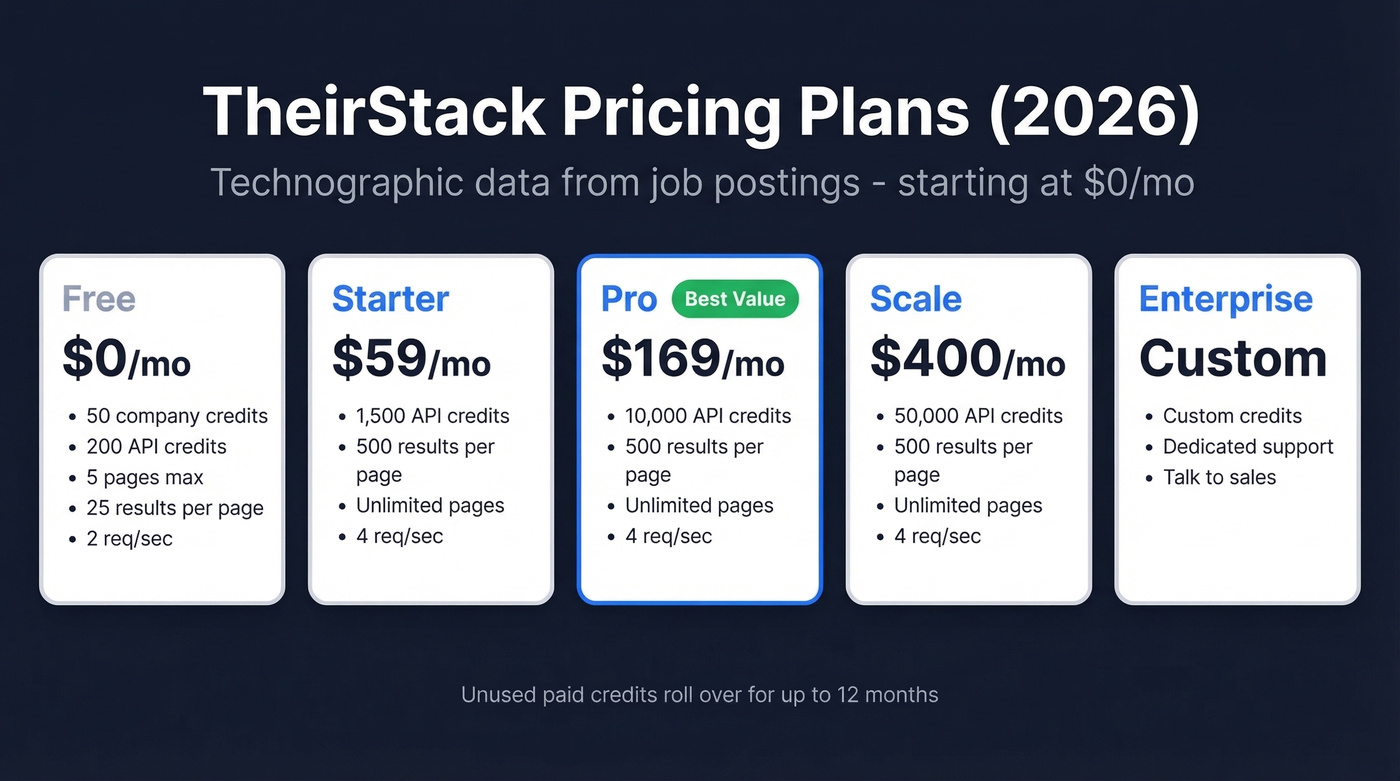
| Plan | Price | Key Inclusion |
|---|---|---|
| Free | $0/mo | 50 company credits, 200 API credits |
| Starter | $59/mo | 1,500 API credits |
| Pro | $169/mo | 10,000 API credits |
| Scale | $400/mo | 50,000 API credits |
| Enterprise | Custom | Talk to sales |
The free plan caps you at 5 pages of results with 25 results per page and a 2 req/sec rate limit. Paid plans unlock up to 500 results per page, unlimited pages, and 4 req/sec.
That jump from free to paid can feel steep for light users - G2 reviewers explicitly ask for cheaper pricing tiers. But compared to BuiltWith's $295/mo entry point, TheirStack is still a fraction of the cost.
How Credits Work
TheirStack uses two credit types. Confusing them will burn through your budget fast.
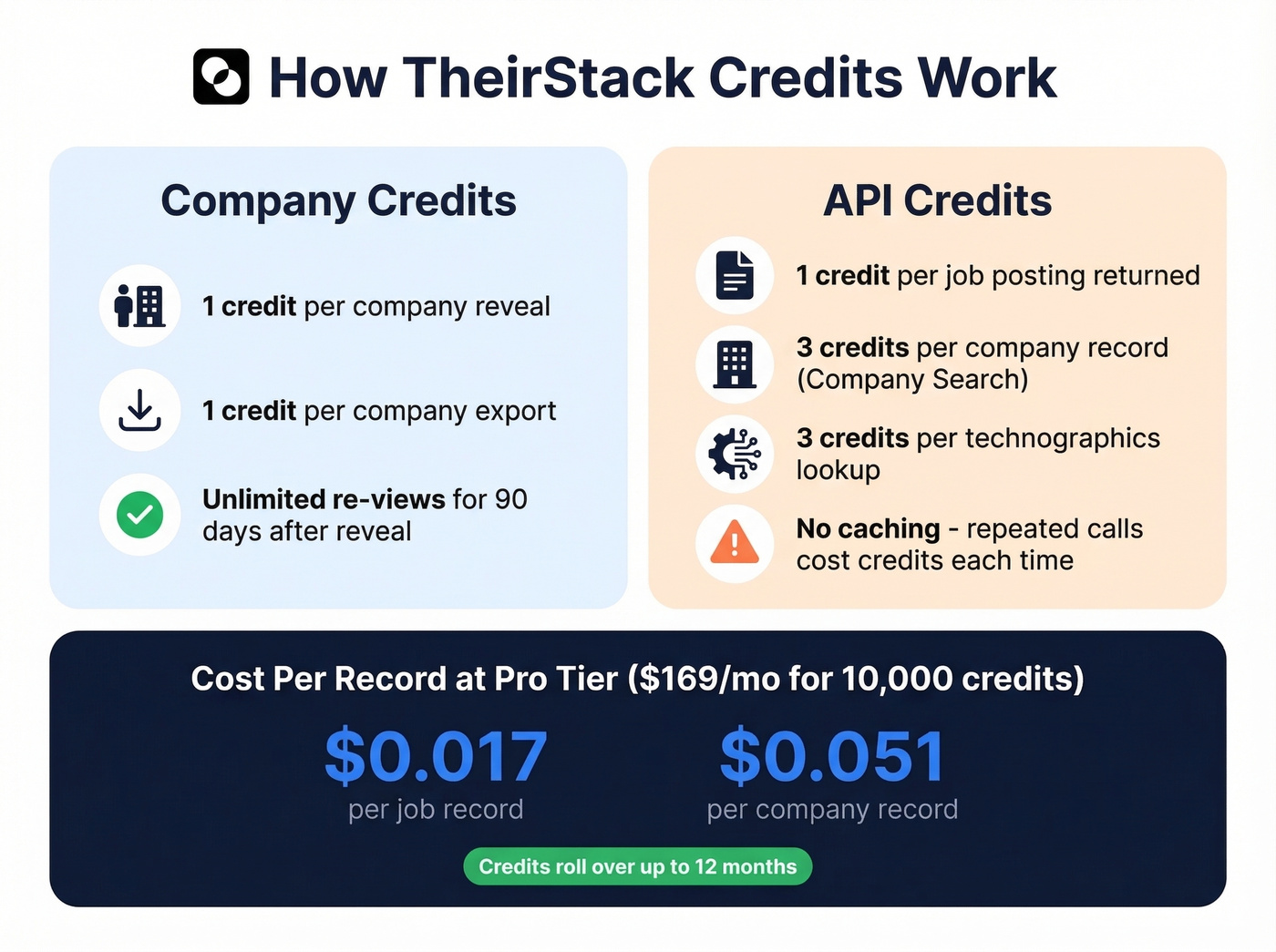
Company credits cost 1 credit per company reveal or export. Once revealed, you can view or export that company and all its jobs unlimited times for 90 days. API credits get consumed per record returned or per webhook event dispatched: 1 credit per job, 3 credits per company record via Company Search, and 3 credits per technographics lookup.
Here's the gotcha: repeated API calls consume credits each time. There's no caching.
At the Pro tier ($169/mo for 10,000 API credits), that works out to roughly $0.017 per job record or about $0.051 per company record - competitive for technographic data at this depth. Unused paid credits roll over for up to 12 months, which is genuinely unusual. Most SaaS tools expire credits monthly, so if you have a slow quarter, you aren't punished for it.
If you're running automated workflows via webhooks, model your credit consumption carefully before picking a tier. The free plan's 50 company reveals can disappear in a single afternoon of prospecting even one vertical.
User Reviews: Pros and Cons
What Users Like
TheirStack holds a 4.8/5 on G2, though the sample is small at 12 reviews. What stands out: users praise the API stability and the support team's responsiveness. One reviewer mentions direct Slack access to the TheirStack team, which is rare for a sub-$200/mo tool.
The core product does what it promises well. TheirStack analyzes 180M+ job postings across 195 countries, aggregating from 324k+ sources to extract technographic and hiring signals. If you're trying to find companies using a specific CRM or internal database - the kind of internal tooling that won't show up in website-crawl technographics - TheirStack is one of the few tools built for that job-posting angle. It also includes confidence scoring based on job posting frequency and context, plus webhook support for real-time triggers.
What Users Don't Like
The biggest gap is obvious: TheirStack finds companies, not people. You'll get a list of accounts using Salesforce and hiring for SDRs, but no emails or phone numbers for the VP of Sales you actually need to reach.
Beyond the contact-data gap, a G2 reviewer described the product as feeling like a "generic API offering" and wanted more customization. On r/LeadGeneration, at least one user posted they're "not happy" with TheirStack, though they didn't elaborate on specifics. And the jump from free to paid frustrates lighter users who don't need thousands of API credits but want more than 50 company reveals.
Let's be honest: if your average deal size is under $5k, you probably don't need job-posting-level tech signals. A basic BuiltWith free lookup and a good contact data tool will get you further, faster.

TheirStack's biggest gap is contact data - no emails, no phone numbers. Prospeo fills that gap with 300M+ profiles, 98% email accuracy, and 125M+ verified mobile numbers. Pair TheirStack's technographic signals with Prospeo's verified contacts starting at $0.01/email.
Turn account lists into booked meetings with verified contact data.
TheirStack vs Alternatives
| Tool | What It Detects | Data Source | Starting Price |
|---|---|---|---|
| TheirStack | Internal tech + hiring signals | Job postings | Free / $59/mo |
| BuiltWith | Web-facing tech | Website crawling | $295/mo |
| Wappalyzer | Web-facing tech | Website crawling | $250/mo |
| Coresignal | Job posting data | Job postings | ~$49/mo |
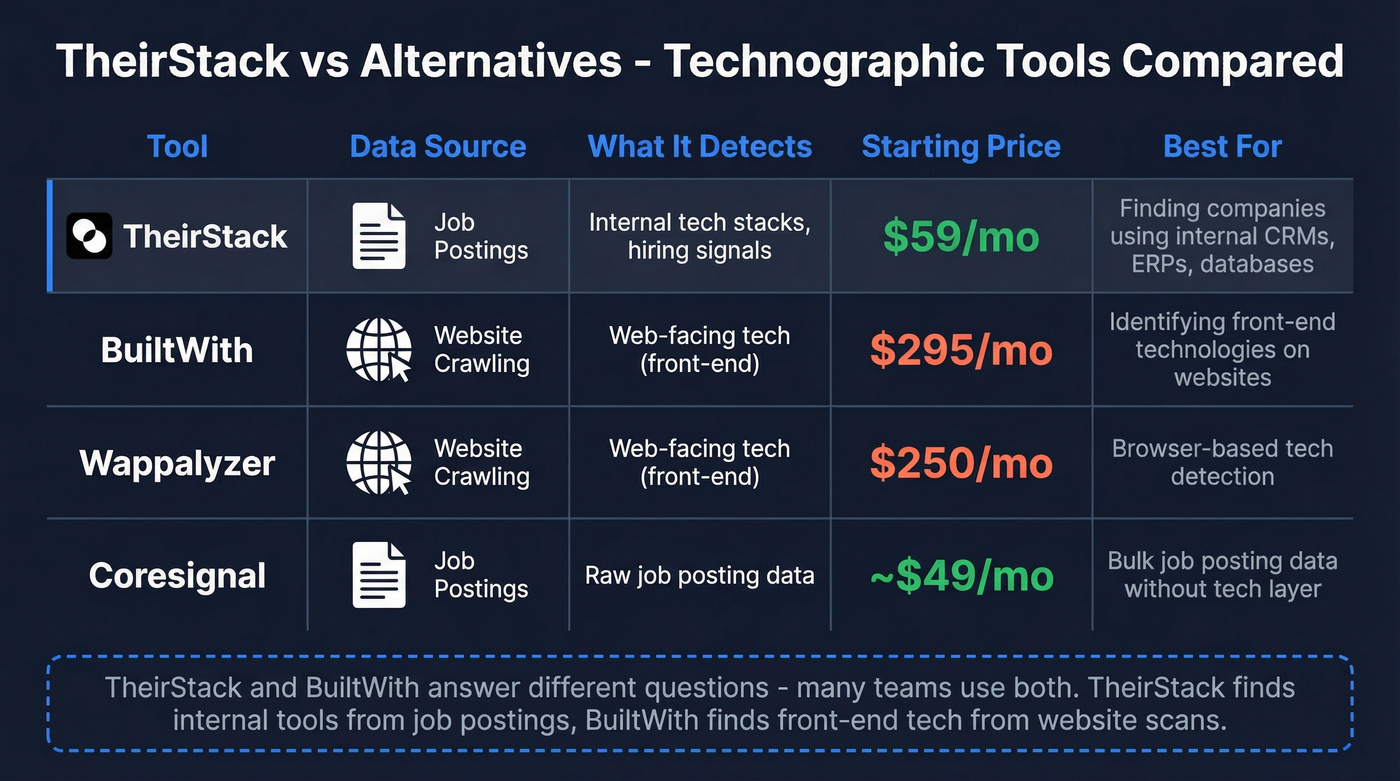
The key distinction: TheirStack and BuiltWith answer different questions. TheirStack focuses on internal tools and hiring signals extracted from job postings. BuiltWith crawls websites for front-end tech, with plans from $295/mo to $995/mo for team access. They complement each other more than they compete.
Coresignal overlaps with TheirStack on raw job-posting data, while TheirStack layers technographics and hiring-signal workflows on top. Wappalyzer sits in BuiltWith's lane at $250/mo.
Verdict - Is It Worth It?
Buy it if you need internal tech stack detection and hiring signals, you prospect via API or webhooks, you want to monitor when past customers start hiring again as a reactivation signal, or you want technographic data at a fraction of BuiltWith's cost. The Pro plan at $169/mo is the best value for API-heavy teams.
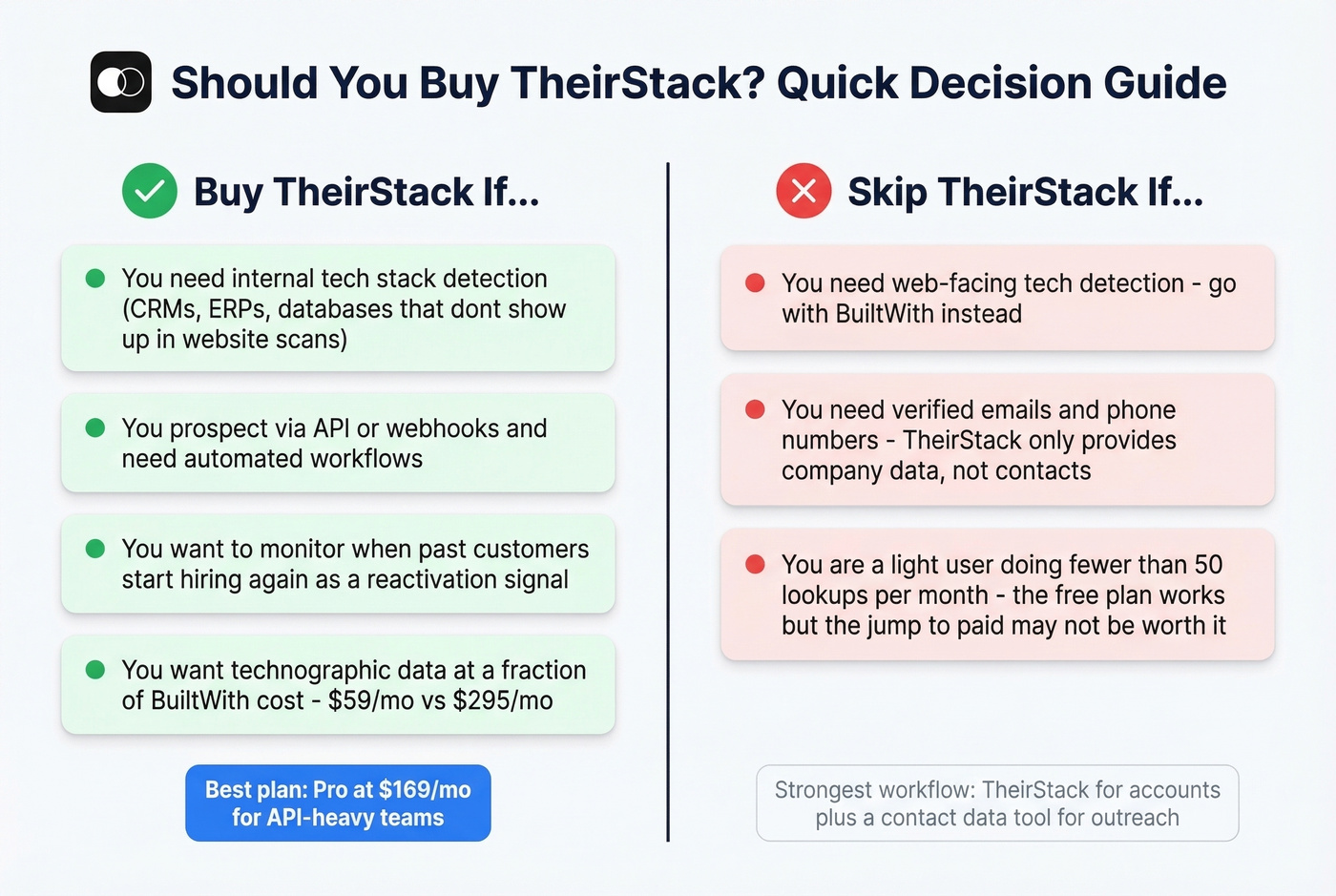
Skip it if you need web-facing tech detection (go with BuiltWith), you need contact data like verified emails and mobile numbers (go with Prospeo), or you're a light user who can't justify the jump from the free tier. For teams doing fewer than 50 account lookups a month, the free plan is fine - but you'll outgrow it quickly once prospecting ramps up.
The strongest workflow we've seen pairs TheirStack for account identification with a dedicated contact data platform for outreach. That's a $59-169/mo technographic engine feeding directly into verified contact discovery, and it outperforms trying to do everything inside a single expensive platform.
If you want to systematize that motion, borrow a few sales prospecting techniques and build a repeatable lead generation workflow around stack + hiring triggers.
You've identified companies hiring for specific tech stacks. Now reach the decision-makers. Prospeo gives you verified emails and direct dials for 300M+ professionals - with a 7-day data refresh cycle, so you're never emailing outdated contacts.
Stop paying for accounts you can't actually reach.
FAQ
Does TheirStack have a free plan?
Yes - 50 company credits and 200 API credits per month, free forever. You're limited to 5 pages at 25 results per page. One thing to note: the free plan is only available to users who've never paid. After your first payment, you're permanently on a paid tier.
What's the difference between company credits and API credits?
Company credits are consumed when you reveal or export a company (1 credit each). API credits are consumed per record returned: 1 per job posting, 3 per company record via Company Search, 3 per technographics lookup. Repeated calls consume credits each time - there's no caching.
Does TheirStack provide contact data?
No. TheirStack provides company-level data - tech stack, hiring signals, and firmographics. For verified emails and direct dials at those accounts, pair it with a dedicated contact data tool.
How does TheirStack compare to BuiltWith on price?
TheirStack starts at $59/mo (Starter) vs BuiltWith's $295/mo entry plan - roughly 5x cheaper. The tradeoff: TheirStack detects internal technologies from job postings, while BuiltWith crawls websites for front-end tech. They answer different questions, so many teams end up using both.