

Best Thunai Alternatives in 2026 (Honest Picks)
G2 lists monday.com, Asana, and Jira as Thunai alternatives. SaaSworthy's list includes PDF editors among 77 "competitors." That's the problem with alternatives directories - they mix categories and surface tools that aren't solving the same job.
Thunai tries to do everything: voice agents, knowledge management, contact center QA, revenue intelligence. So the right alternative depends on which piece you're actually replacing.
Our Picks (TL;DR)
| Use Case | Pick | Our Call |
|---|---|---|
| Verified data for any AI agent | Prospeo | Pairs with everything below |
| Budget voice agents | Retell AI | ★ Top Pick |
| No-code voice deployment | Synthflow | Fastest to deploy |
| Enterprise omnichannel | Yellow.ai | Best breadth |
| Developer customization | Vapi | Most flexible (most expensive) |
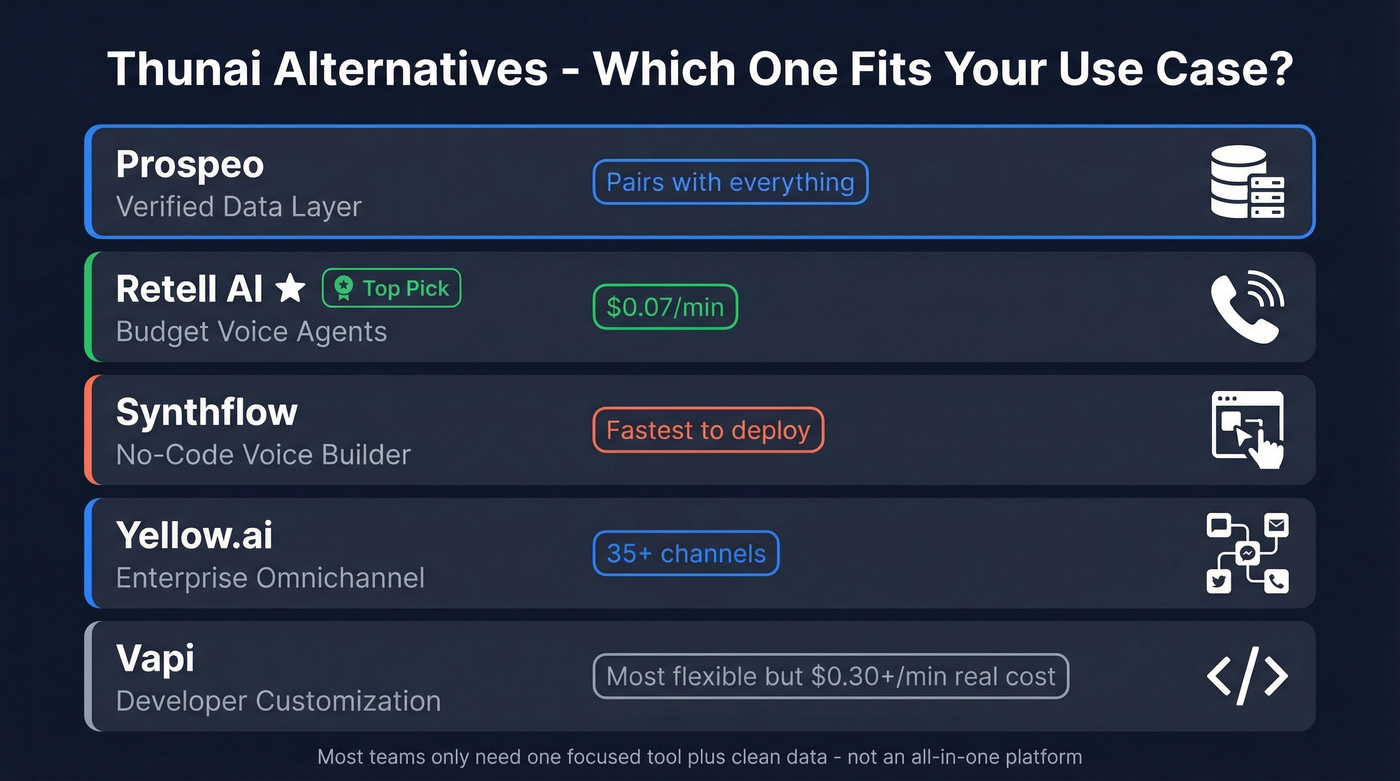
Here's the thing: most teams evaluating Thunai don't need an all-in-one AI platform. They need a focused voice agent tool and clean data feeding it. The "unified platform" pitch sounds great in demos but creates the same vendor lock-in you're trying to escape.
What Thunai Does
Thunai is an agentic AI platform spanning voice agents, chat, email automation, knowledge management, and revenue intelligence. It holds a 5.0/5 on G2 based on 7 reviews, and the company highlights 61% of L1 tickets auto-resolved and 70% faster lead response.
Common G2 complaints include transcription accuracy issues with heavy accents and a more complex-than-expected onboarding process. For teams hitting those friction points, the alternatives below solve specific slices better.

Every voice platform on this list burns credits when agents dial dead numbers. Prospeo's 125M+ verified mobiles hit a 30% pickup rate - so your AI agents talk to humans, not voicemail. Data refreshes every 7 days, not the 6-week industry average.
Stop paying per-minute for calls that never connect.
Top Thunai Alternatives Compared
Prospeo - Clean Data Powering Your AI Agents
We've watched teams spend weeks evaluating voice platforms, deploy one, and then wonder why their AI agents are calling disconnected numbers and emailing dead addresses. The platform isn't the problem. The data is.
Prospeo solves this upstream. Its database covers 125M+ verified mobile numbers with a 30% pickup rate, so your voice agents reach live humans instead of burning minutes on voicemail. Email accuracy runs 98% across 143M+ verified addresses, every record refreshes on a 7-day cycle (the industry average is six weeks), and the API returns a 92% match rate. It integrates natively with Salesforce, HubSpot, Clay, and Zapier - so whatever voice platform you pick from this list, clean data flows directly into it.
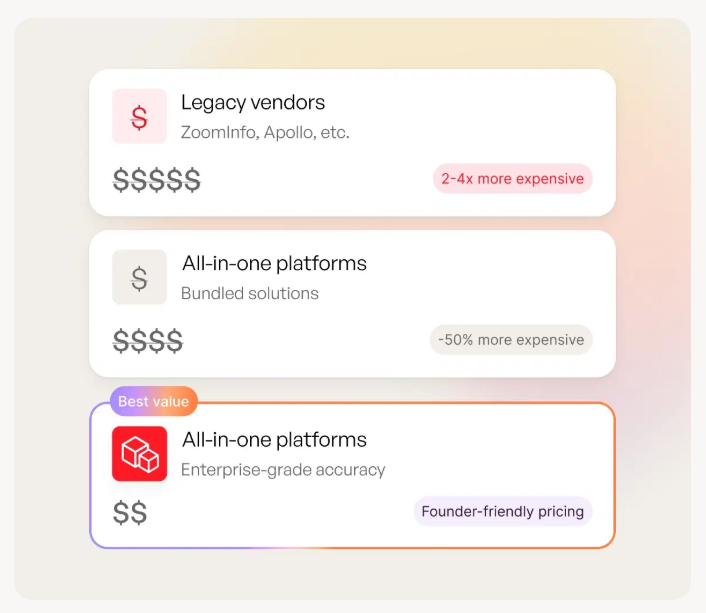
Real results back this up: Snyk's 50 AEs cut their bounce rate from 35-40% to under 5% and generated 200+ new opportunities per month after switching. At roughly $0.01 per email, it's a fraction of what legacy data vendors charge. Free tier gives you 75 emails per month to test, no contracts required.
Retell AI - Budget Voice Agents
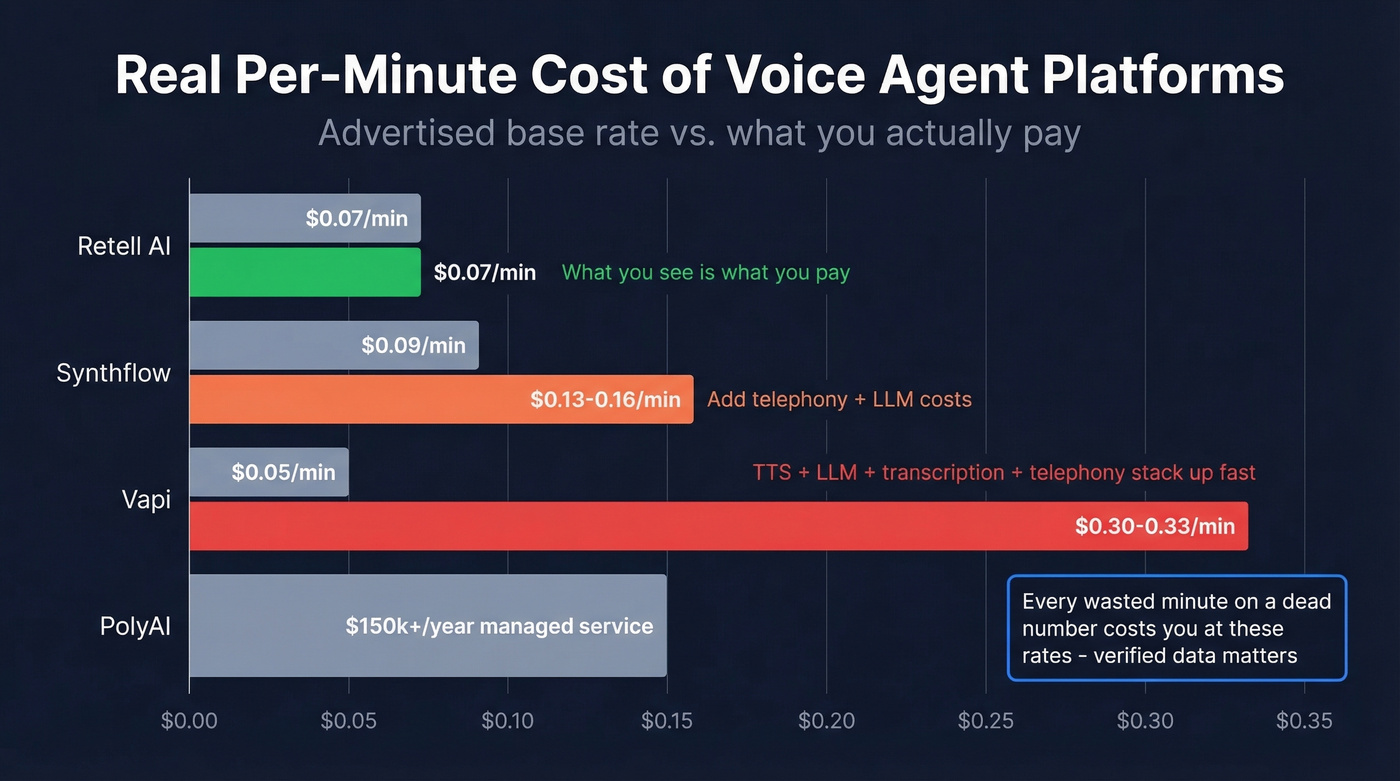
Retell is the default starting point for most teams exploring voice agents, and in our experience, it earns that position. Pricing starts at [$0.07/min](https://www.retellai.com/pricing) with phone numbers at $2/month - no hidden component costs. Response latency sits under 800ms, fast enough that callers don't notice the AI processing gap.
The compliance stack punches above its price point: HIPAA, SOC 2, GDPR, automatic PII redaction, post-call analysis including sentiment, and support for 19+ languages. Uptime is listed at 99.99%.
The tradeoff is scope. Retell is a focused voice agent platform - no omnichannel, no knowledge management, no QA layers. It does one thing well and doesn't pretend otherwise.
Synthflow - No-Code Voice Builder
Where Retell wins on price, Synthflow wins on speed-to-deploy. The drag-and-drop builder gets non-technical teams to a working agent fast, and they're powering 65M+ calls per month across 30+ countries.
Pricing needs a closer look, though. The Voice Engine runs $0.09/min. Synthflow-managed telephony adds $0.02/min, and LLM minutes depend on the model you pick - their pricing page shows examples ranging from $0.02 to $0.05/min. In practice, that puts many builds around ~$0.13-$0.16/min before optional add-ons. You get 5 concurrent calls included; additional concurrency costs $20/month per reserved slot.
Developers will feel constrained by the no-code approach. That's the explicit tradeoff Synthflow makes, and for non-engineering teams, it's the right one.
Yellow.ai - Enterprise Omnichannel
If you need AI agents across 35+ channels, Yellow.ai is one of the closest fits to Thunai's omnichannel ambition. The free plan gives you 500 resolutions per month with one AI agent - enough to test properly. After that, it's $0.99 per resolution. The Enterprise tier moves to unlimited agents and all channels, plus SOC2, GDPR, and ISO coverage.
Skip this if you're only solving for voice. You're paying for channel breadth whether you use it or not.
Vapi - Developer Customization
Vapi is for engineering teams that want full control over the voice pipeline. 350,000+ developers and 150M+ processed calls prove it works at scale. You can get a working demo in under an hour.
But Vapi's $0.05/min base rate is misleading. Add TTS, LLM, transcription, and telephony, and the real cost lands at $0.30-$0.33/min. Enterprise deployments typically run $40k-$70k/year. One Reddit thread describes a test where a voice agent hallucinated restaurant reservation details - a reminder that developer control means developer responsibility for guardrails. Budget for both the dollars and the engineering time.
Haptik - 100+ Language Enterprise CX
Haptik is the enterprise play for massive language coverage - 100+ languages with a security and compliance list that includes ISO, GDPR, CCPA/CPRA, and FIPS 140-2. It's built for large-scale CX orchestration with human handoff, analytics, and multi-step action workflows. Pricing isn't public and is typically sold as an enterprise contract. If accent handling is your primary Thunai frustration, Haptik is worth a demo.
PolyAI - Regulated Contact Centers
PolyAI is a managed-service voice platform for high-volume, regulated contact centers. Starting cost is $150k+/year - bank-grade compliance and white-glove deployment, not self-serve.
Kore.ai - Agent Orchestration
Kore.ai handles multi-channel AI agent orchestration across voice, chat, and messaging. It's enterprise-priced with custom contracts, and best suited for organizations already running complex agent workflows that need a centralized orchestration layer.
Pricing at a Glance
| Tool | Pricing Model | Starting Price | Best For |
|---|---|---|---|
| Prospeo | Credit-based | ~$0.01/email; free tier | Verified data for AI agents |
| Retell AI ★ | Per-minute | $0.07/min | Budget voice agents |
| Synthflow | Per-minute (components) | ~$0.13/min+ typical build | No-code voice builders |
| Yellow.ai | Per-resolution | $0.99/resolution | Enterprise omnichannel |
| Vapi | Per-minute (stacked) | $0.30-$0.33/min typical all-in | Developer customization |
| Thunai | Public plans + add-on modules | Free; paid from $9/mo; Enterprise custom | All-in-one AI platform |
| Haptik | Enterprise | Custom | Multilingual enterprise CX |
| PolyAI | Annual contract | $150k+/year | Regulated contact centers |
| Kore.ai | Enterprise | Custom | Agent orchestration |
Snyk deployed 50 AEs on Prospeo data and dropped bounce rates from 35-40% to under 5%, generating 200+ new opportunities per month. At $0.01 per email, clean data costs less than a single wasted minute on any voice platform above.
Feed your AI agents verified data - 75 free emails to prove it.
How to Pick the Right One
Let's be direct: the "all-in-one AI platform" pitch creates vendor lock-in. Most teams are better off combining a focused tool with clean data and their existing CRM.
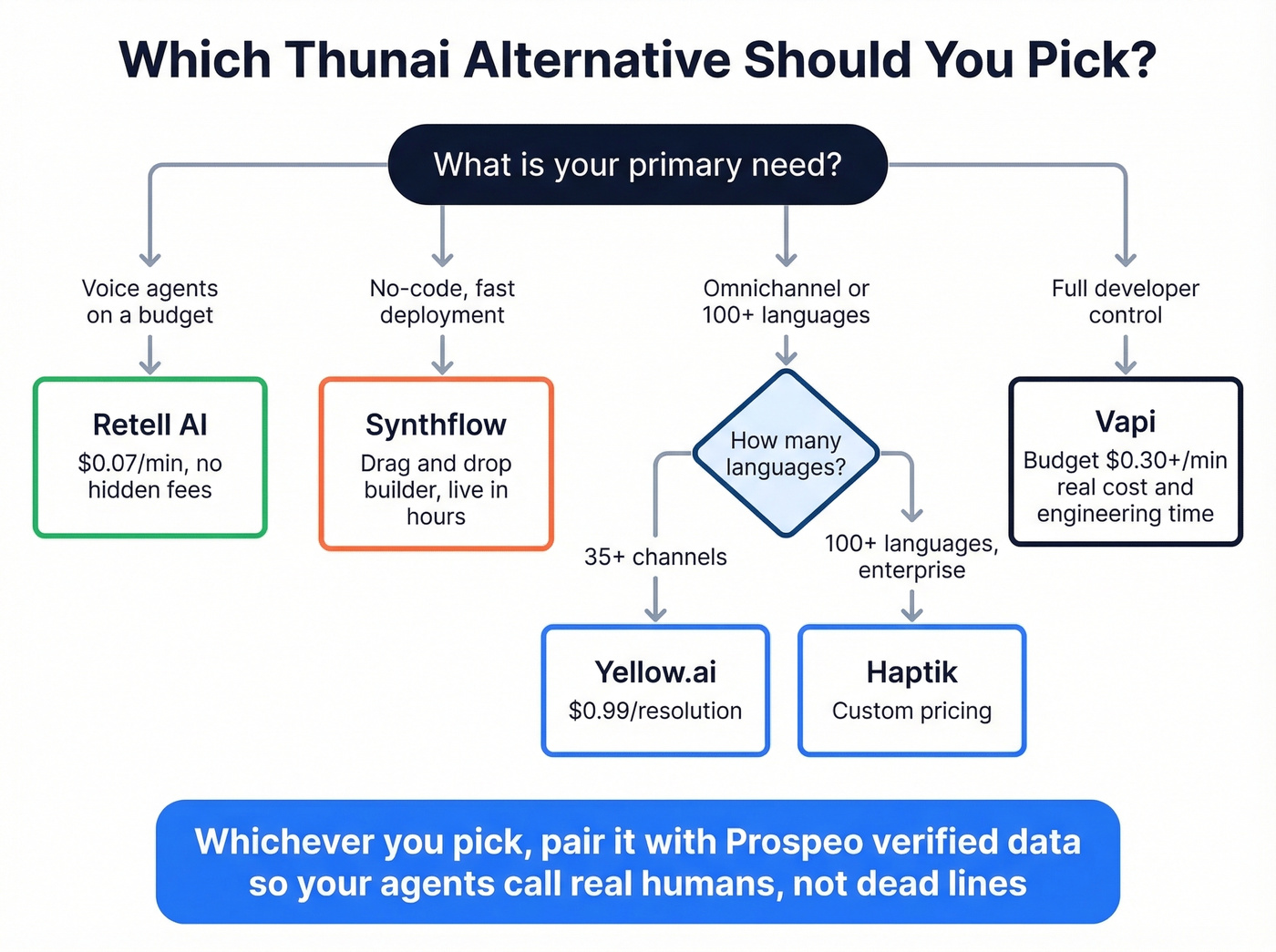
For accent handling across dozens of languages, go with Yellow.ai or Haptik. For transparent, predictable pricing, Retell AI is the answer. Non-technical teams deploying voice agents fast should start with Synthflow. Engineering teams wanting full pipeline control will gravitate toward Vapi - but budget for the real $0.30+/min cost, not the advertised base rate.
And whichever platform you land on, pair it with verified contact data so your agents aren't burning credits on dead lines. That's the piece most "alternatives" lists never mention, and it's the piece that actually determines whether your AI agents book meetings or just rack up minutes.
FAQ
What does Thunai do?
Thunai combines voice agents, chat automation, knowledge management, contact center QA, and revenue intelligence into a single agentic AI platform. It holds a 5.0/5 on G2 based on 7 reviews and targets teams that want unified AI agent management across channels.
Why do people switch from Thunai?
Transcription accuracy issues with heavy accents, more complex onboarding than expected, and the realization that they only need one piece of Thunai's broad feature set - not the whole bundle.
Which Thunai alternative is cheapest?
Retell AI at $0.07/min with phone numbers at $2/month. Vapi advertises $0.05/min but the typical all-in cost runs $0.30-$0.33/min once you add TTS, LLM, transcription, and telephony.
How do I keep AI agent data accurate?
Use a verified data layer that refreshes frequently. Stale CRM data is the top reason voice agents waste minutes on disconnected numbers - a weekly refresh cycle and 98% email accuracy make a measurable difference in agent performance.